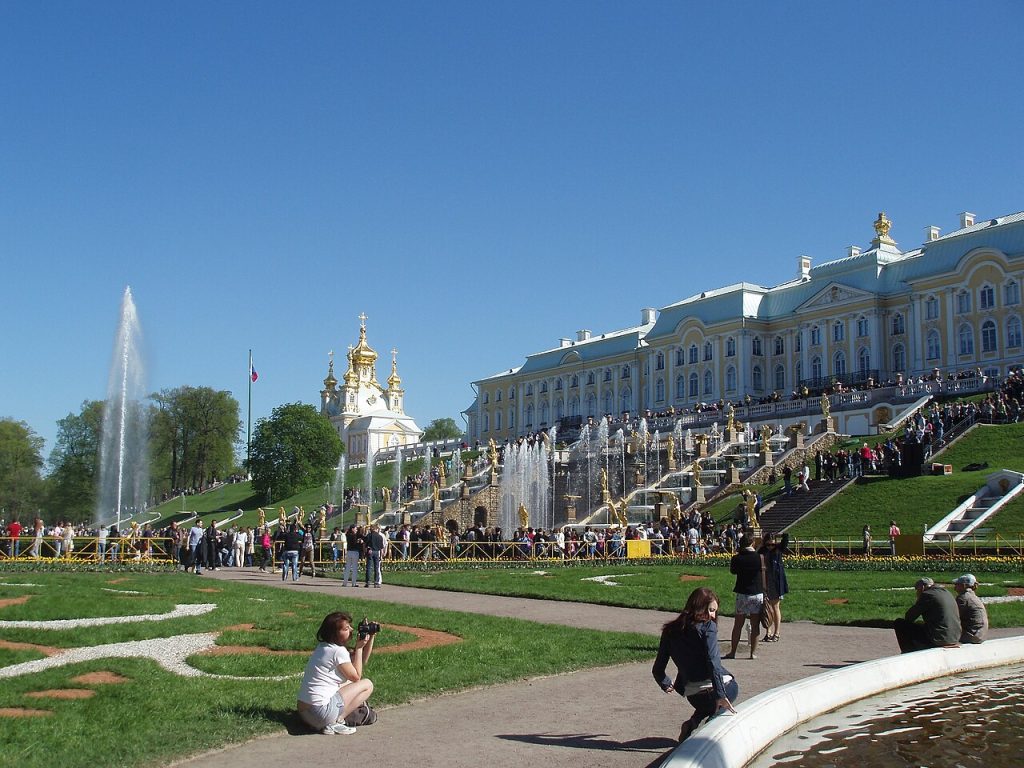
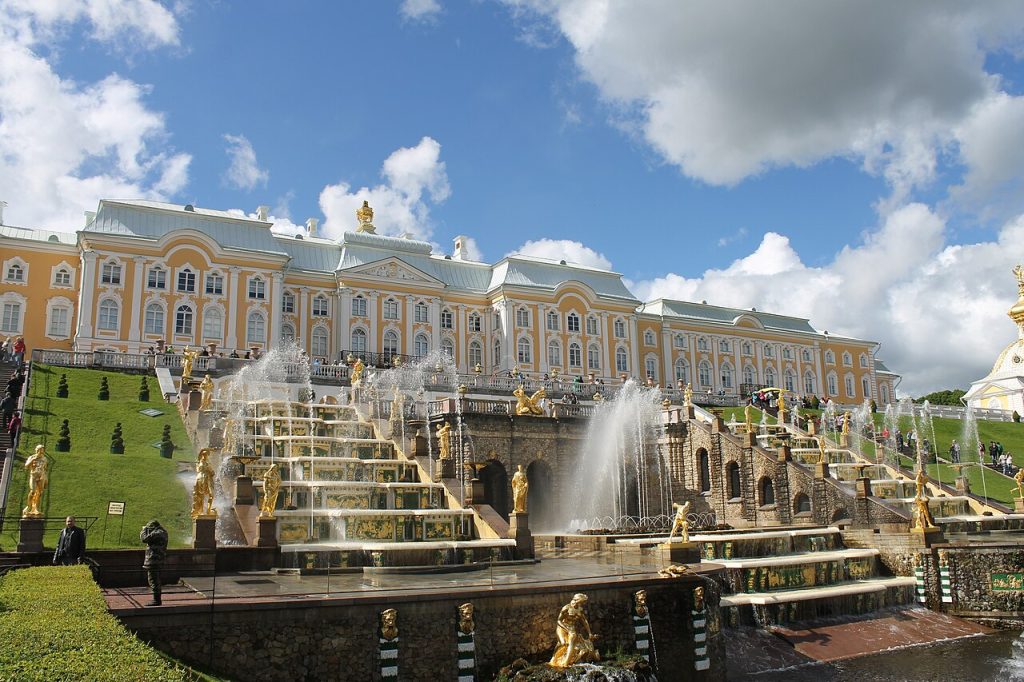
Of all the imperial residences that ring St Petersburg, none announces itself with quite the confidence of Peterhof. You arrive, walk through the Upper Garden, step onto the terrace behind the Grand Palace, and the ground simply falls away in front of you: a gilded cascade of statues and waterfalls tumbling down toward a canal that runs straight to the Gulf of Finland. More than 140 fountains play in the parks below, all of them fed by gravity alone, without a single pump.
Peter the Great began the estate in the 1710s as his answer to Versailles, a seaside statement that Russia had arrived among the great powers of Europe. His daughter Elizabeth enlarged the palace into the baroque showpiece you see today, and every ruler after her left some mark on the gardens, the pavilions, or the interiors. The result is less a single palace than a whole landscape of imperial ambition spread along the shore.
This guide walks you through Peterhof’s story and its grounds: the Grand Cascade and the Samson Fountain, the state halls rebuilt after wartime destruction, Peter’s modest retreat at Monplaisir, the trick fountains that still soak unsuspecting visitors, and all the practical advice you need to plan a day at Russia’s fountain capital.
- Peter the Great’s Seaside Vision
- An Answer to Versailles
- Elizabeth and the Baroque Rebuilding
- The Grand Cascade and Samson Fountain
- A Fountain System Without Pumps
- Inside the Grand Palace
- Monplaisir and Peter’s Private World
- The Lower Park and Its Pavilions
- Trick Fountains and Garden Humor
- Peterhof Under the Later Tsars
- War, Ruin and Resurrection
- Seasons of the Fountains
- Peterhof’s Place in Russian Culture
- Watch Peterhof Palace on Film
- Visiting Peterhof Palace Today
- Palaces Nearby
Peter the Great’s Seaside Vision
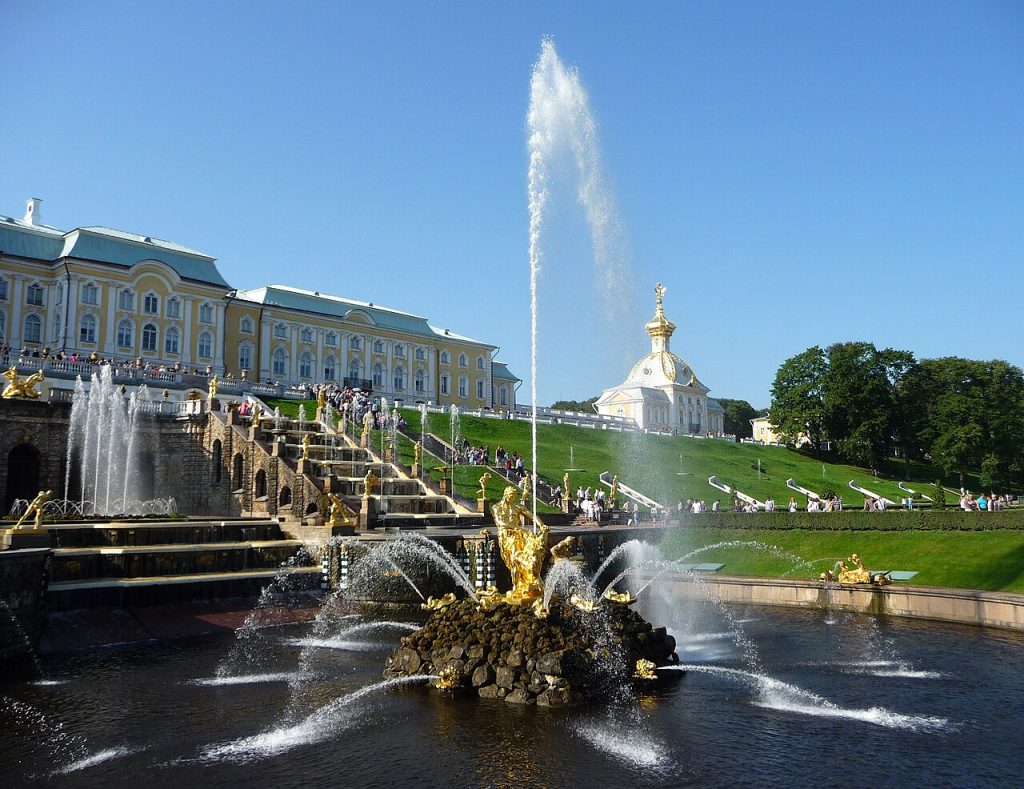
Peterhof began as a practical stopover. While the island fortress of Kronstadt was under construction, Peter the Great needed a landing place on the southern shore of the Gulf of Finland, and in 1705 a small wooden manor appeared on the spot. The tsar quickly saw that the site offered more than convenience. A natural terrace rises about sixteen meters above the shoreline here, and from its edge the view runs across the water to Kronstadt and, on clear days, to the spires of his new capital.
By 1714 Peter was sketching plans in his own hand for a formal residence on the ridge, with gardens spilling down to the sea. He had visited European courts during his Grand Embassy and understood how architecture could speak the language of power. The first Grand Palace, modest by later standards, went up under the architect Johann Friedrich Braunstein, while work began simultaneously on the canal, the cascade, and the little pavilion of Monplaisir by the water’s edge.
The estate was formally opened in August 1723 with a celebration that stunned foreign envoys. Guests sailed in along the new canal, fountains played, and the message was unmistakable: the ruler who had built a navy from nothing had now built a Versailles on the Baltic in under a decade.
An Answer to Versailles
The comparison with Versailles was deliberate, and Peter courted it openly. He had studied descriptions and engravings of Louis XIV’s palace, and in 1717 he visited France and walked its gardens in person. What he took home was not a plan to copy but a standard to beat, and he chose the one advantage Versailles could never claim: the sea.
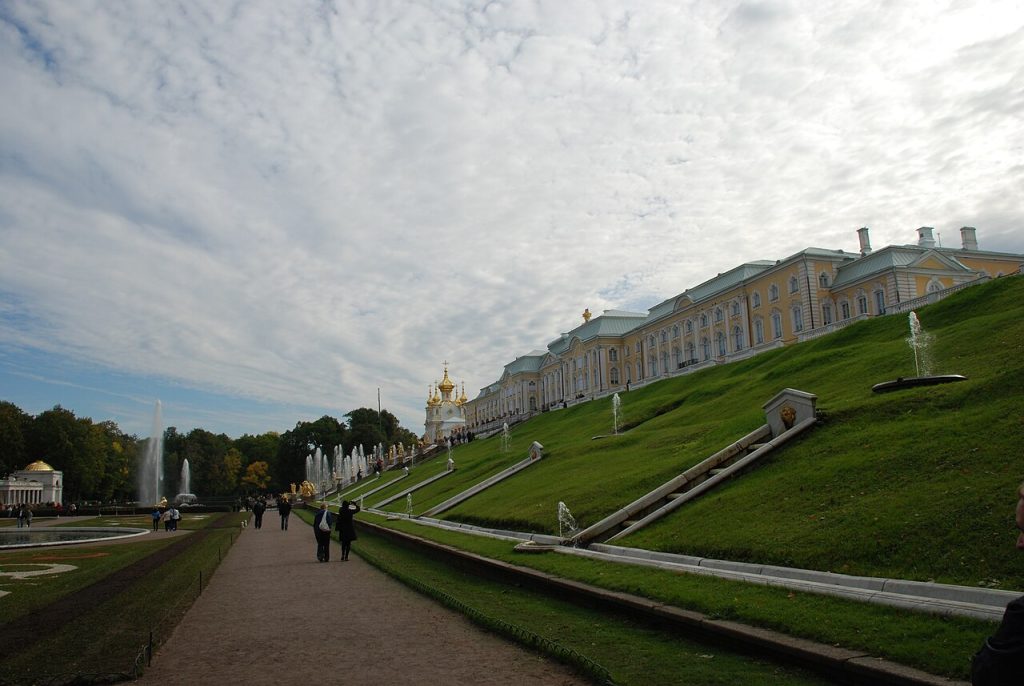
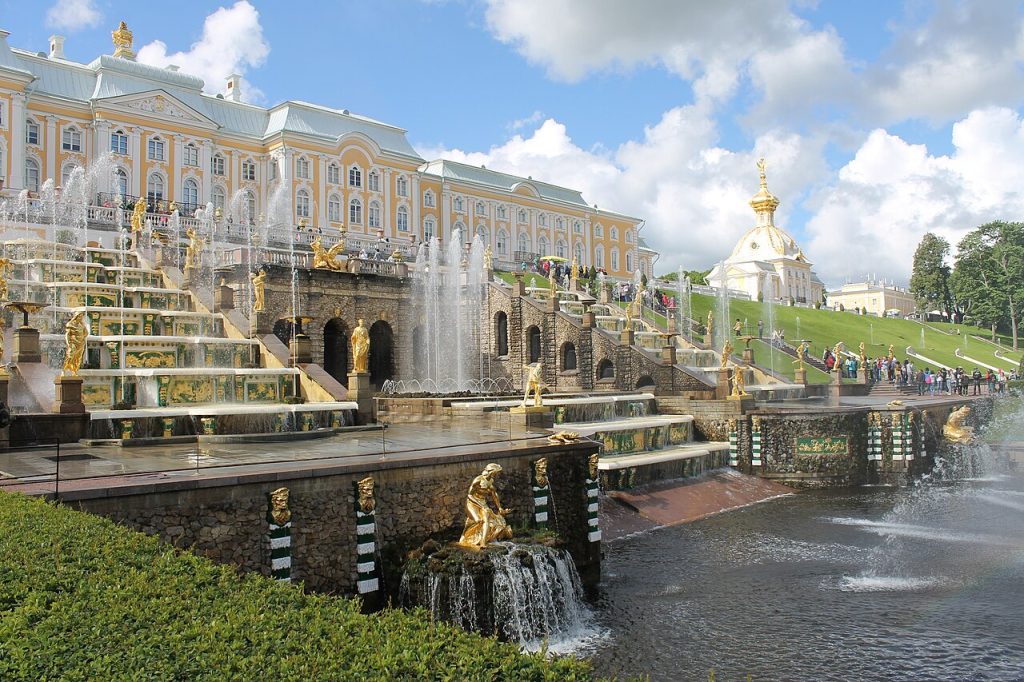
Where the French palace looks inward across ornamental parterres, Peterhof is aimed like an arrow at the Gulf of Finland. The Sea Canal that runs from the foot of the Grand Cascade to the shore is the spine of the whole composition, and in Peter’s day visitors of rank arrived by boat, sailing straight into the heart of the ensemble. The palace on its ridge, the glittering cascade, and the canal formed a single theatrical axis visible from far out on the water.
Peter also outdid his French model in hydraulics. The fountains of Versailles famously ran dry whenever the king was out of sight, their pumps unable to supply them all. Peterhof’s fountains, fed by gravity from springs on higher ground, could play all day, every day. It was a point of pride the Russian court never tired of repeating.
Elizabeth and the Baroque Rebuilding
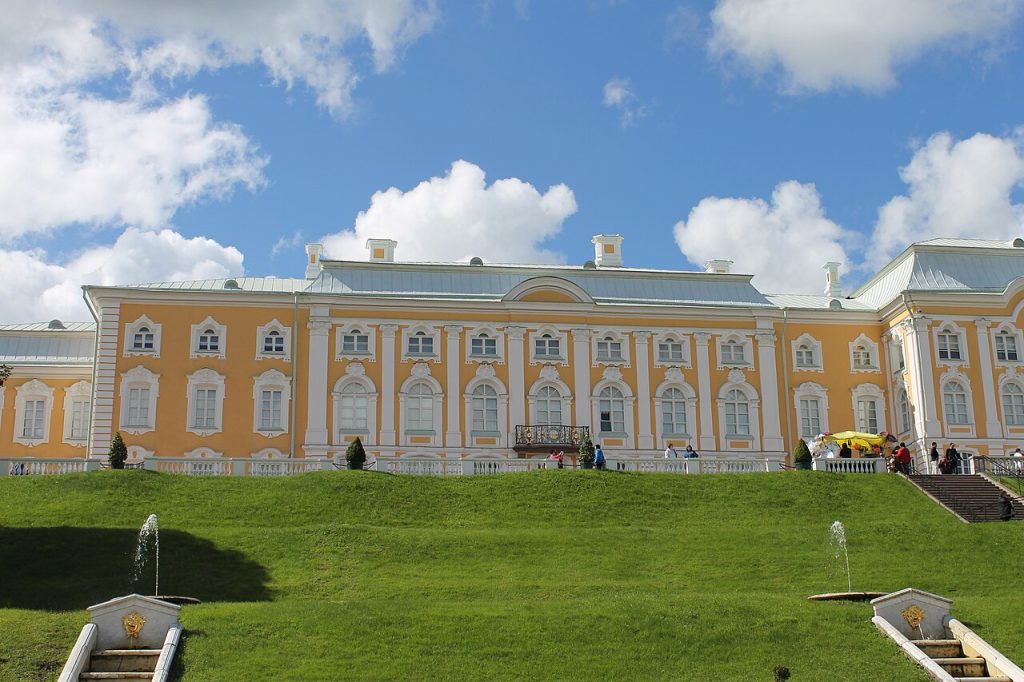
Peter’s original palace was a relatively restrained building, two stories of stone looking down the cascade. It was his daughter Elizabeth who turned it into the golden baroque ribbon that stretches along the terrace today. From 1745 she set her favorite architect, Bartolomeo Rastrelli, to enlarge the building, and he worked on it for a decade.
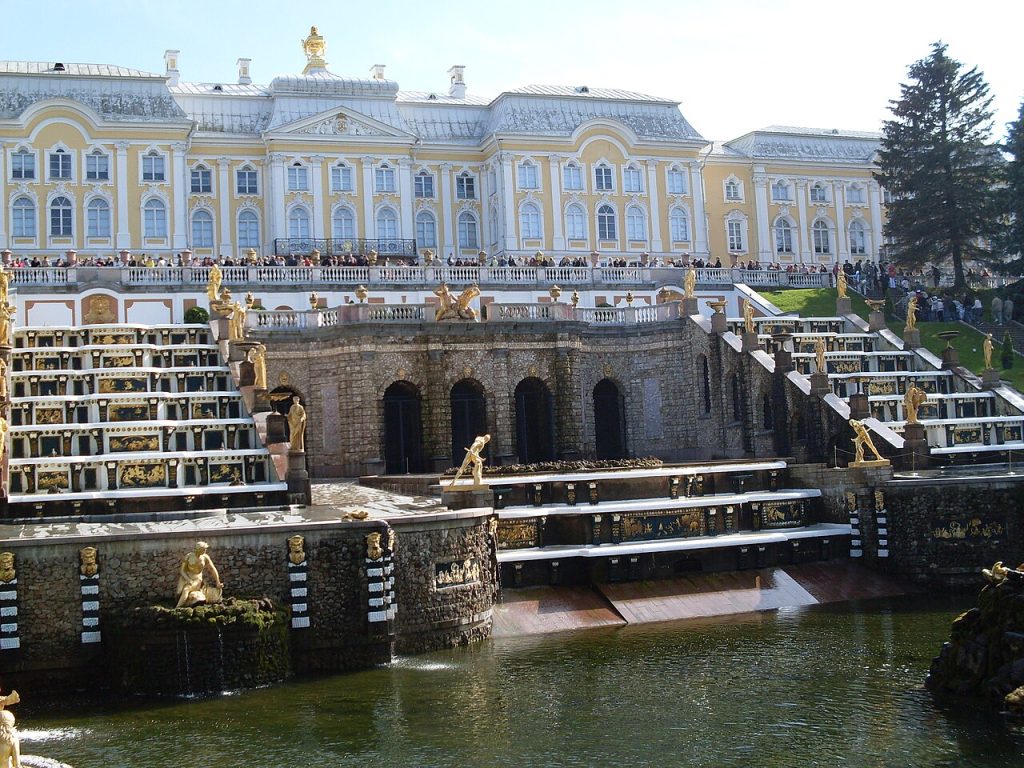
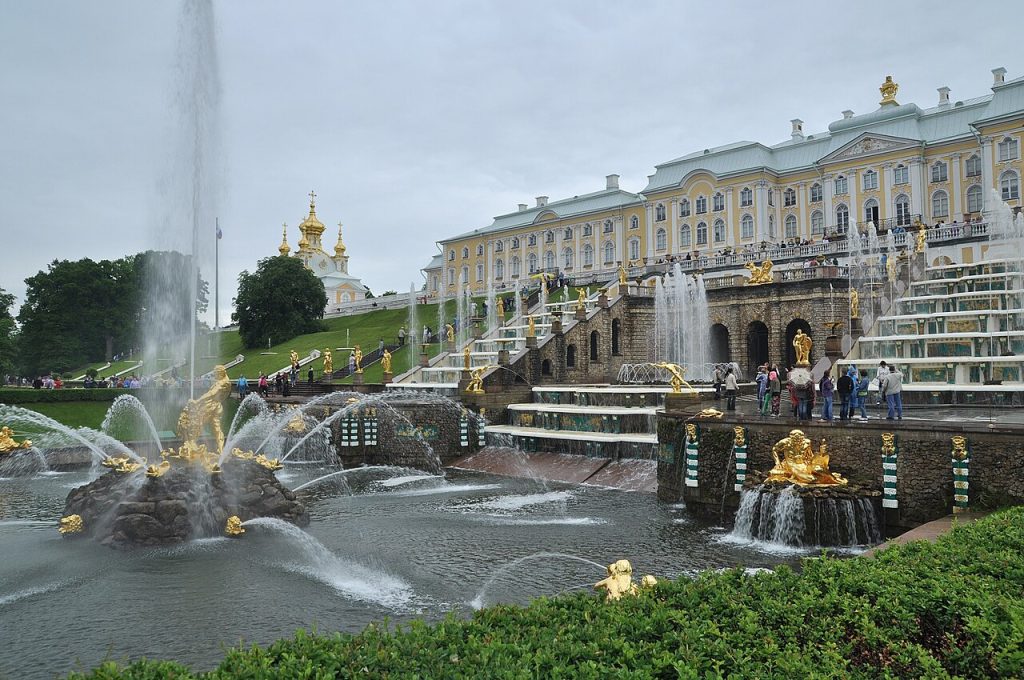
Rastrelli, who would later create the Winter Palace and the Catherine Palace, lengthened the facade to nearly three hundred meters, added a third story at the center, and finished the composition with two gilt-domed pavilions: a church at one end and a block crowned with a double-headed eagle at the other. Inside he unrolled a sequence of state rooms drenched in gilded carving, mirrors, and ceiling paintings, built for the balls and banquets Elizabeth adored.
Out of respect for her father, Elizabeth ordered Rastrelli to preserve Peter’s oak study and several of his rooms within the new structure. The gesture set a pattern that lasted as long as the dynasty: whatever fashions came and went at Peterhof, the relics of the founder were sacred.
The Grand Cascade and Samson Fountain
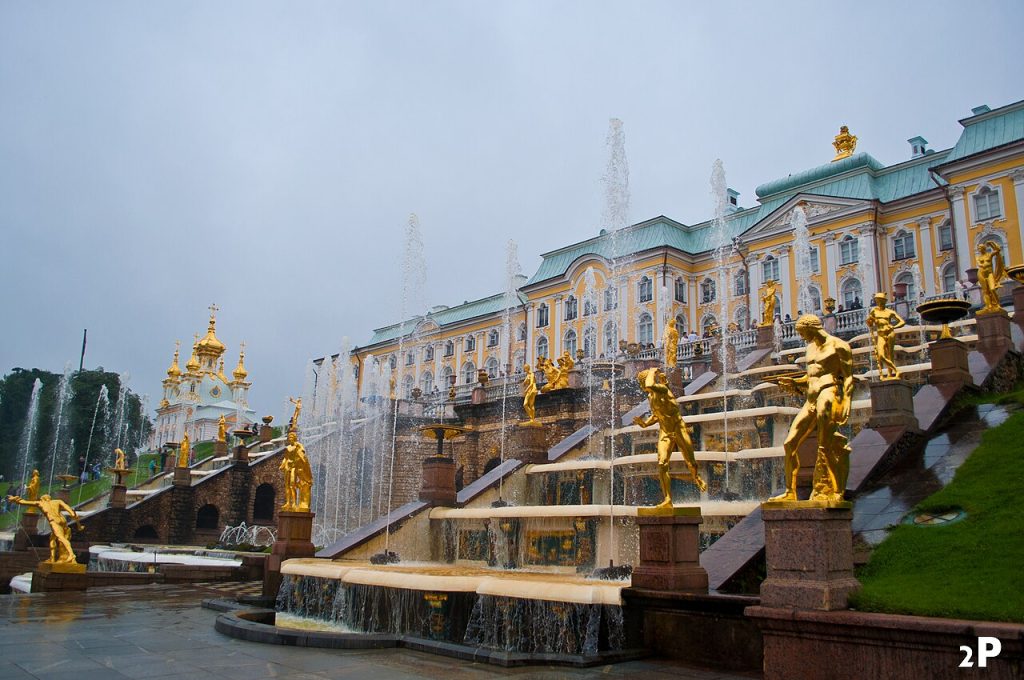
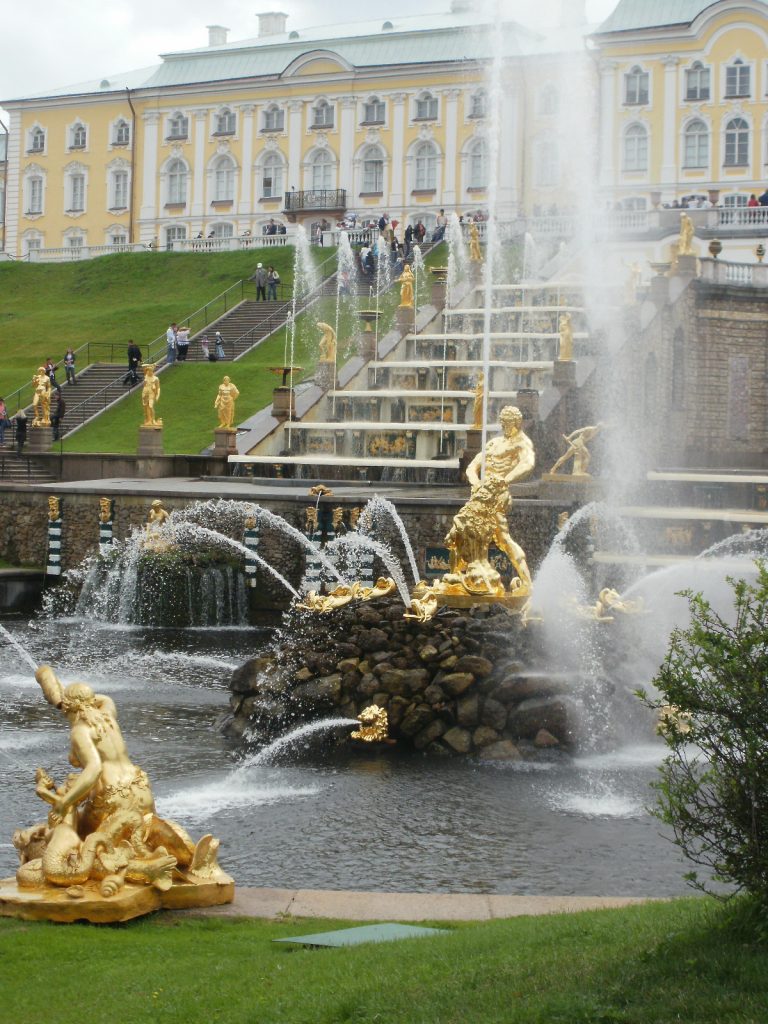
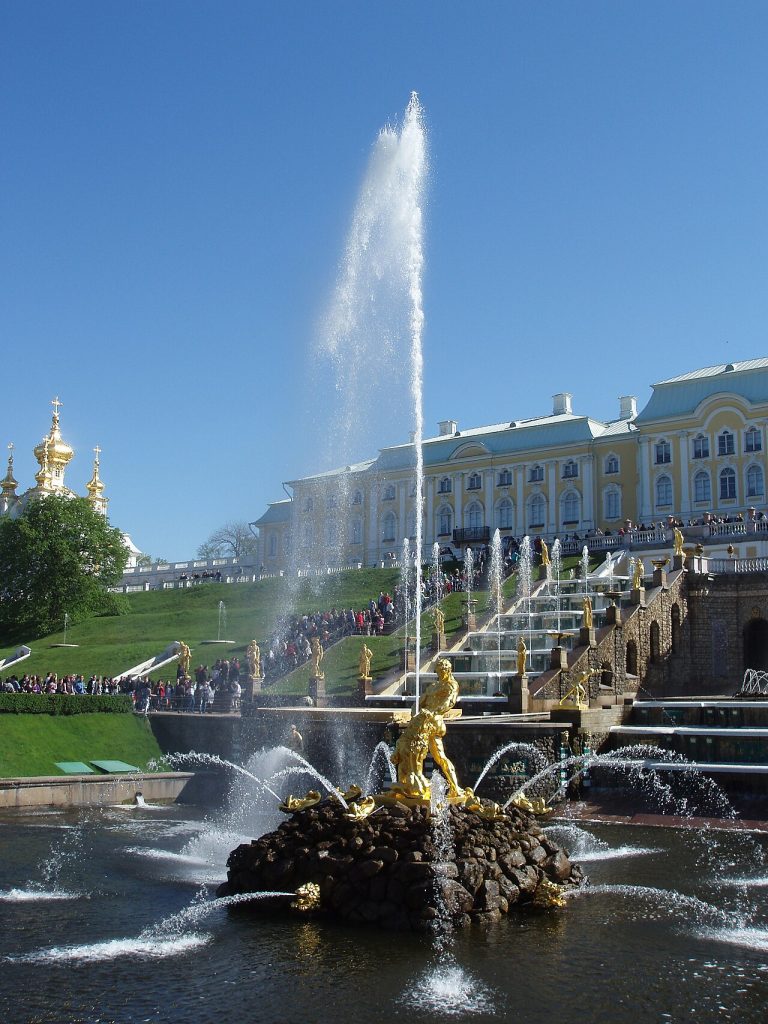
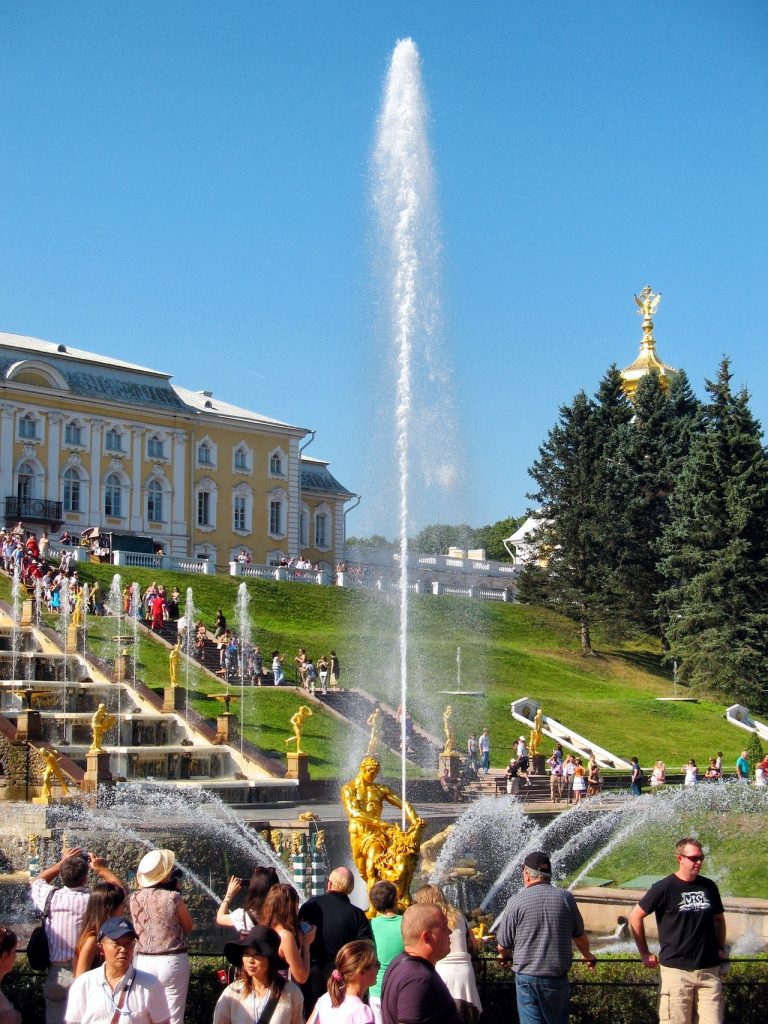
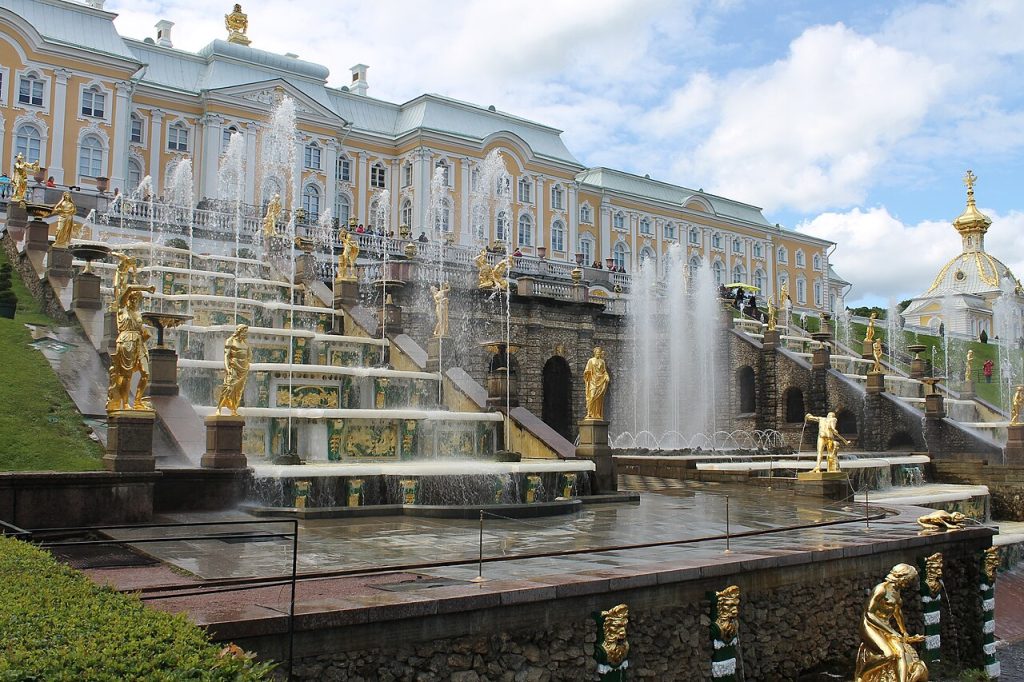
The Grand Cascade is the heart of Peterhof and one of the largest fountain ensembles ever built. Water pours from the grotto beneath the palace down two flights of seven marble steps, past dozens of gilded bronze statues, bas-reliefs, and vases, into a semicircular basin at the head of the Sea Canal. More than sixty fountains and two hundred sculptures take part in the display.
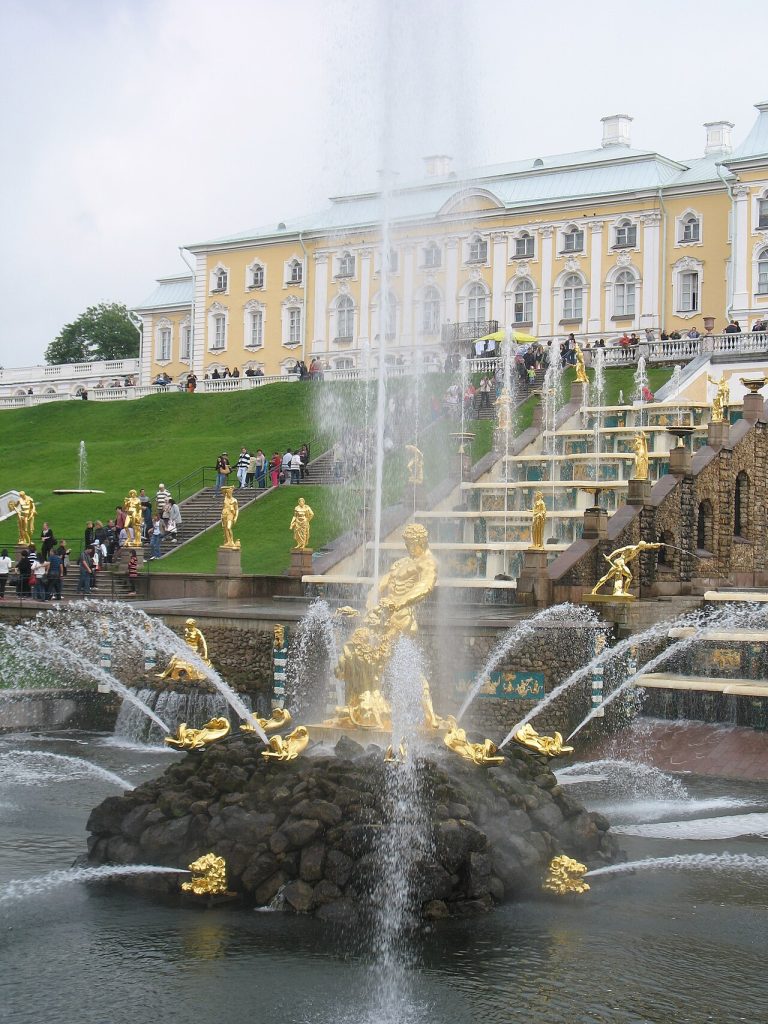
At the center stands the ensemble’s famous emblem: Samson tearing open the jaws of a lion, with a jet of water bursting twenty meters into the sky from the beast’s mouth. The group was added in the 1730s to mark the twenty-fifth anniversary of the Battle of Poltava, Peter’s decisive victory over Sweden. The symbolism was plain to every courtier, for the lion figures on the Swedish royal coat of arms, and the battle had been fought on the feast day of St Sampson.
Each morning in season the cascade is switched on at eleven o’clock to a broadcast of music, and the moment the Samson jet climbs to full height is still the signature image of Peterhof. Arriving a few minutes early to watch the start is one of the simplest pleasures a visit offers.
A Fountain System Without Pumps
The most astonishing fact about Peterhof’s fountains is that nothing pumps them. The entire system runs on gravity, exactly as it did in the 1720s. The engineer Vasily Tuvolkov, trained in France and Holland, located abundant springs on the Ropsha Heights some twenty kilometers to the south, which stand considerably higher than the palace terrace.
Water travels from those springs along a network of canals, sluices, and storage ponds, moving slowly downhill until it reaches reservoirs in the Upper Garden. From there, sealed pipes carry it over the edge of the natural terrace, and the sixteen-meter drop provides all the pressure the Lower Park’s fountains need. The higher the source pond, the taller the jet it can feed.
The water road, as the system is called, is a protected engineering monument in its own right, still maintained by a dedicated team of fountain masters. When you watch the Samson jet stand twenty meters tall with no machinery anywhere in sight, you are looking at early eighteenth-century hydraulics working precisely as designed three centuries on.
Inside the Grand Palace
The interiors of the Grand Palace carry you through the whole arc of imperial taste. The tour begins on Rastrelli’s ceremonial staircase, a torrent of gilded carving and painted sky, and continues into the Ballroom, which Elizabeth ordered made as rich as possible, a wish the architect took literally by covering nearly every surface in gold.
Catherine the Great left her own mark in a cooler key. Her architect Yuri Felten created the Chesme Hall, hung with vast canvases of the Russian naval victory over the Ottoman fleet in 1770, and the two Chinese Studies, lacquered in black and gold to display the fashion for the East. The Throne Room, the largest hall in the palace, mixes both worlds, with portraits of the dynasty watching over a floor made for a thousand dancers.
Perhaps the most charming room is the Picture Hall at the center of the palace, its walls tiled from floor to ceiling with 368 portraits of young women in varied costumes, painted by Pietro Rotari and arranged like a mosaic. Beyond it lie Peter’s preserved oak study and the suites the last Romanovs used on summer visits.
Monplaisir and Peter’s Private World
Down by the water’s edge on the eastern side of the Lower Park stands the building Peter actually loved: Monplaisir, French for my pleasure. He chose the site himself, a stone’s throw from the gulf, and sketched the layout of a modest Dutch-style brick house with a steep roof and long glazed galleries spreading along the shore.
Inside, everything speaks of the tsar’s personal tastes rather than imperial ceremony. There is a tiled Dutch kitchen, a lacquered study in the Chinese manner, and a central hall hung with the paintings he brought back from Europe, the first collection of Western art in Russia. From his bedroom window Peter could watch ships standing in to Kronstadt, and he kept a telescope at hand for the purpose.
Monplaisir remained a place of pilgrimage for the dynasty. Later rulers dined in its hall on the founder’s simple dishes, and Catherine the Great was living in the neighboring wing in 1762 when the coup that made her empress began. The little house by the sea witnessed more history than many a throne room.
The Lower Park and Its Pavilions
The Lower Park spreads across more than a hundred hectares between the terrace and the sea, laid out in the strict geometry of a French formal garden. Alleys radiate from the cascade and from Monplaisir, each one closed by a fountain, a pavilion, or a view of the water, so that every walk ends in a reward.
West of the canal the park holds the Marly Palace, a small cubic house named after a French royal retreat, standing between a quiet pond and the gulf. Fish are still raised in its pond, and in season they are summoned for feeding with a bell, a custom three centuries old. Nearby, the Hermitage pavilion stands on its own moat, equipped with a mechanical table that was raised fully laid from the kitchen below so that diners could eat with no servants in the room.
East of Monplaisir, the Catherine Wing and the Bath Block show the domestic side of court summers, with steam rooms and a garden of their own. Two more cascades, the Chessboard Hill with its painted dragons and the golden steps of the Golden Hill, anchor the slopes on either flank of the park.
Trick Fountains and Garden Humor
Peter the Great had a famously rough sense of humor, and he built it into his garden. Scattered through the Lower Park are trick fountains, joke waterworks designed to drench the unwary, and they still operate exactly as intended. Near Monplaisir, innocent-looking paths and benches erupt with jets of water the moment a visitor steps on a hidden trigger stone.
The most beloved is the little Oak fountain ensemble with its tulips of painted metal, and the Umbrella, a pavilion whose canopy suddenly releases a curtain of water around anyone who sits beneath it. In Peter’s day a servant hidden in the bushes worked the valves, choosing his victims; today some run on timers and some are still operated by hand with the same mischief.
On a warm afternoon the trick fountains become the happiest corner of the park, with children deliberately dancing across the trigger stones. They are a reminder that for all its gilded ceremony, Peterhof was built by a man who liked to laugh, and who thought a soaked courtier in silk was excellent entertainment.
Peterhof Under the Later Tsars
Every generation of Romanovs kept faith with Peterhof. Catherine the Great preferred Tsarskoye Selo but maintained the fountains and added interiors; her son Paul redecorated suites in the Grand Palace. It was Nicholas I in the nineteenth century who gave the estate its second great expansion, buying up neighboring land to create the Alexandria Park as a private family retreat.
In Alexandria he built the Cottage Palace, a Gothic villa where his family could live without ceremony, and a Gothic Chapel for their prayers. The contrast with Rastrelli’s gold could not be sharper, and walking from one park to the other is a lesson in how the dynasty’s idea of home had changed over a century.
The last emperor, Nicholas II, was born at Peterhof in the Alexandria park and spent long summers there with his children. The Lower Dacha where several of his children were born stood by the shore until the twentieth century treated it as harshly as it treated the family itself. Until 1917, the fountains opened each summer as the unofficial start of the court season.
War, Ruin and Resurrection
In September 1941 German forces occupied Peterhof, and the front line settled nearby for more than two years. Museum staff had worked desperately to evacuate what they could, burying statues in the park and shipping treasures east, but there was no saving the buildings. By the liberation in January 1944 the Grand Palace was a burned-out shell, the parks were mined and cratered, and the Samson statue had vanished, carried off for its bronze.
What followed became one of the most celebrated restoration campaigns in history. Soviet authorities decided within months that Peterhof would be rebuilt as it had been, and the first fountains played again in the summer of 1946. A new Samson, recast from photographs and surviving fragments of documentation, was paraded through Leningrad on its way home in 1947 while crowds wept in the streets.
The Grand Palace reopened its first restored halls in 1964, and work has never really stopped since. Generations of craftsmen relearned dead trades, from gilding to decorative plasterwork, to bring the rooms back. What you walk through today is both an eighteenth-century palace and a monument to the twentieth-century people who refused to let it die.
Seasons of the Fountains
Peterhof lives by the calendar of its water. The fountains play roughly from late April or May until mid-October, and the season opens and closes with festivals that draw enormous crowds. The spring opening is a daytime celebration with music at the Grand Cascade, while the autumn closing is the grander affair, an evening spectacle of projections, fireworks, and performances staged on the cascade itself.
High summer brings the famous white nights of the St Petersburg region, when daylight barely fades and the parks stay lively into the evening. July and August are the busiest months, and the contrast between a crowded Saturday and a quiet weekday morning is dramatic, so timing matters more here than at almost any other Russian palace.
Winter has its own rewards. The fountains sleep and the statues are boxed against frost, but the Grand Palace and several small museums stay open, admission drops, and the snow-covered parks are nearly empty. Seeing the cascade silent under snow, you understand better what a feat its summer performance really is.
Peterhof’s Place in Russian Culture
Peterhof is one of the most visited museums in Russia, and its image is stamped deep in the national imagination. The Samson fountain appears in schoolbooks as shorthand for the victory at Poltava; the view down the Sea Canal stands for the whole idea of Russia turning toward the sea and toward Europe. Together with the historic center of St Petersburg, the estate is inscribed on the UNESCO World Heritage list.
The palace and parks have served as a set for countless films and as the stage for state occasions, including summits hosted at nearby Strelna. For residents of St Petersburg, though, Peterhof is simply where you take visiting relatives on a summer weekend, a tradition now several generations old that has outlived the empire, the revolution, and the war.
For the traveler, Peterhof delivers what few places can: a single day that contains engineering genius, imperial theater, personal relics of one of history’s most extraordinary rulers, and the sight of the Baltic glittering at the end of a golden canal. It earns its crowds.
Watch Peterhof Palace on Film
Visiting Peterhof Palace Today
Peterhof lies about thirty kilometers west of central St Petersburg. The most enjoyable approach in season is by hydrofoil from the embankments near the Hermitage, which lands you at the end of the Sea Canal in half an hour. Suburban trains from Baltiysky station to Novy Peterhof and frequent minibuses also make the trip. The Lower Park charges admission in fountain season, and the Grand Palace is ticketed separately with timed entry, so booking ahead in summer is wise. Plan a full day, wear comfortable shoes, and start with the eleven o’clock switching-on of the Grand Cascade. You can find the palace on the map here: Peterhof Palace on Google Maps.
Palaces Nearby
You May Like
Yelagin Palace and the Island Summers of the Empresses