Of all the great human migrations, few are as astonishing as the one that carried people across thousands of kilometers of open Pacific Ocean to the last large landmass on Earth to be settled by humans. The Maori are the Indigenous Polynesian people of New Zealand, a land they call Aotearoa, often translated as the land of the long white cloud. They arrived not by accident but by deliberate, skilled navigation across one of the most formidable oceans on the planet, and in the centuries that followed they built a distinctive and powerful culture in islands utterly unlike the tropical homelands their ancestors had left behind.
Their history encompasses epic voyaging, the forging of a new society, devastating contact with Europeans, near-collapse, and one of the most remarkable cultural and political resurgences of any Indigenous people in the world. It is a story worth telling with both admiration and honesty.
In This Article
Who the Maori Are
The Maori are the tangata whenua, the people of the land, of New Zealand — the Indigenous population who were present long before European arrival. They are a Polynesian people, closely related in language, ancestry, and culture to other peoples of the Pacific such as the Hawaiians, Tahitians, Samoans, and the people of the Cook Islands and Rarotonga, with whom they share a common voyaging heritage. The word maori originally meant ordinary or normal, and came to be used to distinguish the original inhabitants from the European newcomers, who were called pakeha.
Maori society was traditionally organized around kinship, structured into iwi (broad tribal groupings), hapu (sub-tribes or clans), and whanau (extended families). These were not mere administrative units but the living framework of identity, loyalty, and belonging, and they remain profoundly important in Maori life today. A Maori person can typically recite their whakapapa, their genealogy, linking them back through the generations to the very canoes that first brought their ancestors to Aotearoa — a living thread connecting the present to the founding voyages.
Tracing the Great Voyage
The settlement of New Zealand is, by the standards of human history, surprisingly recent. According to most researchers, Polynesian voyagers reached and settled Aotearoa only a few centuries before European contact — current scholarly estimates generally place the arrival somewhere around the thirteenth century, making New Zealand one of the very last major habitable landmasses to be settled by people. This relatively recent arrival means the Maori are an old people in their Polynesian ancestry but comparatively new arrivals in the specific land they made their own.
The ancestors of the Maori were part of the long Austronesian and Polynesian expansion that, over thousands of years, carried seafaring peoples out of Asia and across the islands of the Pacific in an extraordinary feat of exploration. Using large double-hulled canoes and a sophisticated knowledge of stars, swells, winds, and the behavior of birds, these navigators crossed immense stretches of open water. Maori oral tradition preserves the memory of this voyaging in accounts of the founding canoes that carried the ancestors to Aotearoa, and many iwi trace their origins to a specific named canoe — a heritage that scholars treat as containing genuine historical memory even where exact details cannot be confirmed.
Traces of the First Settlers
Archaeology in New Zealand reveals how the early settlers adapted to a land radically different from tropical Polynesia. The first arrivals encountered a temperate, mountainous country with no land mammals to speak of but an astonishing array of birds, including the giant flightless moa. Early Maori, sometimes described by archaeologists as the moa-hunters, relied heavily on these birds, and within a few generations the largest of them were hunted to extinction — an early and sobering example of human impact on a new environment that Maori tradition and modern scholarship both acknowledge.
As the great birds vanished and the climate of the cooler south proved unsuitable for many of the tropical crops their ancestors had carried, Maori society adapted. They cultivated the kumara, a sweet potato, where conditions allowed, developed sophisticated methods of storage and fishing, and in time built fortified hilltop settlements known as pa, whose earthworks still mark the landscape today. These terraced fortifications, along with middens, tool-working sites, and rock drawings, form the archaeological record of a people rapidly remaking themselves to thrive in a new world.
How They Lived and What They Built
Maori life was rooted in the land and sea and organized around the community. They were skilled cultivators, fishers, hunters, and gatherers, managing resources through a system of customary authority and spiritual restriction known as tapu, which could place people, places, or activities under sacred prohibition, and its counterpart noa, the ordinary or unrestricted. Mana, a concept of prestige, authority, and spiritual power, was central to social and political life, won and lost through deeds, lineage, and conduct.
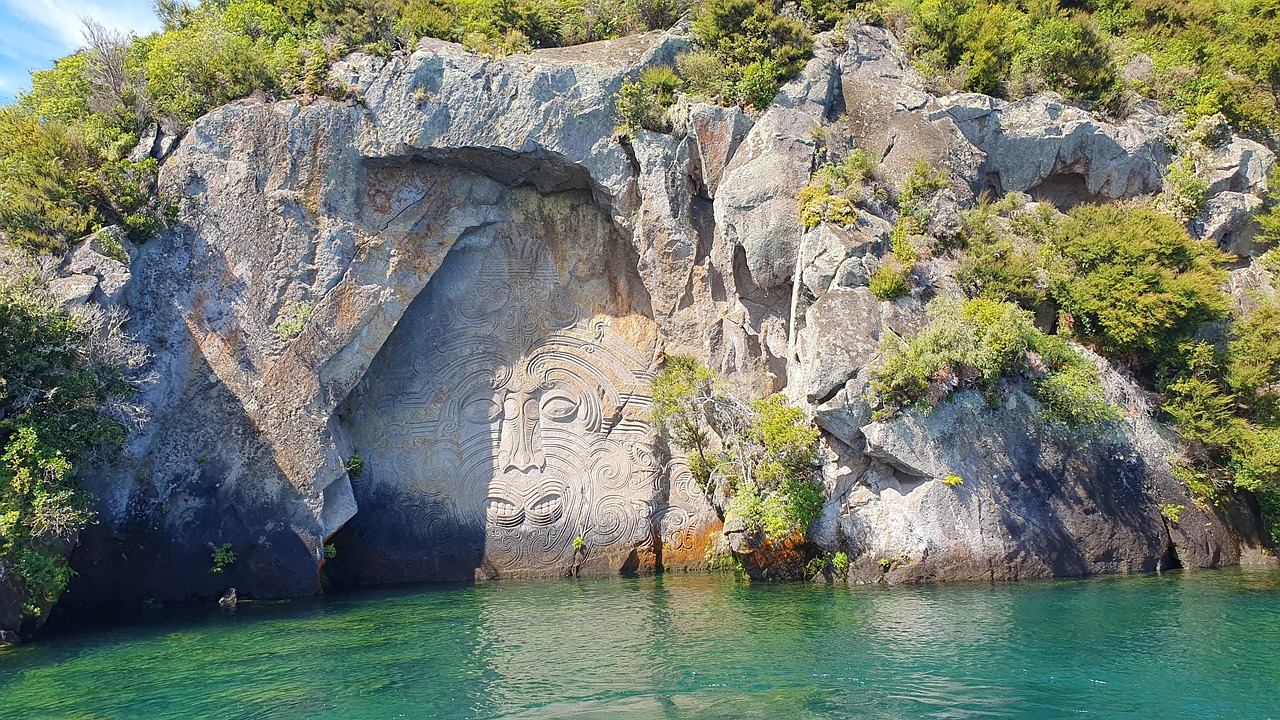
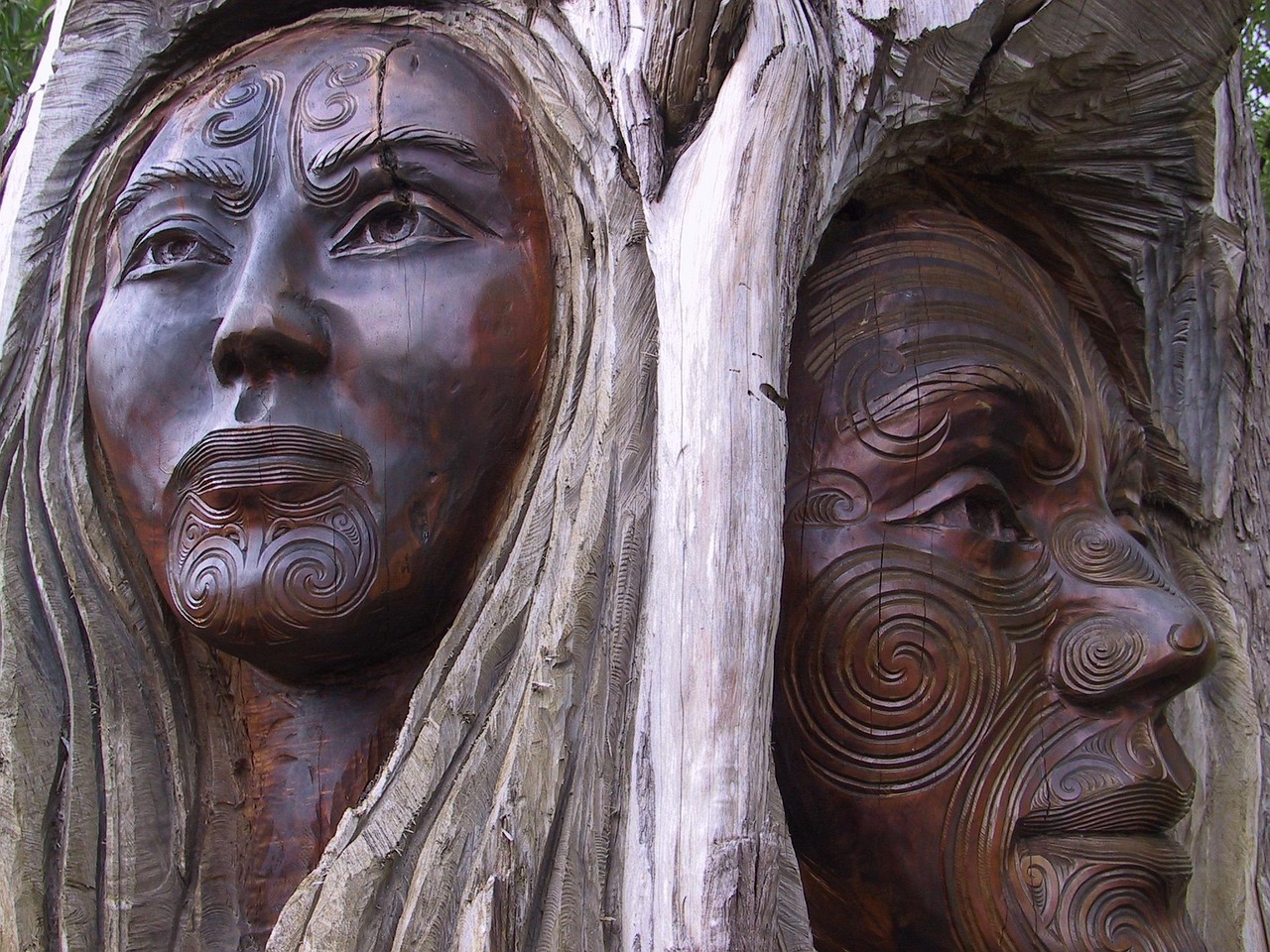
The Maori became masters of carving, an art of breathtaking skill and meaning. Working wood, bone, and the prized green stone known as pounamu or greenstone, they produced intricate carvings covering meeting houses, canoes, weapons, and personal ornaments, every spiral and figure carrying meaning and ancestry. The carved and decorated meeting house, the wharenui, stood at the heart of the communal gathering place, the marae, which remains the focal point of Maori community life. The Maori also developed powerful traditions of oratory, song, and the haka — a vigorous posture dance, today famous worldwide, that could serve as a challenge, a welcome, or an expression of collective feeling. The moko, the distinctive Maori tattoo applied to face and body, marked status, identity, and genealogy in lines of profound personal and cultural significance. Maori women, meanwhile, were the keepers of the highly developed art of weaving, working flax into fine cloaks, mats, and baskets, the most prestigious garments adorned with feathers and reserved for people of high rank. Together, carving and weaving expressed a worldview in which beauty, function, ancestry, and spiritual power were inseparable, and in which every made object carried the mana of those who fashioned and owned it.
War, the Treaty, and a Land Transformed
Warfare was a significant part of pre-European Maori life, conducted between iwi and hapu over land, resources, mana, and the settling of grievances, and Maori developed formidable martial skill and the fortified pa as a response. The arrival of Europeans transformed this world utterly. From the late eighteenth century, contact brought new goods, new crops, new diseases, and, devastatingly, the musket, whose spread set off a period of intensified and especially bloody intertribal conflict in the early nineteenth century.
The pivotal moment came in 1840 with the signing of the Treaty of Waitangi between the British Crown and a large number of Maori chiefs, an agreement that remains the foundational and deeply contested document of New Zealand. According to most historians, the English and Maori language versions of the treaty differed crucially in their meaning, particularly over the question of sovereignty, and these differences sowed misunderstanding and grievance that endure to this day. In the decades that followed, growing European settlement, land confiscation, and broken promises led to a series of wars and to the massive loss of Maori land. Combined with introduced diseases to which the Maori had no immunity, the result was catastrophic: the Maori population fell steeply, and by the late nineteenth century some observers grimly predicted the people would die out altogether. They were proved wrong.
The Maori Language and Its Revival
The Maori language, te reo Maori, belongs to the Eastern Polynesian branch of the great Austronesian language family, linking it closely to Tahitian, Hawaiian, and the other tongues of eastern Polynesia. It was historically an oral language of great richness, the vehicle of an immense body of genealogy, song, proverb, and sacred narrative. Under the pressure of colonization, however, te reo Maori suffered a severe decline. Policies that discouraged or punished the use of Maori in schools, together with urbanization that scattered communities, drove the language toward crisis, and by the mid-twentieth century the number of fluent speakers and especially of children learning it as a first language had fallen alarmingly.
The response was one of the most determined language revivals anywhere in the world. From the latter twentieth century, Maori communities established language nests for young children, immersion schools, and later Maori-medium education up to university level, alongside Maori-language broadcasting. Te reo Maori was eventually recognized as an official language of New Zealand, and its words, greetings, and place names have woven themselves ever more deeply into the everyday life of the whole country. The language is not yet out of danger, and sustaining everyday fluency remains a challenge, but the revival has achieved what once seemed impossible and continues to gather strength.
Gods, Ancestors, and Story
Maori tradition, retold here only in outline and in my own words, holds a cosmology of great beauty. In the beginning, it is said, there were the Sky Father and the Earth Mother locked in a tight embrace, and their children, the gods of forest, sea, wind, war, and cultivated food, dwelt in darkness pressed between them. In the most celebrated of the stories, the children resolved to separate their parents to let in the light, and one of them succeeded in pushing the sky away from the earth, bringing the world of light into being — a separation that the lingering mist and the falling rain are sometimes said to mourn.
Among the most beloved figures of Maori legend is the trickster-hero Maui, a clever and audacious demigod credited in tradition with great feats, including fishing up the North Island of New Zealand from the depths of the ocean and slowing the sun in its course. Maori also shared a deep kinship of story and belief with the wider Polynesian world from which their ancestors came, and figures such as Maui appear in related forms across many Pacific cultures, testimony to the common heritage of these far-flung island peoples. These narratives, alongside countless tribal stories tied to specific mountains, rivers, and ancestors, were not idle entertainment but carried genealogy, moral teaching, and the explanation of the world. Out of respect for their sacred dimension and the many local variations, they are sketched here only in the broadest strokes; in living Maori tradition they remain vital and are passed on with care.
Notable Maori
The Maori have produced figures of national and international distinction across many fields. In the early twentieth century, Sir Apirana Ngata stood as a towering political and cultural leader who worked to revive Maori arts, language, and land development and is widely honored for his contribution to his people. The scholar and politician Te Rangi Hiroa, also known as Sir Peter Buck, became a distinguished anthropologist who studied and championed Polynesian culture. In the arts, the writer Witi Ihimaera gave Maori storytelling a powerful place in world literature, while the singer Dame Kiri Te Kanawa achieved global fame as one of the great operatic sopranos of her age. Maori have also excelled prominently in sport, most visibly in rugby, where the haka performed before matches has become known around the world. As always in this series, where I am uncertain of the specific details of an individual life, I have left them out rather than risk error.
The Maori in the World Today
Today the Maori number in the hundreds of thousands and form a substantial and growing share of New Zealand population, with most estimates placing them at well over fifteen percent of the country people. Far from dying out as nineteenth-century pessimists predicted, the Maori have experienced a powerful demographic and cultural recovery. Maori identity is now a vibrant and central part of New Zealand national life, visible in language, art, ceremony, and a distinctive bicultural framing of the nation that acknowledges the Treaty of Waitangi as a founding partnership.
That said, real challenges and inequalities persist. Maori on average continue to face poorer outcomes than non-Maori in areas such as health, income, education, and justice, the long shadow of colonization and land loss. A formal process has worked for decades to investigate historical breaches of the Treaty and to negotiate settlements with iwi, returning land, resources, and apologies, though debate continues over how far redress should go. Within Maori communities, a flourishing of the arts, language, and tribal self-management sits alongside ongoing struggles for equity. The result is a people neither frozen in the past nor severed from it, but actively shaping a modern identity on their own terms.
The story of the Maori is, in the end, a story of extraordinary navigation in every sense: the ancestral voyages that crossed an ocean to reach Aotearoa, and the harder voyage through colonization, near-destruction, and resurgence to arrive at the confident, living culture of today. They stand as one of the world clearest examples that an Indigenous people, once written off as doomed, can reclaim language, land, and pride, and in doing so reshape the very identity of the nation around them.
\n
More Peoples of the World
\n
This article is part of our Peoples of the World series, exploring fascinating and overlooked cultures around the globe. Explore the other peoples in the collection:
\n
- The Sami
- The Basque
- The Ainu
- The Amazigh (Berbers)
- The Sorbs
- The Sakha (Yakuts)
- The Welsh
- The Tuvan
- The Mari
\n
You May Like