In a narrow valley of the Crimean mountains, where poplars line a shallow river and minarets rise against white cliffs, stands the only palace of its kind left on earth. The Khan’s Palace of Bakhchisaray, the Hansaray, was the seat of the Giray dynasty, the khans of Crimea who descended from Genghis Khan himself and who for three centuries made their mountain capital one of the great courts of the Islamic world. When their state fell to Catherine the Great in 1783, every other monument of Crimean Tatar statehood was scattered; the palace alone survived, garden courtyards, harem, mosque, and the little marble fountain that Pushkin’s poem made immortal.
The name Bakhchisaray means garden palace, and the place still keeps its promise: courtyards of roses and vines, painted wooden galleries, slender towers, and the sound of water running through marble basins, a deliberate paradise built to the Ottoman and Persian taste. Yet the garden holds hard history, the departure of the last khan, the empress’s triumphant visit, wars and deportations, and the long struggle to preserve a fragile monument that is sacred memory to the Crimean Tatar people.
This guide walks the whole valley: the rise of the Girays and their earlier capitals, the palace’s courtyards, divan hall, harem, and mosque, the Fountain of Tears and the love story attached to it, Catherine’s and Pushkin’s visits, the palace’s survival through empire, war, and deportation, and the practical details for visiting one of the most atmospheric places in all the lands once ruled from the saddle.
- The Girays, Heirs of Genghis Khan
- From Cave Towns to the Garden Valley
- Building the Garden Palace
- The Gate of the Entwined Serpents
- The Divan Hall and the Khans’ Government
- The Great Mosque and the Cemetery of Khans
- The Harem and the Falcon Tower
- The Fountain of Tears
- Dilara and the Legend of the Fountain
- The Fall of the Khanate
- Catherine’s Night in the Palace
- Pushkin’s Poem and the Palace’s Fame
- Survival, Deportation and Memory
- Watch the Khan’s Palace on Film
- Visiting the Khan’s Palace Today
- Palaces Nearby
The Girays, Heirs of Genghis Khan
The Crimean khans were no provincial chieftains. The Giray dynasty, founded by Haci I Giray in the 1440s when the Golden Horde was breaking apart, claimed direct descent from Genghis Khan through his son Jochi, and that blood mattered enormously: in the steppe world’s law, only Genghisids could wear a khan’s title, and the Girays were, after the fall of the other Horde successor states, its most senior surviving line. Ottoman sultans, whose protection the khanate accepted in 1478, treated them accordingly, with honors granted to no other vassal.
At its height the khanate’s reach was enormous: its cavalry campaigned from Hungary to Persia, its raids reached Moscow itself, which Khan Devlet I Giray burned in 1571 in the last great steppe assault on the Russian capital, and its slave markets at Kefe fed the Ottoman world. Moscow and Poland alike paid the khans annual tribute into the eighteenth century, a fact Russian historiography long preferred to forget.
But the Girays were also builders, poets, and jurists. The court at Bakhchisaray kept chronicles and composed verse in Crimean Tatar and Ottoman Turkish, khans themselves among the poets; madrasas and mosques filled the capital, and the dynasty’s diplomatic archive corresponded with every power from Stockholm to Isfahan. The palace that survives is the material memory of that civilization, which is why its meaning today runs so much deeper than tourism.
From Cave Towns to the Garden Valley
The khans came down into the valley by stages. Their first Crimean seats lay on the high plateaus, at the fortress town of Qirq Yer, now called Chufut-Kale, whose cave dwellings and walls still crown the cliff above Bakhchisaray, and in the ravine palace of Ashlama-Dere beneath it. By the early sixteenth century the dynasty had outgrown the gorges: a court of growing splendor needed water, gardens, and room for processions.
Khan Sahib I Giray, who had reigned in Kazan before Crimea and knew what a river capital could be, founded the new palace on the Churuk-Su stream around 1532, and the town of Bakhchisaray grew around it. The choice of a garden valley over a fortress crag announced a state confident in its cavalry screen: the khans’ security was the steppe itself, and their capital could afford to be beautiful.
Old Qirq Yer did not die; it became the citadel of the capital’s Jewish and Karaite communities and the state prison where the khans kept their most valuable captives, Russian envoys and noblemen among them, sometimes for decades. The cliff town, the ravines, and the valley palace together made a capital of layered worlds, and the modern visitor can still walk from the garden courtyards up to the cave city in an afternoon, climbing through the khanate’s whole history.
Building the Garden Palace
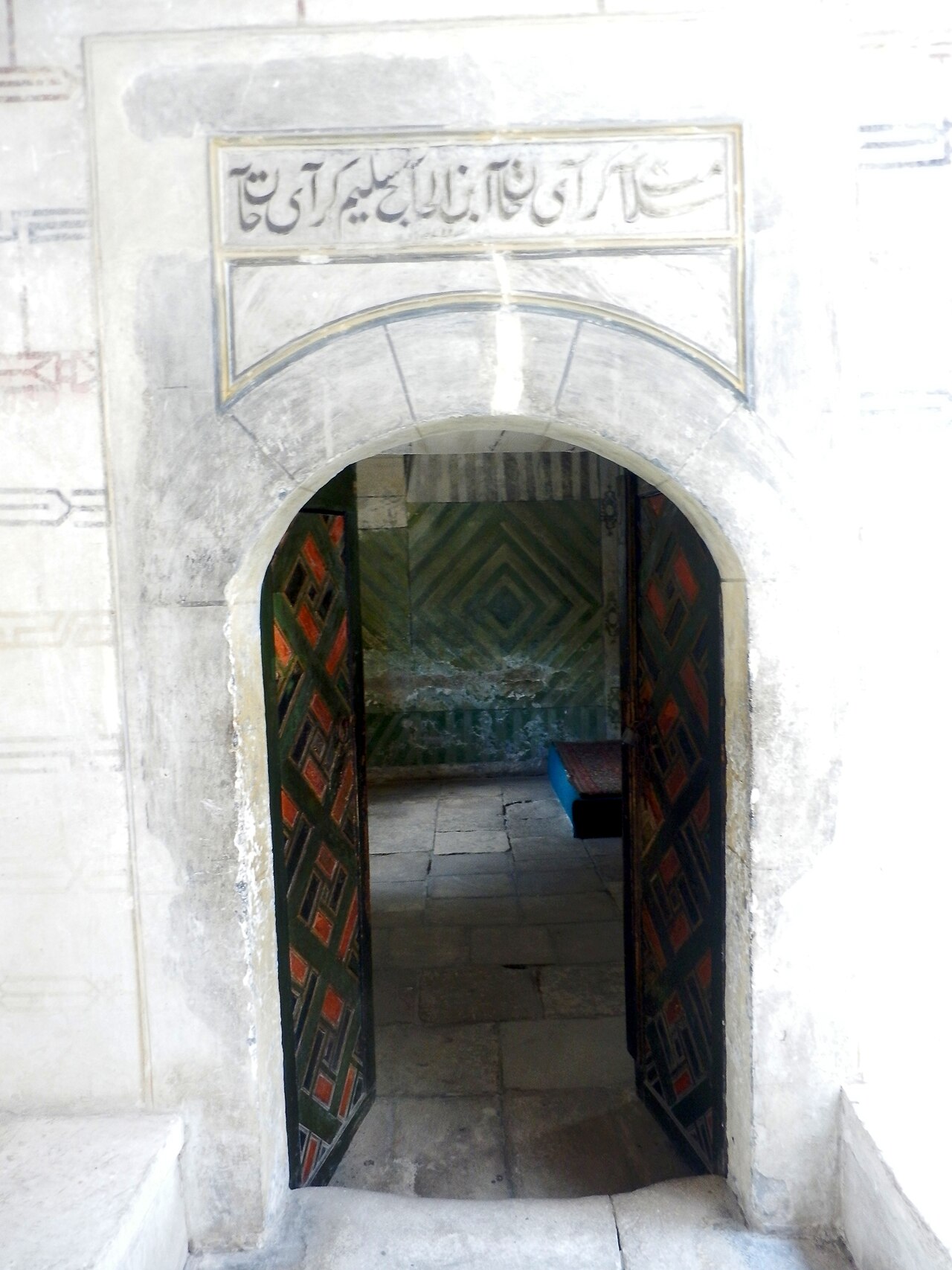
The Hansaray grew for two and a half centuries, each khan adding and rebuilding, Persian, Ottoman, and Italian masters working beside Crimean craftsmen. The oldest dated work in the complex is also its finest carving: the Demir Kapi, the Iron Door portal of 1503, made by the Italian Aleviz Novy on his way to Moscow, where he would build the Kremlin’s Archangel Cathedral, a Renaissance portal in the heart of a khan’s garden, and proof of how wide the dynasty’s connections ran.
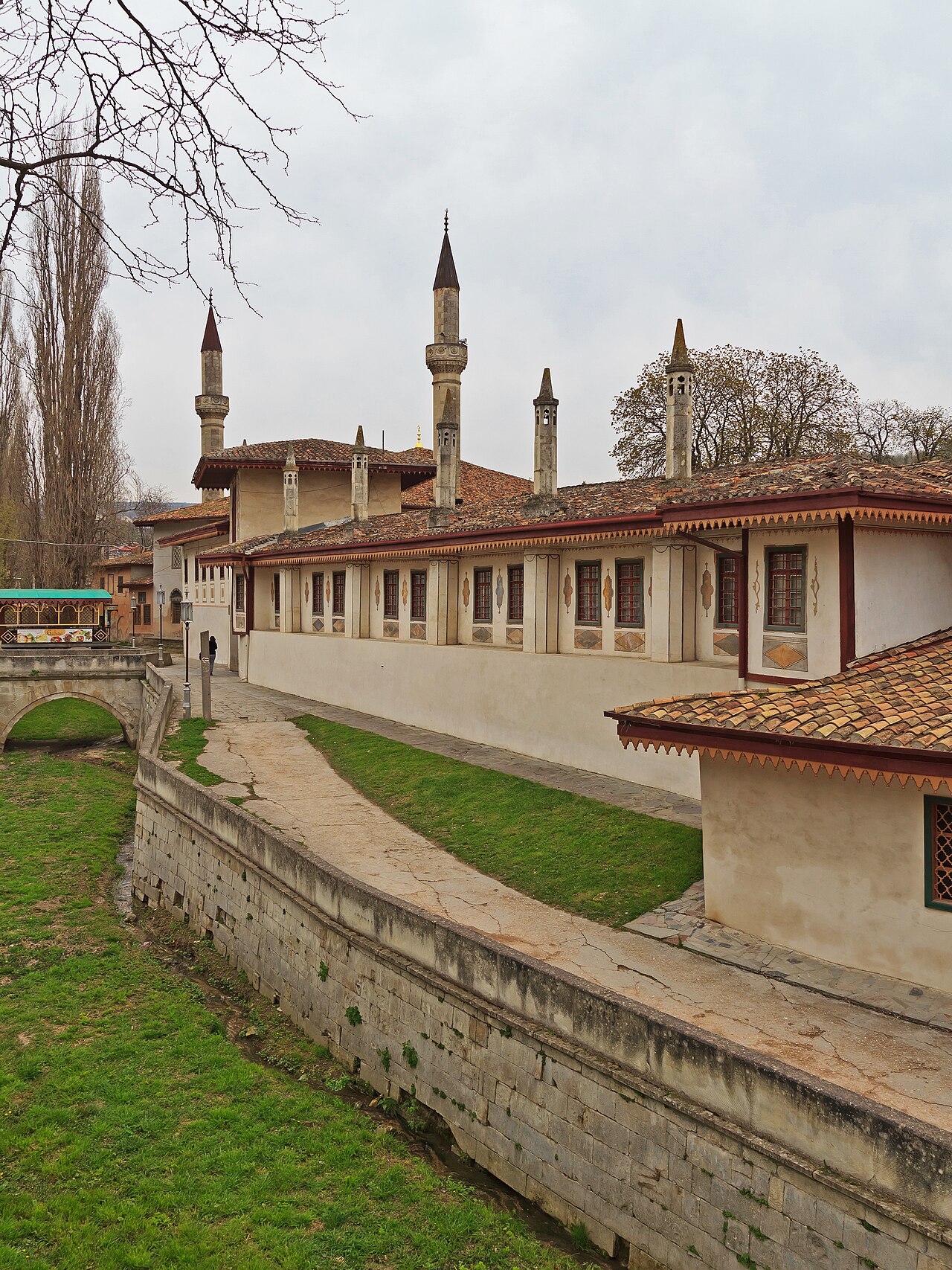
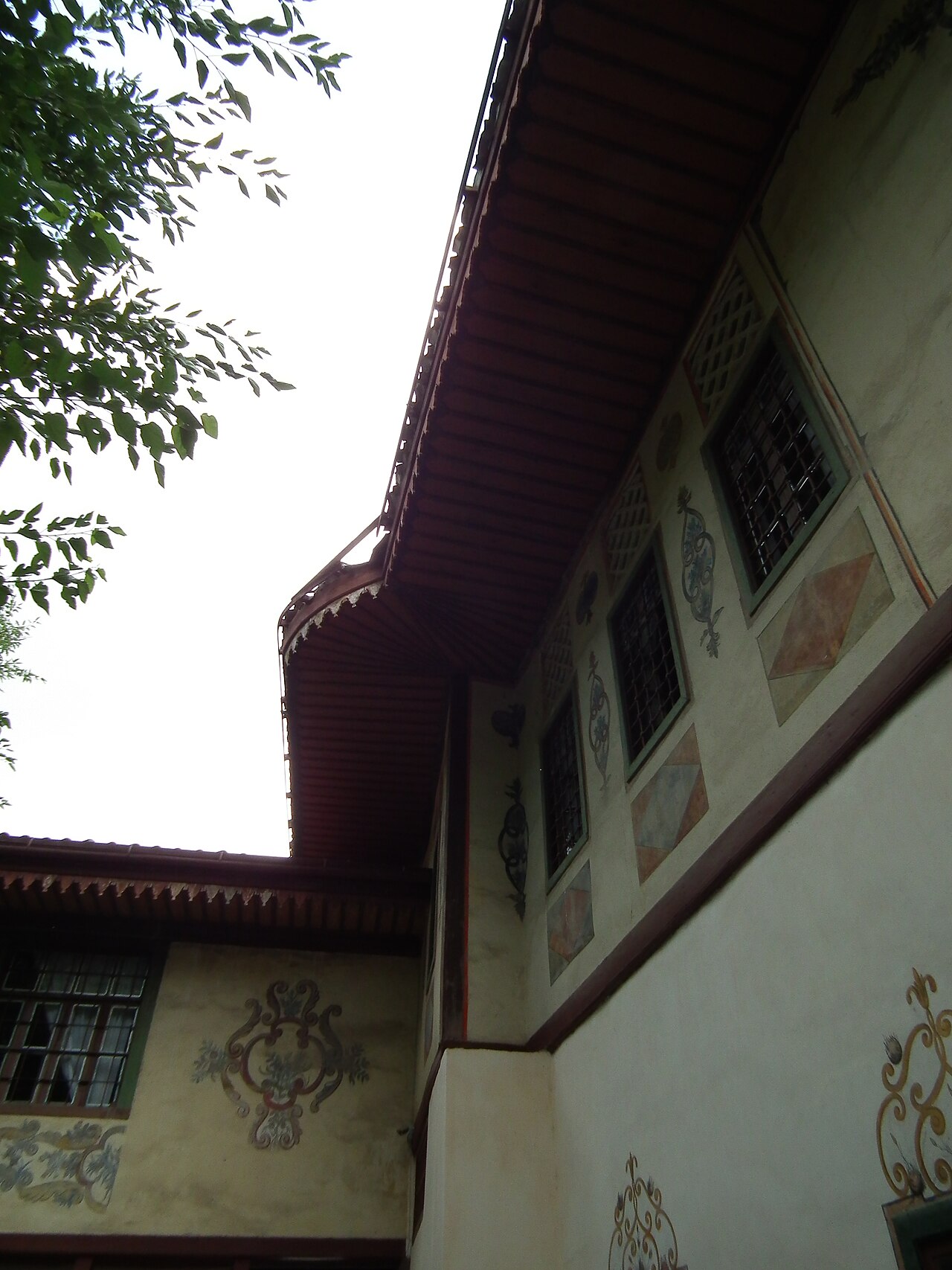
The palace follows the Ottoman court model in miniature: not one monumental block but a small city of pavilions, courtyards, mosque, baths, stables, and gardens along the river, the whole enclosed and inward-turned. Painted wooden galleries, deep eaves, stained-glass windows above carved shutters, and fountains in every court created the cultivated shade the Turkic and Persian tradition prized above marble mass.
What stands today is roughly a sixth of the khans’ full complex, and much of it bears later restorers’ hands, some loving, some clumsy. Fires, Russian military quartering, and nineteenth-century repainting all took their toll; yet the essential rooms, the divan hall, the small palace mosque, the summer arbor, the harem pavilion, and the fountain courts, keep enough original fabric that UNESCO lists the ensemble among the treasures awaiting fuller protection, and recent restorations have worked to undo the over-painting of earlier ones.
The Gate of the Entwined Serpents
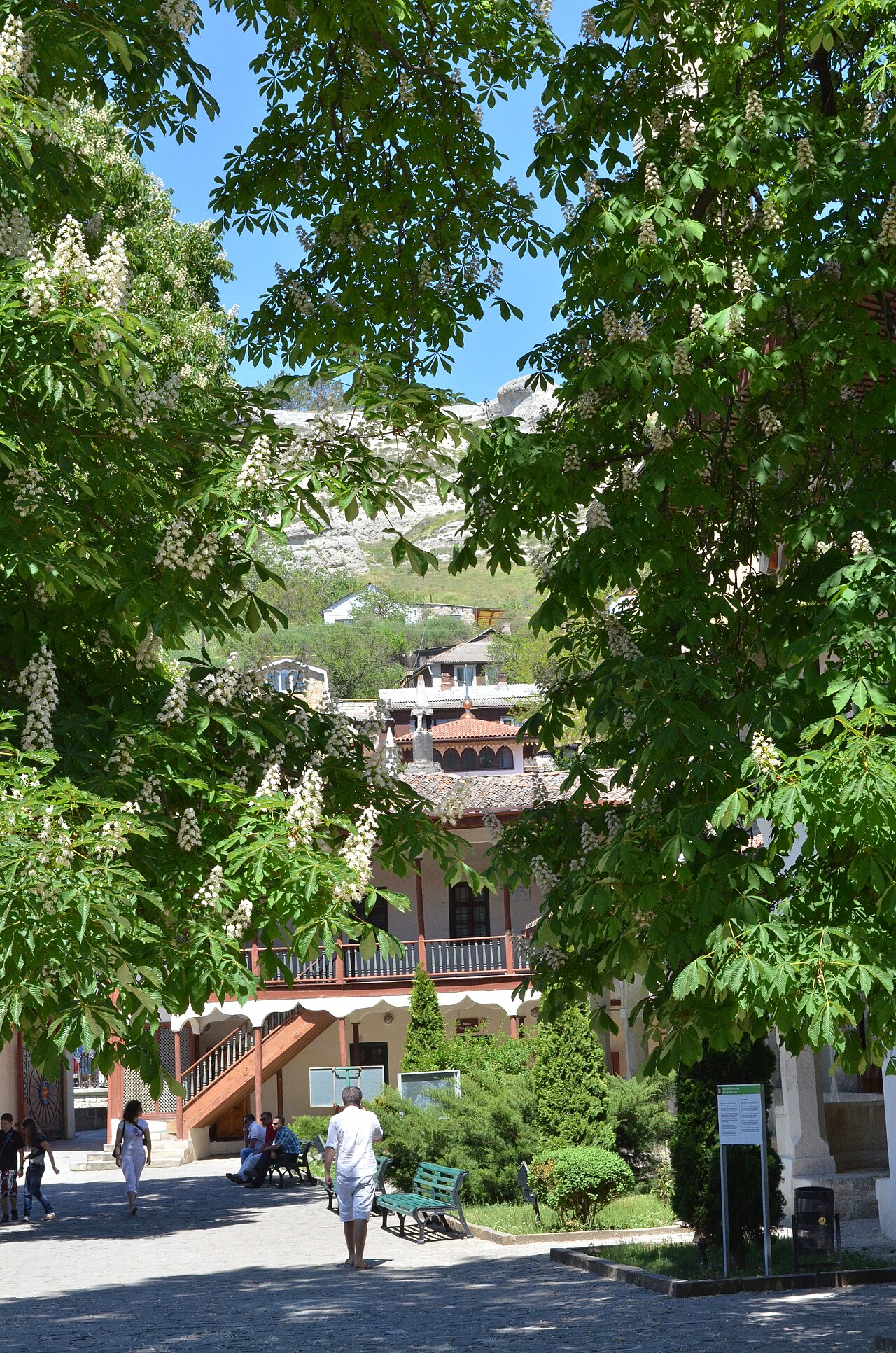
Visitors enter as ambassadors did, across the bridge over the Churuk-Su and through the North Gate beneath its watchtower, where the Giray arms, two serpents entwined, mark the threshold. Legend explains the emblem with a tale: a khan’s son watched two snakes fight by the river, saw the wounded one heal itself in the water and return to victory, and read it as the dynasty’s own promise of revival, a story the Girays’ modern descendants still tell with feeling.
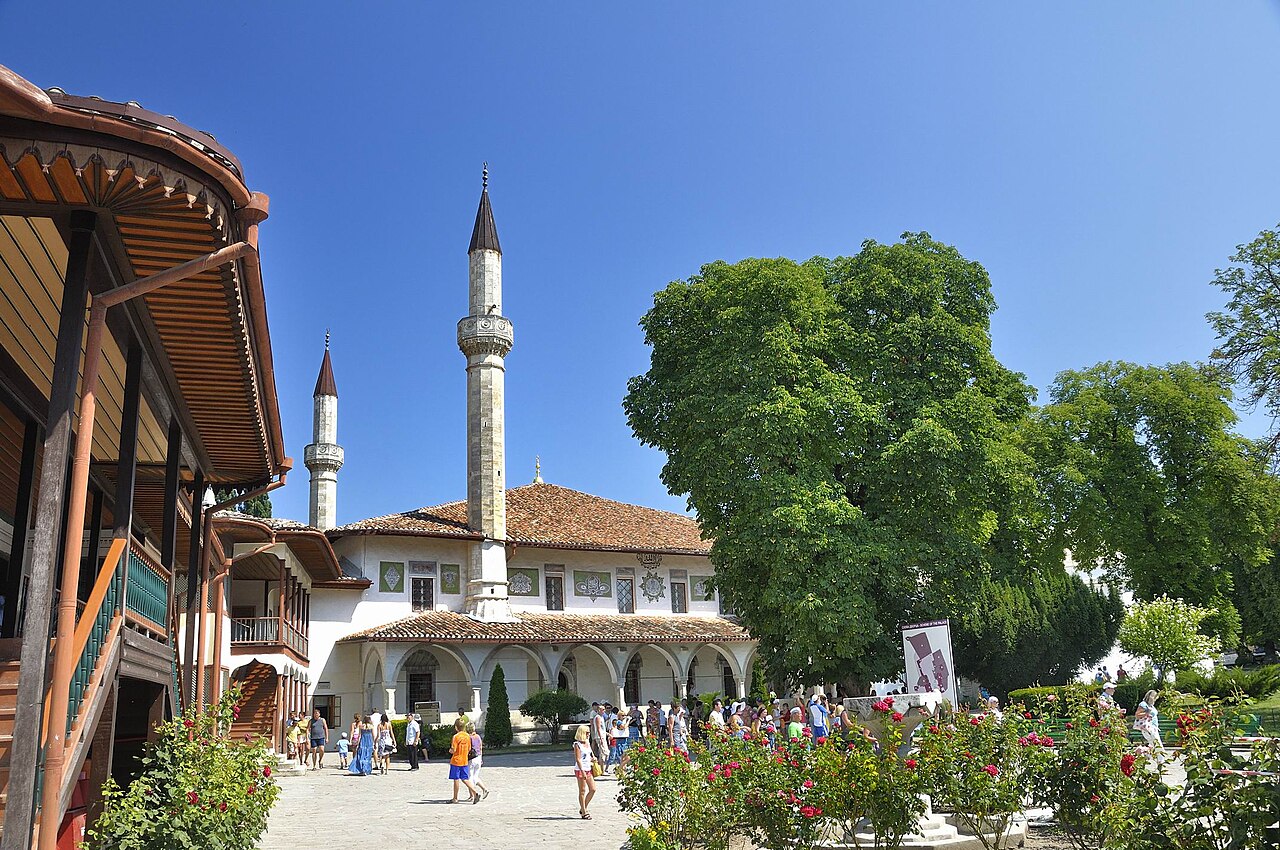
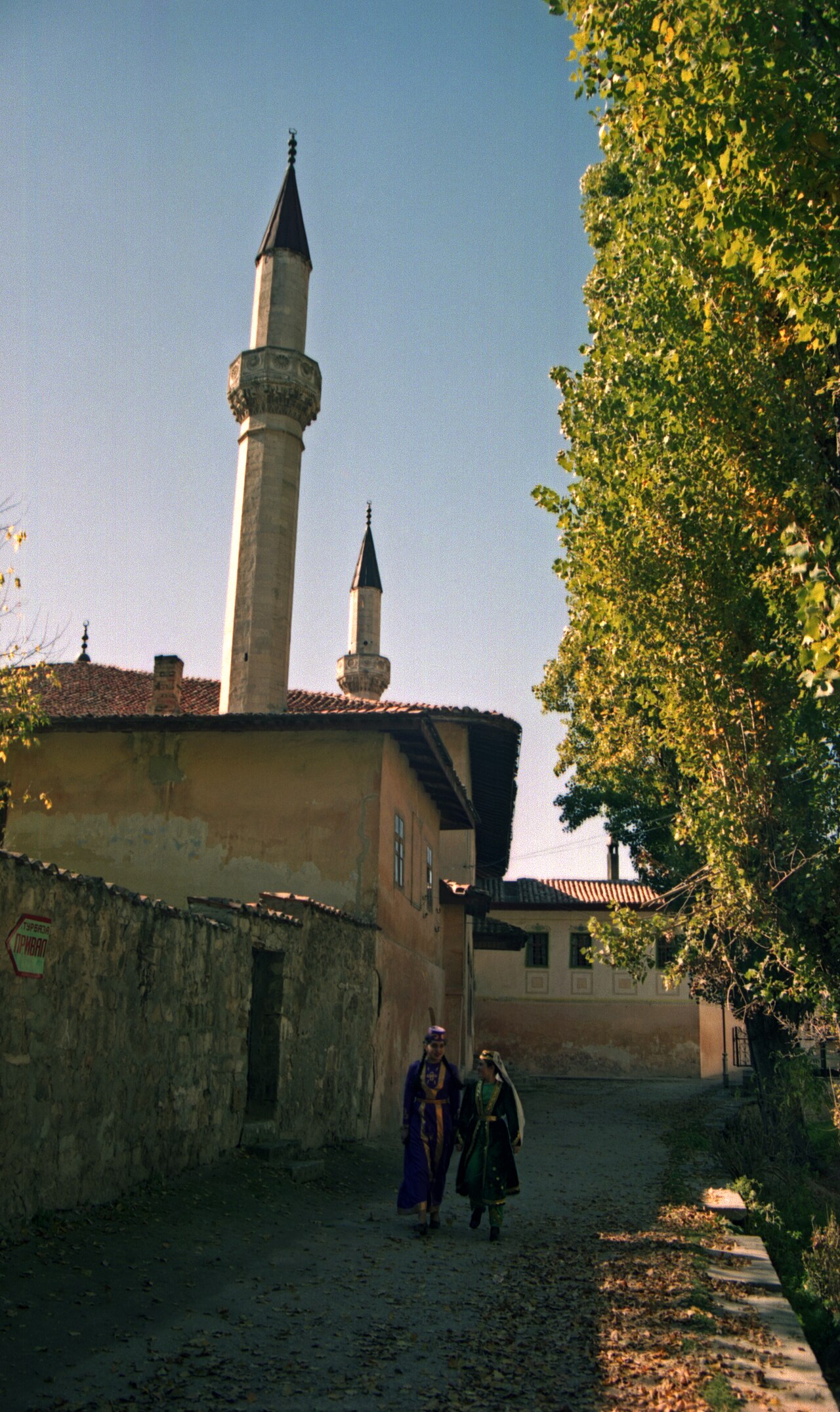
Within the gate the main courtyard opens wide and green, a parade and assembly ground where the khan’s guard of seymens mustered, embassies dismounted, and the court gathered for festivals. To one side rise the minarets of the great mosque; ahead, the palace facades with their painted eaves; the mountains close the view on every side, white cliffs leaning over the valley like a second wall.
The courtyard’s scale surprises those who expect an Oriental miniature: the khanate received ambassadors from Moscow, Warsaw, Stockholm, and Istanbul, and staged their receptions with full steppe theater, lines of guards, robes of honor, mounted escorts. Eighteenth-century envoys’ reports describe the walk from this gate to the divan hall as a calculated procession past wealth and watchful eyes, the same architecture of awe every empire practices, in a garden key.
The Divan Hall and the Khans’ Government
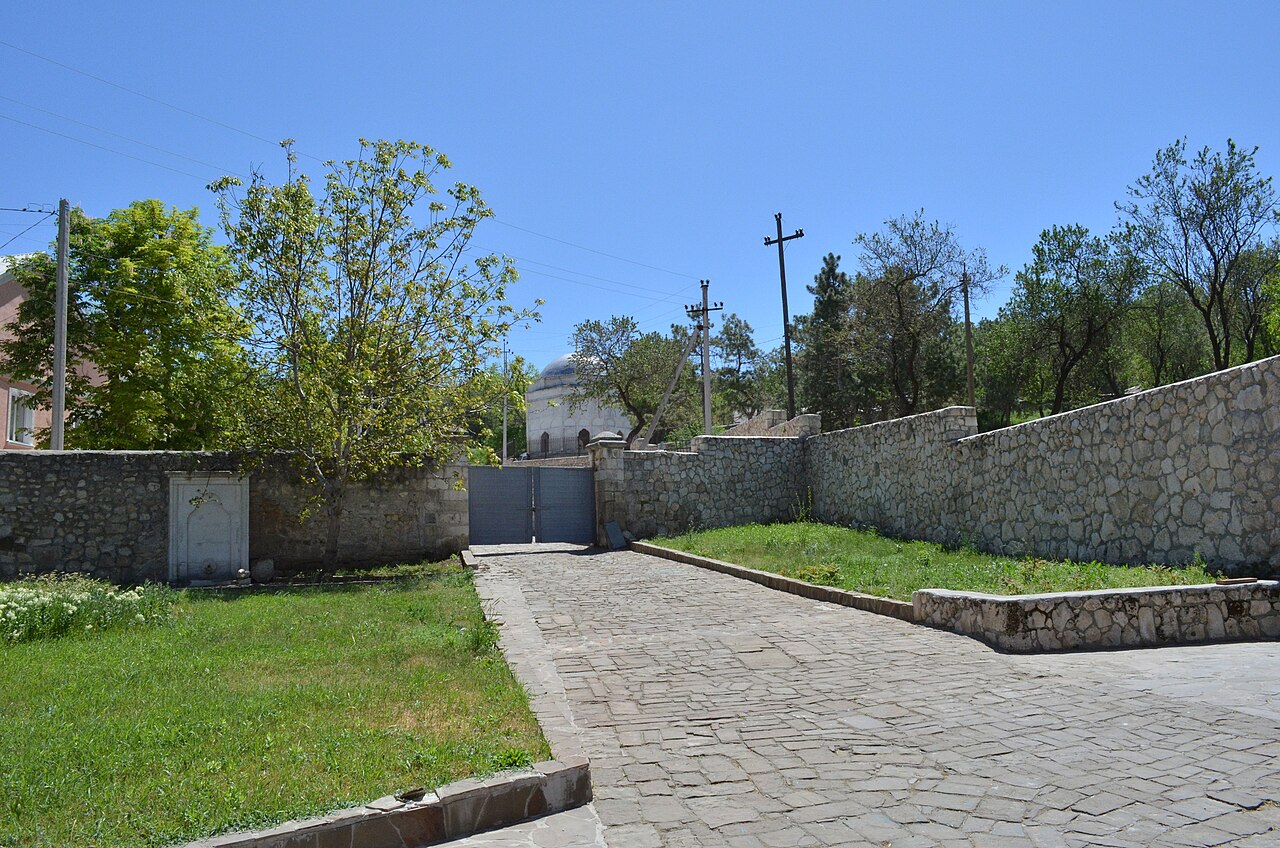
The Divan Hall was the khanate’s council chamber and throne room, where the khan presided over the divan, the council of the great clan leaders, the mufti, and the viziers, beneath a ceiling of carved and painted wood. Stained-glass windows colored the light; the khan’s seat stood on a low dais, and a latticed gallery above, tradition says, let him listen unseen to sessions he chose not to attend, a device his Ottoman overlords would have recognized.
Government here balanced powers in a way visitors from autocratic Moscow found remarkable: the great beys of the Shirin, Barin, and other clans could and did depose khans, the Ottoman sultan confirmed or dismissed them, and law ran through qadis’ courts under Islamic and customary codes. The hall thus witnessed real politics, succession crises, war councils over campaigns against Moscow or Persia, debates over the fatal Russian alliance, not merely ceremony.
In this room, too, the khanate ended constitutionally before it ended in fact: assemblies under Russian pressure in the 1770s and the last khan Sahin Giray’s reforming, doomed government sat here as the state slid toward annexation. The restored hall today, with its fountain murmuring and its colored light, is among the palace’s most evocative spaces precisely because so much argument once filled its quiet.
The Great Mosque and the Cemetery of Khans
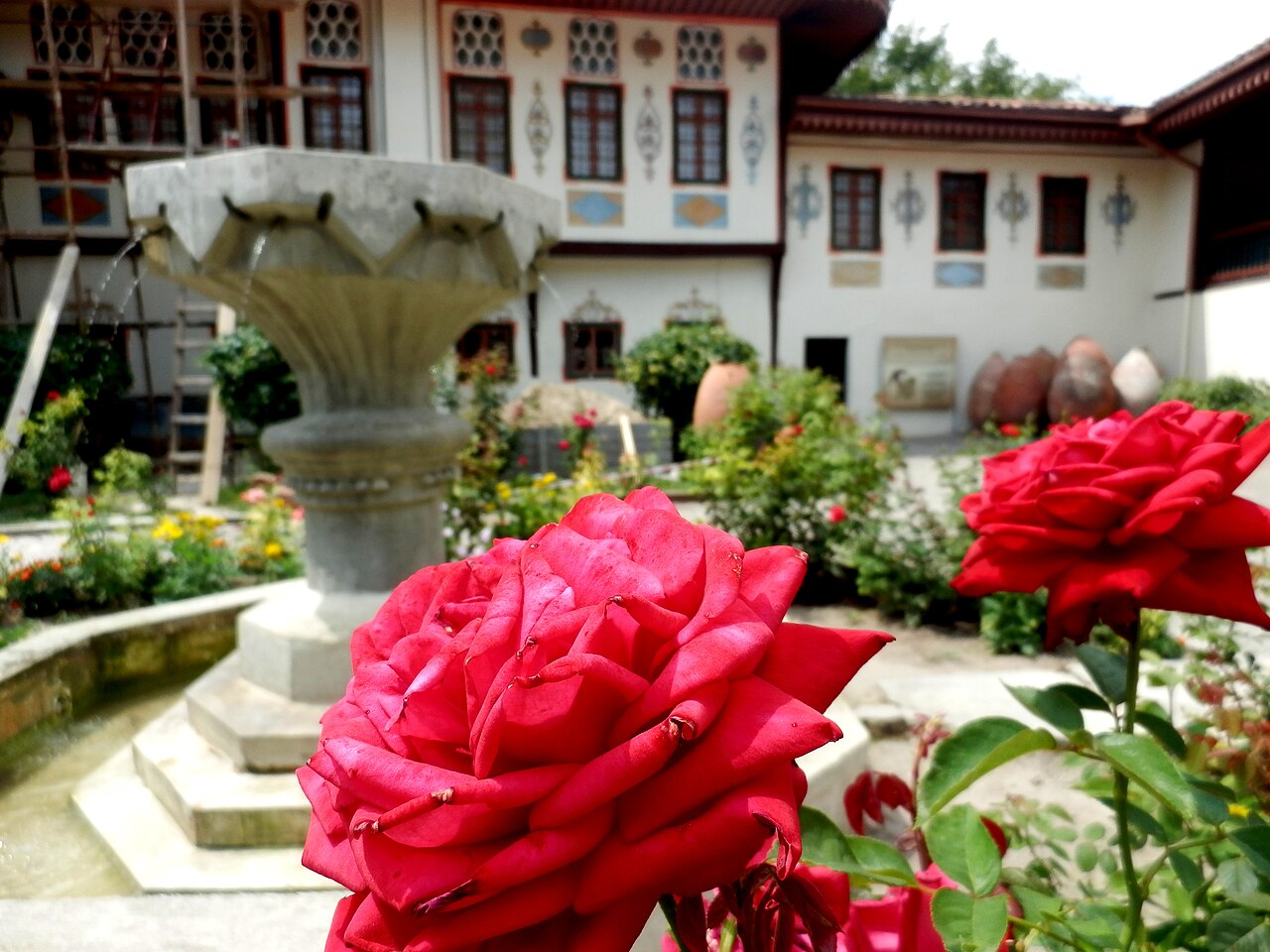
The Buyuk Han Cami, the Great Khan Mosque of 1532, one of Crimea’s largest, anchors the palace’s eastern side with its twin minarets and tiled roof. Sahib I Giray founded it with the palace itself; Khan Krym Giray restored it lavishly in 1763; and the painted exterior panels, the maiolica mihrab, and the khan’s private loge inside survive as the finest monument of Crimean Tatar religious architecture still in worship, for the mosque serves believers again today.
Behind it lies the most moving precinct of the complex: the cemetery of the khans, where nine khans and dozens of their family members rest under turbaned marble stelae and two domed mausoleums, carved with inscriptions that are an anthology of Crimean Tatar epigraphy. Here lie Devlet I Giray, who burned Moscow, and Krym Giray, patron of the famous fountain, the dynasty’s full arc under cypress shade.
The ensemble’s survival as a sacred site matters immeasurably to Crimean Tatars, whose other great monuments were largely destroyed or repurposed over two centuries. Friday prayers in the great mosque, the tended turbans of the cemetery, and the pilgrim-visitors among the tourists give the palace what few museums possess, a living congregation of memory.
The Harem and the Falcon Tower
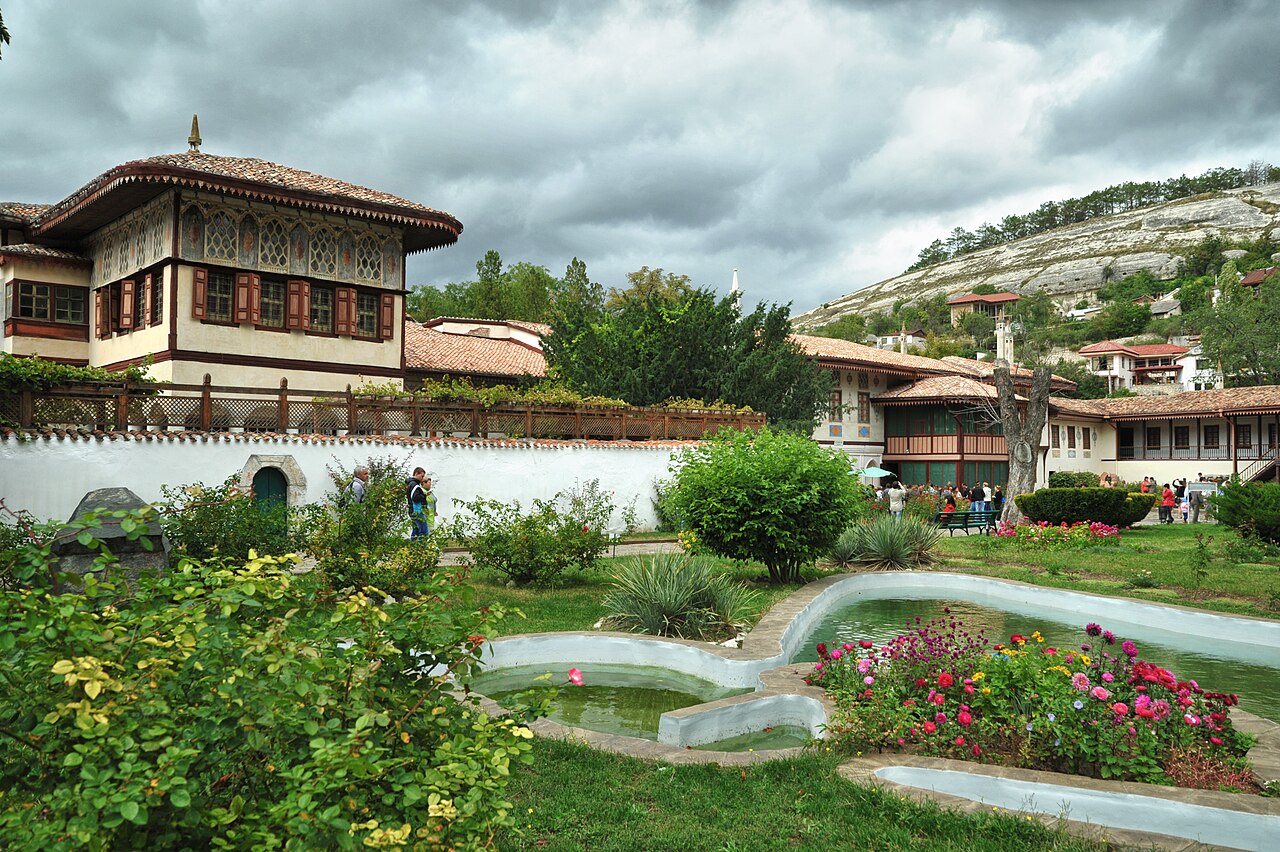
Of the khans’ harem, once four buildings around their own garden, one pavilion survives, and it is enough to correct the fantasies: rooms of painted wood and built-in divans, fretted windows onto a private court, a small fountain, the architecture of family seclusion rather than operatic languor. Here lived the khan’s mother, whose rank in the court was supreme among women, his wives and daughters, with their own staff, budget, and strict etiquette.
Beside the harem garden rises the palace’s oddest structure, the Falcon Tower, a tall timber-framed hexagon latticed like a birdcage, which served, the sources variously say, for the khan’s hunting falcons and as a lookout from which the harem’s women could watch the public courtyards unseen. Its silhouette over the rooftops has become the palace’s informal emblem, a tower built not for defense but for sight lines and birds.
The women of this court were not ornamental: khans’ mothers and wives corresponded with foreign courts, Istanbul above all, endowed mosques and fountains across the khanate, and steered successions. The harem’s surviving rooms, restored with textiles and copperware, are presented today with that political reality in mind, a court within the court, running on intelligence as much as protocol.
The Fountain of Tears
In a quiet courtyard stands a marble wall fountain that would be easy to walk past, and that millions have traveled to see. The Selsebil, built in 1764 by the master Omer for Khan Krym Giray, is a fountain of the Persian paradise type: water wells from a carved flower at the top and falls, drop by drop, from basin to smaller basin, pausing and gathering, like a heart filling and emptying, down to a spiral at the base symbolizing eternity.
The fountain originally stood at the mausoleum of Dilara Bikech, the mysterious beloved of the khan, and was moved to its present court for Catherine the Great’s visit. Its inscription praises Krym Giray and quotes the Quran’s verse on Selsebil, the fountain of paradise; its form, scholars note, is a theology of grief in hydraulics, water as tears, the basins as the stages of mourning, eternity at the end.
By unbroken custom, two roses lie always on the fountain’s upper basin, one red for love, one yellow for sorrow, placed daily by the museum’s staff since Pushkin’s time in honor of the poem that made the marble famous. The little courtyard holds, on summer days, the palace’s densest crowd and its deepest silence at once; the fountain has that effect.
Dilara and the Legend of the Fountain
History records little of Dilara Bikech beyond her mausoleum and the khan’s evident grief; legend has filled the silence for two and a half centuries. In the tale’s most loved version she was a captive, a Polish noblewoman named Maria Potocka in some tellings, a Georgian or Circassian beauty in others, whom the fierce Krym Giray loved against all his nature, and who died young, poisoned, the story insists, by a jealous rival of the harem, Zarema, herself then executed.
The broken khan, the legend continues, summoned the master Omer and commanded him to make the stone weep, so that his own grief would outlast him; Omer answered with the Selsebil, and the khan, who had made Europe tremble, sat before it listening to the water. Historians point out that Krym Giray was also a sophisticated patron who corresponded about Moliere, and that Dilara may simply have been a pious court lady; the valley prefers the lovers, and honestly, so do most historians after sunset.
The legend’s power is not decorative: it humanized the khanate for the Russian imagination at exactly the moment the empire had swallowed it, turning the conquerors’ trophy into a place of sympathy. Every retelling, Tatar, Polish, Russian, bends the story toward its own griefs, which is what great legends are for; the fountain receives them all and keeps dripping.
The Fall of the Khanate
The khanate died slowly and then suddenly. Russia’s wars with the Ottomans through the eighteenth century bled Crimea; the treaty of Kuchuk-Kainarji in 1774 declared the khanate independent, which meant defenseless, detached from Ottoman protection and open to Russian management. Petersburg installed the reformer Sahin Giray as khan, a man who dreamed of a modernized state with a regular army and European administration, and whose reforms set his own clans against him.
Rebellions, Russian interventions, and the engineered emigration of Crimea’s Christians, undermining the treasury, broke the last khan’s government. In 1783, with Russian troops already in the peninsula, Catherine’s manifesto annexed Crimea outright; Sahin Giray abdicated, wandered, and was eventually executed by the Ottomans on Rhodes, the last reigning Genghisid in the western world ending as nobody’s useful guest.
For the palace, annexation meant survival at the price of meaning: Potemkin ordered the Hansaray preserved and refurbished as a trophy residence for the empress’s planned tour, while the capital emptied around it, beginning the long Crimean Tatar emigrations to Ottoman lands that would hollow the khanate’s homeland over the following century. The garden palace became a monument the same year it ceased to be a seat of power.
Catherine’s Night in the Palace
In May 1787 the palace received its strangest guest: Catherine the Great herself, on the fabled Crimean journey staged by Potemkin, slept in the khans’ apartments, in rooms hastily Europeanized for her comfort. With her traveled the Austrian emperor Joseph II incognito and half the diplomatic corps; the empress dined in the summer arbor, admired the fountains, and wrote verses to her court about lying in the khans’ palace amid the calls of the muezzins.
The visit was imperial theater of the highest order, the point being precisely that the empress of Russia slept safe and charmed in the house of Moscow’s old terror. Yet witnesses record genuine enchantment: the firefly-lit valley, the illuminated minarets, Joseph and Catherine strolling the garden courts debating, as crowned heads will, the partition of the Ottoman world whose art delighted them.
The apartments kept for her, the so-called Catherine rooms, remained the protocol suite for a century of crowned visitors, Alexander I, Nicholas I, and the rest, each arriving to sleep symbolically in the conquered dynasty’s bed. The custom preserved the palace, emperors do not let their trophies rot, and distorted it, each visit bringing repainting and European furniture; restorers have been negotiating with those layers ever since.
Pushkin’s Poem and the Palace’s Fame
In 1820 a young exiled poet toured the south, reached Bakhchisaray half-ill on an autumn day, and saw a neglected palace where, he complained in a letter, a rusty pipe dripped in a corner. From that drip came one of Russian literature’s foundational works: The Fountain of Bakhchisaray, published in 1824, Pushkin’s lush Byronic poem of Khan Girey, captive Maria, and jealous Zarema, which fixed the legend in its canonical form and made the palace a pilgrimage overnight.
The poem’s success was enormous, it was the best-selling Russian book of its decade, and its afterlife never ended: Asafyev’s 1934 ballet carried the fountain onto every Soviet stage, with Ulanova dancing Maria; painters, composers, and generations of schoolchildren inherited the images. The two roses on the fountain today continue, knowingly, the poem’s closing gesture, the poet’s roses for the legend’s two women.
Pushkin did something subtler than advertise the palace: he made its preservation a matter of Russian culture’s self-respect. Every later threat to the Hansaray, and there were many, ran into the fact that the national poet had sanctified it; the khans’ house survives in no small part because a twenty-one-year-old exile caught the sound of water in an empty courtyard and refused to let it go.
Survival, Deportation and Memory
The palace’s modern history tracks its people’s. The nineteenth century brought repairs both careful and crude, and the emptying of Tatar Crimea by emigration; the twentieth brought museum status after 1917, with the first Crimean Tatar national institutions briefly headquartered in the palace, scholarly restoration in the 1960s, and the catastrophe at the century’s center: in May 1944 the entire Crimean Tatar people, around two hundred thousand souls, were deported by Stalin’s order in three days, the palace’s own curators among them.
For half a century the Hansaray stood as a museum of an absent nation, its labels speaking of medieval architecture while the heirs lived in Uzbek exile; their mass return from the late 1980s restored to the palace its community, its craftsmen, and its arguments. Since 2014 the ensemble’s restoration under Russian administration has drawn international dispute, UNESCO monitors the works from afar, preservationists debate methods on the roof of the Great Mosque, while the two roses appear on the fountain every morning regardless.
What no dispute touches is the place’s standing: for Crimean Tatars the Hansaray is the national hearth, for the world it is the last palace of the steppe empires, and for any visitor it is simply one of the most quietly overwhelming places in eastern Europe, a garden where a civilization keeps its memory in the sound of falling water.
Watch the Khan’s Palace on Film
Visiting the Khan’s Palace Today
The Khan’s Palace stands in the old town of Bakhchisaray, in southwestern Crimea between Simferopol and Sevastopol: suburban trains and frequent buses from both cities reach Bakhchisaray in under an hour, and the palace lies a short ride or a pleasant riverside walk from the station. The museum opens daily in season with ticketed entry to the main courts, divan hall, harem, and fountain courtyard; parts may be closed for the ongoing restoration, so check locally. Pair the palace with the Uspensky cave monastery and the cliff town of Chufut-Kale up the valley, a half-day walk that completes the khanate’s story, and stay for evening when the tour groups leave and the valley returns to its fountains. You can find the palace on the map here: Khan’s Palace on Google Maps.
Palaces Nearby
You May Like
Tekfur Palace and the Last Byzantine Residence in Istanbul