In this article
- A road into the clouds
- The icon that Luke is said to have painted
- An emperor, a governor, and a promise kept
- Fire after fire, and a stubborn rebuilding
- Why nobody looks at the icon
- What Kykkos means to an Orthodox believer
- The monastery and the making of a nation
- Inside the walls: gold, smoke, and color
- The walk up to Throni
- A day in the life of the mountain
- The painted churches all around it
- If you make the trip
There is a particular kind of silence you only find at altitude, and on Cyprus you have to climb a long way to reach it. The island most people picture is all coastline: the package-holiday beaches of the south, the harbour tavernas, the heat that presses down on Nicosia in August. But turn inland and start climbing, and the Cyprus of postcards falls away behind you. The road narrows. Pines crowd the verges. The air cools by a degree for every few hairpin bends, and the radio loses its signal. Somewhere up there, more than a kilometre above the sea, sitting on a ridge in the heart of the Troodos range, is a cluster of ochre buildings that has been the spiritual heart of this island for the better part of a thousand years. This is Kykkos, and to understand Cyprus you really do have to come here.
It is the richest and the most famous monastery on the island, and it guards a possession that, for an Orthodox Christian, is almost beyond price: an icon of the Mother of God said to have been painted by the Apostle Luke himself. You cannot see it. That is part of the story. But pilgrims have been coming for nine centuries to stand near it anyway, to feel its presence behind its silver-gilt cover, and to ask for the kind of help that does not come from anywhere else.
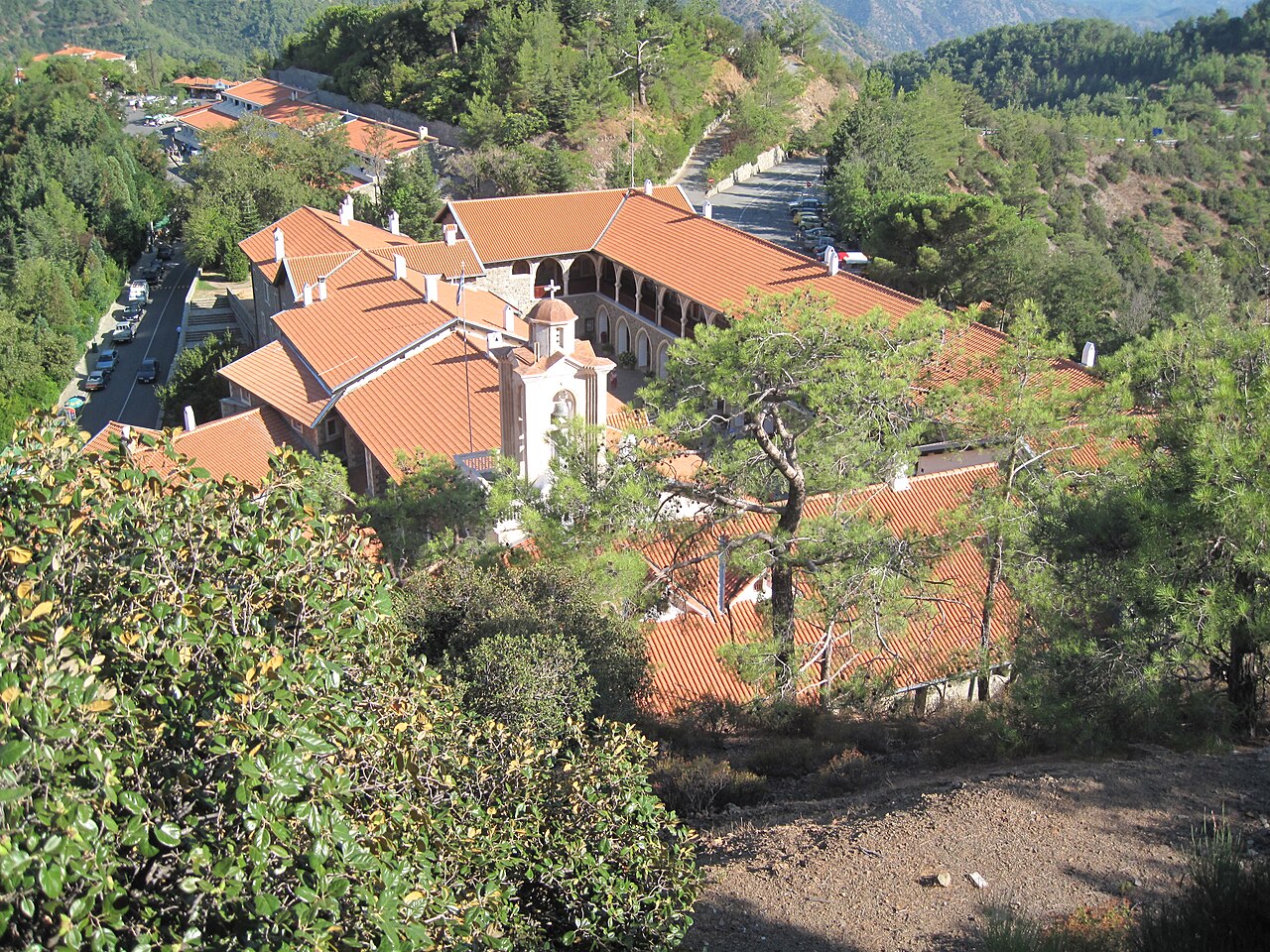
What follows is the story of that icon, of the monastery built to house it, of the fires that nearly ended it more than once, and of the strange and powerful role this mountain sanctuary has played in the life of the Cypriot people, right up to the man who became the island first president and is buried on a hilltop a short walk away.
A road into the clouds
The Troodos massif occupies the centre and west of Cyprus, a great wrinkled dome of rock topped by Mount Olympus at almost two thousand metres. These are old mountains, mineral-rich, the kind that gave the island its name in antiquity, copper, Cyprus, the words share a root. For most of human history the Troodos was a refuge: a place you went to disappear, to escape raiders on the coast, to find pasture in summer when the lowlands baked, or to pray without the world watching. The painted churches scattered through these valleys, ten of them now together a UNESCO World Heritage site, exist because monks and villagers came up here to be left alone with God.
Kykkos sits in the western Troodos at around 1,140 metres, far enough from anywhere that for most of its history reaching it meant days on a mule track. The isolation was the point. A monastery this remote was hard to plunder, hard to tax, hard for any passing empire to interfere with. It also meant that when trouble came to the coast, and over the centuries it came again and again, Arabs, crusaders, Venetians, Ottomans, the British, the mountain kept its own counsel. Today a good asphalt road carries coaches full of visitors up from the coast in a couple of hours, but the sense of having travelled to somewhere set apart survives the journey. You arrive, and the rest of the island feels very far below.
The icon that Luke is said to have painted
At the centre of everything here is a single image. According to the tradition the monks have guarded for centuries, the icon of the Virgin Mary kept at Kykkos is one of three painted from life by the Evangelist Luke, who is remembered in the Eastern Church not only as a Gospel writer and a physician but as the first iconographer, the man who looked on the Mother of God and recorded her likeness so that those who came after would know her face.
Whether or not a first-century brush ever touched this particular panel is not something history can settle, and the Orthodox faithful who venerate it are largely untroubled by the question. What matters to them is the unbroken chain of devotion: the belief that this image carries the blessing and the presence of the one it depicts, and that countless prayers answered over the centuries are proof enough. The icon is of a type the Greeks call Eleousa, the Virgin of Tenderness, in which the Christ child presses his cheek against his mother and she inclines her head toward him, a posture of intimacy and of foreknowledge, because she already senses what is coming for him.
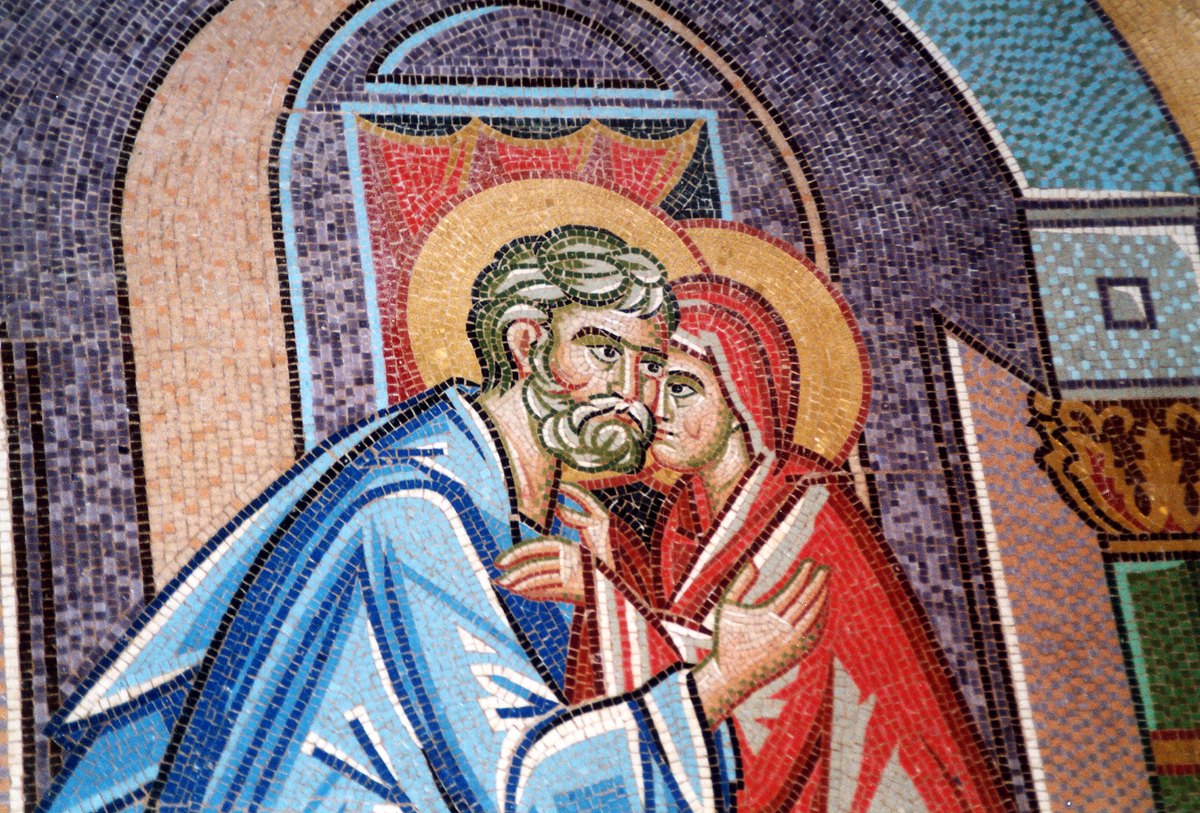
The icon is also called the Panagia Eleousa of Kykkos, and over the years it has acquired a long list of titles and a reputation that spread far beyond Cyprus. It is regarded as miraculous, a worker of cures and, perhaps most famously, a bringer of rain. In a place where summer drought could mean a failed harvest and real hunger, an image believed capable of opening the skies was not a curiosity but a lifeline, and processions carrying it out to pray for rain are remembered in the island folk memory.
An emperor, a governor, and a promise kept
How did an icon attributed to Saint Luke end up on a Cypriot mountain? The monastery tells the story like this, and it is worth telling in full because the whole identity of the place hangs on it.
Late in the eleventh century, in the reign of the Byzantine emperor Alexios I Komnenos, a hermit named Esaias was living in solitude in the Troodos forest. One day the Byzantine governor of the island, a man called Manuel Boutomites, was hunting in the hills, lost his way, and treated the hermit roughly when he asked for directions, an arrogance for which, the story says, he was promptly struck down by a serious illness. Realising he had wronged a holy man, Boutomites sought out Esaias to beg forgiveness, and the hermit told him that he would only be healed if he obtained from the emperor in Constantinople the icon of the Virgin painted by Saint Luke, which was then kept in the imperial palace.
This was no small request. The icon was a treasure of the Byzantine court. But when the emperor own daughter fell ill with the very same affliction that had struck the governor, and recovered only after Alexios promised to give up the icon, the matter was settled. The emperor, reluctant to part with so precious an object, is said to have commissioned an exact copy and tried to keep the original, only for a series of signs to make clear that heaven intended the true icon to go to Cyprus. So it was sent, and Esaias built a church to house it. The emperor funded the foundation of a monastery around it and granted it estates to sustain it. That monastery was Kykkos, and it has guarded the icon ever since.
It is a foundation legend of a familiar Byzantine type, the holy man, the proud official humbled, the imperial treasure surrendered to heaven, but its details matter because they root the monastery directly in the authority of the Christian Roman emperor and in the apostolic age beyond him. Kykkos, in this telling, is not a local shrine that grew popular. It is a piece of the imperial and apostolic patrimony, deliberately planted on the island by Constantinople itself.
Fire after fire, and a stubborn rebuilding
Wooden buildings, oil lamps, candles by the hundred, mountain winters cold enough to demand fires day and night, a monastery like Kykkos was always going to be vulnerable to flame, and its history is punctuated by catastrophe. The complex has burned down, in whole or in large part, several times across the centuries, and each time it has been rebuilt, usually larger and richer than before, by a community that simply refused to let the place die.
The buildings a visitor sees today are therefore not medieval. They are mostly the product of repeated reconstruction, much of it from the eighteenth and nineteenth centuries onward, with major restoration and decoration carried out in modern times. This is one of the quiet truths of pilgrimage sites everywhere: the holiness attaches to the place and to what it holds, not to the age of the stones. People do not climb to Kykkos to admire eleventh-century masonry. They climb because the icon has been here, in this spot, through every fire and every rebuilding, and because the prayers of nine hundred years have soaked into the mountain itself.
The fires also explain the monastery wealth in a roundabout way. Each disaster prompted fresh waves of donation, from Cypriots, from the wider Orthodox world, from Russian tsars and Romanian princes and ordinary believers leaving what little they had. Kykkos accumulated land, treasure, and dependencies across Cyprus and beyond, becoming not just a spiritual centre but an economic power, and that wealth, lovingly poured back into the buildings, is what gives the modern monastery its almost overwhelming richness of decoration.
Why nobody looks at the icon
Here is the detail that surprises almost every first-time visitor. You can travel to the ends of Cyprus, climb into the mountains, walk into the church at the heart of the monastery, stand directly before the most venerated object on the island, and you will not see it. The icon of the Panagia of Kykkos has been kept covered for centuries, its painted surface hidden behind a casing of silver-gilt and a shroud, and to gaze upon the image itself is forbidden.
The tradition holds that the face of the Virgin is too holy to be looked upon directly, and various stories warn of misfortune befalling those who tried, a curious bishop, a doubting visitor, struck blind or worse for their presumption. Whether you read these as literal warnings or as a way of teaching reverence, the effect is the same and rather profound. The icon is venerated precisely as a mystery. Pilgrims kiss the cover, press their foreheads to it, leave their offerings of gold and silver and embroidered cloth, but the image remains veiled, a presence felt rather than seen. In an age that photographs everything and demands to look at everything, there is something quietly radical about a sacred object that says: no, not this, this you will know only by faith.
What Kykkos means to an Orthodox believer
To understand why all this matters, it helps to step back into the world of Eastern Orthodox Christianity, which is the faith of the great majority of Greek Cypriots and the tradition to which Kykkos belongs body and soul. In Orthodoxy, the icon is not decoration and not, as some outsiders assume, an idol. It is a window. The theology, hammered out in the bitter controversies of the eighth and ninth centuries when iconoclasts tried to abolish religious images altogether, holds that the honour given to an icon passes to the person it represents. You do not worship the wood and paint. You venerate the Virgin or the saint or Christ himself, and the image is the meeting point, the place where heaven leans into the visible world.
An icon attributed to Saint Luke carries this idea to its highest pitch. If Luke truly looked on Mary and painted her, then the image is not an artist imagining the Mother of God but a faithful record of how she actually appeared, a kind of holy photograph from the apostolic age. For the Orthodox, that makes Kykkos icon a point of contact with the very beginnings of the Church, a thread running unbroken back to the people who knew Christ in the flesh. To venerate it is to reach across two thousand years and touch the source.
This is also where the gap with Protestant Christianity is widest, and it is worth naming plainly. The Reformation churches, in their various forms, largely rejected the veneration of images and the special devotion to Mary that fills a place like Kykkos. To a strict Protestant sensibility, a covered icon receiving kisses and gold offerings can look uncomfortably like the idolatry the Hebrew prophets thundered against. The Orthodox answer, worked out long before Luther was born, is that there is a world of difference between worship, which belongs to God alone, and veneration, the honour properly shown to the holy. Catholics, who share the cult of Mary and the use of sacred images though they express it differently, stand far closer to the Orthodox here, and a Roman Catholic pilgrim at Kykkos would find the devotion strange in its forms but familiar in its heart.
The monastery and the making of a nation
Kykkos is not only a religious site. For Greek Cypriots it is bound up with the very idea of the nation, and you cannot separate the two. The Orthodox Church on Cyprus has for centuries been more than a religious institution; under Ottoman rule the archbishop was recognised as the leader and spokesman of the Greek Christian population, the ethnarch, responsible for his people before the authorities. The Church carried Greek identity through the long centuries when there was no Greek state on the island, and the great monasteries, Kykkos foremost among them, were its strongholds.
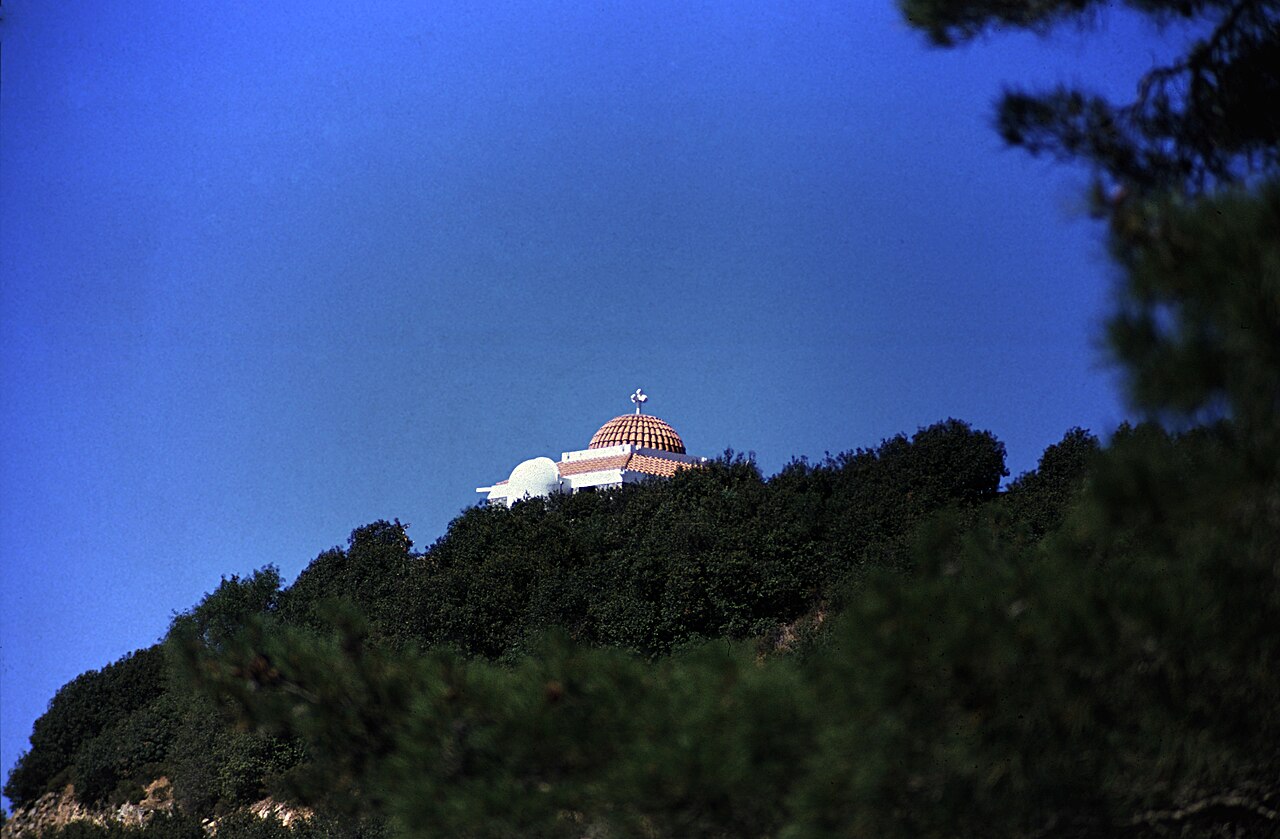
That role reached its climax in the twentieth century in the person of one man. Makarios, who would become Archbishop Makarios III and then the first president of the independent Republic of Cyprus, began his religious life as a novice at Kykkos. The monastery educated and shaped him, and he never forgot it. When he led the movement for the end of British colonial rule and then steered the new republic through its turbulent birth in 1960 and the years of crisis that followed, he carried the mountain with him. After his death in 1977 he was buried, at his own wish, not in a cathedral in the capital but on a hilltop called Throni, a short walk above Kykkos, looking out over the Troodos he had loved as a young man. His tomb there has become a pilgrimage site in its own right, a place where the religious and the national devotion of Greek Cypriots flow together and become hard to tell apart.
This fusion of faith and nationhood is something an outsider should approach with care and respect rather than judgement. Cyprus is a divided island, its wounds from 1974 still open, and the symbols here carry weight that a casual visitor can easily underestimate. But it also explains the intensity you feel at Kykkos. This is not a museum. It is a living centre of a people sense of who they are.
Inside the walls: gold, smoke, and color
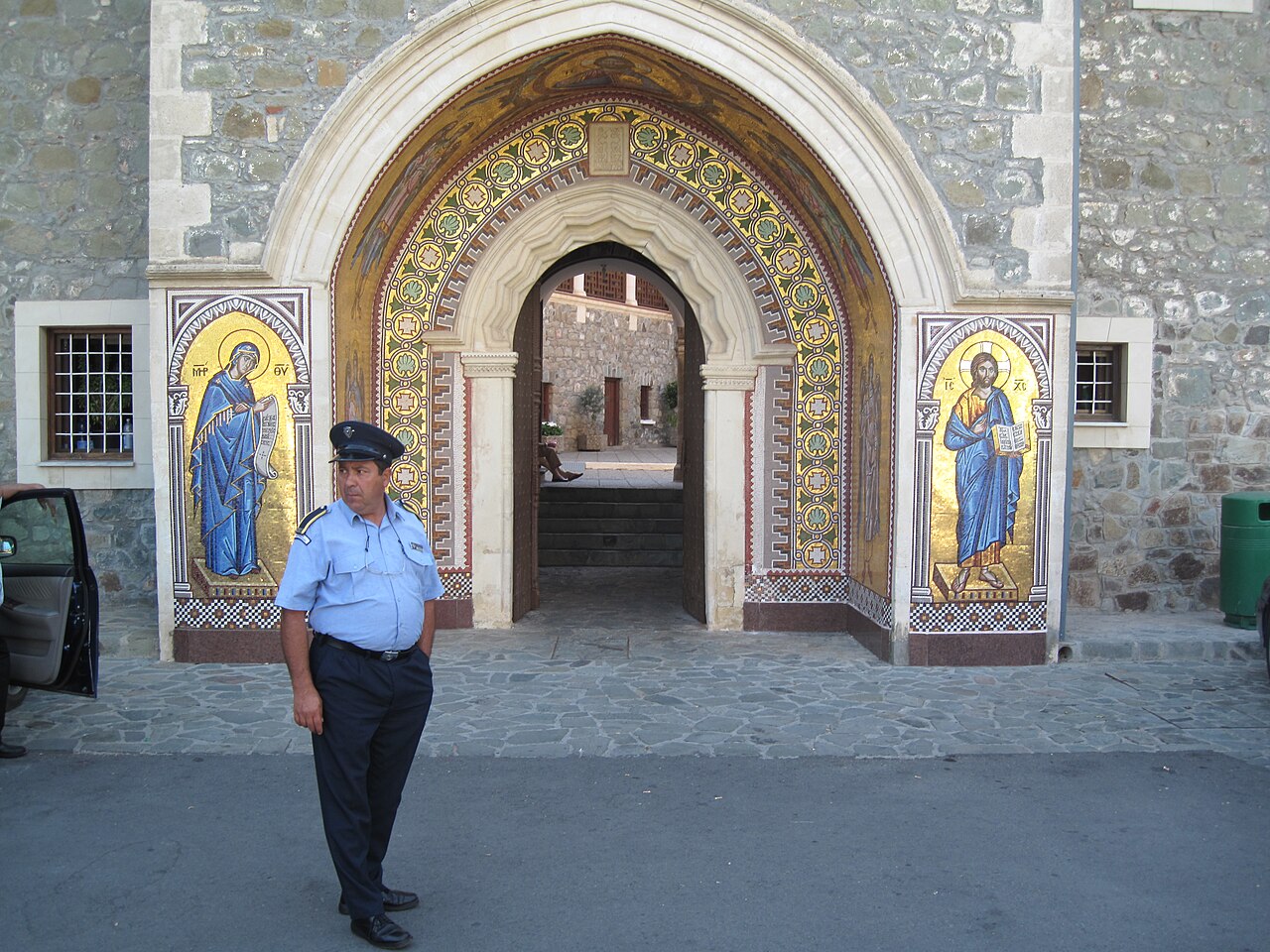
Step through the gate and the first impression is of abundance. After the austerity of the mountain forest, the interior of Kykkos hits the senses like a chord. Long covered galleries run around the courtyards, and almost every surface, walls, ceilings, the arches overhead, is sheathed in mosaic and fresco, much of it modern work executed in the traditional Byzantine manner, gold grounds shimmering in the dim light, saints gazing down with the great calm eyes of Eastern iconography.
The mosaics are the thing visitors remember. Scene after scene from scripture and from the lives of the saints unfolds along the corridors in tiny tesserae of glass and gold, so that walking through is like turning the pages of an illuminated book at architectural scale. The work is recent by the standards of Byzantine art, but it is done with such fidelity to the old conventions that the effect is genuinely transporting, and it represents an extraordinary act of patronage, a deliberate decision to clothe the monastery in the full splendour of the tradition it serves.
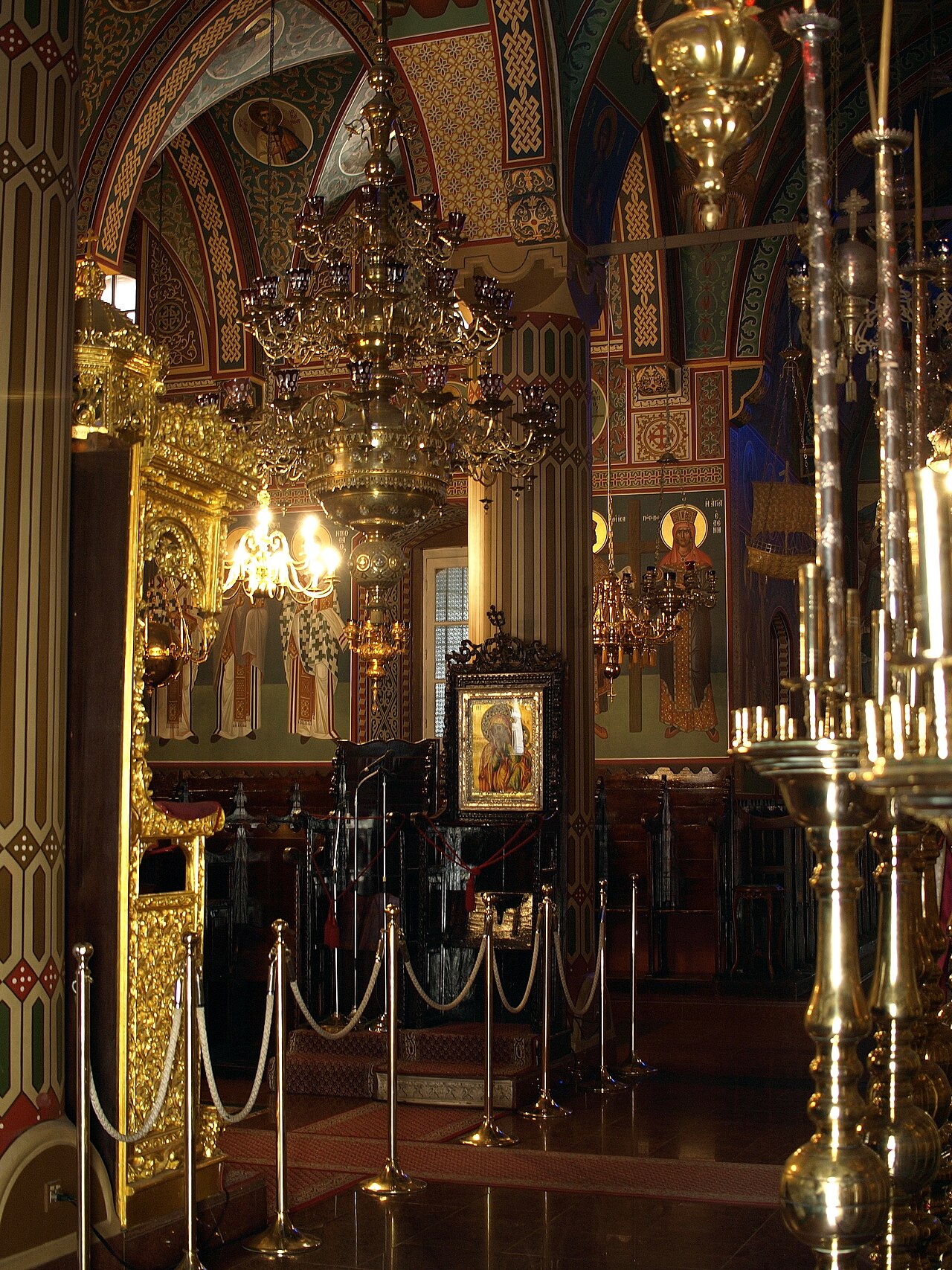
At the heart of it all is the church, the katholikon, where the icon waits behind its screen amid a forest of hanging lamps and the blue haze of incense. Here the offerings of centuries hang in the gloom, silver votives, gold chains, embroidered cloths, the accumulated gratitude of generations who came with a sorrow or a hope and went away believing they had been heard. There is also a museum at Kykkos, one of the finest of its kind on the island, where the monastery treasures, manuscripts, vestments, liturgical vessels, older icons, are displayed for those who want to understand the depth of the collection the mountain has gathered.
The walk up to Throni
Do not leave without making the short pilgrimage up to Throni. From the monastery a path and a road climb a little higher, perhaps three kilometres, to the hilltop where Makarios lies and where a modern chapel and viewing point look out across an immense sweep of the Troodos. On a clear day the forested ridges roll away in every direction, fold after blue-green fold, and you understand at last why men came up here to be alone with God and why one of them chose to be buried facing it forever.
The name Throni means throne, and the place has a quality that earns it. Pilgrims tie ribbons and scraps of cloth to a wishing tree near the summit, a folk custom older than any theology, and the simple chapel there is dedicated, like the monastery below, to the Mother of God. Standing on that height with the wind moving through the pines, the heat of coastal Cyprus an hour and a world away, you get the truest sense of what Kykkos is: not a building but a height, a place lifted up out of ordinary life where the island has gone for nine hundred years to be closer to heaven.
A day in the life of the mountain
It is easy, when you visit on a bright afternoon among the coaches and the souvenir stalls, to forget that Kykkos is not put on for visitors. Beneath the tourism a much older rhythm is still turning, the same rhythm that has governed Orthodox monasteries since the deserts of Egypt fifteen centuries ago. The monks rise long before dawn for the first services, when the church is dark and cold and the only light comes from the oil lamps swaying gently over the iconostasis. The day is divided between prayer and work, the two halves of the monastic vocation that the founders of Eastern monasticism insisted could not be separated, because to pray is to labour and to labour, done in the right spirit, is to pray.
The work at a great house like Kykkos has always been varied. There are the practical tasks any large community needs, the kitchens, the gardens, the upkeep of an enormous complex exposed to mountain weather. There is the care of the pilgrims, who have to be received, guided, sometimes fed and housed, a duty of hospitality that Orthodox monasticism treats as sacred, since the guest is to be welcomed as Christ himself. And there is the intellectual and artistic labour for which Kykkos has long been known: the copying and preservation of manuscripts, the teaching of the young, the patient making and restoring of icons. The monastery ran a school that educated generations of Cypriot churchmen, and its library and archive preserve documents that are a treasure for the history of the whole island.
There is also, less visibly, the management of wealth. A monastery that over the centuries accumulated estates, dependencies, and donations across Cyprus and beyond had to be administered like the considerable institution it was, and the abbot of Kykkos has always been a figure of real weight in the affairs of the Cypriot Church. None of this, the monks would insist, is the point. The point is the unceasing prayer, the daily lifting up of the world before God in a place set apart for exactly that purpose. The estates and the schools and the mosaics are the by-products of a community that has simply been here, praying, for nine hundred years, and that has drawn to itself, like a magnet, the gratitude and the giving of all who believed those prayers were heard.
The painted churches all around it
Kykkos may be the grandest sanctuary in the Troodos, but it does not stand alone, and one of the rewards of coming this far into the mountains is discovering the company it keeps. Scattered through the surrounding valleys are the famous painted churches of Troodos, small, steep-roofed Byzantine and post-Byzantine chapels whose modest exteriors hide interiors covered, wall to wall and floor to ceiling, in some of the finest medieval fresco painting in the eastern Mediterranean. Ten of them are inscribed together on the UNESCO World Heritage list, and they are a different experience entirely from the gleaming abundance of Kykkos.
Where Kykkos overwhelms with gold and scale, these little churches whisper. Many are barely larger than a barn, with great protective wooden roofs added later to shield them from the snow, and from the outside you might walk past one without a second glance. Then you step through a low door and the whole interior blazes at you in deep reds and blues and earth tones, the entire Gospel told in image after image by anonymous masters working between the eleventh and the seventeenth centuries. They painted for villagers who could not read, turning the walls into a Bible in pictures, and the directness of the work, the human faces, the everyday details smuggled into sacred scenes, can move you in a way the more formal splendour of a great monastery sometimes cannot.
Visiting them turns a trip to Kykkos into a proper pilgrimage through the spiritual landscape of the Cypriot mountains. You can spend days working your way from one to the next along the forest roads, Asinou, Agios Nikolaos tis Stegis, Panagia tou Araka and the rest, each one a small jewel-box of devotion, and arrive at Kykkos understanding it not as an isolated marvel but as the crown of a whole mountain world that turned itself, over the centuries, into a kind of vast open-air monastery. The Troodos did not just shelter the faith. It became the faith made visible, painted onto its rocks and raised up on its ridges, and Kykkos is the place where all of it gathers to a point.
If you make the trip
Kykkos is open to visitors year round and there is no charge to enter the monastery itself, though the museum has a modest admission fee that is well worth paying. It sits high in the western Troodos, and the drive up from the coast, whether you come from Limassol, Paphos, or Nicosia, is part of the experience, winding through pine forest and mountain villages where you can stop for the local specialities, cool spring water, loukoumia, the resin-scented wine of the hills. Come dressed for a holy place, shoulders and knees covered, and remember that whatever else it is to historians and tourists, this is first of all a working monastery where monks still keep the daily round of prayer.
Try, if you can, to arrive early or stay late, before or after the coaches, when the corridors are quiet and the only sound is the click of a censer and a monk footsteps on stone. Stand a while before the veiled icon you are not allowed to see. You do not have to share the faith of the people kneeling around you to feel the weight of what has happened in this spot, the centuries of hope carried up the mountain and laid down before an image of a mother and her child. That weight is real, and it does not lift when you drive back down to the sea. It stays with you, the way the cold clear air of high places stays in the lungs a little while after you have come back down to earth.


