Picture a building so long that you cannot take it all in from a single spot. You stand at one end of a turquoise-and-white facade that seems to run on forever, its columns gilded, its window frames crowned with sculpted figures, its roofline glittering as if someone had dipped the whole thing in gold. This is the Catherine Palace, the summer residence of the Russian tsars at Tsarskoye Selo, a short train ride south of Saint Petersburg. It was never meant to be modest, and it has never pretended otherwise.
The palace carries the name of Catherine I, the wife of Peter the Great, but the building you see today belongs far more to their daughter, the Empress Elizabeth, and to the woman who came after her, Catherine the Great. Across the eighteenth century these three women, along with the architects they hired and fired and hired again, turned a modest country house into one of the most extravagant royal residences in Europe. The result is a place that manages to be both a serious statement of imperial power and an almost giddy celebration of gold, mirrors, and light.
Inside, the rooms unfold one after another in a long enfilade, doorways lining up so that you can see straight through a dozen chambers at once. There is the Great Hall, a ballroom so bright it was nicknamed the Light Gallery. There is the legendary Amber Room, its walls sheathed in carved amber that glows like honey in the sun, a chamber so famous that its disappearance during the Second World War became one of the great mysteries of the century. And there are the cooler, more restrained rooms that a later empress commissioned when tastes turned away from baroque excess toward classical calm.
In this article you will walk through the whole story: the architects who shaped the palace, the empresses who paid for it, the fire and war that nearly destroyed it, and the decades of painstaking restoration that brought it back. By the end you will understand why this glittering building on the edge of a quiet park has drawn travelers, artists, and thieves for nearly three hundred years, and why it still feels, when you step inside, like walking into a dream someone had about what a palace should be.

In This Article
- A Summer Palace Fit for an Empire
- Rastrelli and the Baroque Vision
- The Empress Elizabeth, Patron of Gold
- Turquoise, White, and Gold
- The Grand Staircase
- The Great Hall and Its Sea of Light
- The Amber Room
- Catherine the Great and the Turn to Classicism
- The Catherine Park
- A Town Around a Palace
- War and Devastation
- Bringing the Palace Back
- Visiting the Catherine Palace Today
A Summer Palace Fit for an Empire
The Catherine Palace sits in the town of Tsarskoye Selo, which means the Tsar’s Village, about twenty-five kilometers south of the center of Saint Petersburg. For two centuries this was where the Russian imperial family came to escape the formality and the damp of the capital, to breathe country air, to hunt and stroll and hold summer balls away from the machinery of government. The palace anchors a vast landscaped park, and together they formed a self-contained world of pleasure and display.

What strikes you first is the sheer scale. The main facade stretches roughly three hundred meters, making it one of the longest palace fronts anywhere in Europe. When it was first completed under the Empress Elizabeth, contemporaries reported that something like a hundred kilograms of gold went into gilding the exterior ornament alone, an extravagance so blinding that foreign visitors struggled to describe it without sounding as though they were exaggerating. They were not.
But the palace is more than a single grand gesture. It is a layered building, and if you know how to read it you can see the fingerprints of different reigns and different tastes pressed into its walls. The exuberant baroque bones belong to Elizabeth’s era. The cooler, more disciplined classical rooms and garden pavilions belong to Catherine the Great, who found her aunt’s golden excess a little vulgar and set about tempering it. Learning to see these layers is part of the pleasure of a visit.
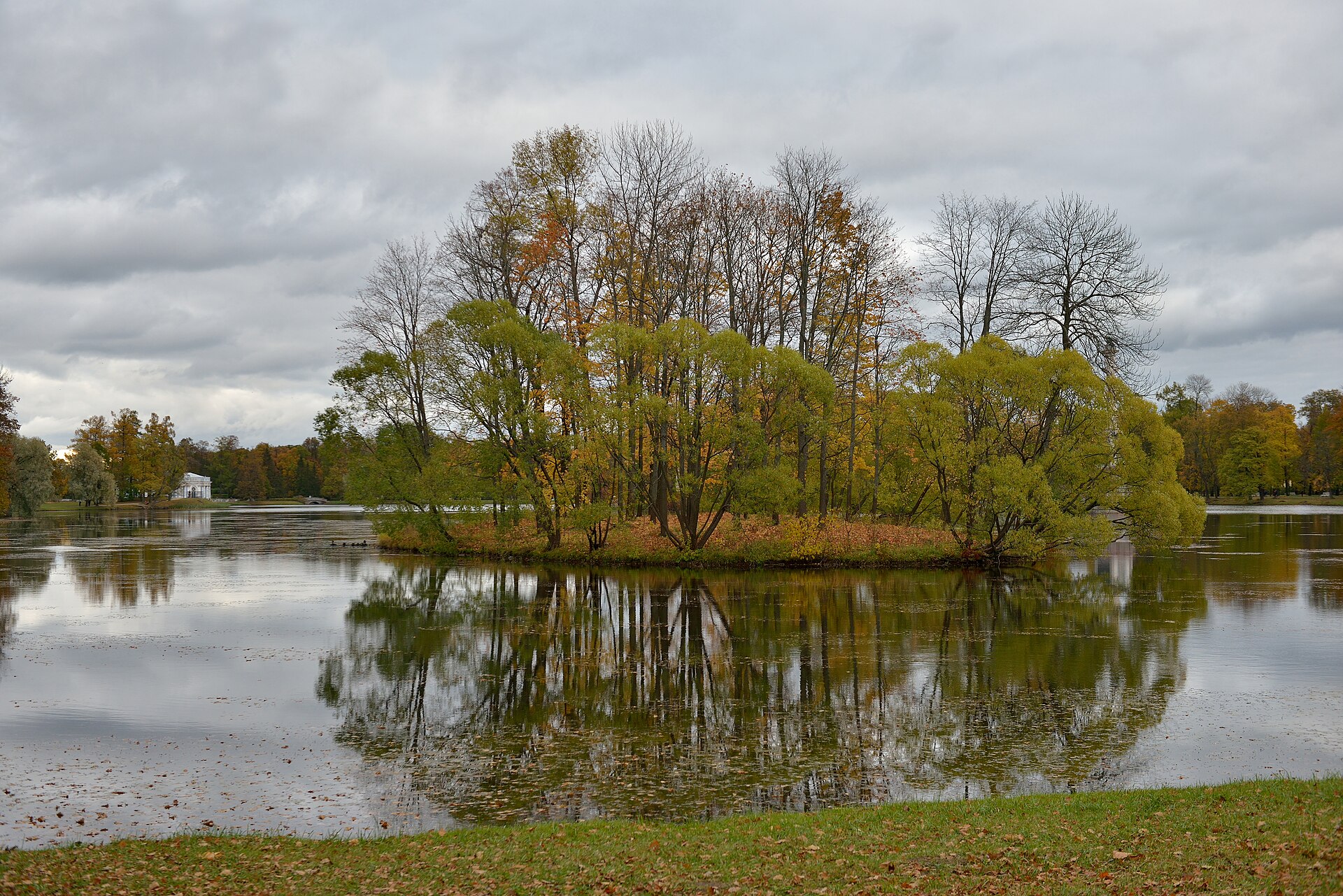
It helps to think of the Catherine Palace not as one building but as the centerpiece of an ensemble. Around it spread formal gardens and a rambling English-style park, dotted with pavilions, bridges, artificial lakes, and follies. The palace was the jewel, but the setting was designed to show that jewel off from every angle, so that a walk through the grounds became a series of carefully composed views, each one framing the glittering facade a little differently.
Try to visit with a little patience, because the palace does not give itself up all at once. The exterior alone can absorb a long, slow walk, and once inside you move through room after room, each one asking for attention. Rushing through would be like skimming a great novel; the pleasure is in the accumulation, in the way one golden hall gives way to another until the sheer abundance of it starts to feel almost dreamlike.
Rastrelli and the Baroque Vision
The architect who gave the palace its unforgettable character was Bartolomeo Francesco Rastrelli, an Italian-born master who became the defining designer of imperial Russia’s baroque age. Working for the Empress Elizabeth, Rastrelli tore down and rebuilt the more modest palace that had stood on the site and replaced it, between 1752 and 1756, with the vast confection of turquoise, white, and gold that survives today. It was the crowning achievement of his career, and it set the standard for royal splendor in Russia.
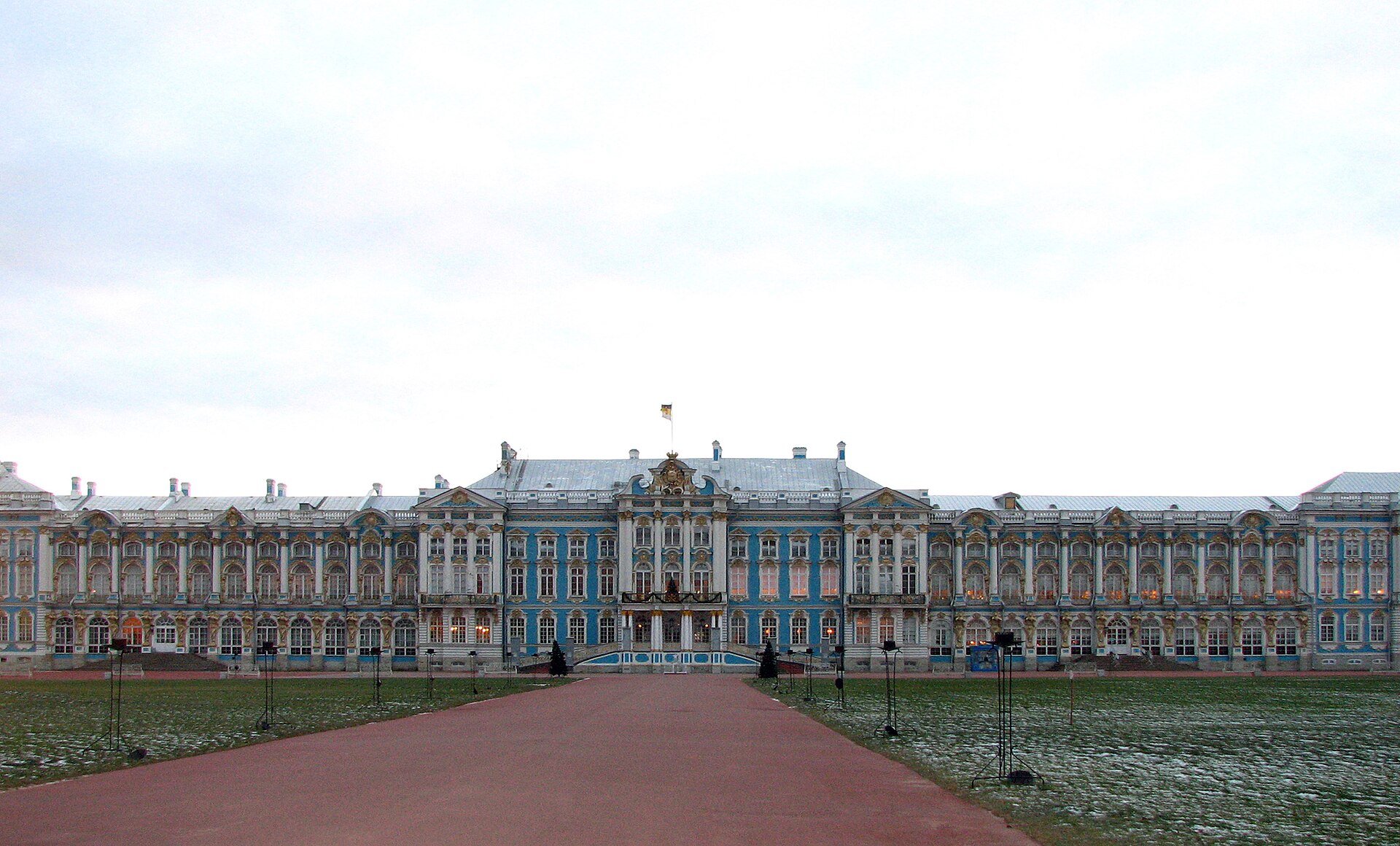
Rastrelli understood spectacle. He gave the facade a rhythm of white columns set against a saturated blue-green ground, and he crowned the whole composition with sculpted figures, mask ornaments, and gilded details that caught the northern light and threw it back at you. Rather than aiming for calm proportion, he aimed for movement and abundance, so that the eye is never allowed to rest but is pulled along the endless front from one flourish to the next.
Inside, Rastrelli extended the same logic. He designed the great enfilade of state rooms, the ceremonial staircase, and above all the dazzling Great Hall, orchestrating a sequence that builds toward moments of overwhelming brightness and gold. His interiors were theatrical in the best sense, choreographing how a visitor would move through the palace and what they would feel at each stage, from anticipation to astonishment.
Rastrelli’s baroque was not to everyone’s taste, and within a generation fashion had moved on. But his work at Tsarskoye Selo remains the emotional heart of the palace. When people picture the Catherine Palace, they picture Rastrelli’s facade and his golden halls, not the quieter rooms that came later. He gave the building its face, and that face has never stopped drawing crowds.
It is worth remembering that Rastrelli worked at a colossal scale across imperial Russia, shaping palaces and cathedrals that together defined an entire architectural age. Yet even among his many commissions, the Catherine Palace stands apart, the fullest and most confident expression of everything his baroque style could achieve when an empress placed no limit on his ambition.
The Empress Elizabeth, Patron of Gold
None of Rastrelli’s splendor would exist without the woman who paid for it. Elizabeth, the daughter of Peter the Great, came to the Russian throne in 1741 and reigned for twenty years. She loved beauty, ceremony, and display, and she poured the resources of the empire into building projects that would announce Russia’s arrival as a great European power. The Catherine Palace was her favorite, named in honor of her mother but shaped entirely by her own extravagant vision.

Elizabeth’s court was famous for its luxury. She is said to have owned thousands of gowns, and she expected her surroundings to match her wardrobe. When she looked at the palace her father’s generation had left, she found it too plain, and she gave Rastrelli a free hand and a deep treasury. The gilding, the mirrors, the endless carved ornament, all of it flowed from her appetite for magnificence and her conviction that a Russian empress should live more splendidly than any monarch in the West.
Her patronage was not only about vanity. In the eighteenth century, architecture was diplomacy. A visiting ambassador who walked through these golden halls carried home a message about Russia’s wealth and confidence. Elizabeth understood that the palace was a kind of argument made in stone and gold, and she was willing to spend enormous sums to make sure the argument was overwhelming.
Elizabeth died in 1761, and she did not live to see later empresses reshape parts of her creation. But the essential character of the Catherine Palace, its warmth, its abundance, its unashamed love of gold, is her legacy. Every visitor who gasps at the Great Hall is responding to a decision Elizabeth made: that beauty on this scale was worth almost any cost.
Turquoise, White, and Gold
Stand back and take in the exterior and you begin to understand how carefully the color scheme was chosen. The blue-green of the walls is cool and calm, a shade that looks especially luminous under the pale skies of the Russian north. Against it, the white columns and window surrounds stand out crisply, giving the vast front a clear structure, while the gilded details supply the warmth and the sparkle. It is a three-part harmony, repeated hundreds of times along the facade.
The gilding deserves special attention. In Elizabeth’s day, much of the exterior ornament was covered in real gold leaf, a display so lavish that it eventually became impractical to maintain. The northern weather is hard on gold, and later reigns replaced some of the gilding with more durable finishes. Restorers today face the same tension between historical accuracy and the sheer cost of returning the palace to its original blaze of gold.
Look closely and you will see that the facade is not flat. Rastrelli modeled it with projecting columns and recesses, so that light and shadow move across it through the day. Sculpted figures known as atlantes appear to support parts of the structure, and carved masks and shells punctuate the design. This is architecture meant to be experienced in motion, revealing new details as you walk its length.
The effect changes with the seasons and the hours. On a bright summer morning the whole front seems to shimmer; under winter snow the turquoise glows against the white landscape; at the long northern dusk the gold catches the last light and burns. Rastrelli could not have controlled the weather, but he designed a building that would look magnificent in every mood the Russian sky could offer.
The Grand Staircase
Entering the state apartments, visitors climb a ceremonial staircase that sets the tone for everything to come. Bathed in light from tall windows, decorated with white and gold and lined with sculpture and ornament, the staircase is a deliberate piece of stagecraft. It lifts you physically upward while preparing you emotionally for the splendor of the halls above.

The staircase you see today is not entirely as Rastrelli left it. Over the years the interiors were altered, damaged, and restored, and the present staircase reflects the work of later designers as well as modern restorers who rebuilt it after the devastation of the twentieth century. Yet it faithfully preserves the original idea: that arrival at the palace should feel like an ascent into a brighter, more golden world.
Details reward a slow climb. Carved balustrades, decorative vases, and paintings set into the walls all contribute to a sense of abundance, while the flood of daylight keeps the whole space feeling airy rather than heavy. The designers understood that gold and white, handled well, can feel luminous instead of oppressive, and the staircase is a lesson in that balance.
By the time you reach the top, you have been prepared. The staircase has slowed your pace, lifted your gaze, and filled your eyes with light and ornament. Whatever comes next, you are ready to be impressed, and the palace is about to deliver on that promise in the most spectacular room of all.
The Great Hall and Its Sea of Light
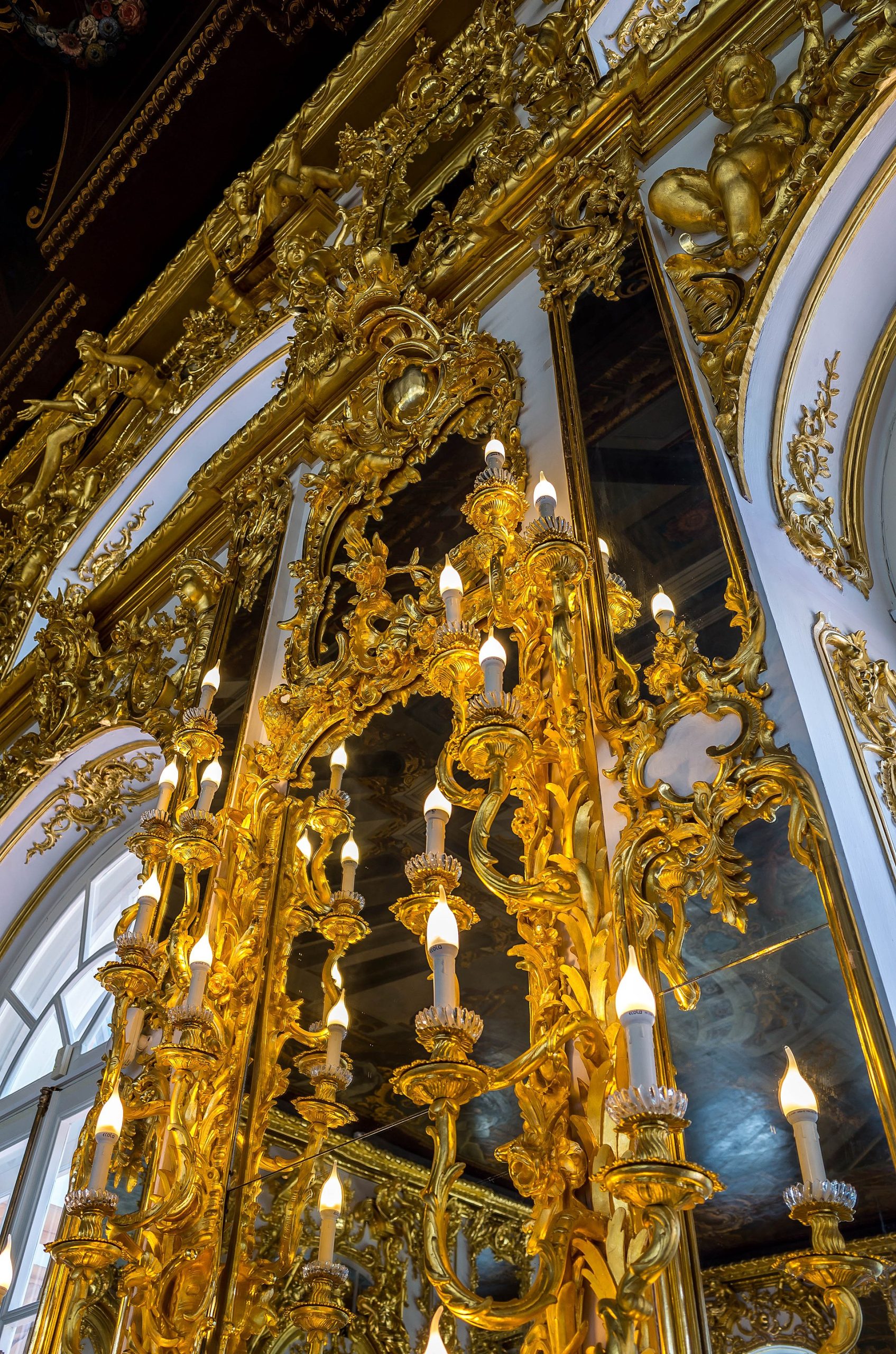
The Great Hall is the climax of Rastrelli’s design and, for many visitors, the single most breathtaking room in the palace. Running nearly the full width of the building, it is a vast ballroom lined with tall windows on both sides, so that daylight pours in from every direction. Between and above the windows, gilded carving covers the walls in an almost overwhelming density of ornament, and the whole room seems to glow. It earned the nickname the Light Gallery, and the name fits.
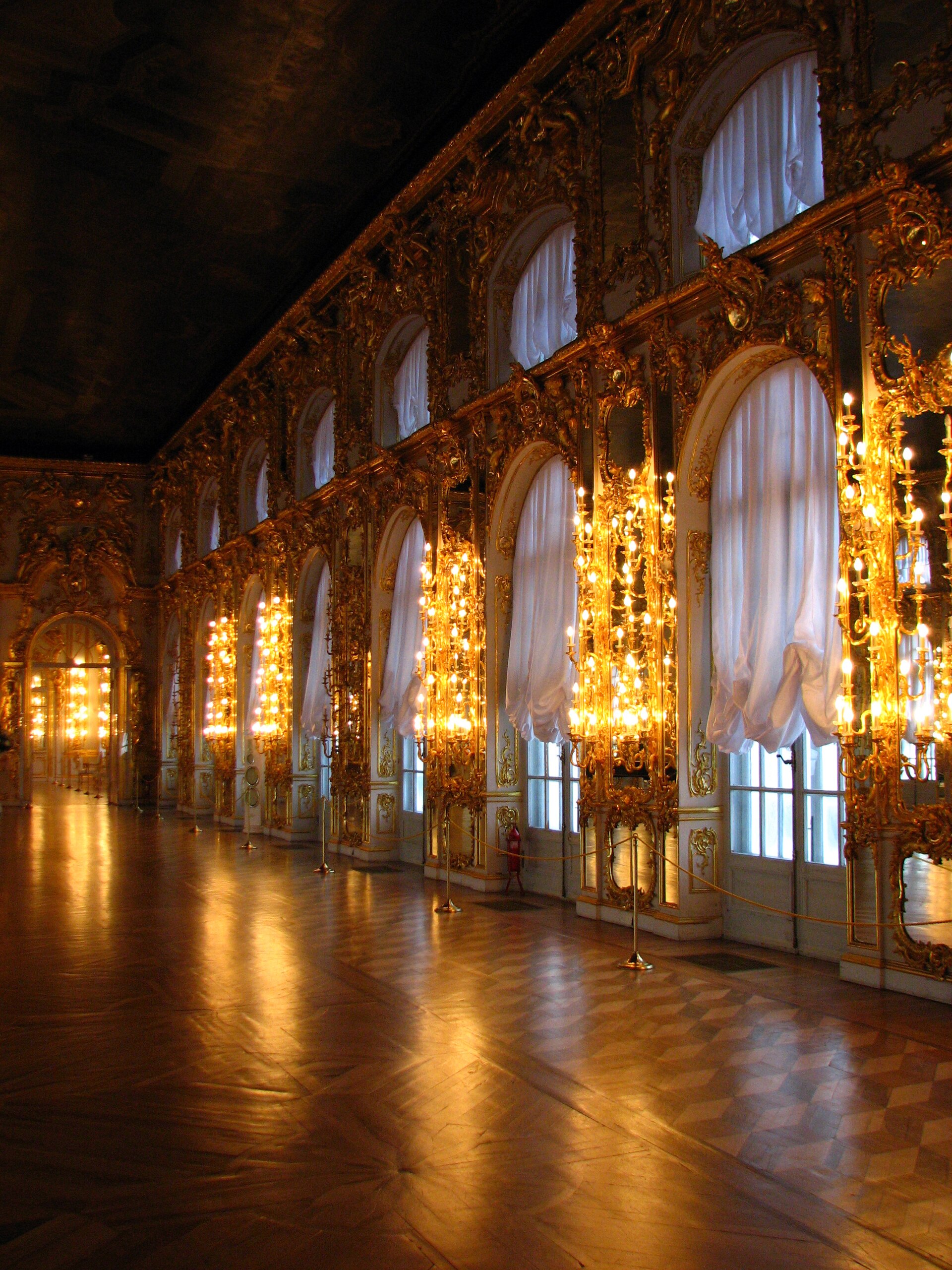
The scale is deliberate. This was a room built for the grandest occasions of the imperial court, for balls and receptions where hundreds of guests in silk and jewels moved beneath a painted ceiling and the blaze of countless candles. At night, with the mirrors and gilding catching the candlelight, the effect must have been staggering, a space that dissolved the boundary between architecture and pure spectacle.
The painted ceiling adds another layer of grandeur, opening the room upward into an illusion of sky and allegory. Baroque designers loved these ceiling paintings because they made a room feel limitless, as though the gilded walls simply gave way to the heavens. Standing in the center of the Great Hall and looking up, you feel the room expand around and above you.
Like so much of the palace, the Great Hall that dazzles visitors today is a triumph of restoration as much as of original craft. The room was gutted during the war, and its recovery required decades of patient work by gilders, carvers, and painters. That it once again overwhelms the eye is a testament both to Rastrelli’s vision and to the artisans who refused to let it be lost.
The Amber Room
No part of the Catherine Palace is more famous than the Amber Room, a chamber whose walls are covered in intricately carved panels of amber, backed with gold leaf and set with mirrors. When sunlight falls across it, the room glows in shades of honey, orange, and brown, a warmth quite unlike the cool gold of the rest of the palace. It has been called, with some justice, the eighth wonder of the world.

The room has an extraordinary history. The original amber panels were created in Prussia in the early eighteenth century and given to Peter the Great as a diplomatic gift. Later they were installed at Tsarskoye Selo and expanded, with craftsmen adding more amber, mirrors, and detail until the room reached its full splendor. Amber is difficult and costly to work, and assembling an entire room from it was a feat that no other palace in the world could match.
Then came catastrophe. During the Second World War, German forces occupying Tsarskoye Selo dismantled the Amber Room and carried its panels away. After the war, the panels vanished, and despite decades of searching they have never been conclusively found. The fate of the original Amber Room remains one of the great unsolved mysteries of the twentieth century, a lost treasure that has inspired countless investigations and legends.
The room you can visit today is a painstaking reconstruction. Beginning in the late twentieth century, Russian craftsmen spent years relearning the difficult art of amber carving and rebuilding the room panel by panel, using historical photographs and surviving fragments as their guide. Completed in the early two thousands, the new Amber Room lets visitors experience the glow that so astonished earlier generations, even as the original remains lost.
The mystery of the lost panels has never quite let go of the public imagination. Over the decades, treasure hunters, historians, and adventurers have chased rumors of the amber’s hiding place across Europe, following leads into mines, bunkers, and sunken ships. Nothing conclusive has ever turned up, and the very absence of an answer has only deepened the legend, turning a room into one of the enduring riddles of the modern age.
Catherine the Great and the Turn to Classicism
When Catherine the Great came to power in 1762, tastes across Europe were shifting away from baroque abundance toward the cooler discipline of classicism, inspired by the newly excavated ruins of antiquity. Catherine embraced the change. While she preserved Rastrelli’s golden halls, she also commissioned a suite of new interiors in a restrained classical style, and for this work she turned to the Scottish architect Charles Cameron.
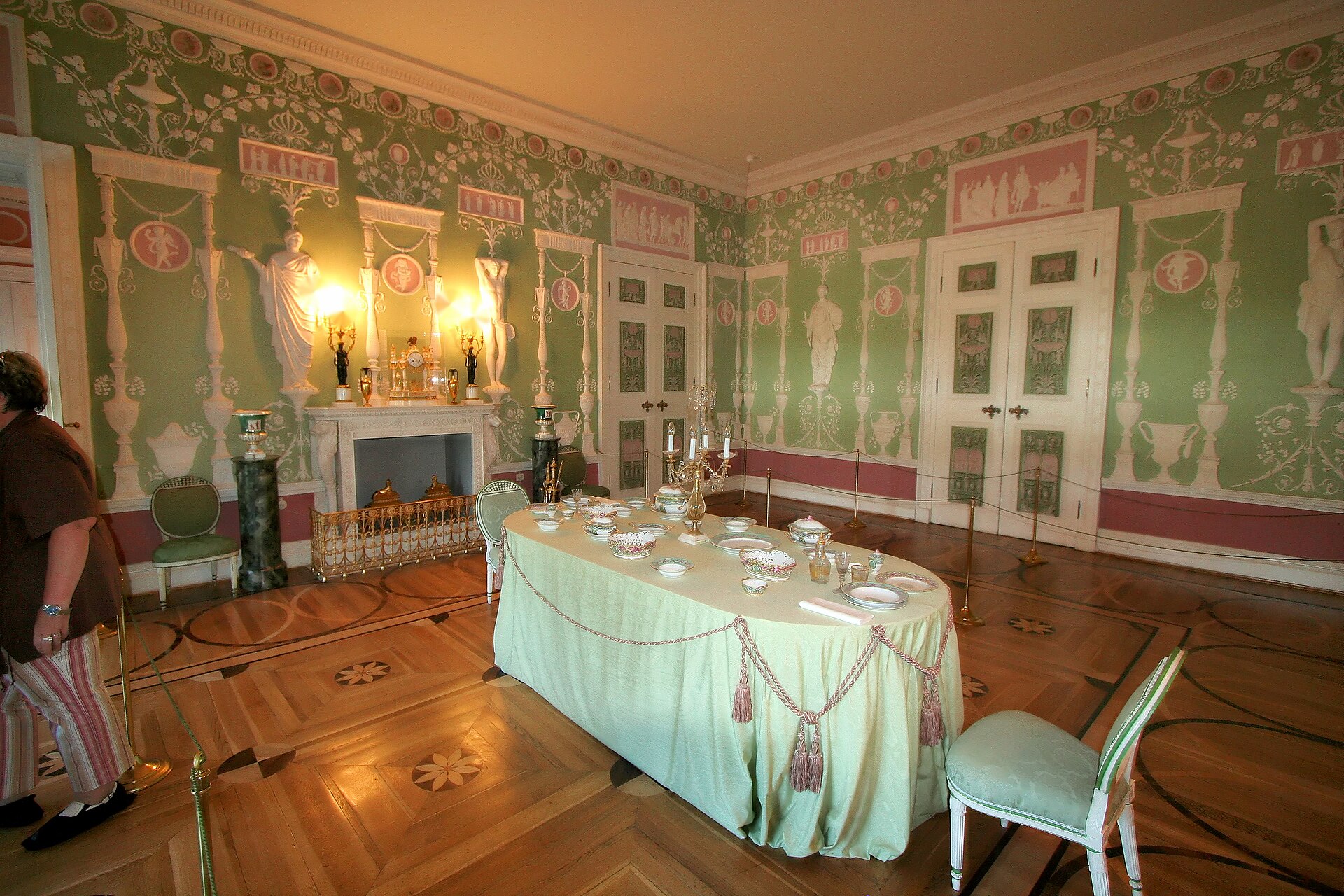
Cameron’s rooms are a deliberate contrast to Elizabeth’s gold. Where Rastrelli overwhelmed, Cameron refined. He used delicate colors, elegant proportions, and motifs drawn from Roman antiquity to create spaces of calm sophistication, such as the cool green tones of the dining rooms and private apartments he designed for the empress. Walking from the Great Hall into these chambers feels like stepping from a fanfare into a quiet, cultivated conversation.
This contrast tells you a great deal about the two empresses. Elizabeth wanted to overwhelm visitors with the raw magnificence of the crown. Catherine, a woman of the Enlightenment who corresponded with philosophers and collected art on a vast scale, wanted to show taste and refinement as well as wealth. The palace holds both ambitions side by side, and the tension between them is part of what makes it so fascinating.
Cameron also worked beyond the palace walls, designing garden structures that extended Catherine’s classical vision into the landscape. His work marks the moment when the Catherine Palace stopped being purely a baroque creation and became a layered record of changing taste, a building where two great eras of European design meet within a single set of walls.
The meeting of these two styles under one roof is, in the end, one of the palace’s greatest gifts to a visitor. You can trace in a single walk the shift from one century’s idea of magnificence to the next, from gold that dazzles to proportion that soothes, and in doing so you feel the taste of an entire continent turning on its hinge.
The Catherine Park
A palace of this ambition needed a setting to match, and the Catherine Park provides it. Spreading out behind and around the building, the park combines a formal garden of clipped hedges and geometric paths with a looser, more naturalistic English-style landscape of lakes, meadows, and winding trails. Together they offer an ever-changing series of views, each one composed to show the palace or a pavilion to best effect.
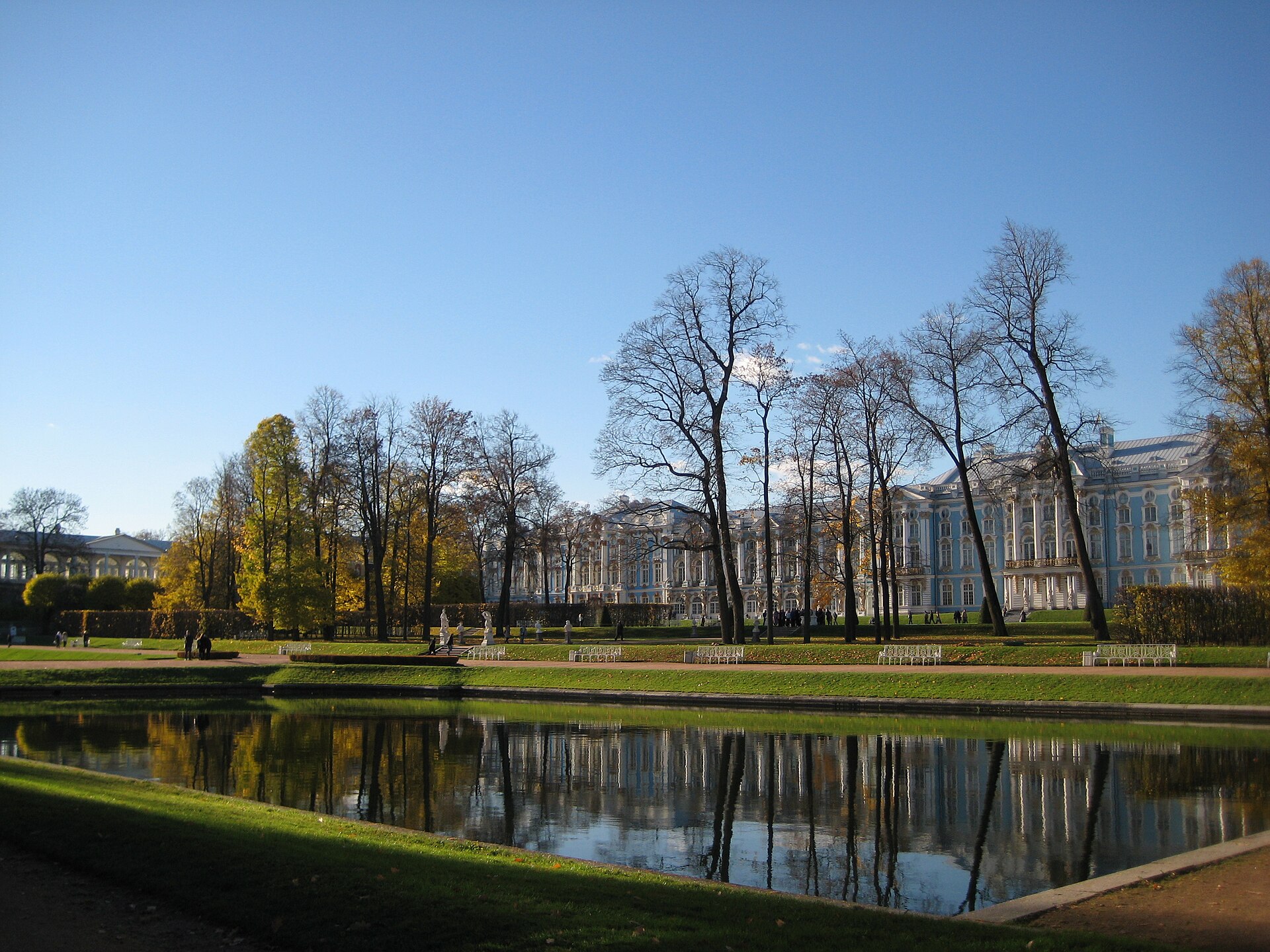
The formal garden, closest to the palace, reflects the taste of the earlier eighteenth century, with its ordered symmetry and disciplined plantings. Beyond it, the landscape park reflects the fashion that swept Europe later in the century, when designers rejected rigid geometry in favor of scenery that imitated wild nature, complete with artificial lakes, rolling lawns, and carefully placed clumps of trees.
Scattered through the park are pavilions, bridges, monuments, and follies, many of them small architectural jewels in their own right. There are classical galleries, exotic structures inspired by distant lands, and monuments raised to commemorate military victories. A walk through the grounds becomes a kind of leisurely tour through the tastes and triumphs of the age, with the glittering palace always somewhere in view.
For the imperial family, the park was as important as the palace itself. It was a place for exercise and reflection, for private conversation away from the formality of the state rooms, and for the simple pleasure of a beautiful landscape. Today it offers visitors the same gift, a chance to slow down, breathe, and see the great turquoise facade rise beyond the water and the trees.
A Town Around a Palace
Over time, the presence of the imperial family drew a whole town into being around the palace. Tsarskoye Selo grew into an elegant settlement of villas, gardens, and institutions, all shaped by the proximity of the court. It became one of the most fashionable addresses in imperial Russia, a place where being near the tsars conferred prestige and where the rhythms of life followed the movements of the crown.
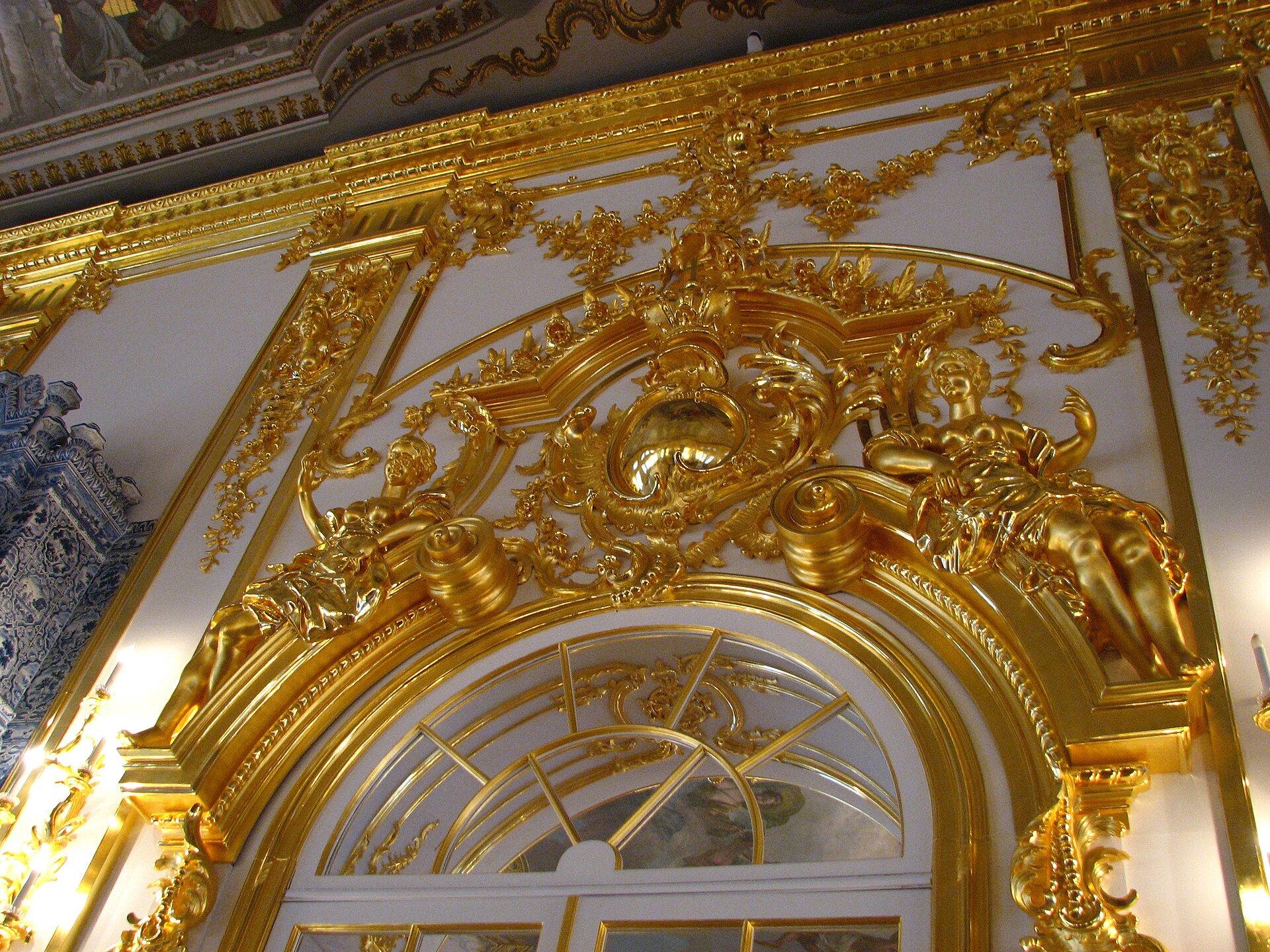
The town is perhaps most famous for its Lyceum, an elite school founded in the early nineteenth century to educate the sons of the nobility. Its most celebrated pupil was the poet Alexander Pushkin, whose years there left such a mark that the town was eventually renamed Pushkin in his honor. For lovers of Russian literature, Tsarskoye Selo is hallowed ground, the place where the country’s greatest poet came of age within sight of the imperial palace.
This literary and cultural aura adds a dimension to the palace that pure architecture cannot. The glittering halls were not only stages for court ceremony; they were part of a landscape that shaped Russian art, poetry, and memory. Generations of writers and artists associated Tsarskoye Selo with beauty, youth, and a certain melancholy grandeur, and their words have woven the place into the national imagination.
When you visit today, it is worth remembering that you are stepping into a town with layers of meaning far beyond the palace gates. The imperial residence is the centerpiece, but around it lies a landscape saturated with history, from the schoolrooms that trained an elite to the quiet streets that a young poet once walked, all of it gathered in the shadow of that endless golden facade.
War and Devastation
The twentieth century nearly destroyed everything. After the Russian Revolution the imperial family was gone, and the palace was turned into a museum, its treasures opened to a public that had never been allowed inside. For two decades it survived as a monument to a vanished world. Then came the Second World War, and with it catastrophe on a scale the palace had never known.

During the war, German forces occupied Tsarskoye Selo, and the Catherine Palace suffered terribly. The Amber Room was stripped and carried off. Interiors were looted and burned. By the time the occupation ended, much of Rastrelli’s masterpiece was a gutted shell, its golden halls blackened, its roof gone, its walls open to the sky. Photographs from the period show a ruin so complete that many doubted it could ever be brought back.
The loss was not only material. The palace had stood for centuries as a symbol of Russian grandeur, and its near-destruction was felt as a wound to the nation’s memory. Alongside the physical damage came the theft of irreplaceable works of art, some of which have never been recovered, scattered by the chaos of war across a shattered continent.
Yet even in the ruins there was resolve. Museum staff had managed to evacuate some treasures and to document the interiors before the occupation, preserving the knowledge that would later make restoration possible. The determination to rebuild took root even before the war ended, as those who loved the palace refused to accept that its golden halls were gone for good.
For the people who had cared for the palace, the sight of the ruins was almost unbearable. Curators who had spent their lives among these interiors returned to find blackened walls and open sky where the golden halls had been. Yet that grief became fuel. The promise to rebuild, made amid the rubble, would carry the restorers through decades of exacting work in the years to come.
Bringing the Palace Back
The restoration of the Catherine Palace became one of the great preservation projects of the twentieth century. Beginning after the war and continuing for decades, teams of artisans set out to rebuild what had been lost, working from old photographs, surviving fragments, and detailed prewar records. They had to revive crafts that had nearly died out, retraining gilders, carvers, and painters in techniques the original builders had used.
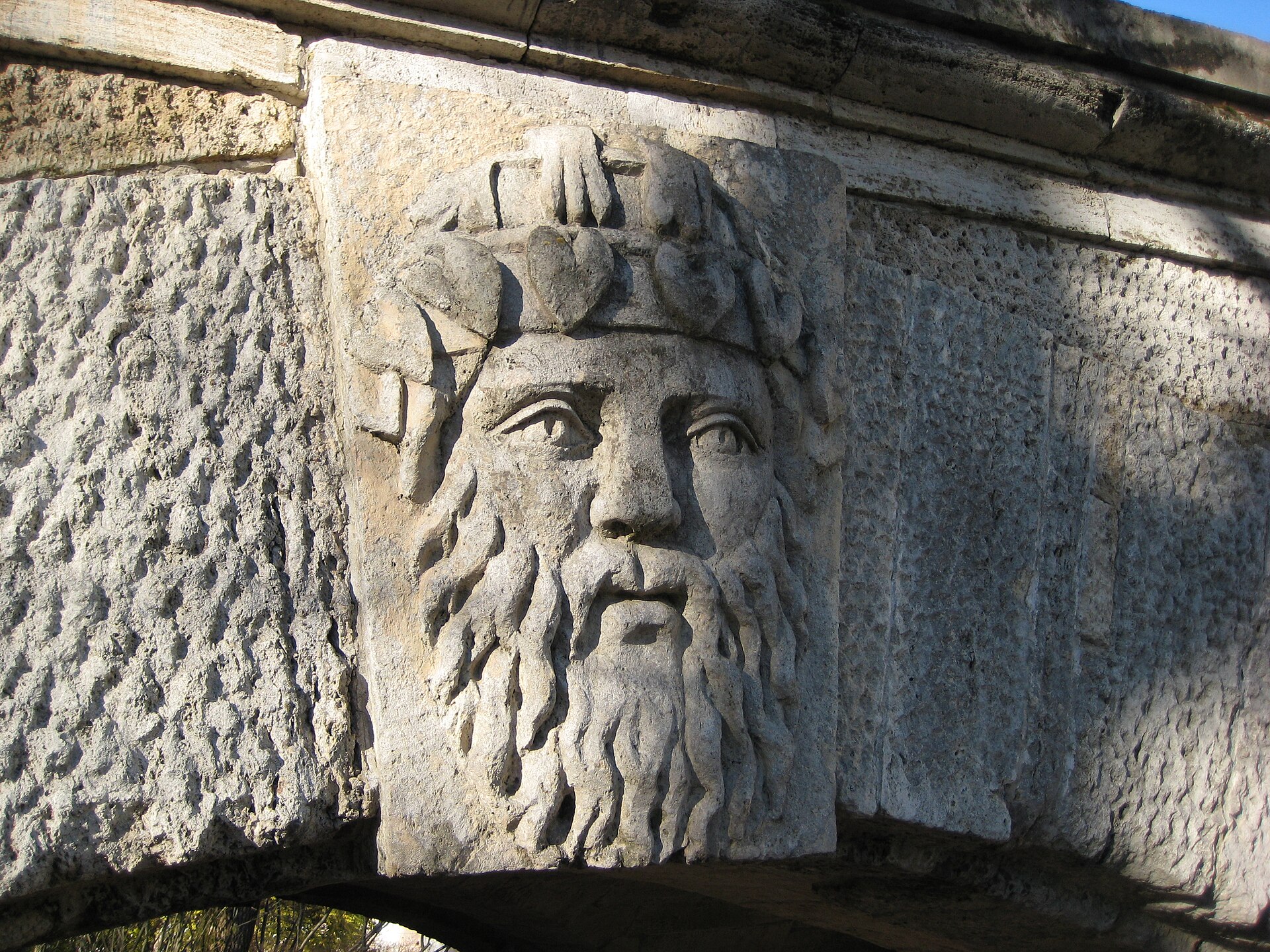
Progress was slow and painstaking. Rebuilding a single hall could take years, as craftsmen carved and gilded ornament by hand to match the originals as closely as possible. Room by room, the palace came back, its golden interiors reappearing where blackened ruins had stood. Visitors who returned over the years could watch the resurrection unfold, one restored chamber at a time.
The most symbolic achievement was the reconstruction of the Amber Room. Relearning the difficult art of working amber, craftsmen spent years rebuilding the lost chamber panel by panel, and its completion in the early two thousands felt like the closing of a wound that had stayed open since the war. The new room could never replace the original, but it restored to the palace the glow that had made it legendary.
The restoration is not entirely finished even now, and work continues on parts of the palace and park. But what has been accomplished is remarkable. To walk through the Great Hall or the Amber Room today is to see not only the vision of Rastrelli and the ambition of the empresses, but also the devotion of the modern artisans who refused to let that vision die.
Visiting the Catherine Palace Today
Today the Catherine Palace is one of the most popular destinations near Saint Petersburg, drawing visitors from around the world who come to see its golden halls, its restored Amber Room, and its beautiful park. It is easy to reach from the city, and it makes a natural companion to a visit to the great palaces of Saint Petersburg itself, part of a landscape of imperial residences that ring the former capital.
View the exact location on Google Maps
Inside, visitors follow a route through the restored state apartments, moving from the ceremonial staircase through the blazing Great Hall to the Amber Room and the quieter classical chambers beyond. Because the palace is so popular, the Amber Room in particular can be crowded, and planning your visit for early in the day or booking ahead can make the experience far more comfortable.
The park is a highlight in its own right and should not be rushed. Allow time to walk the formal gardens and the landscape park, to find the pavilions and monuments hidden among the trees, and to see the great turquoise facade from across the water. In summer the grounds are lush and green; in winter, under snow, they take on a stark and haunting beauty that many visitors find just as memorable.
However you plan your day, the Catherine Palace rewards the effort. It is a place where three centuries of Russian history are written into the walls, from Elizabeth’s golden ambition to the scars of war and the patient triumph of restoration. Few buildings tell so grand a story so vividly, and fewer still can send you back out into the daylight feeling as though you have just stepped out of a golden dream.
Give yourself a full half day if you can, and consider combining the visit with the other imperial residences in the area to see how the tsars shaped an entire landscape of palaces and parks. However you arrange it, leave time simply to stand before the facade and take it in, because no photograph quite prepares you for the moment when that endless turquoise-and-gold front first fills your view.
Palaces Nearby
The Catherine Palace is only one of the great imperial residences ringing Saint Petersburg. If its golden halls have left you wanting more, these nearby palaces make natural next stops on the same journey.
You May Like




One thought on “The Catherine Palace: Amber, Gold, and the Summer Splendor of Tsarskoye Selo”