On the banks of the river Neva in St Petersburg, its long green-and-white facade stretching in imperial splendour along the water and the great square before it, stands the palace that was for nearly two centuries the seat of the most powerful rulers in Russia. The Winter Palace was the principal residence of the emperors and empresses of Russia, the stage for the pomp of the Romanov court, and the setting for some of the most dramatic events in Russian history. Today it forms the heart of one of the greatest museums on earth.
The palace is a masterpiece of the exuberant Baroque, its enormous facades adorned with columns, statues, and ornament, painted in the distinctive colours that make it one of the most recognisable buildings in Russia. Built for an empress and enlarged by her successors, it contains within its walls a sequence of state rooms of overwhelming magnificence, from a golden staircase to vast throne rooms and halls glittering with gold, malachite, and the accumulated treasures of the Russian crown.
Alongside the palace, and joined to it, grew the Hermitage, the great collection of art begun by Catherine the Great, which expanded over the centuries into one of the largest and most important museums in the world. The Winter Palace and the Hermitage together form a single vast complex, at once an imperial residence and a treasure house of world art, embodying both the power of the Russian monarchy and its role as a patron of culture.
The history of the Winter Palace is inseparable from the history of Russia itself, from the age of the great emperors and empresses through the wars against Napoleon to the revolution that swept the monarchy away. This is the story of the great palace on the Neva, of the rulers who built and adorned it, of the treasures it holds, and of the momentous events that unfolded within its walls, from imperial splendour to revolution and, at last, to its rebirth as a museum for all the world.
In This Article
- The Imperial Palace on the Neva
- Peter the Great and the New Capital
- Empress Elizabeth and Rastrelli’s Baroque Palace
- A Palace of Fifteen Hundred Rooms
- The Jordan Staircase
- The Great State Halls
- The Malachite Room and the Private Apartments
- The Gallery of 1812
- Catherine the Great and the Birth of the Hermitage
- The Pavilion Hall and the Peacock Clock
- The Great Fire and the Rebuilding
- 1917: Revolution at the Winter Palace
- The State Hermitage Museum Today
The Imperial Palace on the Neva
The Winter Palace was, for almost two centuries, the official residence of the emperors and empresses of Russia, the centre of the Russian court and the symbol of the power of the Romanov dynasty. Standing in the heart of St Petersburg, the imperial capital founded by Peter the Great, it embodied the grandeur and the ambitions of a monarchy that ruled the largest empire on earth.
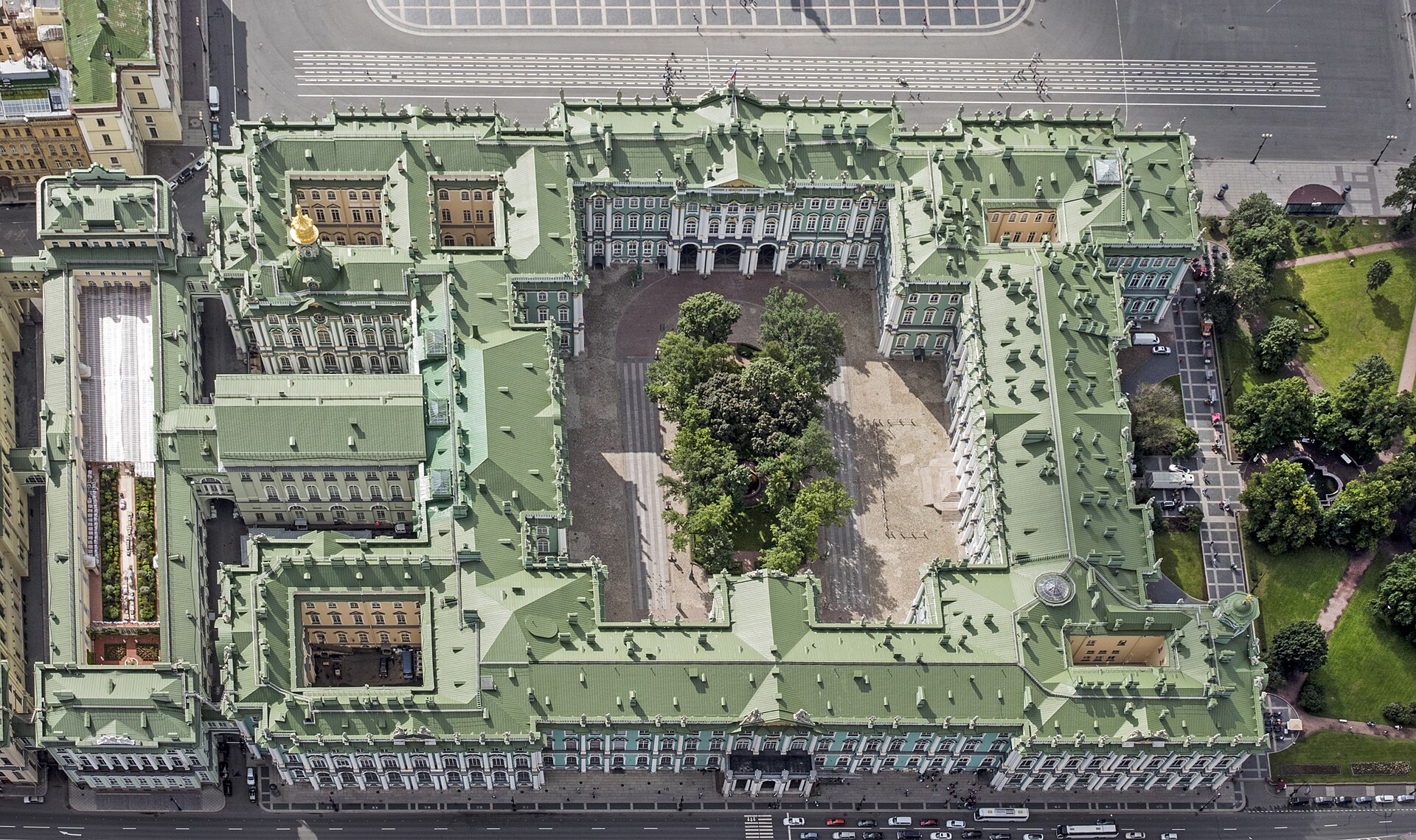
The palace is enormous, containing around fifteen hundred rooms and stretching in a great quadrangle along the bank of the Neva, its facades facing the river on one side and the vast Palace Square on the other. Its sheer scale reflects the power it was built to express, and it ranks among the largest royal residences ever constructed, a fitting seat for the rulers of a vast empire.
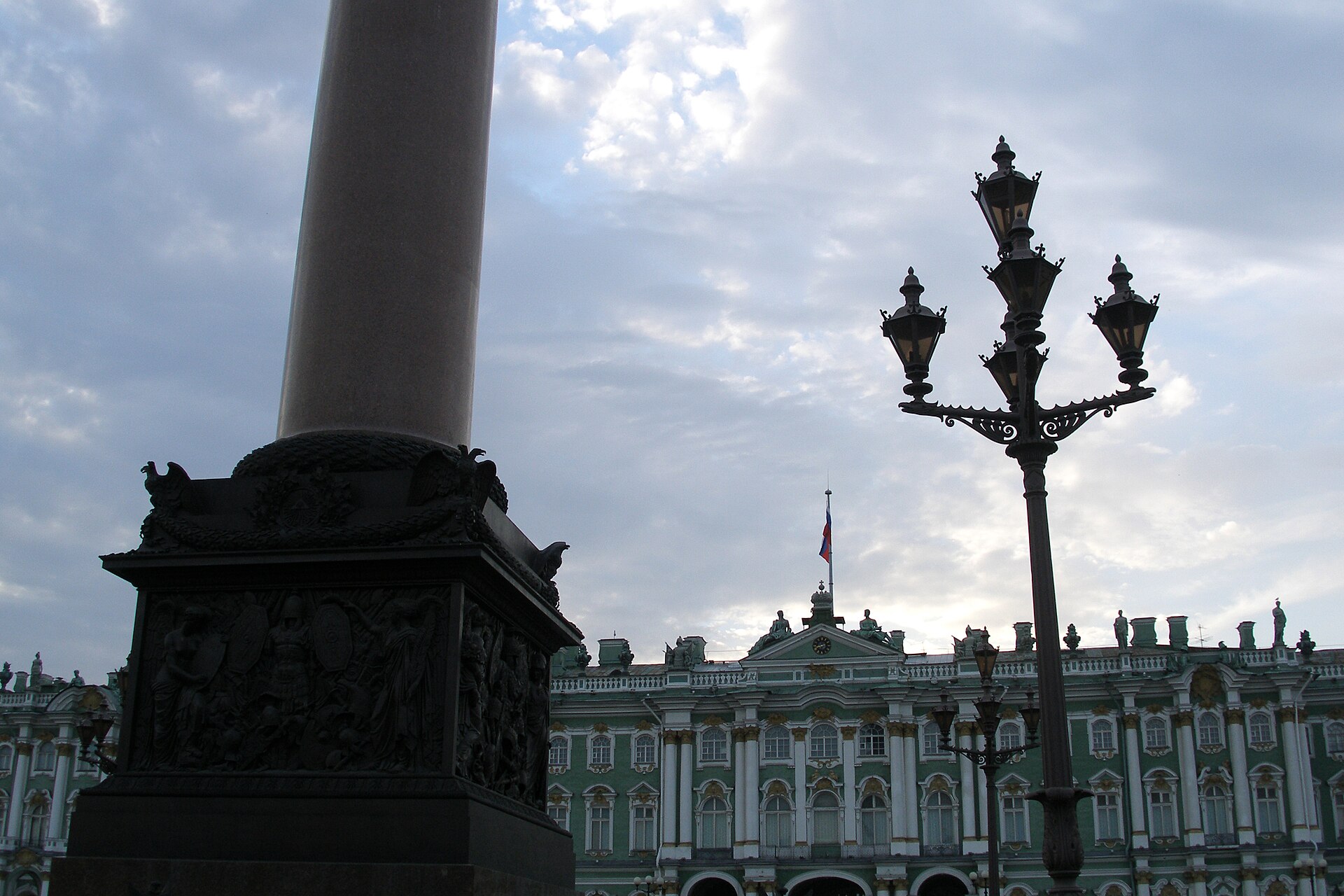
Painted in its distinctive colours and adorned with a wealth of columns, statues, and Baroque ornament, the Winter Palace is one of the most recognisable and beloved buildings in Russia. Its long, richly decorated facades, rising above the Neva and the great square, form one of the defining images of St Petersburg, the elegant imperial city that Peter the Great created as his window on Europe.
Beyond its role as a residence, the palace became the heart of a great museum, for the imperial art collections gathered here grew into the State Hermitage, one of the largest and most celebrated museums in the world. The Winter Palace is thus both a monument to the vanished Russian monarchy and a living treasure house of art, uniting in a single great building the history of an empire and the heritage of world culture.
The palace stands as the supreme symbol of imperial St Petersburg, the city that the Romanovs built to embody their vision of a modern, European Russia. Its position at the head of the great Palace Square and along the Neva places it at the very centre of the imperial capital, and its history has been intertwined with that of the city and the nation at every stage, from the age of the great emperors to the revolution and beyond.
Peter the Great and the New Capital
The story of the Winter Palace begins with Peter the Great, the visionary and ruthless tsar who transformed Russia and founded the city of St Petersburg in the early eighteenth century. Determined to modernise his country and to give it a capital that would face toward Europe, Peter built his new city on the marshy banks of the Neva, and it was here that the imperial residences, including the Winter Palace, would rise.

Peter built for himself modest winter residences in the new city, the earliest of the palaces to bear the name, far smaller and plainer than the great building that would later stand on the site. These early palaces reflected the practical and unpretentious character of the tsar himself, who cared more for shipbuilding and reform than for courtly magnificence, but they established the tradition of an imperial winter residence in the heart of the new capital.
The founding of St Petersburg was one of the great acts of will in Russian history, the creation of an entirely new capital on conquered marshland, built at enormous human cost to serve as the symbol of a new, European-facing Russia. The city, with its canals, its classical architecture, and its grand river frontages, became one of the most beautiful in Europe, and the Winter Palace would become its crowning glory.
From Peter’s practical beginnings, the Winter Palace would grow, under his successors, into a residence of overwhelming magnificence, as the Russian monarchy embraced the courtly splendour of the great European courts. The modest winter houses of the reforming tsar gave way to the grand Baroque palace we know today, a transformation that mirrored the rise of Russia itself to the front rank of the powers of Europe.
Empress Elizabeth and Rastrelli’s Baroque Palace
The Winter Palace as it stands today was the creation of Empress Elizabeth, the daughter of Peter the Great, who reigned in the middle of the eighteenth century and who determined to build a residence of unparalleled magnificence. Dissatisfied with the earlier palaces on the site, she commissioned an entirely new building on the grandest scale, employing the greatest architect then working in Russia.

The architect was Bartolomeo Rastrelli, an Italian who had risen to become the supreme master of the Russian Baroque, and who created for Elizabeth a series of magnificent palaces, of which the Winter Palace was the greatest. Working in the exuberant style that has come to be known as the Elizabethan Baroque, he gave the palace its grand facades, its wealth of ornament, and its air of imperial splendour.
Rastrelli’s palace is a masterpiece of the Baroque, its long facades animated by ranks of columns, its skyline crowned with statues and urns, and its whole surface enlivened with a profusion of decorative detail. Painted in colour and picked out with white and gold, it achieves an effect of festive magnificence, a building that seems to celebrate the power and the glory of the Russian monarchy in every line.
The great palace was completed in the early 1760s, though Elizabeth herself did not live to see it finished, and it became the principal residence of the Russian emperors and empresses who followed her. Rastrelli’s Winter Palace stands as one of the supreme achievements of the Baroque in Russia, the crowning work of a great architect and the enduring symbol of the imperial court he served.
Rastrelli’s work in Russia extended far beyond the Winter Palace, for he also created the great summer palaces of the imperial family and other masterpieces that together defined the golden age of the Russian Baroque. Yet the Winter Palace was his supreme achievement, the largest and most magnificent of his creations, and it remains the enduring monument to his genius and to the empress who commissioned it.
A Palace of Fifteen Hundred Rooms
The scale of the Winter Palace is difficult to grasp, for it contains around fifteen hundred rooms, together with vast halls, galleries, staircases, and service areas, all arranged within its great quadrangular structure. It was designed to house not only the imperial family but the entire apparatus of the court, and its size reflects the enormous establishment that surrounded the rulers of Russia.
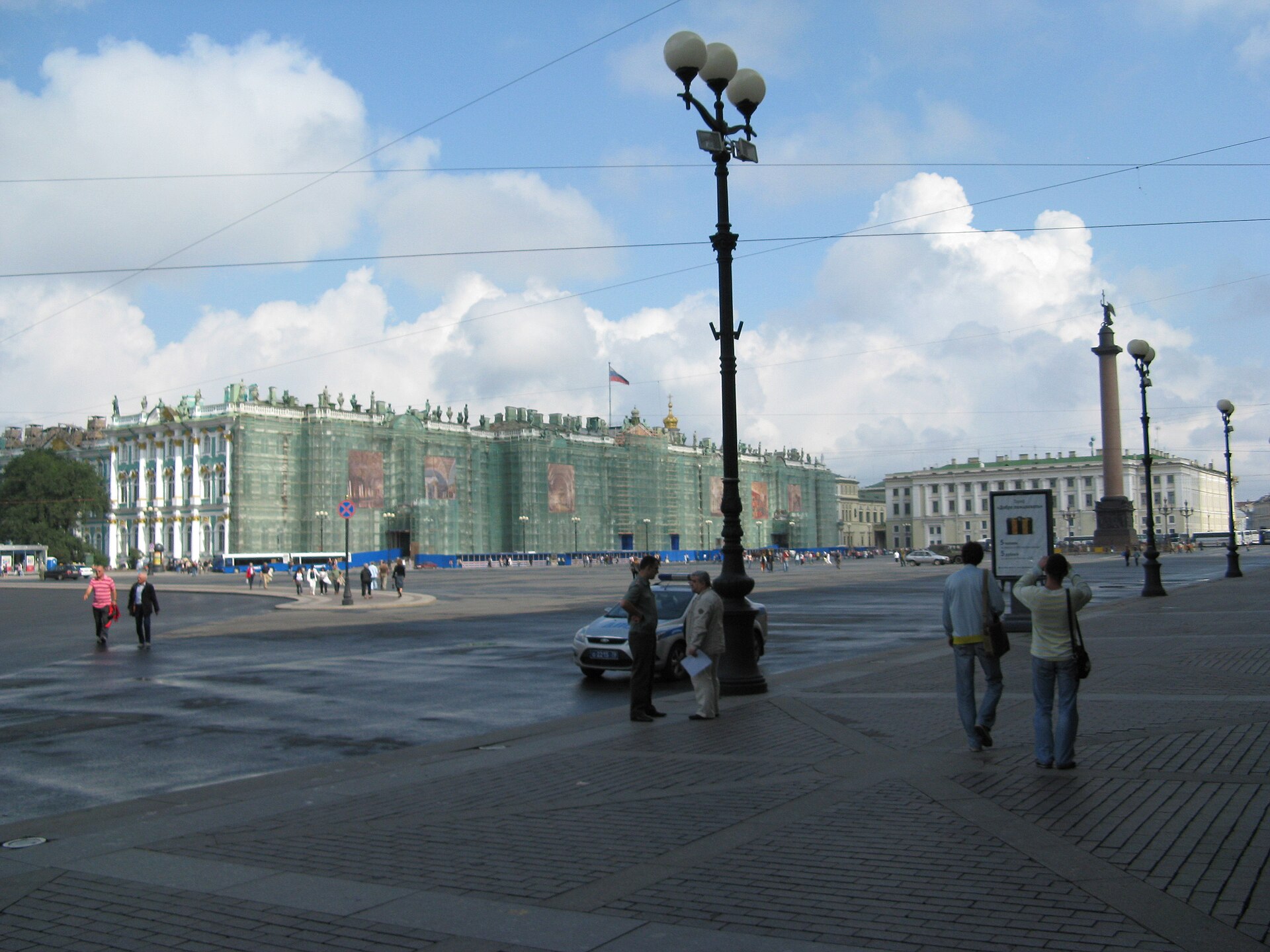
The palace presents different faces to its surroundings, its northern front looking out across the broad Neva, its southern front facing the immense Palace Square, and its other sides enclosing courtyards within. Each facade is a masterpiece of Baroque design, and together they create a building of overwhelming grandeur, a great mass of ornamented stone at the very heart of the imperial capital.
Before the palace extends the vast Palace Square, one of the great urban spaces of Europe, at whose centre rises the Alexander Column, a colossal monument raised to commemorate the Russian victory over Napoleon. The square, framed by the palace on one side and the great curved facade of the General Staff Building on the other, forms a magnificent setting for the residence of the emperors.
The Palace Square was the setting for the great ceremonies and parades of the imperial court, and it would later become the scene of momentous historical events. Together the palace and the square form one of the noblest architectural ensembles in the world, a fitting expression of the power and the grandeur of the Russian empire at the height of its glory.
The Jordan Staircase
The magnificence of the interiors is announced by the great ceremonial staircase, the Jordan Staircase, one of the masterpieces of Rastrelli and one of the most spectacular staircases in the world. Rising in a great sweep of white marble beneath a soaring painted ceiling, it carries the visitor upward toward the state apartments in a dazzling display of Baroque splendour.
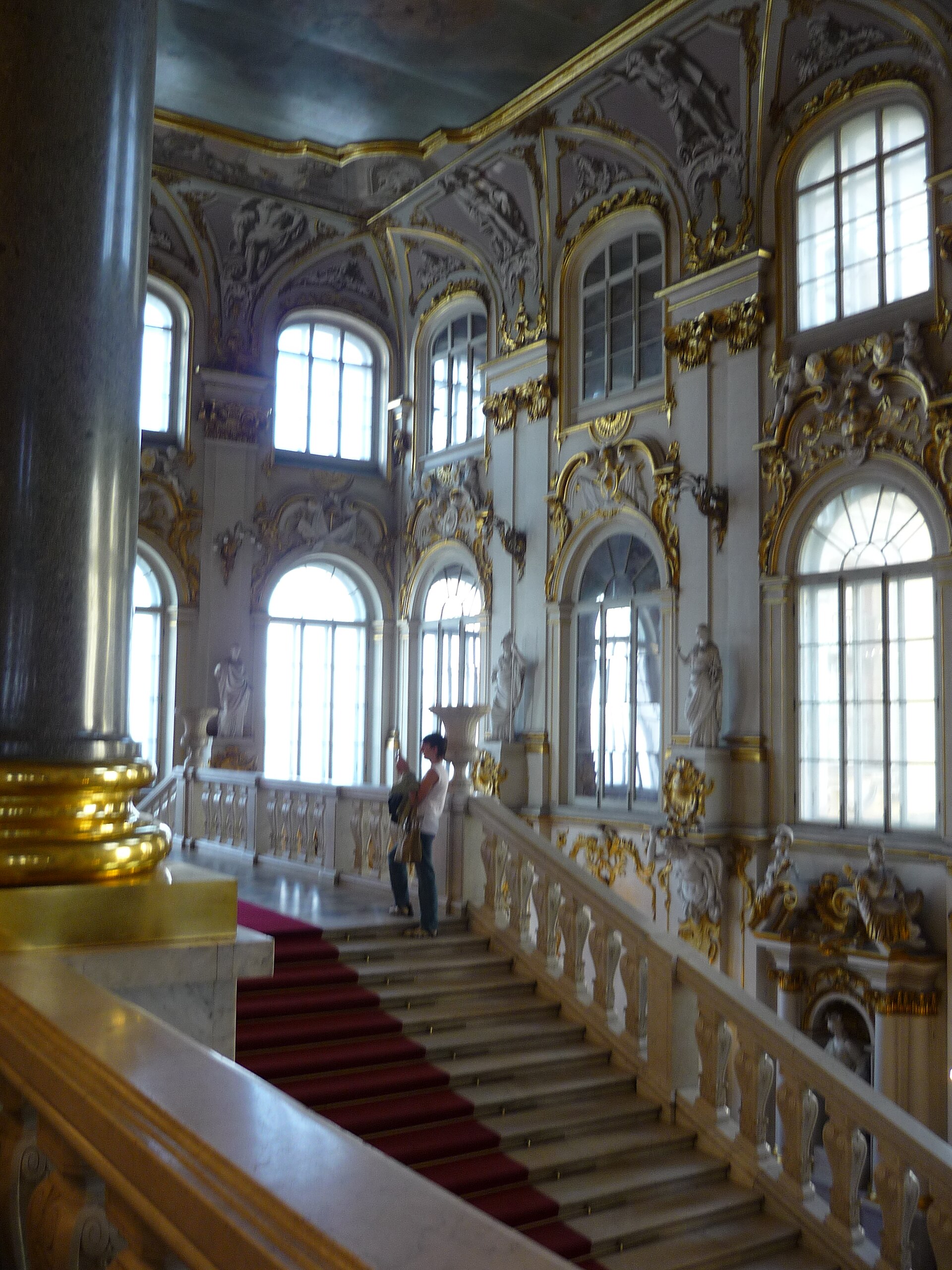
The staircase is a riot of ornament, its walls and vaults adorned with gilding, sculpture, and mirrors, its balustrades of marble, and its ceiling opening in a great painted illusion of the heavens. Light floods the space from great windows, catching the gold and the white marble, and the effect on the visitor ascending toward the halls above is one of overwhelming magnificence.
The staircase takes its name from the ceremony of the Blessing of the Waters, held each year at the nearby river, during which the imperial family would descend it in solemn procession. It thus served not only as a grand architectural showpiece but as a stage for the rituals of the court, the route by which the emperors made their ceremonial appearances.
Rebuilt after a great fire in the nineteenth century, the Jordan Staircase was restored to Rastrelli’s original design, and it remains today one of the glories of the palace, the magnificent introduction to the state apartments. To ascend it is to enter fully into the world of the imperial court, a space of pure Baroque theatre that prepares the visitor for the splendours beyond.
The staircase also served a symbolic purpose, marking the ascent from the everyday world into the sacred sphere of the monarchy, and its overwhelming richness was calculated to impress upon every visitor the gulf that separated the emperor from ordinary mortals. Its combination of marble, gold, mirrors, and painted sky created an effect of ascending toward the heavens themselves, a fitting prelude to the majesty of the halls above.
The Great State Halls
Beyond the staircase lies a sequence of vast state halls, the ceremonial rooms in which the emperors held court and received their subjects and foreign envoys amid surroundings of overwhelming magnificence. The grandest of these is the Great Throne Room, also known as St George’s Hall, an immense chamber of white marble and gold where the imperial throne stood beneath a canopy.
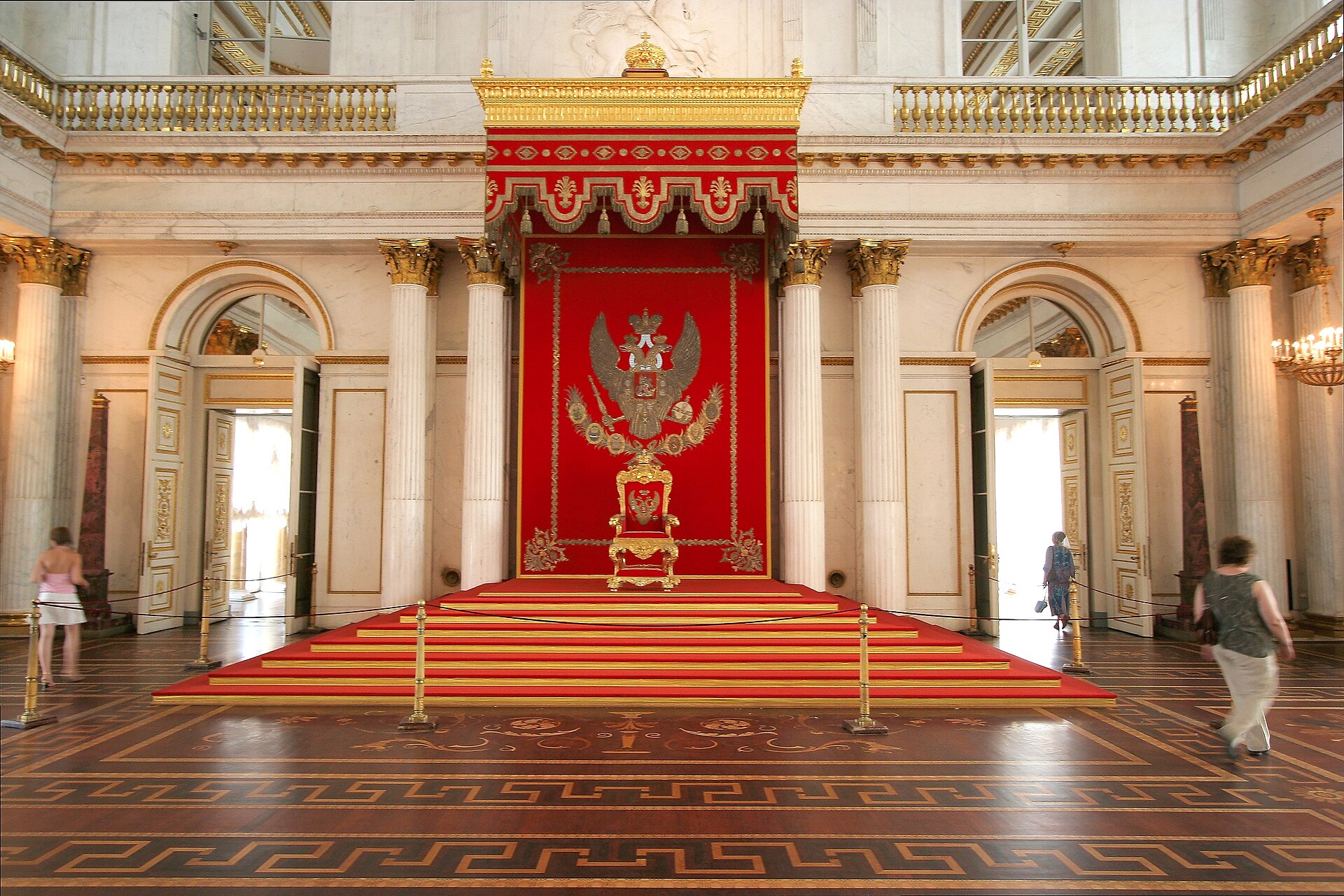
St George’s Hall was the setting for the most solemn ceremonies of the Russian court, its great expanse of marble columns and gilded ornament creating an atmosphere of imperial majesty. Here the emperors presided over the great occasions of state, and the hall embodied, in its scale and its splendour, the absolute power of the Russian autocracy at the height of its glory.
The palace contains other magnificent halls, each with its own character and purpose, from the Armorial Hall with its great gilded columns to the halls used for balls, receptions, and banquets. These vast spaces, glittering with gold and light, were the setting for the brilliant social life of the imperial court, the balls and ceremonies that were famous throughout Europe for their magnificence.
Together these great halls form a sequence of imperial splendour scarcely equalled anywhere, a succession of vast and glittering rooms designed to overwhelm the visitor with the power and the wealth of the Russian monarchy. They remain today among the most magnificent interiors in the world, a breathtaking record of the grandeur of the vanished imperial court.
The decoration of these halls, with their marble, their gilding, and their vast painted ceilings, represented an enormous investment of wealth and artistry, drawing on the finest craftsmen and the richest materials the empire could provide. Each hall was conceived as part of a grand ceremonial sequence, through which visitors would pass toward the throne, their sense of the emperor’s majesty growing with every magnificent room.
The Malachite Room and the Private Apartments
Among the most celebrated of the palace’s interiors is the Malachite Room, a chamber of extraordinary richness whose columns, pilasters, and ornaments are made of malachite, the brilliant green stone mined in the Ural Mountains. Used as a grand drawing room in the private apartments of the empress, it is one of the most opulent rooms in the palace, a dazzling display of the mineral wealth of the Russian empire.
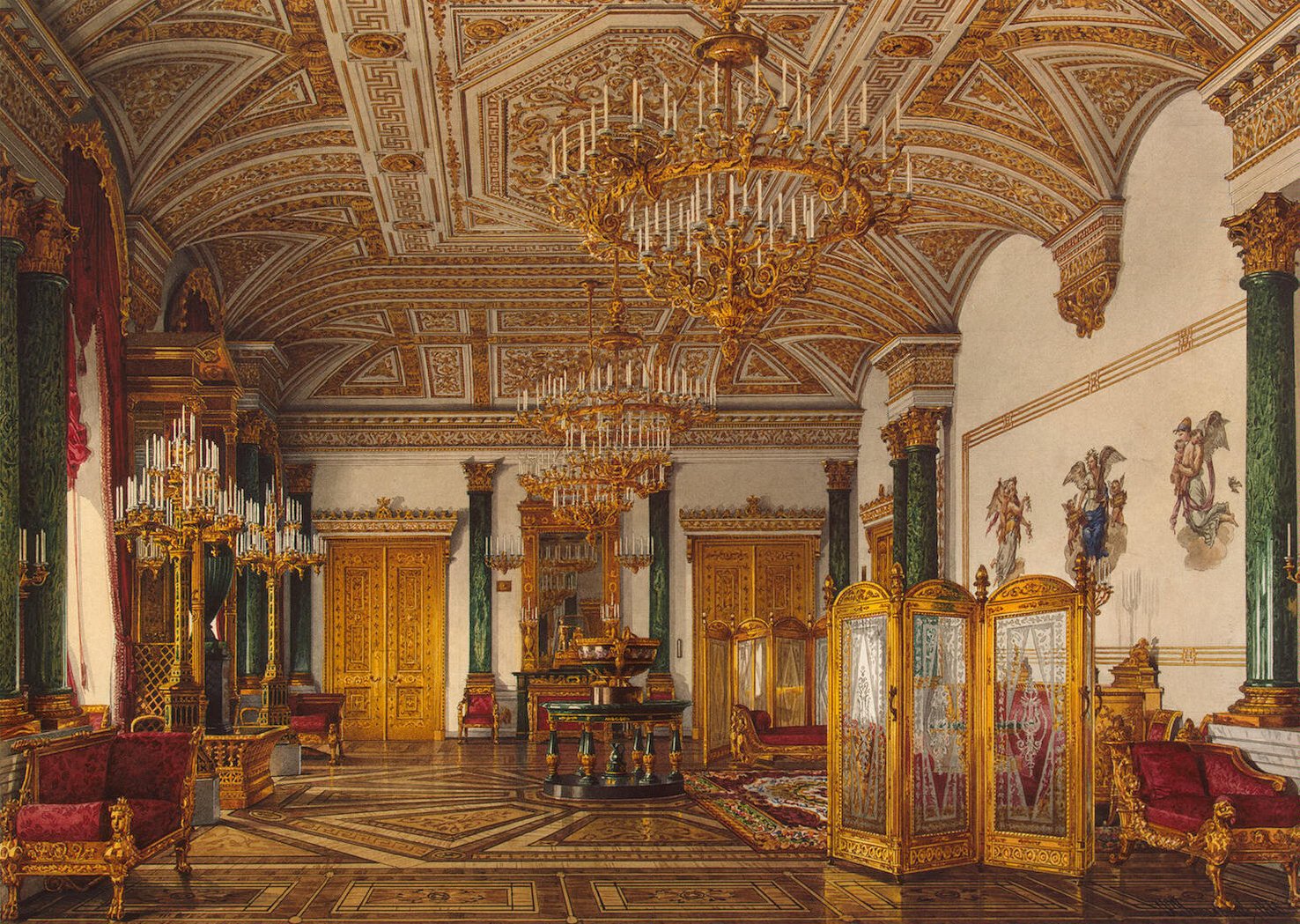
The green malachite, combined with gold, creates an effect of astonishing splendour, and the room is a masterpiece of the use of decorative stone, a material of which Russia possessed unrivalled resources. The Malachite Room reflects the taste of the imperial court for the rich and the magnificent, and it stands as one of the most memorable of all the palace’s interiors.
The Malachite Room also has a place in history, for it was here, during the last months of the monarchy, that the Provisional Government which briefly ruled Russia after the fall of the tsar held some of its meetings, before it too was swept away. The room thus witnessed the final act of the drama of the Russian monarchy, adding a note of historical poignancy to its beauty.
Beyond the great state rooms, the palace contained the private apartments of the imperial family, decorated with a comfortable magnificence and reflecting the tastes of the successive rulers who inhabited them. These rooms, more intimate than the vast state halls, give a sense of the domestic life of the Romanovs amid the overwhelming grandeur of their great palace on the Neva.
The use of malachite on such a scale was possible only because of Russia’s control of the great mineral deposits of the Urals, and the room was intended in part as a display of the empire’s vast natural wealth. The technique of working the stone, cutting and matching thin slices to create the appearance of solid malachite columns, was a Russian speciality, and the room stands as a showcase of both the resources and the craftsmanship of the empire.
The Gallery of 1812
One of the most remarkable rooms in the palace is the Military Gallery of 1812, created to commemorate the Russian victory over Napoleon in the great patriotic war that had seen the French emperor’s invasion of Russia end in catastrophe. The gallery is hung with hundreds of portraits of the generals who had led the Russian armies to victory, a hall of heroes celebrating one of the supreme moments of Russian history.

The portraits, the work of a leading painter of the age, gaze down from the walls of the long gallery, an array of the commanders who had defeated the greatest military power of the day and driven Napoleon’s Grand Army from Russian soil. The gallery was conceived as a monument to national triumph, a celebration of the deliverance of Russia and of the men who had achieved it.
The war of 1812, with the burning of Moscow and the destruction of Napoleon’s army in the Russian winter, was one of the defining events of Russian history, a national epic of resistance and victory. The creation of the gallery within the Winter Palace placed this triumph at the very heart of the imperial residence, linking the glory of the monarchy to the deliverance of the nation.
The Military Gallery of 1812 remains one of the most moving rooms in the palace, its ranks of portraits preserving the memory of a great national victory. It stands alongside the Alexander Column in the square outside as a monument to the Russian triumph over Napoleon, and it reflects the way in which the Winter Palace served not only as a residence but as a monument to the history and the glory of the Russian empire.
The gallery reflects the profound importance of the victory over Napoleon in the Russian national consciousness, an event that came to be seen as a great patriotic triumph and a moment of national deliverance. By enshrining the memory of that victory at the heart of the imperial palace, the monarchy bound its own prestige to the glory of the nation, and the gallery remains a powerful monument to one of the defining episodes of Russian history.
Catherine the Great and the Birth of the Hermitage
The transformation of the Winter Palace from an imperial residence into one of the world’s great museums began with Catherine the Great, the formidable empress who ruled Russia in the later eighteenth century and who was one of the most passionate art collectors in history. Catherine acquired great collections of paintings and other treasures from across Europe, and to house them she built, adjoining the palace, the first of the Hermitage buildings.
Catherine’s collection grew with astonishing speed, as she bought entire galleries of masterpieces from the collections of European nobles and monarchs, assembling in a few decades one of the greatest art collections in the world. To accommodate these treasures she added the Small Hermitage and then the Large Hermitage to the palace complex, creating private galleries where she could enjoy her collection in retreat.
The name Hermitage, meaning a place of retreat, reflected the original private character of these galleries, which Catherine intended as a refuge where she could contemplate her treasures away from the ceremony of the court. From these private beginnings would grow the vast public museum of later times, but its origins lay in the passion of a single extraordinary empress.
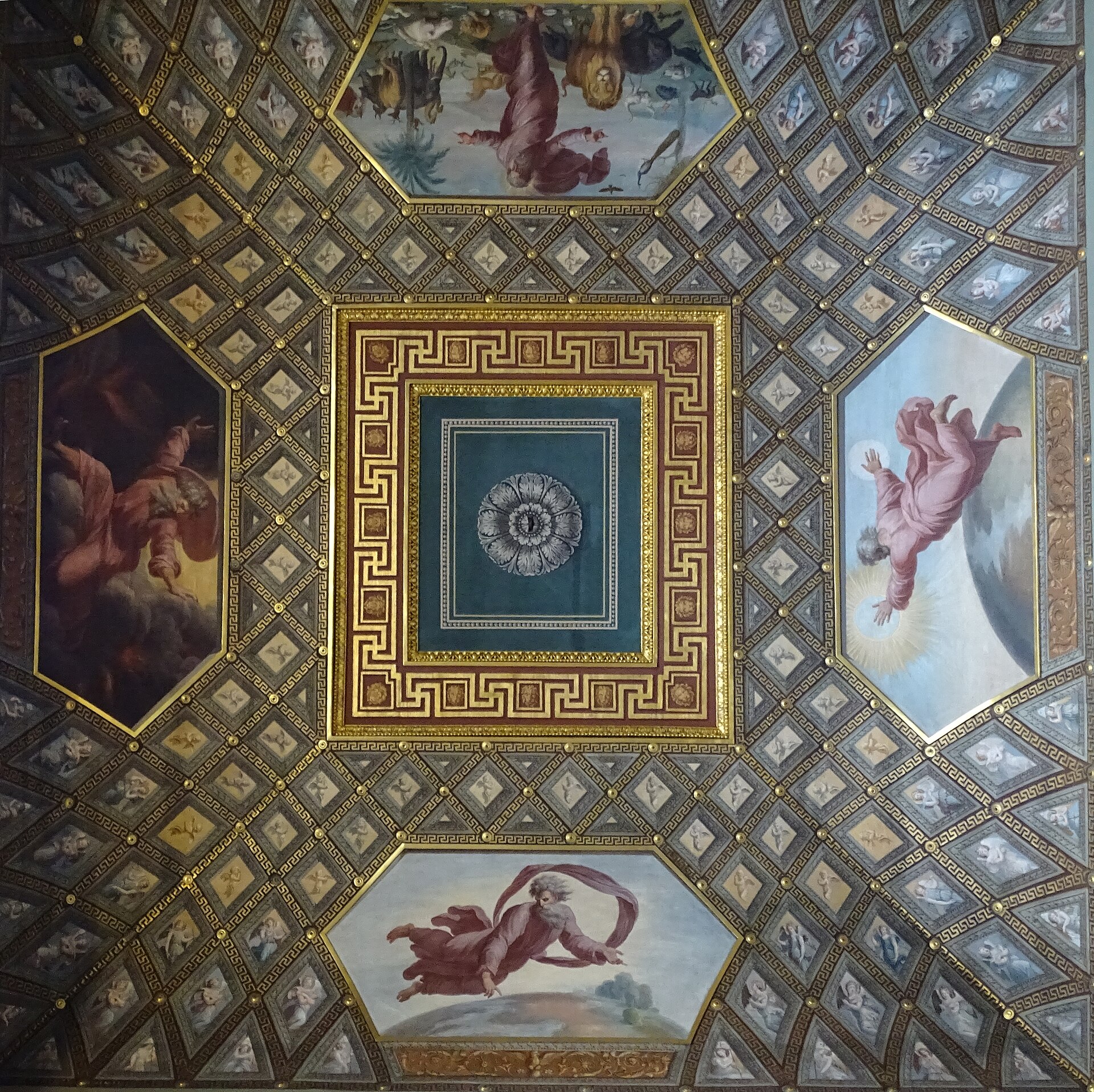
Catherine also commissioned remarkable works for her galleries, including a full-scale copy of the famous Raphael Loggias of the Vatican, recreating in St Petersburg one of the masterpieces of the Italian Renaissance. Her patronage laid the foundations of the State Hermitage, and her collection remains at the heart of the museum that grew from her passion, one of the greatest legacies of her remarkable reign.
Catherine’s approach to collecting was as much political as aesthetic, for the acquisition of great art collections was a way of proclaiming the arrival of Russia as a cultured European power, the equal of the older nations of the West. In gathering her treasures she made St Petersburg one of the great centres of art in Europe, and she laid the foundation for the extraordinary museum that would grow from her passion in the centuries to come.
The Pavilion Hall and the Peacock Clock
Among the most beautiful of the Hermitage interiors is the Pavilion Hall, a light and elegant chamber in the Small Hermitage, decorated in a graceful nineteenth-century style with white marble, gilding, and great crystal chandeliers. Its rows of arched windows, its fountains, and its intricate mosaic floor create an atmosphere of airy elegance quite different from the Baroque grandeur of the state halls.
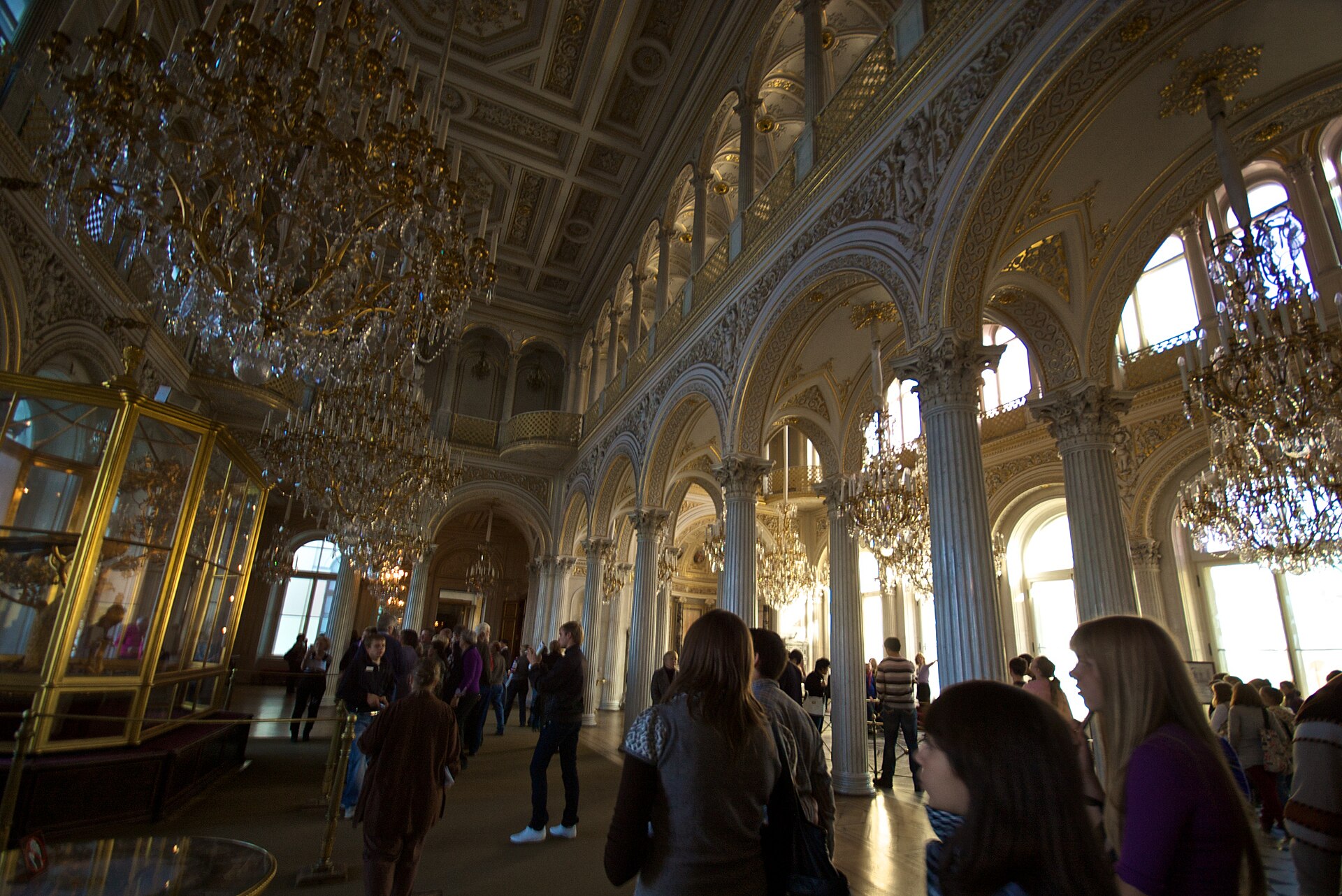
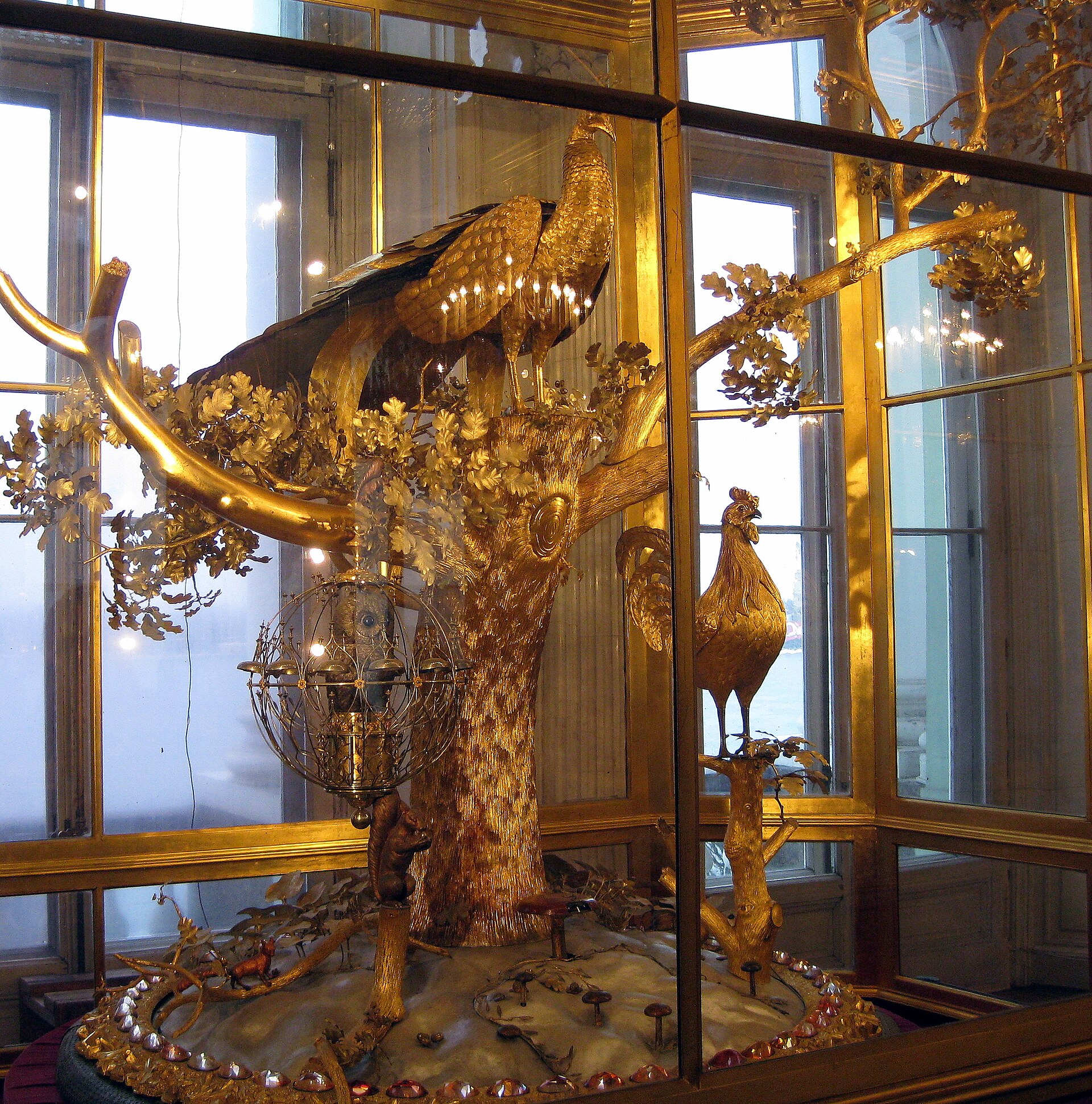
The great treasure of the Pavilion Hall is the celebrated Peacock Clock, an extraordinary automaton made in the eighteenth century in the form of a group of life-sized gilded birds. When set in motion, the mechanism brings the birds to life, the peacock spreading its glittering tail in a marvel of the clockmaker’s and goldsmith’s art, one of the most famous and beloved objects in the whole Hermitage.
The Peacock Clock, acquired in the age of Catherine the Great, is a masterpiece of European craftsmanship and a wonder of mechanical ingenuity, and it has delighted visitors for more than two centuries. It embodies the taste of the imperial court for the ingenious and the marvellous, and it remains one of the treasures that draws visitors to the Hermitage from around the world.
The Pavilion Hall, with its elegant decoration and its famous clock, is one of the highlights of a visit to the museum, a space of beauty and wonder within the great complex. It reflects the way in which the Hermitage gathered not only paintings but treasures of every kind, from the works of the great masters to the marvels of the decorative arts, making it one of the richest collections in the world.
The Great Fire and the Rebuilding
In the winter of 1837, the Winter Palace suffered a catastrophe, when a great fire broke out and raged through the building for days, gutting the magnificent interiors and destroying much of Rastrelli’s and his successors’ work. The blaze was one of the greatest disasters ever to befall the palace, and it left the great residence a burnt-out shell, its splendid halls reduced to ashes.
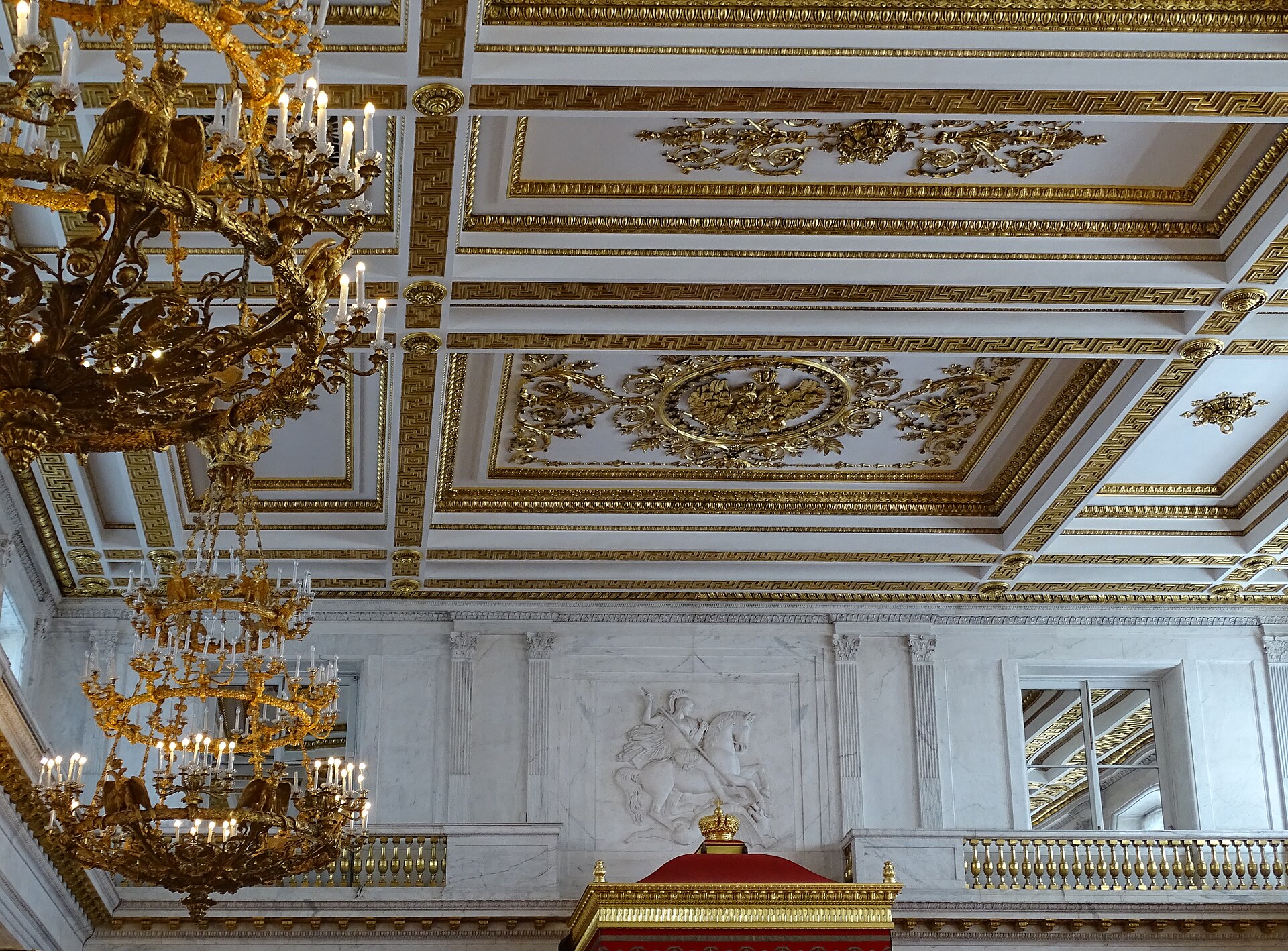
The response to the disaster was extraordinary. The emperor ordered that the palace be rebuilt with all possible speed, and a vast workforce laboured through the following months, in conditions of great hardship, to restore the great building. In a remarkably short time, the interiors were recreated, many of them restored to their original appearance, and the palace rose again from the ruins.
The rebuilding was carried out with great care to recover the magnificence of the lost interiors, and the great state rooms, the staircase, and the halls were restored to their former glory. The speed and the scale of the reconstruction were a testament to the resources of the imperial state and to the importance attached to the great symbol of the monarchy.
The fire and the rebuilding form a dramatic chapter in the history of the palace, and much of what the visitor sees today dates from this nineteenth-century restoration, faithful to the earlier designs. That the palace could suffer such destruction and be so completely restored is a measure of its importance to the Russian monarchy, and of the determination to preserve the great residence at the heart of the empire.
1917: Revolution at the Winter Palace
The Winter Palace, for so long the symbol of imperial power, became in 1917 the setting for the events that brought the Russian monarchy and then its successors to an end. After the fall of the tsar earlier that year, the palace became the seat of the Provisional Government that sought to rule Russia, and it was here that the drama of the revolution reached its climax.

In the autumn of 1917, in the events that became known as the October Revolution, the forces of the Bolsheviks moved against the Provisional Government, and the storming of the Winter Palace became one of the iconic images of the revolution. The palace that had been the heart of imperial Russia was seized, and the government sheltering within it was overthrown, marking a decisive moment in the birth of the new Soviet state.
The events at the Winter Palace in 1917 transformed the course of Russian and world history, bringing to an end the old order and inaugurating the revolutionary regime that would rule Russia for the rest of the century. The palace, once the residence of emperors, became a symbol of the revolution that had swept them away, its very name bound up with the great upheaval.
After the revolution, the Winter Palace ceased forever to be a royal residence, and it entered upon a new life. The imperial family was gone, the monarchy abolished, and the great palace, along with the treasures of the Hermitage, passed into the hands of the new state, to be transformed, in time, into a museum for the people, a new role for the great building on the Neva.
The storming of the Winter Palace was later mythologised on a grand scale, dramatised and re-enacted as a founding legend of the new Soviet state, so that the image of the crowds surging into the palace became one of the iconic symbols of the revolution. Whatever the historical realities of that night, the events at the Winter Palace marked, beyond doubt, the end of one age of Russian history and the violent beginning of another.
The State Hermitage Museum Today
Today the Winter Palace, together with the adjoining Hermitage buildings, forms the State Hermitage Museum, one of the largest and oldest museums in the world, holding a collection of some three million works of art and objects gathered over more than two centuries. The palace that was once the residence of emperors is now a treasure house open to the world, visited by vast numbers of people each year.
View the exact location on Google Maps
The collections of the Hermitage span the whole history of world art, from the antiquities of the ancient world to masterpieces of the European painting of every school, together with sculpture, decorative arts, and treasures of every kind. The museum occupies the Winter Palace and the neighbouring buildings, so that a visit combines the experience of the great imperial interiors with that of one of the supreme art collections in the world.
To walk through the museum is to move through the magnificent state rooms of the palace, from the Jordan Staircase to the great halls, while encountering at every turn the masterpieces of the collection. The union of the imperial architecture with the treasures of world art makes the Hermitage a unique destination, at once a monument to the Russian monarchy and a museum of world culture.
From the practical winter houses of Peter the Great, through the Baroque magnificence of Rastrelli’s palace, the passion of Catherine the Great, the triumphs and tragedies of the imperial age, and the revolution that ended the monarchy, the Winter Palace has stood at the centre of Russian history. Reborn as the State Hermitage, it endures as one of the great palaces and one of the great museums of the world, a monument to the whole sweep of Russian and European history.
The transformation of the imperial residence into a public museum was itself a profound act, turning the very symbol of autocratic power into a place of culture and learning open to all. In this new role the Winter Palace has flourished, its collections growing and its halls admired by visitors from every corner of the earth, so that the palace continues, under a wholly changed order, to stand at the centre of the cultural life of Russia and of the world.
Palaces Nearby
If Peterhof has whetted your appetite for imperial Russia, there is more to explore just a short journey away. These nearby palaces make natural companions to a visit here.
You May Like
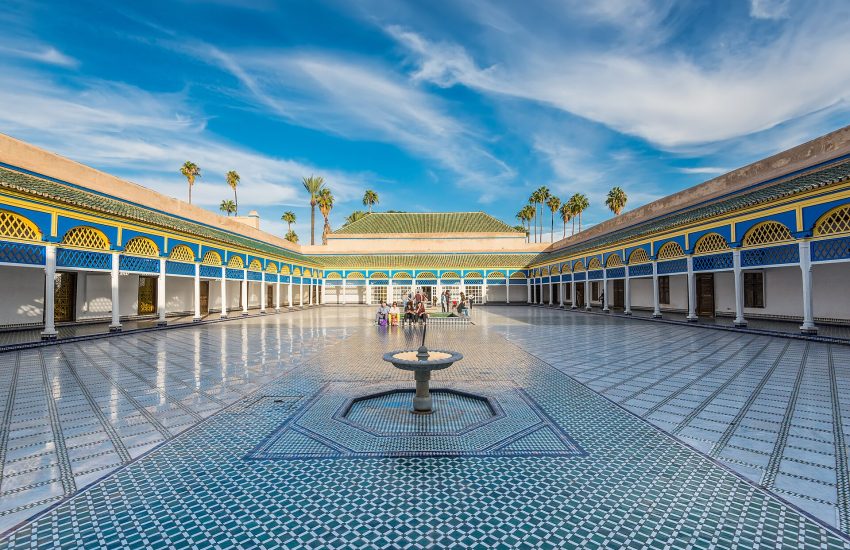
The Bahia Palace of Marrakech: A Vizier’s Dream of Moroccan Splendor