When night falls over the city of Mysore in southern India, something magical happens. Along the outlines of a great palace, tens of thousands of light bulbs blaze into life, tracing every dome, arch, and tower in fire against the darkness. The Mysore Palace, officially the Amba Vilas Palace, transforms into a glowing vision, and crowds gather to watch one of the most spectacular sights in all of India. It is a fitting drama for a palace that is itself among the grandest ever built in the country.
The Mysore Palace was the seat of the Wodeyar dynasty, the rulers who governed the kingdom of Mysore for centuries. The building you see today is not ancient but dates from the early twentieth century, raised after fire destroyed an earlier wooden palace on the same spot. Yet in its splendor it more than matches the oldest royal residences, a confident statement of the wealth and cultural ambition of one of India’s most enlightened princely states.
What makes the palace so remarkable is its style, a rich and harmonious blend of Indian, Islamic, and European elements known as the Indo-Saracenic. Domes and arches, towers and colonnades, come together in a design of great exuberance, while within, halls of astonishing splendor glitter with stained glass, carved wood, ivory inlay, gold, and murals. It is a palace that seems to gather the artistic traditions of the world into a single dazzling whole.
In this article you will explore the Mysore Palace from the dynasty that built it to the fire that gave it its present form, through its magnificent halls and its famous festival, to the great illumination that lights it each evening. Along the way you will discover why this glowing palace in the south, home to a proud and cultured dynasty, ranks among the most beloved and most visited monuments in all of India.

In This Article
- The Grandest Palace of the South
- The Wodeyar Dynasty
- The Fire and a New Beginning
- The Architect Henry Irwin
- The Indo-Saracenic Splendor
- Domes, Towers, and the Great Facade
- The Durbar Hall
- The Marriage Pavilion and Its Glass Dome
- A Treasure House of Craft
- The Splendor of Dasara
- The Great Illumination
- The Palace as Museum
- Visiting the Mysore Palace Today
The Grandest Palace of the South
The Mysore Palace stands at the heart of the city of Mysore, a vast and imposing building surrounded by gardens and enclosed within a walled compound entered through grand gates. It dominates the city, both physically and in the imagination, the undisputed centerpiece of Mysore and one of the most famous royal residences in India.
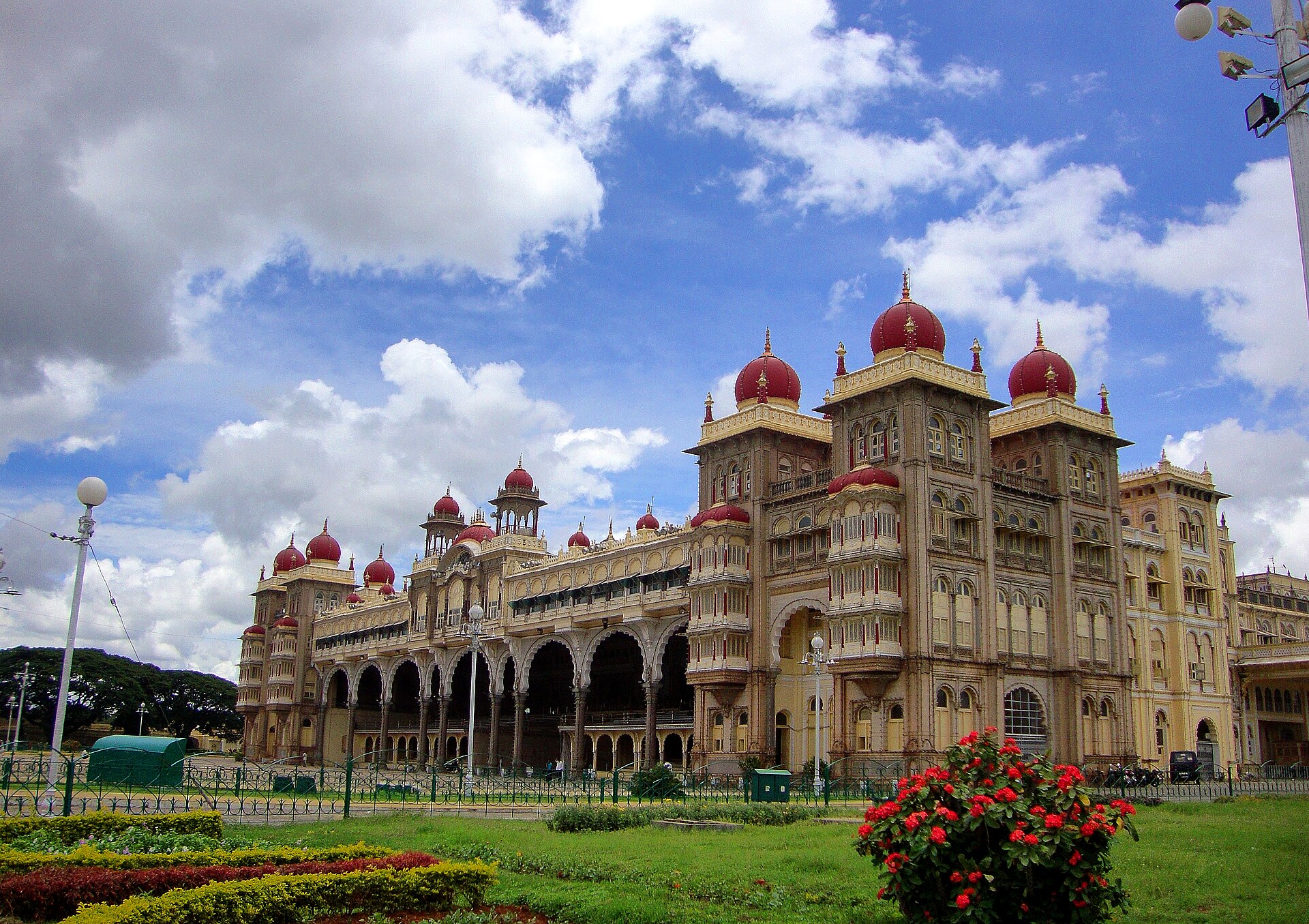
The palace is enormous, a sprawling structure of halls, courtyards, and towers built on a grand scale. Its long facade, punctuated by arches and columns and crowned by a skyline of domes and turrets, presents an image of overwhelming richness, while a tall central tower topped by a gilded dome rises above the whole composition as its crowning feature.
Though it dates only from the early twentieth century, the palace draws on centuries of tradition, and it was designed to embody the glory of a dynasty with deep historical roots. It replaced an earlier palace destroyed by fire, and its builders spared no expense in creating a residence worthy of the kingdom of Mysore and its cultured rulers.
For the millions who visit each year, the Mysore Palace is a wonder. Its scale, its rich decoration, and above all its famous nighttime illumination make it one of the great sights of India, a building that combines the grandeur of a royal residence with the theatrical magic of a spectacle, glowing at the heart of the city that grew up around it.
It is worth remembering, as you take in all this splendor, how young the building actually is. Barely more than a century old, the Mysore Palace belongs to the age of railways and electricity, and yet it wears the grandeur of a far older world. That blend of the modern and the traditional runs through everything about it, and it is part of what makes the palace feel so alive.
The gardens and open spaces around the palace add greatly to its effect, giving the vast building room to breathe and offering the visitor changing views as they approach. From across the lawns, framed by trees and reflected in the light, the palace reveals its full grandeur, and the walk toward it becomes part of the pleasure of the visit.
The Wodeyar Dynasty
The palace was the seat of the Wodeyar dynasty, who ruled the kingdom of Mysore for much of its history. Theirs was one of the longest-lasting royal houses in India, and under their rule Mysore became known as a state of exceptional culture, learning, and good governance, admired for its patronage of the arts and its progressive administration.
The Wodeyars were great patrons of music, dance, painting, and scholarship, and their court became a center of the cultural life of southern India. This tradition of enlightened patronage shaped the character of the kingdom and left a lasting legacy, and the palace they built stands as a monument to their refinement and their love of the arts.
The history of the dynasty was not without upheaval. At one period the rulers were eclipsed by powerful figures who seized effective control of the kingdom, and Mysore became embroiled in major conflicts. But the Wodeyar line endured, and in time the dynasty was restored, going on to preside over an era of prosperity and cultural flourishing.
By the time the present palace was built, the Wodeyars ruled one of the most respected princely states in India, celebrated for its enlightened governance and its contributions to industry, education, and the arts. The palace expressed this proud identity, a residence fit for a dynasty that saw itself as a guardian of culture and a model of good rule.
The dynasty’s reputation for good governance was not mere flattery. Under Wodeyar rule, Mysore became known for its investment in education, industry, and public works, earning a place among the most forward-looking states in India. The palace, for all its traditional splendor, was the seat of a government that prided itself on progress, a reminder that magnificence and modernity could go hand in hand.
The Fire and a New Beginning
The Mysore Palace as we know it owes its existence to a disaster. An earlier palace on the site, built largely of wood, was destroyed by fire in the late nineteenth century, during the preparations for a royal wedding. The loss of the old palace was a grievous blow, but it opened the way for the creation of the magnificent building that stands today.

Rather than simply repair or replace the old structure, the rulers of Mysore resolved to build a new palace of unprecedented splendor, one that would be fireproof and worthy of their dynasty. The commission was ambitious, calling for a grand residence that would combine the latest in construction with the richest traditions of Indian palace design.
The decision to build anew reflected both the wealth of the state and the confidence of its rulers. The kingdom of Mysore was prosperous and well-governed, and it could afford to create a palace on the grandest scale. The fire, tragic as it was, became the occasion for one of the great architectural achievements of early twentieth-century India.
From the ashes of the old wooden palace, then, rose the new Amba Vilas Palace, a building far grander than the one it replaced. The story of its creation is a story of resilience and ambition, of a dynasty that responded to catastrophe not with retreat but with a determination to build something more magnificent than ever before.
There is a certain poignancy in the fact that the fire broke out during preparations for a wedding, a moment meant for celebration. Yet the response of the dynasty turned tragedy into triumph. Instead of mourning what was lost, the rulers seized the chance to build something greater, and the palace that rose from the ruins became a far more enduring monument than the one the flames had taken.
The Architect Henry Irwin
The new palace was designed by the British architect Henry Irwin, a leading figure in the architecture of India during the period, known for his mastery of the styles then in fashion for grand public and royal buildings. Working for the rulers of Mysore, he created a design of extraordinary richness that would become one of his most celebrated works.

Irwin was a master of the Indo-Saracenic style, an approach that combined Indian and Islamic architectural traditions with European techniques and forms. This style was well suited to a grand royal palace in India, allowing the building to draw on local traditions while incorporating the scale and structural methods of contemporary Western architecture.
The design called for the finest materials and craftsmanship, and artisans and materials were gathered to realize Irwin’s vision. The construction of so vast and elaborate a building was a major undertaking, requiring years of work and the skills of countless craftsmen, from stone carvers and woodworkers to painters and makers of stained glass.
The result was a triumph, a palace that fused many traditions into a coherent and magnificent whole. Irwin’s design gave the Wodeyars a residence that matched their ambitions, blending the grandeur of a European palace with the richness of Indian ornament, and creating one of the defining monuments of its age in India.
Bringing together the many crafts required for so ambitious a building was itself a remarkable act of organization. Woodcarvers, stonemasons, glassmakers, painters, and metalworkers all had to be gathered and coordinated, their separate skills woven into a single coherent vision. The palace is thus not only Irwin’s achievement but the collective work of a whole community of artisans at the height of their powers.
The Indo-Saracenic Splendor
The style of the Mysore Palace is the Indo-Saracenic, a rich synthesis of architectural traditions that flourished in India during this period. In this approach, the domes and arches of Islamic architecture, the columns and detailing of Hindu temple design, and elements drawn from Gothic and other European styles were brought together into a single exuberant whole.
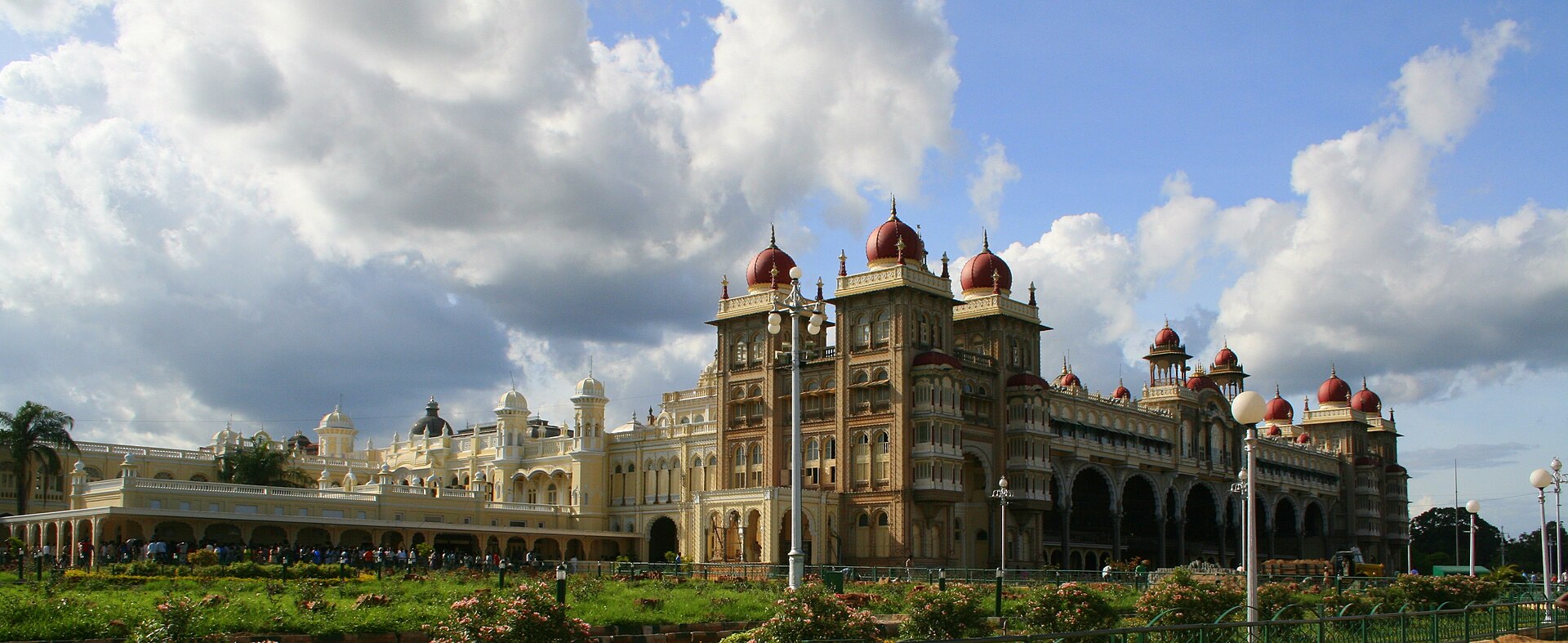
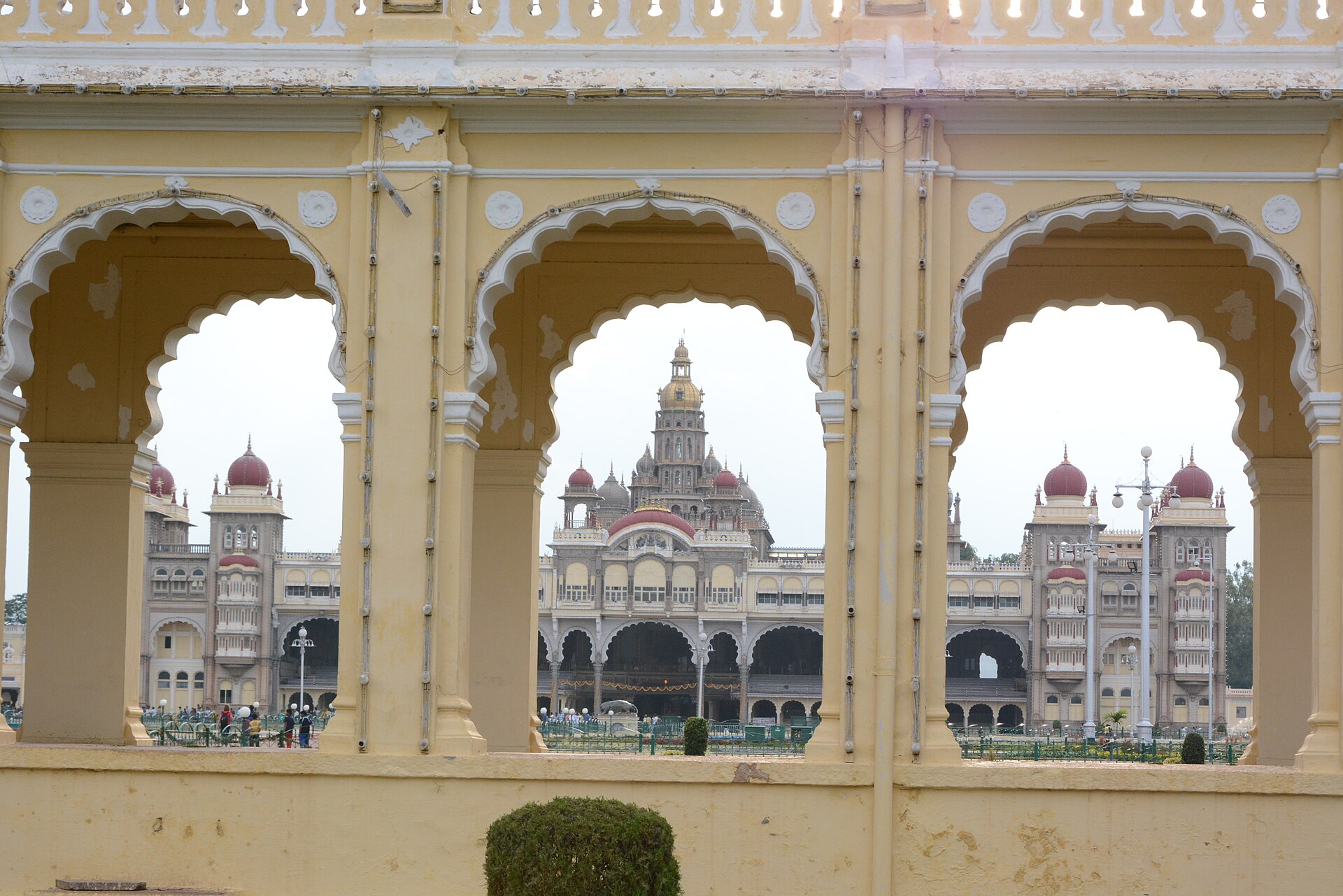
At Mysore, this fusion produced a building of great variety and richness. Bulbous domes crown the towers, pointed and rounded arches line the facades, and carved detail covers many surfaces, while the overall composition follows a symmetry and grandeur that give the diverse elements a sense of unity and order.
The Indo-Saracenic style was well suited to the aspirations of the princely states, allowing them to build residences that were unmistakably Indian in flavor yet grand and modern in scale and construction. The Mysore Palace is one of the finest examples of the style anywhere, a showcase of its possibilities and its splendor.
The effect of all this is a palace that seems to draw together the artistic traditions of many cultures into a harmonious celebration. Rather than belonging to a single tradition, the Mysore Palace speaks many architectural languages at once, and in doing so it captures the cosmopolitan spirit of its age and the ambition of the dynasty that built it.
The Indo-Saracenic style has sometimes been debated, seen by some as a colonial invention and by others as a genuine and creative fusion. Whatever the arguments, at Mysore the style achieves a confidence and coherence that silence such doubts. Here the many influences are not merely combined but harmonized, producing a building that feels whole and self-assured rather than merely eclectic.
What is perhaps most striking is how the style speaks to the identity of Mysore itself, a kingdom that saw itself as a meeting point of cultures and a patron of many traditions. In gathering Hindu, Islamic, and European elements into a single harmonious design, the palace becomes an architectural portrait of the cosmopolitan and cultured state that built it.
Domes, Towers, and the Great Facade
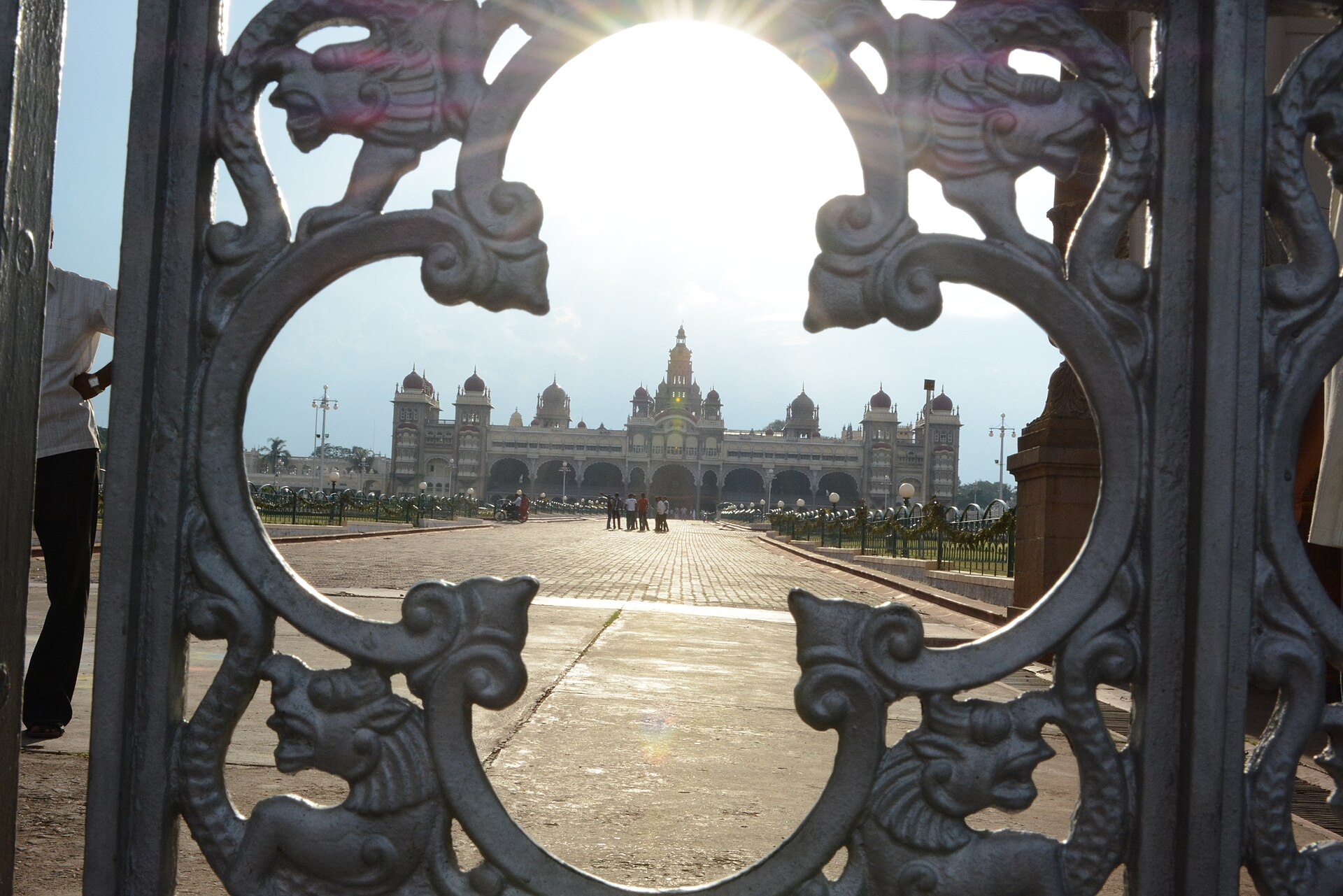
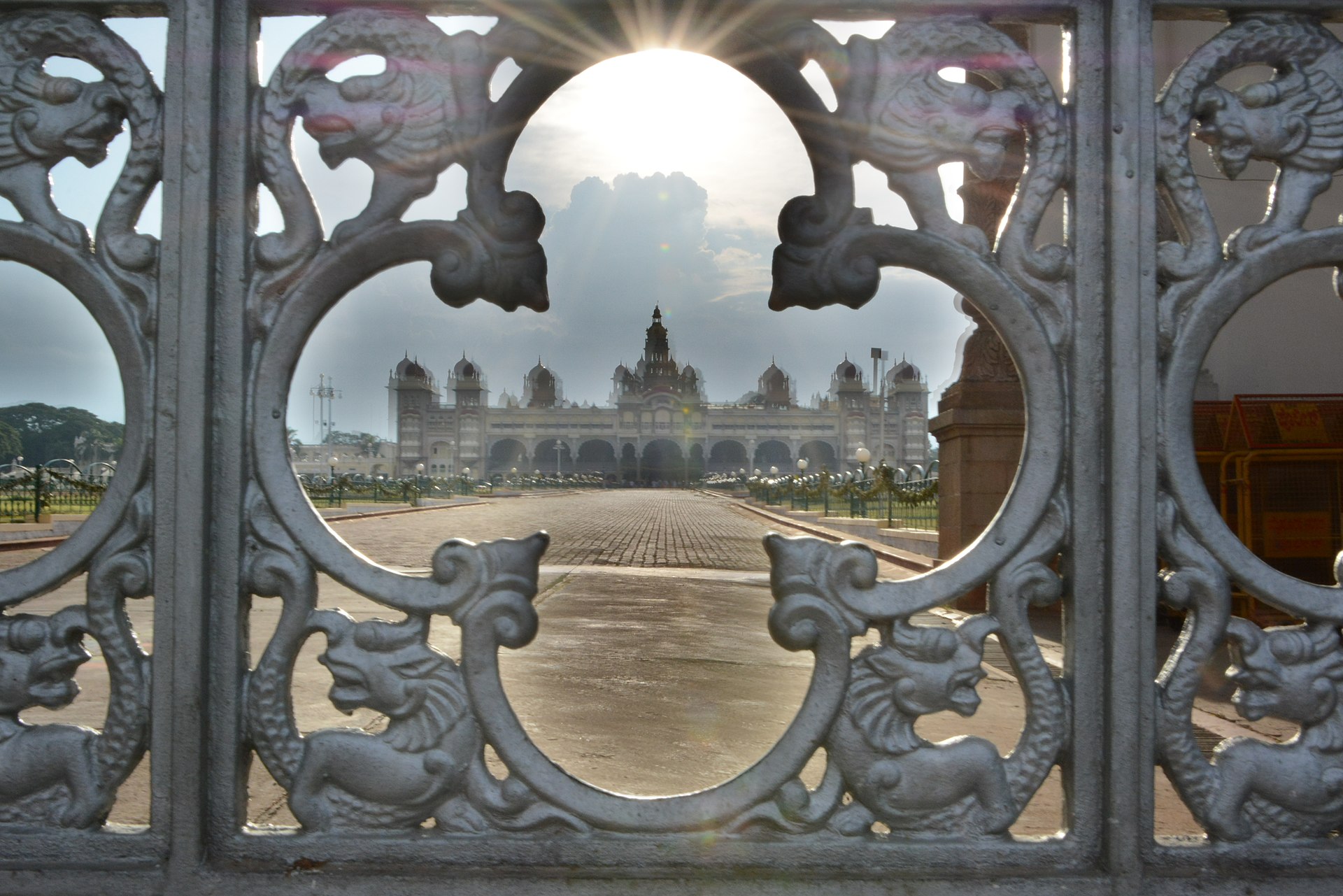
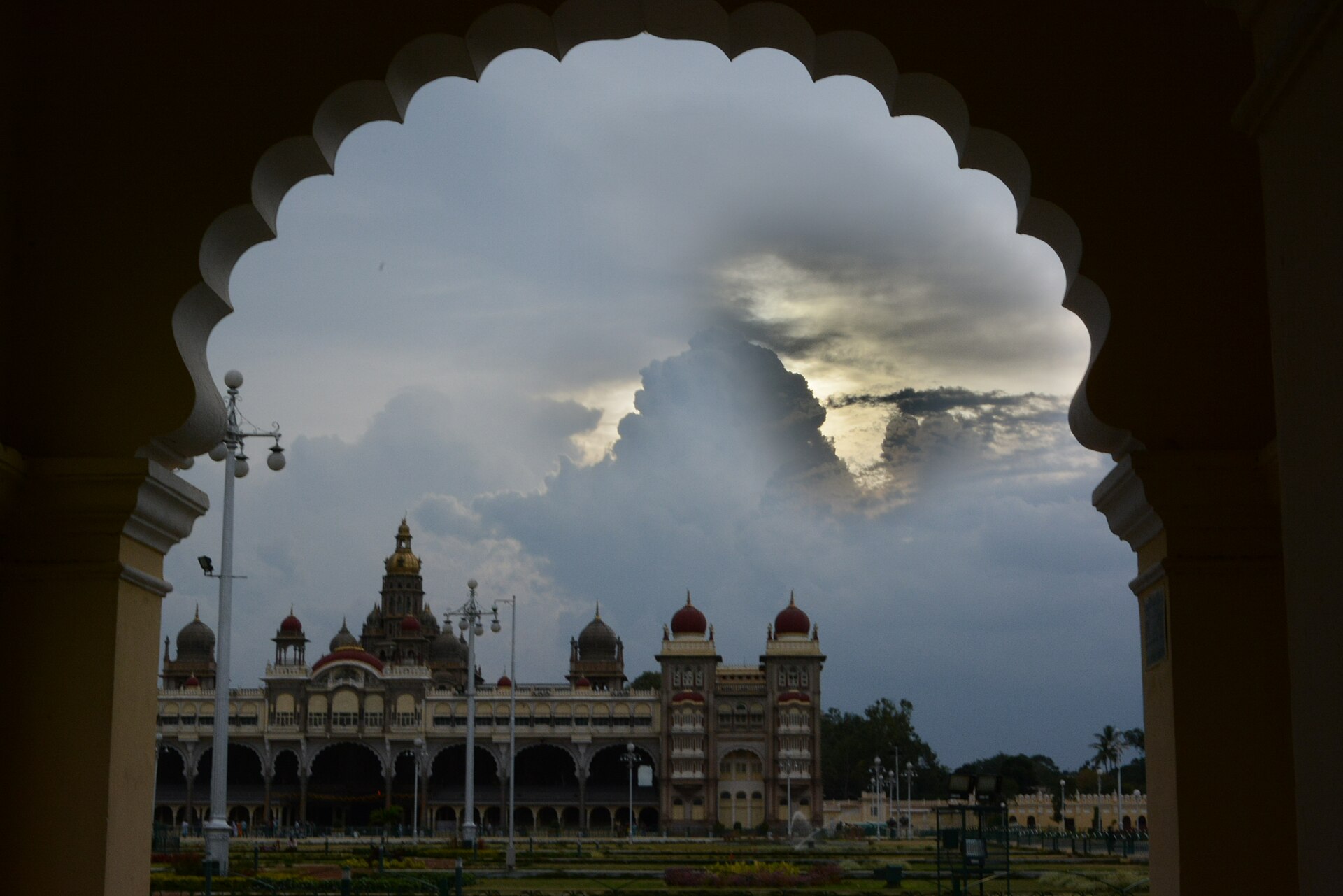
The exterior of the Mysore Palace is a feast for the eye. Built of fine grey granite with domes of pink marble, its long facade is composed of arches, columns, and bays, richly detailed and crowned by a varied skyline of domes and turrets. The whole presents an image of grandeur and abundance, impressive from every angle.

Rising above the center of the palace is a tall tower topped by a gilded dome, the crowning feature of the building and a landmark visible across the city. This central tower gives the palace its distinctive silhouette and draws the eye upward, lending the vast horizontal facade a strong vertical accent and a sense of soaring ambition.
The materials were chosen for both beauty and durability, a response to the fire that had destroyed the old wooden palace. Stone and marble replaced timber, ensuring that the new building would endure, while also providing surfaces for the rich carving and detailing that enliven the facade and express the wealth of the dynasty.
Surrounded by gardens and approached through grand gates, the palace presents itself to visitors as a vision of royal magnificence. The great facade, with its domes and towers glowing in the sun, is one of the most photographed sights in India, and it prepares the visitor for the even greater splendors that await within.
The contrast between the grey granite and the pink marble domes gives the palace much of its distinctive beauty, the cool stone grounding the building while the rosy domes lift it toward the sky. In the changing light of the day, this interplay of colors shifts and softens, so that the palace seems to alter its mood from hour to hour, always magnificent but never quite the same.
The Durbar Hall
Among the most magnificent spaces in the palace is the Durbar Hall, the grand hall of public audience where the ruler would appear before his court and people on ceremonial occasions. A vast columned space, richly decorated and open along one side to views over the palace grounds, it is one of the great ceremonial halls of India.

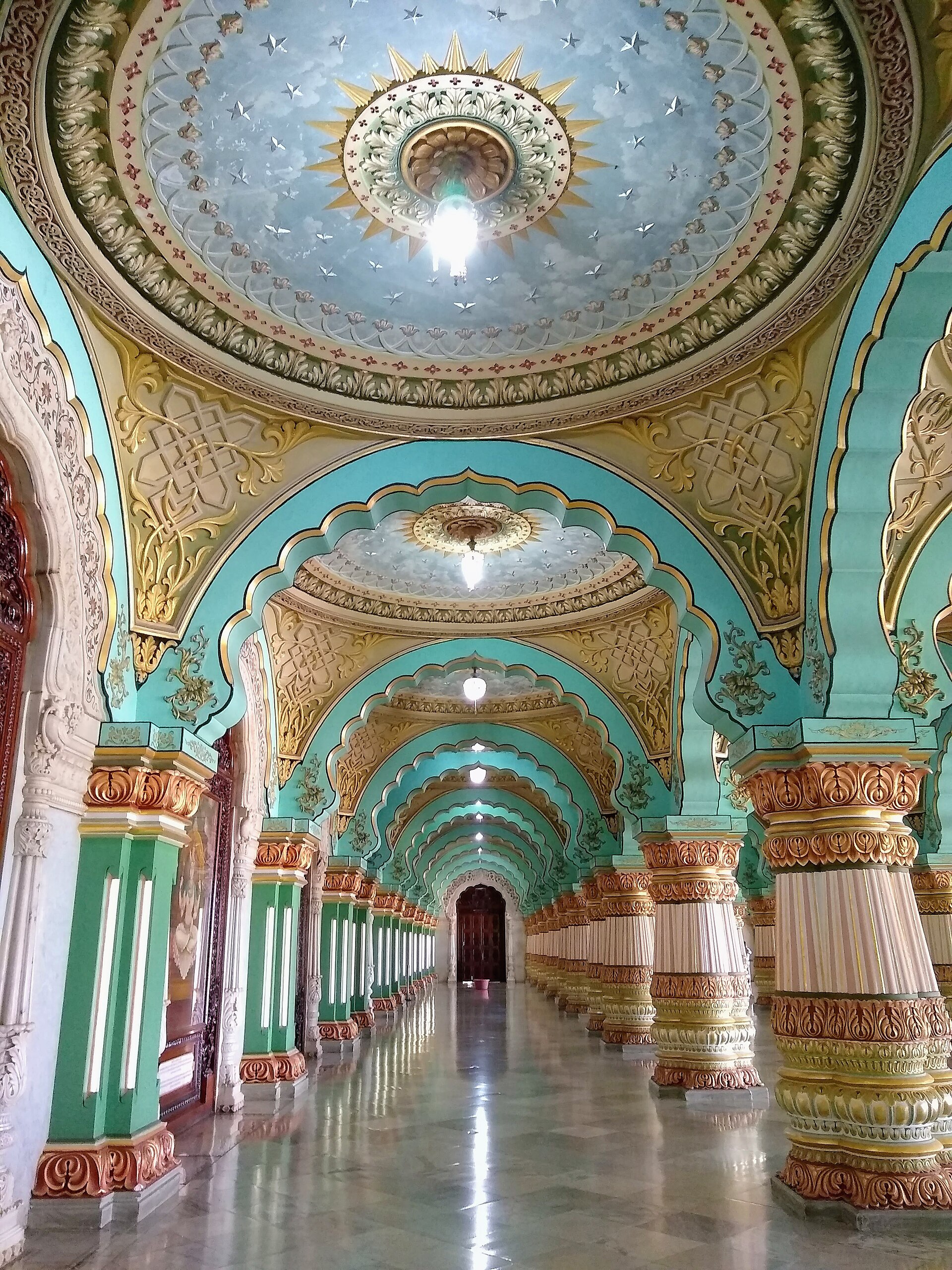
The hall is a showcase of the palace’s decorative arts. Rows of ornate columns support the ceiling, the floors and surfaces gleam with rich materials, and paintings and ornament cover the walls. Everything about the space was designed to impress, a fitting setting for the grand ceremonies of the Mysore court and the display of royal majesty.
From the Durbar Hall, the ruler could preside over the great events of the kingdom, seated in splendor before his assembled court. The scale and richness of the hall reflected the importance of these occasions and the dignity of the throne, and it remains one of the most awe-inspiring spaces in the entire palace.
Open to the air along one side, the hall also connects to the world beyond, offering views over the grounds and allowing the ceremonies within to be linked to the life of the palace and the city. It is a space that combines grandeur with a certain openness, a magnificent stage for the ceremonial life of the Wodeyar dynasty.
Standing in the Durbar Hall, it is easy to imagine the ceremonies it was built to hold, the ruler enthroned in splendor, the court arrayed before him, the whole space alive with color and reverence. Even empty, the hall retains that sense of occasion, its scale and richness preserving the memory of the great gatherings for which it was designed.
The Marriage Pavilion and Its Glass Dome
Perhaps the most beautiful space in the entire palace is the Kalyana Mantapa, or marriage pavilion, an octagonal hall used for royal weddings and celebrations. It is famous above all for its ceiling, a magnificent dome of stained glass, whose intricate patterns, including radiant peacock designs, glow with color when light shines through them.

The stained glass dome is one of the glories of the palace, a work of extraordinary craftsmanship. Composed of countless pieces of colored glass arranged in elaborate patterns, it casts a shifting, jewel-like light over the hall below, transforming the space into a chamber of color and enchantment quite unlike anything else in the building.
The floor of the pavilion is equally splendid, decorated with intricate patterns that complement the dome above, so that the whole space is a harmony of color and design from floor to ceiling. It was in this beautiful hall that the great celebrations of the royal family took place, framed by some of the finest decorative art in India.
The marriage pavilion captures the palace at its most exquisite. Where the Durbar Hall overwhelms with grandeur, the Kalyana Mantapa enchants with beauty, its glass dome filling the space with light and color. For many visitors, it is the most magical room in the palace, a jewel at the heart of a treasure house.
The peacock, with its shimmering, many-colored plumage, was the perfect subject for a dome of stained glass, and the craftsmen rose magnificently to the challenge. As light moves across the glass through the day, the painted birds seem almost to come alive, their colors deepening and shifting, so that the ceiling is never quite static but forever changing with the sun.
A Treasure House of Craft
Throughout the Mysore Palace, the interiors dazzle with the richness of their decoration and the skill of their craftsmanship. Rosewood doors inlaid with ivory, ceilings covered in painting and gilding, floors of fine materials, walls hung with portraits and murals, all combine to create rooms of overwhelming splendor.
The palace is a showcase of the traditional crafts of India, employing the finest artisans in wood, ivory, stone, glass, and metal. The intricately carved and inlaid doors, the delicate detailing, and the rich use of gold and color testify to a tradition of craftsmanship that the Wodeyars did much to nurture and sustain.
Among the treasures displayed within the palace are magnificent works of art, ceremonial objects, and the accumulated splendor of the royal collection. Paintings depicting scenes of court life and religious subjects, fine furnishings, and objects of gold and jewels give a vivid sense of the luxury of the Mysore court at its height.
To move through these interiors is to be immersed in beauty at every turn. The palace was designed to display the wealth and taste of the dynasty and to celebrate the artistic traditions of the kingdom, and it succeeds magnificently, offering room after room of decoration so rich that the eye can scarcely take it all in.
The use of ivory inlay in the great rosewood doors is a particular marvel, the pale figures glowing against the dark wood in patterns of astonishing delicacy. Such work demanded not only skill but patience almost beyond imagining, and it stands as a testament to a tradition of craftsmanship that the Wodeyars cherished and that the palace was built in part to celebrate.
The Splendor of Dasara
The Mysore Palace is inseparable from the great festival of Dasara, one of the most important and spectacular celebrations in southern India. For centuries the rulers of Mysore have presided over this festival, and the palace stands at its heart, the setting for ceremonies of extraordinary color and grandeur.
During the festival, the palace and the city come alive with processions, music, and ceremony. Among the most famous sights is the golden throne of the Wodeyars, a magnificent ceremonial seat displayed during Dasara, and the grand procession featuring richly caparisoned elephants that winds through the city in a spectacle of royal pageantry.
These celebrations connect the palace to deep religious and cultural traditions, marking the triumph of good over evil and reaffirming the role of the ruler in the life of the kingdom. The festival draws enormous crowds, and it remains one of the great cultural events of India, centered on the palace and its dynasty.
Through Dasara, the palace continues to fulfill its ancient role as the ceremonial heart of Mysore. The pageantry, the golden throne, the processions, all keep alive the traditions of the Wodeyar court, and they make the festival season a time when the full splendor and significance of the palace are on magnificent display.
The connection between the palace and Dasara runs deep, for the festival is not merely held at the palace but is bound up with the very identity of the dynasty and the kingdom. To see the palace during Dasara, alive with processions and pageantry and blazing with light, is to see it fulfilling the purpose for which it was truly made, as the ceremonial heart of a proud and ancient realm.
The golden throne in particular carries immense significance, brought out only during the festival and associated with the deepest traditions of the dynasty. To glimpse it in its ceremonial setting is to touch the sacred heart of the Wodeyar monarchy, a reminder that behind all the color and spectacle of Dasara lies a profound sense of duty, devotion, and continuity.
The Great Illumination
The most famous spectacle associated with the Mysore Palace is its illumination, when the entire building is outlined by tens of thousands of light bulbs that trace its every dome, arch, and tower against the night. When the lights blaze on, the palace becomes a glowing vision, and the sight has become one of the defining images of India.
The illumination takes place on special occasions and, most spectacularly, during the Dasara festival, when the palace is lit each evening to the delight of enormous crowds. The transformation is breathtaking: by day a majestic building of stone and marble, by night a shimmering outline of golden light, as if the palace had been redrawn in fire.
The effect depends on the careful placement of countless bulbs along the contours of the building, so that its architecture is revealed in glowing lines against the darkness. This marriage of architecture and light turns the palace into a work of theater, a spectacle that draws visitors from across the country and around the world.
For many people, the illuminated Mysore Palace is the abiding memory of a visit, an image of pure enchantment. It captures something essential about the palace itself, a building that has always been about splendor and display, and that reaches its most magical form when, each evening of the festival, it blazes into light against the southern sky.
There is something almost childlike in the delight the illumination inspires, a pure wonder that crosses every barrier of age and background. In an age of dazzling technology, the simple spectacle of a great building outlined in light still stops people in their tracks, and the crowds that gather each evening to watch the palace blaze into life are proof of its enduring magic.
The Palace as Museum
Today much of the Mysore Palace is open to the public as a residential museum, allowing visitors to explore its magnificent halls and to see the treasures of the Wodeyar dynasty. The palace draws millions of visitors each year, making it one of the most visited monuments in all of India.
Within the palace, visitors follow a route through the grand ceremonial halls, the beautiful marriage pavilion, and other richly decorated rooms, taking in the paintings, furnishings, and objects that fill them. The collections offer a vivid picture of the life and splendor of the Mysore court and of the artistic traditions the dynasty patronized.
The palace museum preserves not only the building but the memory of the dynasty and its culture, keeping alive the traditions of one of India’s most celebrated royal houses. Displayed within their original setting, the treasures of the collection gain added power, immersing the visitor in the world of the Wodeyar court.
For all its role as a museum, the palace remains a living symbol of Mysore and its heritage, still central to the great festival of Dasara and to the identity of the city. It is at once a monument of the past and a living institution, a treasure house of art and a beloved emblem of the kingdom it once served.
Photography is often restricted within the palace, a rule that has an unexpected benefit: it encourages visitors to look with their own eyes rather than through a screen. Freed from the impulse to capture everything, many find themselves more fully present, taking in the richness of the halls and the play of colored light in a way that a photograph could never truly preserve.
The sheer number of visitors the palace receives each year testifies to its hold on the imagination of the country. For countless Indians, a visit to the Mysore Palace is a cherished experience, a chance to connect with a proud heritage, and the crowds that fill its halls are drawn as much by affection and pride as by curiosity.
Visiting the Mysore Palace Today
Today the Mysore Palace is one of the most popular attractions in India, drawing enormous numbers of visitors to explore its halls, admire its architecture, and witness its famous illumination. It lies at the heart of the city of Mysore, a destination celebrated for its heritage, its culture, and its beauty.

View the exact location on Google Maps
A visit leads through the grand rooms of the palace, from the majestic Durbar Hall to the enchanting marriage pavilion with its glass dome, past the paintings, carvings, and treasures that fill the interiors. The scale and richness of the palace mean that a visit offers continual wonders, room after room of splendor.
For the fullest experience, many visitors aim to see the palace both by day and by night, admiring its stone and marble grandeur in the sunlight and returning to witness the magic of the illumination after dark. To see the palace outlined in light is an unforgettable experience, the highlight of any visit to Mysore.
Whether you come for the architecture, the history, the festival, or the illumination, the Mysore Palace offers an experience of rare splendor. It is the glowing heart of a cultured and historic city, a monument to a proud and enlightened dynasty, and one of the most magnificent and beloved palaces in all of India.
Mysore itself rewards exploration beyond the palace, with its gardens, temples, and markets, but the palace remains the reason most travelers come. Set aside enough time to see it properly, unhurried, and to return in the evening for the lights, and you will carry away an impression of splendor that ranks among the finest that India has to offer.
Palaces Nearby
The Mysore Palace is one of the great royal residences of India. To continue your journey through the splendor of princely India, these palaces make natural companions to a visit here.
You May Like