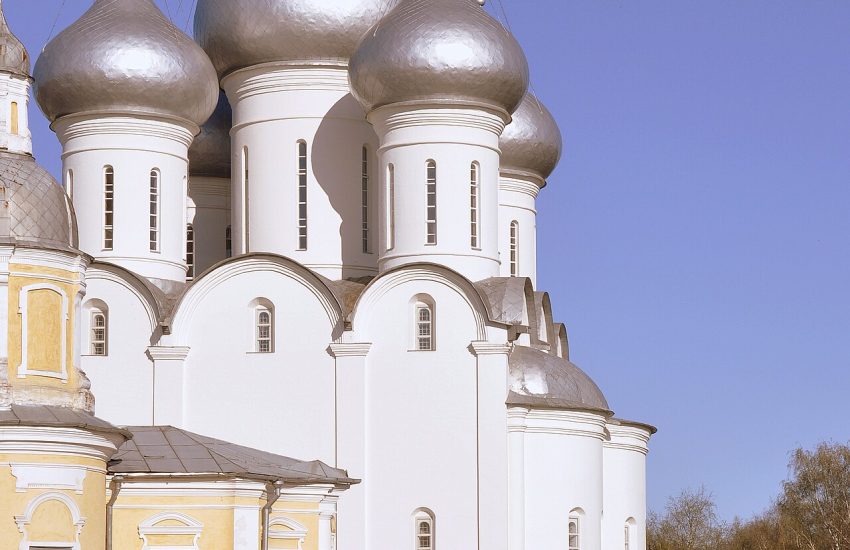
Of all the towns of the Golden Ring, Suzdal is the one travelers fall in love with: a place of ten thousand people and five monasteries, where cows graze under church domes, the Kamenka river loops through meadows inside the town itself, and no building since the tsars stands taller than a bell tower. At its heart, inside grass-grown ramparts a thousand years old, lies the Suzdal Kremlin, the oldest court of the Golden Ring, with a cathedral whose blue domes are spangled with golden stars, a bishops’ palace of labyrinthine chambers, and a wooden church that arrived whole on carts from a dying village.
Suzdal was a capital when Moscow was a hunting camp: the Rostov-Suzdal land was the cradle of northeastern Rus, and the princes who built Moscow, Yuri Dolgoruky and his line, ruled from here first. History then performed its favorite trick, passing the town by so completely, no railway, no industry, that the Middle Ages survived in the open air, until the twentieth century discovered that Suzdal’s poverty had preserved a treasure and declared the whole town a museum.
This guide walks the oldest hundred meters in central Russia: Vladimir Monomakh’s first cathedral and the ramparts of the 1020s, the Nativity Cathedral with its golden gates and star-strewn domes, the bishops’ chambers and their great cross-vaulted hall, the fearsome jail-monasteries and exiled tsaritsas of Suzdal’s darker registers, the town’s rescue as a museum-reserve and film set, and all the practical detail for Russia’s most concentrated dose of deep past.
- The Cradle of Northeastern Rus
- Monomakh’s Cathedral and the Ramparts
- Capital Days and Dolgoruky
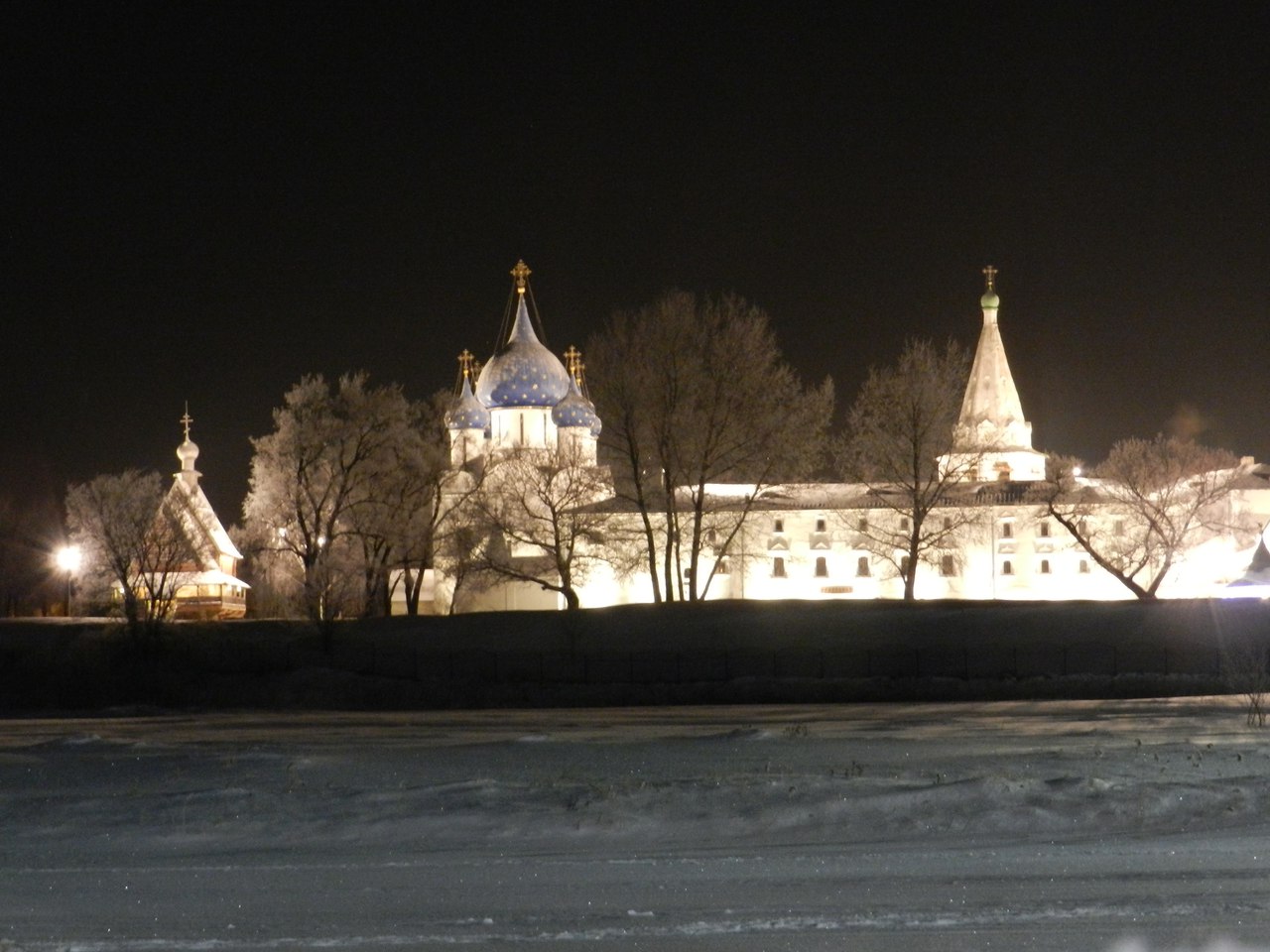
- The Nativity Cathedral
- The Golden Gates of Suzdal
- The Mongol Storm
- The Bishops’ Court
- The Cross Chamber
- Exiled Tsaritsas and the Convent
- The Wooden Church That Traveled
- The Town That Became a Museum
- Suzdal on Screen
- The Suzdal Rhythm
- Watch the Suzdal Kremlin on Film
- Visiting the Suzdal Kremlin Today
- Palaces Nearby
The Cradle of Northeastern Rus
Suzdal enters the chronicle in 1024, in an entry about a pagan revolt during famine, which means the town was already old and taxable a millennium ago; archaeology pushes settlement on the Kamenka’s loops back further still, into the mixed Finnic and Slavic world of the river roads. The fertile opolye, the rare belt of black earth amid the northern forests, made the Suzdal land the breadbasket that let princes feed retinues, and power followed the grain.
In the eleventh and twelfth centuries the Rostov-Suzdal principality grew into Kievan Rus’s northeastern wing and then its successor: as Kiev declined, the center of Russian life shifted here, to Suzdal and its daughter towns, and it was from this land, Zalesye, the place beyond the forests, that Moscow’s eventual empire would descend, every later tsar tracing his line through Suzdal’s princes.
The town’s sanctity matched its politics: Suzdal’s bishops ruled a diocese covering the whole northeast, its monasteries multiplied until the little town held a convent or monastery on every rise, and the skyline of domes over meadows that enchants visitors is simply the medieval ratio preserved, a capital’s worth of churches for a village’s worth of houses, history’s concentrate.
Monomakh’s Cathedral and the Ramparts
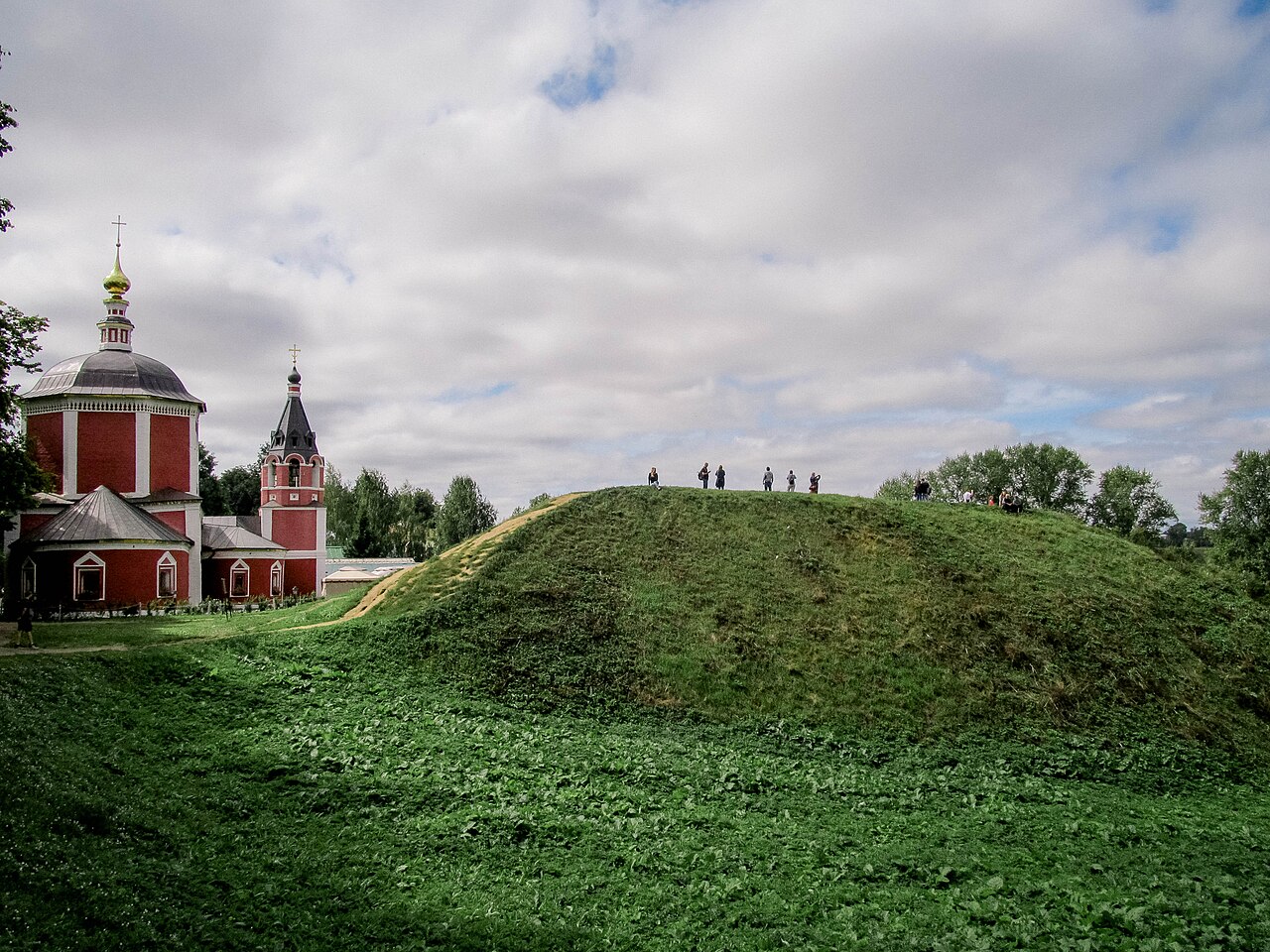
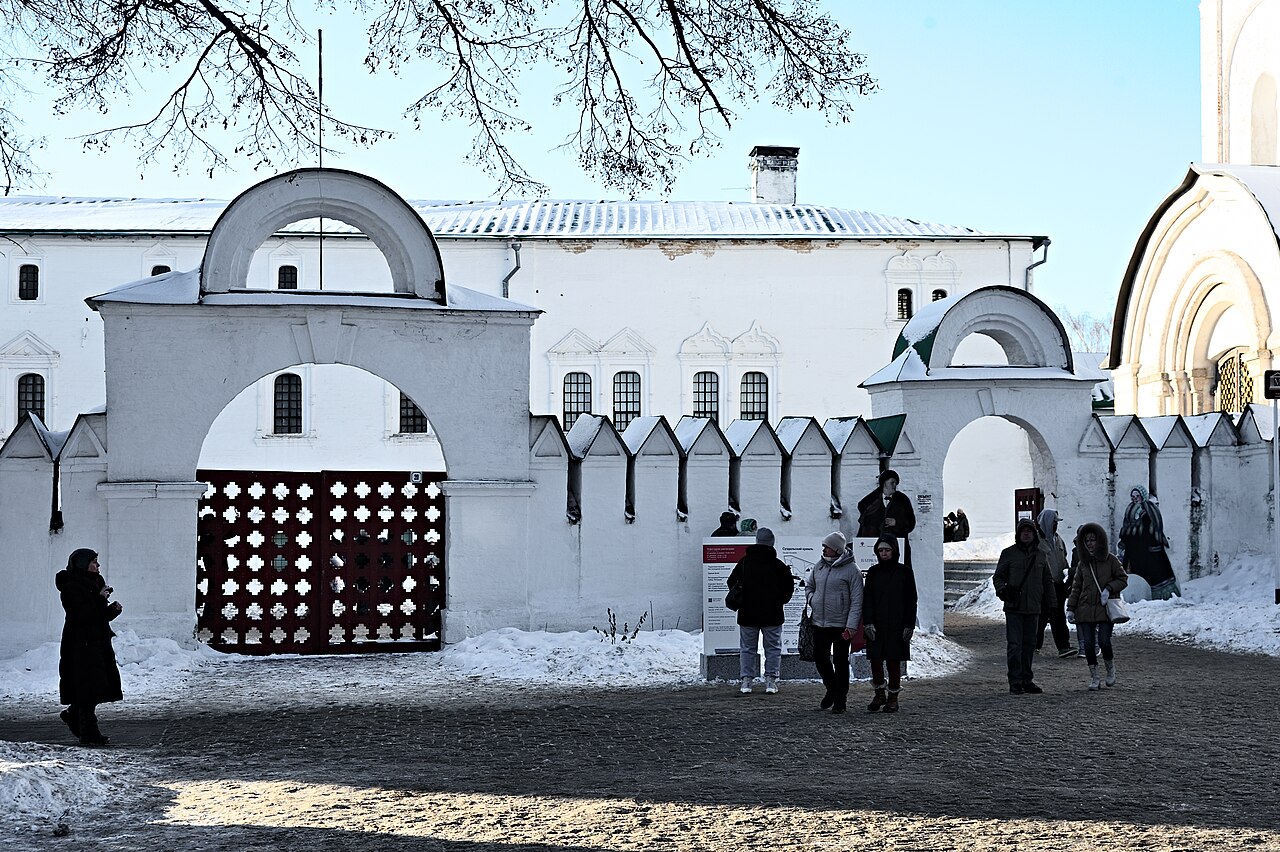
The Kremlin’s earthworks are the town’s oldest monument and still its boundary: ramparts raised at the turn of the eleventh to twelfth centuries ring the river-looped promontory for fourteen hundred meters, grass-grown, walkable, and in winter the town’s sledding hills, fortification softened into landscape, with the wooden walls that once topped them gone since a 1719 fire and never missed by the view.
Within them stood the land’s first great church: Vladimir Monomakh, grand prince and the dynasty’s lawgiver, built a cathedral of the Dormition here around 1100, the chronicles record, in brick, the oldest stone building of the northeast, whose foundations archaeologists found beneath the present cathedral’s floor, the town’s architectural genealogy running in one vertical line from Monomakh’s brick to the starred domes above.
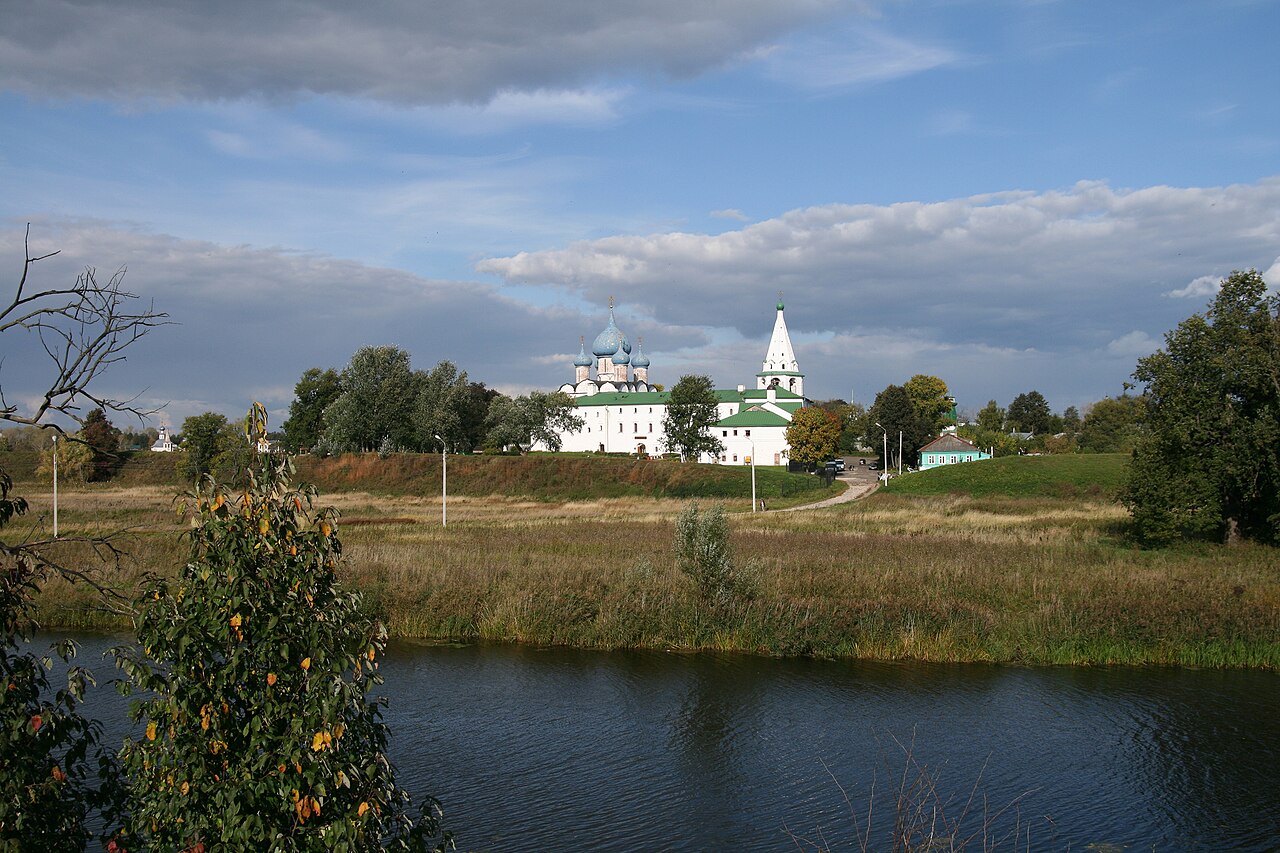
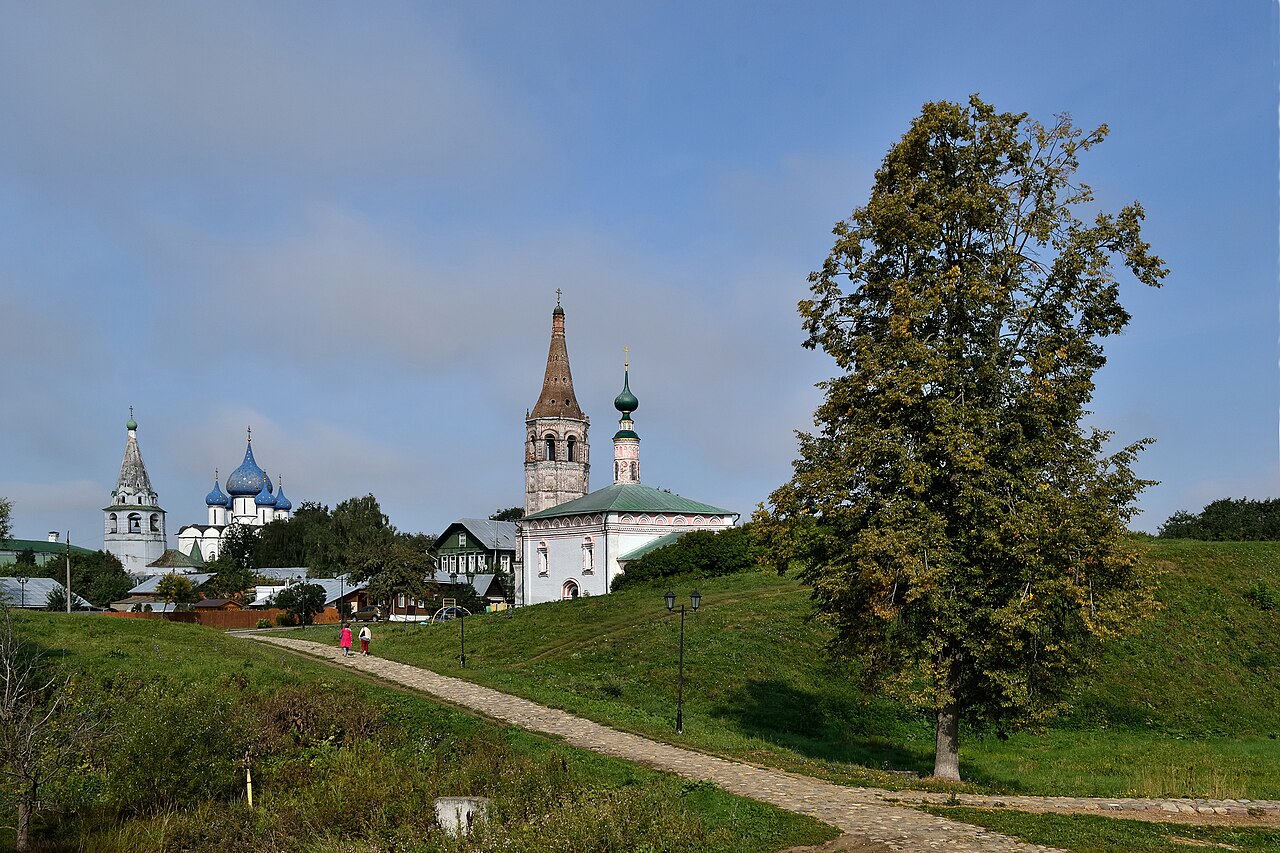
The ramparts’ circuit remains the best introduction to Suzdal: from their crest the Kremlin’s ensemble, the river’s loops, the convents’ towers, and the meadows compose themselves in every direction, the medieval town plan legible at a glance, and the walk makes plain the site’s logic, the river’s moat-loop guarding the promontory that guarded the land.
Capital Days and Dolgoruky
Suzdal’s political noon came with Yuri Dolgoruky, Monomakh’s son, who made the town his capital in the 1120s and ruled the northeast from it for thirty years while reaching, as his nickname Long-Arm records, for Kiev itself; the same prince’s fortifying of a minor border point called Moscow in 1147, the chronicle’s first mention, was a Suzdal administrative act, the future capital founded as this town’s outpost.
Yuri’s son Andrei Bogolyubsky moved the throne to Vladimir in 1157, preferring his own new city, and Suzdal began its long second rank, capital rank in memory, junior in fact, though the title Suzdal land clung to the whole principality and the town kept its bishops, its monasteries, and its pride, the mother town of the dynasty that would gather Russia.
The capital interlude left the town its self-understanding, still palpable: Suzdal treats Moscow, affectionately, as a descendant that did well, and the Kremlin’s displays make the point with documents and genealogies, the Rurikids’ northeastern line running Rostov, Suzdal, Vladimir, Moscow, the imperial river rising from this meadow spring.
The Nativity Cathedral
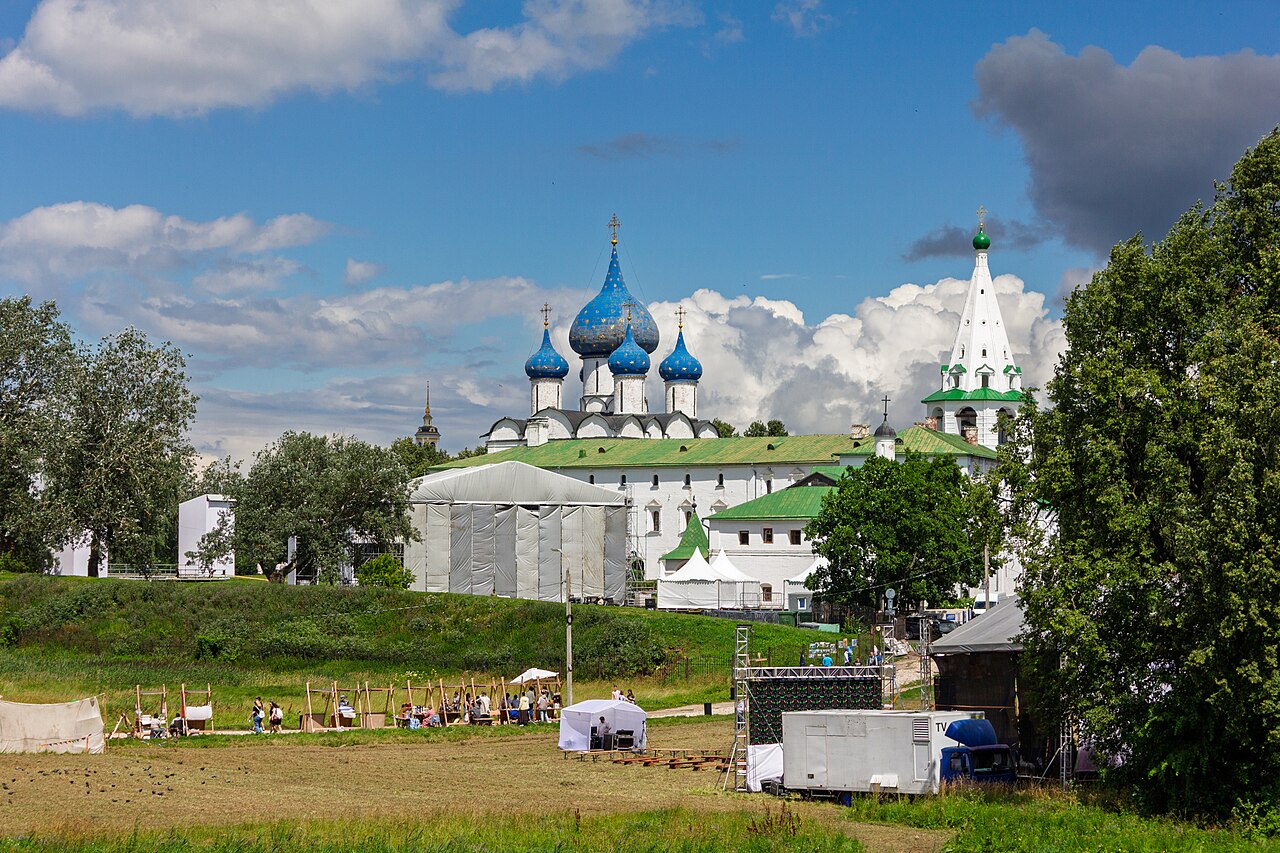
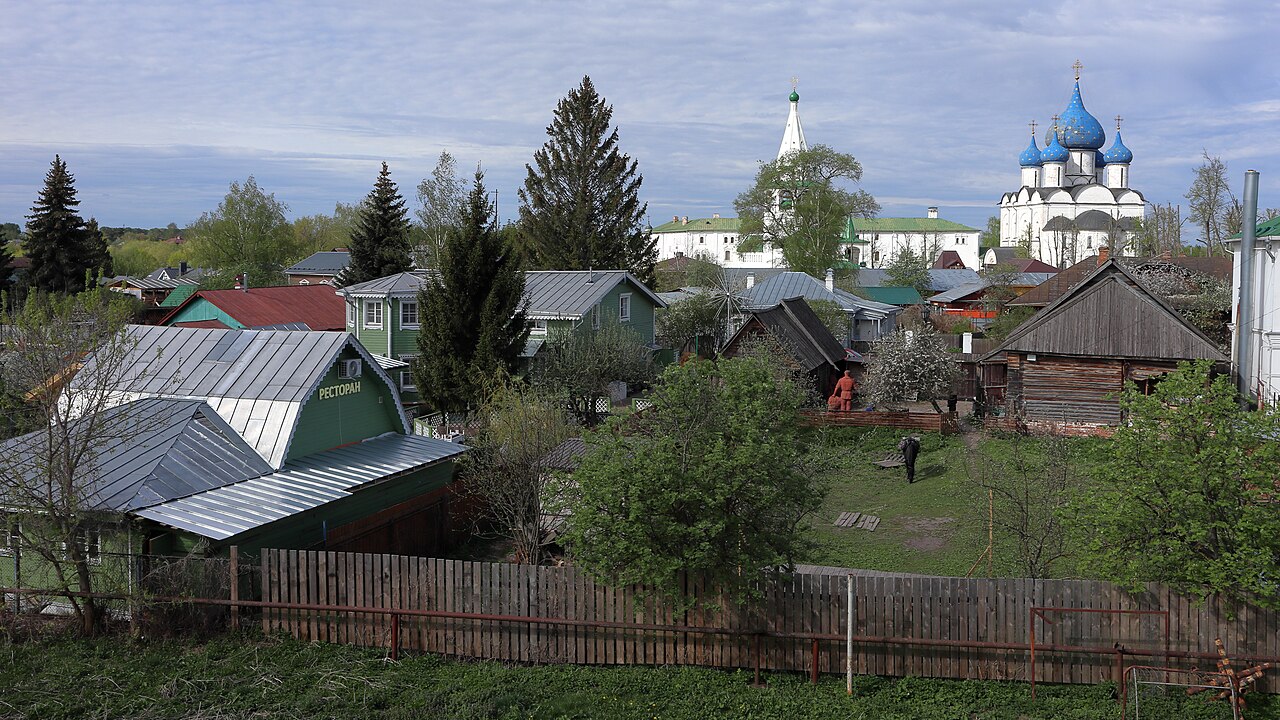
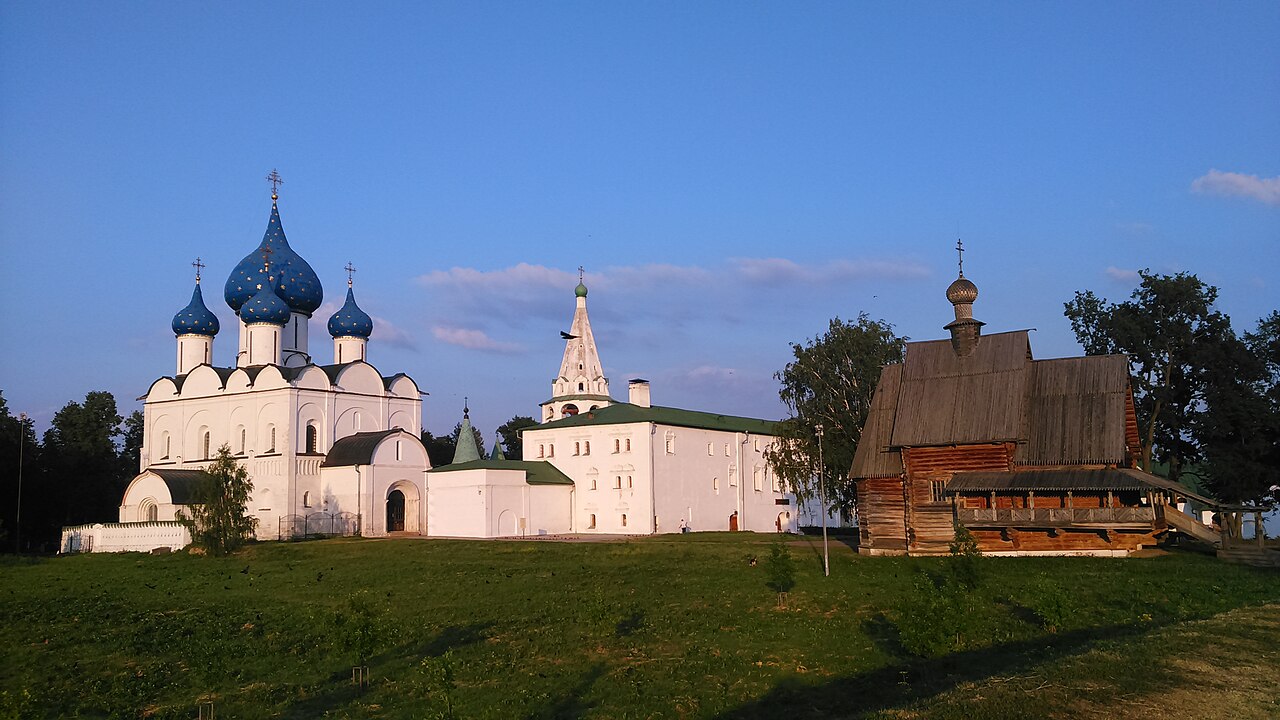
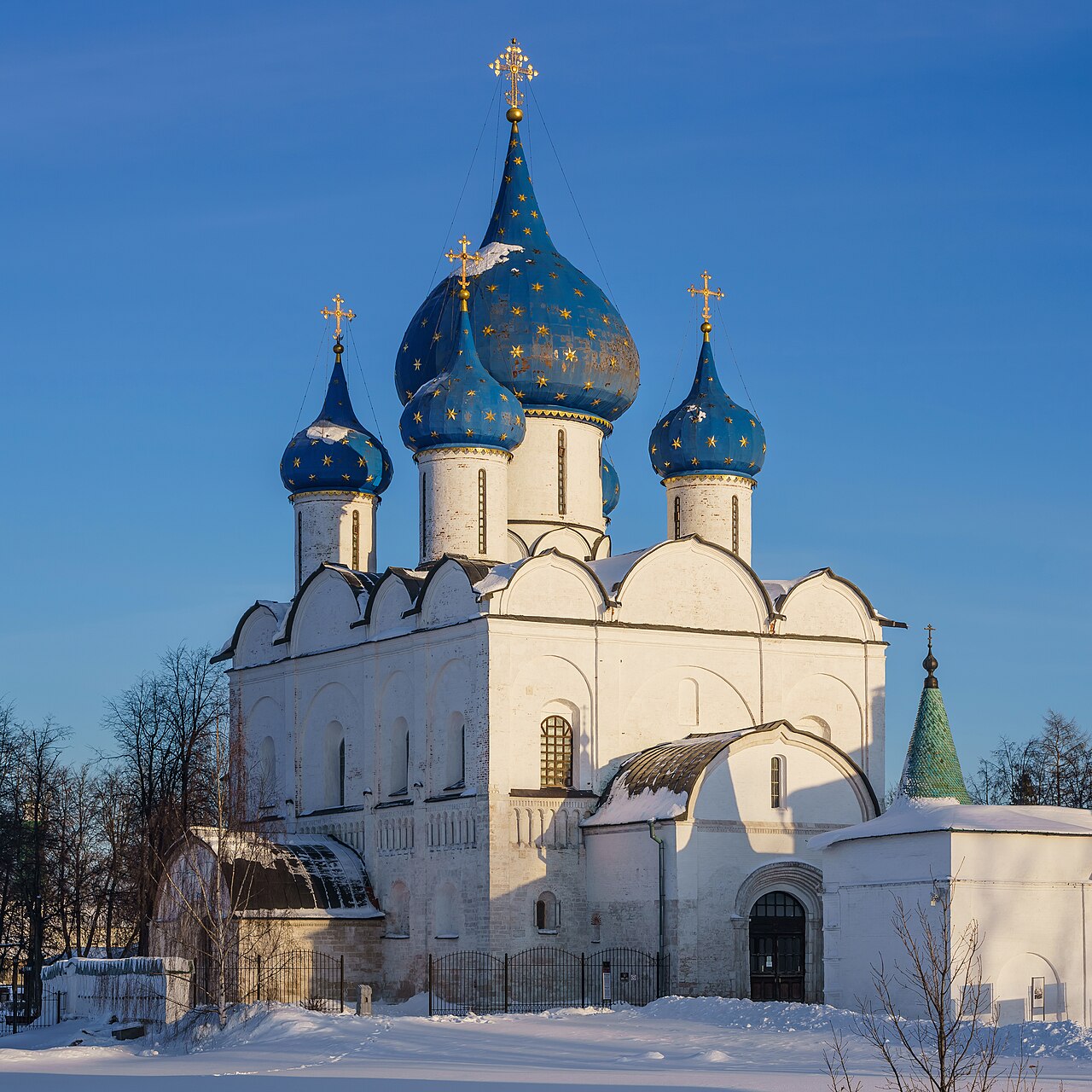
The Kremlin’s heart is the Cathedral of the Nativity of the Theotokos, built 1222 to 1225 under Prince Georgy Vsevolodovich on Monomakh’s foundations, the only church of the pre-Mongol northeast built not of smooth limestone but of porous tufa with limestone details, its lower third original thirteenth-century work, carved with the era’s beasts and ornament, female masks among them, the cathedral being dedicated to the Mother of God and, scholars suggest, to the town’s women.
The upper body and the five great drums are the 1528 rebuilding after centuries of damage, and the domes’ present glory is seventeenth-century taste: deep ultramarine strewn with golden stars, the night sky brought down over Suzdal, the single most photographed image of the town and, with Rostov’s silver and Vladimir’s gold, one of the Ring’s three canonical skylines.
The interior keeps treasures in layers: fresco fragments of the 1230s, the great seventeenth-century cycles, the necropolis of Suzdal’s princes and bishops along the walls, including sons of the cathedral’s builder, and over all the vast iconostasis, the church functioning now in shared museum-and-parish rhythm, incense and audio guides negotiating the same ancient air, UNESCO’s white-monuments listing covering the whole.
The Golden Gates of Suzdal
The cathedral’s western and southern doors are the Kremlin’s hidden masterpiece: the Golden Gates of the 1230s, oak leaves sheathed in copper plates worked in fire-gilding, zolotaya navod, scenes of the Gospels and the archangels drawn in gold on blackened ground, twenty-eight panels a door, the finest surviving examples of the technique anywhere and among the very few pre-Mongol metalwork ensembles to escape the storm that followed their making by a decade.
The technique itself is the marvel the guides linger on: gold dissolved in mercury, painted onto the prepared copper, the mercury driven off by fire, the gold fused, a process as poisonous as it was permanent, worked by masters whose names are lost and whose lungs, the craft’s historians note grimly, paid for the angels’ permanence.
That the gates survived 1238, when the Mongols burned the town around them, borders on the inexplicable, hidden, spared, or simply too fixed to loot, and they hang now where they have hung for eight centuries, opened on feasts, the touchable, walk-past presence of the world before the catastrophe, which in Suzdal is not an abstraction but a date in the next paragraph of every tour.
The Mongol Storm
In February 1238 Batu’s army, having taken Vladimir, fell on Suzdal: the chronicle’s spare lines record the town burned, the people slain or marched off, the monasteries pillaged, one catastrophe among the dozens that winter that broke the old Rus and opened the Mongol centuries, the Kremlin’s ramparts proving, like every Russian earthwork that year, helpless against the siege train of the steppe.
Suzdal’s recovery ran through the church: the town rebuilt around its cathedral and monasteries, served briefly as a junior capital again in the fourteenth century’s Suzdal-Nizhny Novgorod principality, minting its own coins and chronicling its own line, before Moscow absorbed the land in the 1390s, the mother town folded into the daughter’s empire, its political history essentially complete by 1400.
What remained was sanctity and the long provincial afternoon: pilgrimage, fairs, cucumber gardens, the famous Suzdal cucumbers still feted each July, and the slow accumulation of churches by merchant piety, history hereafter happening to Suzdal rather than from it, with the single exception of the exiles the capitals kept sending, for the town’s quiet had its uses.
The Bishops’ Court
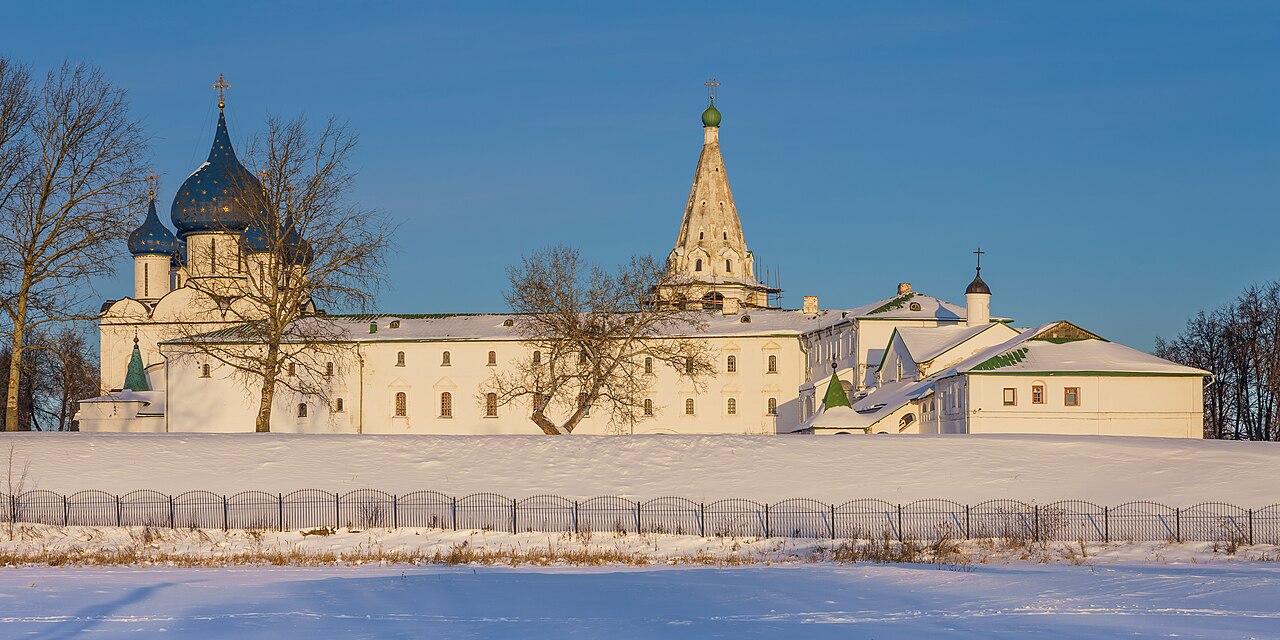
Beside the cathedral spreads the Kremlin’s palace: the bishops’ and archbishops’ chambers, a connected labyrinth built across the fifteenth to eighteenth centuries, culminating under Metropolitan Hilarion in the 1680s and 1690s, refectory, chancellery, residential blocks, and gallery passages knitted into one of the best-preserved hierarchs’ courts in Russia, Suzdal’s answer, at bishop’s rather than metropolitan’s scale, to Jonah’s Rostov.
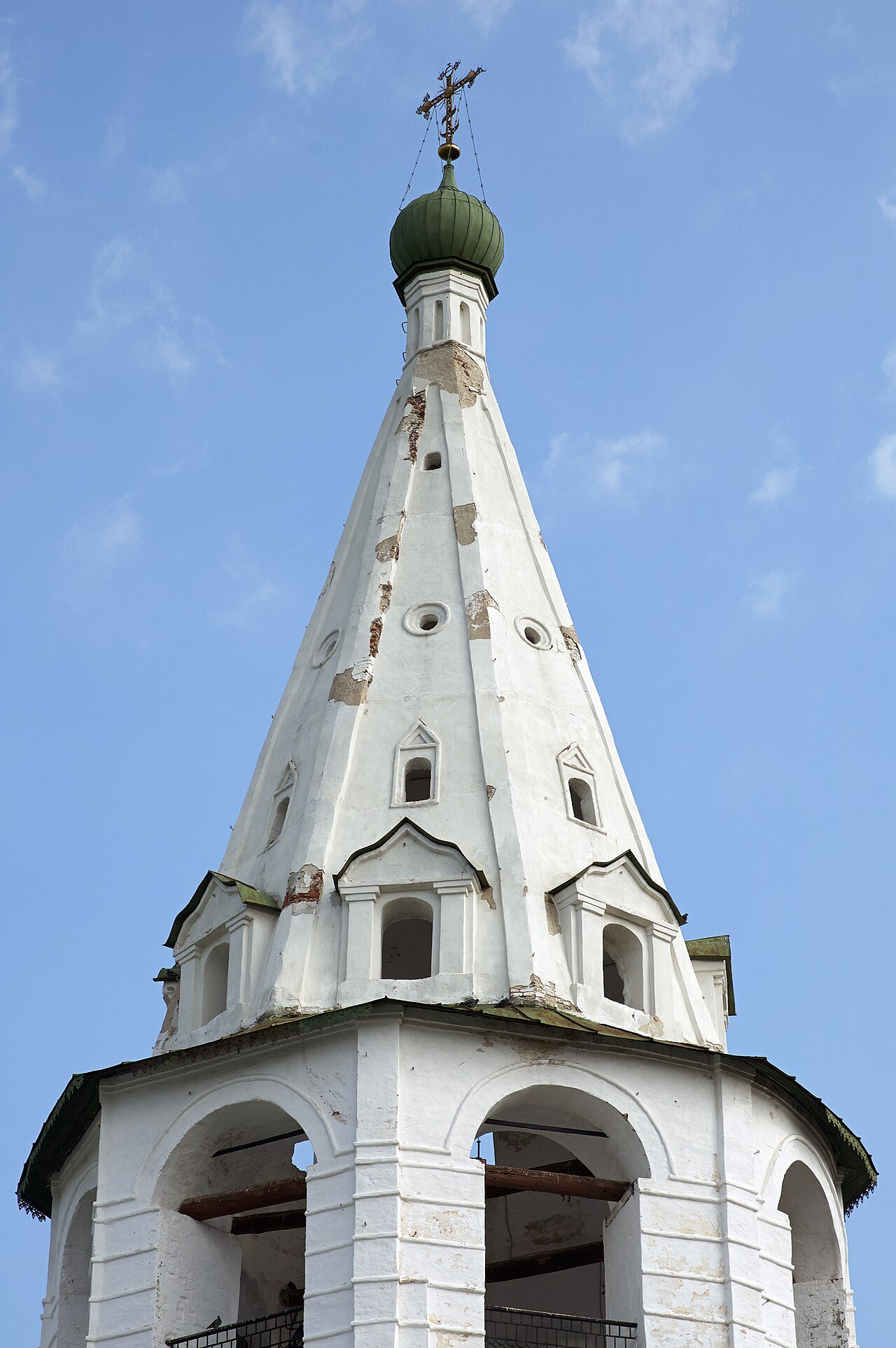
The complex’s tent-roofed bell tower of 1635 carries the town clock, its chiming mechanism a cherished reconstruction, and the chambers house the Suzdal museum’s principal exhibitions: the history halls with the land’s archaeology and the princes’ and bishops’ treasures, the old-Russian painting collection with icons of the Suzdal school’s seven centuries, and the restored interiors of the hierarchs’ household.
The court’s domestic wing preserves the eighteenth-century bishop’s apartments, tiled stoves, portraits, the working clutter of a provincial Vatican, through which the visit passes from state rooms to pantries, the ecclesiastical palace as living machine, a register of palace life the imperial residences rarely show so plainly.
The Cross Chamber
The chambers’ showpiece is the Cross Chamber of the 1680s, Hilarion’s ceremonial hall: three hundred and thirty-eight square meters vaulted without a single pillar, a nine-sazhen span that contemporaries ranked among the engineering feats of the age, larger in clear span than Moscow’s Palace of Facets, the provincial bishop’s hall outdoing the tsars’ in the one dimension that counts in vaulting.
The hall is restored to its early eighteenth-century state from inventories: the long table in state, the tiled stoves towering in the corners, portraits of hierarchs and sovereigns, the bishop’s seat beneath the icons, the room where the diocese’s councils, the royal receptions, and the great feast days gathered for two centuries, and where the museum now stages its most ceremonial exhibitions and events.
Standing under the unsupported vault is the point: the visitor is meant to look up, as guests have been meant to since the 1680s, and feel the span, brick persuaded into sky by provincial masters whose names the account books half-preserve, the Russian seventeenth century’s quiet claim that the capital of faith builds as boldly as the capital of power.
Exiled Tsaritsas and the Convent
Suzdal’s quiet made it the capitals’ oubliette, and the Pokrovsky convent across the river from the Kremlin was its gilded cell: here Vasily III sent his wife Solomonia Saburova in 1525 for barrenness, forcibly veiled so the grand prince could remarry, the church scandalized, the legend insisting she bore a son in the convent and hid him by staging his burial, the little false grave duly found by archaeologists in 1934 holding a doll in a boy’s shirt, history refusing to pick between tale and trick.
The convent’s register of involuntary brides reads like the dynasty’s shadow chronicle: Ivan the Terrible’s wife Anna Vasilchikova, the tragic Evdokia Lopukhina, Peter the Great’s discarded first wife, whose Suzdal years ended in the torture of her circle when Peter’s inquisitors descended in 1718, and a dozen great names between, the town holding the empire’s unwanted queens while its markets sold cucumbers under their windows.
The Kremlin’s own precincts held the male equivalent in the Spaso-Yevfimiev monastery’s prison, founded by Catherine’s decree, whose cells held religious dissidents and, in the Soviet sequel, the monastery served as a filtration camp, Field Marshal Paulus its most famous ward after Stalingrad, Suzdal’s sanctity and captivity twined to the end, the museum in the old prison now the Ring’s most sobering half hour.
The Wooden Church That Traveled
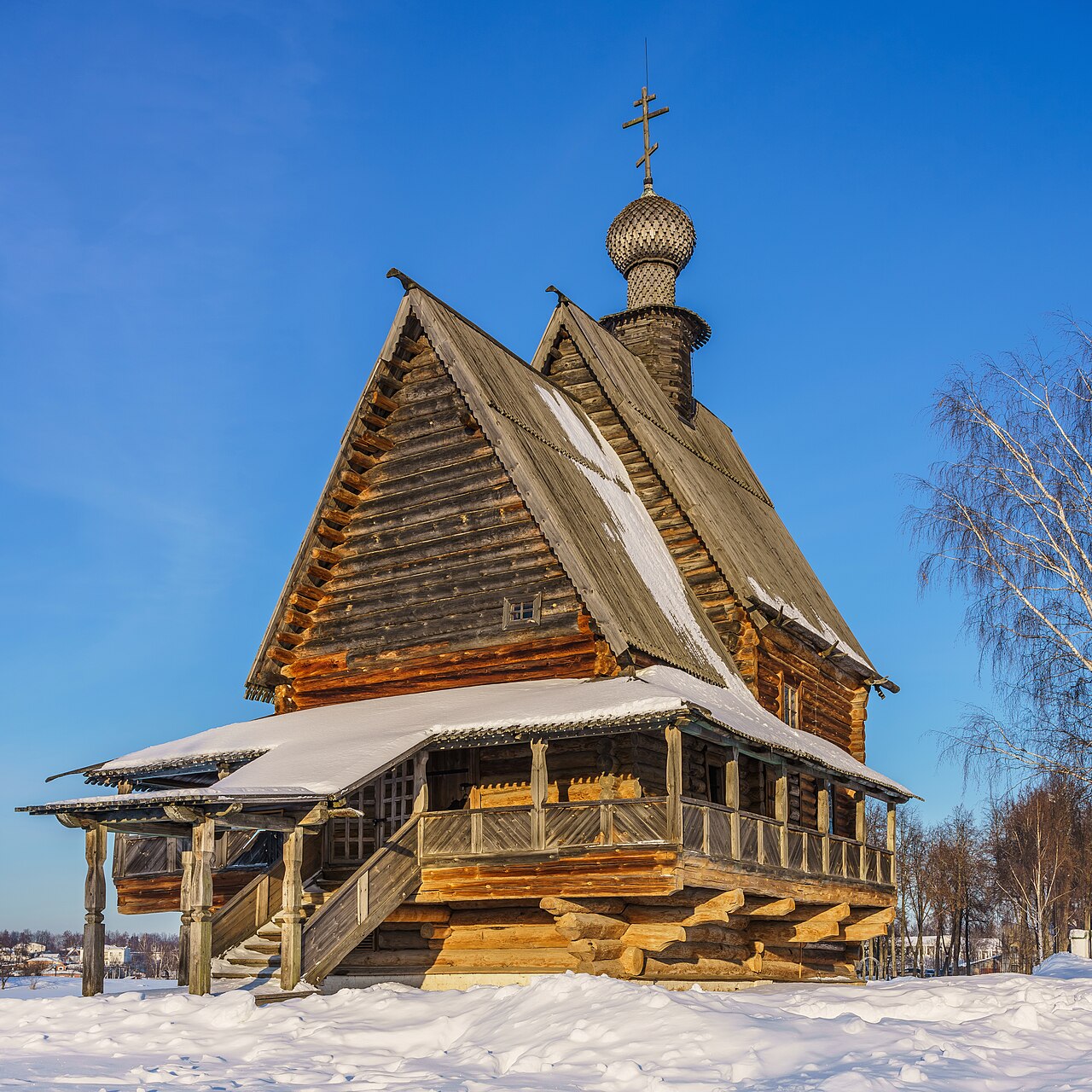
The Kremlin’s youngest ancient monument arrived on trucks: the Church of St Nicholas from the village of Glotovo, built 1766, a perfect kletskaya, log-cell, church of the northern carpentry, moved whole to the Kremlin’s rampart corner in 1960 when its village emptied, the first exhibit of Suzdal’s open-air preservation and the Kremlin ensemble’s wooden grace note against the cathedral’s stone.
The rescue begat a museum: across the river the Museum of Wooden Architecture assembled, from the 1960s, churches, mills, and peasant houses from the Vladimir land’s dying villages, the transfiguration church of 1756 on its scented log scale, windmills turning on the meadow, so Suzdal curates not only its own past but the vanished countryside’s, the axe’s civilization given sanctuary by the town the railways forgot.
St Nicholas’s placement was exact: it stands where the Kremlin’s southwest tower once rose, wooden church for wooden walls, and its silhouette against the sunset over the Kamenka supplies the ensemble’s most painted view, the thousand-year court completed, in its tenth century, by a village church younger than Versailles, which is the kind of joke Suzdal’s timeline plays naturally.
The Town That Became a Museum
Suzdal’s modern salvation was planned: the 1960s Soviet decision to develop the Golden Ring route found the town intact, no railway since the nineteenth century bypassed it, no industry beyond gardens, and the 1967 master plan made preservation the town’s industry, height limits, the museum-reserve uniting Kremlin, monasteries, and wooden museum, and the tourist infrastructure threaded discreetly behind historic facades.
The result became a model cited worldwide: a living town, not a reservation, where the thousand-year fabric sets the rules, UNESCO’s 1992 listing of the cathedral ensemble crowning the status, and the millennium celebrations of 2024 refreshing the whole, Suzdal demonstrating that poverty’s accidental preservation could be converted into prosperity’s deliberate kind.
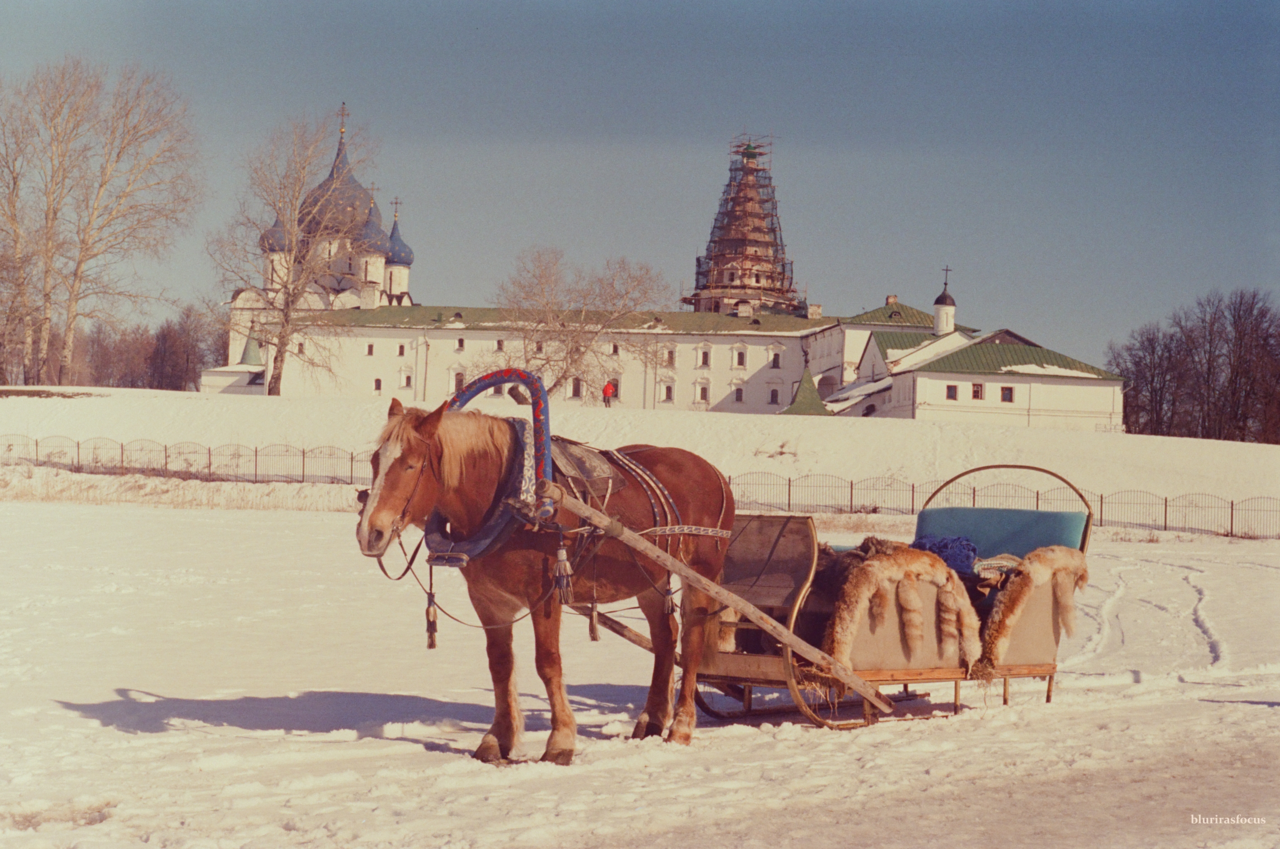
The economics are visible and cheerfully medieval: guesthouses in merchant homes, mead-brewing revived at scale, the cucumber festival, horse carts on the Kremlin lane, the town earning from pilgrims as it did eight centuries ago, with the museum-reserve’s scholarship, restoration workshops and all, underwriting the picture’s honesty.
The Suzdal Rhythm
Suzdal on screen completes the circle: Tarkovsky shot Andrei Rublev’s medieval Russia here in the 1960s, the snow scenes under the Kremlin walls entering world cinema, and productions have returned ever since, the town supplying old Rus to the cameras as Rostov supplies old Moscow, with the locals’ practiced calm toward film crews part of the municipal temperament.
The visitor’s Suzdal rhythm finds itself quickly: churches till the legs protest, then the meadow paths, the mead tasting’s honeyed flights, the river bathhouse steam, and the bell-ringing floating over it all, the town built to the pace of processions rewarding exactly that pace, with dawn and late evening, the coaches gone, returning the ramparts to the cows and the committed.
The Kremlin at those hours delivers the Ring’s quietest profundity: the starred domes over the dark cathedral mass, the wooden church black against afterglow, the ramparts’ grass holding the day’s warmth, a thousand years present at once and nothing in sight to contradict them, the oldest court of the Golden Ring closing the day as it has closed forty thousand days before.
Practical wisdom for the Kremlin itself: begin at the ramparts’ southwest corner by the wooden church for the orientation view, take the cathedral and Golden Gates before the first coaches arrive, then the bishops’ chambers at leisure, the Cross Chamber and icon halls rewarding slow attention, and finish along the river path below the walls, where the ensemble composes its best photographs across the Kamenka’s reflections. The clock tower’s chimes mark the quarter hours as they have for generations, and the lane outside the gates keeps the town’s horse carts, mead stalls, and felt-boot sellers in their accustomed places, the market’s thousand-year murmur continuing beside the court it has always served.
Watch the Suzdal Kremlin on Film
Visiting the Suzdal Kremlin Today
Suzdal lies 220 kilometers east of Moscow and 35 from Vladimir, which has the railway: fast trains from Moscow’s Kursky station reach Vladimir in under two hours, with buses and taxis covering the Suzdal leg in forty minutes, and direct Moscow buses serve the town. The Kremlin grounds open daily into the evening; the cathedral, bishops’ chambers, and exhibitions sell museum tickets with combined options, the wooden architecture museum across the river keeping its own hours, and the ensemble’s churches close in extreme weather to protect frescoes. Give Suzdal a full day minimum, ideally a night, adding the Spaso-Yevfimiev monastery’s bell concerts and the Pokrovsky convent; July’s cucumber festival and winter’s snow weeks are the signature seasons. You can find the Kremlin on the map here: Suzdal Kremlin on Google Maps.
Palaces Nearby
You May Like
The Pskov Pogankin Chambers and the Merchant Palaces of the Frontier