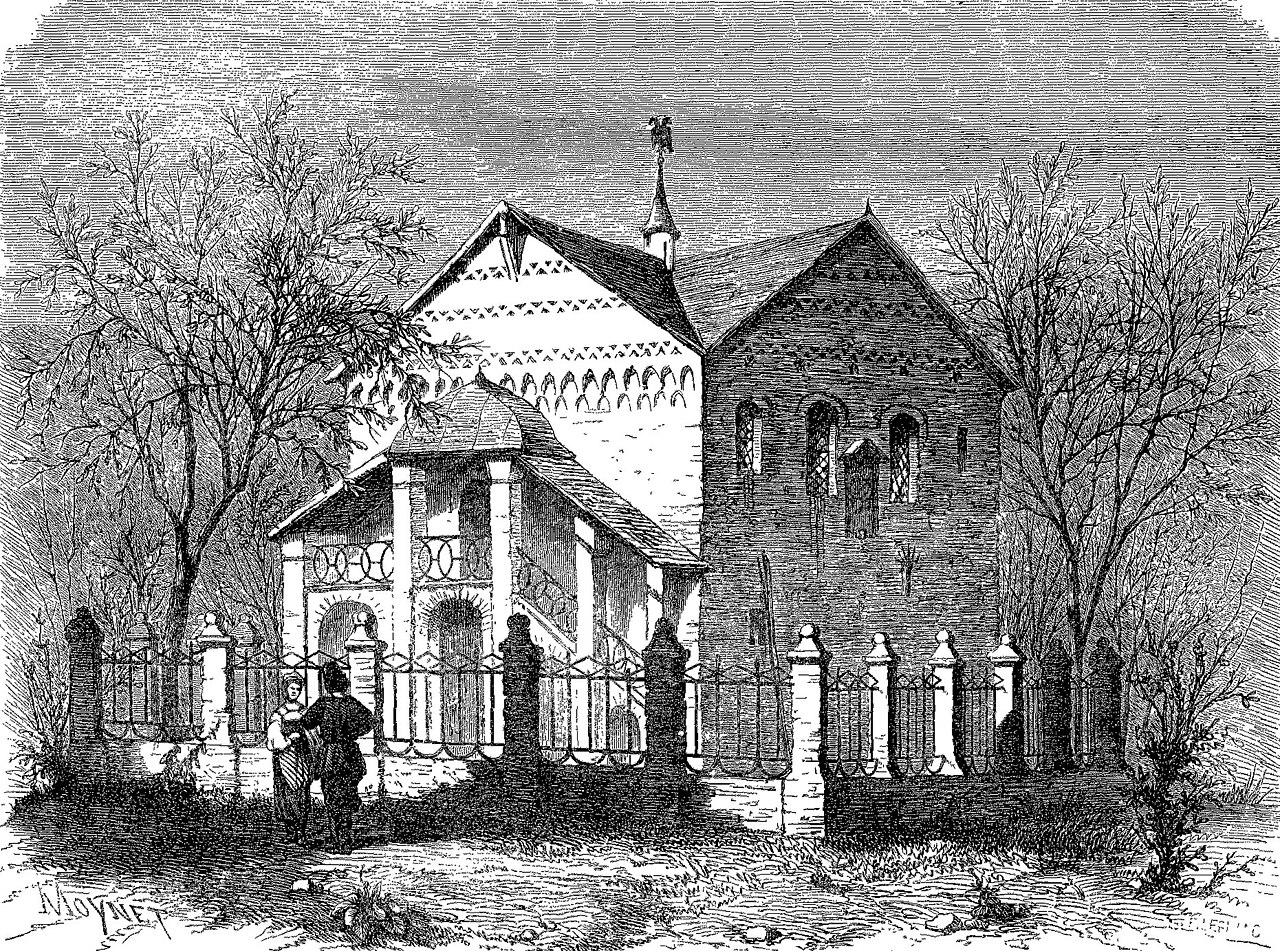
On a quiet bend of the upper Volga, where river cruise ships now tie up beneath old willows, stands a small red-brick palace with a story far too large for it. The palace of the Uglich princes, built in the 1480s, is one of the oldest surviving residential buildings in all Russia, and on the grass before it, on 15 May 1591, a nine-year-old boy was found dying of a knife wound to the throat. The boy was Dmitry, last son of Ivan the Terrible, and his death on this lawn opened the darkest chapter in Russian history, the Time of Troubles, and one of its strangest mysteries, which historians still argue four centuries on.
Uglich’s little kremlin holds the whole drama in a hundred meters: the prince’s palace where Dmitry lived his provincial exile, the crimson Church of St Dmitry on the Blood built where he fell, its famous fresco telling the town’s version of the story, and the bell, the famous exiled bell of Uglich, that rang the alarm and was punished for it like a man, whipped, mutilated, and deported to Siberia for three hundred years.
This guide tells the full tale: ancient Uglich and its appanage princes, the palace’s rare survival from the fifteenth century, Dmitry’s exile court and the fatal noon, the investigation led by the future tsar Vasily Shuisky and its suspiciously convenient verdict, the mother’s bell and the town’s massacre and punishment, the False Dmitrys who rose from the grave the town dug, the boy’s sainthood, and the practical details of visiting the Volga’s most haunted lawn.
- Uglich and Its Princes
- The Palace of the 1480s
- Prince Andrei the Big and His Fall
- Dmitry’s Exile Court
- The Fatal Noon of 1591
- The Bell That Was Punished
- Shuisky’s Investigation
- Accident or Murder
- The Grave That Opened the Troubles
- The False Dmitrys
- The Boy Who Became a Saint
- The Church on the Blood
- The Uglich Kremlin Today
- Watch the Uglich Palace on Film
- Visiting the Uglich Palace Today
- Palaces Nearby
Uglich and Its Princes
Uglich is old even by upper-Volga standards: local tradition claims a founding in 937, the chronicles notice the town by 1148, and through the Mongol centuries it served as the seat of an appanage principality, one of the family shares into which the Rurikid princes divided their patrimony, passing eventually into Moscow’s orbit as a holding for the grand princes’ younger sons and brothers, the classic appanage town, provincial, pious, and politically combustible.
The combustibility was structural: an appanage prince was by definition a possible rival, a spare heir with lands, revenues, and a court of his own, and Moscow’s consolidating rulers treated their Uglich kin accordingly, with honors in good years and dungeons in bad. The town’s princely history reads as a chronicle of gilded suspicion, which gives its two most famous residents, Andrei the Big and the boy Dmitry, their shared plot line a century apart.
The town itself prospered on the river: Volga trade, fisheries, and the kremlin on its low bluff over the water, with wooden walls long gone and the cathedral square open to the river breeze. Modern Uglich, a cruise stop and watchmaking town of thirty thousand, keeps the appanage scale, everything important within five minutes’ walk of the lawn where everything important happened.
The Palace of the 1480s
The red-brick chambers by the cathedral are a survival against all odds: built in the 1480s for Prince Andrei Vasilievich, brother of Ivan III, as the ceremonial core of a great wooden palace complex, they are, with a handful of rivals, the oldest dwelling standing in Russia, older than Moscow’s Palace of Facets’ completion, provincial brickwork pioneering while the capital still imported Italians.
The building is a princely hall-house of the earliest type: a high vaulted throne chamber on the upper floor over service undercrofts, the brick patterned at the gables in bands and crosses, the whole once joined by passages to vanished wooden living quarters, so what stands is the palace’s stone heart, the room where the appanage court held its audiences and feasts.
Its survival ran through neglect rather than care: too solid to rot, too holy by association to demolish, it decayed under temporary roofs for centuries, was restored with romantic additions, the porch and roof are nineteenth-century interpretations, for the 1890s tercentenary of Dmitry’s death, and now houses the Uglich museum’s oldest treasures, the throne room’s vault sheltering icons and the relics of the drama that made the address immortal.
Prince Andrei the Big and His Fall
The palace’s builder lived its first tragedy: Andrei the Big, able and popular, fell out with his brother Ivan III over the gathering of power that was making Moscow’s ruler a sovereign rather than an elder kinsman; in 1491, summoned to Moscow under friendship’s forms, Andrei was seized at dinner, and he died in chains two years later, his sons imprisoned for decades, the Uglich line extinguished by fraternal arithmetic.
The chronicles preserve Ivan’s remarkable half-apology: the grand prince wept, they record, and told the metropolitan he had acted for the land’s sake, lest after his death his grandchildren fight the old wars again, reasons of state confessing themselves at the dawn of the Russian autocracy, in the very generation the palace’s bricks were drying.
Andrei’s fall set the palace’s pattern a century before Dmitry: Uglich as the gilded cage of dangerous kin, the hall built for appanage pride becoming the stage of its liquidation. When another suspect heir arrived in 1584, a toddler with the worst name in Russia, the town and the palace already knew the play.
Dmitry’s Exile Court
Dmitry was Ivan the Terrible’s last child, born 1582 to the tsar’s seventh and uncanonical wife Maria Nagaya, which made the boy’s very legitimacy a church question and his existence a political one: when Ivan died in 1584 and the feeble Fyodor inherited under the regency of Boris Godunov, the Nagoy clan and their prince were sent at once to Dmitry’s appanage of Uglich, honorable exile with the fittings of a court and the function of a quarantine.
The Uglich years ran on resentment: the Nagoys, stripped of capital influence, nursed grievances and, the record suggests, the boy’s sense of destiny, while Godunov’s clerks ran the appanage’s finances over their heads. Of Dmitry himself the sources sketch an epileptic, high-strung child, given, hostile testimony later claimed, to violent games, snowmen named for Moscow’s boyars beheaded with a toy saber, Godunov’s first among them, the detail too good for propaganda to have missed, whoever invented it.
The court’s days centered on the palace and the adjoining cathedral: lessons, church, the riverbank, a provincial routine under watch, with the one standing anxiety every witness later agreed on, the boy’s falling sickness, his epilepsy, which had recently returned, his mother treating it with prayers and distrust of doctors, and which would stand at the center of the mystery to come.
The Fatal Noon of 1591
On Saturday 15 May 1591, at midday, Dmitry was in the palace yard with his nurse, his bed-keeper, and four playmates, playing tychka, a game of flicking a knife into the ground, when, in the official record’s version, a fit seized him and he fell on the blade, the wound opening his throat; in the version his mother screamed from the first instant, the boy had been murdered by Godunov’s agents, the clerk Bityagovsky’s son and his companions, set over the court as watchers.
What is certain is the next hour: the cathedral bell rang the alarm, the town poured into the kremlin, and the crowd, led by the Nagoys’ cries, lynched the accused watchers, Mikhail Bityagovsky, his son, and others, fifteen dead by the day’s end, the appanage administration massacred on the lawn beside the dying or dead prince, Uglich pronouncing and executing its own verdict before Moscow had heard the news.
The town had, in effect, risen against the regent’s government over the body of the heir presumptive: however the boy died, the massacre was rebellion, and everyone in the kremlin that afternoon, the grieving clan, the bloodied crowd, the silent bell-ringer, understood that Moscow’s answer would decide far more than a criminal case.
The Bell That Was Punished
Moscow’s answer included history’s most famous judicial absurdity: the alarm bell itself was tried for sedition, condemned, flogged, its tongue torn out and one ear, its mounting lug, struck off, and exiled with the convicted townsmen to Tobolsk in Siberia, where it hung in disgrace, inventoried as the first inanimate exile, for nearly three hundred years, Uglich petitioning across the centuries for its pardon.
The punishment’s logic was medieval and perfectly serious: the bell had voiced the rebellion, so the bell bore the rebellion’s penalty, mutilated as a human rebel would be, the state teaching the Volga that even bronze answers for rising against it. Some sixty Uglich families went to Siberia with their bell, founding, tradition holds, the exiles’ first colonies, the town’s population and voice deported together.
The return came only in 1892: Uglich’s petitions finally granted, the bell was pardoned, shipped home up the rivers, and hung in the Church on the Blood, where it hangs now, cracked, earless, and toured daily, struck softly for visitors so that the alarm of 1591 still sounds, domesticated, over the lawn it once set ablaze, Russia’s strangest relic and its most literal one.
Shuisky’s Investigation
Within days Moscow sent a commission of inquiry headed, with exquisite irony, by Prince Vasily Shuisky, a magnate of ambitions entirely his own, and its file survives, the Uglich delo, Russia’s oldest great criminal dossier: dozens of depositions taken on the spot, the playmates, the nurse, the clan, the townsmen, sworn testimony assembled while the graves were fresh, a document historians have cross-examined ever since.
The depositions, read straight, support the accident: the playmates testify to the fit and the fall on the knife, the attendants to the illness’s history, and the commission’s verdict followed, death by God’s judgment through the falling sickness, with the consequences falling on the living, the Nagoys imprisoned or scattered, the mother forced to the veil as the nun Martha, the town punished through its tongue-torn bell and deportations.
But the file’s very tidiness is the problem: taken under the regent’s authority, by a commission with every reason to find what was found, from witnesses who had just watched a lynching answered by state terror, the depositions prove the verdict’s convenience better than its truth, and Shuisky himself would spend the next fifteen years proving that the file’s author believed none of it longer than circumstances required.
Accident or Murder
The question has three classic answers, and Shuisky gave all three himself: in 1591, accident by epilepsy, his commission’s finding; in 1605, when the first False Dmitry marched on Moscow, Shuisky swore the boy had been murdered but had escaped, no, that another child was buried, the pretender was true; in 1606, having helped murder that pretender and taken the throne, Shuisky proclaimed the boy had been murdered by Godunov and was a saint in heaven, exhuming the uncorrupted relics to prove it, three verdicts, one witness, each at the moment of maximum personal utility.
Historians split along the old lines still: the murder thesis, canonized by Karamzin and Pushkin’s Boris Godunov, fits Godunov’s motive, the watchers’ lynching, and the clan’s instant certainty; the accident thesis, dominant among modern specialists, fits the depositions, the fit’s medical plausibility, and the awkward fact that Dmitry’s death helped Godunov less than legend assumes, the boy being canonically illegitimate and the succession unsettled regardless.
The mystery’s insolubility is itself the historical fact that matters: Russia could never agree how the last Rurikid died, and into that uncertainty walked every adventurer of the next twenty years. The lawn at Uglich is the scene of the crime either way, the crime being, at minimum, the truth’s first assassination.
The Grave That Opened the Troubles
The Time of Troubles, Russia’s near-death experience of 1598 to 1613, grew directly from the Uglich lawn: when Tsar Fyodor died childless in 1598, the Rurikid dynasty’s seven centuries ended, and Godunov’s elected tsardom stood exposed to famine, boyar hatred, and above all the whisper the bell had rung, that the true heir’s blood was on the new tsar’s hands, or, stranger and more corrosive, that the true heir lived.
The catastrophe’s scale beggars summary: the great famine of 1601 to 1603 killed perhaps a third of the realm, pretenders and Polish armies took Moscow itself, Swedes took Novgorod, tsars were made and unmade yearly, and the state dissolved into banditry and civil war until the national militia of 1612 and the Romanov election of 1613 closed the abyss, with the Uglich boy’s name the whole storm’s password.
Uglich itself drank the Troubles to the lees: Polish-Lithuanian bands sacked the town repeatedly, the chronicle numbering its churches and people burned in terms that archaeology confirms, so the town that had lynched the clerks in 1591 was itself near-annihilated within a generation, the lawn’s first blood returning as a flood, which is the moral the town’s guides, standing between palace and church, have drawn for four hundred years.
The False Dmitrys
The dead boy became the age’s most successful political identity: the first False Dmitry, by the standard account the runaway monk Grigory Otrepyev, persuaded Poland, an army, and finally Moscow itself that he was the Uglich prince escaped, reigning as tsar for eleven months in 1605 to 1606, marrying Marina Mniszech, and dying in a boyar coup, his body burned and the ashes, the story insists, fired from a cannon toward Poland, the only tsar ever launched from artillery.
The second False Dmitry, the Tushino thief, claimed to be the first escaped once more, besieged Moscow from his own court-camp, and was accepted, under duress, by Marina as her miraculously twice-saved husband; a third pretender followed in Pskov, and the name’s magic worked because the Uglich grave had been officially opened and reopened, accident, escape, murder, sainthood, until no verdict held authority, the state having spent the truth’s currency itself.
The pretender era’s lesson entered Russian political culture permanently, samozvanstvo, self-appointment, recurring from Pugachev’s Peter III to the century’s sundry survivors, and its root is the Uglich lawn: a child’s unexplained death at the dynasty’s end, the gap in the record becoming a door, and through the door, armies. Few spots on earth have generated more consequence per square meter of grass.
The Boy Who Became a Saint
The third verdict proved final: in 1606 the new tsar Shuisky, needing the grave sealed against further resurrections, had Dmitry’s remains translated from Uglich to Moscow’s Archangel Cathedral, the uncorrupted body examined by hierarchs, miracles recorded, and the boy canonized as the Holy Right-Believing Tsarevich Dmitry of Uglich and Moscow, martyr, the church settling with sanctity what the state could not settle with inquiry.
The cult took genuine root: the saint’s day processions, the healing miracles at the Moscow shrine, and in Uglich the sanctification of the death-site itself, with the town’s identity reorganized around its martyr, his image, the boy with the martyr’s cross, becoming Uglich’s arms and the Volga’s best-known icon subject, innocence slain entering the national iconography’s deepest register.
The relics’ politics outlived the Troubles: the shrine guarded the throne against the name’s further use, princes swore oaths at the tomb, and the dynasty that followed kept the cult in repair, the Romanovs’ legitimacy resting partly on their reverence for the line they had replaced. The saint’s Uglich feast, 28 May by the modern calendar, still fills the kremlin with processions, the lawn’s oldest anniversary kept as holiday rather than wound.
The Church on the Blood
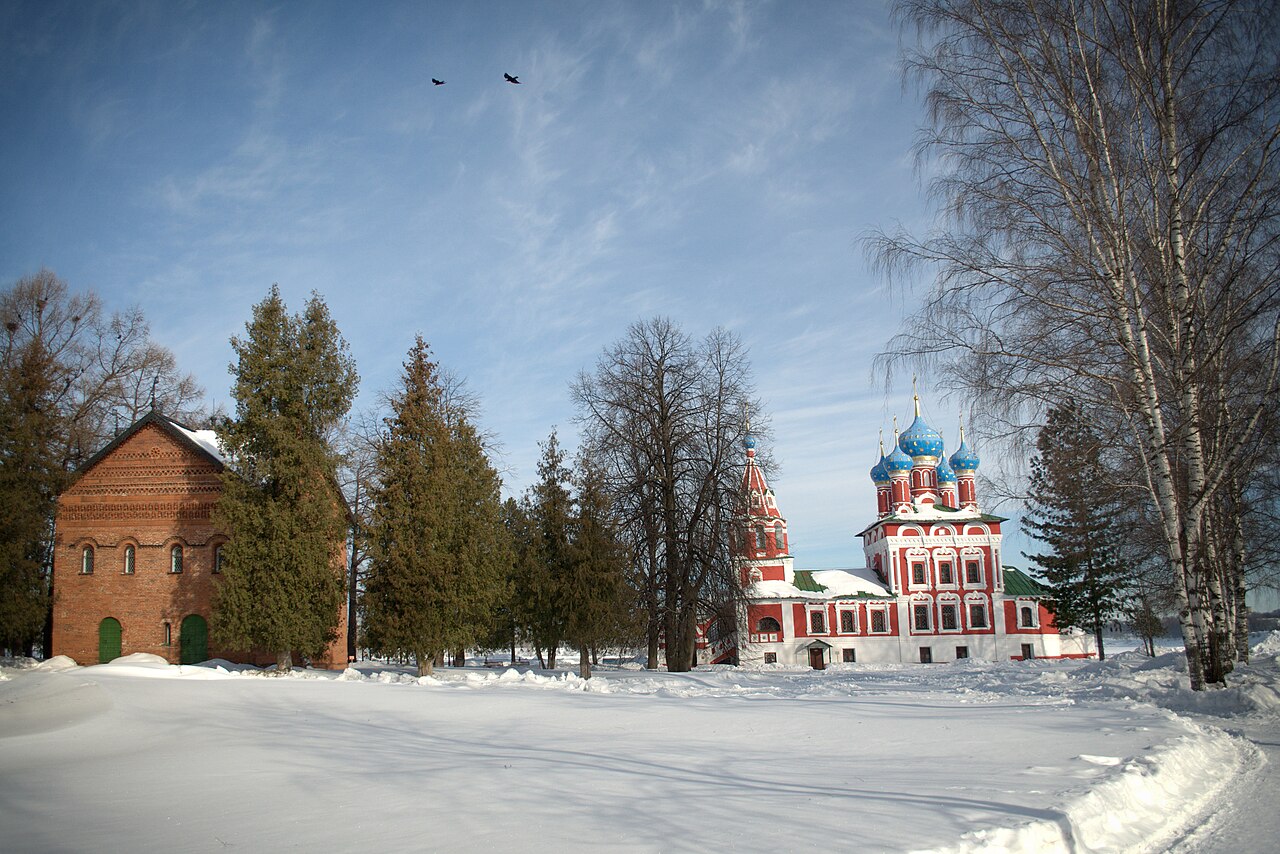
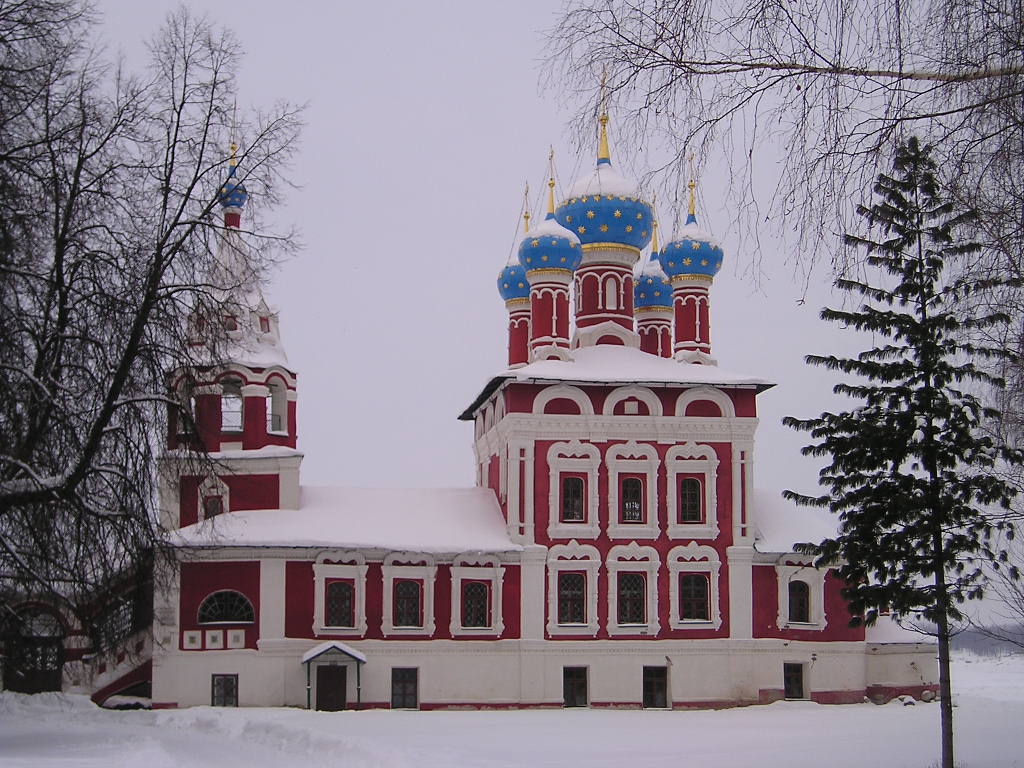
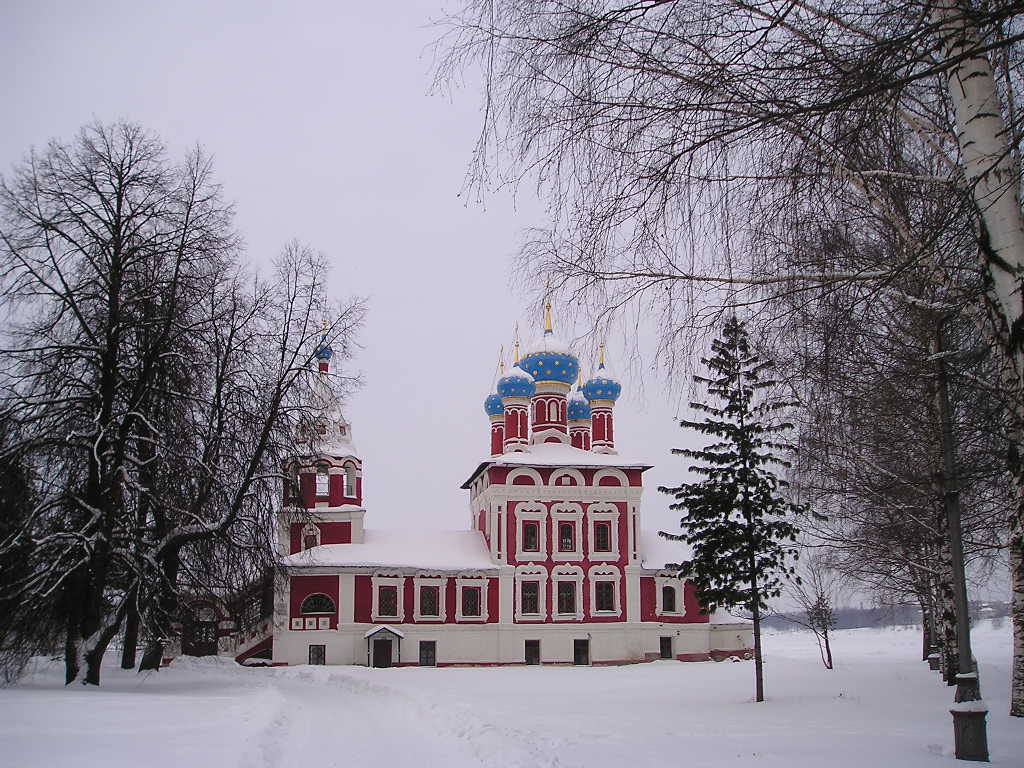
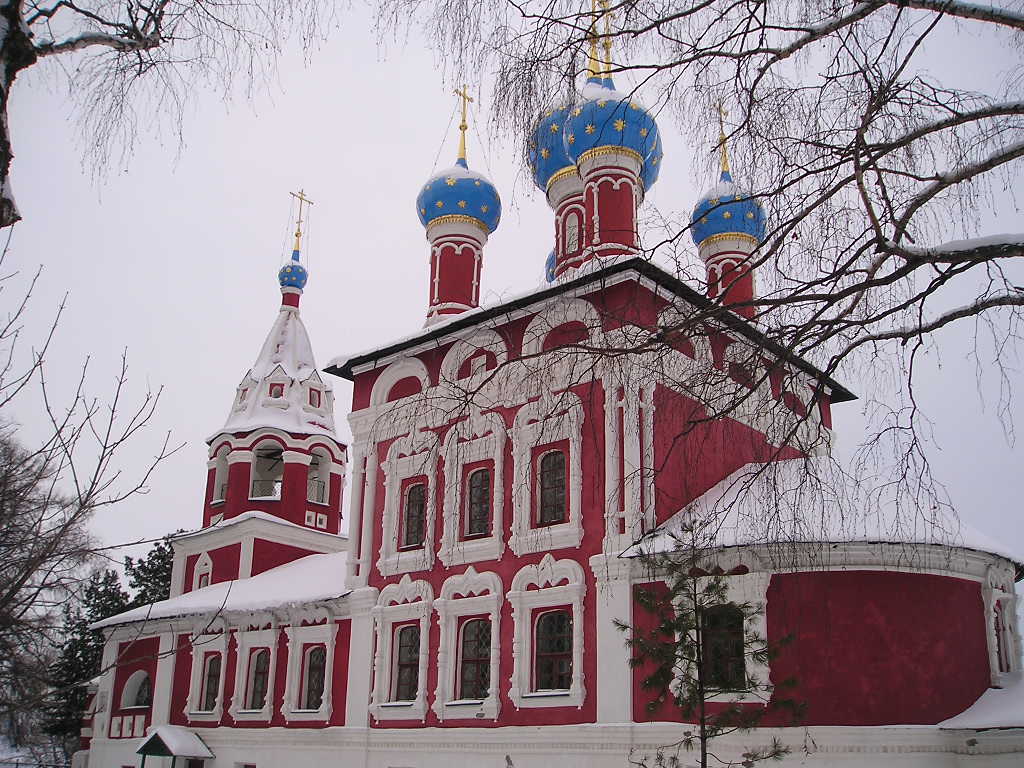
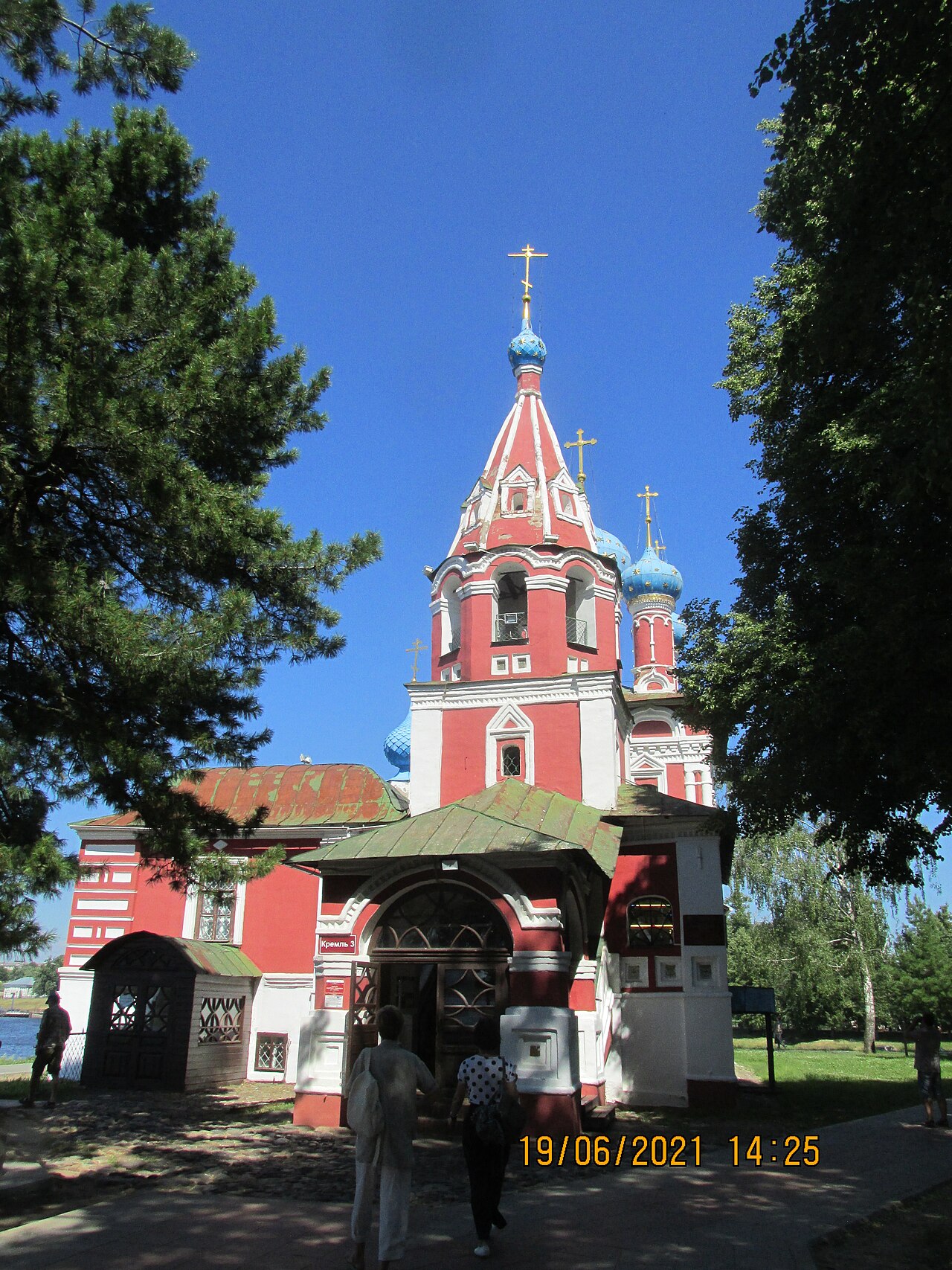
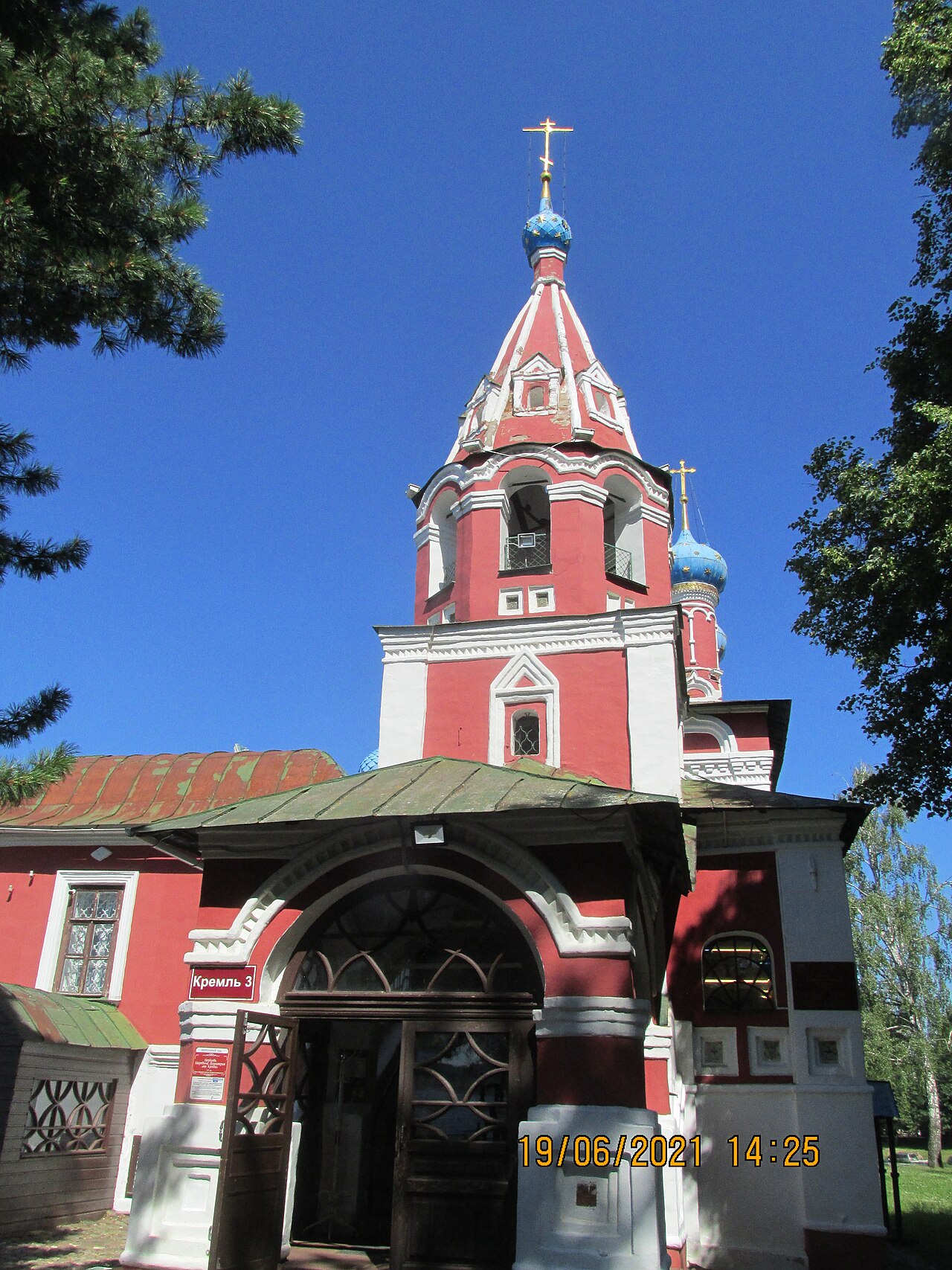
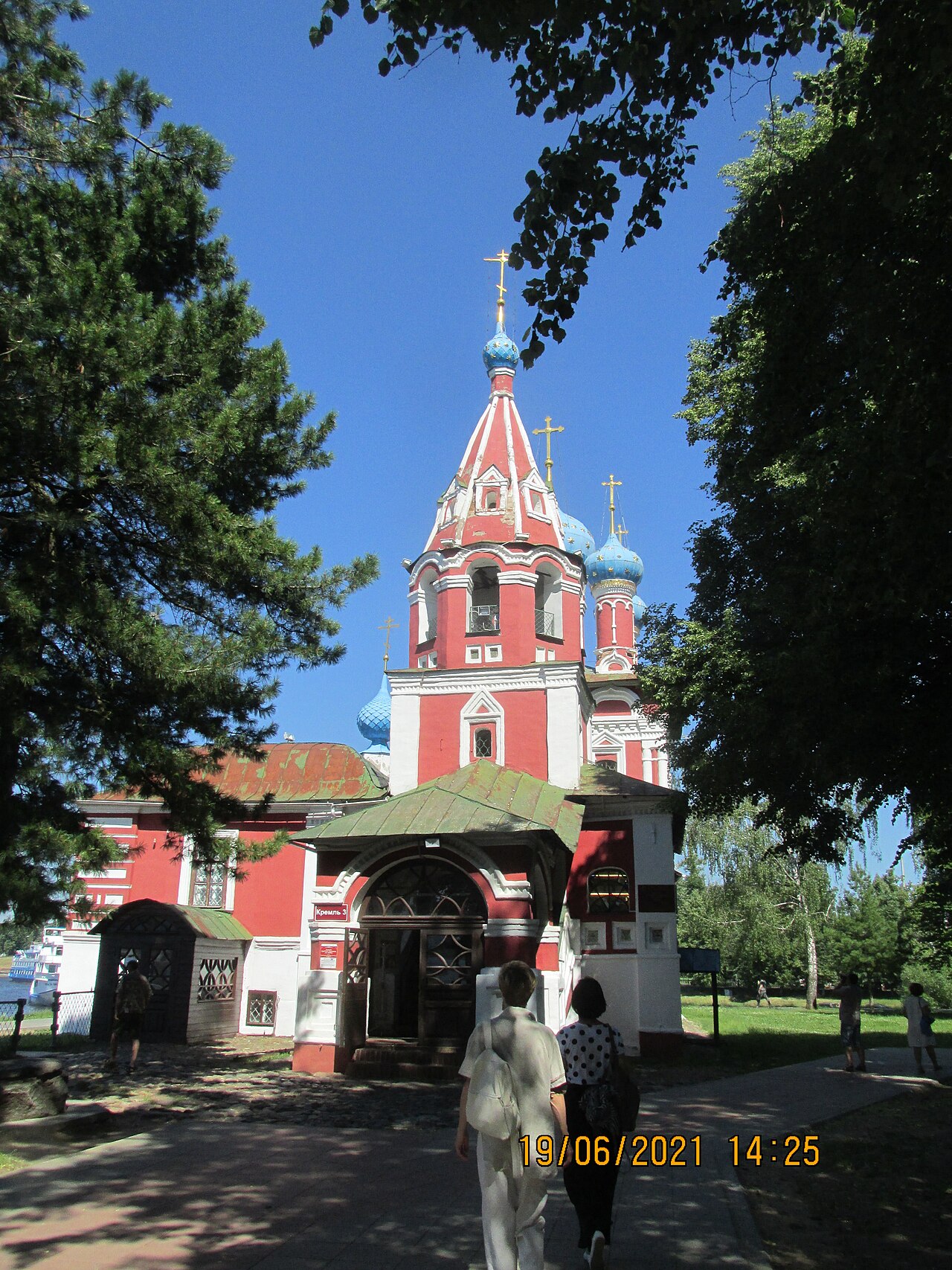
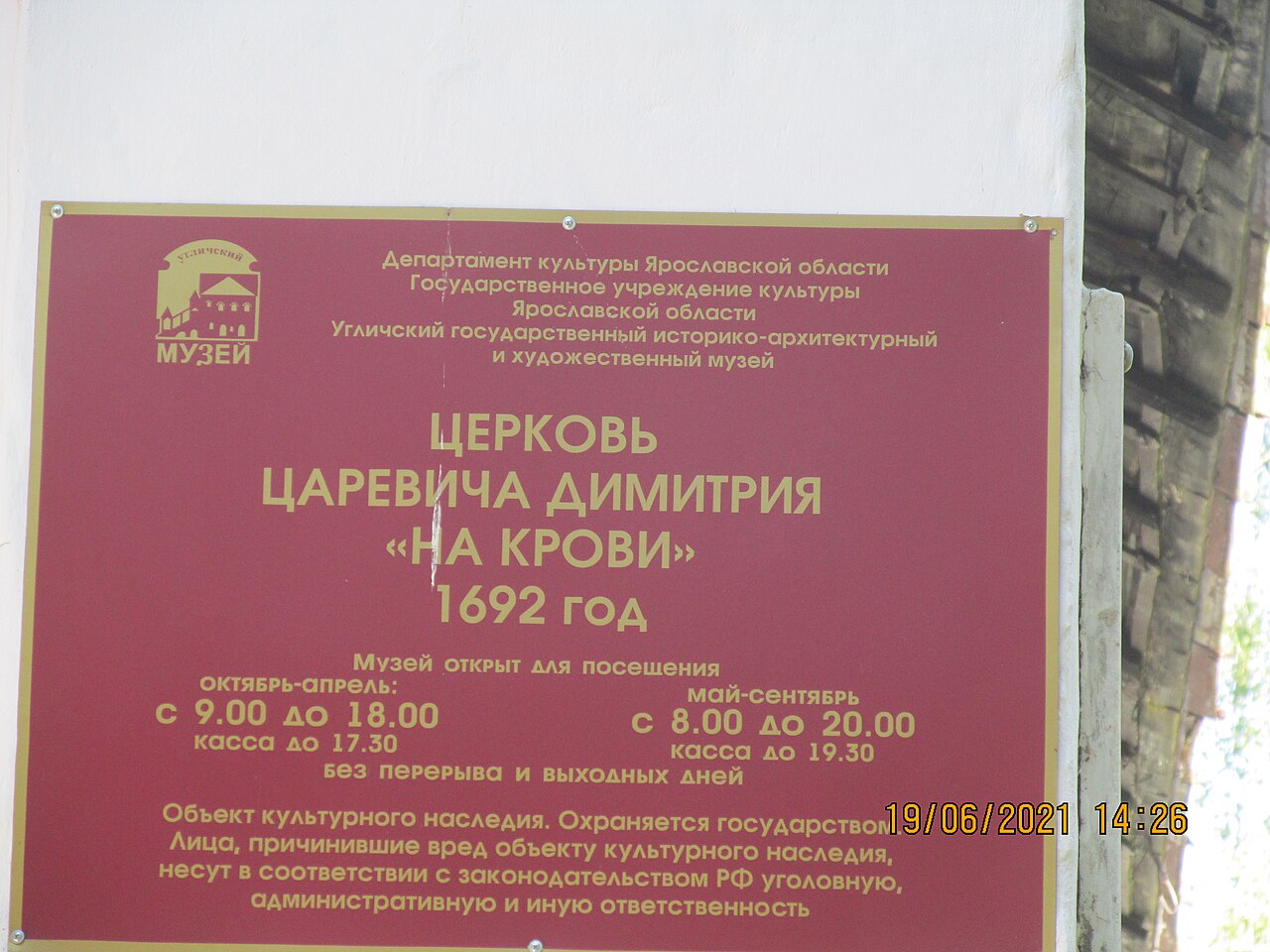
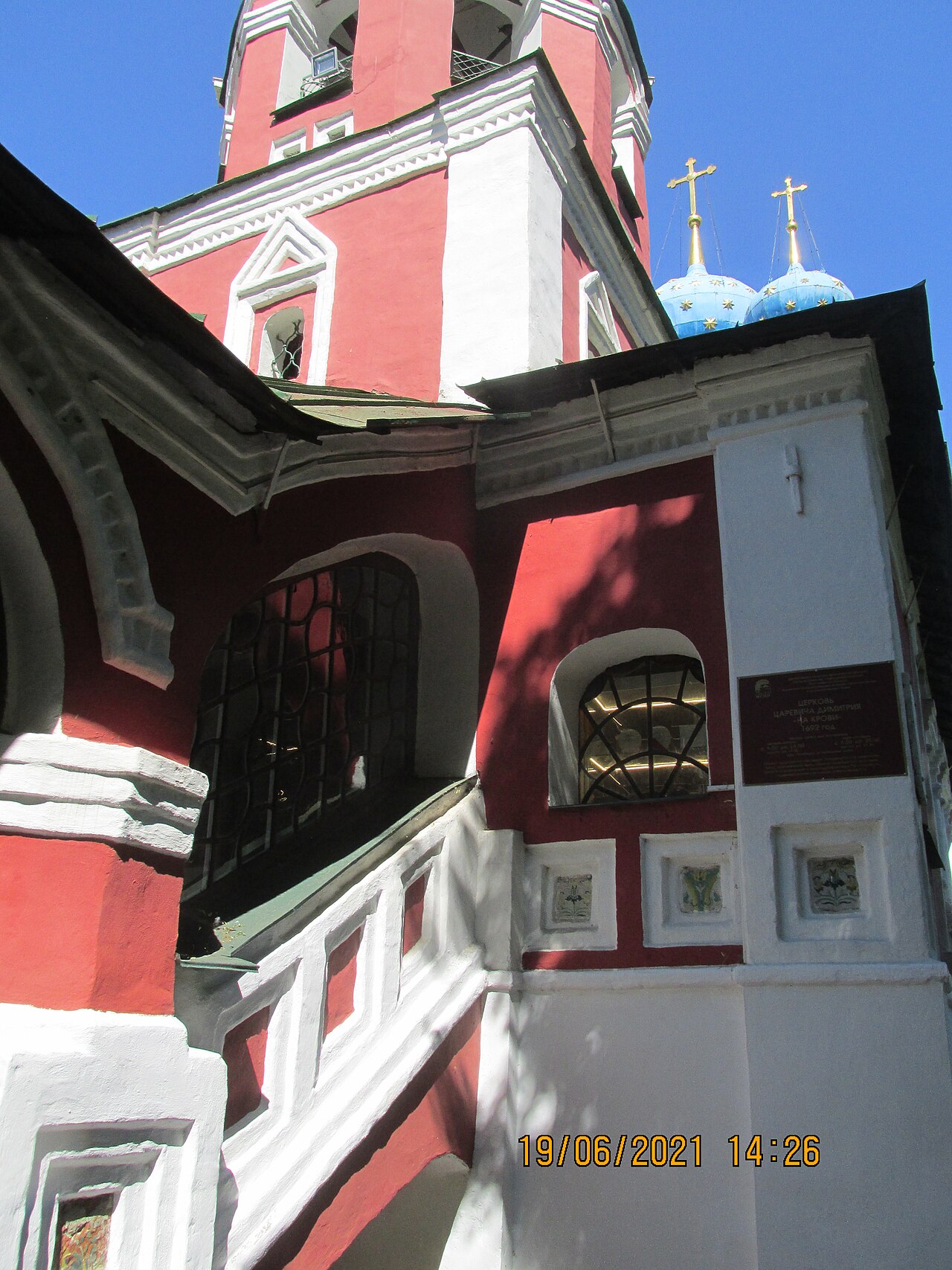
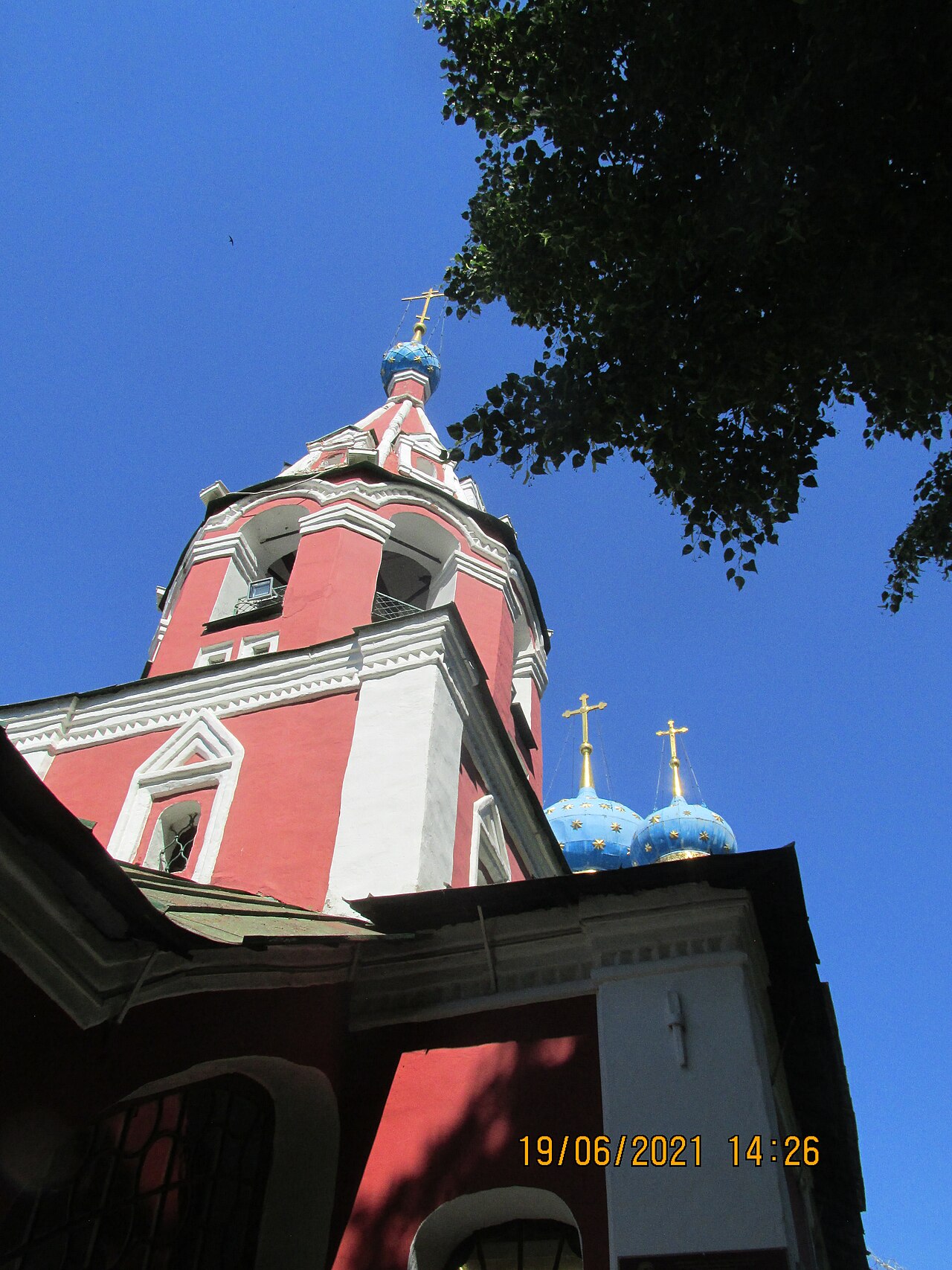
The death-site’s church is the kremlin’s crimson exclamation: the Church of St Dmitry on the Blood, the stone version of 1692 replacing earlier wooden shrines, painted oxblood red with white trim and blue starred domes, the color scheme a deliberate liturgy, blood and heaven, standing exactly where the nurse’s screams began, its altar, tradition insists, over the spot of the fall.
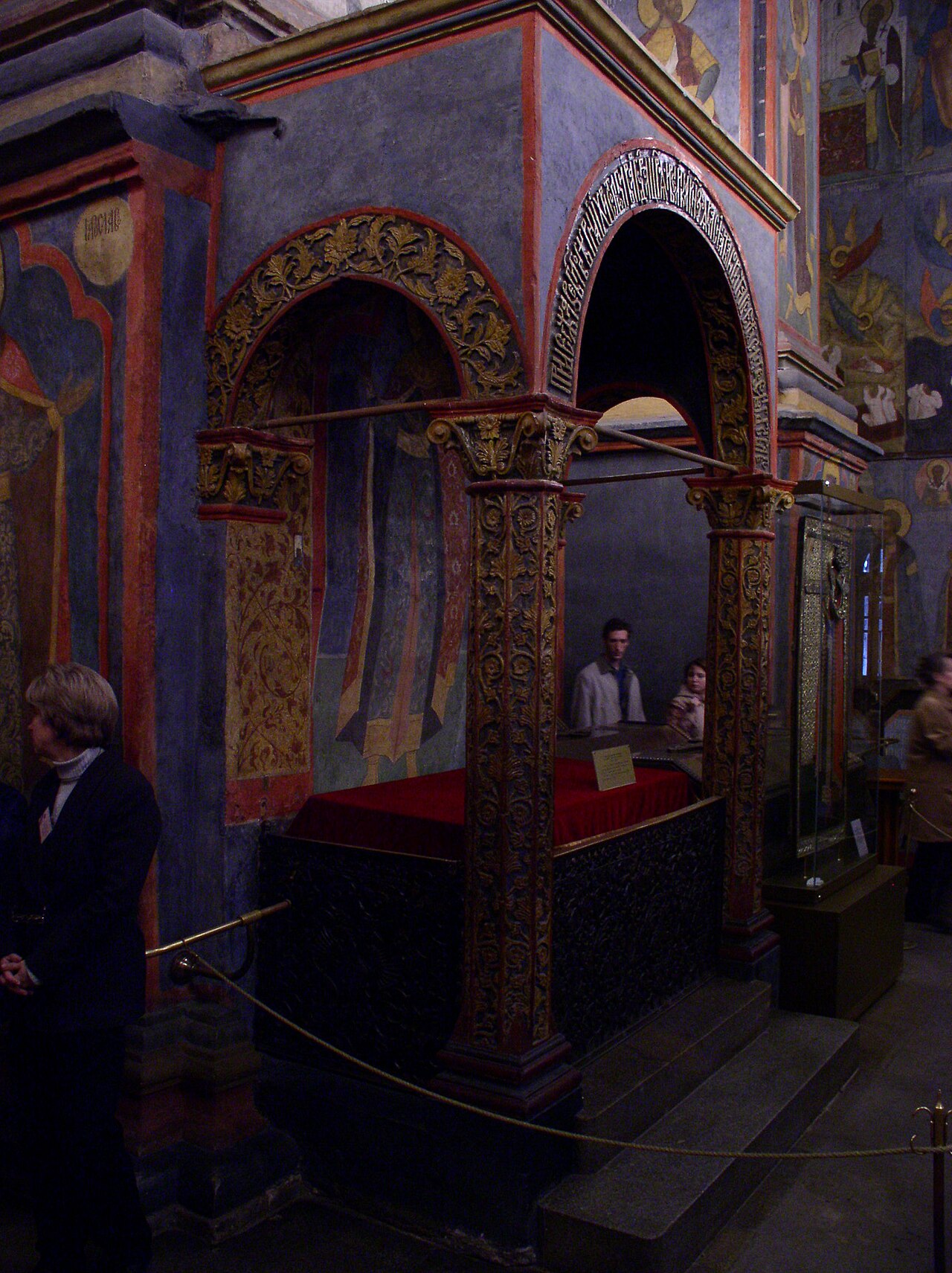
The interior delivers the town’s version in paint: the west wall’s great fresco cycle of 1772 shows the whole 15 May in sequence, the game, the murder as Uglich always told it, assassins at the boy’s throat, the alarm, the lynching, naive, vivid, and utterly partisan, history painted by the victim’s town, with the exiled bell hanging beside the scene it set off, and the reliquary items, the boy’s bier among them, completing the ensemble.
The church functions as museum and the museum as shrine, the double register suiting the place: candles below the murder fresco, cruise groups filing past the bell, and the lawn outside returning every visitor to the scene’s strange smallness, the whole national catastrophe fitting between a palace porch and a riverbank, which is the Uglich effect, history’s weight at domestic scale.
The Uglich Kremlin Today
The kremlin ensemble today gathers the palace, the Church on the Blood, the Transfiguration cathedral of 1713 with its towering iconostasis, the bell tower whose chimes greet the cruise ships, and the former city duma building housing museum displays, all set on the open lawn above the Volga, walls long vanished, so the historic core presents itself as a riverside park of red and white verticals, five minutes end to end and five centuries deep.
The museum’s collections flesh the story: the palace’s throne hall shows the appanage era’s icons and arms, the Dmitry relics and the famous bell anchor the church, and the painting collection includes the nineteenth century’s treatments of the drama, the town curating its tragedy with the practiced care of four hundred years’ custodianship, souvenir bells ringing in the stalls outside.
Uglich beyond the kremlin rewards the stayed hour: the Alekseevsky monastery’s grief-built Divnaya church of the Troubles’ aftermath, the Resurrection monastery’s arcaded ensemble, the hydroelectric dam and its Soviet-deco museum downstream, and the watch factory’s Chaika museum, the town’s twentieth-century pride, so the Volga stop that history booked for one terrible noon fills a civilized full day.
Watch the Uglich Palace on Film
Visiting the Uglich Palace Today
Uglich lies 240 kilometers north of Moscow on the upper Volga: buses and drivers reach it in about four hours via Sergiev Posad or Yaroslavl roads, the nearest railway runs to Kalyazin or Rostov with bus connections, and the pleasantest arrivals are the Volga cruises, for which Uglich is a classic green stop. The kremlin grounds are open daily and free; the palace of the princes, the Church on the Blood with the exiled bell, and the cathedral sell modest museum tickets, typically with a combined option, high season bringing cruise-crowd pulses worth timing around, early morning and late afternoon the quiet hours. Pair Uglich with Rostov Veliky or Yaroslavl for a Golden Ring day, and give the lawn ten unhurried minutes at the end; the place works best in silence. You can find the palace on the map here: Uglich Palace on Google Maps.
Palaces Nearby
You May Like
The Pskov Pogankin Chambers and the Merchant Palaces of the Frontier