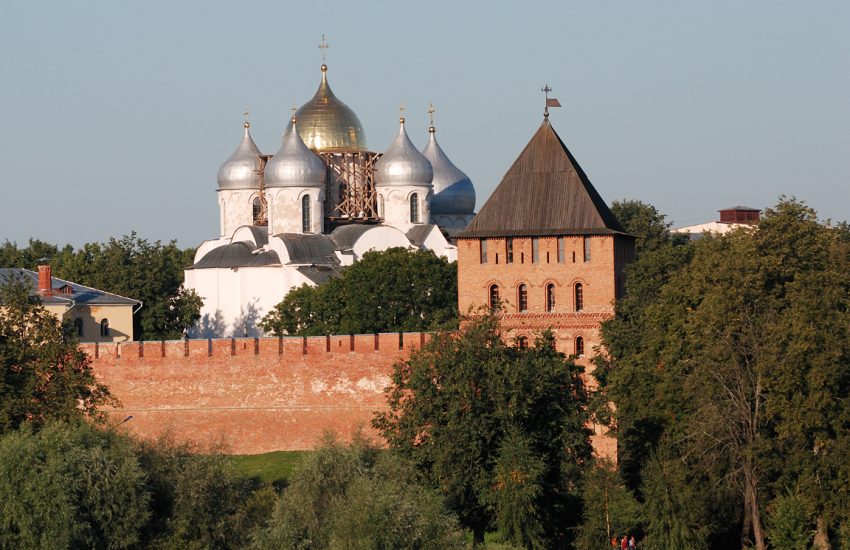
In Russia’s far west, where the Velikaya river runs toward its lake and Estonia lies an hour down the road, the city of Pskov keeps two kinds of stone memory. On the headland above the rivers stands the Krom, the fortress of the medieval Pskov republic, with its Trinity Cathedral blazing white over walls that beat off twenty-six major sieges. And in the merchant quarter below stands a building stranger than any fortress: the Pogankin Chambers, a seventeenth-century merchant’s palace with walls two meters thick, built by the richest and worst-named man in town, whose fortune bred legends the police archives never quite dispelled.
Pskov was Novgorod’s younger brother and rival: a veche republic in its own right from 1348, Europe’s gateway to Russia and Russia’s shield against the Teutonic knights, a city of stone churches and stone merchants’ houses when Moscow still built in logs. Its absorption by Moscow in 1510 was gentler than Novgorod’s and its afterlife prouder: the frontier fortress stopped Stefan Batory’s great siege in 1581 and entered the modern age as the empire’s west gate, where, in 1917, in a railway carriage at Pskov station, Nicholas II signed the abdication that ended the monarchy, the frontier town bracketing Russian statehood at both ends.
This guide walks both monuments and the history between: the Krom and the republic it governed, the Trinity Cathedral and the sieges, merchant Pskov’s stone domesticity and the Pogankin fortune’s dark legends, the chambers’ museum treasures from the republic’s silver to the frontier’s icons, and the practical details of visiting Russia’s best-preserved medieval frontier city.
- The Frontier Republic
- The Krom on the Headland
- The Trinity Cathedral
- Dovmont’s Town
- Twenty-Six Sieges
- Batory at the Walls
- Stone Merchant Pskov
- Pogankin and His Name
- The Chambers’ Fortress Domesticity
- Legends of the Cellars
- The Museum in the Chambers
- The Abdication at Pskov
- War, Restoration and UNESCO
- Watch the Pskov Chambers on Film
- Visiting the Pskov Chambers Today
- Palaces Nearby
The Frontier Republic
Pskov enters the chronicle in 903, with Princess Olga, the dynasty’s formidable saint, as its legendary daughter, and grew through the Kievan centuries as Novgorod’s western outpost until, by the charter of Bolotovo in 1348, it stood recognized as a sovereign republic of its own: the Pskov veche assembling by its cathedral, electing its magistrates, hiring its princes on Novgorod’s model, and writing, in the Pskov Judicial Charter of 1397, one of medieval Europe’s most sophisticated law codes, commercial law for a commercial people.
The republic’s life was the border’s: Livonian knights and Lithuanian princes a day’s ride away, Hanseatic trade through Dorpat and Riga filling the wharves, and the city’s whole architecture answering the double calling, churches by the dozen in the squat, whitewashed, utterly local Pskov manner, and fortifications in rings, the stone town expanding wall by wall until five circuits guarded the peninsula, Europe’s largest fortress perimeter of its age by the local boast.
Pskov’s school of builders became the republic’s export: the masters who raised Moscow’s Annunciation Cathedral and Kazan’s walls were Pskov men, church-building artels traveling the realm while their own town kept its stern style, and the republic’s painting, the Pskov school’s heavy-browed saints on cinnabar grounds, holds its own room in every survey of Russian art, the frontier’s culture punching far above its population.
The Krom on the Headland
The Krom, Pskov’s kremlin, takes the triangle where the Pskova falls into the Velikaya: limestone walls and towers enclosing the republic’s sacred and political heart, the veche square at the cathedral’s feet, the state’s archive and treasury in the Trinity’s keeping, and the famous storage cages, the kleti, where the city kept its reserves under heaven’s and the law’s double guard, theft from the Krom ranking as treason by the Charter, punishable with death.
The fortress’s bones are the republic’s engineering: the walls’ local limestone laid in the plastered Pskov manner, the Great Gates’ trap passage doubling under the Trinity bell tower, and at the headland’s point the round Kutekrom tower of 1400, the ensemble reading from the rivers as one gray ship of state, the image every Pskov postcard has printed since postcards began.
South of the Krom proper runs its unique annex, Dovmont’s Town, the stone pocket where the republic packed its government churches, seventeen churches’ foundations in a hectare, excavated and conserved as a field of stone plans, medieval Russia’s densest sacred quarter standing today as an open-air diagram of a state that prayed in committees.
The Trinity Cathedral
The Trinity Cathedral is Pskov’s vertical: the fourth church on Olga’s legendary site, the present building of 1699 lifting its whitewashed mass and five domes seventy-eight meters over the Krom, visible, the saying runs, from every road into the land, the republic’s old formula, the Trinity’s house, having meant the state itself, war declared and peace sworn before its icons, the magistrates’ oaths and the archive in its sacristy.
The interior carries the frontier’s devotions: the seven-tier iconostasis rising gilded into the dome’s shadow, the relics of Pskov’s princes and holy fools, Dovmont’s sword preserved as the city’s palladium, girded ceremonially on each new prince, and the Olga chapel keeping the founder’s cult, the cathedral working through all political weathers, its Soviet closure ending early, and the services running now as the fortress’s living pulse.
The bell tower beside it watches the rivers as the fortress’s eye, and the whole composition, white verticals over gray walls at the waters’ meeting, makes the classic approach from the far bank one of Russian architecture’s set views, the republic’s statement still legible: law and faith in one silhouette, guarded.
Dovmont’s Town
Pskov’s model prince was an exile: Dovmont, a Lithuanian duke fleeing his homeland’s feuds in 1266, baptized Timofei, elected by the Pskovites and reigning thirty-three years as the republic’s sword, unbeaten, the chronicle insists, in every battle against his former countrymen and the German knights, builder of the second wall that bears his name, and canonized after death as the city’s heavenly commander, his sword passing to successors as the office’s regalia.
Dovmont’s contract reign became the republic’s ideal of the prince: a hired, loved, and bounded sovereign, the anti-model to autocracy remembered pointedly through the Moscow centuries, his sainted shrine in the Trinity and his sword in the museum keeping the constitutional sermon’s props, the frontier republic canonizing not a founder-king but an employee of genius.
His stone pocket of government churches, Dovmont’s Town, grew for two centuries after him as the republic’s acropolis annex, and its excavated field now serves as the Krom’s forecourt, the visitor crossing the little state’s whole institutional map, chapel-ministries underfoot, before the Great Gates swallow the path toward the Trinity, medieval constitutionalism as a landscape experience.
Twenty-Six Sieges
Pskov’s military ledger stands alone in Russia: by the standard count twenty-six major sieges between the thirteenth and eighteenth centuries, Teutonic knights, Lithuania, Sweden, Poland, the city taken by storm, the locals note with care, essentially never, the knights’ brief treachery-aided tenure of 1240 to 1242 ending with Alexander Nevsky’s liberation on the way to the ice, the walls otherwise holding through everything the frontier sent.
The defense was the republic’s civic liturgy: the walls’ five rings manned by the town’s hundreds, the clergy processing the icons along the battlements at the worst hours, the chronicle recording the saints seen standing on the towers, and the engineering answering the age, the Pokrovskaya tower at the circuit’s south corner growing into one of Europe’s largest artillery towers, ninety meters around, the republic’s cannon answering Europe’s.
The record bred the city’s self-image, the stone shield of Rus, and the paradox of its politics: the freest city defended the realm that would absorb it, Moscow’s gatherers sheltering behind Pskov’s walls while unpicking Pskov’s liberties, the republic ending in 1510 not by siege but by summons, its veche bell taken down at Moscow’s order and the town, the chronicler mourned, weeping for its ancient will.
Batory at the Walls
The city’s greatest hour came under Moscow’s flag: in 1581, the Livonian war collapsing, the Polish king Stefan Batory brought perhaps fifty thousand men and Europe’s siege art against Pskov, whose garrison and towns-people, led by Prince Ivan Shuisky, held the five-month siege through breach assaults, mining duels, and the September storm that took the Pokrovskaya corner towers for a day, the defenders, the women of the town in the chronicle’s honored lines among them, retaking the walls by night.
The failed siege saved more than the city: Batory’s exhausted army wintered into the truce of Yam-Zapolsky, Russia losing Livonia but keeping its west, Pskov included, the war’s one unambiguous Russian glory standing at these walls, commemorated by the Batory breach’s preserved scar and the icon of the siege’s visions carried in the cathedral’s processions since.
Peter the Great gave the walls their last campaign: expecting Charles XII after Narva, he modernized Pskov’s circuits with earth bastions in 1701, burying church roofs in the ramparts’ haste, and the Swedish storm passing elsewhere, the fortress stood down for good, its three centuries’ military career closing undefeated, a record the town prints, reasonably, on everything.
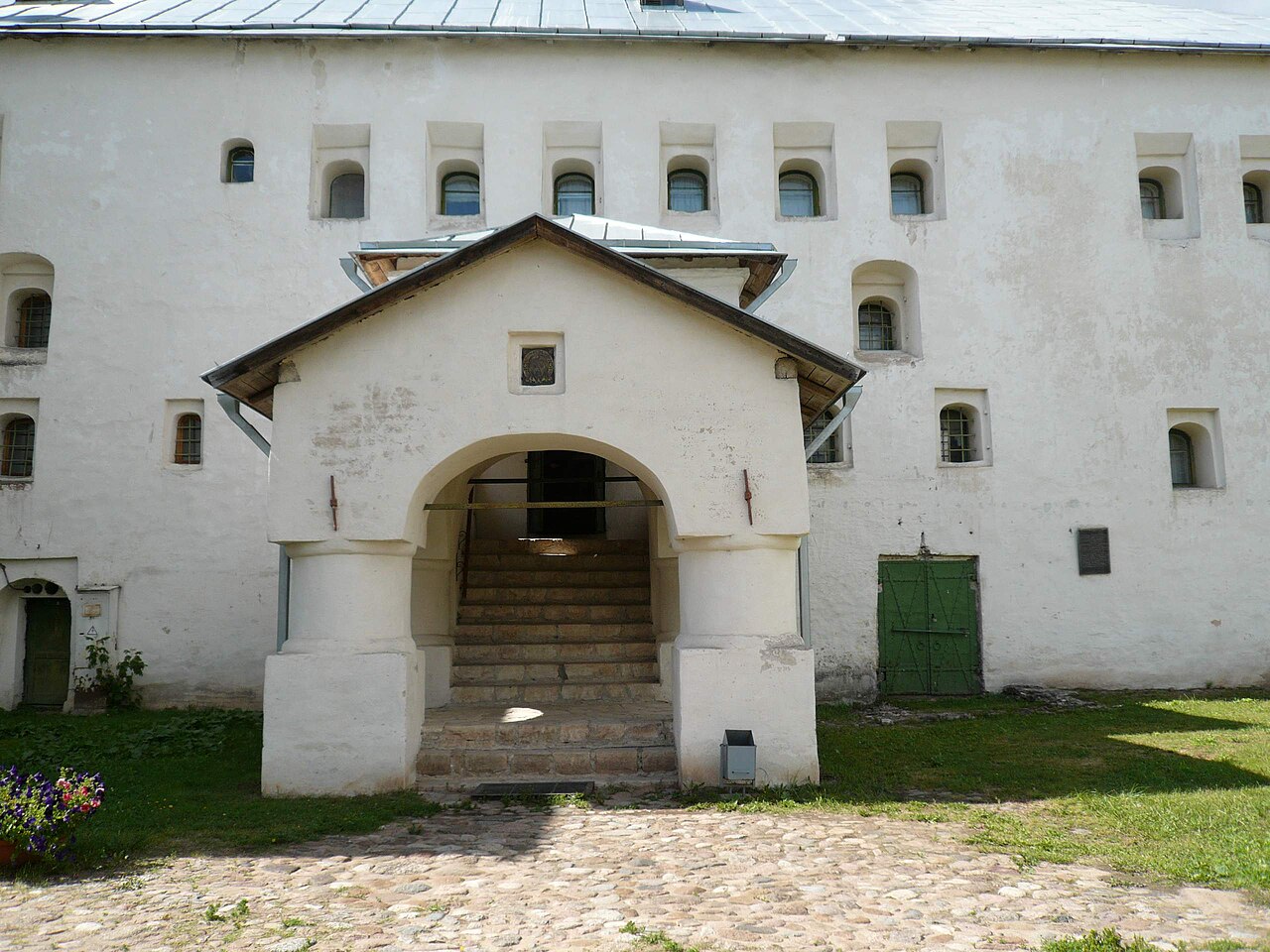
Stone Merchant Pskov
Below the fortress, Pskov built the other Russia’s rarity: stone merchant houses by the dozen in the seventeenth century, the trading town’s answer to the fire-prone timber age, vaulted ground floors for goods, living floors above, chapel rooms and strong cellars, whole dynasties, the Menshikovs, the Yamskys, the Trubinskys, raising stone compounds while Moscow’s merchants still built wooden, Pskov’s civil architecture of the 1600s surviving as Russia’s best such ensemble.
The habit was the frontier’s arithmetic: Baltic trade through the Swedish wall of the century paid in silver worth guarding, the border’s raids argued for walls at home, and the republic’s old stone school stood ready, so the merchant chamber, the palaty, became the town’s signature, austere outside, vaulted and tile-stoved within, domestic fortresses for commercial lords.
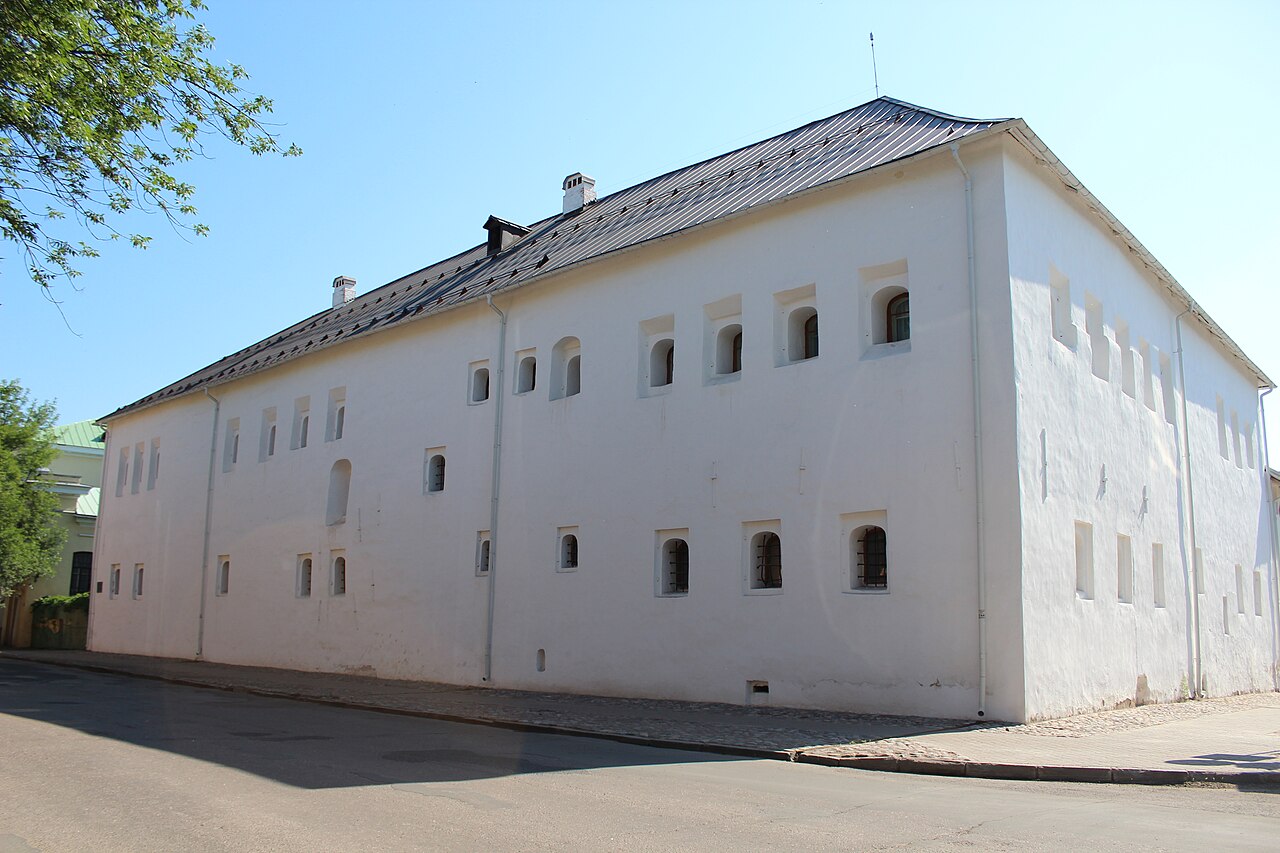
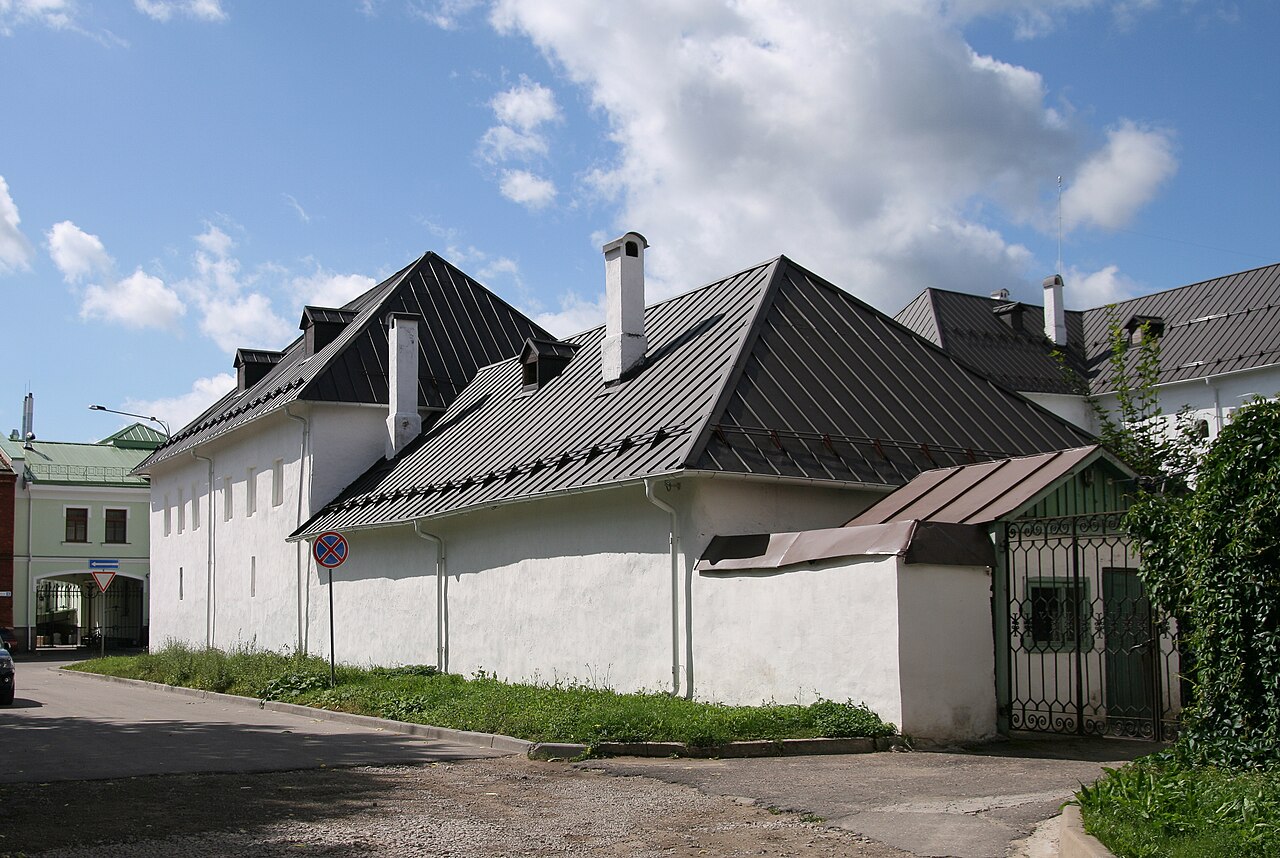
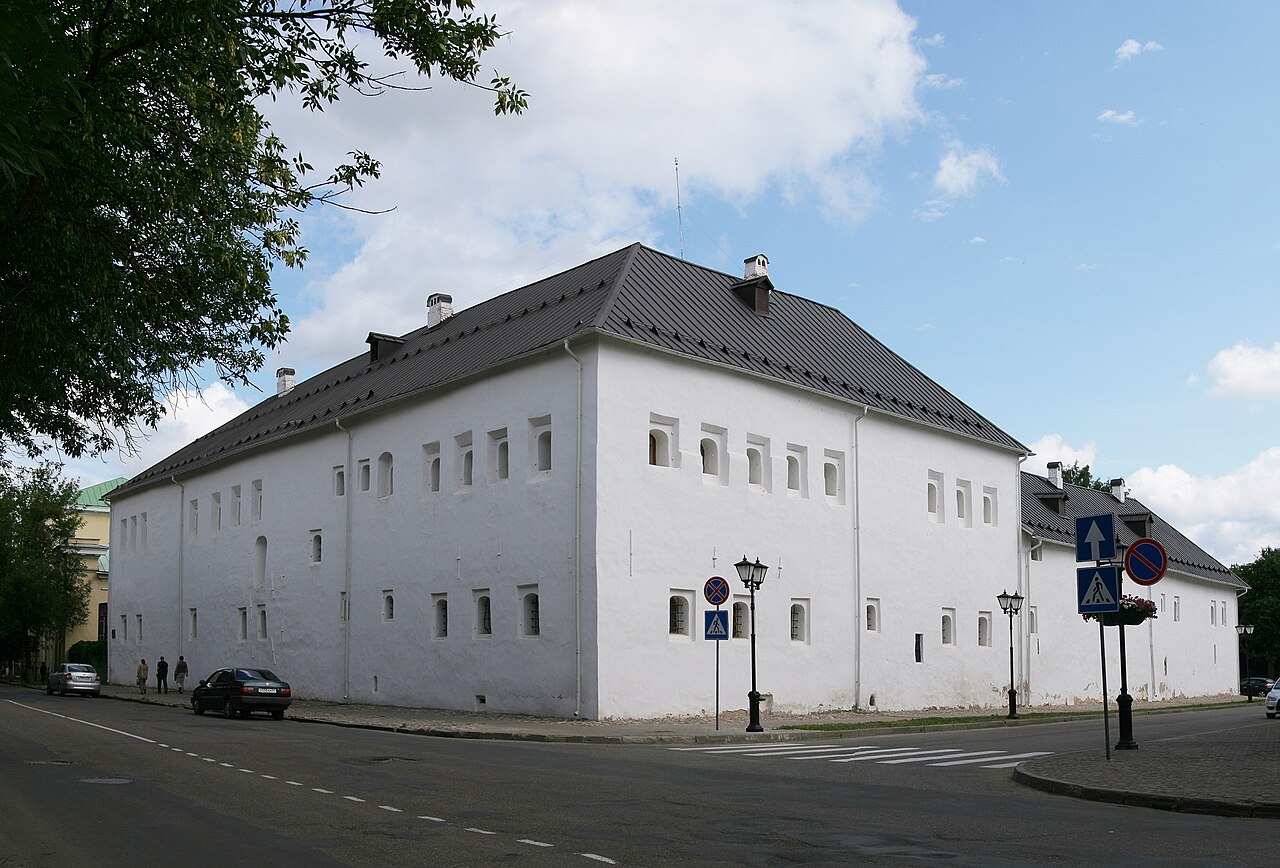
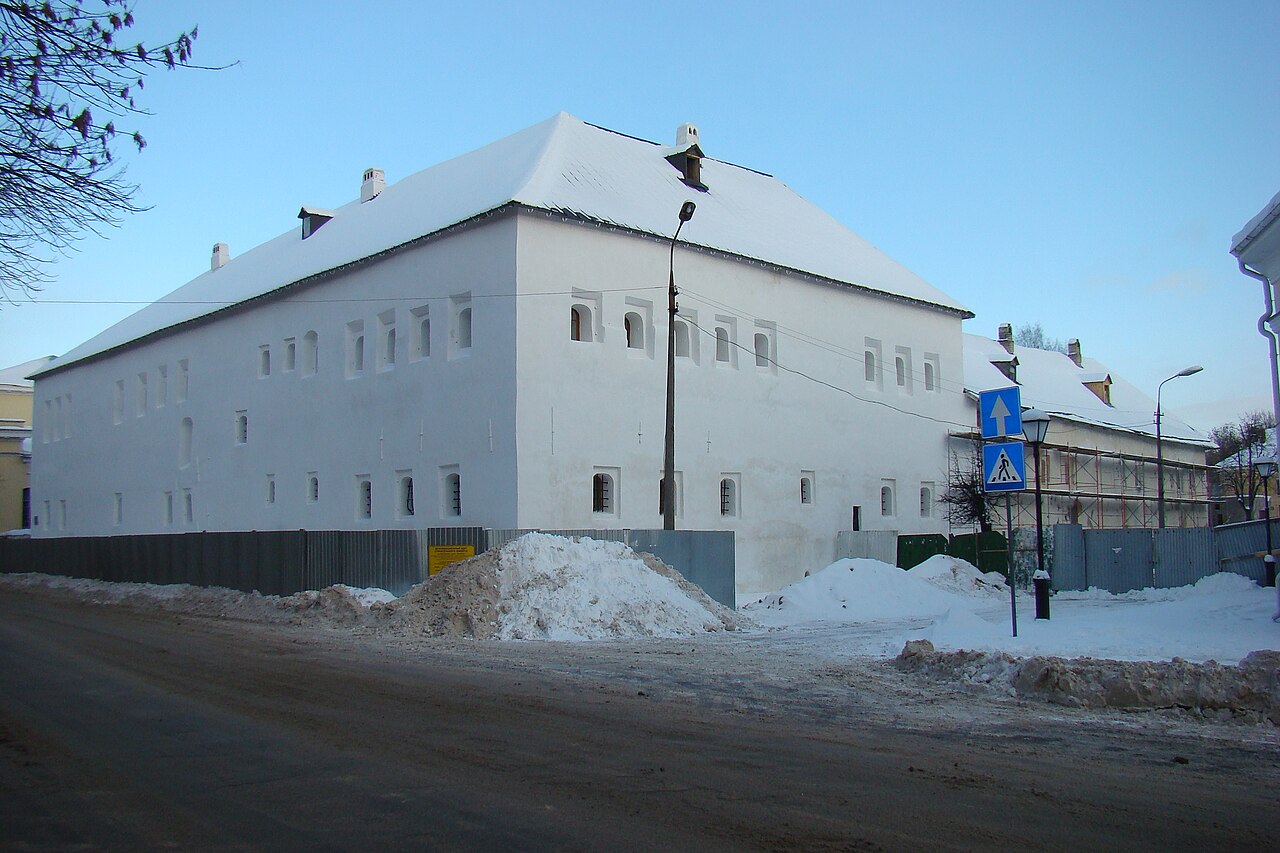
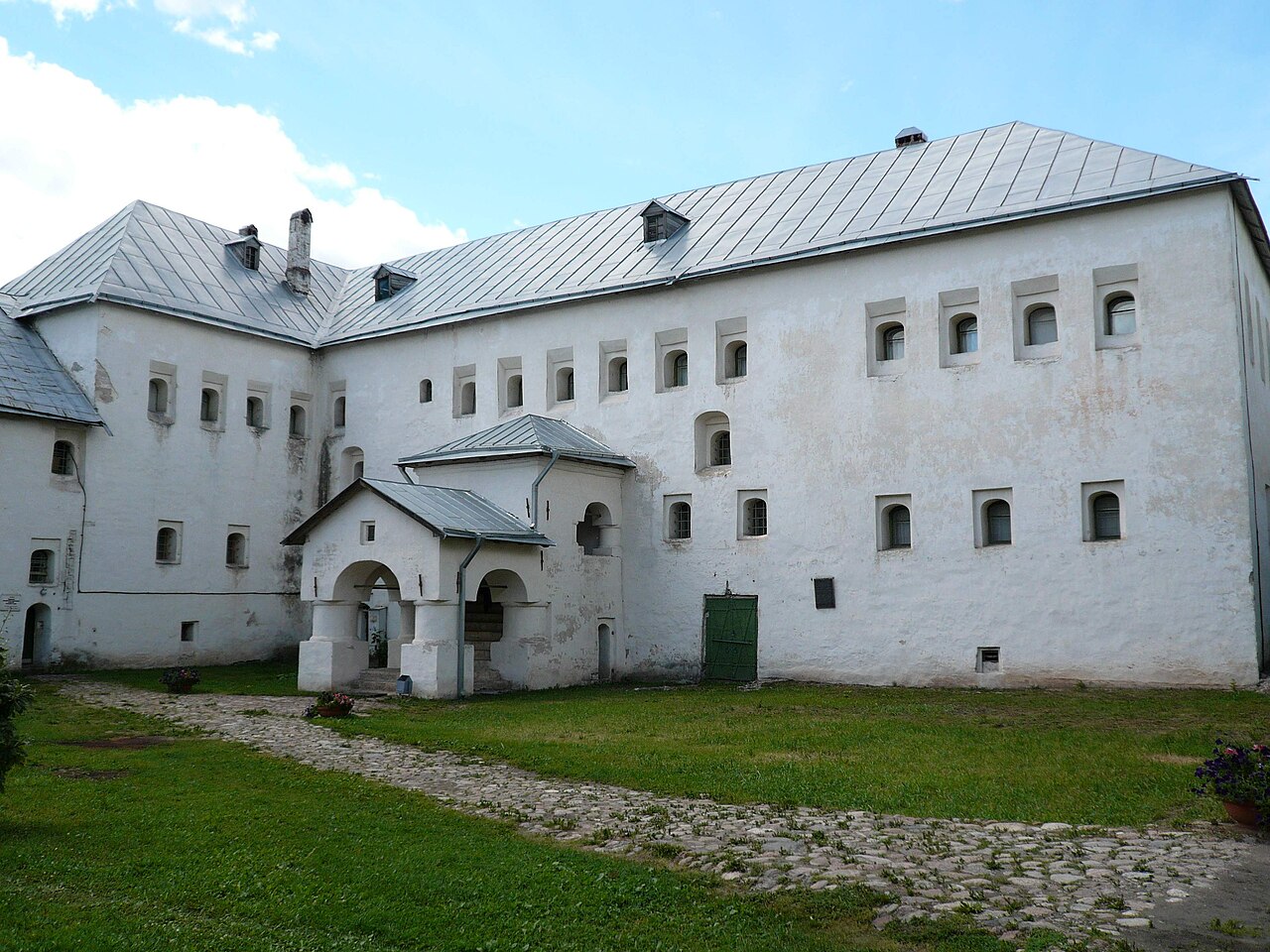
Among them one compound outscaled all: the chambers the richest man of seventeenth-century Pskov built in the 1670s, three stone wings on the old Polonishche quarter, walls to two meters, windows barred, one hundred and more rooms by the inventories, half warehouse, half palace, wholly defensive, the house of Sergei Ivanovich Pogankin, merchant of the first hundred, mint lessee, and owner of the town’s most discussed surname.
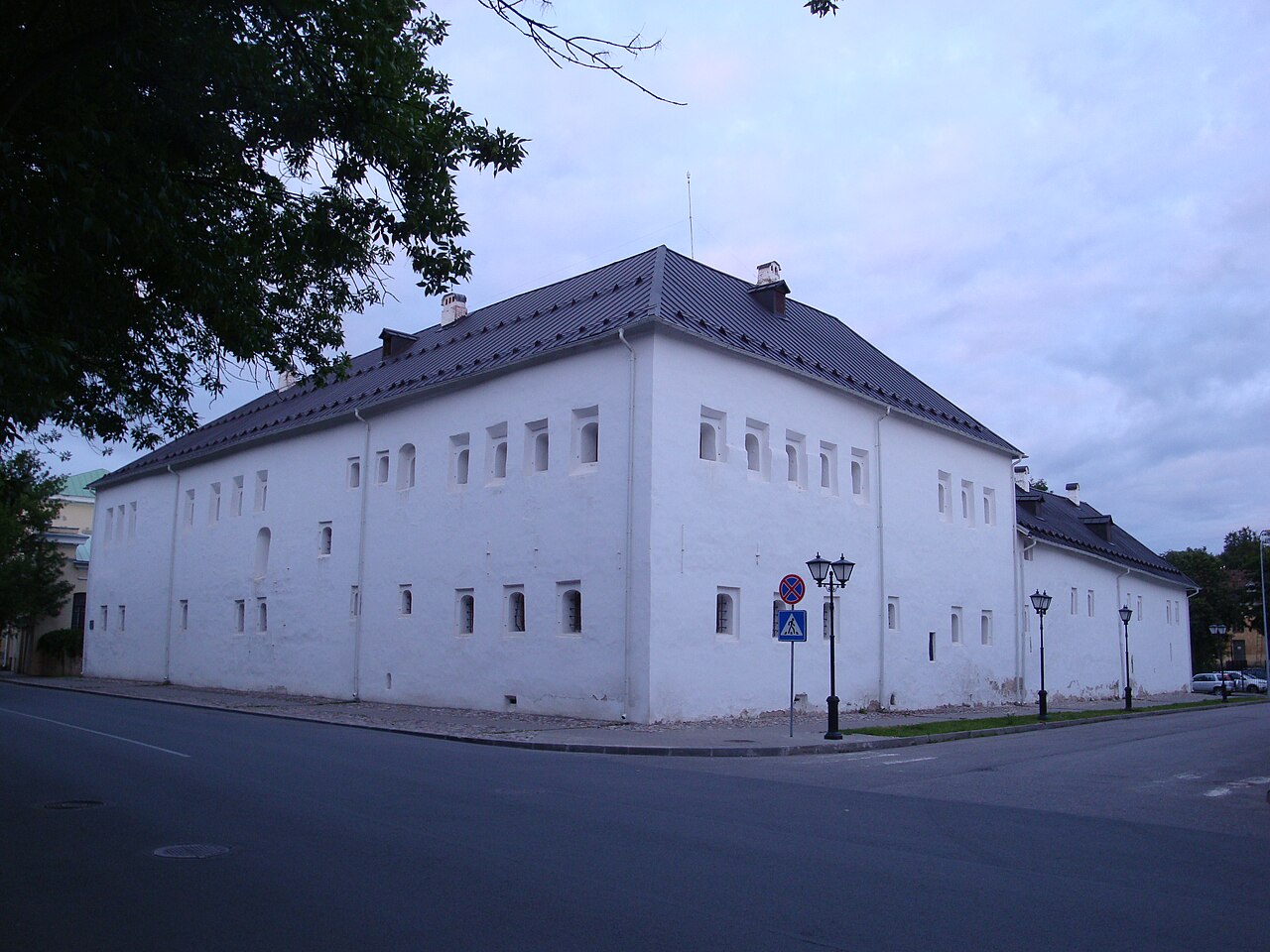
Pogankin and His Name
Sergei Pogankin is documented and his name is not flattering: pogany meant unclean, pagan, foul, and the town’s etiology ran to legend from the start, the fortune, one tale held, dug from a cursed hoard; another made an ancestor the keeper of plague money no one else would touch; the crispest version has Ivan the Terrible himself, asking the merchant what he would pay toward some levy and hearing how much is needed, snapping that only something unclean, pogano, could answer so, the autocrat’s joke becoming a dynasty’s name.
The archives’ Pogankin needs no curse to explain: leaseholder of the sovereign’s Pskov mint, dealer in flax, leather, and the Swedish trade, holder of town offices and church endowments, his account books, preserved and studied, showing the methodical accumulation that built the chambers, with sums lent to the treasury itself, the frontier’s Fugger in miniature, named like a villain and audited like a saint.
The family’s end fed the legend’s second life: the male line extinguished by the early eighteenth century, the chambers passing through widows to the state, and the town concluding, as towns do, that the name had collected its debts, the house’s later uses, provisions store, then military depot, keeping the vaults shuttered and the stories circulating until the museum age opened both.
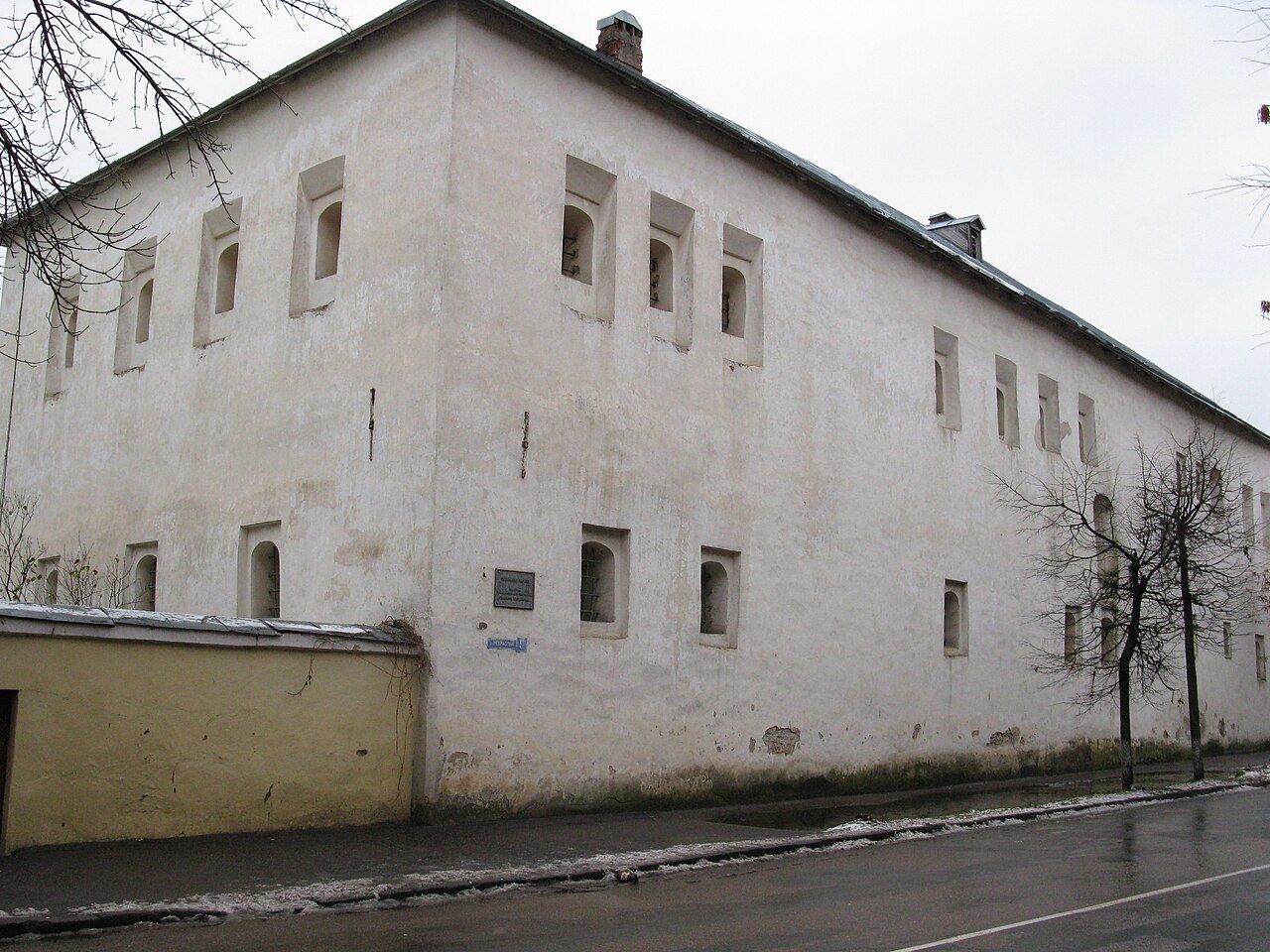
The Chambers’ Fortress Domesticity
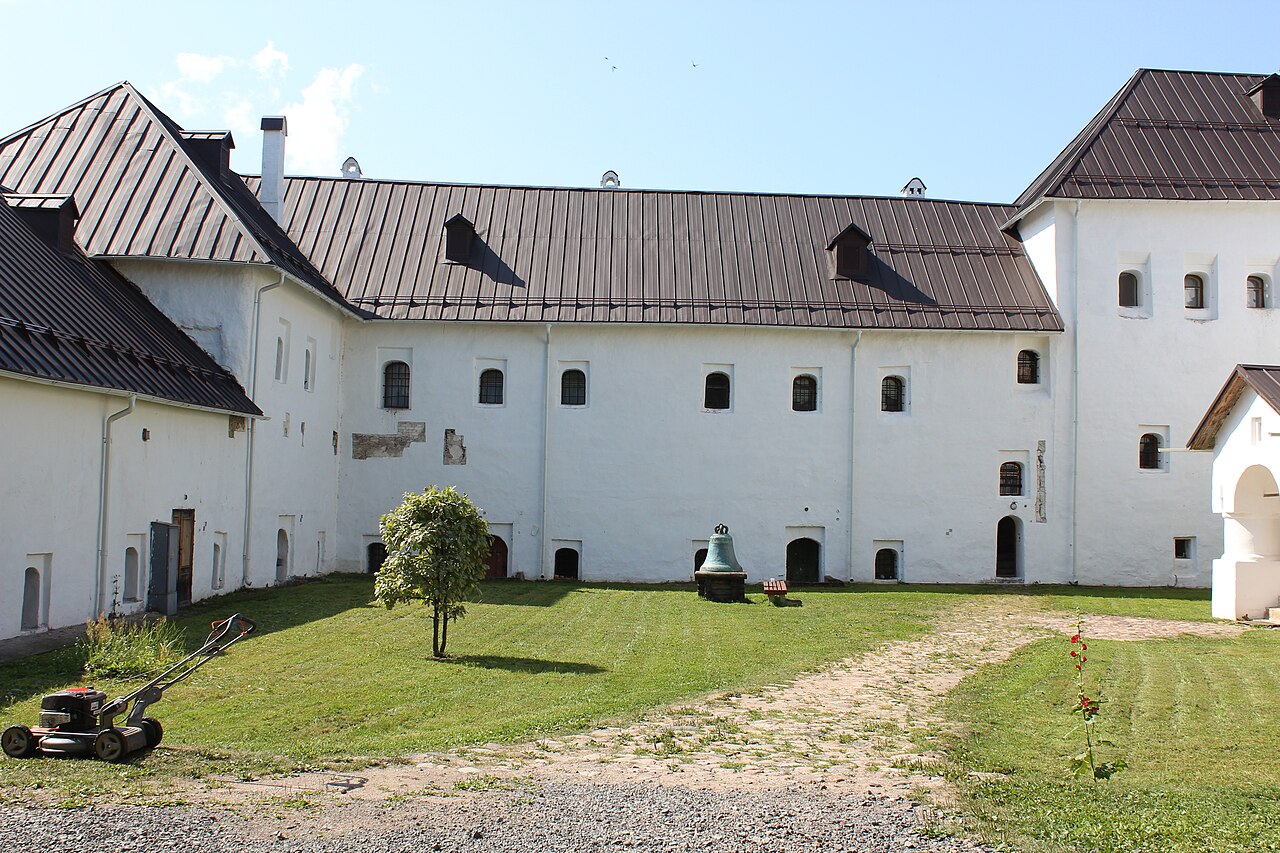
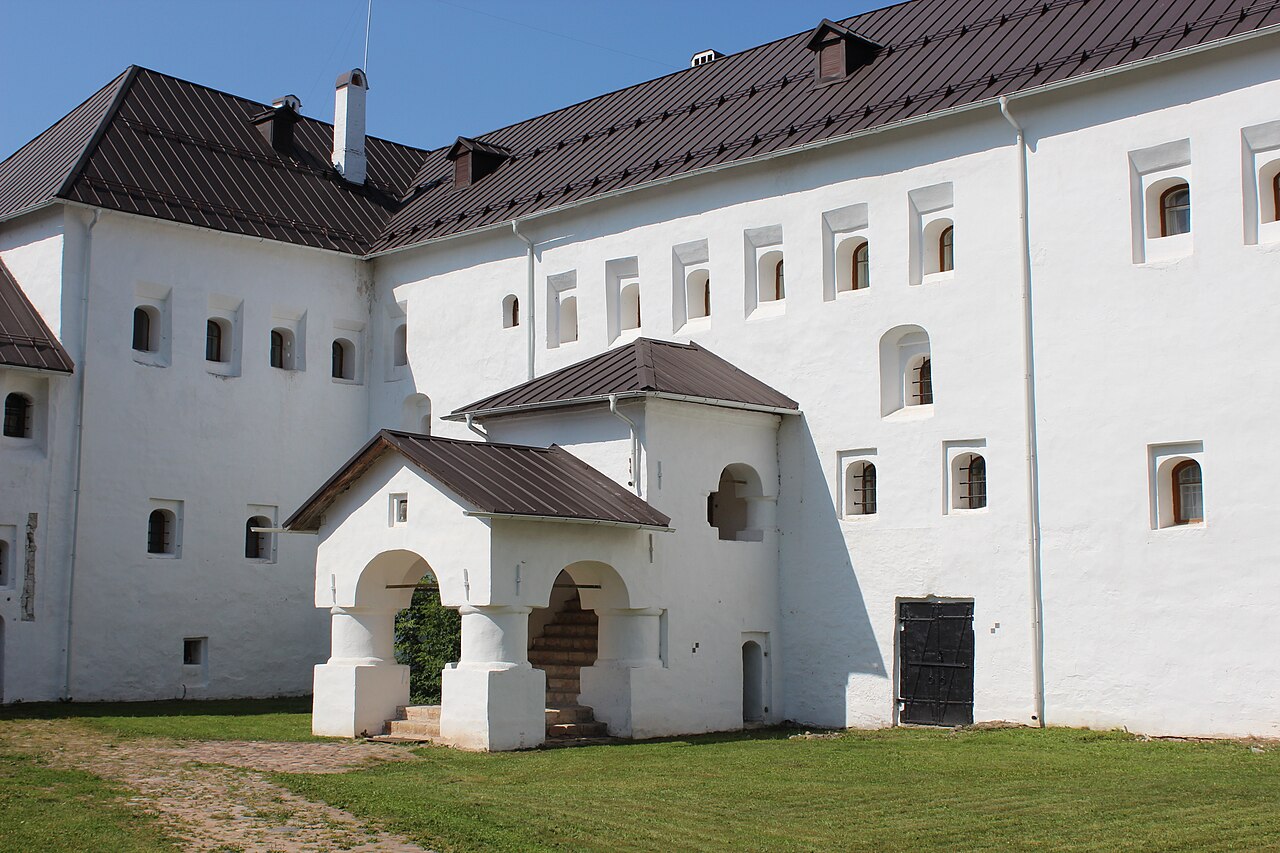
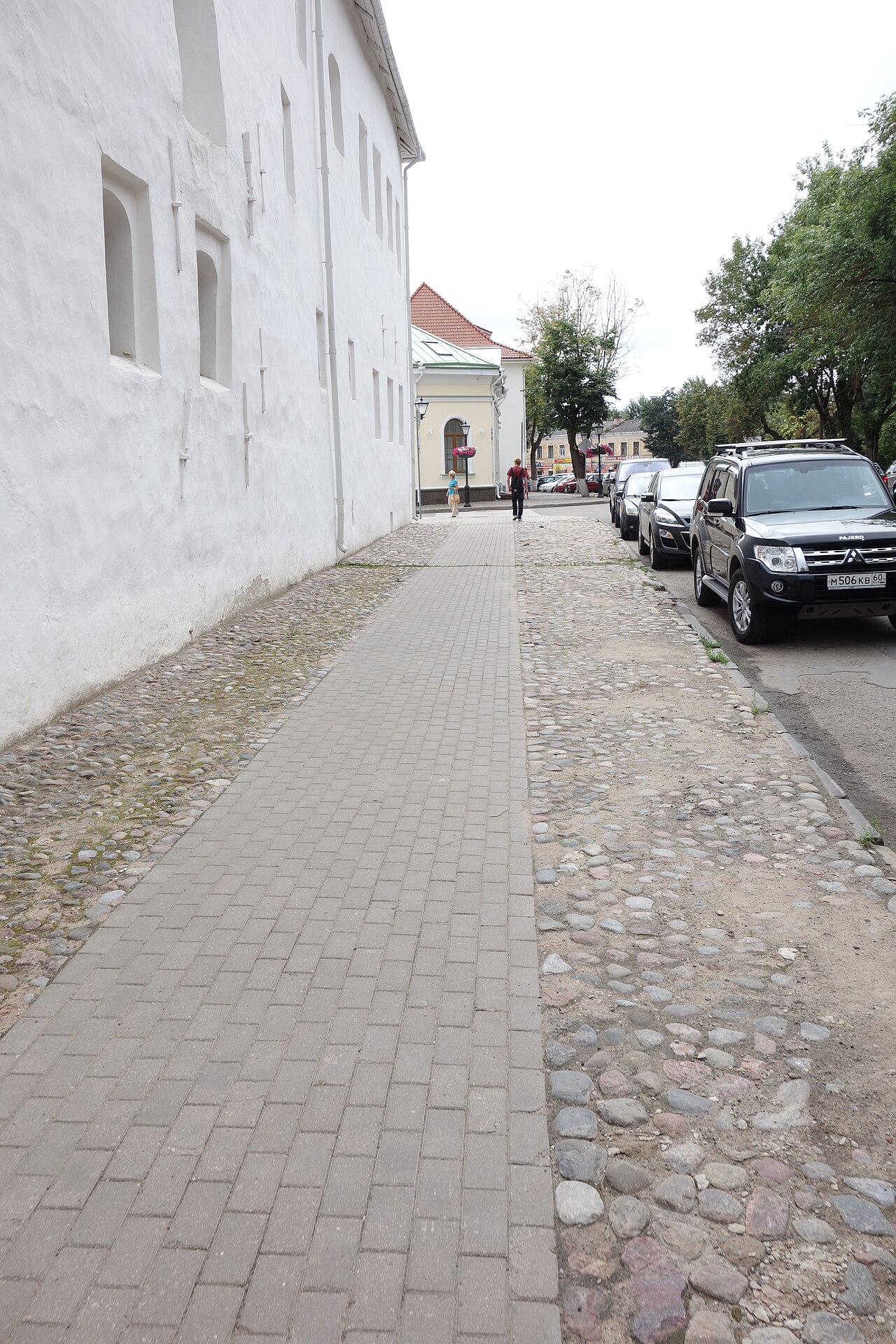
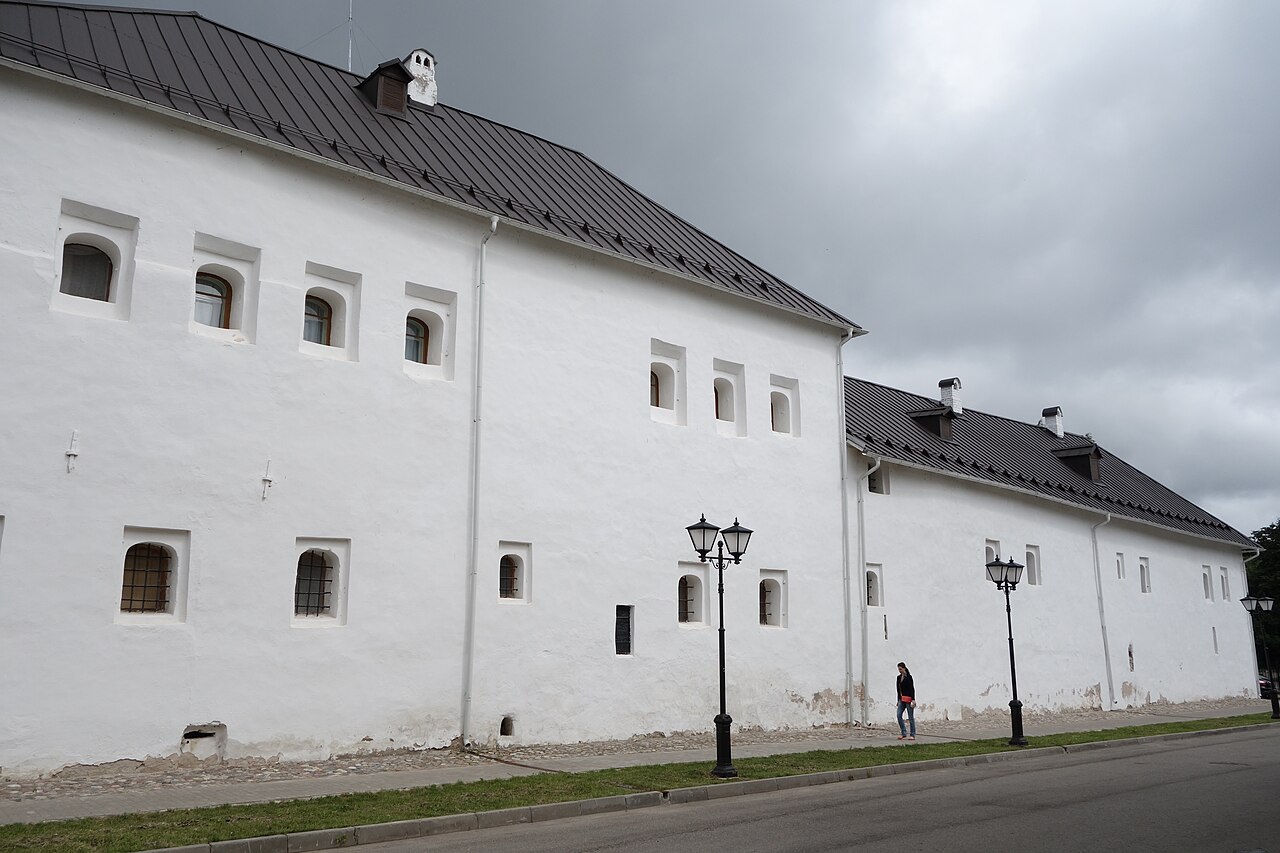
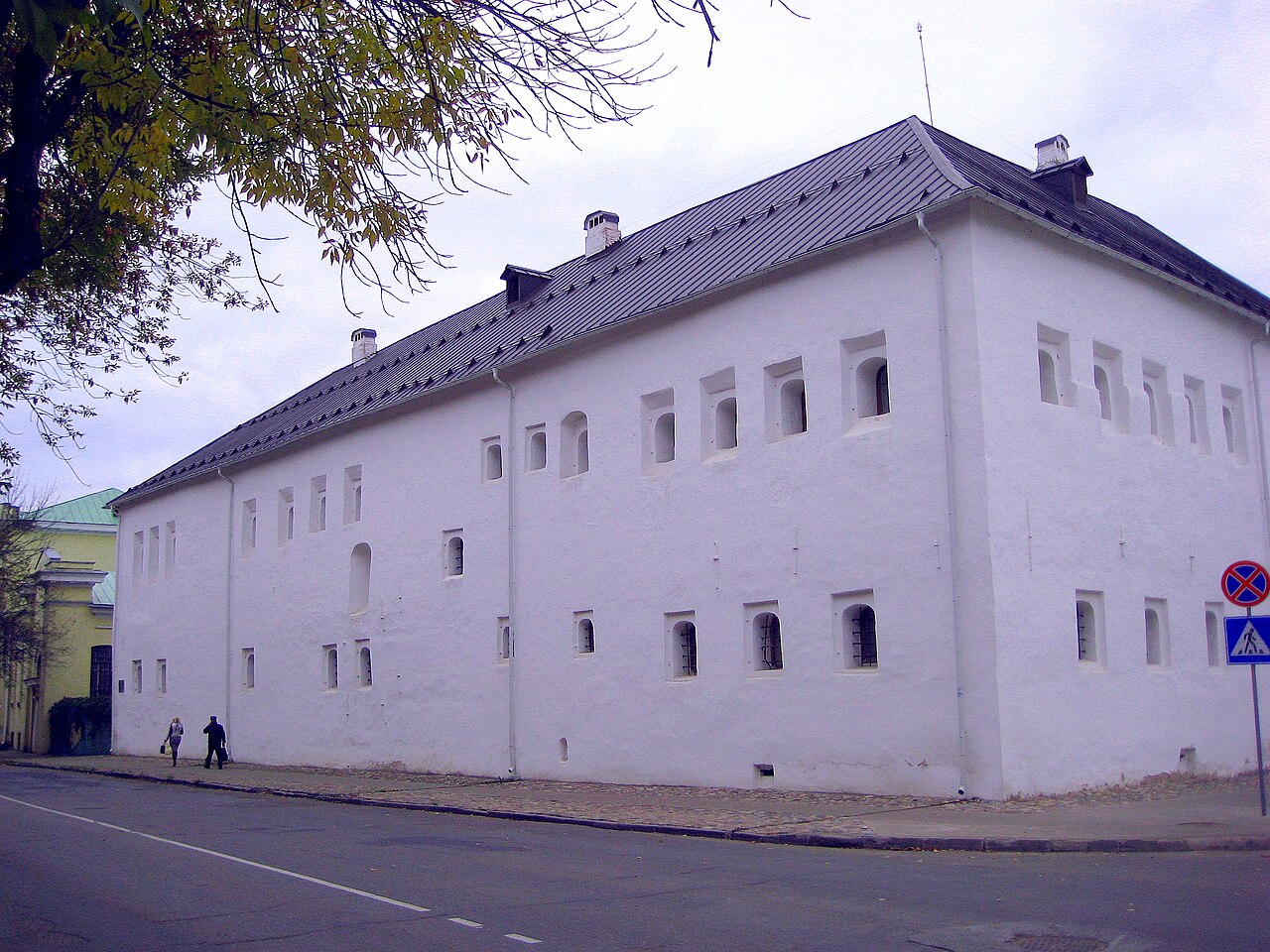
The Pogankin Chambers are merchant architecture at its most eloquent: three wings of two and three stories meeting at right angles, the limestone walls battered and whitewashed, windows deep-set behind iron, the single outside staircases climbing under their stone tents to the living floors, and within, the Pskov house’s full program, vaulted warehouse halls below, the master’s chambers with their tiled stoves and icon corners above, the strong rooms’ iron doors surviving in place.
The plan reads the household’s hierarchy like a section drawing: goods and servants at ground, the family’s vaulted parlors and bedchambers on the second, the wooden third story, lost early, for the summer rooms, with the compound’s chapel, counting room, and cellars completing a settlement in one house, built, the guides summarize, by a man who trusted stone, iron, and God, in roughly that order.
Architectural history prizes the chambers as the civil twin of Pskov’s churches: the same masons’ manner, the plastered masses and shadowed openings, turned to domestic use at palace scale, Russia’s largest surviving seventeenth-century town house, the secular masterpiece of the school that built fortresses, standing two streets from the walls it imitated.
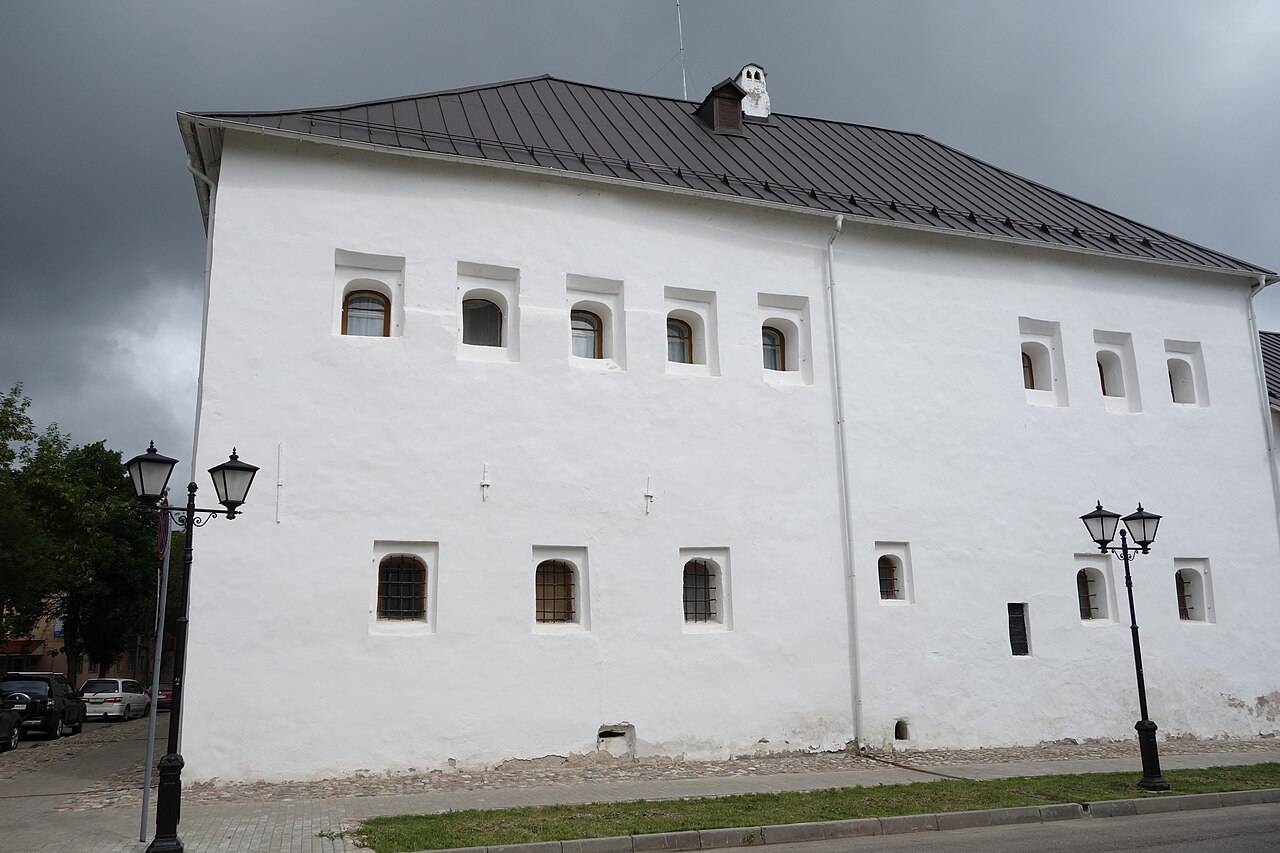
Legends of the Cellars
The chambers’ thick walls bred the town’s favorite ghost stories: the bricked treasure cellar sought by every generation’s boys, the underground passage to the Krom that diggers periodically fail to find, the murdered guest of one tale and the walled-up strongbox of another, Pskov’s folklore furnishing the house the archives left austere, and the museum, wisely, letting the vaults’ acoustics tell their own versions after closing time.
One documented drama suffices anyway: in 1710, the Great Northern War’s plague year, the chambers served the garrison as a quarantine store, the inventories recording the dead quarter’s goods under Pogankin vaults, the house’s fortress logic proving itself in the grimmest key, and supplying the legends their respectable kernel, walls built against everything eventually hold everything.
The modern cellar truth is better than treasure: the museum’s gold storeroom, the special depository of the Pskov hoards, buried coin and silver from the trading centuries lifted from the region’s soil, now resides in the house built by the mint’s leaseholder, the legends’ bullion materialized two floors below the ticket desk, under guard the stories would respect.
The Museum in the Chambers
The chambers became Pskov’s attic in 1900: the city’s museum moving in and never leaving, the Pskov State Museum-Reserve now filling the wings with the land’s whole inheritance, the icon halls where the Pskov school’s green-and-cinnabar panels hold their own against Novgorod’s, the silver treasury with the republic’s and the merchants’ plate, the siege relics, Dovmont’s sword among them, and the trading floors’ reconstructions giving Pogankin’s own business its exhibit.
The twentieth century audited the collection brutally: the Nazi occupation of 1941 to 1944 looted the museum toward the Reich, the postwar restitutions recovering part, the losses catalogued in the museum’s own honest displays, and the chambers themselves, burned in the war, restored by the Pskov school of restorers whose names, Spegalsky first, the town honors as it honors its medieval masters.
The museum’s latest era has returned the chambers’ own biography to the fore: restoration campaigns through the 2010s and 2020s renewing the wings, the Pogankin rooms reinterpreted with the account books and the mint’s story, and the house joining the city’s UNESCO churches on the visitor’s standard route, the merchant’s fortress completing, at last, its promotion from warehouse to monument.
The Abdication at Pskov
Pskov’s last imperial scene played at its railway station: on 2 March 1917, the imperial train halted here by the revolution’s spreading rail strikes, Nicholas II received the Duma’s delegates and his generals’ telegrams in the saloon carriage and signed the abdication, for himself and his son, the dynasty of three centuries ending on Pskov track, the frontier city that had watched Muscovy become an empire witnessing the empire’s signature out.
The symmetry struck contemporaries at once: Olga’s city, the chronicle’s cradle-ground of the dynasty’s legend, closing the dynasty’s book, and the town keeps the memorial modestly, a chapel by the station and the carriage’s story in the museum, Pskov’s register of Russian beginnings and endings, 903 to 1917, complete without a word of boast.
The twentieth century then wrote its own Pskov chapters, border town of the new states, occupation and ruin, the postwar restorers’ renaissance, and the city emerged holding what it had always held, the stones of the alternatives: the republic’s walls, the merchant’s palace, the station of the last signature, Russian history’s full syllabus teachable on one walkable riverbank.
Watch the Pskov Chambers on Film
Visiting the Pskov Chambers Today
Pskov lies 290 kilometers southwest of St Petersburg: Lastochka trains cover the run in three and a half hours, night trains serve Moscow, and the compact center puts the Pogankin Chambers on Nekrasova street fifteen minutes’ walk from the Krom. The museum-reserve opens daily except Mondays, tickets by exhibition or combined, with the icon and silver collections the essential halls and the gold storeroom shown on scheduled guided entries; the Krom and Trinity Cathedral are free-entry and open long hours, the wall walks seasonal. Give the city a full day, chambers and Krom in the morning, the Mirozhsky monastery’s twelfth-century UNESCO frescoes across the river after lunch, and the evening to the embankments; a second day reaches Izborsk’s fortress and the Pechory cave monastery west toward the border, the frontier’s full set. You can find the chambers on the map here: Pogankin Chambers on Google Maps. Spring high water and the white nights of June give the fortress its most dramatic settings, while winter wraps the walls and the merchant quarter in the deep northern quiet that suits their history best, so any season rewards the journey west.
Palaces Nearby
You May Like
The Vologda Kremlin and Ivan the Terrible’s Northern Capital