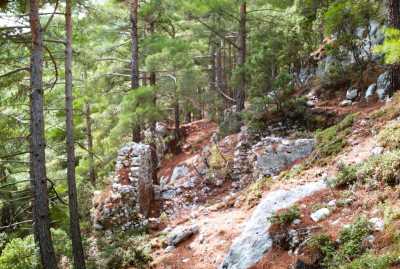
İdebessos is a Lycian city located near Kozağacı locality, Karacaören neighborhood, north of Kumluca district center. It is located seven kilometers north of Akalissos, northwest of Kormos. The “ss” suffix in its name suggests that there was another settlement, older than what is seen with the ruins. However, the earliest historical information is from the Lycian Union period. Although there is not much information about the settlement in ancient sources, it is stated that they formed a sympoliteia (political union) with Akalissos and Kormos. It is known that Akalissos was its leader. The city, which took the name Edebessos after the Roman period, was known as a bishopric within the Myra Metropolis during the Christian period, called Lebissos/Lemissos.
Idebessos, a rather small-sized settlement, was founded on a narrow ridge extending in the north-south direction, parallel to the Bey Mountain overlooking the Alakır Stream. The ruins are spread out, some on the plain facing west, and some on both slopes of a steeply descending hill towards the east, protected by walls. Traces of the Roman and Byzantine periods can be seen on the city walls. There is a small theater to the west of the wall, looking towards the mountain. While five rows of seating can be seen in the cavea of the theater, which is thirty meters in diameter and is thought to seat 600-700 people, there is no trace of the stage building. The theater dates back to the Hellenistic period due to its plan. The building approximately 70 meters north of the theater is the bathhouse. This small-sized structure was built in the tradition of Lycian baths.
When you go towards the north, you encounter a small-sized basilica. The building, which has survived to the present day in a very damaged condition, belongs to the Middle Ages.

The city walls can be seen around the acropolis in the southeast. The walls behind the theater, which mostly contain residences, official buildings and mausoleums, have created a safe area in this section. Sarcophagi can be seen inside and outside the city walls. Among the sarcophagi, all of which are from the Roman period and at least fifty of them can be counted, the most striking are the triple sarcophagus clusters sitting on “U” shaped exedras. Most decorations of the plain sarcophagi, some of which have tabula ansata, are Pisidian shields with or without spears on their side faces.
Idebessos, which is represented by a single vote in the Lycian Union, is among the “Ancient Cities of the Lycian Civilization” (2009) proposed to the UNESCO World Heritage List.
Resources

Cevdet Bayburtluoğlu, Lykia, Istanbul, 2004, 148-151.
Nevzat Çevik, Lykia Kitap, İstanbul, 2015, 445-449.
Source: Antalya Provincial Culture and Tourism Directorate


One thought on “Idebessos Antik Kenti – Travel Guide – Antalya”