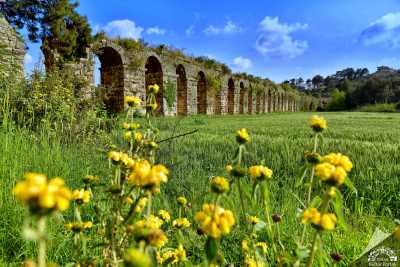
Kitanaura is an important ancient settlement located on the hills and slopes north of Saraycık locality, within the borders of Gölcük neighborhood of Kumluca district. Based on coins with the Kita legend from the Hellenistic period, it is understood that Kitanaura minted coins in this period. Although there is limited information about its Roman history, this city, surrounded by walls, was used until the Middle Ages. It is understood from the bishop lists and Byzantine ruins in the city that it was an important bishopric under the Metropolitan of Perge during the Byzantine period.
The ruins of the ancient city were first named as Apollonia by travelers Spratt and Forbes, who visited here in 1842; It was subsequently localized as Mnara by A. J. Schönborn. However, according to the road route specified in the Stadiasmus Patarensis (Patara Road Monument) in Patara, it has become certain that the ruins in Saraycık belong to Kitanaura. According to Stadiasmus Patarensis, Kitanaura is 17-18 kilometers away from Idebessos and this settlement is within the sovereignty borders of Termessos.
The ruins lie on the acropolis extending in the east-west direction and along the southern and western skirts of the acropolis and the forest road. The acropolis, which is 1300 meters above sea level and surrounded by walls, is entered through three gates. The main entrance is from the southwest. There are ruins of a basilica from the early Byzantine period at the southwestern end of the acropolis. Important public buildings begin at the eastern border of the Acropolis square.
The three entrances, narthex, three naves, two rows of columns and the apse of the large basilica are distinct. A large, rectangular cistern is located along the northern side of the large basilica. This is the largest cistern in the city. The most important public structure of the city is the bathhouse. Located right next to the forest road in the southwest of the acropolis, the bath consists of seven sections and extends in the north-south direction. Some sections have been preserved down to the roof level. The apodyterium (dressing-dressing) section of the bath is very impressive with its arched niches. The wall extending towards the hill opposite the apodyterium belongs to the aqueduct that meets the water needs of the bath.

Both sides of the forest road extending from the west of the acropolis to the north are full of graves. The most famous tomb known in the necropolis, where aedicula tombs, sarcophagi, chamosorions and osteotheks are concentrated, is Saraycık Heroon. There are many reliefs of military clothing and weapons on the orthostats on the podium and the facades of the ante walls of the tomb, which has survived to the present day in a very solid condition.
Kitanaura is among the “Ancient Cities of the Lycian Civilization” (2009) recommended to the UNESCO World Heritage List.
Resources

T.R. Antalya Governorship, Cultural Inventory (Kemer-Kumluca-Finike), 2005, 115.
Nevzat Çevik, Lycian Book, Istanbul, 2015, 487-493.
Source: Antalya Provincial Culture and Tourism Directorate