A short walk through the park from the golden extravagance of the Catherine Palace stands a quieter building with a very different story to tell. The Alexander Palace, a serene neoclassical residence of yellow and white, was the last true home of the Romanov dynasty. Nicholas II and his family lived here for more than a decade, and it was from these rooms that they were taken into exile in August 1917, never to return.
Catherine the Great built the palace in the 1790s as a wedding gift for her favorite grandson, the future Alexander I, and the architect Giacomo Quarenghi gave it one of the most admired colonnades in Russia. For a century it served as a comfortable secondary residence, until the last emperor made it his permanent refuge from a capital he distrusted.
This guide walks you through the palace’s two lives: Quarenghi’s classical masterpiece and the private world of the last imperial family, the restored rooms where their photographs, uniforms, and children’s toys have returned, the surrounding Alexander Park with its towers and pavilions, and the practical details of visiting today.
- Catherine’s Gift to Her Grandson
- Quarenghi’s Classical Masterpiece
- The Famous Double Colonnade
- A Century of Quiet Service
- Nicholas II Makes a Home
- The Private Rooms of the Family
- The Children’s Floor
- Court Life Behind the Gates
- War and Revolution
- House Arrest and the Last Departure
- The Palace After the Romanovs
- The Great Restoration
- The Alexander Park
- Watch the Alexander Palace on Film
- Visiting the Alexander Palace Today
- Palaces Nearby
Catherine’s Gift to Her Grandson
Catherine the Great took personal charge of raising her eldest grandson Alexander, grooming him from birth to inherit her throne, by her preference ahead of his father Paul. When the sixteen-year-old married Princess Louise of Baden in 1793, the empress announced a gift to match her ambitions for him: a brand-new palace in the park at Tsarskoye Selo, just north of her own residence.
The choice of site spoke clearly. The young couple would live within sight of the empress, inside the dynasty’s favorite summer estate, in a building that owed nothing to the baroque of Elizabeth’s palace and everything to the new classical taste Catherine had championed for thirty years.
Construction moved quickly, and in the spring of 1796 Alexander and his wife moved in. Catherine died that November, and the palace she had intended as a statement about the future became, over the next century, exactly that, though not in ways she could have imagined.
Quarenghi’s Classical Masterpiece
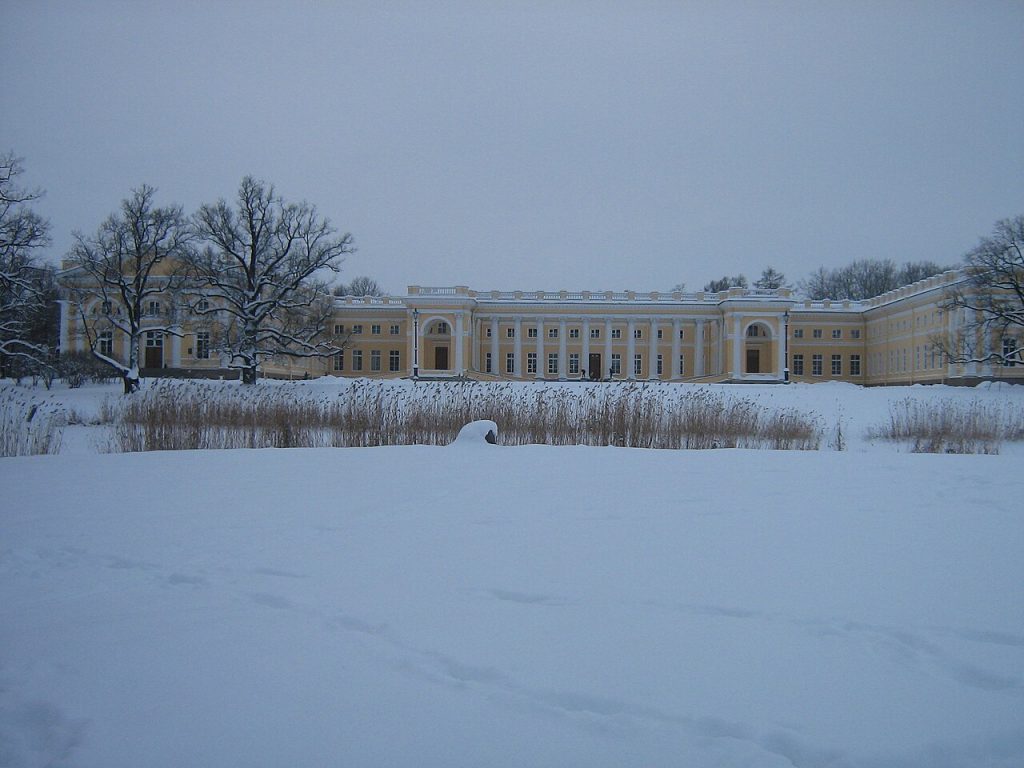
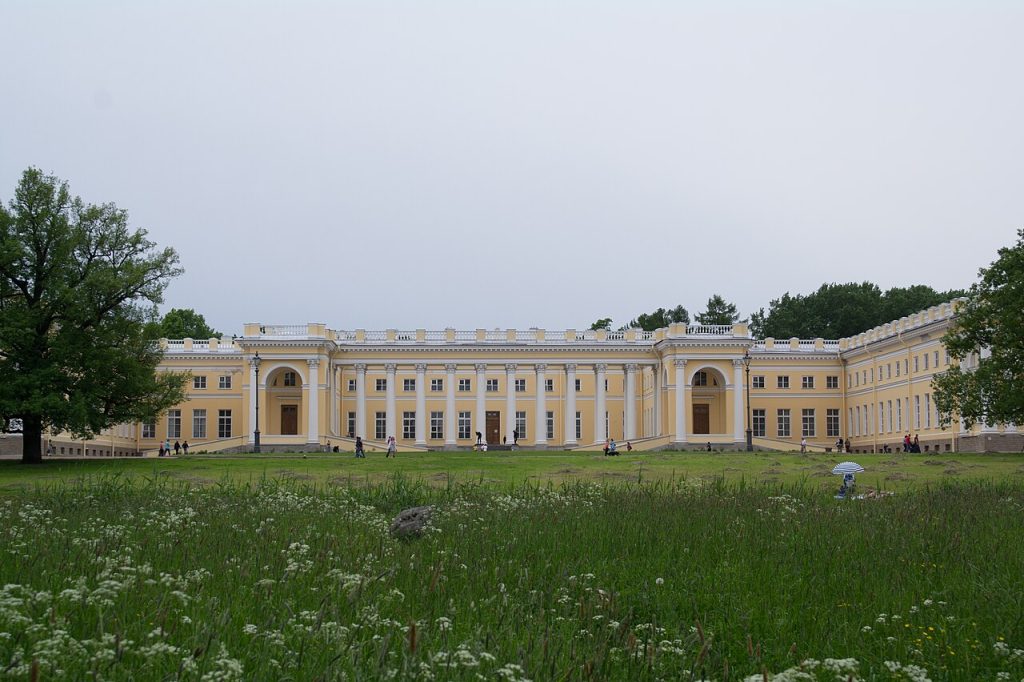
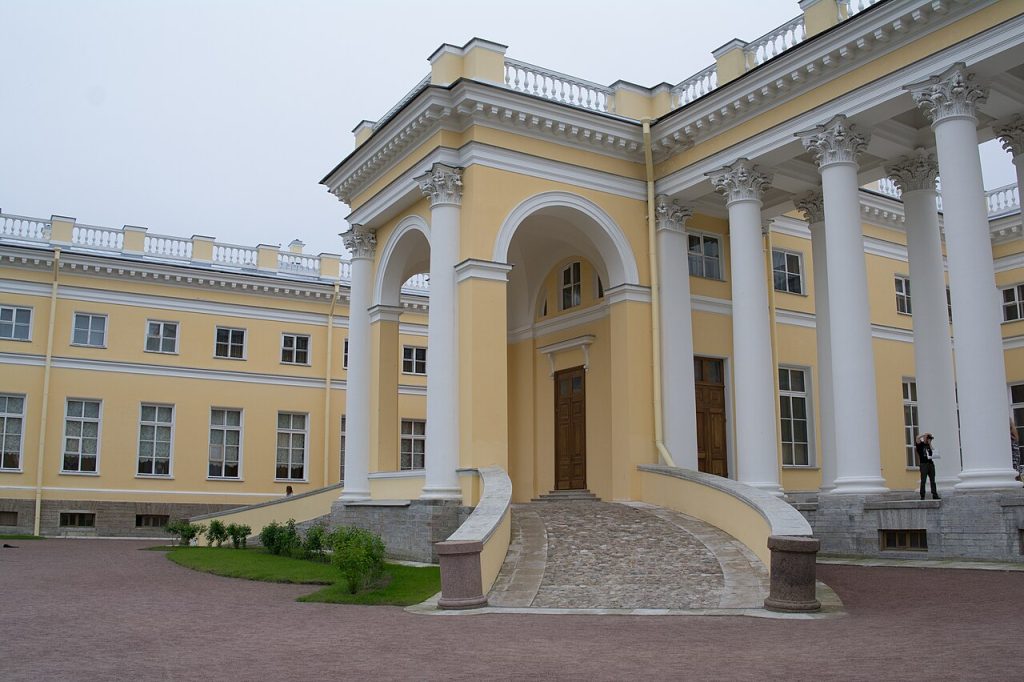
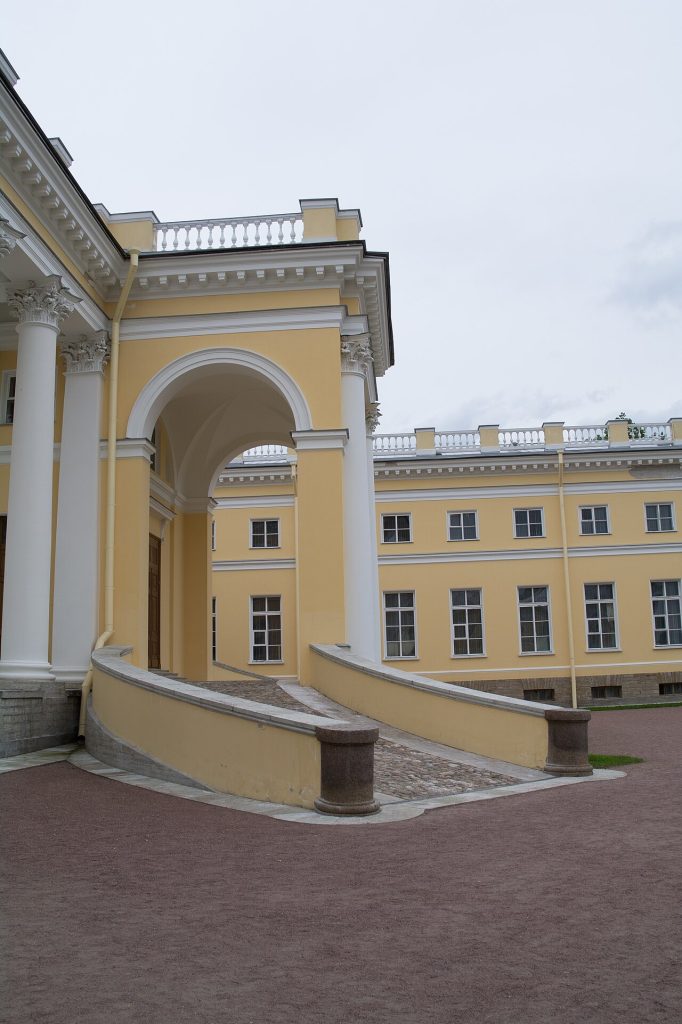
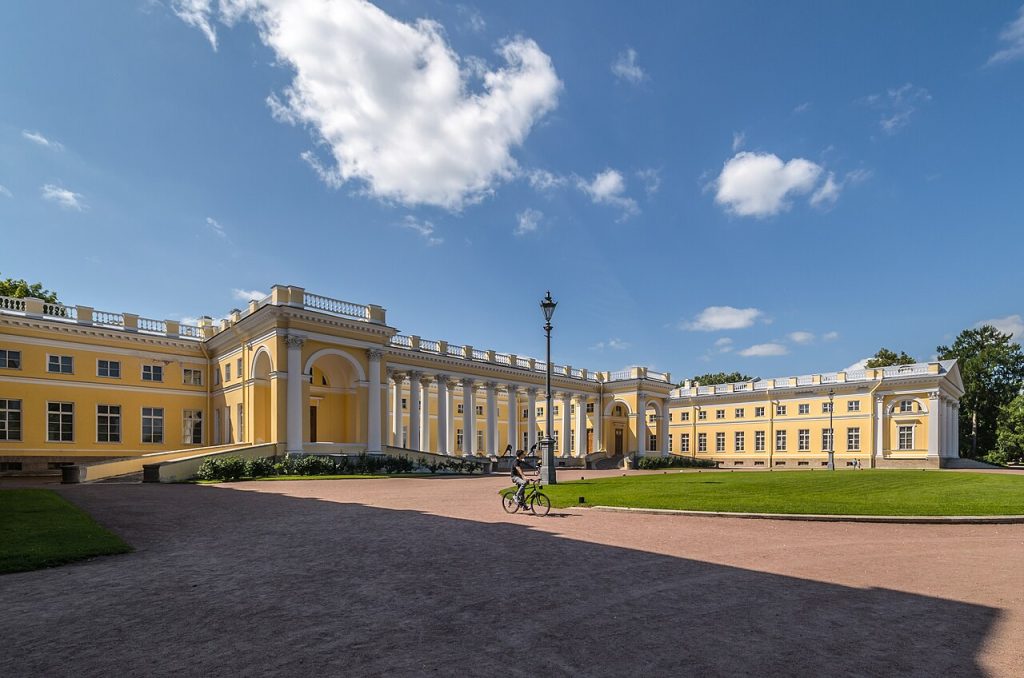
Catherine gave the commission to Giacomo Quarenghi, the Italian architect whose austere Palladian buildings had already changed the face of St Petersburg. At Tsarskoye Selo he produced what many consider his finest work: a long two-story palace of perfect proportions, its yellow walls and white details radiating calm beside the exuberance of Rastrelli’s palace nearby.
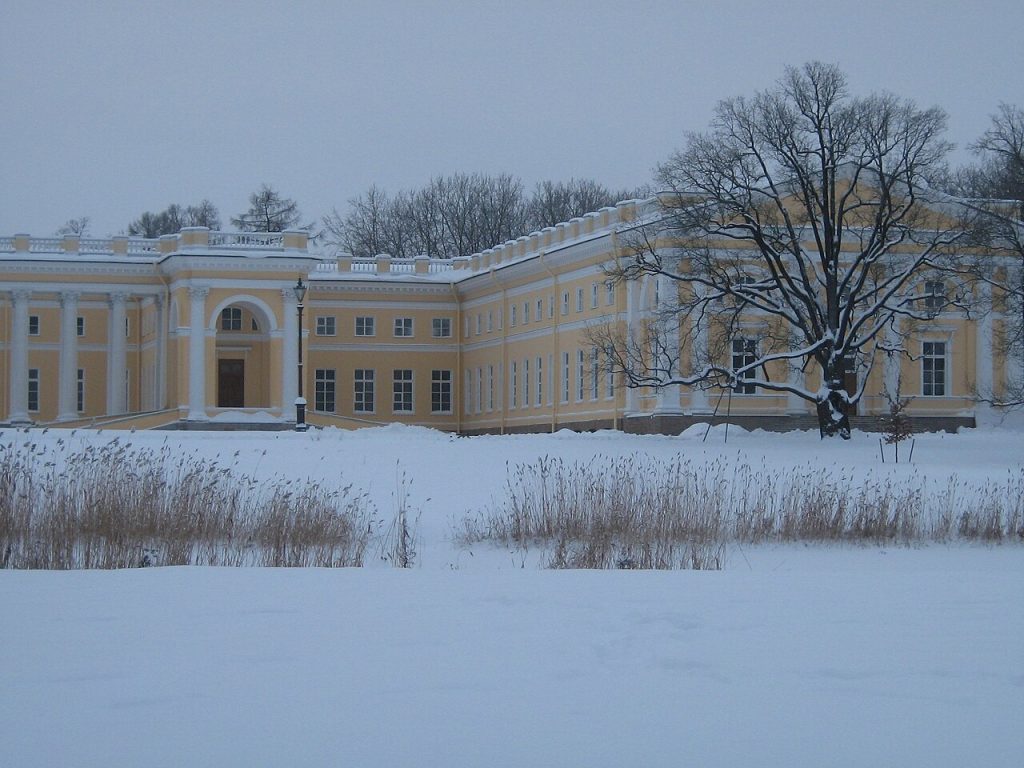
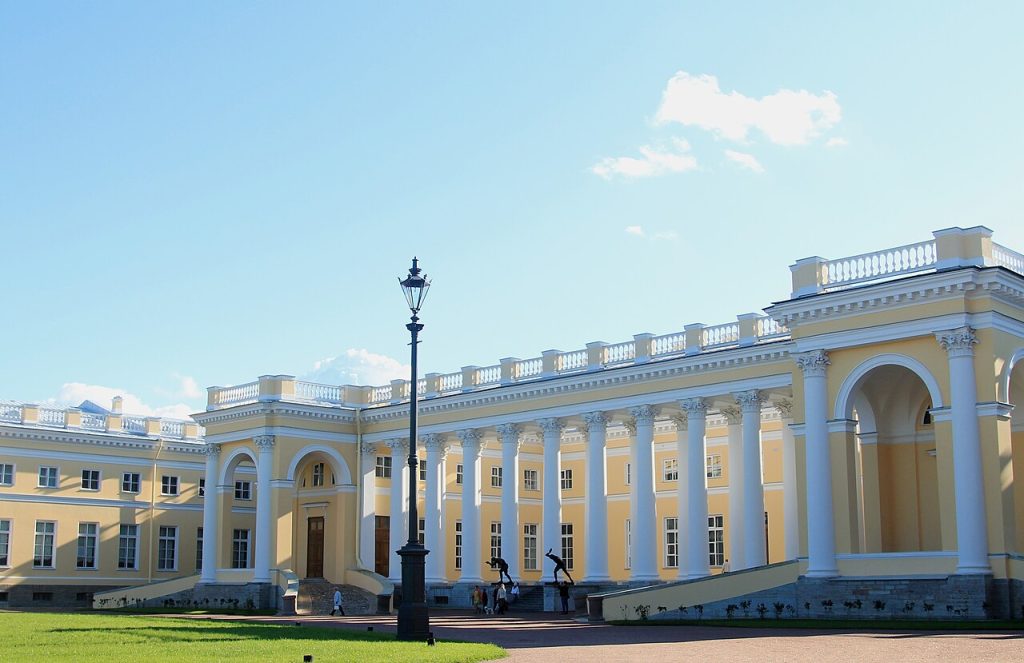
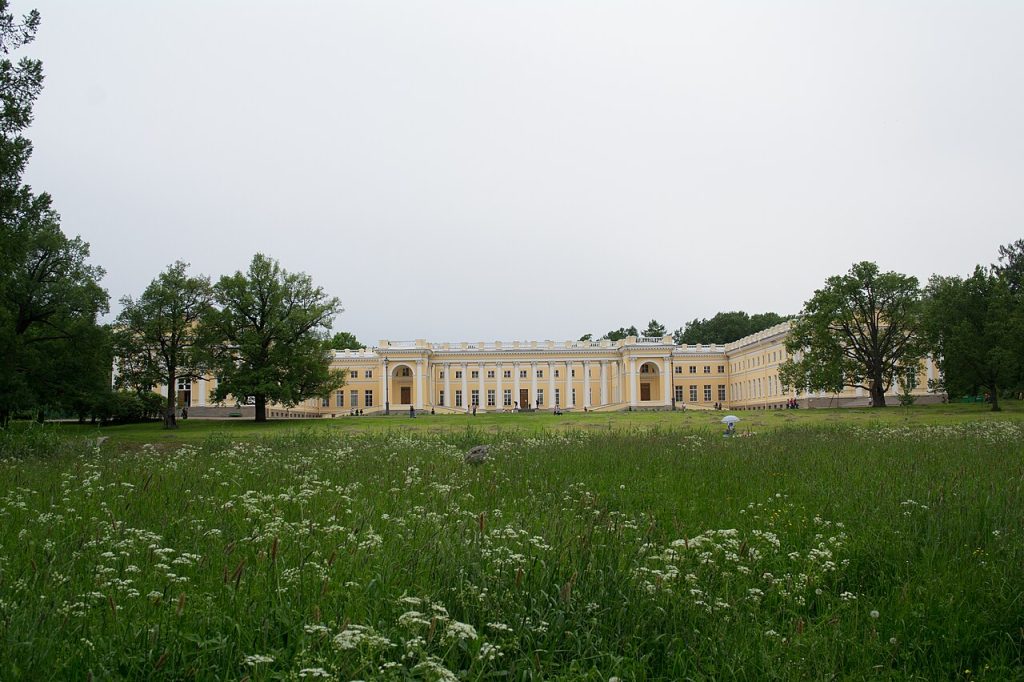
The plan is a wide U, with two wings embracing a front court. Quarenghi kept ornament to a minimum and let geometry speak, trusting the rhythm of windows and the great colonnade at the center to carry the design. Contemporaries ranked the palace among the most beautiful in Europe precisely for its restraint.
Inside, the architect arranged a suite of state rooms along the garden front, centered on a trio of halls divided by wide arches, with a semicircular hall at the middle looking out over the park. The interiors shared the facade’s discipline: pale walls, sparing gilt, and light flooding in from both sides.
The Famous Double Colonnade
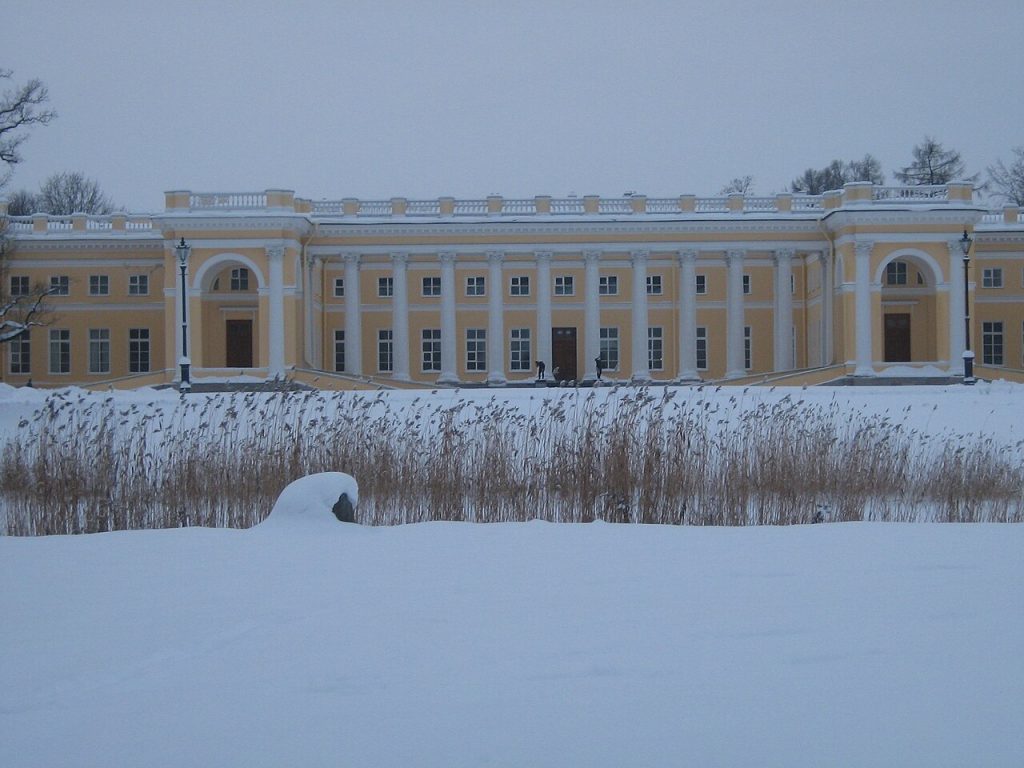
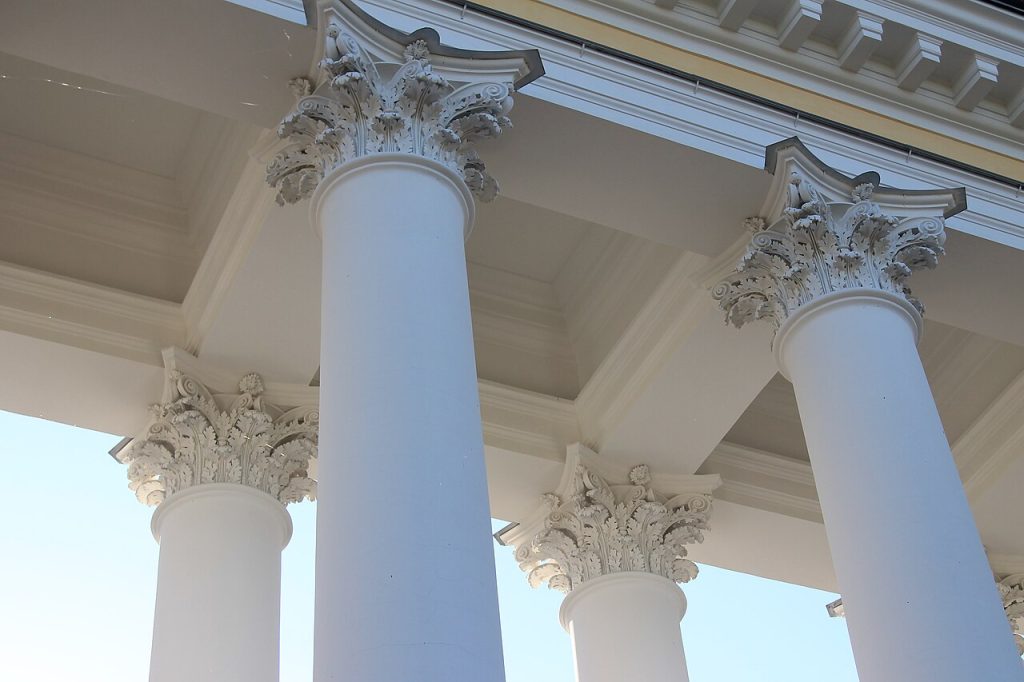
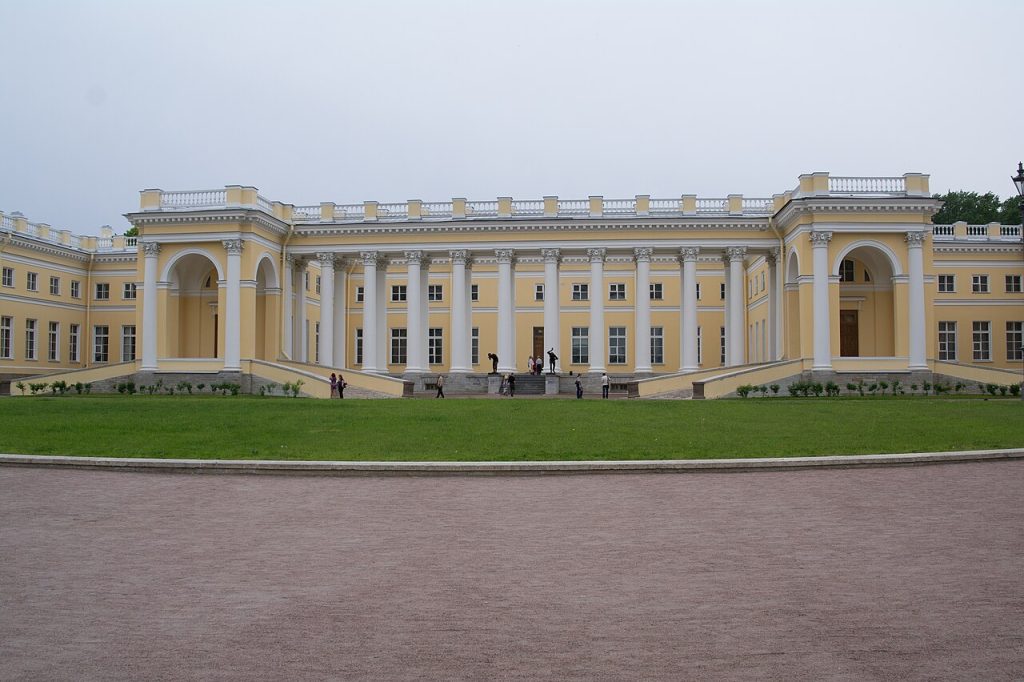
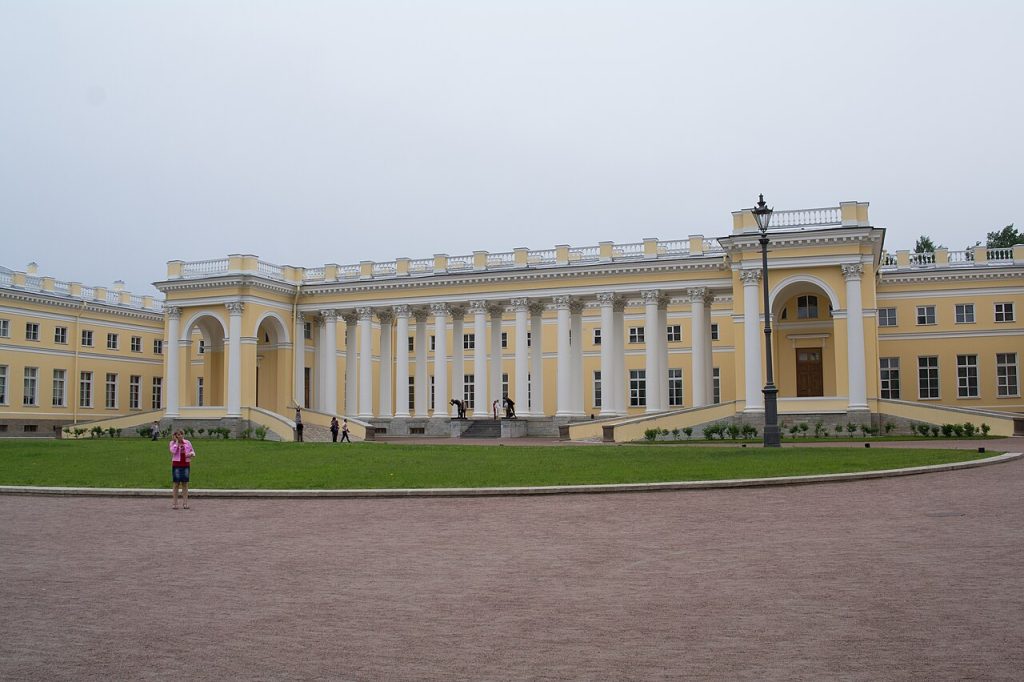
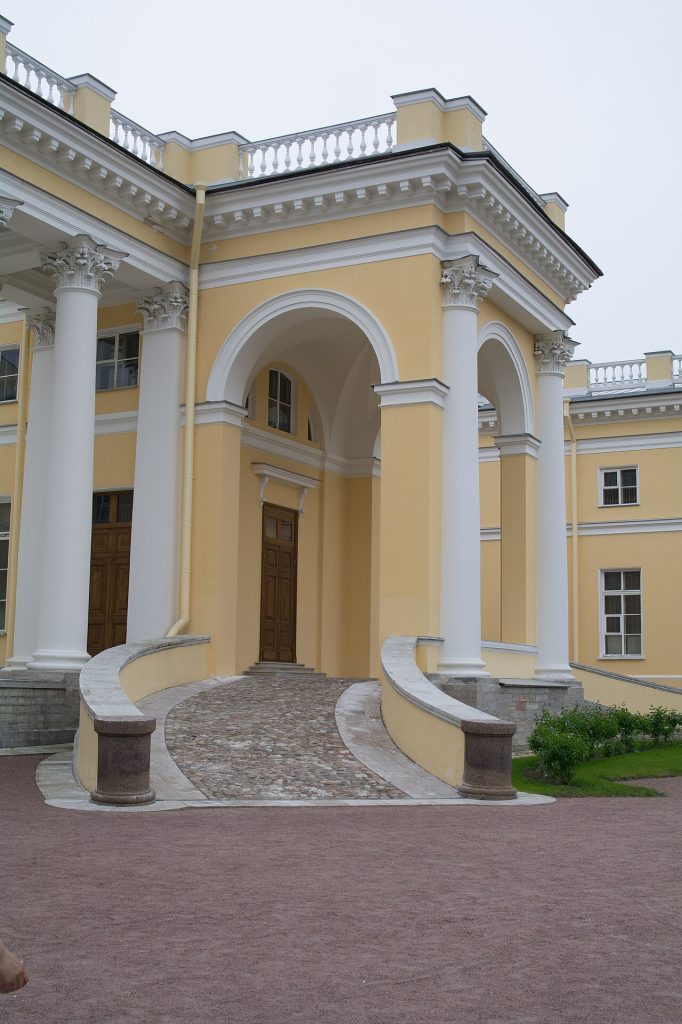
The signature of the Alexander Palace is the open double colonnade that screens its central section: two parallel rows of Corinthian columns, thirty-two in all, standing free of the building and framing a shaded gallery between the wings. It is an idea of startling simplicity, turning the approach to the palace into a procession through white columns with the garden visible beyond.
The colonnade gave the building its airy, villa-like character and quickly became one of the most painted and photographed views at Tsarskoye Selo. In the early twentieth century, statues of youths playing knucklebones and other games stood among the columns, and the imperial children treated the gallery as an extension of their playground.
Architectural historians have spent two centuries praising the device. By detaching the columns from the facade, Quarenghi created depth and shadow that animate the long building at every hour of the day, achieving with pure structure what Rastrelli next door achieved with gold.
A Century of Quiet Service
After Alexander I came to the throne in 1801 he preferred the Catherine Palace for official summers, and the newer building settled into the role of a family annex. His brother Nicholas I used it fondly, and it was here that court mourning gathered when Nicholas died in 1855. Alexander III spent part of his youth in its rooms, though as emperor he kept his family mainly at Gatchina.
Throughout the nineteenth century the palace served as a staging post for grand occasions at Tsarskoye Selo and a home for younger members of the dynasty. Its interiors were refreshed by each generation, acquiring comfortable private suites alongside Quarenghi’s cool state rooms.
The building’s relative modesty, by imperial standards, turned out to be its destiny. When a ruler finally chose it as a principal residence, he chose it precisely because it was not a stage but a house, set in a fenced park where a family could live almost privately.
Nicholas II Makes a Home
Nicholas II was born at Tsarskoye Selo and had spent happy spells at the Alexander Palace as a child. After the revolution of 1905 made the capital feel dangerous, he moved his family here permanently, and for the last twelve years of the empire the modest palace in the park was the true center of Russian power, far more than the Winter Palace the world associated with the tsars.
The emperor and empress remade the eastern wing for themselves in the fashionable Art Nouveau taste. Alexandra’s Mauve Boudoir, upholstered in her favorite color, became the most famous room in the palace, while Nicholas’s New Study mixed English club comfort with Russian woodwork. Critics at court sniffed at the middle-class coziness; the family did not care.
Daily life followed a rhythm closer to a country gentleman’s than an autocrat’s: morning walks, lessons for the children, tea at fixed hours, evenings of reading aloud. Ministers came out from the capital by train to report, and the fate of a sixth of the earth was decided in rooms hung with family photographs and chintz.
The Private Rooms of the Family
The restored private apartments are the emotional heart of today’s museum. In Alexandra’s suite, the Mauve Boudoir has been recreated down to its lilac silk and the icons the empress kept close in her final years at home, when illness and anxiety increasingly confined her to this room, resting on her famous couch as the children came and went.
Nicholas’s rooms tell their own story. His working study holds the plain desk at which he signed the orders of a world war; his reception room saw the audiences that failed to save the monarchy. The Moorish-style bathroom with its sunken pool, a marvel of 1900s plumbing, reminds you that this was also simply a modern family home of its era.
Museum curators have returned thousands of original objects: uniforms, dresses, the children’s drawings, the empress’s needlework, photograph albums the family filled obsessively. The effect is intimate to the point of discomfort, as if the owners had stepped into the park and might return.
The Children’s Floor
The five imperial children, the grand duchesses Olga, Tatiana, Maria, and Anastasia and the tsarevich Alexei, grew up on the upper floor of the eastern wing, in rooms deliberately kept simple. The girls slept two to a room on folding camp beds, by family tradition, with cold baths in the morning; their shared schoolrooms and the boy’s playroom full of toy soldiers and model ships have been restored from photographs.
Alexei’s rooms carry the palace’s quietest tragedy. The heir’s hemophilia shaped the household: his bedroom connected quickly to his parents’ floor, a sailor-attendant was never far, and the empress’s dependence on the healer Rasputin, so corrosive to the dynasty’s reputation, began at this bedside.
Visitors consistently name the children’s floor the most affecting part of the museum. The exercise books, the uniforms sewn for a boy who played at soldiering, the growth marks and photographs, all gain unbearable weight from the knowledge of what awaited the family in Yekaterinburg in July 1918.
Court Life Behind the Gates
Even a family seeking privacy dragged an empire behind it. The Alexander Palace in its last decade housed a working court: a commandant’s office, kitchens feeding hundreds, a telephone exchange, and the convoy of Cossacks and the composite regiment that guarded the park’s fences. Receptions still filled Quarenghi’s halls when protocol demanded.
The palace saw its share of history’s visitors. Here Nicholas received ambassadors and ministers; here, during the tercentenary of the dynasty in 1913, the family appeared at the height of ceremonial splendor. The semicircular hall hosted the last great Christmas trees of the old regime, with gifts for the staff and their children.
Technology crept in alongside tradition. The palace had electricity, elevators, telephones, and even an early cinema installation for the children’s beloved film evenings. The contrast between this modern comfort and the medieval idea of autocracy the household embodied is one of the strangest flavors of the place.
War and Revolution
The First World War transformed the palace. Alexandra and her elder daughters trained as nurses and worked in hospitals set up at Tsarskoye Selo, including wards in the palace complex itself. Nicholas spent long months at military headquarters, and the house of family teas became a place of telegrams, casualty lists, and gathering dread.
As defeat and scarcity poisoned the capital through 1916, the palace’s isolation turned against its owners. Rumor made Alexandra a traitor and Rasputin the true ruler; the murder of the healer that December brought no relief. When bread riots in Petrograd became revolution in February 1917, the emperor was away at the front, and the empress waited here with children sick with measles as the garrison’s loyalty dissolved.
On 2 March 1917, in a railway carriage far from home, Nicholas abdicated. The dynasty that had begun with Michael Romanov in 1613 ended with a signature, and the Alexander Palace ceased in that moment to be a seat of power, becoming instead a prison for the family inside it.
House Arrest and the Last Departure
The Provisional Government placed the family under house arrest at the Alexander Palace in March 1917, and for five months their world shrank to a suite of rooms and a guarded section of the park. The deposed emperor sawed firewood and dug a kitchen garden with his daughters; guards, by turns hostile and awed, watched Russia’s former masters plant cabbages.
Alexander Kerensky, the government’s strongman, came several times to interrogate the couple, and departures were discussed, including asylum in Britain, which London ultimately withdrew. The family lived in a strange suspension, part prisoners, part museum pieces, while the children recovered from illness and resumed lessons with their tutors.
Before dawn on 1 August 1917, fearing both mobs and rescue plots, Kerensky sent the family by rail to Tobolsk in Siberia. They left from the palace they loved with luggage, dogs, and a few loyal retainers. From Tobolsk the Bolsheviks later moved them to Yekaterinburg, where guards murdered the entire family in July 1918. The palace never saw its owners again.
The Palace After the Romanovs
Within a year of the family’s departure, the Soviet state opened their home to the public as a museum of the fallen regime, and through the 1920s crowds filed past the Mauve Boudoir and the children’s rooms exactly as visitors do today, though then the tone was accusation rather than elegy. In the 1930s ideology hardened, parts of the collection were dispersed, and wings went to other uses.
The Second World War brought occupation. German forces and their allies used the palace for a headquarters and a prison, the park became a cemetery for SS men, and liberation in 1944 found the building scarred and emptied, though structurally it survived better than the gutted Catherine Palace next door.
The postwar decades were a long exile from memory. The palace housed a naval institute, closed to the public, its surviving interiors hidden behind office partitions while the town around it carried the poet Pushkin’s name and the dynasty went unmentioned. Only in the 1990s did the building return fully to museum hands.
The Great Restoration
The palace reopened its first memorial rooms in 1997, but the decisive campaign began in 2015, when the museum closed the building for the most ambitious restoration in its history. Working from photographs, inventories, and physical traces, restorers rebuilt the private apartments of Nicholas and Alexandra to their appearance around 1910, down to wallpapers rewoven from surviving fragments.
The first thirteen restored rooms opened to visitors in August 2021, including the Mauve Boudoir, the emperor’s study and bathroom, and the couple’s bedroom with its wall of icons. Work continues on further suites, the children’s floor, and the state halls, with the palace planned as the center of a museum quarter devoted to the last reign.
The project has drawn worldwide attention because its subject is not architecture alone but memory. Each reopened room restores a disputed chapter of Russian history to physical form, and the palace has become the place where the country goes to look its last dynasty in the eye.
The Alexander Park
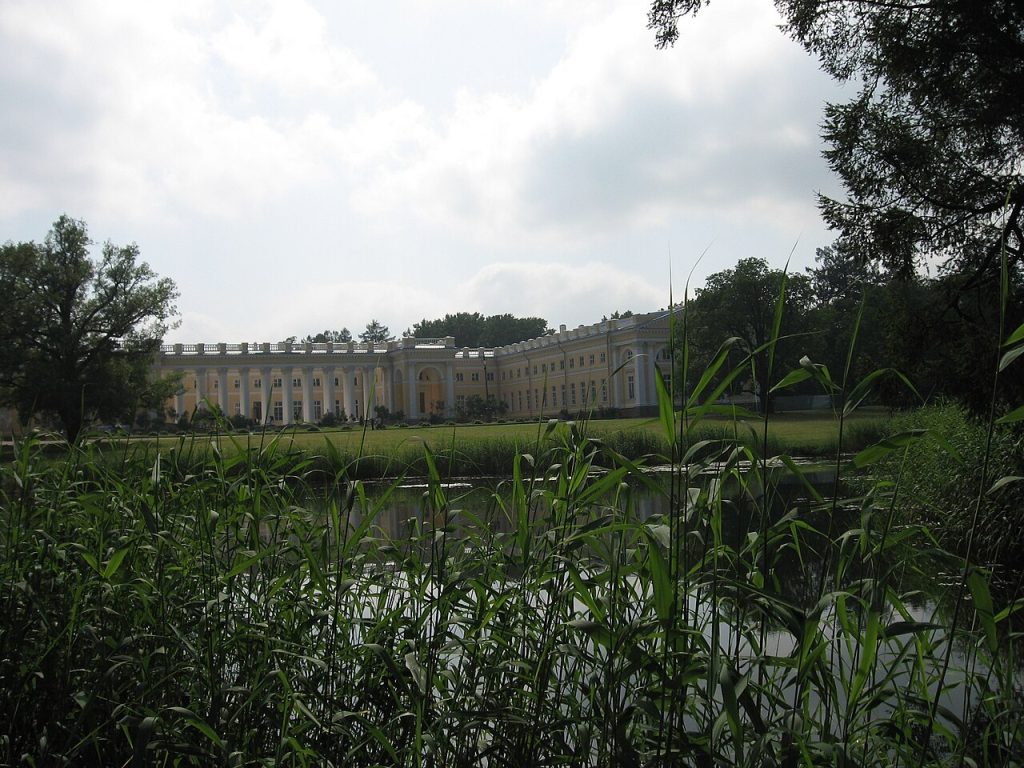
The palace stands in its own park of some two hundred hectares, wilder and quieter than the Catherine Park next door, and most visitors to Tsarskoye Selo never discover it. Its lawns and canals nearest the palace give way to deep woodland crossed by straight alleys, with a scattering of buildings as strange as any in Russia.
The Chinese Village, a cluster of pagoda-roofed houses built for Catherine the Great, hides in the trees near the Creaking Pagoda; the Dragon Bridge and Great Caprice arch over the park’s roads. Farther out stand the neo-Gothic follies of the 1820s: the White Tower, a toy fortress where imperial children took gymnastics, the Arsenal, and the Chapelle, an artificial ruin.
On the park’s edge the Feodorovsky Cathedral, built for Nicholas II in revival Russian style, served as the family’s parish church, and the brick fantasy of the Feodorovsky Gorodok beside it housed its clergy. Walking from Quarenghi’s colonnade to these last monuments of the dynasty, you cross the whole arc of imperial taste in half an hour.
Watch the Alexander Palace on Film
Visiting the Alexander Palace Today
The Alexander Palace stands in the town of Pushkin, a ten-minute walk through the park from the Catherine Palace, and the two are best combined in one day trip from St Petersburg. Trains from Vitebsky station and minibuses from Moskovskaya metro serve the town. The restored private apartments are open with timed tickets, and queues are far shorter than at the Amber Room next door, making this the calmer half of any Tsarskoye Selo day; check the museum’s site for the current state of ongoing restoration, and note the palace closes on Wednesdays. The surrounding Alexander Park is free and open daily. You can find the palace on the map here: Alexander Palace on Google Maps.
Palaces Nearby
You May Like
Peterhof Palace and the Fountain Capital of the Tsars