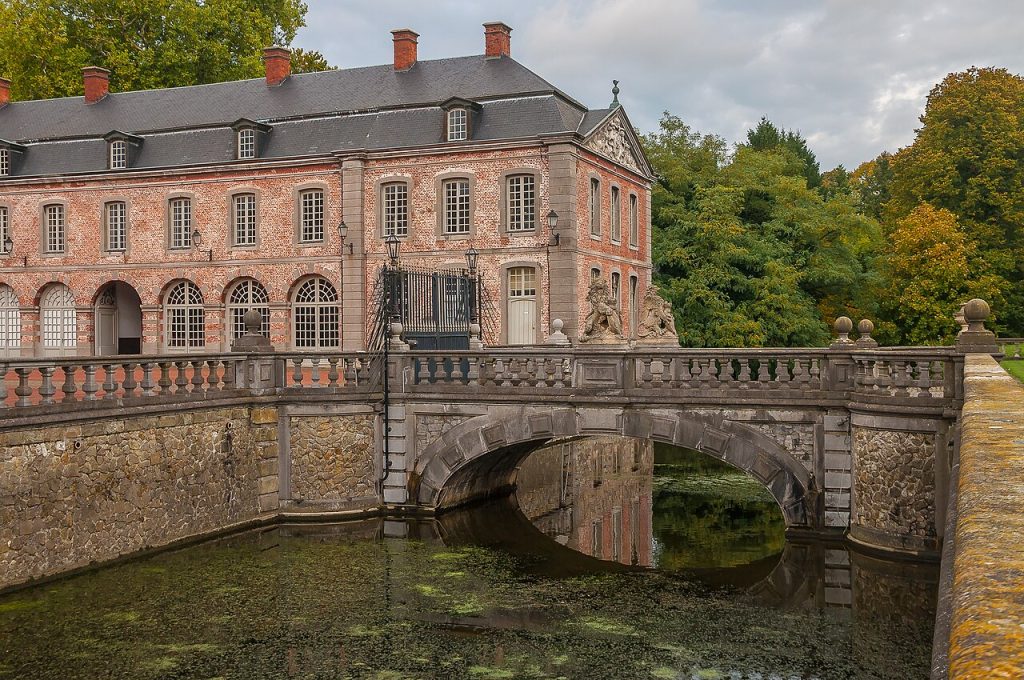
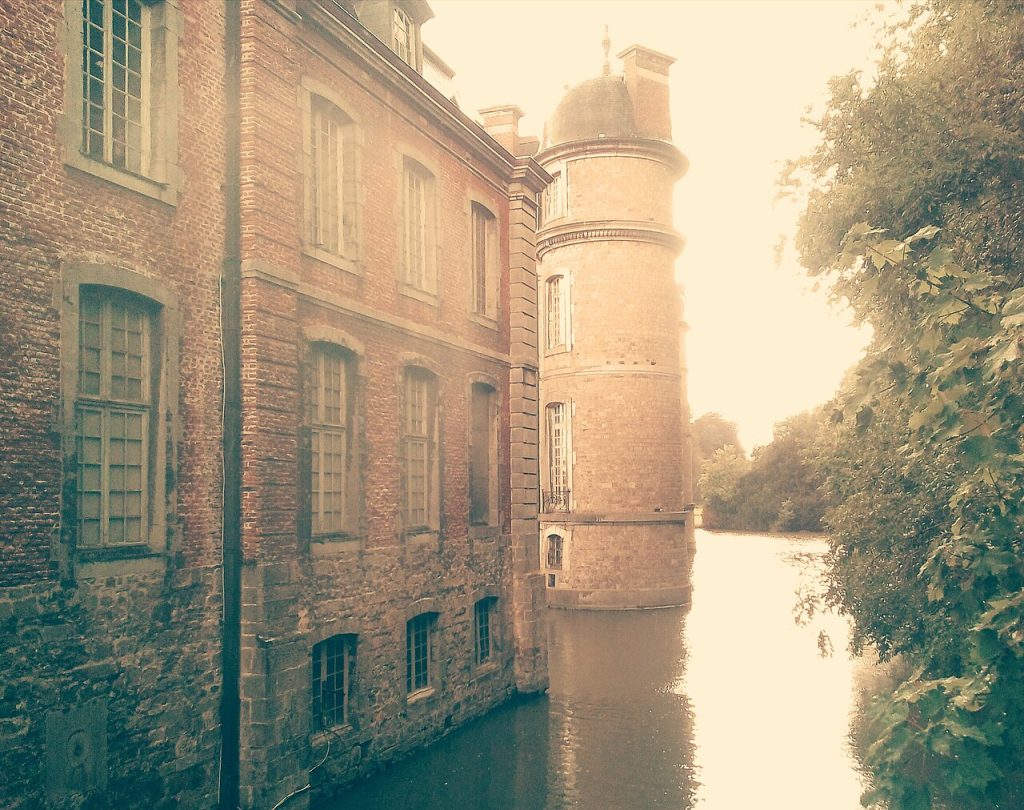
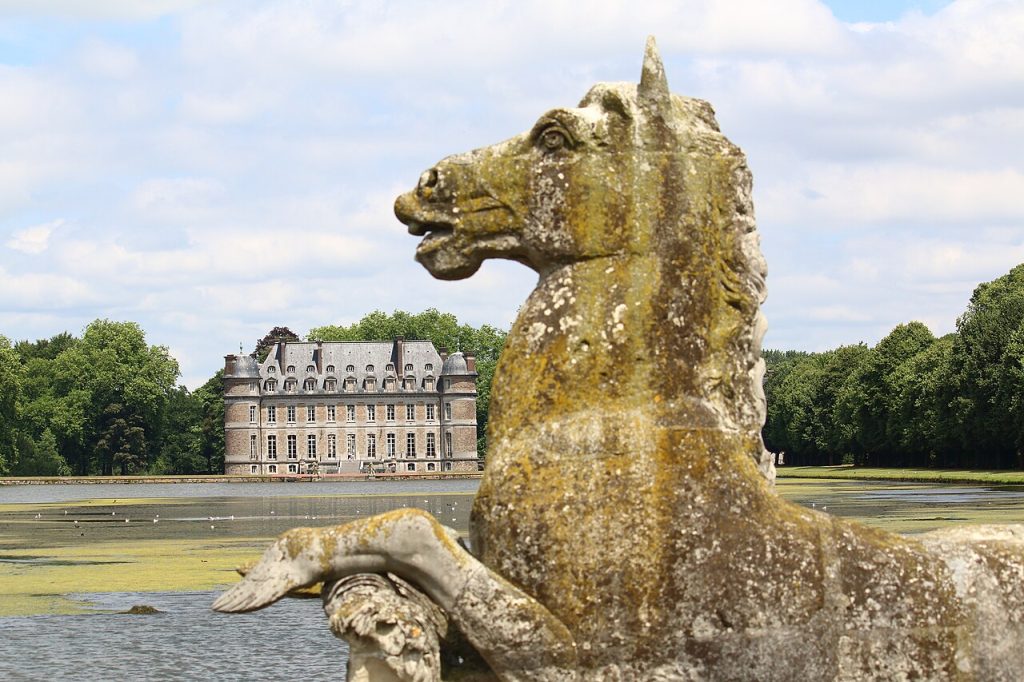
Now, stop on the bridge before you cross, and look down at the water. The moat at Beloeil is not a decorative pond. It is the surviving outline of a medieval fortress, and everything elegant that stands above it is built on the footprint of something that was designed to keep people out.
Belgians call this place the Versailles of Belgium, which is the kind of comparison that usually flatters nobody. In this case it points at something real. The gardens here are enormous, rigorously geometric, and laid out with the confidence of people who assumed they would be in charge for a very long time.
They were right. The Ligne family has held Beloeil since the fourteenth century and still lives here. That continuity is the rarest thing on the site, rarer than the books, the furniture or the water.
- The Fortress Under the Palace
- The House of Ligne
- Charles-Joseph, the Prince Who Wrote
- The Gardens Built Around Water
- The Great Basin and Its Scale
- A Library of Twenty Thousand Books
- The Rooms and What They Hold
- The Fire That Nearly Ended It
- Rebuilding in the Old Image
- Two Wars and a Border Province
- Still a Family House
- Walking the Garden Today
- Why Beloeil Matters
The Fortress Under the Palace
Hainaut was border country. For centuries this was the zone where the French crown, the dukes of Burgundy, the Habsburgs and later the Spanish and Austrian administrations pushed against one another, and a landowner here needed walls rather than windows.
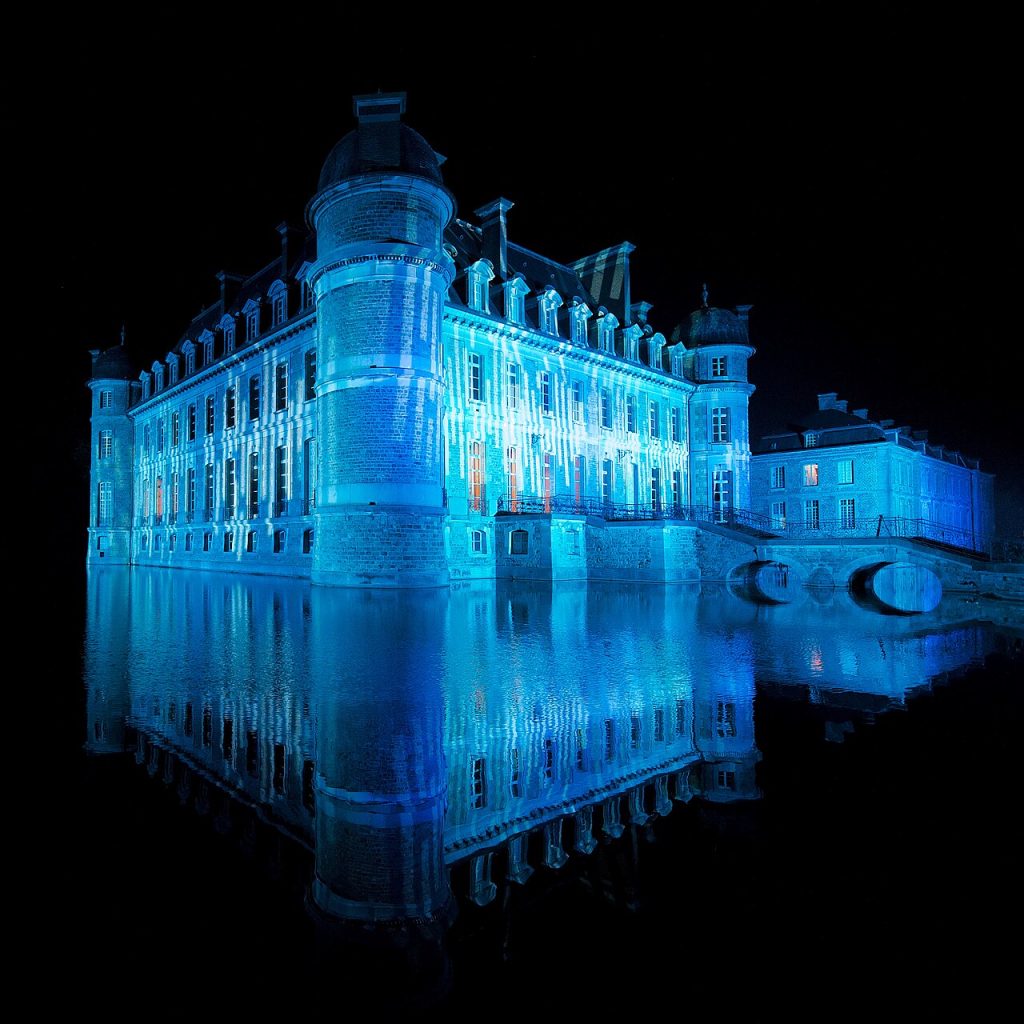
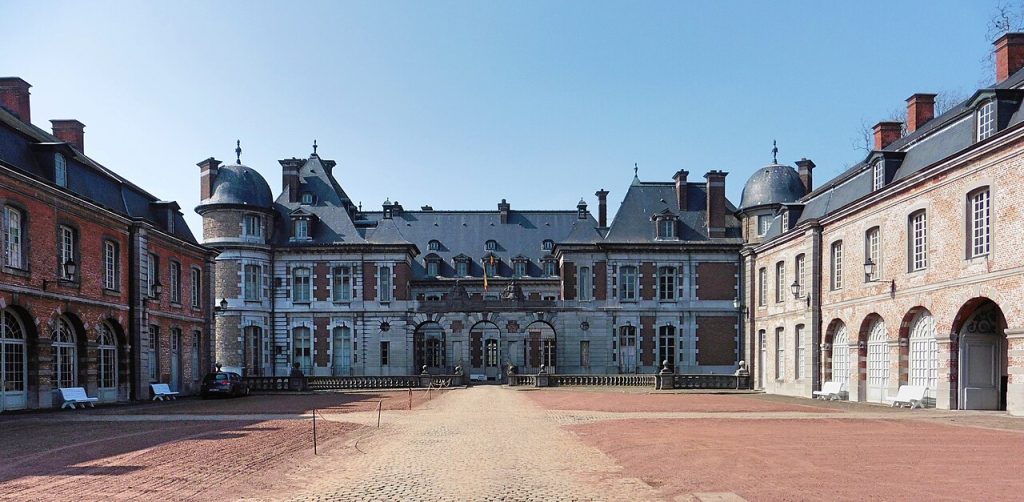
The first castle at Beloeil was exactly that: a square fortress with corner towers, surrounded by water, built for defence. The transformation into a residence happened slowly, as artillery made such defences pointless and as the family’s wealth made comfort possible.
You can still read the old plan. The rectangular island, the corner pavilions, the single approach across water. Everything graceful about the building is draped over a military skeleton.
The House of Ligne
The Ligne family emerges in the historical record in the twelfth century and acquires Beloeil in the fourteenth. From there they become one of those European families who seem to appear at the edge of every major event: soldiers for the Habsburgs, diplomats, field marshals, governors, correspondents of philosophers.
What makes them unusual is that they never lost the house. Not in the religious wars, not under French occupation, not during two world wars that ran directly across this province, not through the twentieth-century collapse of aristocratic fortunes that emptied so many comparable houses in France and Britain.
Keep that in mind in every room. You are looking at eight hundred years of one family’s accumulated choices, not a curated selection of a period.
Charles-Joseph, the Prince Who Wrote
If Beloeil has a presiding spirit it is Charles-Joseph, prince de Ligne, born in 1735, soldier in the Austrian service, friend of Voltaire, Rousseau, Goethe, Casanova and Catherine the Great, and one of the great letter-writers of the eighteenth century.
He fought in the Seven Years’ War, served as a field marshal, travelled with Catherine to the Crimea, lost his fortune and most of his estates in the French revolutionary wars, and spent his last years in Vienna writing with undiminished cheerfulness about a world that had destroyed him.
He also wrote about gardens, at length and with strong opinions, and the park at Beloeil is the practical expression of those opinions. Reading him before you visit changes the walk completely.
The Gardens Built Around Water
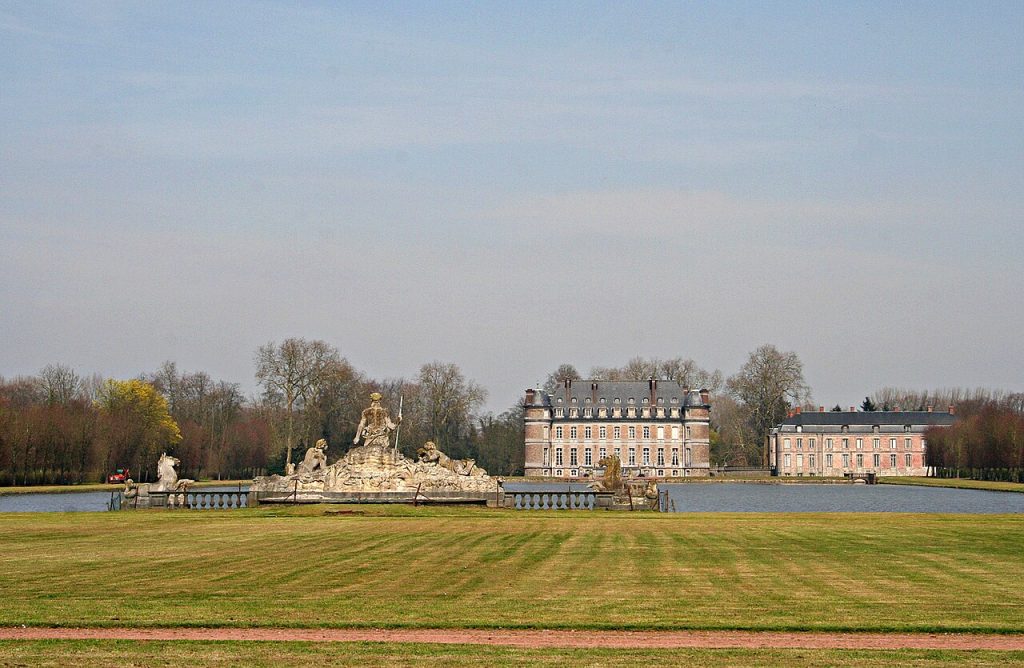
The park covers some twenty-five hectares of formal design, and water is its organising principle. Canals, basins and ditches run through it in straight lines, feeding one another and holding the composition together. In a flat, wet province, this is both aesthetic and practical.
The layout dates largely from the eighteenth century, when the French formal tradition was at its height. Green rooms cut from hornbeam hedges open off the main axes, each with its own character, so the garden works as a sequence of discoveries rather than a single view.
Walk it slowly. The pleasure of a formal garden is in the moment when a hedge opens and a statue, a basin or a long perspective appears exactly where the designer intended.
The Great Basin and Its Scale
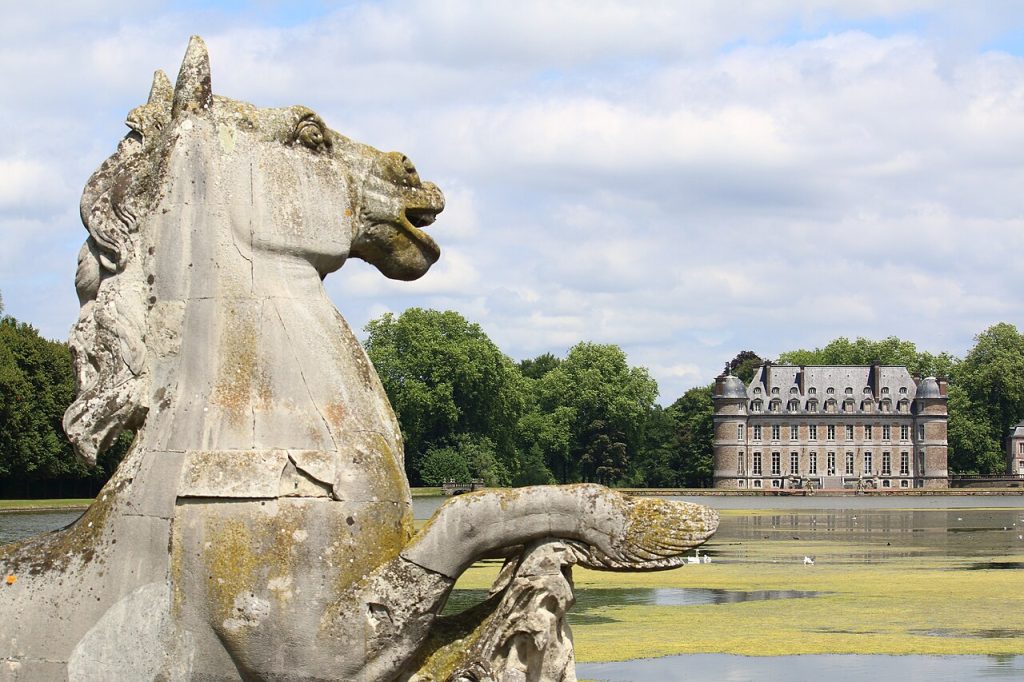
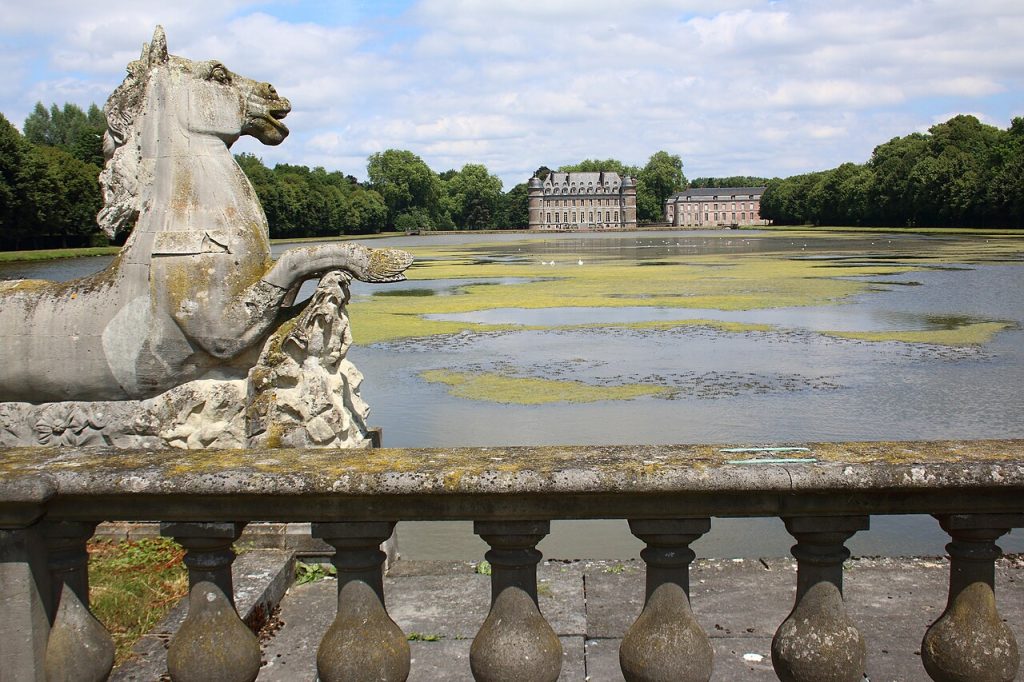
At the heart of the composition lies the great basin, a rectangle of water several hundred metres long running away from the castle. Stand at the castle end and the far end looks like a horizon. Stand at the far end and the building looks like a model.
This is the trick that formal gardens learned from Le Nôtre: use flat water to extend a building’s authority across the landscape. The basin costs nothing to maintain compared with parterres of flowers, and it does far more work.
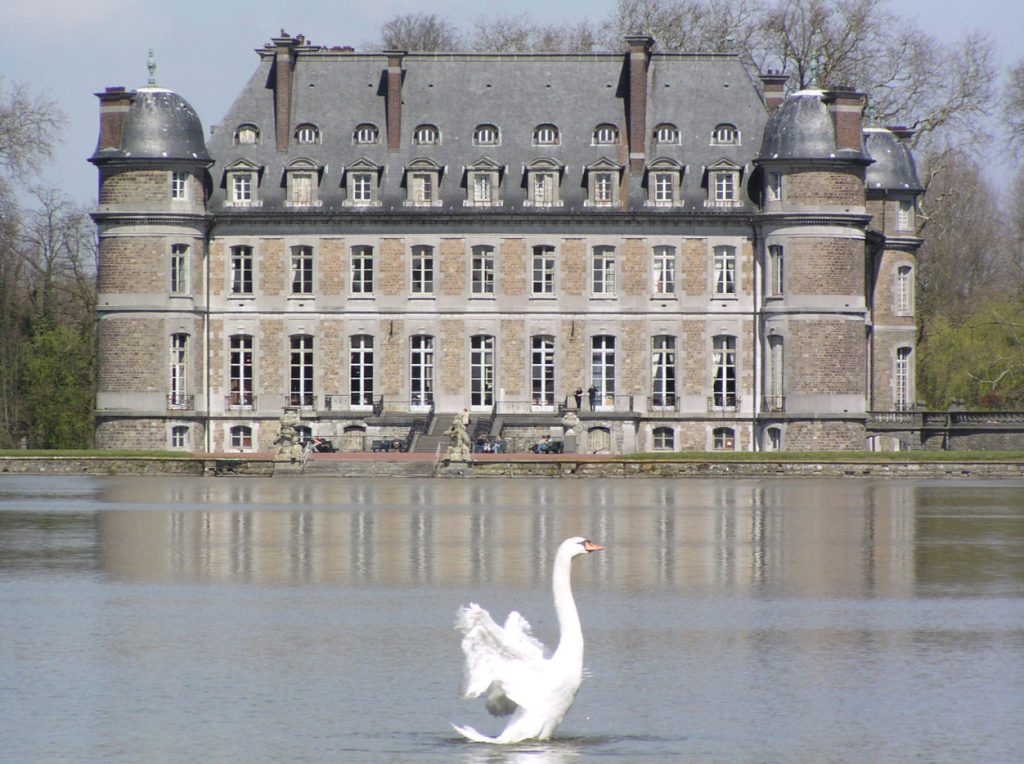
Come on a still morning if you can. The reflection doubles the castle, and the whole composition suddenly makes sense as a single designed object.
A Library of Twenty Thousand Books
Inside, the library is the room that silences visitors. The Ligne collection runs to tens of thousands of volumes, assembled across centuries, including manuscripts, early printed books and the working library of a family that produced soldiers, diplomats and writers.
Private libraries of this age and size rarely survive intact. They get sold in bad decades, broken up among heirs, or dispersed at auction after a war. This one stayed, which tells you something about how the family understood the house.
Look at the bindings rather than the titles. The colours and sizes record purchasing habits across generations, and you can see where money was plentiful and where it was not.
The Rooms and What They Hold
The interiors are a mixture: eighteenth-century panelling, Flemish tapestries, family portraits, furniture from several centuries, objects brought back from embassies and campaigns. The arrangement is domestic rather than museological.
That matters. Houses that were lived in continuously accumulate rather than curate. A Russian gift sits near a Habsburg portrait near a piece of nineteenth-century comfort, because that is the order in which they arrived.
If you have visited the great French chateaux, the contrast is instructive. There, the rooms have usually been restored to a chosen date. Here, the date is all of them at once.
The Fire That Nearly Ended It
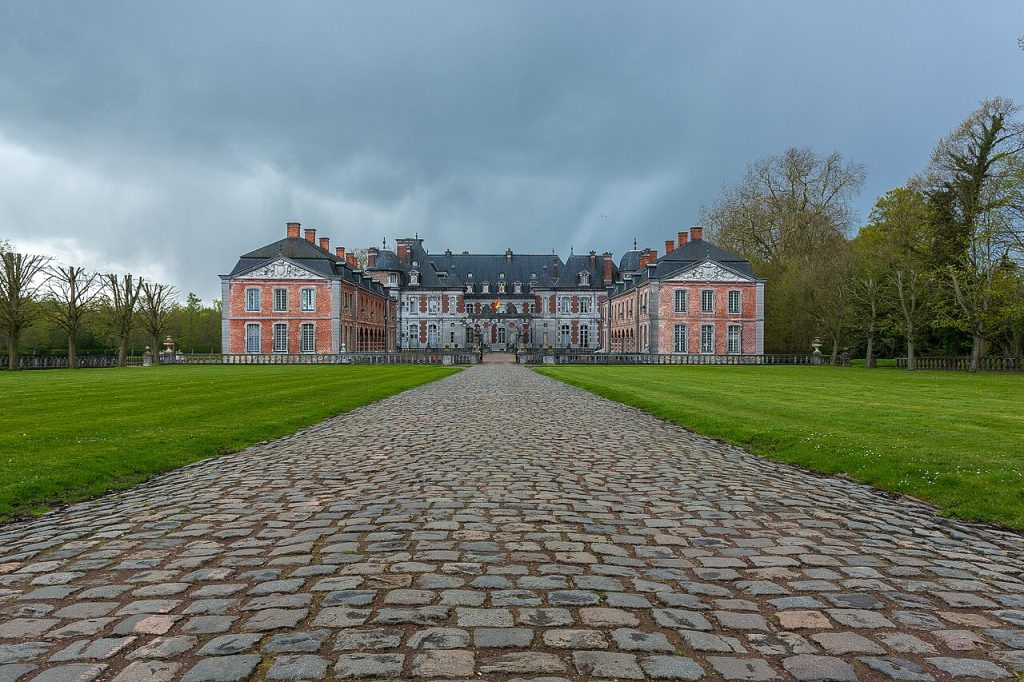
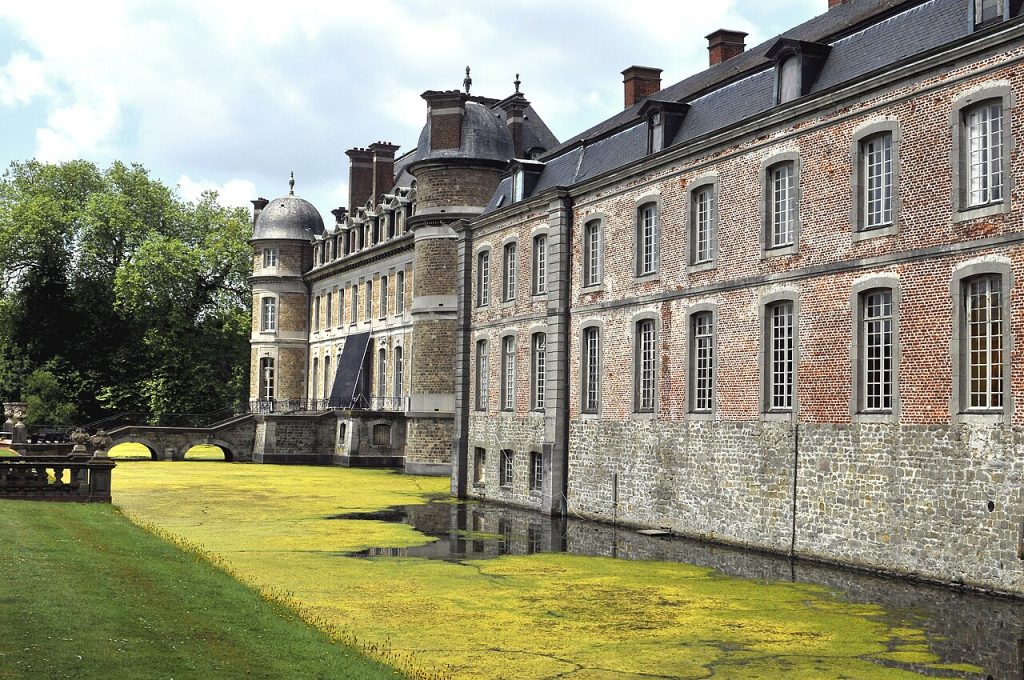
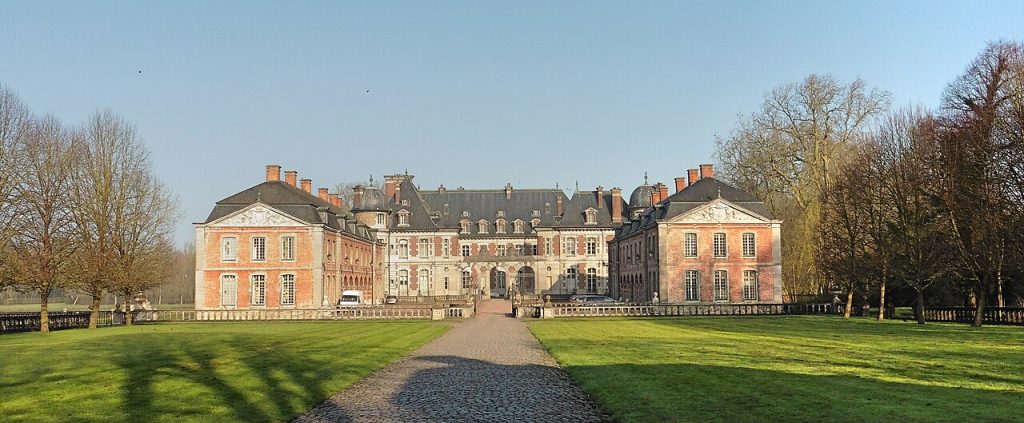
On a December night in 1900 fire broke out and destroyed the main body of the castle. The corner pavilions survived; the central block did not. Much of the furniture and a large part of the library were saved by servants and villagers carrying objects out across the bridge.
Accounts of the night describe books passed hand to hand and paintings cut from frames. The rescue is the reason the collections you see today exist, and it is one of those episodes that explain why an aristocratic house can still be a local institution.
The ruins stood through the following winter while the family decided what to do.
Rebuilding in the Old Image
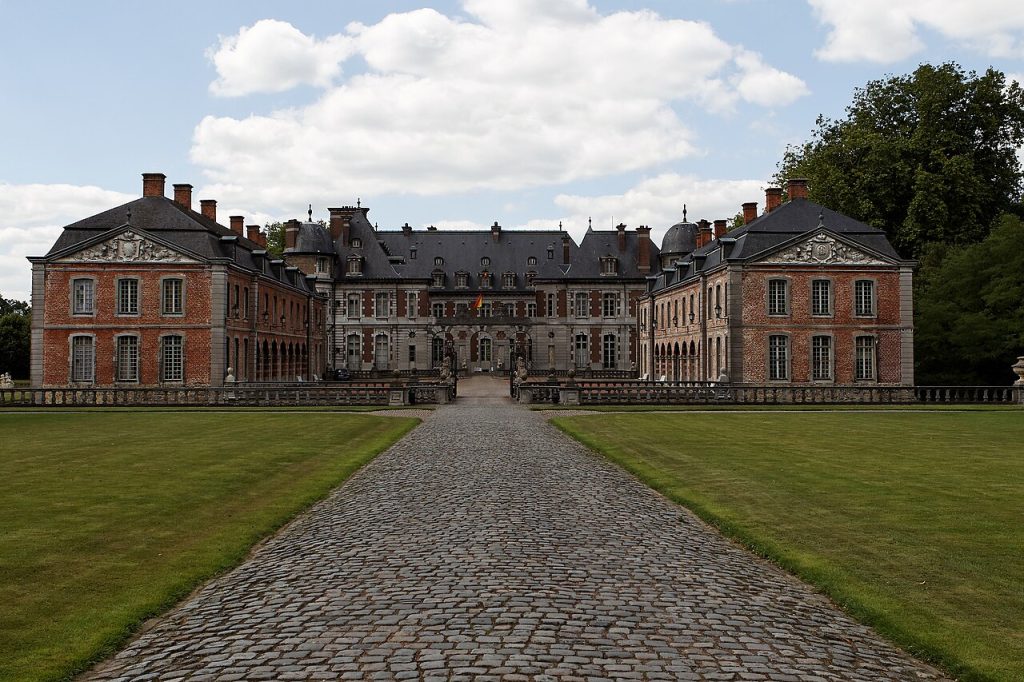
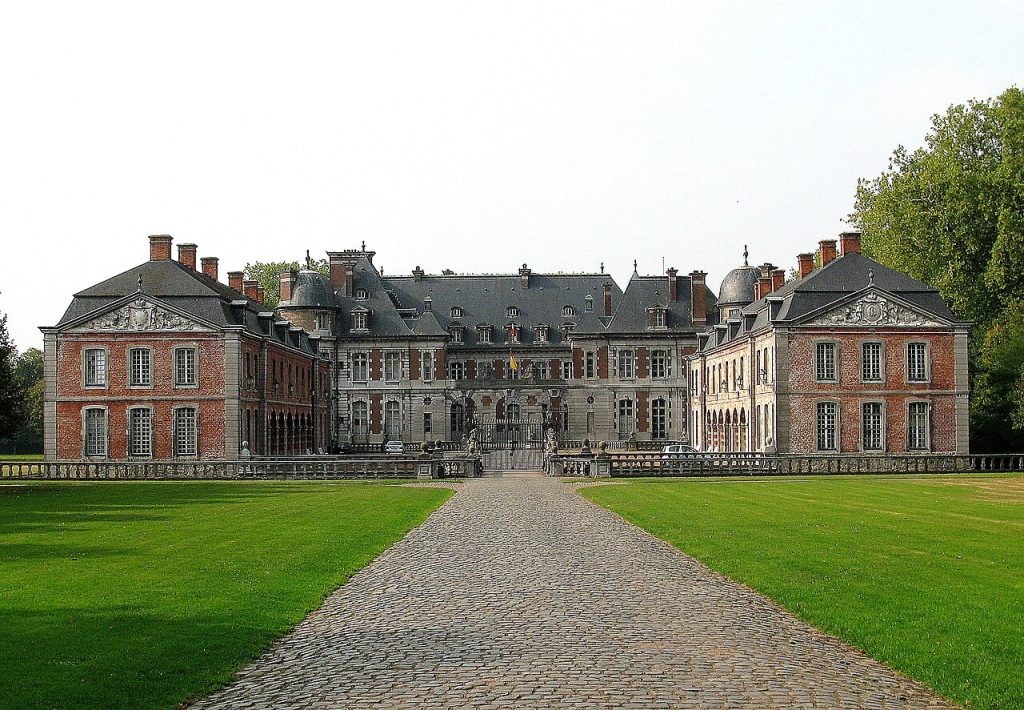
The decision was conservative, and in retrospect correct. Rather than build something fashionable, the family rebuilt the central block in the eighteenth-century manner, reproducing the lost facades so that the composition with the gardens would still work.
Purists have complained ever since that the heart of the castle is a century younger than it looks. Walk the park and the complaint dissolves. The building exists to terminate a set of axes, and an honest modern block would have broken the only thing that cannot be rebuilt: the relationship between house and landscape.
Look closely at the stonework and you can date it. Stand back a hundred metres and you cannot.
Two Wars and a Border Province
Hainaut sits on the invasion route. German armies crossed this province in 1914 and again in 1940, and the estate was occupied in both wars. Houses in that position usually lose something: contents, trees, roofs, or the family itself.
Beloeil came through with damage but without catastrophe, partly through luck and partly because an occupied chateau is more useful as a headquarters than as a ruin. The park lost timber. The house kept its collections.
When you walk the avenues, notice how many trees are of similar age. Replanting after a war is one of the slowest forms of restoration, and the results only become visible to a later generation.
Still a Family House
The present prince de Ligne and his family live here, which shapes everything about the visit. Opening hours are seasonal, certain rooms are private, and the atmosphere is closer to a well-run country estate than to a state museum.
This is increasingly rare in Europe. Maintaining a building of this size from private resources requires a working business: ticketed visits, events, weddings, a miniature railway in the park, licensing, forestry. The elegance you see is funded by a great deal of unglamorous commerce.
It is worth appreciating the arrangement rather than resenting it. The alternative, in most comparable cases, has been sale, division or abandonment.
Walking the Garden Today
Give the garden at least two hours. Start along the main axis, then work outward through the hedged compartments, then return along the water. The scale is deceptive from photographs: the long perspectives take much more walking than they appear to.
Spring brings the fresh green of clipped hornbeam and the first reflections. High summer is the fullest but also the busiest. Autumn, when the beeches colour and the water goes still, is the connoisseur’s season.
Bring something waterproof. This is Hainaut, and the weather here does what it likes.
Why Beloeil Matters
Most of the great formal gardens of Europe survive as public property, maintained by states that inherited them after revolutions or extinctions. Beloeil survives inside the family that made it, which means the park has never had to be reconstructed from drawings.
That gives it a quality that is hard to name and easy to feel: the design has been adjusted continuously by people who use it, rather than frozen at a date chosen by a committee. Trees have been replaced, compartments reworked, functions added.
Cross the bridge again on your way out and look back at the water. Eight hundred years is a long time for one family to look at the same reflection.
Visiting Beloeil Castle Today
Beloeil lies in the Belgian province of Hainaut, between Mons, Tournai and Ath, about an hour by car from Brussels. Public transport is possible via Ath or Mons with a connecting bus, but a car makes the visit far easier.
The castle and park open seasonally, typically from spring to early autumn, with reduced days outside the summer peak and occasional closures for private events. Tickets cover the park, with the castle interior on a separate or combined ticket depending on the season, so check before travelling.
Allow half a day. Combine it with Ath or with the Grand Place at Mons if you are making a day of it. Find it here: https://www.google.com/maps?q=50.5581,3.7339
Palaces Nearby
You May Like
Huis ten Bosch and the Orange House in the Woods