In this article
- A church the size of a promise
- Why the Immaculate Conception, and what it means
- A nation that needed a church of its own
- The long, slow building of a basilica
- A church of many faces: the chapels of a whole people
- What the shrine means to an American Catholic
- Where Catholics and Protestants part ways
- Inside the great church
- The crypt and the quiet below
- The bells, the organ, and the sound of the place
- A living shrine, not a relic
- The architects who dreamed it
- If you visit
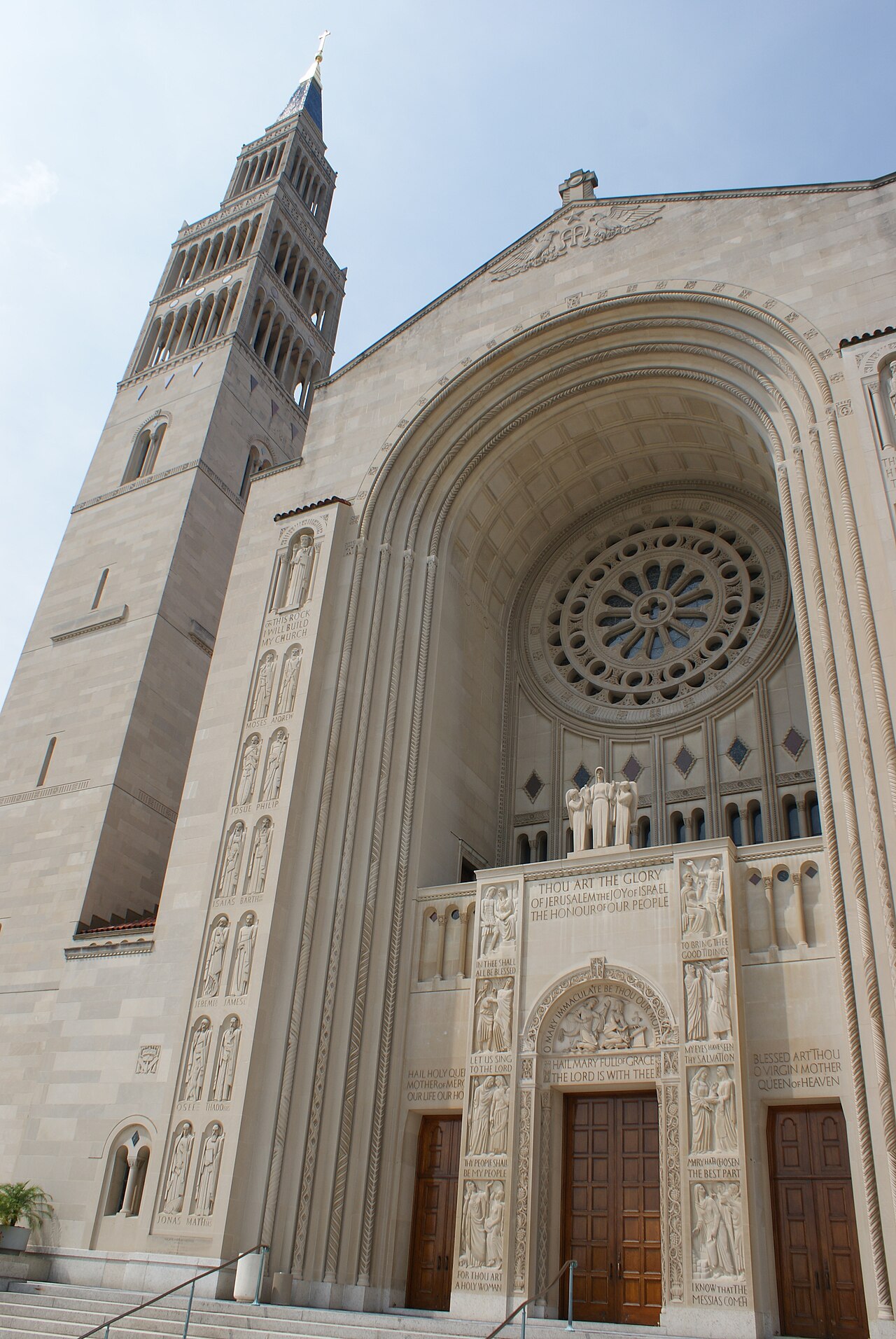
Washington is a city of monuments, and most of them are about power. The dome of the Capitol, the white shaft of the Washington Monument, the marble temples raised to dead presidents, all of it speaks the language of the republic, of law and government and the secular faith of a nation. But a few miles northeast of the National Mall, on the campus of the Catholic University of America, there rises a building that speaks a different language entirely. It has a great blue and gold dome and a soaring bell tower, and it is, by a clear margin, the largest church in the United States and one of the largest in the world. It is not a cathedral. It is something rarer and, in its way, more ambitious: a national shrine, a church built not for a diocese but for a whole country, dedicated to the Virgin Mary under the title of the Immaculate Conception.
To stand before the Basilica of the National Shrine of the Immaculate Conception is to encounter the boldest architectural statement American Catholicism ever made about itself. Here was a community that had arrived in the New World as a suspect minority, often poor, often immigrant, often distrusted, and that decided, over the course of the twentieth century, to build a church big enough and beautiful enough to say plainly: we belong here, and this is our home too. The story of how that church came to be is the story of American Catholicism itself.

What follows is the story of the great basilica in Washington, of the doctrine it is named for and why that doctrine matters, of the long decades it took to build, of the astonishing patchwork of chapels inside that make it a kind of map of every people who carried the Catholic faith to America, and of what the place means to the millions who come to pray there.
A church the size of a promise
The scale of the basilica is the first thing that strikes you, and it is meant to. This is one of the ten largest church buildings on earth and the largest Catholic church in North America, capable of holding many thousands of worshippers. Its style is deliberately unusual for the United States, a fusion of Romanesque and Byzantine, all rounded arches and great mosaic surfaces and that enormous dome, rather than the soaring Gothic spires that an English-speaking visitor might expect of a great church. The choice was deliberate. Gothic belonged to medieval northern Europe; the Romanesque-Byzantine idiom reached back to the early, undivided Church of the first Christian centuries, and it set the American shrine apart from the cathedrals of the old countries its builders had left behind.
But the size is not really about architecture. It is about confidence, hard-won and a long time coming. For much of American history, Catholics were a minority viewed with suspicion in a largely Protestant country, their loyalty questioned, their churches sometimes attacked. To build, in the national capital, a church that would dwarf almost every other place of worship in the land was an act of faith in two senses: faith in God, and faith that Catholics had become, finally and permanently, part of the American story. The building is a promise made in stone, and the promise is that this faith is here to stay.
Why the Immaculate Conception, and what it means
The shrine is dedicated to the Virgin Mary under a specific and often misunderstood title, the Immaculate Conception, and it is worth pausing to be clear about what that doctrine actually says, because a great many people, including many Christians, get it wrong. The Immaculate Conception does not refer to the virgin birth of Jesus. It refers to Mary herself, and to the Catholic teaching that she was conceived in her mother womb without the stain of original sin, the inherited fallenness that, in Christian theology, every other human being carries from birth. By a unique grace, the doctrine holds, God preserved Mary from that stain from the very first moment of her existence, preparing a pure vessel to bear his Son.
This belief was held and debated in the Church for many centuries before it was solemnly defined as dogma by Pope Pius IX in 1854, an act of papal authority that would itself become significant. And it has a particular American resonance, because in 1846, a few years before that definition, the Catholic bishops of the United States chose the Virgin Mary under exactly this title, the Immaculate Conception, as the patroness of their young and growing nation. The great church in Washington is the architectural fulfilment of that choice. It is the national patroness given a national house.
For Catholics, the Immaculate Conception is not an abstraction but a window into the whole drama of salvation. Mary, preserved from sin, becomes the new Eve, the woman whose obedience undoes the first woman disobedience, the one creature who is wholly what God intended every human being to be. To dedicate a national shrine to her under this title is to place the entire country, symbolically, under her protection and to hold her up as the model of the redeemed life. Whether or not one shares the belief, the ambition of the gesture is breathtaking.
A nation that needed a church of its own
The idea for the shrine grew out of a particular moment in American Catholic life at the start of the twentieth century. The Catholic University of America had been founded in Washington in the 1880s as the intellectual flagship of the Church in the United States, and it was there, in the early 1900s, that the rector, Bishop Thomas Shahan, conceived the idea of a great national church dedicated to the patroness of the country. He took the idea to Rome, won the blessing of Pope Pius X, and set about the enormous task of raising the money and the will to build it.
What makes the project remarkable is that it was, from the beginning, a genuinely national effort, paid for not by a single wealthy patron or a single diocese but by the contributions of Catholics across the entire country, rich and poor, from every immigrant community and every corner of the land. Schoolchildren sent in pennies. Parishes took up collections. Bishops lent their dioceses. The basilica was to be, quite literally, the church that the whole American Catholic people built together, and that origin is stamped into every part of it.
The long, slow building of a basilica
Great churches are rarely built quickly, and this one was no exception. The foundation stone was laid in 1920, and the lower level, the crypt church, was completed and opened for worship within a few years. Then came the long interruption. The Great Depression of the 1930s and the Second World War that followed it made it impossible to continue, and for decades the unfinished shrine stood capped at its lower level, a great promise waiting for the means to fulfil it.
It was only after the war, in a confident and prosperous America where Catholics had served and died alongside their countrymen and had earned a new place in national life, that the work resumed in earnest. The bishops of the United States threw their weight behind completing the great upper church, and through the 1950s the superstructure rose at last, the walls, the vast nave, the bell tower, and the famous dome. The upper church was dedicated in 1959. But even then the building was not truly finished, because a church of this kind is decorated rather than merely built, and the work of filling its acres of wall and ceiling with mosaic and art has continued, on and off, for decades.
The most striking recent chapter came in our own century, with the completion of the Trinity Dome, the great central dome of the church, whose interior was finally clad in an enormous mosaic and dedicated in 2017, nearly a hundred years after the foundation stone was laid. Only then could the basilica be called complete. That a building should take the better part of a century to finish is not a failure but a feature of the genre; the great cathedrals of medieval Europe took far longer, and a church meant to last for ages can afford to be built slowly.
A church of many faces: the chapels of a whole people
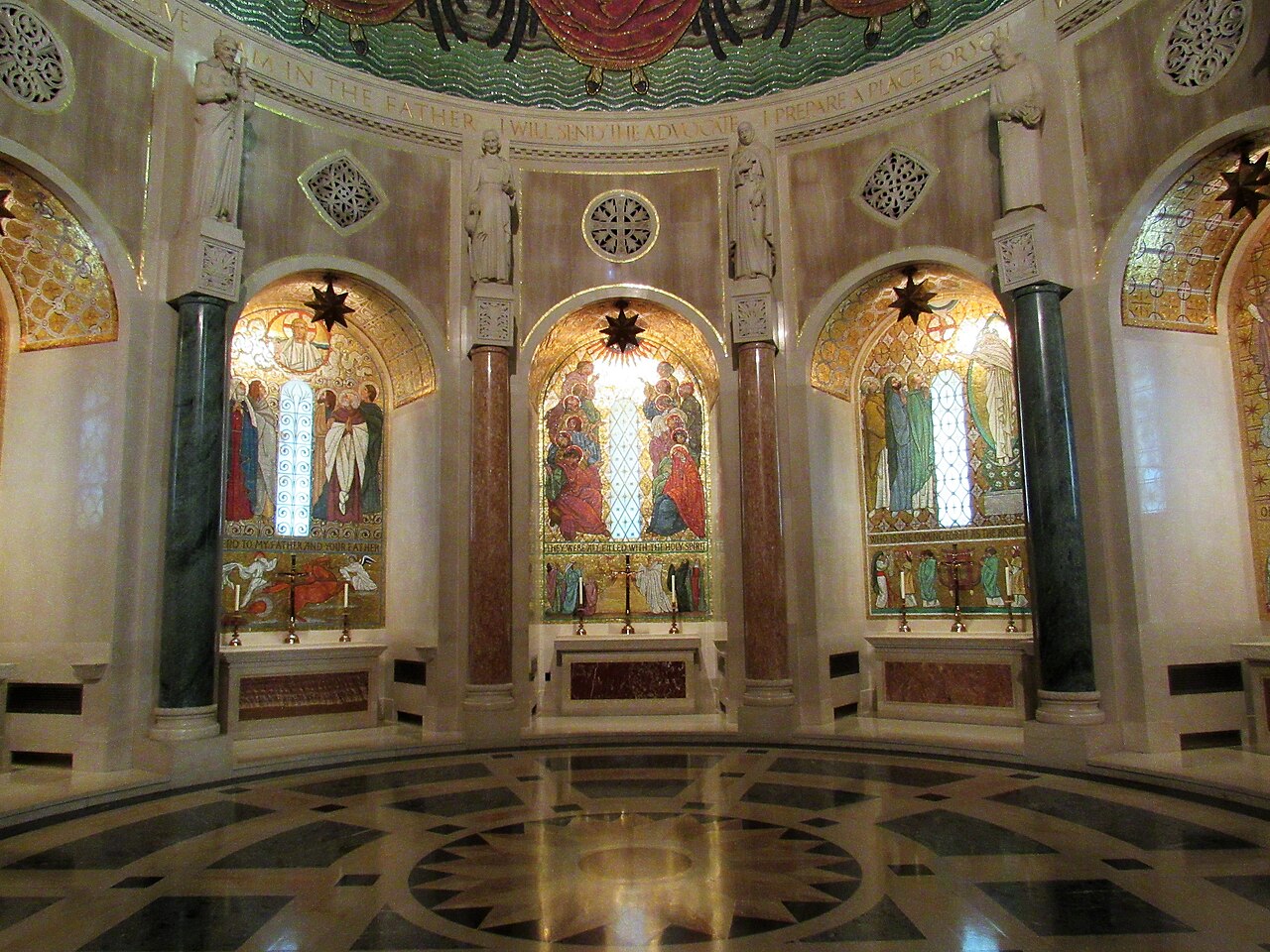
Walk through the basilica and you discover the single feature that, more than its size, makes it unlike almost any other church in the world. Lining the great nave and filling the crypt level below are dozens of separate chapels and oratories, each dedicated to the Virgin Mary under a different title, and together they form a kind of atlas of the entire Catholic world, with special attention to the many peoples who carried the faith to America.

There is a chapel to Our Lady of Guadalupe for the Mexican faithful, and one to Our Lady of Czestochowa for the Poles, and Our Lady of Lourdes for the French, and shrines reflecting the devotions of the Irish, the Italians, the Filipinos, the Vietnamese, the Africans and the African Americans, the Slovaks, the Chinese, and on and on through the astonishing diversity of the people who became American Catholics. Each community, as it grew and prospered, gave a chapel to the national shrine, decorating it in its own style and dedicating it to its own beloved image of the Mother of God.
The effect is profoundly moving once you understand it. The basilica is not the church of one ethnic group imposing its taste on everyone else. It is a house with many rooms, in which every people that brought the faith to these shores has a place of its own, gathered under the single roof of the national patroness. In a country built by immigrants and forever arguing about who belongs, the shrine offers a quiet and powerful answer: all of you, all of you belong here, and here are your mothers, side by side, under one dome.
What the shrine means to an American Catholic
For a Catholic in the United States, the basilica occupies a unique place. It is not the seat of a bishop, so it is not a cathedral in the technical sense, and Washington has its own cathedral elsewhere. What the shrine is, instead, is the national church, the one place that belongs to all American Catholics at once rather than to any single diocese, and the principal site in the country for the kind of large national gatherings, ordinations, and pilgrimages that the whole Church takes part in.
It is here that great Masses are celebrated to mark moments in the life of the American Church, here that pilgrims come from every state, here that the annual vigil for the protection of unborn life draws enormous crowds. Popes have prayed here on their visits to the United States. For an ordinary believer, to make the journey to the national shrine is to do in an American key what Catholics have always done: to travel to a holy place set apart, to lay one prayers before an image of the Mother of God, and to feel oneself part of something vastly larger than one own parish, a communion that stretches across the whole country and back through the centuries.
Where Catholics and Protestants part ways
A church like this one throws into sharp relief the differences that have divided Western Christianity since the Reformation, and an honest visitor should understand them. The intense Marian devotion that fills the basilica, the dozens of chapels to the Virgin, the dogma of the Immaculate Conception defined by papal authority, the very idea of dedicating a nation to Mary, sits at the heart of what separates Catholics from most Protestants.
The Reformers of the sixteenth century, and the Protestant traditions that descend from them, generally insisted that Christ alone is the mediator between God and humanity, and they grew wary of the elaborate honour paid to Mary and the saints, fearing it drew attention away from Christ himself. Many Protestants reject the Immaculate Conception outright, partly because they find no explicit basis for it in scripture and partly because, defined by the Pope in 1854, it stands as an assertion of exactly the kind of papal teaching authority the Reformation rejected. To a Protestant of a plainer tradition, a national shrine to the Virgin can look like a misplacing of devotion that belongs to God alone.
The Catholic response, worked out over many centuries, is that honouring Mary takes nothing from Christ but rather magnifies him, since all her glory comes from her role as his mother and points always back to him. Mary is venerated, in this understanding, not worshipped; she is the first and greatest of the redeemed, the one who shows what God grace can do in a human life, and to ask her prayers is no different in kind from asking a living friend to pray for you. Eastern Orthodox Christians share the deep love of Mary, though they have historically been cautious about the specific Western formulation of the Immaculate Conception. The great church in Washington stands, in a sense, as a monument on one side of this long and unresolved family argument within Christianity, and knowing that makes a visit richer, whatever one own convictions.
Inside the great church
Step inside the upper church and the scale becomes overwhelming in the best way. The nave stretches away beneath a ceiling of domes, and the eye is drawn upward and forward to the great apse, where an enormous mosaic of Christ in Majesty, sometimes called the Christ in Majesty, gazes down over the high altar, a powerful and even startling image of the risen Lord rendered in millions of pieces of glass and gold.

Mosaic is the basilica chosen language, and it covers acre upon acre of its surfaces, glittering in the light that falls from high windows. The art is modern but draws on the ancient Byzantine tradition of the great churches of the Christian East, and the cumulative effect, scene after scene from scripture and the lives of the saints, is of walking inside a vast jewelled book. The recently completed Trinity Dome overhead is the crown of it all, its interior a single immense mosaic depicting the Holy Trinity, the Virgin Mary, and a procession of American saints and figures, the final flourish that completed a hundred-year project.
For all its grandeur, the church is built to be prayed in, and it usually is. Even with tour groups moving through, you will find people kneeling in the chapels, candles burning before a hundred different images of the Virgin, the low murmur of devotion that fills any great living church. The art is not there to be admired the way one admires a museum. It is there to lift the heart toward heaven, and on a good day, with the light coming through and the mosaics glowing, it does exactly that.
The crypt and the quiet below
Beneath the soaring upper church lies the crypt level, the part of the shrine that was built first, back in the 1920s, and opened for worship while the great church above was still only a dream. It is a different world down here, lower, more intimate, more hushed, with heavy Romanesque arches and a warmer, more enclosed feeling than the vast spaces overhead.
The crypt church, with its Mary Memorial Altar, was where the shrine life began, and for many pilgrims it remains the most prayerful corner of the whole complex. Many of the national and ethnic chapels are gathered here as well, tucked along the corridors, so that a walk through the crypt level is a quiet pilgrimage through the devotions of the world Catholic peoples. There is a deliberate poetry to the arrangement: the great public statement of the upper church above, and below it, closer to the earth, the more private and personal chapels where individual souls bring their individual sorrows. A great shrine needs both, the grand and the intimate, and this one has them stacked one above the other.
The bells, the organ, and the sound of the place
A great church is not only something you see; it is something you hear, and the basilica was built to make a glorious noise. High in its bell tower, which rises beside the dome and gives the building its distinctive double silhouette against the Washington sky, hangs a carillon, a set of tuned bronze bells played from a keyboard, capable of ringing out hymns and peals across the campus and the surrounding neighbourhood. The sound of bells calling the faithful to prayer is one of the oldest in Christendom, and to hear them roll out over the city is to be connected, for a moment, to every village and cathedral town in the long history of the faith.
Inside, the music is carried above all by the great pipe organs, whose ranks of pipes can fill the enormous volume of the upper church with sound that seems to come from the walls themselves. In a space this size, music behaves differently than it does in an ordinary church; a single sustained chord can hang in the air for seconds, rolling around the domes, and a full congregation singing beneath the mosaics produces something close to overwhelming. The basilica has long taken its music seriously, maintaining choirs and a tradition of liturgical song worthy of the building that houses it, because in the Catholic understanding the beauty of worship, its sights and its sounds together, is itself a way of glorifying God and lifting the human heart toward him.
This matters more than it might seem. The whole logic of a church like this one, its size, its mosaics, its bells and organs, rests on the conviction that beauty is not a luxury added on top of faith but a path into it. The senses, in this tradition, are not obstacles to the spirit but doors to it, and a building that engulfs you in colour and sound and scale is doing theology with stone and glass and bronze. You do not have to be argued into reverence here. The place simply produces it, the way a mountain produces awe, and that is exactly what its builders intended.
A living shrine, not a relic
It would be easy to treat the basilica as a finished monument, a grand thing completed and set aside to be admired, especially now that the last great dome has been clad in mosaic and the hundred-year project is technically done. But that would miss what the place actually is. The shrine is not a relic of a confident Catholic past; it is a working church at the centre of a living and rapidly changing community, and its story is still being written by the people who fill it.
The face of American Catholicism has shifted enormously even in the lifetime of the building. The Irish, Italian, Polish, and German immigrants whose pennies helped raise the walls have been joined, and in many places succeeded, by new generations of believers from Latin America, from Asia, from Africa, and the chapels of the shrine have kept pace, with newer dedications reflecting newer communities taking their place beside the older ones. The basilica that was built to say American Catholics belong here now has to say it on behalf of a far more global and diverse Church than its founders could have imagined, and it does so naturally, because its whole design was always a house with room for everyone.
That is perhaps the deepest thing to understand about the place before you visit. It is grand, yes, and historic, and full of remarkable art, but it is not a museum and it does not feel like one. On any given day it is full of people actually praying, lighting candles, attending Mass, making the small individual pilgrimages that have brought people to holy places since the beginning. The building makes its enormous public statement, but underneath that statement runs the same quiet current that runs through every shrine on earth: ordinary human beings, carrying their hopes and their griefs, coming to a beautiful place to lay them down before something larger than themselves. The architecture is exceptional. The thing happening inside it is as old as prayer.
The architects who dreamed it
Behind every great building stand the people who imagined it before a single stone was set, and the basilica owes its character to the architects and artists who shaped its long evolution. The original design came from a Boston firm well known for ecclesiastical work, whose lead architect chose, against the prevailing taste for Gothic, the Romanesque and Byzantine vocabulary that gives the church its distinctive feel. It was a bold decision in its day, and a wise one, because it freed the building from competing with the medieval cathedrals of Europe and let it speak instead in the older, rounder, more luminous language of the early Christian basilicas of Rome and the great domed churches of the Christian East.
The decoration unfolded over generations, drawing in mosaic artists, sculptors, and designers who filled the immense surfaces with their work across the better part of a century. Each successive phase brought new hands and, inevitably, slightly different sensibilities, so that the interior is not the seamless product of a single vision but the accumulated labour of many, a kind of conversation across decades about how to render the sacred in glass and stone. The great apse mosaic, the chapels, the domes, each carries the mark of the era that made it, and a careful visitor can read the changing taste of the twentieth century in the way the images shift from one part of the church to another.
There is something fitting in this. A church built by the pennies of millions, dedicated to a whole nation diverse people, and raised over the course of a hundred years was never going to be the tidy expression of one mind. It was always going to be a collective work, layered and various, like the community that built it. The architects gave it its bones and its grand idea; the generations that followed gave it its flesh, and the result is a building that feels less like a monument dropped from above and more like something grown, slowly and lovingly, out of the faith of a whole people.
If you visit
The basilica sits on the campus of the Catholic University of America in the northeast of Washington, a short walk from a Metro station, and it is open to visitors every day with no charge to enter, though donations keep the enormous building standing. You can simply walk in and wander, or join one of the guided tours that explain the art and the history, and on Sundays and holy days the great church fills for Mass beneath the mosaics.
Give yourself far more time than you think you will need. The upper church alone rewards a long slow look, and the crypt level below, with its maze of chapels, can absorb another hour easily. Climb, if you can, to take in the dome and the bell tower from outside, and stand for a while in the nave letting the scale of the place settle on you. Whether you come as a believer, as a lover of art and architecture, or simply as someone curious about how a once-distrusted minority built the largest church in America, you will leave with a clearer sense of a story most visitors to Washington never hear. The monuments on the Mall tell you what the nation believes about itself. This great church, off to one side, tells you what a large part of its people believe about heaven, and it tells it at a volume impossible to ignore.


