Labraynda, the sacred site of Zeus Labrayndos, is located in ancient Caria (Southwestern Anatolia), 14 km from the city of Mylasa (Milas), to which it is connected. It is located in the north east. The oldest finds date back to approximately B.C. It belongs to the year 600. In the 6th and 5th centuries, the sanctuary consisted of a single small artificial terrace, which was later used as a temple terrace. In 497, a war was fought in the sacred area and the Carian army, together with its allies the Miletians, was defeated by the Persian army.
B.C. The 4th century is the most important period of the temple. This place gained a new appearance during the time of the satraps Maussollos (377 – 352 BC) and Idirieus (351 – 344 BC). At the annual sacrificial feast in Labranda in 355, Maussollos narrowly escaped an assassination attempt made against him.
It is probably due to this happy salvation that here; Large-scale construction projects were initiated, including a series of artificial terraces, one or two entrance buildings, a small Doric building (possibly a fountain building), a monumental staircase, two large banquet halls (androns), a columned structure (called oikoi), a stoa and a columned temple of Zeus. B.C. This project and construction activities ended with the death of Idrieus in 344.
The use of the sanctuary as a cult place ended with a great fire disaster in the AD century. The distance between the Labranda sanctuary and Milas is 8 meters wide and 14 km long. There was a long sacred road. Traces of pavement on this road have been preserved until today.
Starting from Mylasa to the sanctuary in Labranda and 8 m. It could be reached by a wide sacred road. Traces of the pavement on this road have been preserved until today. The area can be accessed through one of two entrance buildings. The building, called the Doric building, is located just east of the south propylon building with its irregular, almost rectangular formation. It is a building in the Doric order, facing north, with a front courtyard with four columns and a marble façade.
During the Roman Period, this small building was included in the bath complex.
The Propylon area is bordered to the north by a wall showing impressive masonry, opening to long rooms with four wide gables. These long rooms are storage or treasure rooms. They form part of a large building complex. This structure is bordered by a structure with six rectangular rooms and a porch, used for the sacred meal, located on the east and upper level. The middle terrace is reached via a 12 meter wide staircase.
Here is the Andron of Mau-solos (Andron B). This is the first structure started by the Heka-tomnos Dynasty. It is a temple-like building with its rectangular cella and wide rectangular recess at the back. Statues of Artemisia, the wife and sister of Mausolos, and perhaps Zeus were probably kept in this recess.
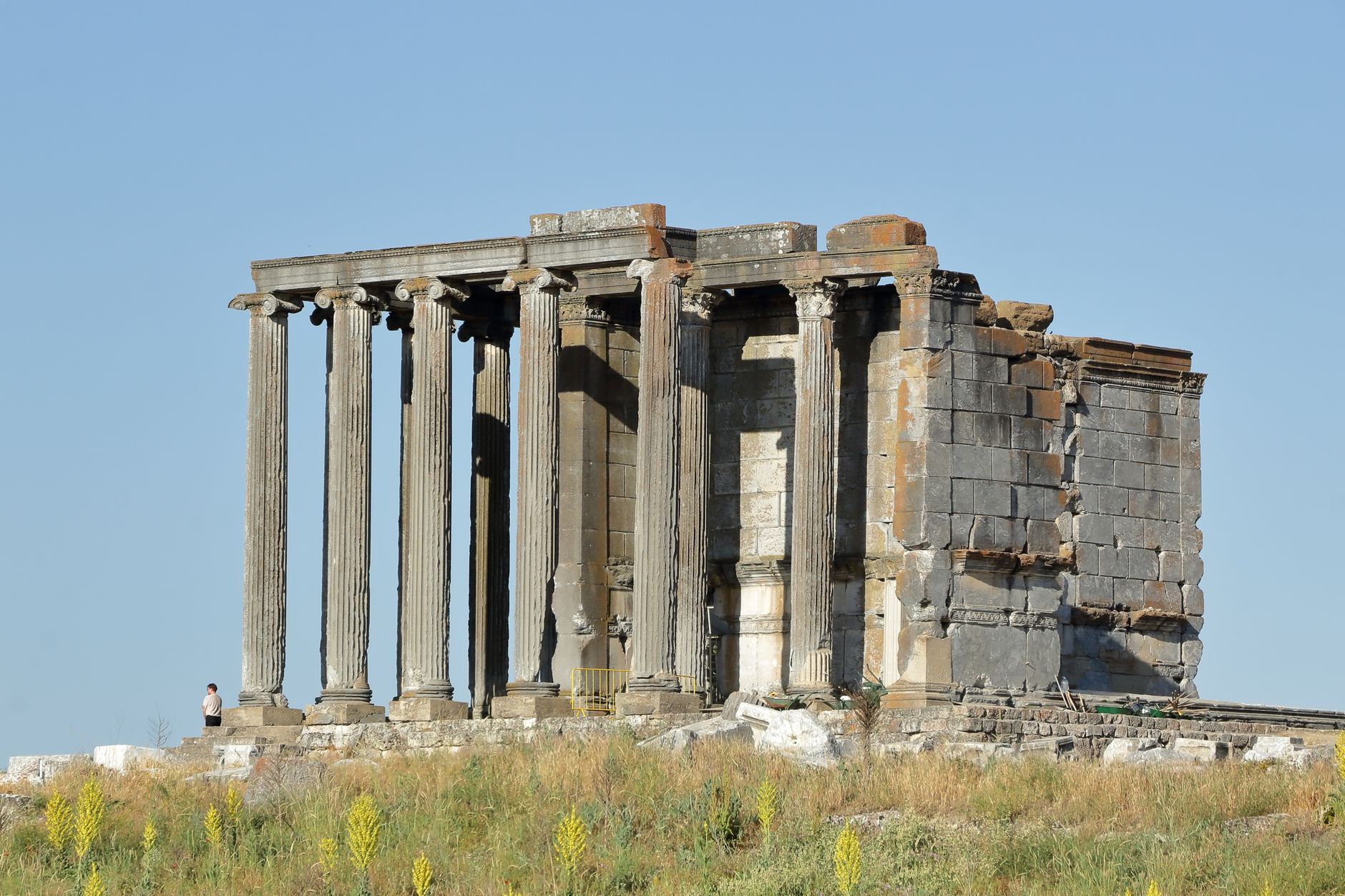
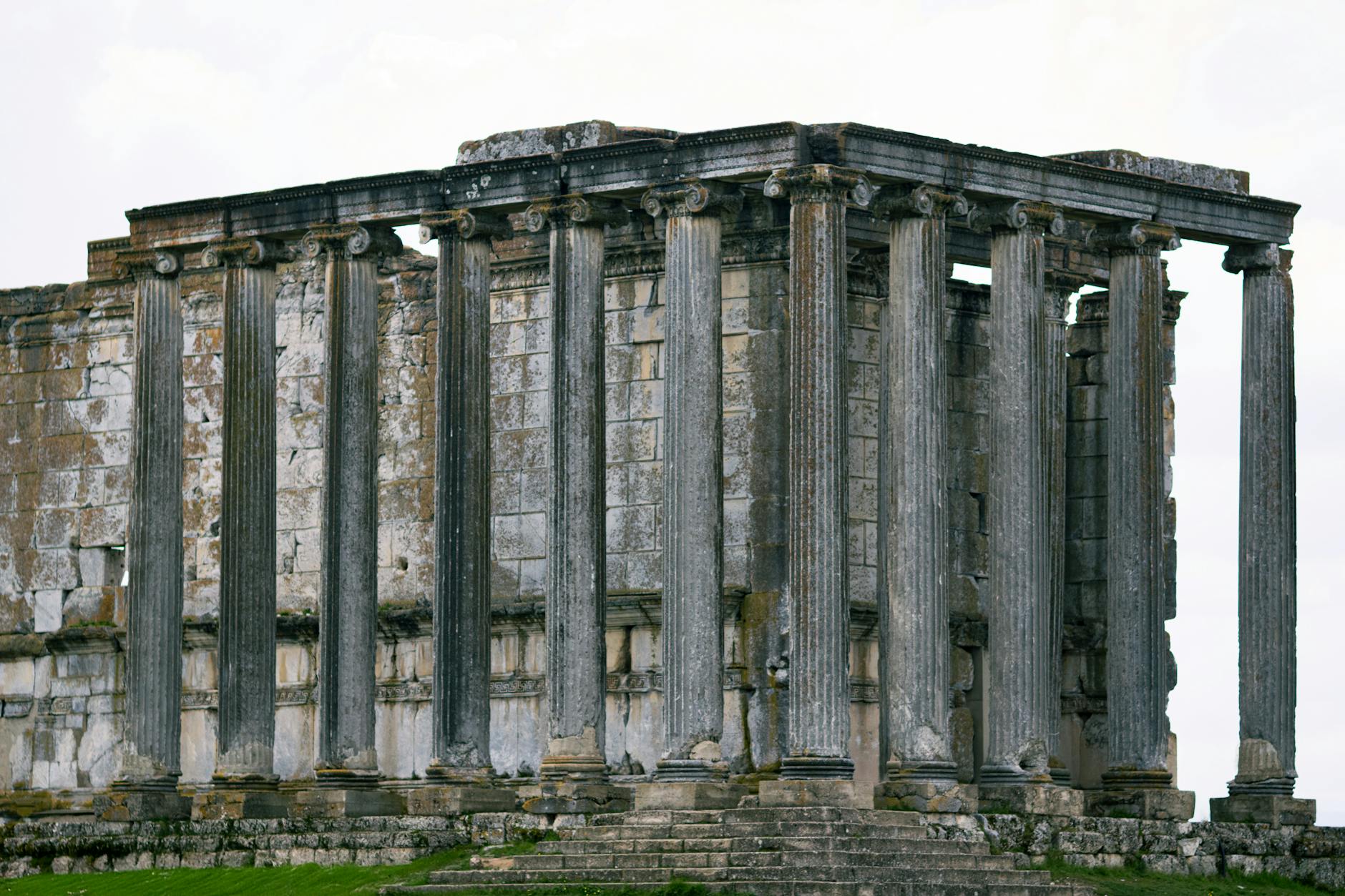
The Temple of Zeus, located on the top terrace, faces east. Its oldest phase is dated to the 4th century. In the second phase, in order to adapt to the dimensions of the sella, a series of columns, 6 on the front and 8 on the sides, and a space (Opisthodomos) were added behind the sella. This temple with columns was consecrated by Idrieus. Due to the details in its layout and general location, this temple is similar to the Temple of Athena in Priene.
This indicates that both temples were built by the architect Pytheos. There is the Andron of Idrieus (Andron A) in the southwest and near the temple. It is the best preserved building of the settlement. The south wall is 7.9 m above floor level. is in height. In terms of plan, it is the same as Mausolos’ Andron. Inside the sella, traces of low plastered benches containing couches used during the sacred feast can be found.
The statues of the King’s family, Idrieus, his sister and wife Ada, and Zeus were kept in the niche on the back wall.
Oikoi consists of two rectangular rooms of unequal sizes behind the porch with four doric columns located between the antes. The roof covering of this building is composed of a mixture of partly Doric and partly Ionic orders. This building was probably used both as the archives of the sanctuary and as a place for the priests to work and for sacred banquets.
There is a steep hill in the north of the sanctuary. On the southern slope of this, 15 m above the temple. There is a tomb of 100 meters long. The burial chamber and its entrance have protruding vaults. The roof is made of granite in the Doric order. 200 m from the sanctuary. To the west, there is a stadium reinforced with a retaining wall. The starting and finishing stones of both races are still available.
Races must have been held here during the five-day feast held in the sacred area. Labranda excavation was carried out in 1948 by A.W. from Uppsala University, Sweden. It was started by PERSSON and still continues at intervals. Now the excavations are carried out by P. HELLSTRÖM.
Places to Visit
Labranda, which takes its name from the double-sided ax “Labrys”, the symbol of Zeus and the war tool of the Amazons, is known for its soft drinkable spring water, ancient city and tiger land. Temples, priesthoods, city walls and tombs are among the must-see places in Labranda, which is also very rich in minerals.
The ancient city of Labranda is 14 km from Milas. It is located on the plateau known as Kocayayla in the north. It has a unique view among pine and plane trees at an altitude of 700 meters above sea level. It takes its name from the word “Labrys”, which means double-sided axe. In addition, this ax was the symbol of the god Zeus and the war tool of the Amazons.
Tigers and Bears
The local elders cannot stop talking about the tigers that lived in the hot, rocky, dense vegetation in the 1950s. In 1947, the villagers who heard cat-like growling and roaring at the foothills of Kayadibi Mountain paid attention. Those who did not herd the cows but left them on the mountain, armed themselves and started hunting for herds when the herd returned missing in the evening.
The memories of Osman Gürsoy, who was a guard at the ruins in the 90s, are quite interesting: In 1950, a tiger had two cubs in the middle of the stream flowing on the back stony hill of Labranda. The guard continues as follows: “I was 9-10 years old, I was a shepherd at that time. When I saw the cubs when the mother tiger was not around, I cut them with the tar in my hand. I was a child, I didn’t know, I thought it was a wolf cub. The next day, while I was leading the herd, the mother tiger went crazy and jumped into the herd.
He ate one of the goats right in front of me. Later, he ate many shepherds’ goats. One day, in 1951, while he was walking with the herd, the goats scattered like kittens when they saw the tiger, this time the tiger ran away. I came and explained that the villagers organized hunting parties to shoot tigers and bears. It was a cunning animal. He hunted outside, not in his own shelter, and would hide near the Ancient City. When it dives into a herd, it attacks the animal’s lungs.
He would eat his liver first. He would hang the parts he could not eat on the tree and return when he was hungry. Stone-made tiger traps still remain on the mountain. In the past, we used to put liver in the tiger to catch it. The bears were haunting the honey-filled hives. Bear hives, i.e. walls, were built on rocks to prevent bears from entering.
“Most of them were shot and now there are neither tigers nor bears left due to malnutrition,” he says… You can see the stuffed animals of the last tigers of the Mediterranean at the Ege University Natural History Museum in Bornova, Izmir. Excavations in the ancient city have been suspended in recent years. The oldest find in the excavations dates back to 6000 BC.
The ancient city has been well preserved to this day. Moreover, Osman Gürsoy, who has been a guard at the ruins for 25 years, also provides English-German services free of charge. Temple of Zeus Labrandos, Androns, Priests’ Houses, Propleas, Doric House, Eastern Bath, Stadium, Religious Washing Hall, walls, tombs, sacred road are among the places to be seen in the ancient city of Labranda.
Moreover, it is possible to visit all these places without sweating, thanks to the gentle breeze. If you want to see the whole of this ancient city, you should climb the steps on the magnificent “Watching Stone”. The view from the top will even make you speechless. The burial chamber is quite interesting… The burial chamber where the king, his two wives and his two children sleep belongs to the Carian period… The door of the building, which is an example of the Hellenistic era, is made of 6-ton granite block stone.
The stones are bound together with lead… Tigers and bears that lived in the 1950s in the region, which is very rich in mica and alibite mines, are another thing that is talked about by the local people. However, due to hunting, neither tigers nor bears are found in the region today. The last stuffed tigers of the Mediterranean are in the Ege University Natural History Museum in Bornova, Izmir.
Famous for its spring water, another feature that I cannot help but mention here is the taste of the water I drank in Milas. The spring water, which is lime-free, very easy to drink, light and digestible, is an unforgettable taste especially for the people of Istanbul who are longing for water, and it has the feature of not causing stones or sand in the kidneys. The branches of the springs gushing from the highest hills of Labranda were collected in a warehouse in 1948 and brought down to Milas by pipe.
This beautiful Labranda water, bottled in Milas, is also available for sale.
Labranda Ancient City Pictures
You May Like
Aspendos Ancient Theater Travel Guide