There are cities where the castle is a museum you visit and then leave behind, a stop between lunch and the train. Prague is not one of them. Here the castle is not a single building at all but a whole quarter of the city stacked on a ridge above the Vltava, a thousand years of Bohemian ambition compressed into stone, and it watches over the red rooftops and the black spires below like a crown that was never taken off. You cannot really see Prague without seeing it, and you cannot understand the Czech story without walking through it.
What makes Prague Castle so strange and so wonderful is that it refuses to be one thing. It is a Gothic cathedral and a Romanesque basilica, a royal palace and a lane of tiny painted houses, a fortress and a garden, the seat of medieval kings and the office of a modern president, all at once and all on the same crowded acreage. Emperors were crowned here and defenestrated ministers were thrown from its windows. Alchemists chased gold in its shadows and Franz Kafka wrote by candlelight in one of its lanes.
So let us take our time with it. This is not a place you rush. Come with me up the hill, past the guards at the gate and into the courtyards, and we will walk through the centuries the way the castle itself was built, layer upon patient layer, until you understand why this ridge above the river has been the beating heart of a nation for more than a thousand years.
In This Article
- Standing Where the River Bends
- The Prince Who Planted a Fortress
- Wenceslas, the Duke Who Became a Nation’s Saint
- How a Cathedral Took Six Centuries to Finish
- Charles IV and the Golden Age of Bohemia
- Inside the Hall Where Knights Rode on Horseback
- The Old Royal Palace and Its Buried Floors
- A Window, a Fall, and the War That Followed
- Golden Lane and the Little Houses of Legend
- Rudolf’s Strange and Brilliant Court
- The Castle and the City Below It
- Gardens Hung Above the Rooftops
- The Seat of a Republic After Dark
Standing Where the River Bends
Begin with the geography, because the castle is where it is for a reason. The Vltava swings through Prague in a long lazy curve, and on its western bank the land rises sharply into a rocky spur called Hradčany. Whoever held that spur held the river crossings, the trade roads, and the eye-line over everything below. It was, in the ninth century, the obvious place to build something that would last, and the people who built it clearly meant it to.
Prague Castle holds a record that sounds almost like a boast until you walk it and realize it is simply true: it is the largest coherent castle complex in the world, sprawling across roughly seventy thousand square meters, nearly six hundred meters long and about a hundred and thirty wide. That is not a keep and a moat. That is a small walled town, with three great courtyards, a cathedral, two churches, a monastery, palaces, towers, gardens, and lanes, all knitted together over more than a millennium of continuous building.
Because it grew over so many centuries, the castle is really an argument in stone between every age that touched it. A Romanesque wall runs into a Gothic buttress that leans against a Renaissance facade painted by a Baroque hand and tidied by a twentieth-century architect. Nothing here was designed all at once, and that is exactly the pleasure of it. You are not looking at one vision. You are looking at a thousand years of people all insisting, in their own style, that this hill mattered.
If you want to find it on a map before you climb, here are the coordinates to drop a pin on the ridge above the river.

The Prince Who Planted a Fortress
The story starts around the year 880, with a prince named Bořivoj, the first of the Přemyslid rulers we can name with any confidence and the first Christian among them. He moved his seat to the Hradčany spur and raised the earliest fortifications, timber and earth and stone, and inside them he built a small church dedicated to the Virgin Mary. Fragments of that very first church still survive underground, which means the religious heart of the castle has beaten on almost the same spot for eleven centuries.
The Přemyslids were a homegrown dynasty, Bohemian to the bone, and for the next four hundred years they made this hill the center of their power. They were dukes first and kings later, and every generation seems to have added something, a wall here, a church there, a hall for feasting and judgment. The castle in those early centuries was less a palace than a command post, a place from which to rule a young and often fractious country still deciding what it wanted to be.
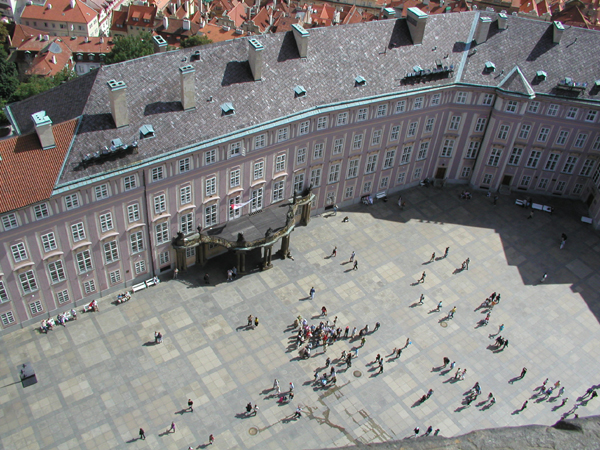
It helps to remember how raw and dangerous that world was. Bohemia sat at a crossroads between the emerging German empire to the west and the Slavic lands to the east, and its rulers were forever balancing alliance against independence. The castle was the physical expression of that balancing act, a stronghold that had to impress allies and deter enemies in the same breath. When you stand in the third courtyard today, on its calm stone pavement, you are standing on the buried foundations of that anxious, ambitious beginning.
What strikes me most about those first Přemyslid centuries is the sheer continuity. Dynasties usually move their capitals, abandon old seats, chase new advantages. The rulers of Bohemia did not. Whatever else changed, the hill stayed the hill. Generation after generation climbed the same slope, worshipped in churches built over their grandfathers’ churches, and were buried within sight of where they were crowned.
Wenceslas, the Duke Who Became a Nation’s Saint
No figure looms larger over the early castle than Wenceslas, the duke the Christmas carol turned into a king he never quite was. He ruled Bohemia in the tenth century, a pious and reform-minded prince who strengthened the church and tried to keep peace with the German neighbours. In 935 he was murdered on the way to Mass, cut down by followers of his own brother, Boleslav, in a family betrayal so stark it reads like something from a saga.
His death made him. Almost immediately Wenceslas was venerated as a martyr, and within a generation he had become the patron saint of Bohemia, the eternal duke whose protection the country invoked in every crisis. His remains were brought to the Church of St. Vitus on the castle hill, and the site of his tomb would eventually be enshrined in one of the most dazzling chapels in Europe. To this day the Czech crown jewels are locked behind his chapel door, as if the nation still keeps its most precious things under his eye.
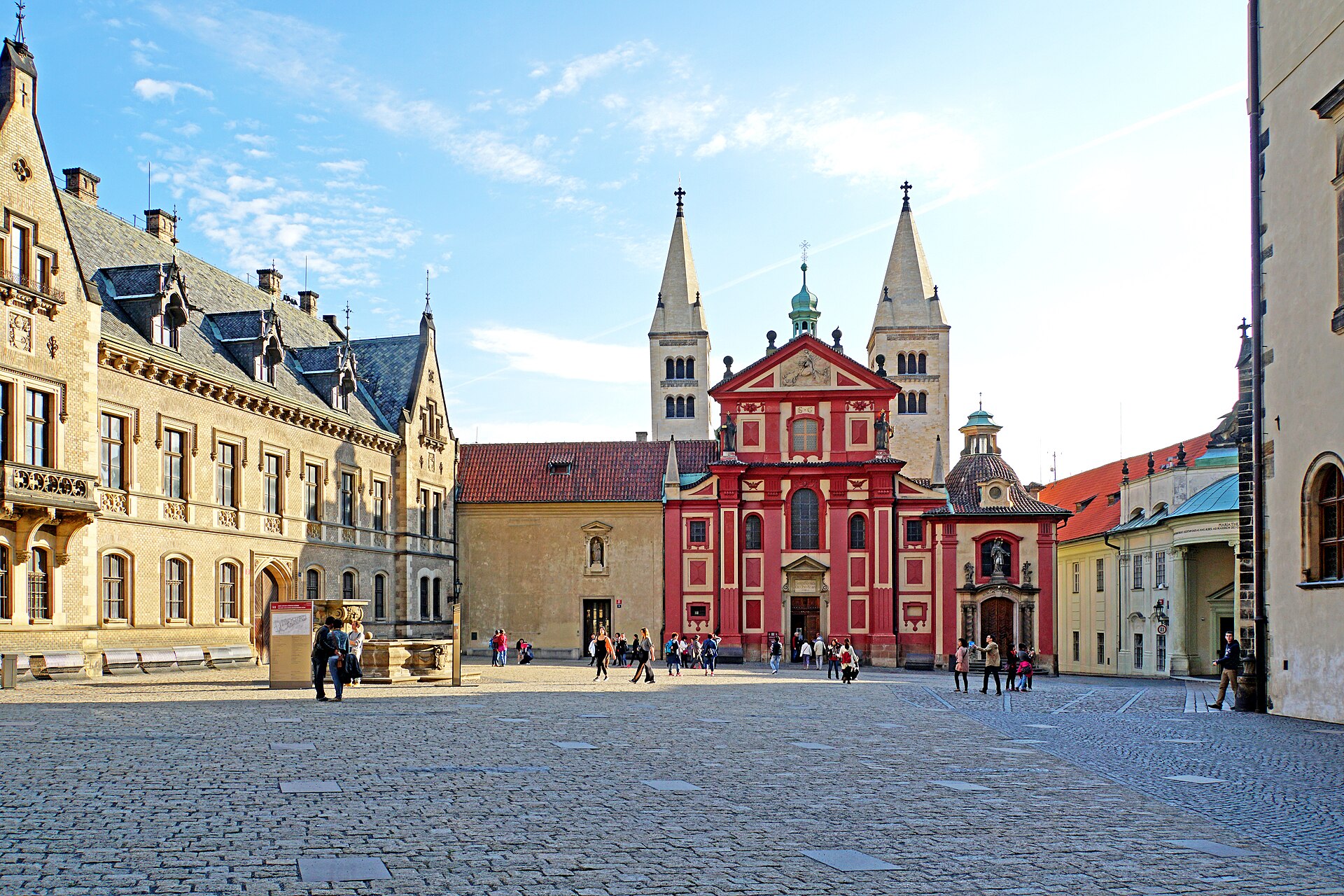
Near the tombs of these early rulers stands St. George’s Basilica, founded around the year 920 and rebuilt after a fire in the twelfth century. Behind its cheerful brick-red Baroque face lies one of the oldest and most authentically Romanesque interiors in the country, all heavy stone arches and severe, honest light. Walk inside and the centuries fall away. This is roughly what the early dukes would have known, a space built for a harder, plainer kind of faith.
The cult of Wenceslas tells you something important about how the Czechs have always seen their castle. It was never only a seat of political power. It was a sacred landscape, a place where sainthood and sovereignty were braided together so tightly that you could not always tell where the church ended and the state began. The good duke murdered on his way to Mass became the symbol of the nation, and his hill became its holy ground.
It is worth pausing on how unusual this is. Most nations trace their founding myths to conquerors or lawgivers. The Czechs chose a murdered peacemaker, a duke remembered less for what he built than for how he died. That choice says something gentle and stubborn about the national character, a preference for moral authority over brute strength that echoes down the centuries to figures like Havel.
How a Cathedral Took Six Centuries to Finish
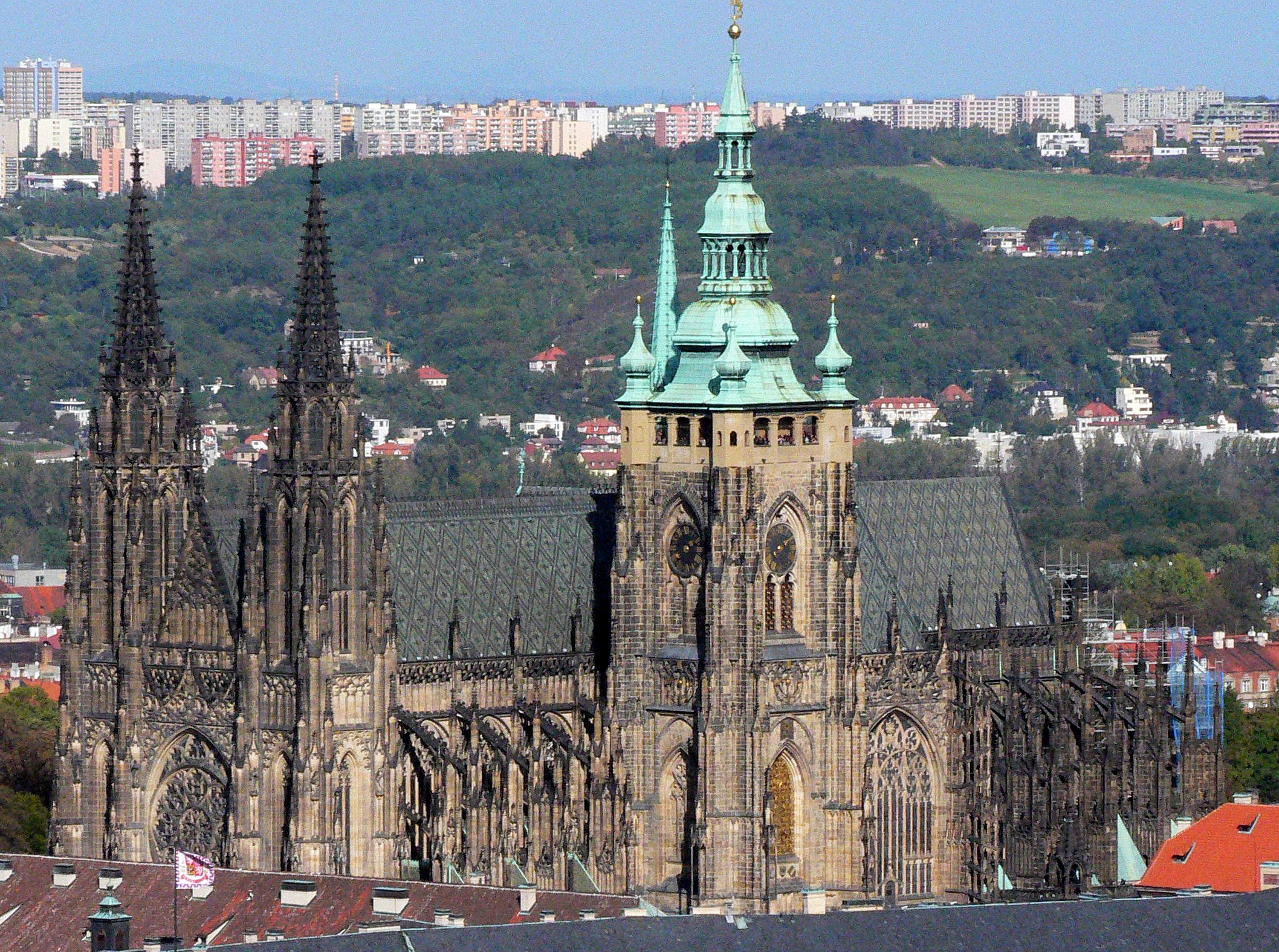
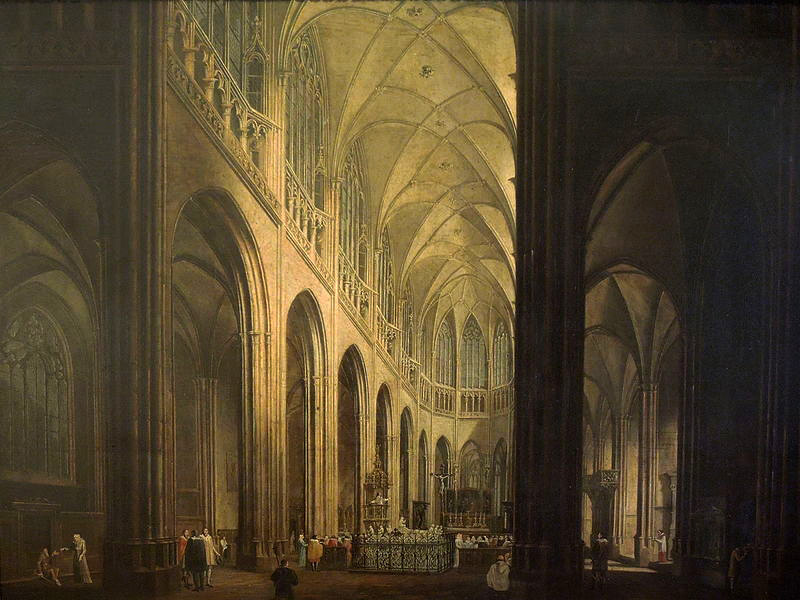
If the castle has a single soul, it is St. Vitus Cathedral, the great Gothic mountain of stone that rises from the third courtyard and pins the whole complex to the sky. But the cathedral you see did not appear at once. It grew out of a rotunda founded by Wenceslas himself, which became a Romanesque basilica, which was finally swept aside in 1344 when a young and enormously ambitious ruler decided Bohemia deserved a cathedral to rival any in Christendom.
That ruler was Charles IV, and the foundation stone he laid began a project that would outlast him by nearly six hundred years. The first architect was Matthias of Arras, trained in the French Gothic tradition, and after his death the work passed to a young genius named Petr Parléř, who gave the cathedral its soaring, inventive character, its net vaults and its flowing tracery. Then came wars, plagues, fires and empty treasuries, and the cathedral simply stopped, half-built, its western end open to the weather for centuries.
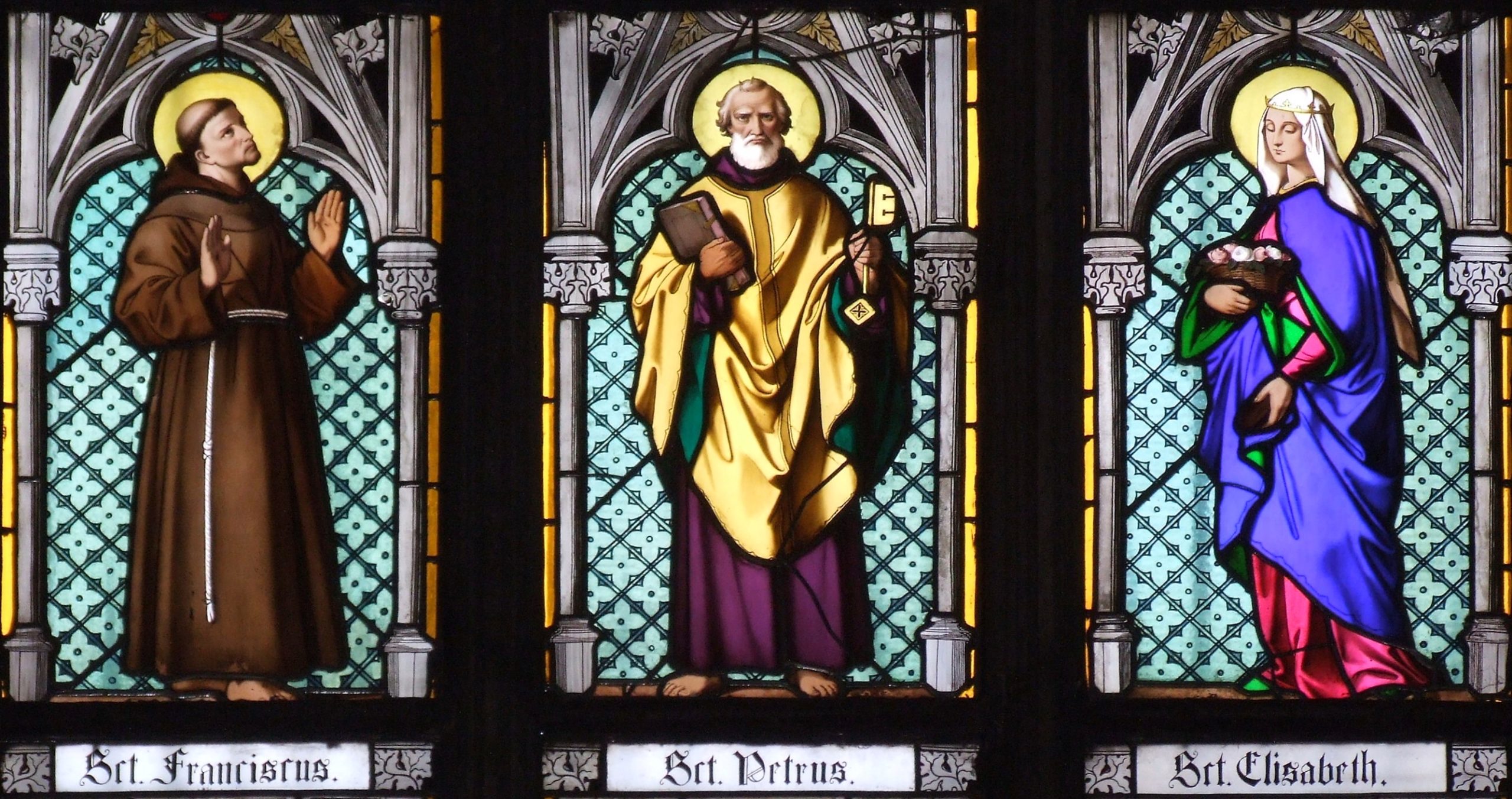
It was not truly finished until 1929, when a wave of national feeling in the young Czechoslovak state finally completed the nave and the western towers in careful imitation of Parléř’s Gothic. Stand in the completed cathedral and you are looking at a building begun for a medieval emperor and finished for a modern republic, six centuries of Czech history reaching up toward the same vault. The stained glass throws pools of color across the floor, including a famous window designed by the artist Alfons Mucha.
To feel the scale of the place properly, it helps to see it moving, to watch the light shift across the ribs of the vaulting and the crowds drift beneath windows the height of houses. This short walk through the castle grounds and its great church gives you a sense of what no still photograph can, the sheer vertical ambition of it all.
Charles IV and the Golden Age of Bohemia
To understand the castle at its height you have to understand Charles IV, who is to Prague what Augustus was to Rome. Born in 1316, raised at the French court, he became King of Bohemia and then Holy Roman Emperor, and he chose Prague, not any German city, as the capital of his empire. Suddenly this hill above the Vltava was not merely a national seat but the center of Central Europe, and Charles poured his immense energy into making it look the part.
He rebuilt the cathedral, expanded the palace, and reshaped the entire city below, founding a university, throwing a new stone bridge across the river, and laying out a whole New Town according to a grand plan. He also had the Crown of St. Wenceslas made, the sacred coronation crown of the Bohemian kings, dedicated to the patron saint and kept, then as now, among the crown jewels in the cathedral. When a Bohemian king was crowned with it, he was symbolically borrowing it from the dead saint himself.
Charles thought in centuries. He gathered relics, commissioned chronicles, and deliberately wove Bohemia’s story into the larger history of the empire and the church, so that Prague would be remembered not as a provincial capital but as a holy imperial city. His reign is still called the golden age, and the phrase is not mere nostalgia. For a few decades in the fourteenth century, this castle really was one of the great centers of the European world.
What I find moving about Charles is how much of what he built is still here to touch. The cathedral, the bridge, the crown, the university, the very idea of Prague as a capital worthy of an emperor, all of it flows from the ambition of one far-sighted king who looked at a hill above a river and decided it should be the heart of everything.
There is a nice irony in the fact that the man who did the most to glorify the Bohemian crown was himself half French by upbringing and thoroughly European in outlook. Charles proved that local pride and cosmopolitan ambition need not be enemies. He loved Bohemia precisely because he had seen the wider world, and he wanted his homeland to stand among its greatest kingdoms rather than at its edge.
Inside the Hall Where Knights Rode on Horseback
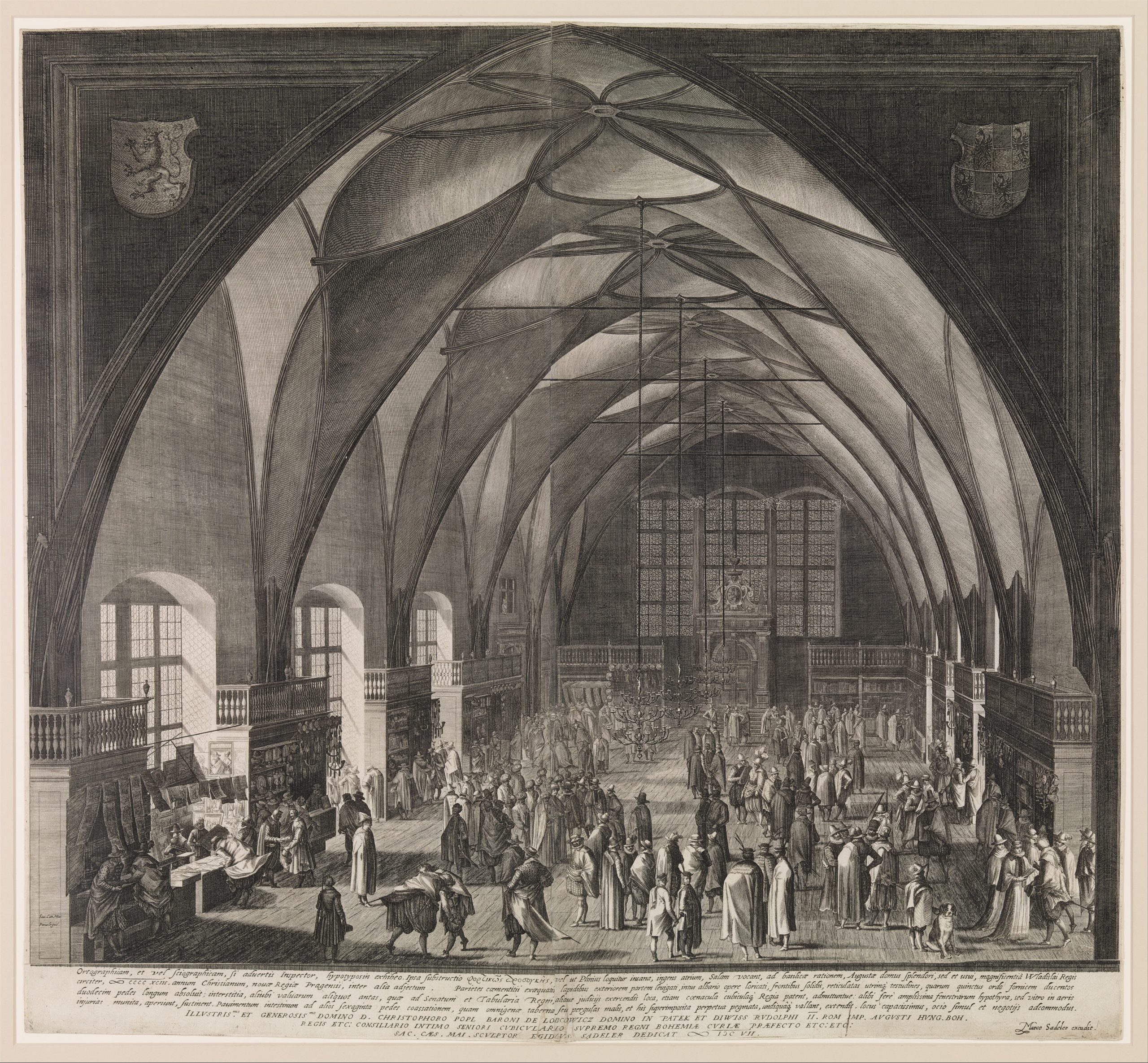
Of all the rooms in the castle, none makes visitors stop quite like Vladislav Hall. It is enormous, a single unbroken space more than sixty meters long, roofed by a ceiling of ribbed vaulting that seems to grow and branch like something organic rather than built. There are no interior columns to break it up, no supports marching down the middle, just that astonishing spread of stone flowers overhead and a sense of space that feels almost impossible for its age.
It was built between 1493 and 1502 under King Vladislav II Jagellon, and its architect, Benedikt Ried, was one of the great structural imaginations of his day. The vault is late Gothic pushed to its absolute limit, but the windows are already Renaissance, round-arched and classical, which makes the hall a hinge between two whole worlds of architecture. In one room you can watch the Middle Ages turning into the modern age.
The hall was built for grandeur, and it got it. Coronation feasts were held here, markets and assemblies too, and famously it was large enough for indoor jousting tournaments, which is why one entrance, the Rider’s Staircase, has broad shallow steps designed so that knights could ride their horses right up into the hall. Imagine the noise of it, hooves and armor echoing under that vault, the whole court roaring.
Today the hall is still used for the most solemn moments of Czech public life. Presidents are sworn in here, and elections to the highest offices take place beneath the same vault where medieval knights once charged. Few rooms anywhere can claim such an unbroken line of ceremonial use, five centuries of a nation’s biggest occasions playing out under one extraordinary ceiling.
The Old Royal Palace and Its Buried Floors
Vladislav Hall is only the grandest room of a much older structure, the Old Royal Palace, and this building is perhaps the best place in the whole castle to feel how the centuries pile up. It began as a Romanesque palace under Prince Soběslav in the twelfth century, and rather than tear the old work down, each later age simply built on top of it, so the palace today is layered like geology, with Romanesque foundations under Gothic halls under Renaissance additions.
You can actually descend through these layers. Below the bright Jagellonian hall lie the darker, heavier Gothic rooms of the Luxembourg kings, and below those the cool Romanesque cellars of the earliest stone palace. Walking down is like walking backward in time, the arches growing squatter and the light growing dimmer, until you reach the raw twelfth-century stonework where the whole thing began. Few buildings let you read their own biography so clearly.
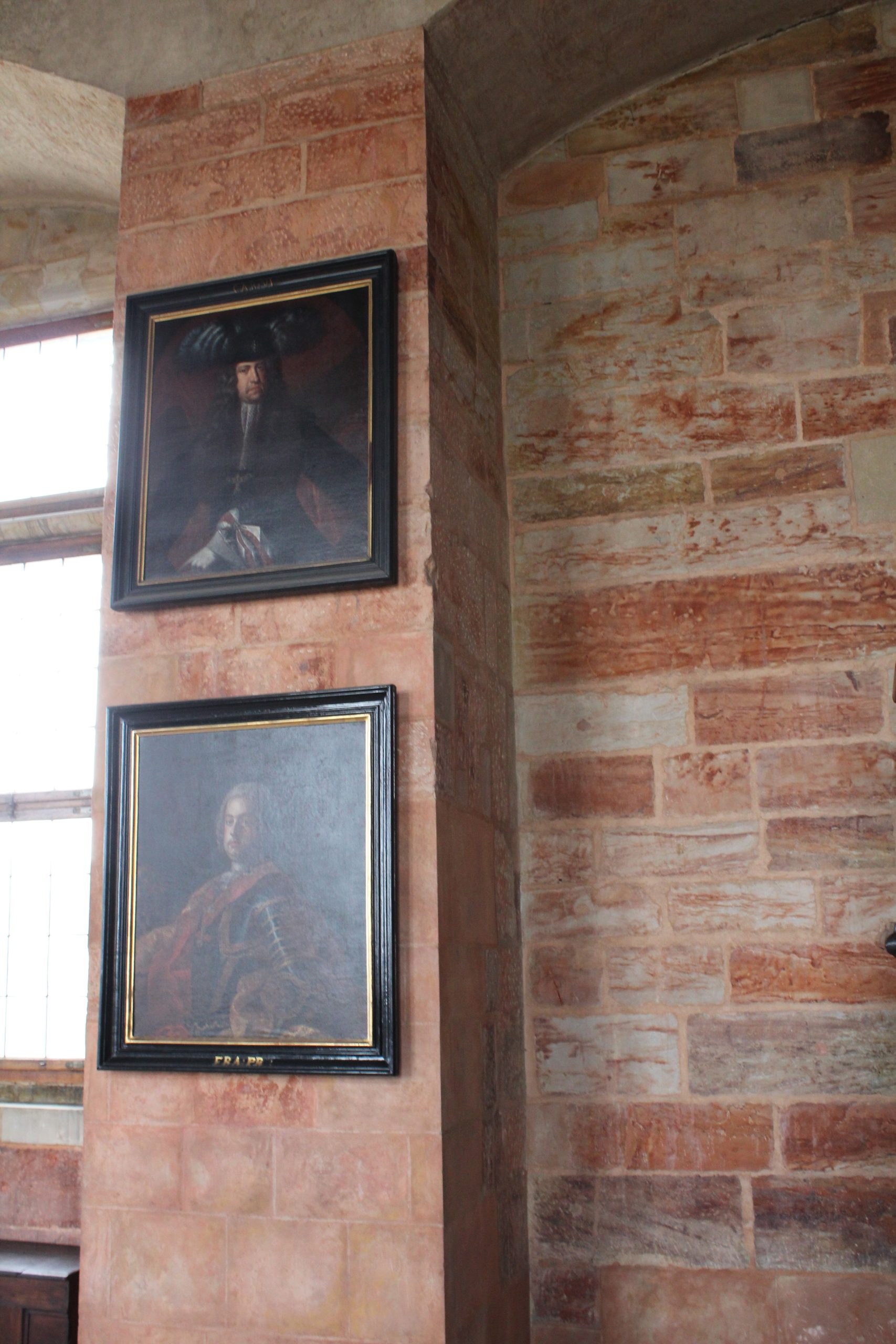
For centuries this palace was the working heart of the Bohemian state, the place where kings held council, dispensed justice, received ambassadors and stored records. The Bohemian Chancellery, the offices from which the kingdom was administered, sat within these walls, and it was in one of those chancellery rooms that the castle’s most notorious act of violence would take place, an act that helped set fire to the whole of Europe.
There is something honest about a palace that never pretended to be finished, that let every generation leave its mark rather than imposing a single tidy style. The Old Royal Palace is not beautiful in the way the cathedral is beautiful. It is something rarer, a building that wears its entire history on the surface, and lets you climb down into the past floor by floor.
A Window, a Fall, and the War That Followed
On the 23rd of May, 1618, a group of Protestant Bohemian nobles climbed up into the Bohemian Chancellery in the Old Royal Palace, seized two Catholic imperial governors and their secretary, and threw all three out of a high window into the ditch below. This is the famous Second Defenestration of Prague, and it is one of those rare moments where you can point to a single room and say, here is where a continent caught fire.
The grievance was religious and constitutional. Bohemia’s Protestants believed the Catholic Habsburg emperor was trampling the freedoms they had been promised, and hurling his officials from a window was a deliberate, theatrical act of defiance, a rejection of Habsburg authority as loud as anyone could make it. Remarkably, all three men survived the fall, landing in a heap of refuse below, which Catholics promptly hailed as a miracle and Protestants explained rather less romantically.
Whatever saved them, it did not save the peace. The defenestration triggered the Bohemian Revolt, which spiralled outward into the Thirty Years’ War, the catastrophic religious and dynastic conflict that would ravage central Europe for a generation and kill a staggering share of its population. It is sobering to stand at that window today, look down at the ordinary drop below, and realize that one act of fury in this castle helped unleash decades of ruin across a continent.
The Bohemian cause itself was crushed at the Battle of White Mountain in 1620, just outside Prague, and the defeat ushered in centuries of Habsburg rule. The castle, which had been the stage for Bohemian defiance, became a symbol of Bohemian subjugation. History turns on strange hinges, and one of the strangest is a chancellery window on a spring morning in 1618.
Golden Lane and the Little Houses of Legend
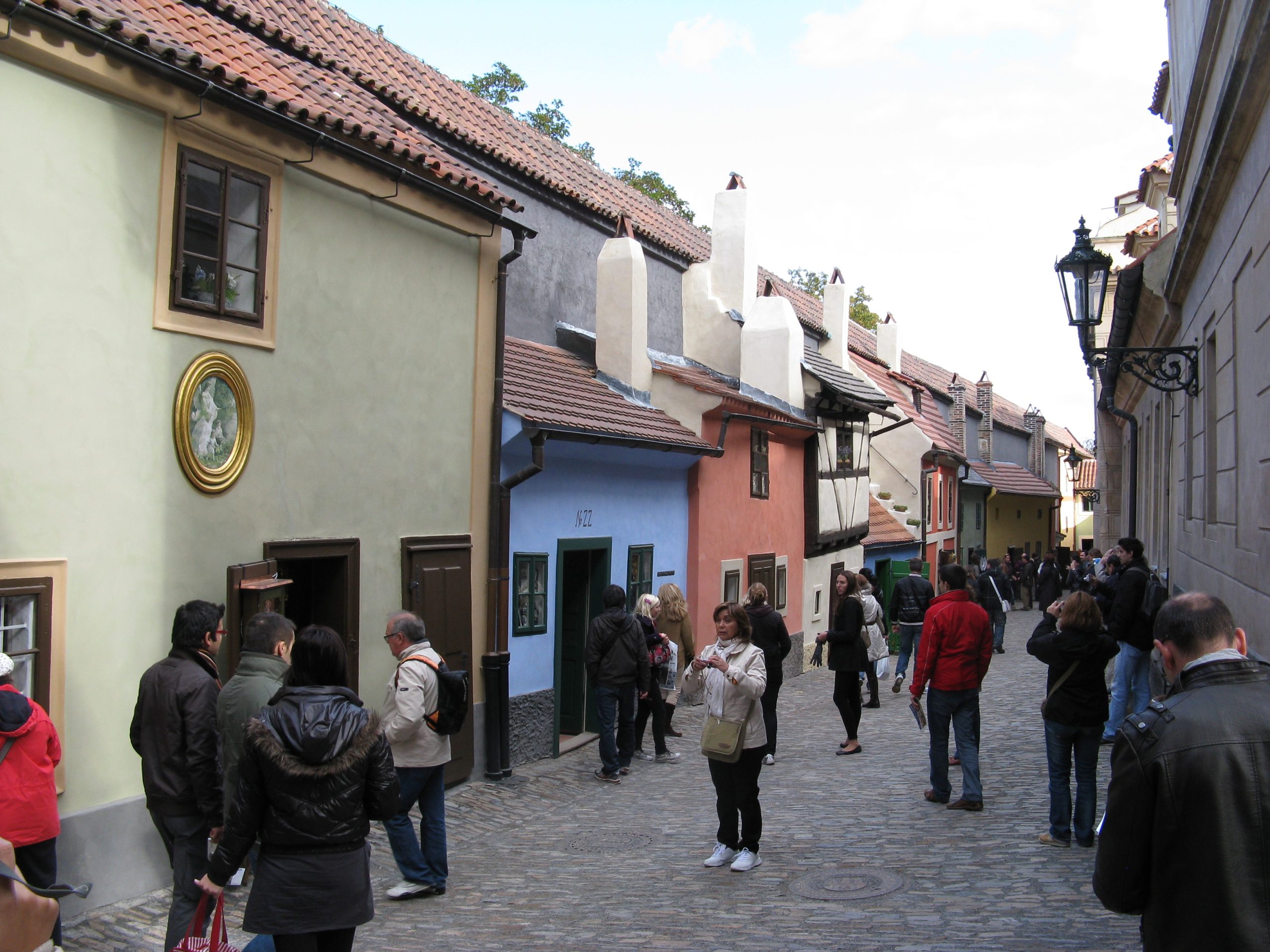
Tucked against the northern rampart is the castle’s most unexpected and most charming corner, Golden Lane, a narrow cobbled street lined with a row of tiny, brightly painted houses that look as if they belong in a fairy tale rather than a fortress. The cottages are small enough that a tall visitor has to stoop, their doorways low, their windows like something from a doll’s house, and they are among the most beloved sights in all of Prague.
The lane was built in the sixteenth century to house castle marksmen, and later it filled with goldsmiths, which may be one source of its glittering name. The more romantic story ties it to the alchemists said to have worked at the court of Emperor Rudolf II, chasing the philosopher’s stone and the secret of turning base metal into gold. Whether or not any alchemist ever actually lived here, the legend clung to the street and never let go.
Its most famous resident came much later. For a time around 1916 and 1917, the writer Franz Kafka worked in the little house at number 22, borrowed from his sister, coming up to the quiet lane to write in the evenings. There is something perfect about Kafka, chronicler of vast impersonal bureaucracies, finding his workspace in the literal shadow of the castle, that ultimate symbol of remote and unaccountable authority looming over the individual.
Today the houses hold small shops and exhibitions, and in the evening, when the day visitors have gone, the lane empties and quiets and you can almost believe the old stories. It is a reminder that this castle was never only about emperors and cathedrals. It was also a place where ordinary people, marksmen and goldsmiths and struggling writers, lived out their small lives in the great shadow on the hill.
In the colder months, when frost silvers the cobbles and the little chimneys breathe smoke, the lane looks almost unchanged from the days when its residents were castle marksmen. It is one of the few places in the whole complex where you can still feel the texture of ordinary daily life rather than the grandeur of church and state.
Rudolf’s Strange and Brilliant Court
In the late sixteenth century the castle enjoyed a second, stranger golden age under Emperor Rudolf II, who moved the imperial court from Vienna to Prague in 1583 and turned the hill into one of the most extraordinary centers of learning and curiosity in Europe. Rudolf was a melancholic, obsessive, endlessly inquisitive man, less interested in the tedious business of ruling than in art, science, astronomy and the mysteries at the edge of both.
He gathered around him an astonishing collection of minds and objects. The astronomers Tycho Brahe and Johannes Kepler worked under his patronage, and Kepler formulated some of his laws of planetary motion during his years connected to this court. Rudolf filled the castle with a vast cabinet of curiosities, paintings, clocks, exotic specimens and scientific instruments, a treasury of the strange and the beautiful that reflected a mind hungry to understand everything at once.
It was also the golden age of Prague’s alchemists and occultists, drawn by an emperor who took such things seriously, and the reputation of the castle as a place of hidden knowledge and secret experiment dates largely from these years. The line between science and magic was blurry then, and Rudolf stood right on it, funding genuine astronomy and dubious gold-making with equal enthusiasm.
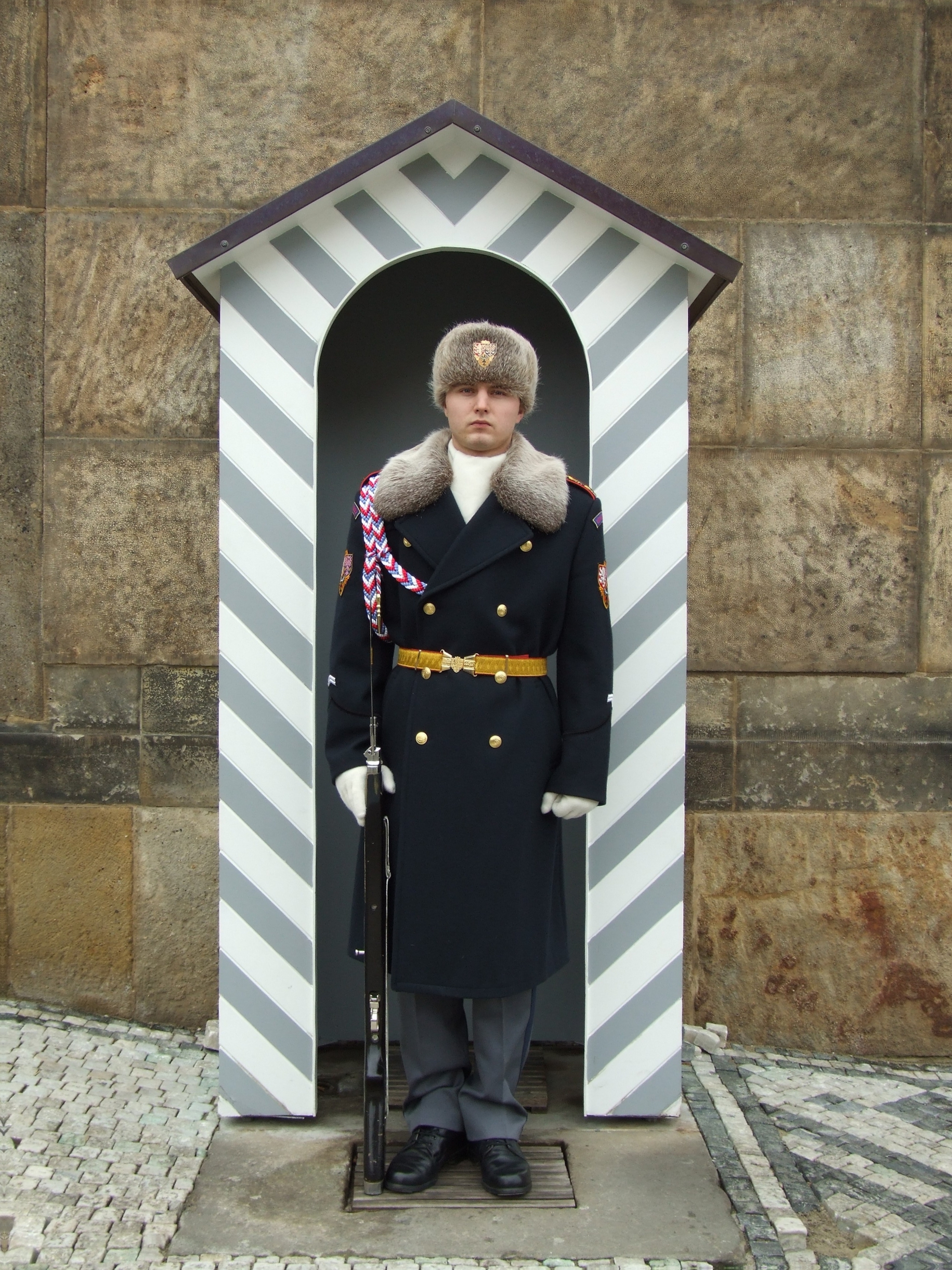
Ceremony has never left the castle, and the guards you see at the gates today, in their crisp uniforms, changing on the hour with a small flourish, are the ceremonial descendants of centuries of court ritual that reached one of its peaks under Rudolf. His court eventually collapsed into intrigue and his reign ended badly, but for a few decades this hill was where Europe came to wonder at the universe, and that spirit of curiosity still hangs about the place.
The Castle and the City Below It
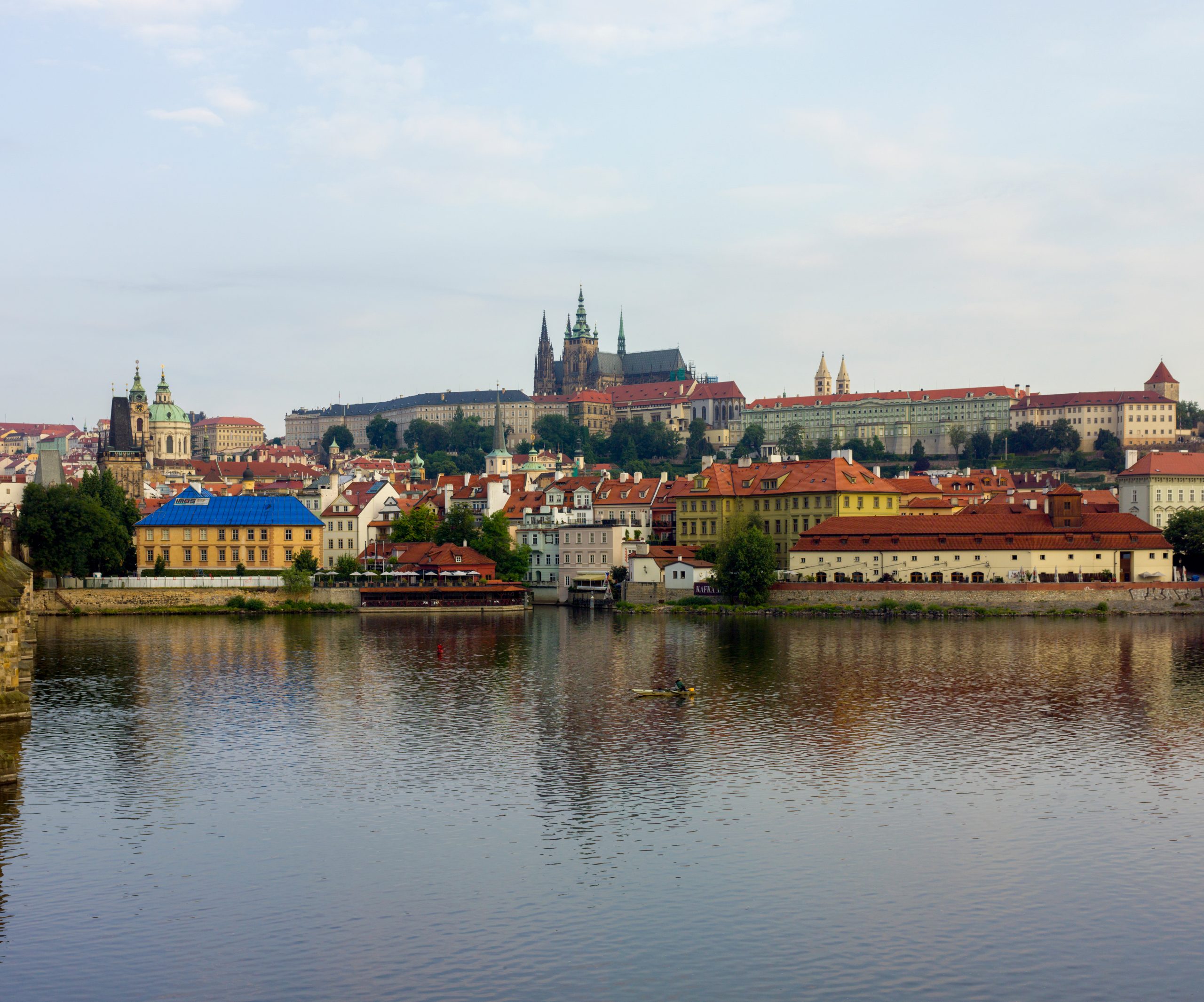
You cannot separate the castle from Prague, because for a thousand years the two grew together, the fortress on the hill and the city in the valley locked in a single silhouette. The classic view is from Charles Bridge, Charles IV’s great stone crossing, where you look up past the statues on the parapet and see the cathedral spires and the long line of the castle wall floating above the red roofs. It is one of the most photographed views in Europe, and it earns it.
The relationship between hill and river shaped everything about how Prague works. The castle quarter, Hradčany, and the Lesser Town beneath it, Malá Strana, developed as the aristocratic and ecclesiastical side of the city, all palaces and gardens and churches, while the Old Town across the river became the merchant heart. The bridge stitched the two together, and along it kings rode in coronation processions from the Old Town up to the castle to be crowned.
That coronation route, the Royal Way, is still walkable today, and it is the best way to feel the city as its medieval rulers experienced it, climbing gradually from the bustle of the Old Town Square, across the river, and up the steep lanes of the Lesser Town to the castle gates. The whole city is arranged as a slow processional ascent toward the crown on the hill.
To stand on the bridge at dawn, before the crowds, and watch the light catch the cathedral is to understand why writers and painters have been obsessed with this skyline for centuries. The castle does not sit apart from Prague like a museum on the edge of town. It presides over it, the fixed point around which the whole beautiful city turns.
Gardens Hung Above the Rooftops
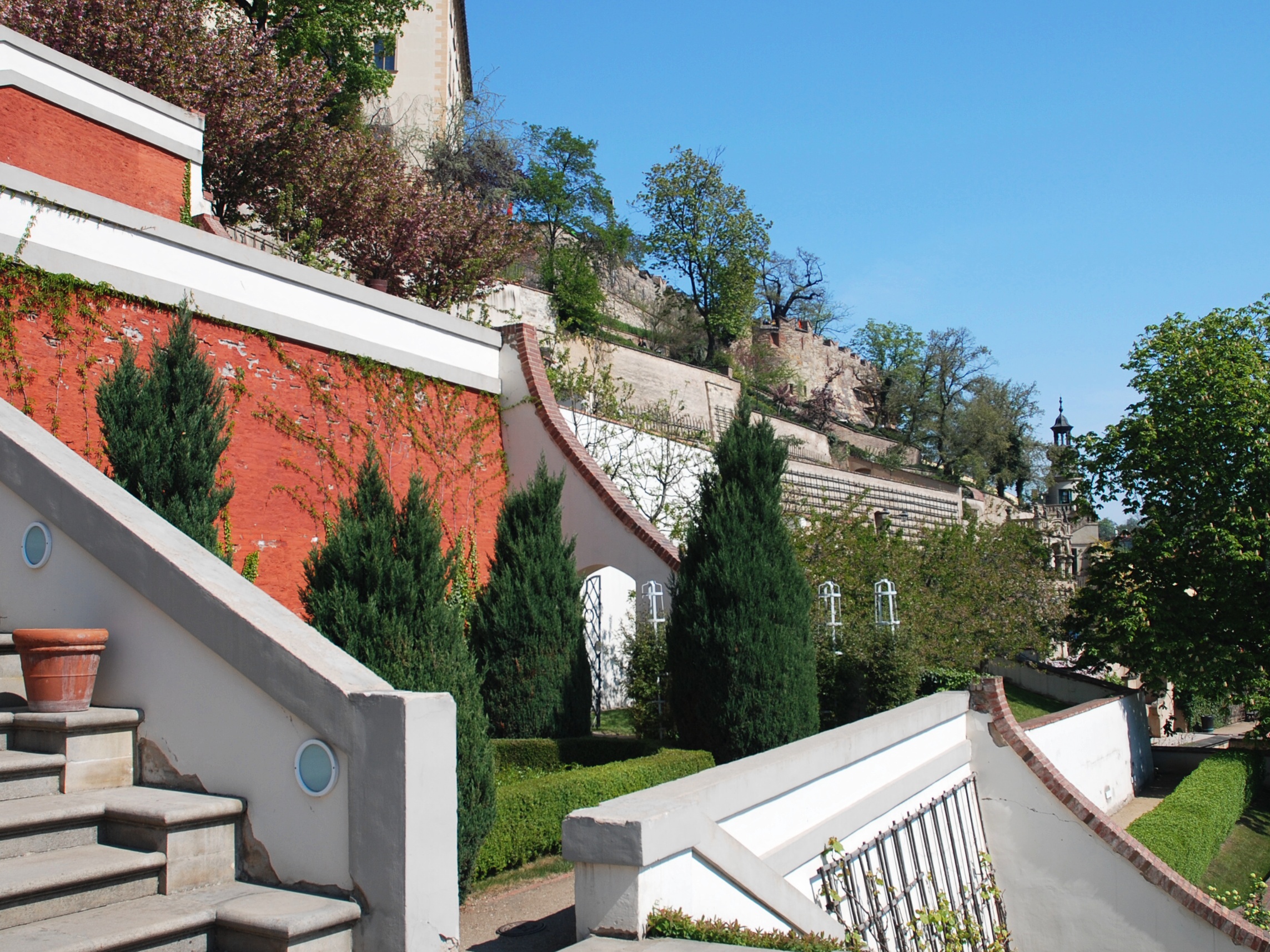
For all its history of coronations and defenestrations, the castle also knows how to be gentle, and nowhere more so than in its gardens. Along the southern slope, terraced gardens tumble down toward the Lesser Town in a series of balustrades, staircases and shaded walks, offering some of the loveliest views in Prague and a welcome escape from the crowds pressing through the courtyards above.
The grandest of the formal gardens is the Royal Garden to the north, laid out in the sixteenth century in the Renaissance taste, home to the elegant Summer Palace, often called the Belvedere, one of the purest Renaissance buildings north of the Alps. Nearby stands the Ball Game Hall, its walls covered in delicate sgraffito decoration, built for the courtly recreations of a more leisured age. These were pleasure grounds, designed for strolling and conversation and the quiet display of good taste.
The gardens matter because they show a different face of power. A fortress is about strength, but a garden is about confidence, the confidence of rulers secure enough to spend their wealth on beauty and leisure rather than walls and weapons. When the Habsburgs and their architects laid out these terraces and planted these parterres, they were making a statement as surely as any king who built a tower, just in a softer language.
On a warm afternoon, with the fruit trees in blossom and the whole of Prague spread out below the balustrade, the castle gardens are among the most romantic places in the city. It is worth remembering, as you rest there, that this same slope was once a defensive glacis, and that the peace you are enjoying was won and held over a very long and often violent history.
The Seat of a Republic After Dark
The castle’s story did not end with kings and emperors. When Czechoslovakia was born from the collapse of the Habsburg empire in 1918, the new republic did something quietly radical, it made the ancient royal castle the seat of its elected president. The architect Josip Plečnik was invited to adapt the old imperial rooms for democratic use, and he did so with extraordinary sensitivity, adding modern touches that respected the weight of centuries around them.
Through the twentieth century the castle absorbed the whole turbulent history of the Czech lands, Nazi occupation, communist rule, and finally the Velvet Revolution of 1989, after which the dissident playwright Václav Havel walked into the castle as the first president of a free Czechoslovakia. There is a deep symbolism in that, a man who had been a prisoner of the state taking his office in the very heart of the state, under the same vault where kings were once crowned.
Today Prague Castle remains the official residence and office of the President of the Czech Republic, which makes it that rare thing, a monument that is also a living seat of government. Presidential standards fly from the towers when the head of state is in residence, and the ceremonial guard still changes at the gates, blending a thousand years of ritual with the workings of a modern democracy.
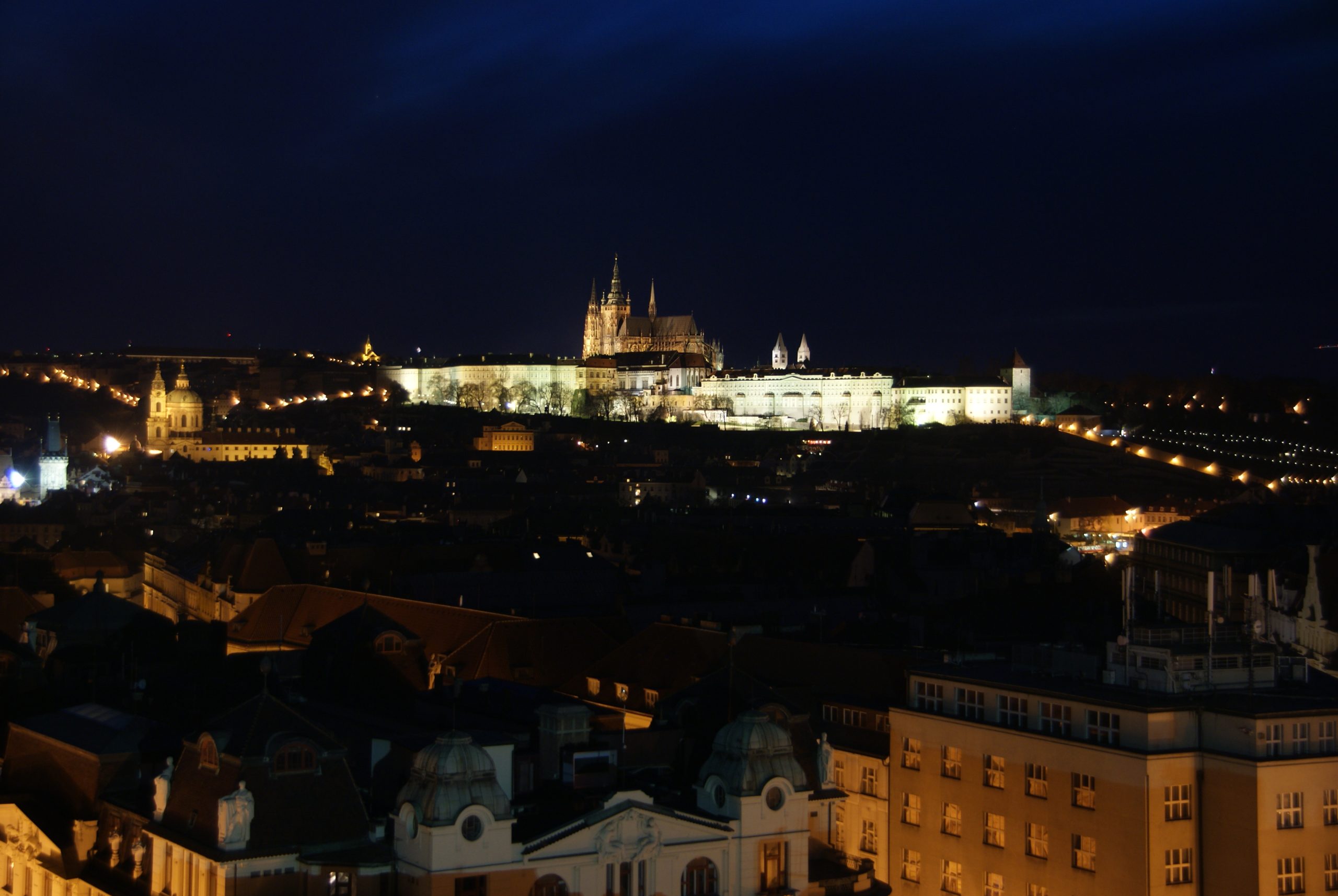
At night, when the floodlights come on and the cathedral glows above the dark river, the castle looks less like a museum and more like what it has always been, the fixed heart of a nation. Kings, emperors, alchemists and presidents have all climbed this hill and left their mark, and the lights burning in its windows tonight are simply the latest chapter of a story with no sign of ending.
Castles Nearby
Why the Castle on the Hill Still Belongs to Everyone
Most castles ask you to imagine the life that once filled them. Prague Castle does not, because that life never stopped. The cathedral still holds Mass, the president still works behind the old walls, the guards still change at the gate, and the crowds still climb the same hill the Přemyslid princes climbed eleven hundred years ago. It is not a preserved past. It is a living present with unusually deep roots.
That, in the end, is what makes it unmissable. You are not visiting a ruin or a relic but the continuous heart of a people, the one place where every chapter of the Czech story, sacred and violent, brilliant and tragic, has been written and is still being written. Walk its courtyards slowly, let the layers reveal themselves, and you will carry the shape of a whole nation’s history home with you.
And when you finally come back down the hill in the evening, and turn to see the whole complex glowing above the Vltava, you will understand why the Czechs never took the crown off this ridge. Some places are simply too important to abandon. Prague Castle is one of them, and it has been for a thousand years.
You May Like
Hohensalzburg Fortress: The Great White Stronghold That Never Fell


