In the flat, quiet countryside of central Poland, between Warsaw and Lodz, a long avenue of trees leads to a graceful baroque palace that has captivated visitors for more than three centuries. Nieborow is not the biggest residence in Poland, nor the most famous, yet many who visit it fall under its spell. It has the feel of a real aristocratic home, filled with books, paintings, tiles and keepsakes gathered by generations of owners, and surrounded by a formal garden and a park of great charm.
Built at the end of the seventeenth century by a powerful churchman and later shaped by the princely Radziwill family, Nieborow is a treasure house of Polish history and taste. Its staircase is lined with thousands of Dutch tiles, its library holds rare globes and old volumes, and in one of its rooms rests a marble head of an ancient tragic queen that has inspired poets.
In this article we will explore Nieborow from its baroque origins to its Radziwill golden age, through its interiors, its gardens and its links with the romantic park of Arkadia nearby, and we will finish with tips for your own visit.
In This Article
- A Baroque Gem in the Polish Countryside
- A Cardinal Builds a Country Seat
- The Genius of Tylman van Gameren
- The Radziwills Take Over
- A Staircase Clad in Dutch Tiles
- Halls and Drawing Rooms of a Princely Home
- A Library of Rare Books and Globes
- The Head of Niobe and Other Treasures
- The Nieborow Majolica Workshop
- Helena Radziwill and the Dream of Arkadia
- The Formal Garden and Its Sculptures
- Nieborow on Film
- Visiting Nieborow Today
A Baroque Gem in the Polish Countryside
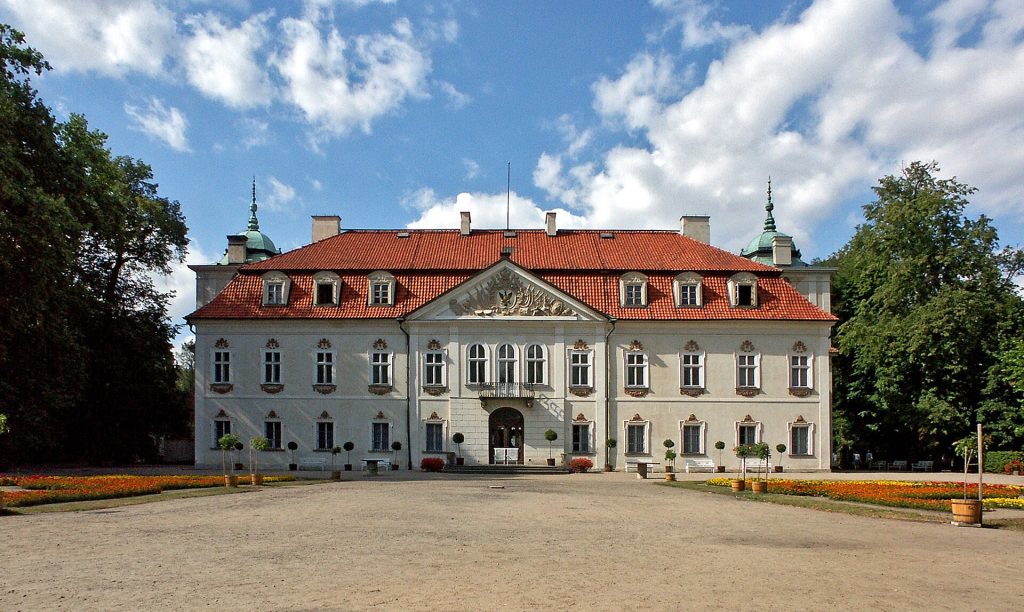
As you approach Nieborow, the palace appears at the end of a straight avenue, its pale facade framed by tall trees. It is a compact, elegant building, with a central block flanked by two corner towers topped with graceful cupolas. The proportions are calm and balanced, the decoration restrained, and the whole effect is one of quiet dignity.
Around the palace stretch a formal garden and a landscaped park, with avenues of lime trees, ponds, sculptures and shady corners. In spring and summer the grounds are full of birdsong and the scent of flowers, while in autumn the trees turn gold and the estate takes on a gentle, melancholy beauty.
Nieborow lies close to the historic town of Lowicz, famous for its colourful folk traditions, and about an hour and a half from Warsaw. It makes an easy day trip from the capital, often combined with a visit to the romantic garden of Arkadia, just a few kilometres away.
What makes Nieborow special is its intimacy. This is not a vast royal palace but a lived in country house, and as you walk through its rooms you feel that the owners have just stepped out, leaving their books, pictures and treasures waiting for their return.
Arriving early in the morning, when mist still hangs over the fields and the avenue is quiet, is an especially magical experience. The palace seems to emerge slowly from the landscape, and you can easily imagine carriages rolling up the drive centuries ago.
The estate also includes outbuildings, stables and service buildings that once supported the daily life of the palace. Together with the house and the gardens, they form a complete ensemble that gives a vivid picture of how a great Polish country estate functioned, and for much of the year it is refreshingly free of crowds.
The approach itself is part of the experience. The avenue of old trees acts like a frame, drawing your eye toward the palace and building a sense of anticipation. It was designed that way centuries ago, and it still works its magic on every visitor who arrives.
A Cardinal Builds a Country Seat
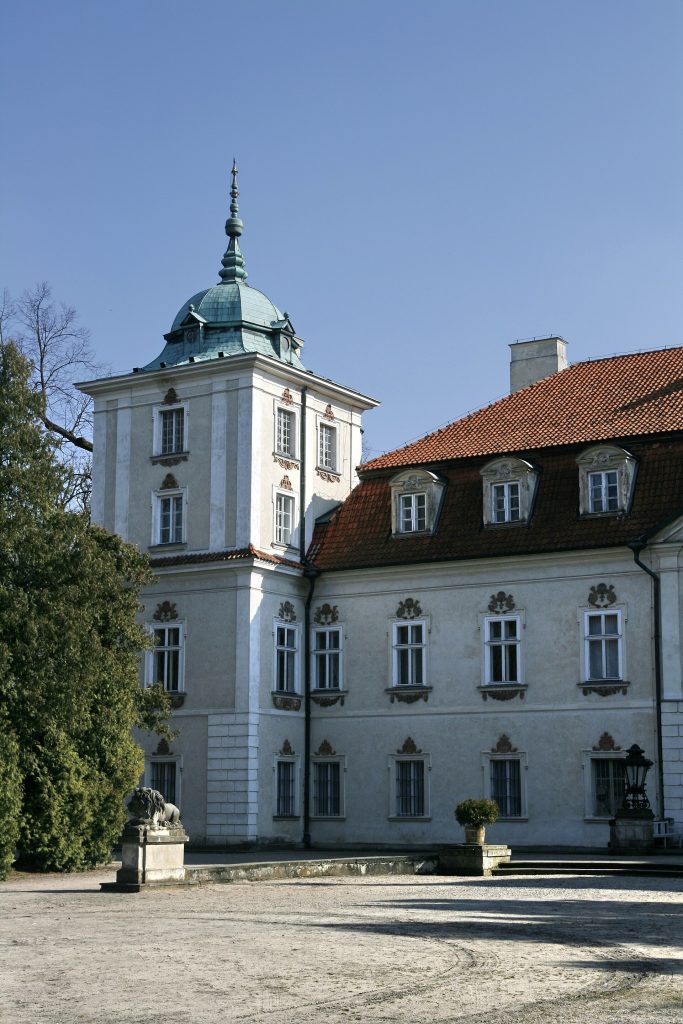
The story of the palace begins in the 1690s with Michal Stefan Radziejowski, cardinal and primate of Poland, the highest churchman in the land. In the elective monarchy of the Polish Lithuanian Commonwealth, the primate also acted as interrex, ruling between the death of one king and the election of the next, which made him one of the most powerful figures of his day.
Radziejowski was ambitious, worldly and wealthy, and he wanted a country residence that reflected his status. He acquired the estate at Nieborow and commissioned a new palace on the site of an older manor house. The building went up quickly, and within a few years the cardinal had a fashionable baroque residence surrounded by gardens.
The cardinal was a controversial figure, deeply involved in the political intrigues of his age, including the struggles that followed the death of King John III Sobieski. His reputation was mixed, but his taste in architecture was excellent, and Nieborow is his finest legacy.
The office of primate was one of the most prestigious in the Commonwealth, combining spiritual authority with real political power. Holders of the office often lived in great style, and Radziejowski was no exception. His residences, his court and his patronage of the arts were all designed to reflect his elevated position.
Although he built Nieborow, he spent relatively little time there, as his duties kept him in Warsaw and elsewhere. After his death in 1705, the estate passed through several hands before entering the most important chapter of its history, when it was acquired by the Radziwill family in the second half of the eighteenth century.
It is pleasant to imagine the cardinal strolling in the new gardens on one of his rare visits, discussing politics with visiting nobles and planning his next move in the complicated game of Commonwealth politics. The palace he left behind proved far more enduring than his political schemes.
The estate he chose was well placed, close to Lowicz, which had long been the seat of the primates of Poland. Building here allowed Radziejowski to combine his official duties with the pleasures of country life, a balance many great churchmen of the time sought.
The Genius of Tylman van Gameren
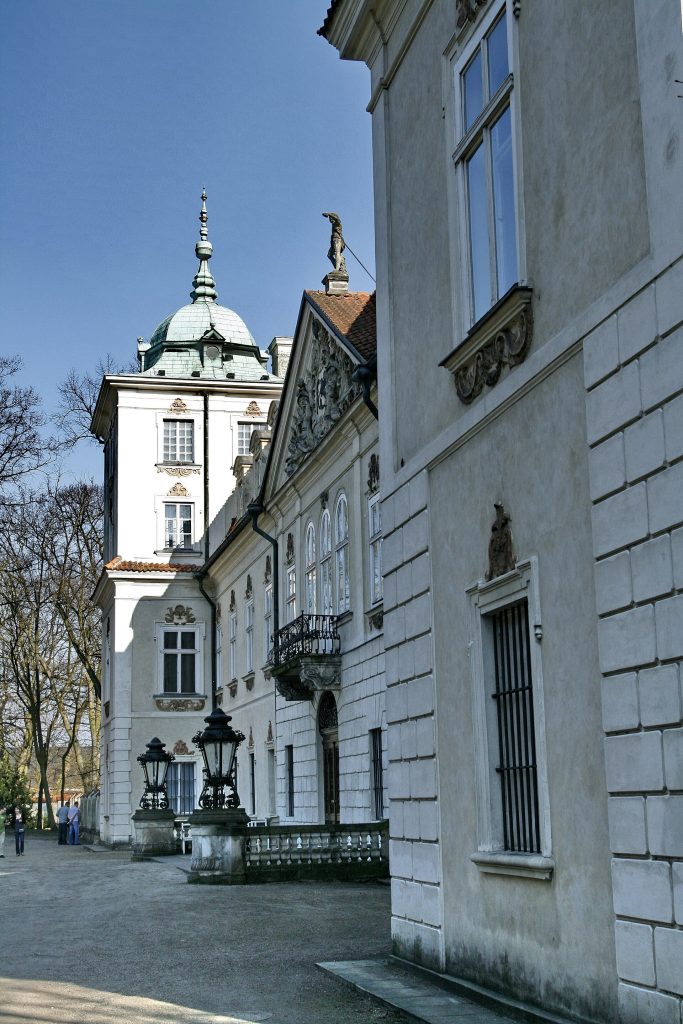
To design his palace, Radziejowski turned to Tylman van Gameren, a Dutch born architect who had settled in Poland and become the leading architect of the late seventeenth century there. Tylman designed churches, palaces and townhouses across the country, bringing the elegant classical style of the Netherlands and Italy to the Polish landscape.
At Nieborow, Tylman created a building of great clarity and balance. The central block is two storeys high, with a pediment over the entrance, while the two corner towers give the palace its distinctive silhouette. The design reflects both Dutch restraint and Italian grandeur, combined with the traditions of the Polish manor house.
Inside, Tylman arranged the rooms in a simple and practical sequence, with a central hall leading to the staircase and the main rooms on the upper floor. This logical layout made the palace comfortable to live in as well as impressive to visit, which is one reason why later owners kept its basic structure intact.
Tylman worked for many of the leading families of his time, and his buildings can be found in Warsaw, Krakow and across the countryside. Among his best known works are the Krasinski Palace in Warsaw and several fine churches. Nieborow is one of his most charming and best preserved country houses.
His influence on Polish architecture was enormous. In a sense, he helped create the classic image of the Polish aristocratic residence that we still recognise today, and if you look closely at the facade, the windows and the towers, you will see the hand of a master who understood how to create beauty through simplicity.
Compare the palace with the grander residences of Warsaw, such as Wilanow, and you will notice how Tylman adapted his style to the setting. Here he chose modest scale and harmony over display, creating a house that feels at home in the gentle landscape of the Mazovian plain.
The Radziwills Take Over
In 1774 the estate was bought by Michal Hieronim Radziwill, a member of one of the greatest aristocratic families of Poland and Lithuania. The Radziwills were immensely wealthy and influential, with vast estates, palaces and collections, and under their ownership Nieborow became a centre of culture and refinement.
Michal Hieronim and his wife Helena remodelled the interiors in the elegant classical style of the late eighteenth century, filled the palace with art and furniture, and developed the gardens. Helena in particular was a woman of great taste and imagination, and she created the romantic park of Arkadia nearby, one of the most famous landscape gardens in Poland.
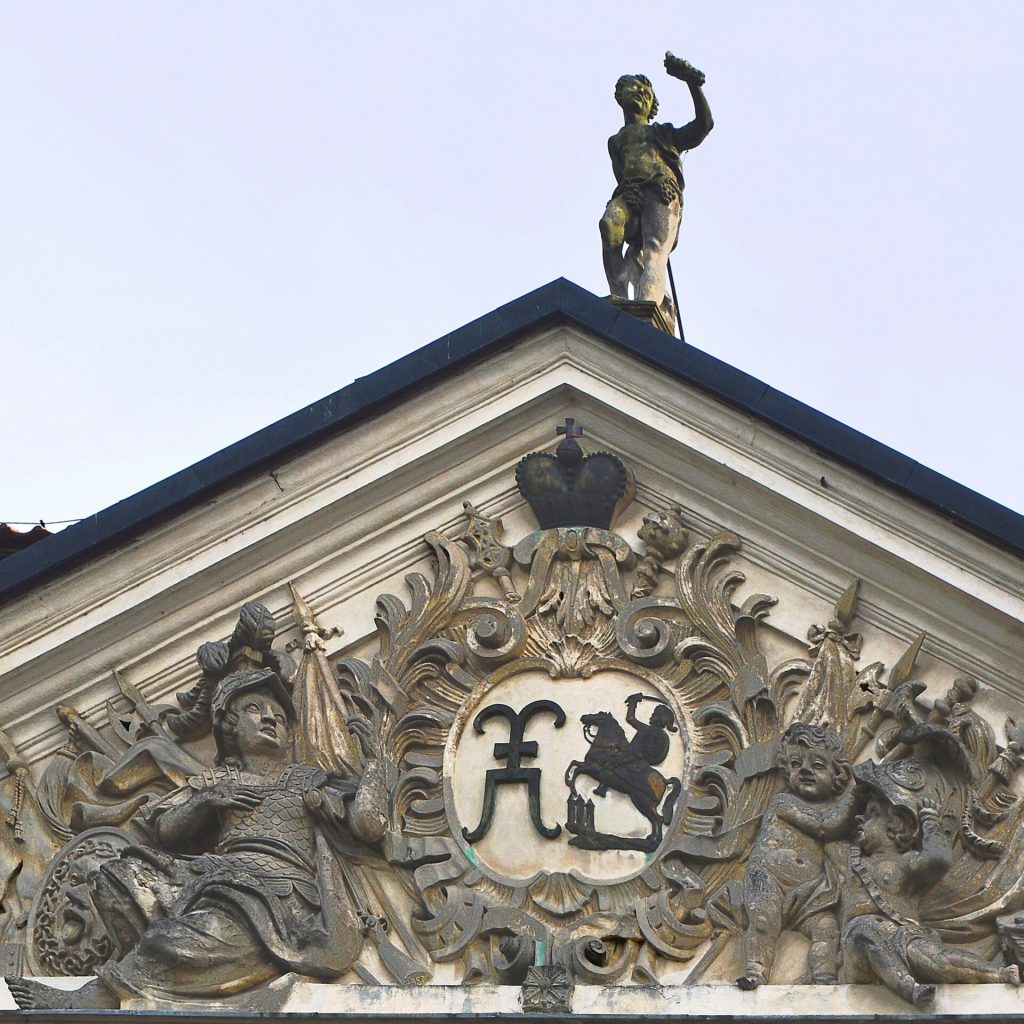
The Radziwill coat of arms can be seen above the entrance and in various places in the palace, a reminder of the family that owned Nieborow for more than a century and a half and shaped its character more than anyone else.
The Radziwills had roots in the Grand Duchy of Lithuania and produced statesmen, soldiers, churchmen and patrons of culture over the centuries. During the nineteenth century, when Poland had lost its independence, aristocratic houses like Nieborow became important guardians of national memory, preserving books, portraits and historical objects at a time when Polish culture was under threat.
During the two world wars the palace faced many dangers, but it survived better than many other aristocratic houses. Its collections were partly protected and later returned, which explains why so much of the original atmosphere remains today.
Helena Radziwill was one of the most remarkable women of her time in Poland. Educated, artistic and sociable, she corresponded with writers and thinkers and gathered around her a circle of friends who shared her love of art and nature. Her influence on both Nieborow and Arkadia gave the estate its distinctive romantic flavour.
Under later generations of the family, the palace became a place where Polish history was collected and remembered, with documents, portraits and mementos of national heroes alongside family keepsakes.
The family was also connected by marriage and friendship to many other great houses of Europe, and visitors to Nieborow over the years included writers, artists, politicians and members of royal families. Each left a small mark on the atmosphere of the house.
A Staircase Clad in Dutch Tiles
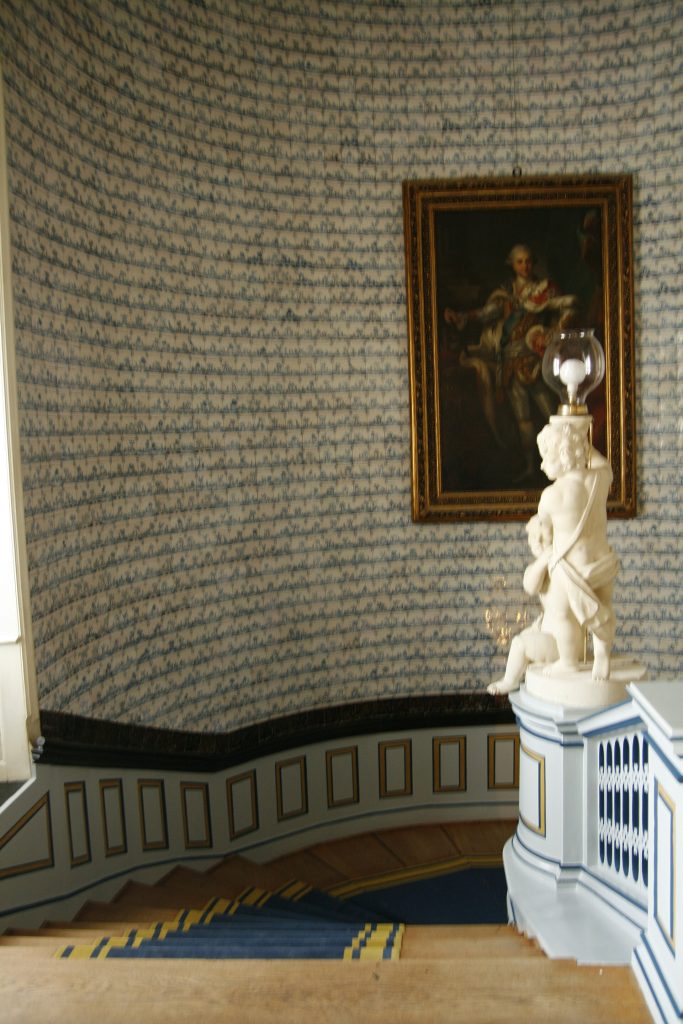
One of the most memorable features of Nieborow is its main staircase. Its walls are covered with thousands of blue and white Dutch tiles from the eighteenth century, creating a shimmering surface of small painted scenes, flowers and ornaments. Climbing these stairs feels a little like walking inside a giant piece of porcelain.
The tiles were imported from the Netherlands, where tile making had reached a high level of artistry. Each one was painted by hand, and if you look closely you will see little landscapes, ships, figures and animals. Some show biblical scenes, others everyday life, with windmills, boats and farmers at work, and spotting your favourite scene is part of the fun.
The choice of Dutch tiles may also be a gentle nod to the origins of the architect, though they were a fashionable luxury throughout northern Europe at the time. Few houses in Poland have such a lavish tiled interior.
The staircase also has a practical elegance. Its proportions are generous, and the light falling from the windows makes the tiles glow. On a sunny day the whole space seems to shimmer, and photographers love to capture the effect.
Restorers have worked carefully to preserve the tiles, replacing damaged ones only where necessary and keeping as many originals as possible, so today you see the staircase much as the Radziwills did. Take your time here, because these tiles reward close looking.
Children often enjoy turning the tiles into a game, counting ships or looking for animals hidden among the patterns. Adults, too, find themselves lingering, discovering small details they missed on the way up.
Few visitors forget their first sight of these walls. The combination of light, colour and craftsmanship creates an atmosphere that is cool and calm, a perfect introduction to the treasures waiting above.
Halls and Drawing Rooms of a Princely Home
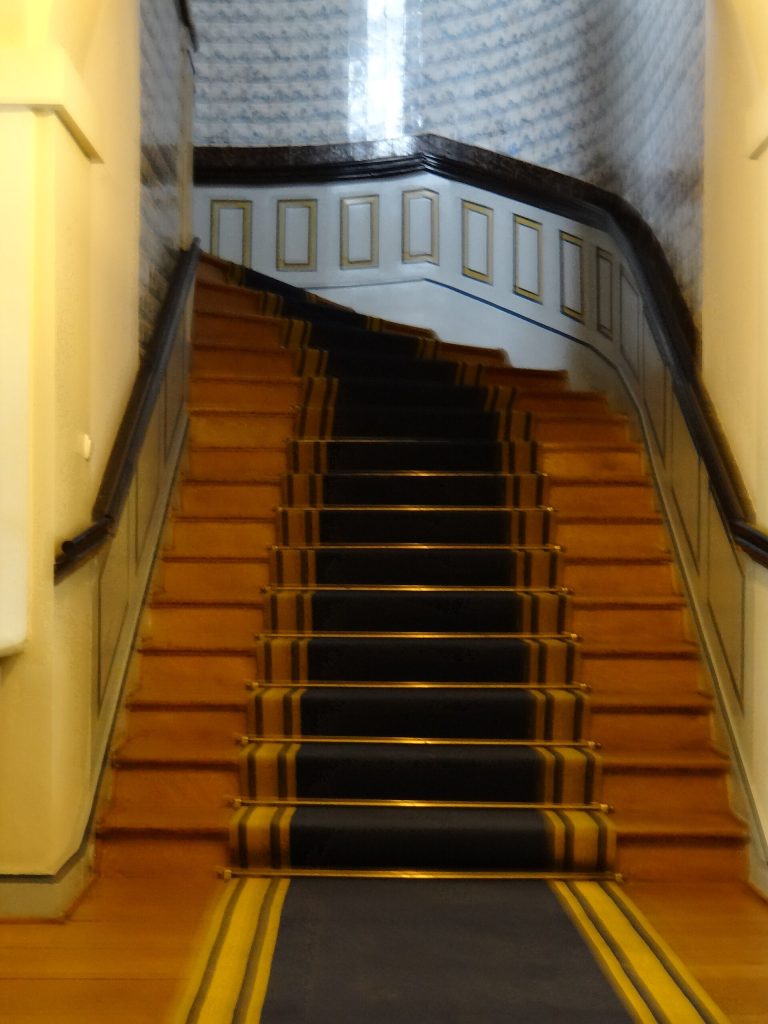
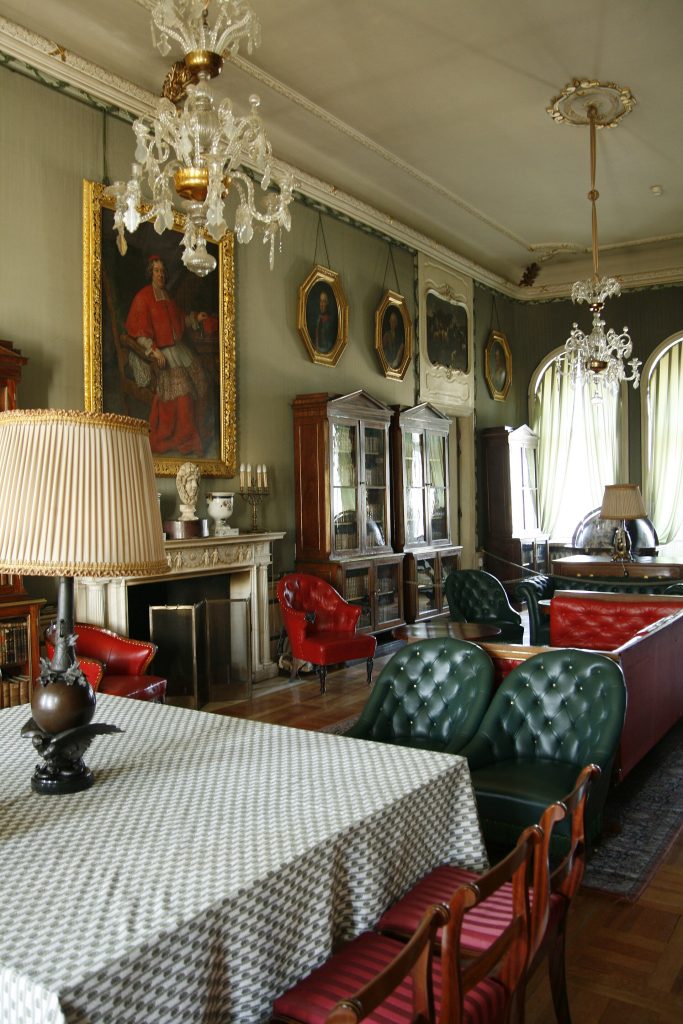
At the top of the stairs, a sequence of rooms opens before you, each furnished as it might have been when the Radziwills lived here. There are drawing rooms with silk walls, dining rooms set with fine porcelain, bedrooms and studies, all filled with paintings, furniture and objects gathered over generations.
The main hall is a dignified space for receiving guests, with portraits of the family looking down from the walls. Other rooms reflect different periods and tastes, from late baroque elegance to the classical restraint of the late eighteenth century and the comfortable style of the nineteenth.
What makes these interiors so special is their authenticity. Much of the furniture and many of the objects belonged to the Radziwills themselves, and because the palace survived the war relatively intact, the rooms retain a genuine sense of a family home.
Several rooms display porcelain, silver and glass, as well as elegant clocks and candelabra. Portraits help you put faces to the names you hear, from stern statesmen in formal dress to elegant ladies and lively children.
The rooms are not roped off from a distance as in some larger museums, so you can often get a close look at the details. Even the floors deserve a glance, with fine parquet and old boards that creak gently underfoot, and this intimacy is why so many visitors leave feeling that they have been guests rather than tourists.
One room displays objects connected with Polish history, a reminder of the role aristocratic families played in preserving national heritage. Another shows the more private side of family life, with smaller furniture, personal belongings and the comfortable clutter of a real home.
Look out for the tiled stoves that once heated the rooms during the cold Polish winters. These beautiful objects, often decorated with painted or glazed tiles, combine practical function with elegance and are a characteristic feature of country houses in this part of Europe.
A Library of Rare Books and Globes
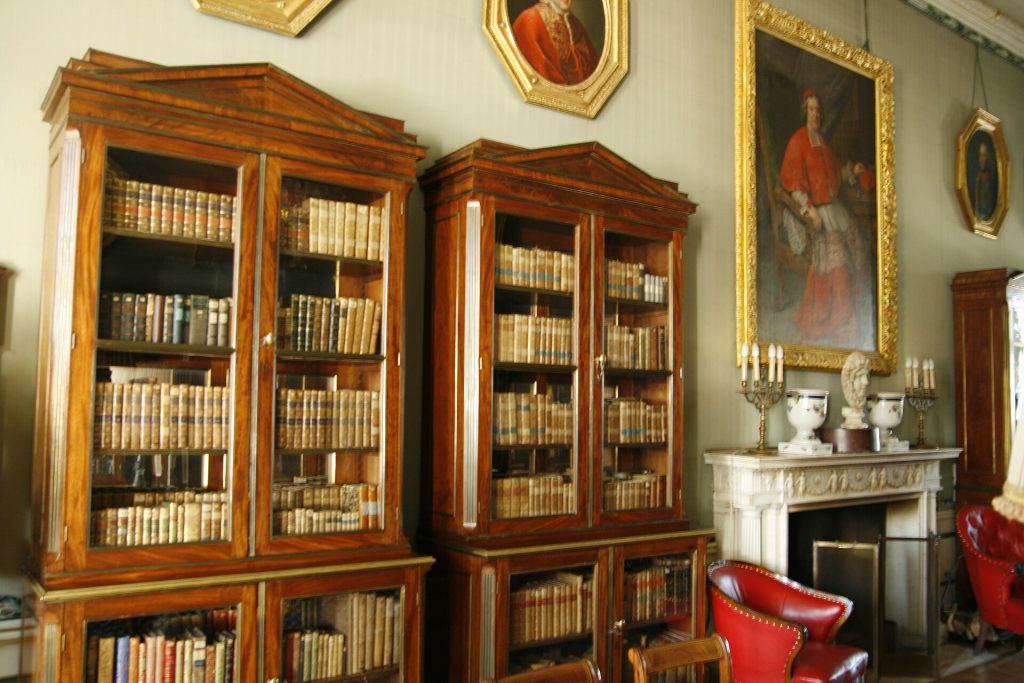
The library is one of the treasures of Nieborow. Its shelves hold thousands of volumes collected by the Radziwills, from old books in many languages to works on history, science, literature and travel. The room has a warm, scholarly atmosphere, with wooden bookcases, desks and comfortable chairs.
Among its most famous objects are two large globes, one terrestrial and one celestial, made in Venice in the late seventeenth century by the celebrated cosmographer Vincenzo Coronelli. The terrestrial globe shows the world as it was known at the time, with some regions still uncertain or imagined, while the celestial globe depicts the constellations as figures from mythology.
The library reflects the intellectual interests of the Radziwill family, who were patrons of learning and the arts. Here they read, wrote letters, studied maps and discussed the ideas of the Enlightenment with visitors.
It also contains manuscripts, maps and family documents, some of which have been studied by historians for what they reveal about aristocratic life, politics and culture in the Polish lands. It is a working memory of the family as much as a showpiece.
In the evening light, with the sun slanting through the windows across the rows of books, the library has an almost magical calm. Book lovers will find it hard to leave.
Many of the books carry the bookplates of their Radziwill owners, and some contain notes written in the margins centuries ago. These small traces of past readers bring the library to life in a way that a modern collection never could.
The room was also a social space. Guests would gather here in the evenings to read aloud, look at engravings or examine the globes, turning learning into a shared pleasure that was very much part of aristocratic culture in the eighteenth century.
The Head of Niobe and Other Treasures
Among the many works of art at Nieborow, one has achieved almost legendary status in Poland. It is an ancient Roman marble head, believed to depict Niobe, the queen of Greek myth who lost her children as punishment from the gods. Her face, turned slightly upward in sorrow, has a haunting beauty that moves almost everyone who sees it.
In the myth, Niobe boasted of her many children and mocked the goddess Leto, who had only two. In revenge, Apollo and Artemis killed her children, and Niobe wept so endlessly that she was turned to stone. The marble head captures that moment of grief with extraordinary power.
The head has been at Nieborow for generations. In the twentieth century it inspired the poet Konstanty Ildefons Galczynski, who wrote a celebrated poem about it after visiting the palace. Since then the Niobe of Nieborow has become a symbol of the house and one of the most beloved artworks in Polish culture, and some visitors come specifically to see it.
The palace also contains a fine collection of paintings, sculptures and decorative arts by Polish and European artists, many from the Radziwill collections, others gathered from aristocratic houses after the war. Ask the guides about the Niobe and the poem it inspired, a lovely example of how one object can connect ancient myth, aristocratic collecting and modern poetry.
The poem is still read and recited across Poland, and it has helped make Nieborow a place of pilgrimage for lovers of literature. Standing before the marble face, many visitors fall silent, touched by grief carved in stone two thousand years ago.
Other sculptures in the collection include classical busts and reliefs, some ancient and some later copies, which reflect the passion of eighteenth century collectors for the art of Greece and Rome. Together they give the interiors a quiet classical dignity.
The Nieborow Majolica Workshop
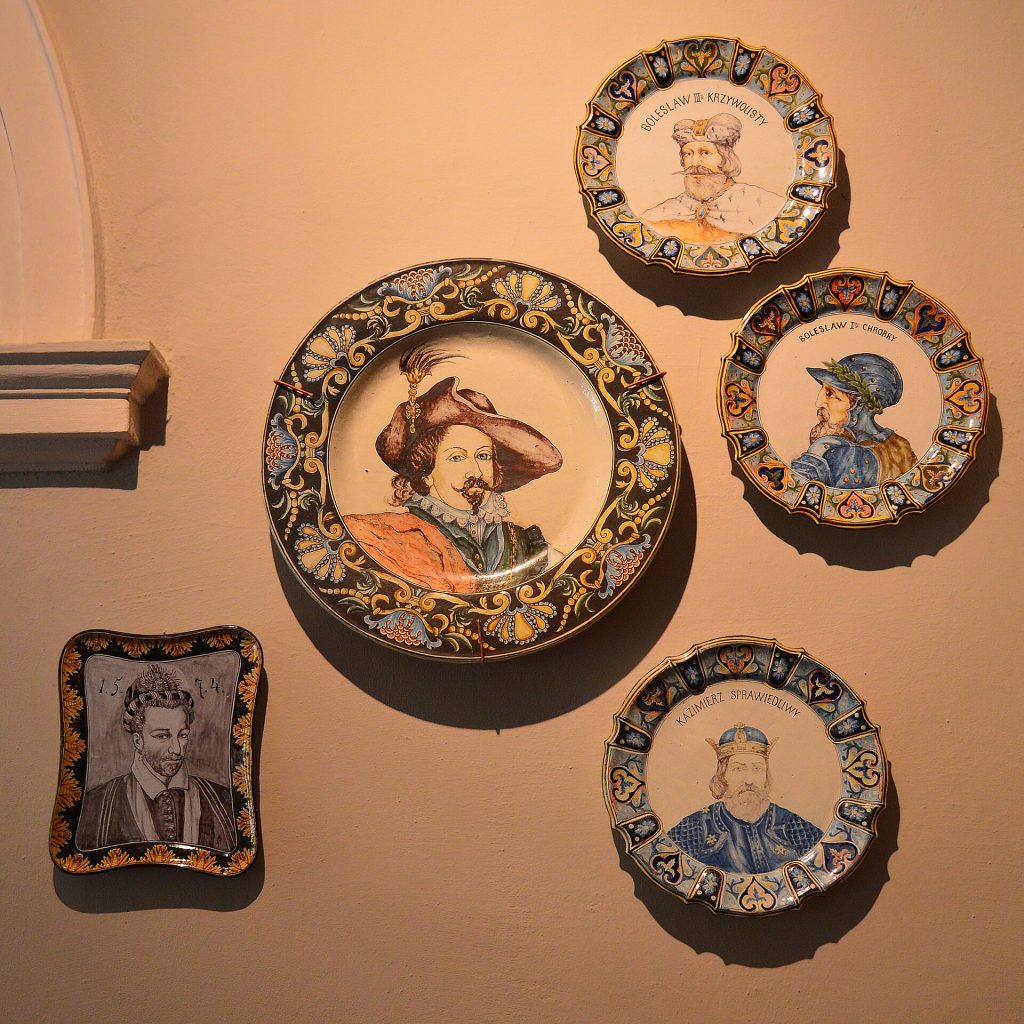
In the late nineteenth century, a member of the Radziwill family founded a majolica workshop at Nieborow. Majolica is colourfully glazed earthenware, and the products of the Nieborow workshop became prized for their bright colours, bold patterns and fine craftsmanship.
The workshop produced plates, vases, tiles and decorative pieces in a variety of styles, some inspired by Renaissance Italian ceramics with mythological scenes, others by folk art and the decorative movements of the late nineteenth century. It operated for about a quarter of a century before closing in the early twentieth century, and its pieces are now valued by collectors.
Examples of Nieborow majolica can be seen in the palace, and they add a cheerful note to the collections. Their vivid colours make a striking contrast with the cool blue and white of the Dutch tiles on the staircase.
The workshop also produced architectural ceramics, some of which can still be found in buildings around the region. It reflects the Radziwill interest in supporting local crafts, as well as their love of beautiful objects, and it is one of the more unexpected stories that Nieborow has to tell.
If you are interested in ceramics, look out for the marks and signatures on the pieces, which help identify their origin and date. Collectors prize the rare examples that appear on the market, and museums in Poland hold some of the finest pieces.
The bright glazes of greens, yellows and blues were achieved through careful firing techniques, and the workshop employed skilled local artisans who passed their knowledge on to later generations.
Helena Radziwill and the Dream of Arkadia
No visit to Nieborow is complete without hearing about Arkadia, the romantic garden created by Helena Radziwill a few kilometres away. Inspired by the idea of a lost golden age of happiness and harmony, she designed a landscape park filled with temples, ruins, grottoes and pavilions, scattered among lakes, meadows and groves.
Arkadia was one of the most celebrated landscape gardens in eighteenth century Poland. Every building and view was designed to evoke an emotion, from joy to melancholy, and the garden was meant to be experienced as a poetic journey. Highlights include a Temple of Diana, a Gothic house, an amphitheatre and an island of poplars, many incorporating genuine fragments brought from older buildings.
Helena often invited guests to Arkadia, where they would wander among the temples and ruins, reading poetry and contemplating the passage of time. It was a world of sentiment and imagination, very different from the formal grandeur of baroque gardens.
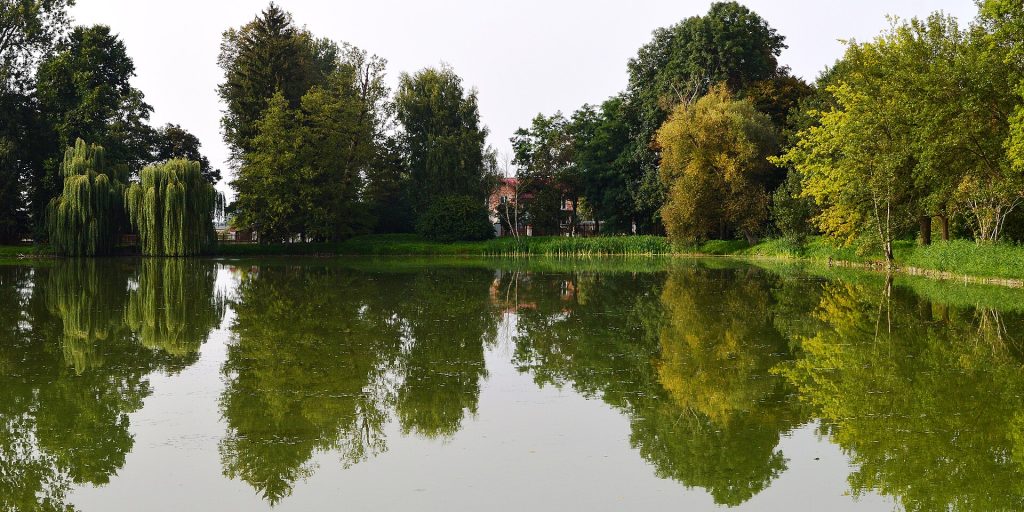
The palace park at Nieborow itself also has great charm, with its lake, old trees and quiet paths. Today Arkadia and Nieborow are managed together, and Arkadia can be reached by car, bicycle or even on foot. Allow an hour or two to wander its paths and discover its hidden corners.
Visiting Arkadia after Nieborow is like moving from prose to poetry. Where the palace speaks of order, learning and family, the garden speaks of emotion, memory and longing, and together they reveal the full range of the aristocratic imagination in the age of the Enlightenment.
The Formal Garden and Its Sculptures
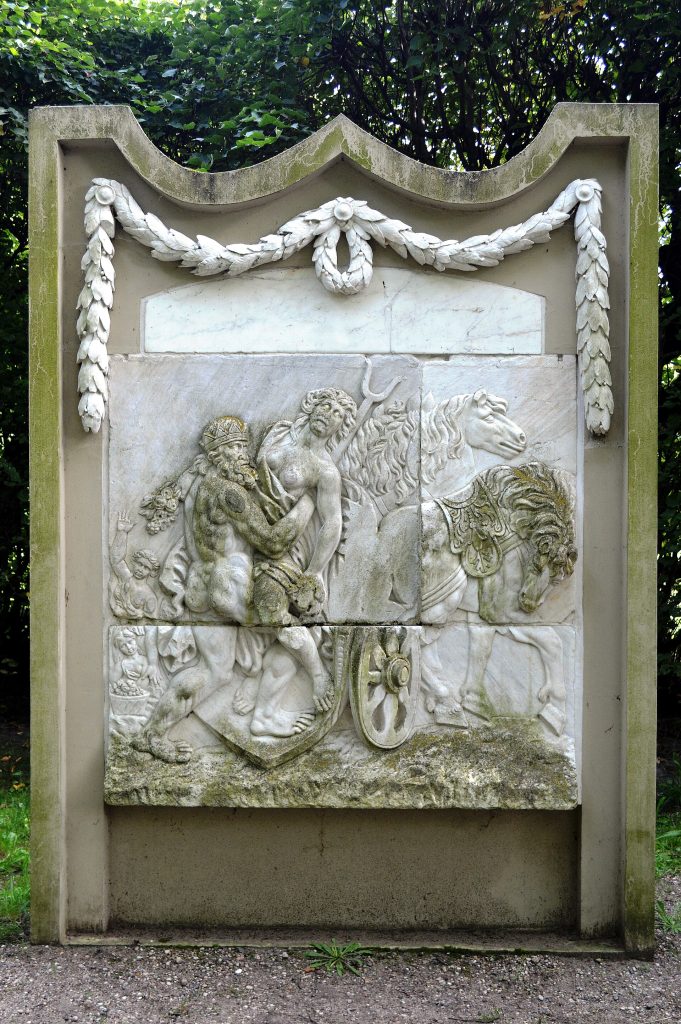
Behind the palace lies a formal garden in the French style, laid out with geometric beds, clipped hedges and straight avenues of lime trees. It reflects the baroque ideal of order and symmetry, extending the architecture of the house into the landscape.
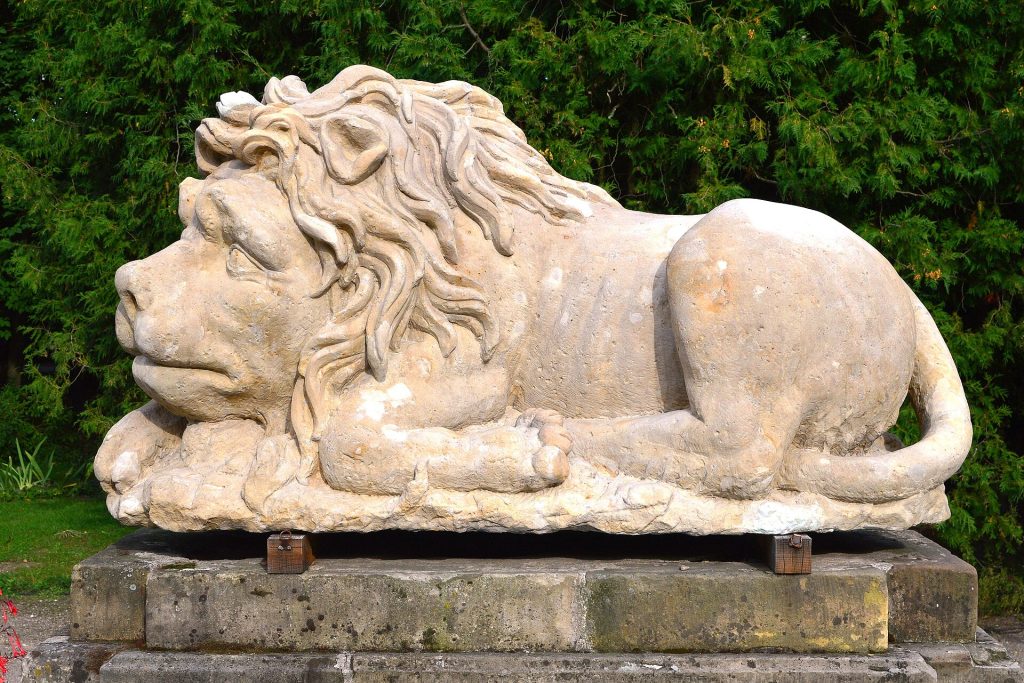
Scattered through the garden are sculptures, including classical figures and stone lions that guard paths and steps. They give the garden a sense of history and grandeur, and their weathered surfaces make wonderful subjects for photographs.
The lime avenues are especially beautiful in early summer, when they are in flower and fill the air with sweet fragrance. In autumn they turn golden, and in winter their bare branches create dramatic patterns against the sky.
The garden has been restored in recent decades to bring back its original layout, based on careful research into historic plans. In the warmer months it is a lovely place for a picnic or a quiet rest on a bench, and looking back at the palace you can appreciate how carefully Tylman and his successors planned the relationship between building and landscape.
Photographers will find many good angles here, from the long perspectives of the lime avenues to close ups of sculptures and reflections of the palace in the water. Early morning and late afternoon light are especially kind to the old stone.
Along the edges of the garden, look for old trees that may have been planted in the time of the Radziwills. Their great trunks and spreading crowns are living links to the people who once walked these same paths.
Nieborow on Film
To get a feel for the atmosphere of Nieborow before you visit, the video below takes you around the palace, its interiors and its gardens. It is a lovely way to preview the tiled staircase, the library and the park.
As you watch, notice how the palace sits in its landscape and how the interiors preserve the character of a family home. Seeing the house in motion also helps you appreciate its scale, neither too large nor too small, a perfectly proportioned home that balances grandeur with comfort.
Pay attention to the light in the interiors, which changes beautifully through the day and gives the rooms much of their warmth.
If the video tempts you to go, the final section covers practical tips for planning your visit.
Visiting Nieborow Today
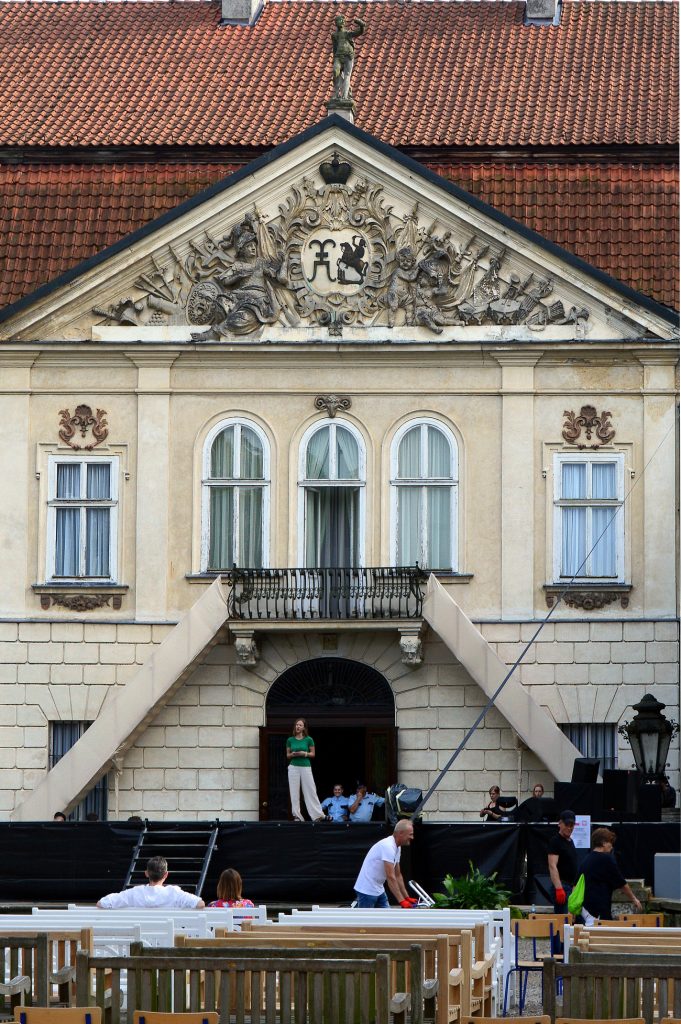
After the Second World War the palace was taken over by the state, and since 1945 it has been a branch of the National Museum in Warsaw. Thanks to this, its interiors and collections have been carefully preserved, and Nieborow is one of the best places in Poland to experience an aristocratic country house as it once was.
Nieborow lies in the Lodz Voivodeship, near the town of Lowicz, about 80 kilometres west of Warsaw. It is easy to reach by car, and there are train connections to Lowicz, from where local buses or taxis can take you on to the palace and Arkadia.
The palace interiors can be visited with a ticket, and the gardens and park are open for walking. Opening times vary by season, so check the current schedule before you set out. Plan at least half a day if you want to see both Nieborow and Arkadia at a relaxed pace.
The palace also offers accommodation in some of its buildings and hosts concerts, cultural events and gatherings of writers and artists, continuing its long tradition of hospitality.
Lowicz itself is well worth a visit, famous for its vibrant folk costumes, paper cut outs and embroidery, and for its colourful Corpus Christi processions. Combining Nieborow, Arkadia and Lowicz makes for a rich and varied day out. Bring comfortable shoes, wander slowly, and let the peaceful atmosphere of this old estate work its quiet magic.
Whenever you choose to come, Nieborow offers a gentle, unhurried experience. It is a place to slow down, look closely and enjoy the quiet beauty of a house that has been loved and cared for over many generations.
View the location on Google Maps
Palaces Nearby
If Nieborow has charmed you, Poland is rich in princely residences. Here are two more remarkable palaces well worth adding to your journey:
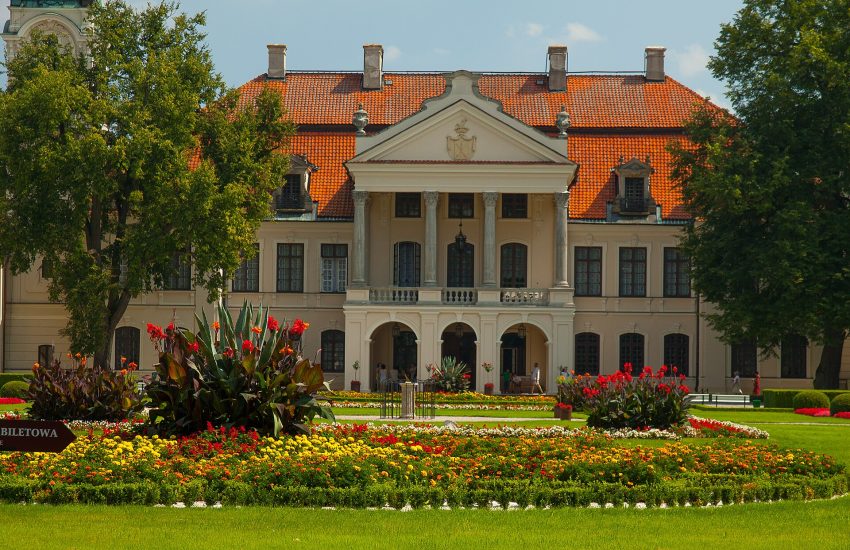
- Kozlowka Palace – the Zamoyski palace near Lublin, crowded with a thousand paintings and crowned by a chapel modelled on Versailles.
- Rogalin Palace – the Raczynski seat near Poznan, with a celebrated picture gallery and the legendary ancient oaks.
You May Like
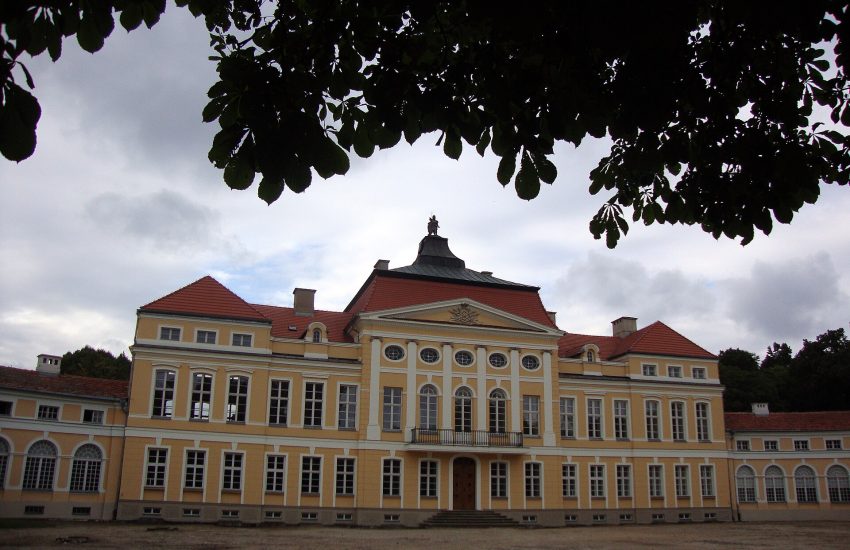
Rogalin Palace and the Ancient Oaks of the Raczynski Family


2 thoughts on “Nieborow Palace and the Radziwill Treasures of Central Poland”