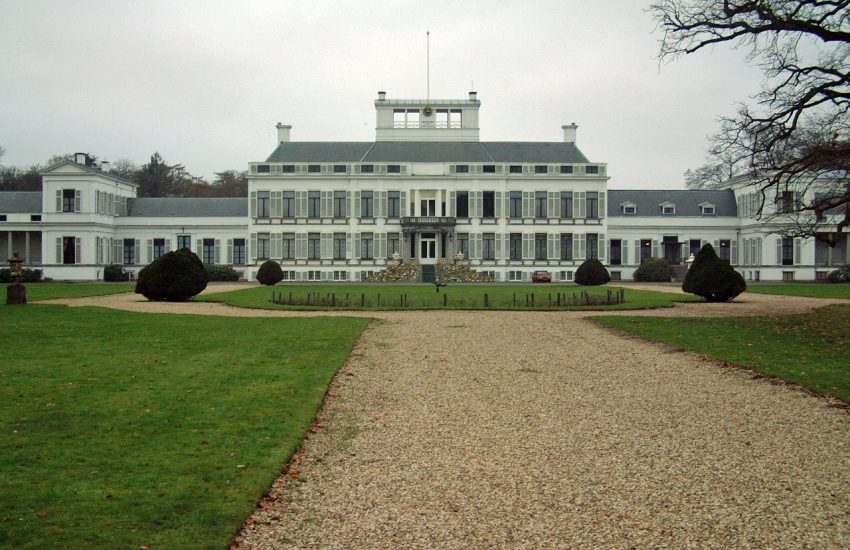
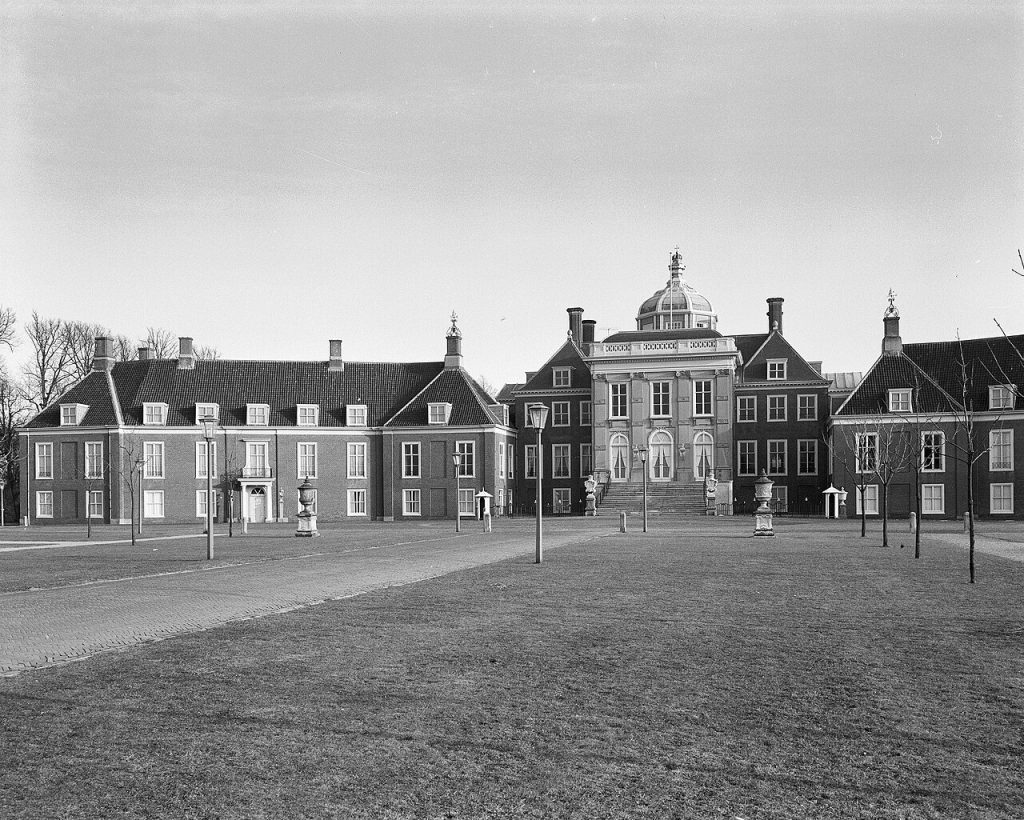
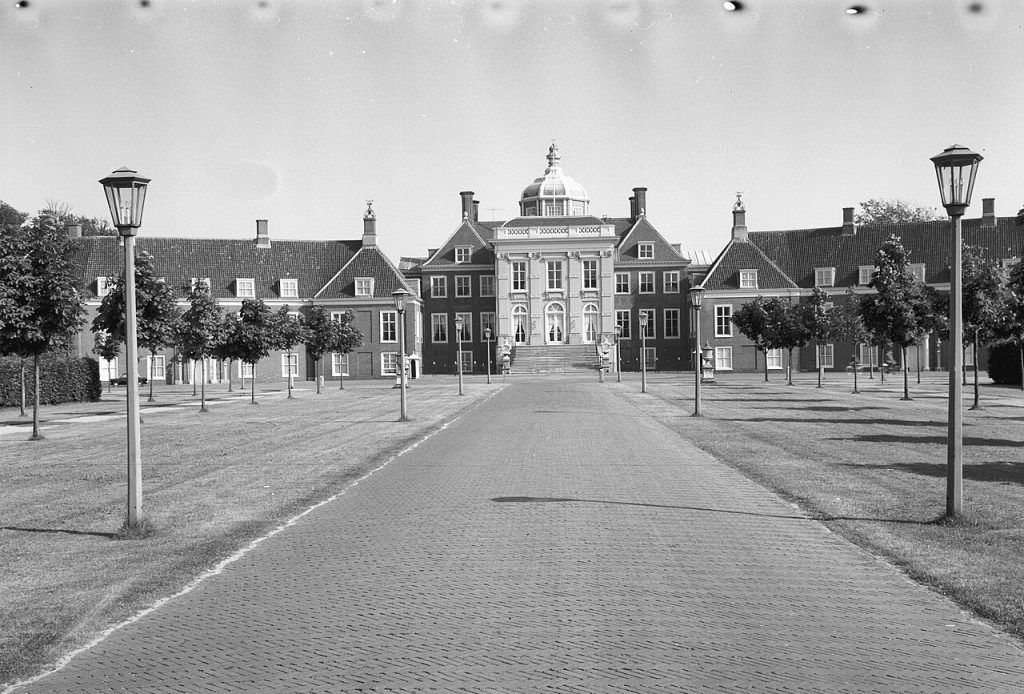
Now, stop at the gate and look down the avenue, because the approach is the argument. Huis ten Bosch does not sit on a square or dominate a city skyline. It stands at the end of a straight cut through the Haagse Bos, a working forest in the middle of The Hague, and the trees do most of the ceremonial work that columns would do elsewhere.
This is the only palace in this series that began as a monument to a dead man. The woman who built it had just lost her husband, and she turned the central hall of her new country villa into a painted memorial so overwhelming that visitors still fall silent in it. Everything else here grew around that room.
It is also, unlike most palaces you can read about, a working home. The king of the Netherlands lives here. That single fact changes what you can see, what you can photograph, and what the building means. You are looking at an address, not an exhibit.
- Amalia van Solms and a Widow’s Commission
- Why a Palace in a Forest
- Pieter Post and the Dutch Classical Style
- The Oranjezaal and Its Painted Walls
- The Painters Who Worked in Shifts
- The Wings That Doubled the House
- The French Years and the Napoleonic Turn
- The Peace Conference That Met Here
- War, Damage and the V2 Launch Sites
- Beatrix and the Long Restoration
- A King Moves In
- The Gardens and the Public Forest
- What You Can Actually See
Amalia van Solms and a Widow’s Commission
Amalia van Solms arrived in the Netherlands as a lady-in-waiting and ended as the most powerful woman in the republic. She married Frederick Henry, prince of Orange, in 1625, and over the next twenty years she turned the Orange court into something that could hold its own with the courts of France and England.
In 1645 she bought land in the Haagse Bos and began a country house. Her husband died in 1647, before it was finished, and the project changed character immediately. The house became a memorial, and its central hall became the stage on which Frederick Henry’s achievements would be painted, floor to ceiling, for anyone who entered.
Keep her in mind as you look at the building. Nothing about it is accidental. A woman who knew exactly how political reputations were made commissioned every square metre.
Why a Palace in a Forest
The Haagse Bos was hunting ground belonging to the counts of Holland, and building in it was a statement about status. But there is a practical logic too. The Hague was the seat of government, not a royal capital, and the Orange family were stadtholders, not kings. A palace in the middle of town would have looked like a claim nobody had agreed to.
A villa in the woods, fifteen minutes from the political centre, solved the problem elegantly. It was grand without being constitutional. Several Dutch royal buildings follow that same careful logic, and it is one of the reasons the monarchy survived into the modern era without the resentment that attached to grander houses elsewhere.
Notice the trees as you walk. Much of the Haagse Bos is public, and the palace sits inside it like a clearing that happens to contain a state.
Pieter Post and the Dutch Classical Style
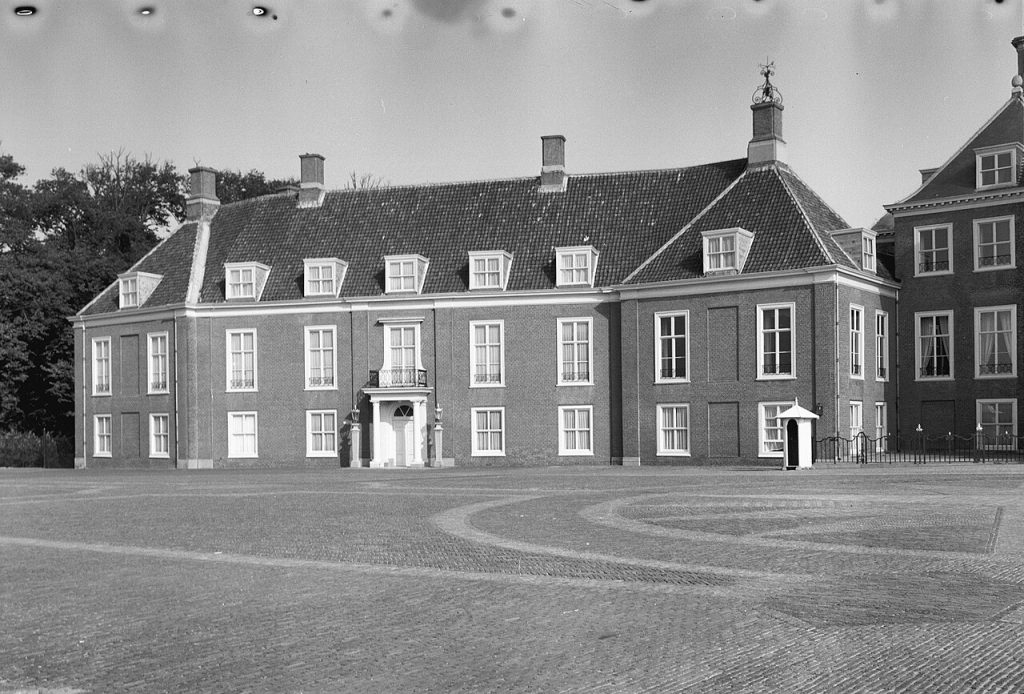
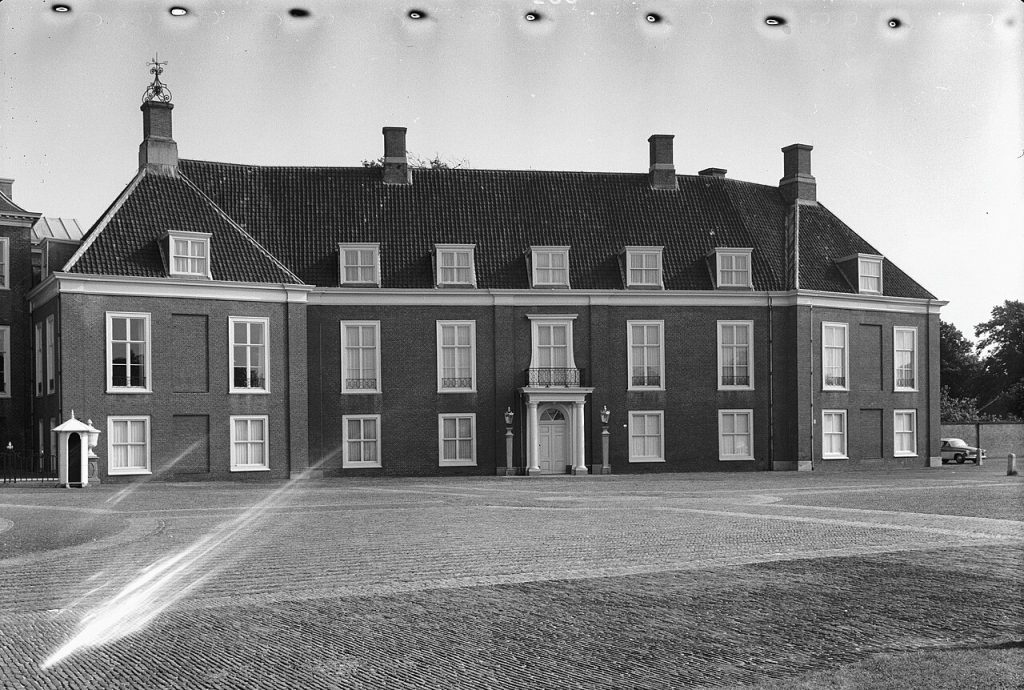
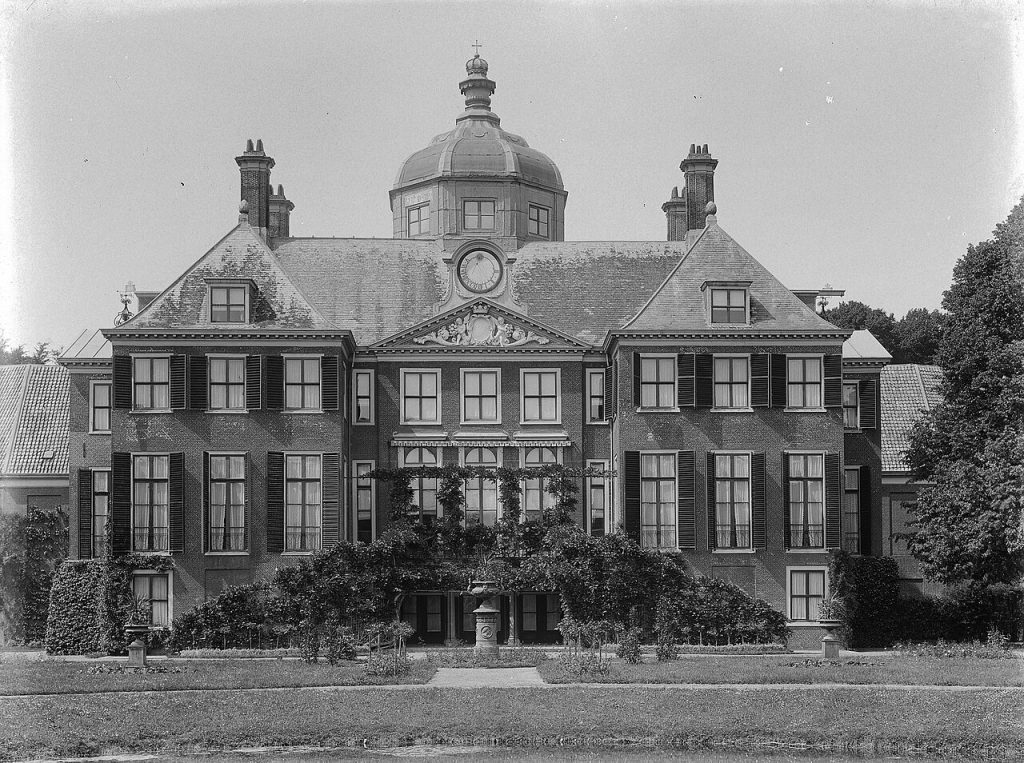
The architect was Pieter Post, working from designs associated with Jacob van Campen, the man who built Amsterdam’s city hall. What they produced is the clearest statement of Dutch classicism you will find: brick and stone, pilasters, a central dome over a cross-shaped hall, and almost no decorative excess.
Look at the proportions rather than the ornament. The building works because the parts relate to each other in simple ratios, not because anything is carved. That restraint is a deliberate Protestant and republican choice, and it reads as modern three and a half centuries later.
Then step inside the central hall and watch the restraint collapse entirely.
The Oranjezaal and Its Painted Walls
The Oranjezaal, the Orange Hall, is the reason this palace matters to art history. It is a tall cross-shaped room rising through the centre of the house, and every wall and the full height of the vault are covered with painted canvases forming one continuous programme.
The subject is Frederick Henry: his campaigns, his virtues, his triumph, his apotheosis. The scheme was designed by Constantijn Huygens, the polymath secretary of the Orange court, and it was executed between 1648 and 1652, in the years immediately after the prince’s death and the Peace of Westphalia.
Stand in the middle and turn slowly. Baroque painted rooms usually sit above you, decorating a ceiling. This one surrounds you at eye level and keeps going upward, so the effect is less like admiring a ceiling and more like standing inside an argument.
The Painters Who Worked in Shifts
No single artist could have done it. Huygens assembled a team drawn from both the Dutch Republic and the southern Netherlands, including Jacob Jordaens from Antwerp, who painted the enormous triumph scene, alongside Dutch painters such as Caesar van Everdingen, Jan Lievens and Gerard van Honthorst.
The mixture is politically remarkable. Catholic Flemish painters from the territory the Dutch had been fighting worked on a memorial to the man who fought them, commissioned by his widow, in the years when the war finally ended. Art historians have been arguing about what that means ever since.
Look for the seams where styles meet. Jordaens is heavy, warm and physical; the Dutch painters are cooler and more precise. The room does not quite resolve into one voice, and it is better for it.
The Wings That Doubled the House
Amalia’s villa was compact. The palace you see now is not, because Daniel Marot added wings in the early eighteenth century, giving the building the long frontage it has today and turning a country retreat into something that could house a court.
Marot was a Huguenot who had fled France, bringing the vocabulary of Versailles with him, and his work here is the point where Dutch restraint takes on a French accent. Compare the wings with the central block and you can see the shift: more movement, more emphasis, more willingness to perform.
The addition also tells you about the Orange family’s trajectory. By the eighteenth century they were no longer merely first citizens of a republic. They were building for the possibility of a crown, which arrived in 1815.
The French Years and the Napoleonic Turn
In 1795 the French arrived, the stadtholder fled to England, and the palace entered a strange period. The revolutionary Batavian Republic briefly considered turning it into a national museum, which would have made it one of the first public art museums in Europe.
Instead, under Louis Bonaparte, installed by his brother as king of Holland, it became a royal residence again. The furniture of the period that survives in the palace dates from this Napoleonic interlude, and it is a reminder that Dutch royal taste has French as well as German and Russian layers.
When the Orange family returned in 1813, they inherited a house that had been emptied, refilled, renamed and reinterpreted within twenty years. Palaces absorb regime change more easily than people do.
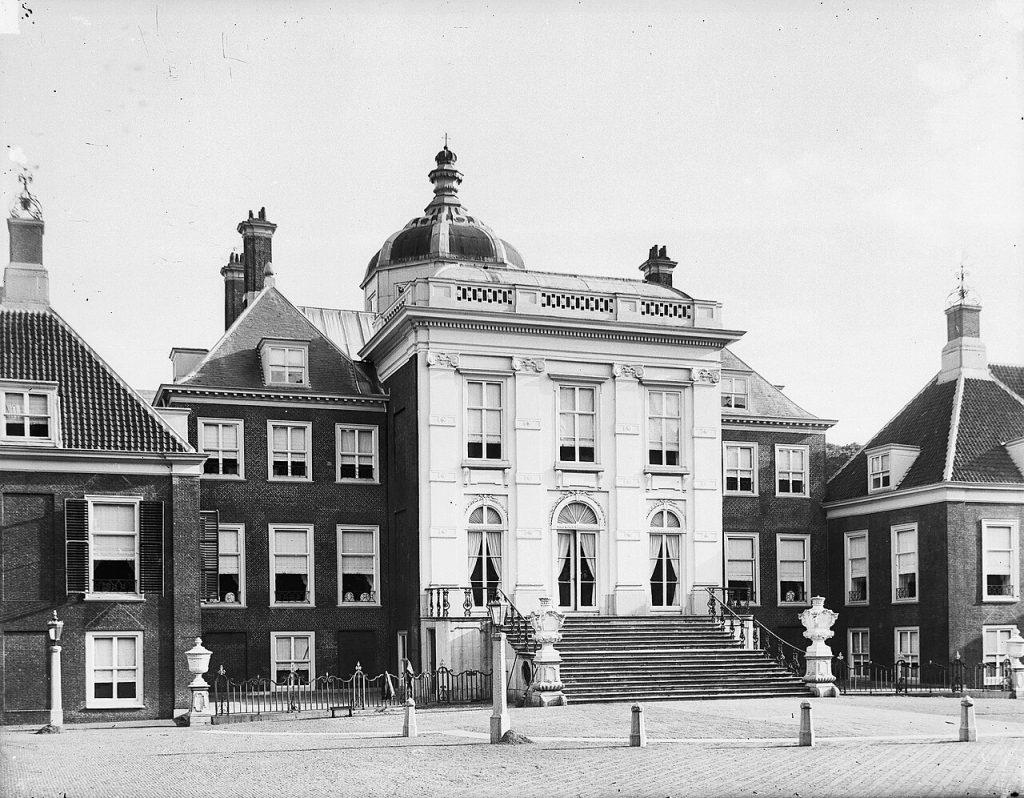
The Peace Conference That Met Here
In 1899 the first Hague Peace Conference met in the Oranjezaal. Delegations from twenty-six states sat under paintings celebrating a seventeenth-century warlord and negotiated the laws of war, arbitration and disarmament.
The irony was noted at the time. It was also, in a sense, the point: the Dutch offered a room saturated in the memory of conflict as the setting for an attempt to limit it, and the conventions agreed there became part of the foundation of modern international law.
The conference led directly to the Permanent Court of Arbitration and, a decade later, to the Peace Palace a few kilometres away. The Hague’s identity as a city of international justice starts in this painted hall.
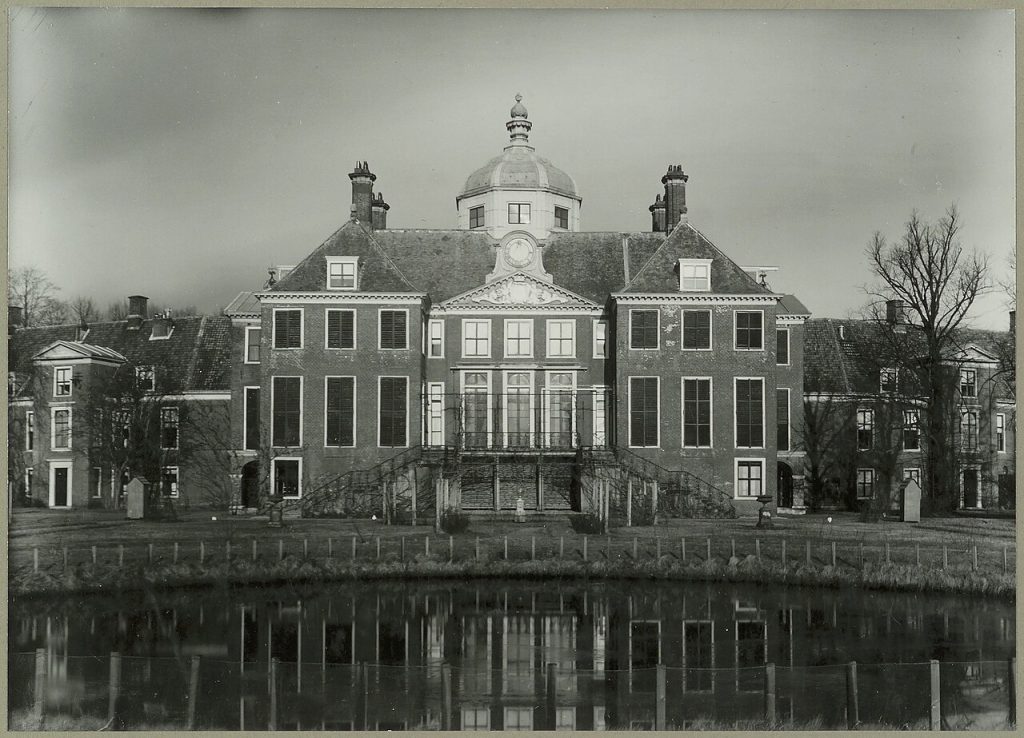
War, Damage and the V2 Launch Sites
The Second World War came closer to this building than to any other palace in the Netherlands. The Germans used the Haagse Bos as a launch area for V2 rockets aimed at London, and Allied bombing aimed at those sites fell near the palace. Blast damage, looting and neglect left it in poor condition by 1945.
There was serious discussion about demolishing it. The roof was failing, the canvases of the Oranjezaal had been removed for safekeeping, and the Dutch state had a country to rebuild. What saved it was precisely that painted hall: you cannot demolish a building that contains a national monument you have already evacuated for protection.
Restoration ran through the late 1940s and 1950s. The paintings came back. The building became a palace again rather than a ruin in a bombed wood.
Beatrix and the Long Restoration
Queen Beatrix made Huis ten Bosch her home from 1981 until her abdication in 2013, and during those decades the palace functioned as both residence and workplace. She received ministers here, worked in a study here, and raised three sons on the estate.
It was in this period that the Oranjezaal underwent its great modern restoration, a project running from 1998 to 2001 that removed centuries of varnish and overpaint. The results changed how the room is understood. Colours that had gone brown turned out to be blue and silver.
Conservation at that scale is slow, expensive and invisible in photographs taken from outside. Most of what has happened to this palace in living memory has been maintenance of that kind.
A King Moves In
When Willem-Alexander became king in 2013, the plan was to move into Huis ten Bosch. The move took six years. The building required a thorough renovation of services, security, insulation and layout, work that ran from 2014 to 2018 and cost a sum that was debated in parliament and in the press.
The family moved in during early 2019, and the palace became the primary royal residence again, with Queen Maxima and their three daughters. Noordeinde Palace in the city centre remains the working office; this is where they live.
That is why your visit will be a view from outside. A palace that is occupied is not a museum, and the Dutch state is noticeably firm about the difference.

The Gardens and the Public Forest
The palace gardens combine a formal section near the building with an English landscape park beyond, and the whole sits inside the Haagse Bos, which is open to the public. That combination produces an unusual effect: you can walk in a forest that belongs to the city and see, through the trees, the home of the head of state.
The forest itself is worth the trip. It is old, it is flat, it is threaded with cycle paths, and on a weekday morning it belongs to joggers and dog walkers rather than tourists. Follow the main avenue toward the palace until the barriers stop you, then take the side paths east.
In spring there are bluebells and birdsong a few hundred metres from a motorway. The Dutch are very good at this kind of compressed landscape.
What You Can Actually See
Be realistic about this before you travel. The palace interior, including the Oranjezaal, is not open to general visitors. It opens occasionally for special events, restorations and press occasions, and announcements come at short notice.
What you can do is walk the forest, see the exterior from the approach, and then go and see the Orange story told properly elsewhere in The Hague: the Mauritshuis for the painting, Noordeinde for the working palace, the Peace Palace for what the 1899 conference started.
Think of Huis ten Bosch as the centre of a circle rather than a destination in itself. The city around it explains it better than a ticket would.
Visiting Huis ten Bosch Today
Huis ten Bosch stands in the Haagse Bos on the eastern side of The Hague, about twenty-five minutes on foot from Den Haag Centraal station and a few minutes by tram or bus toward Bezuidenhout. The forest entrances are well signposted and free to enter.
The palace itself is the residence of King Willem-Alexander and is closed to the public. Do not plan a trip around getting inside; plan it around the forest walk, the approach avenue and the surrounding museums. Security staff are present and photography of gates and personnel is discouraged.
Go early in the morning for the best light down the avenue, and combine the visit with Noordeinde Palace gardens, which are open daily, and the Mauritshuis in the centre. Find it here: https://www.google.com/maps?q=52.0944,4.3419
Palaces Nearby
You May Like
Soestdijk Palace and the Royal Family That Lived Quietly