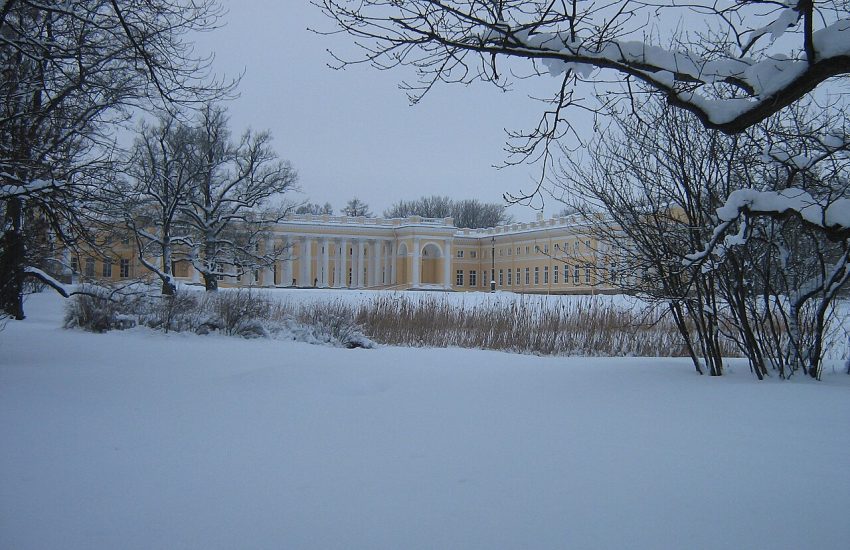
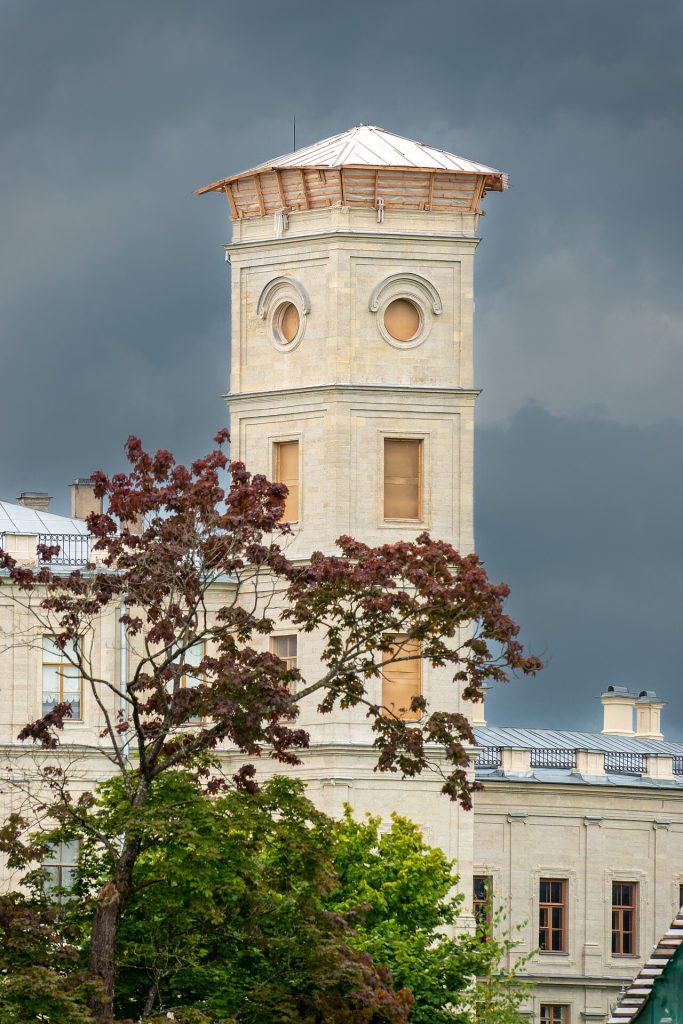
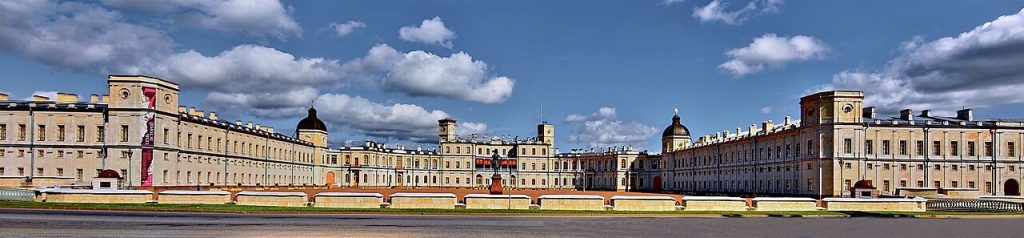
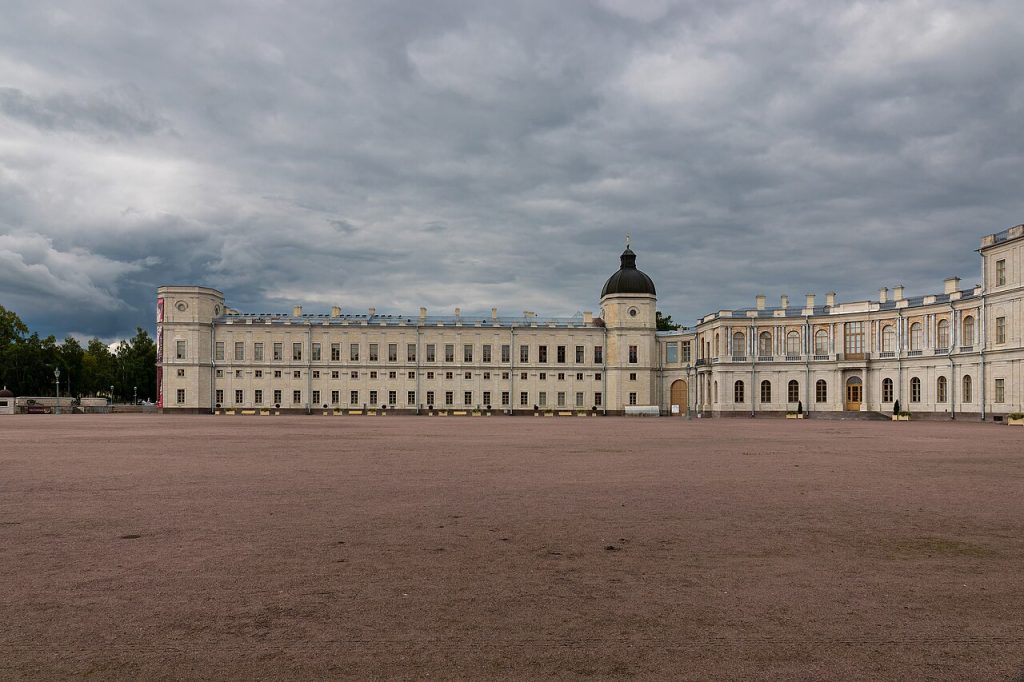
Forty-five kilometers south of St Petersburg, beyond the polished suburbs of Tsarskoye Selo and Pavlovsk, stands the strangest of the imperial residences. Gatchina is a palace pretending to be a castle: nine hundred rooms behind austere walls of local limestone, two pentagonal towers, a moat-like ditch, and an underground passage running from the state rooms to a grotto on the lake. No other Romanov home looks anything like it.
The estate began as Catherine the Great’s gift to her favorite, Count Grigory Orlov, whose architect Antonio Rinaldi built the castle-palace between 1766 and 1781. After Orlov’s death Catherine bought it back for her son Paul, and Gatchina became the obsession of Russia’s most eccentric emperor, then the fortress-refuge of Alexander III, the tsar who felt safe nowhere else.
This guide explores the palace’s military theater and hidden passages, the parks laid around a chain of lakes so clear they were called Gatchina’s mirrors, the priories and pavilions, the estate’s dramatic twentieth century, and everything you need to plan the trip south from St Petersburg.
- A Reward for a Favorite
- Rinaldi’s Castle Palace
- Paul’s Private Kingdom
- The Gatchina Garrison
- State Rooms Behind Stone Walls
- The Underground Passage
- Lakes and Parks
- The Priory Palace
- Alexander III’s Fortress Home
- Last Years of the Old Regime
- Museum, War and Ruin
- The Long Rebirth
- Gatchina Today
- Watch Gatchina Palace on Film
- Visiting Gatchina Palace Today
- Palaces Nearby
A Reward for a Favorite
Grigory Orlov had done Catherine the Great the greatest of services: he and his brothers organized the coup of 1762 that put her on the throne. Among her rewards was the Gatchina estate, bought for him in 1765, a tract of forest and lakes south of the capital that had once belonged to Peter the Great’s sister.
Orlov was a hunter, and Gatchina’s woods were its first attraction; the estate became a hunting seat on a princely scale. But the count also shared his empress’s building ambitions, and the palace he commissioned was designed from the start to astonish, a residence in the guise of an English castle, the first of its kind in Russia.
Catherine visited often during the fifteen years of construction, and the orangeries, the park, and the hunting lodge entertained the court’s inner circle. When Orlov died in 1783, two years after his castle was finished, the empress bought Gatchina from his heirs and immediately regifted it, with pointed irony, to the son who hated her favorites: the Grand Duke Paul.
Rinaldi’s Castle Palace
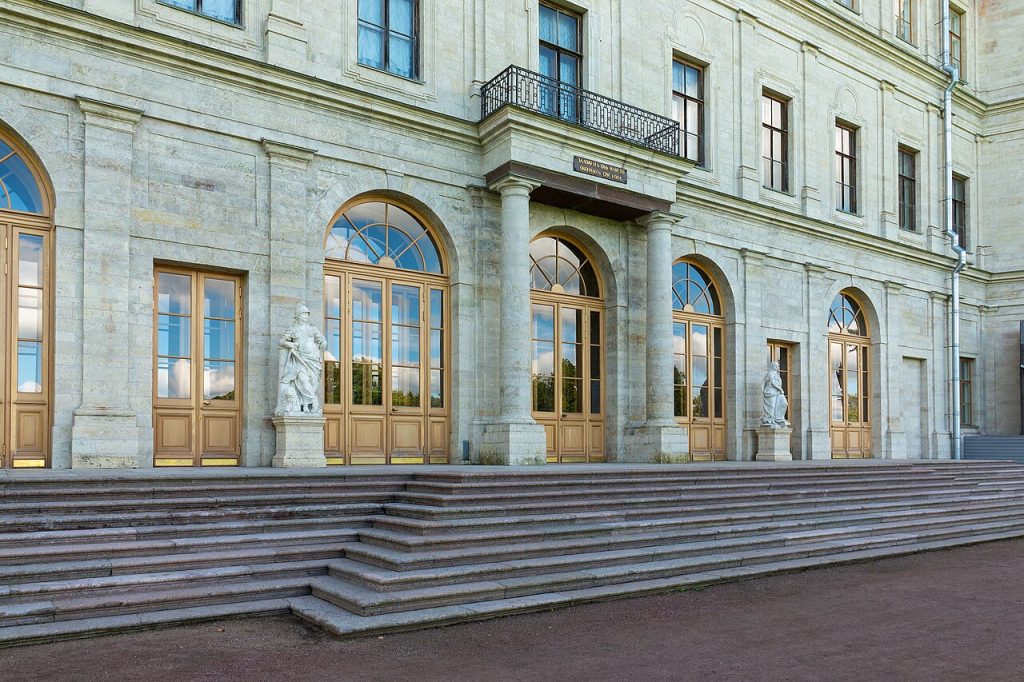
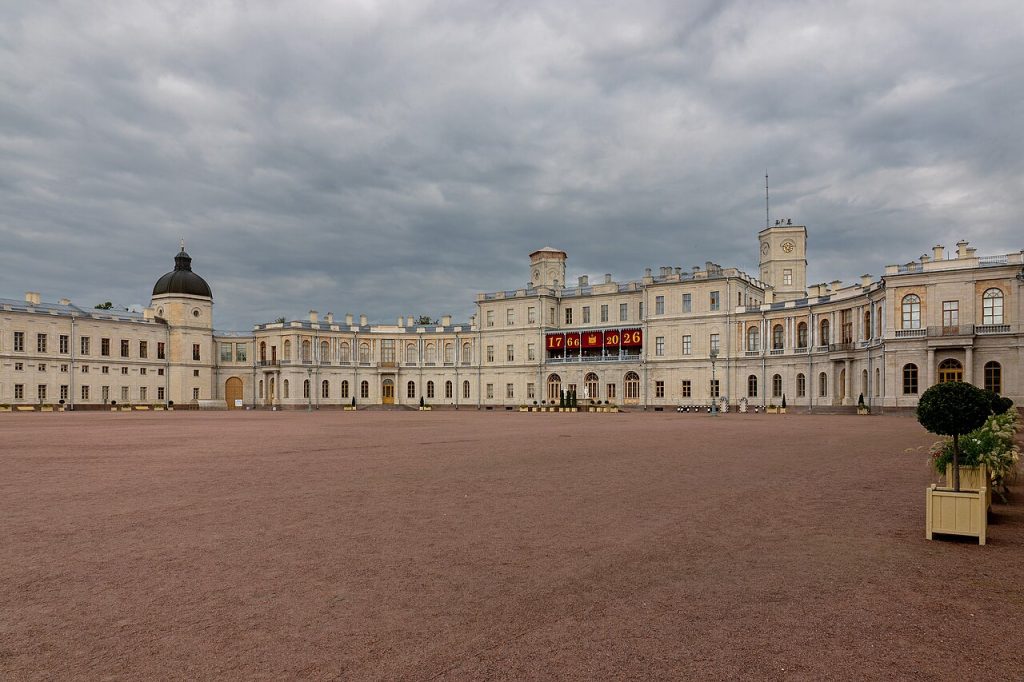
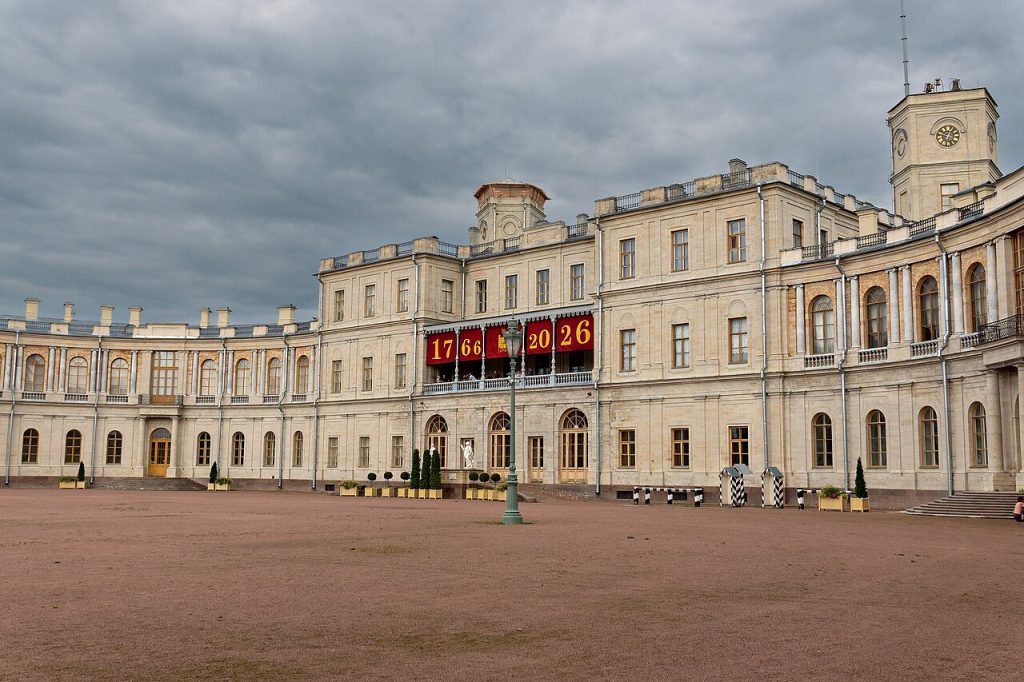
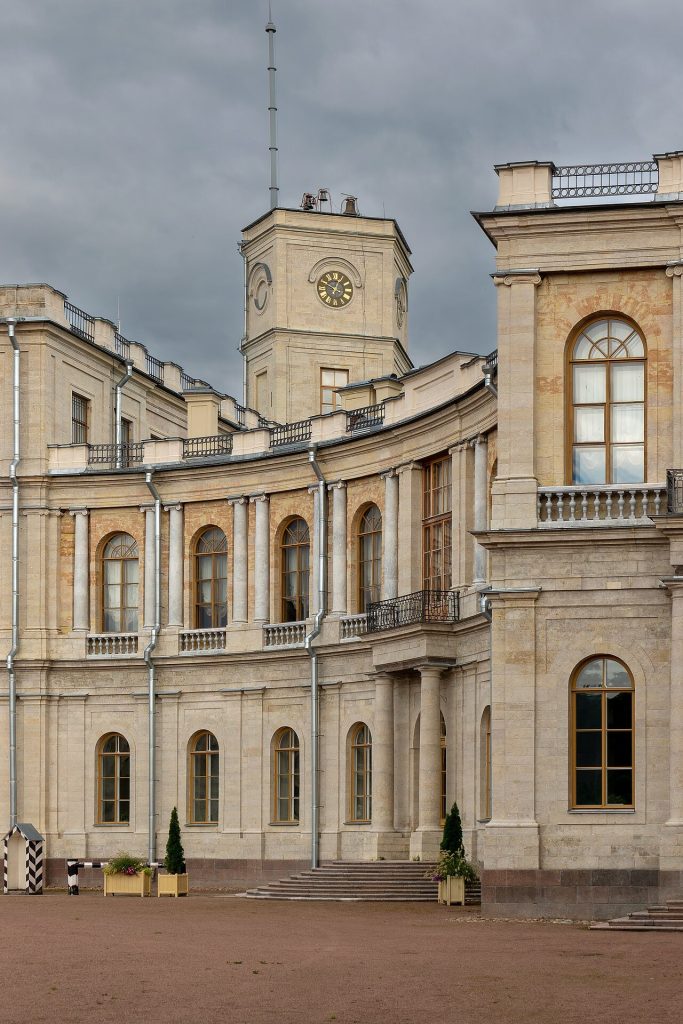
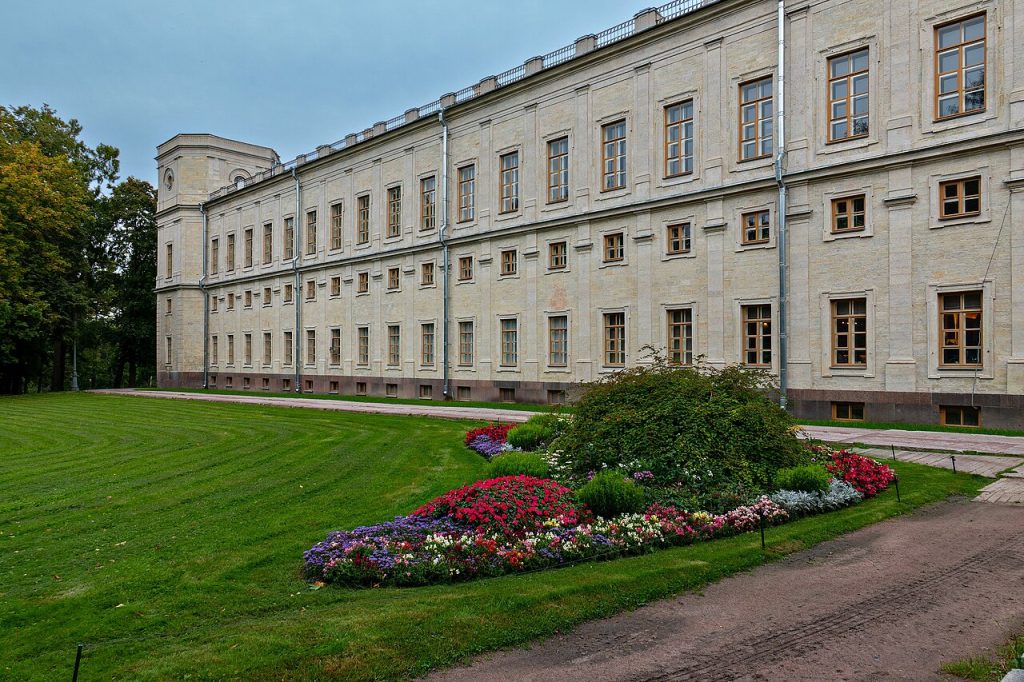
Antonio Rinaldi, the Italian master who had built the Marble Palace in the capital and the Chinese Palace at Oranienbaum, gave Orlov something unique: a three-story central block crowned with two five-sided towers, linked by curved single-story galleries to service squares on either flank, the whole faced not in painted stucco but in cool gray Pudost limestone quarried nearby.
The stone is the palace’s soul. It shifts color with the weather, silver in sunlight, lead-dark under rain, and it gives Gatchina a gravity no turquoise-and-gold residence possesses. Rinaldi matched the exterior’s restraint inside with floors and doorways of exquisite craftsmanship and his signature delicate stucco.
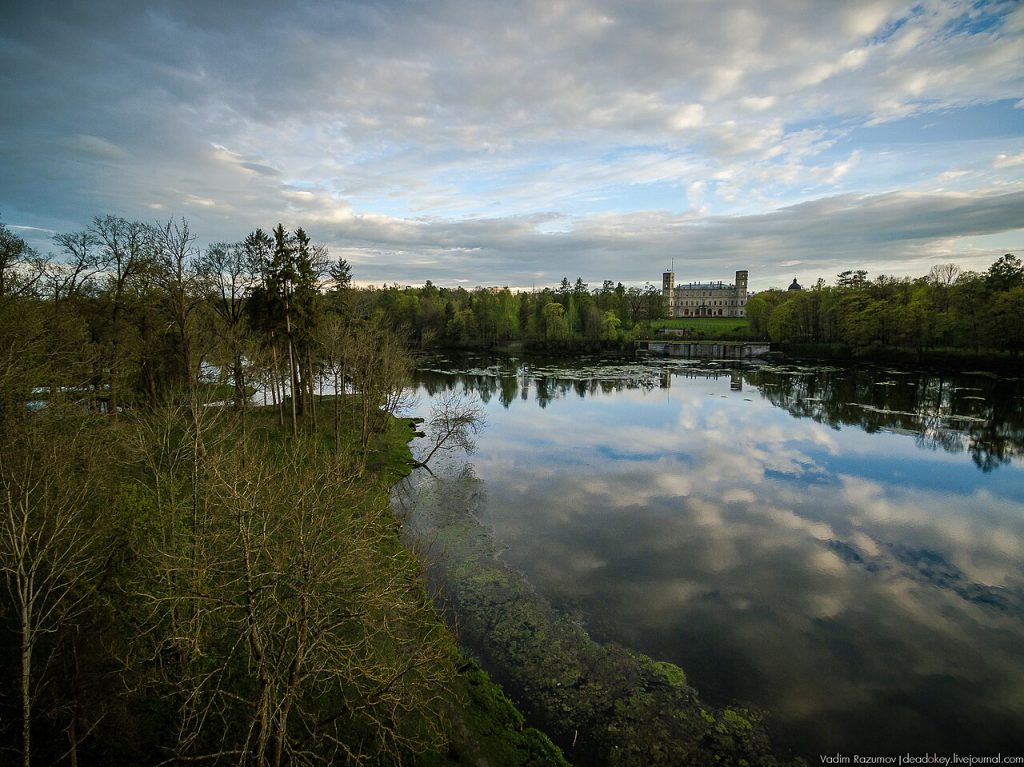
The English park laid out around the Silver and White lakes at the same time was the first landscape garden in Russia, planted while Tsarskoye Selo’s was still on paper. Castle and lakes together made a composition closer to a romantic novel’s setting than anything the Russian court had seen.
Paul’s Private Kingdom
Paul received Gatchina in 1783 and made it the capital of his life in internal exile. Distrusted by his mother and excluded from power for thirteen years, he built at Gatchina a state in miniature, with its own army, its own regulations, and a court that ran on Prussian time while Catherine’s Petersburg glittered and intrigued.
The grand duke drilled his battalions on the parade ground before the palace each morning, in Prussian-style uniforms his mother’s generals mocked. Gates, sentry boxes, and barriers in the estate’s own black-and-white livery controlled every road; lights-out sounded across the town at a fixed hour. Visitors found the atmosphere half garrison, half monastery.
Yet Gatchina’s Paul was not only a martinet. He and Maria Feodorovna raised a large family here, theatricals and concerts filled the evenings, and the emperor-to-be planned reforms of the army and state that he would enact, chaotically, during his brief reign. The castle walls guarded less a tyrant than a wounded heir rehearsing for a throne he received too late.
The Gatchina Garrison
The Gatchina troops deserve their own chapter in Russian history. Paul’s private force grew to several battalions of infantry with cavalry and artillery, perhaps two thousand men, trained to a precision unknown in the regular army and equipped at the grand duke’s expense. Officers unwelcome at Catherine’s court found careers here, among them a young artillerist named Alexei Arakcheyev, later the most feared administrator of the empire.
Court wits called them toy soldiers, but the joke soured in 1796 when Paul became emperor and his Gatchina men marched into the capital as the new model for the entire Russian army, bringing their drill, their uniforms, and their iron discipline with them. The guards regiments never forgave the provincial upstarts.
The military flavor outlived Paul at Gatchina. The town that grew beside the palace remained a garrison and aviation town; Russia’s first military airfield school opened here in 1910, and the palace’s parade ground has heard drill commands across three centuries.
State Rooms Behind Stone Walls
The severity of Gatchina’s exterior makes its interiors the sharper surprise. When Paul inherited the palace, Vincenzo Brenna rebuilt the state floor in imperial splendor: the White Hall with its antique reliefs, the Marble Dining Room ringed by columns, the Throne Room where Paul’s crimson chair still stands beneath a canopy, and the Chesme Gallery celebrating the navy’s victories.
Rinaldi’s earlier rooms survive alongside, their refinement unmistakable in the Chinese doors and intricate parquet. The private apartments on the ground floor, by contrast, kept a domestic scale: Paul’s low-vaulted study, the family’s small drawing rooms, and the mezzanine rooms where Alexander III later chose to live.
The restoration, still advancing room by room, has returned the great halls and much of Paul’s floor to full dress. Walking from the gray courtyard into the White Hall’s light remains the essential Gatchina experience: the castle opens like a geode.
The Underground Passage
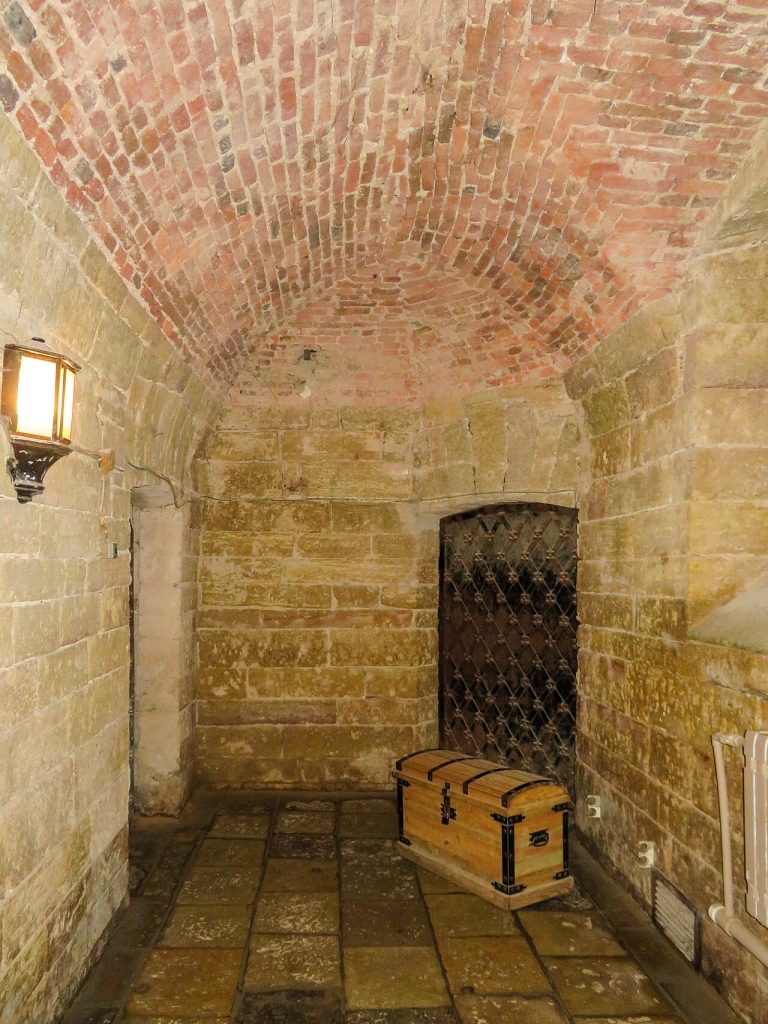
Every castle needs a secret, and Gatchina’s is real. From the palace’s ground floor a stone staircase descends to an underground passage more than a hundred meters long, running beneath the parade ground to emerge in a grotto called Echo on the shore of the Silver Lake. Orlov built it as an aristocratic amusement; legend, inevitably, prefers escape routes and ghosts.
The grotto earned its name honestly: the vault returns a spoken word four times, and guides have tested it on visitors for two and a half centuries. Paul enjoyed leading guests down by candlelight, and the passage features in every memoir of the palace’s great days.
The tunnel had one brush with real history. In October 1917, when the revolutionary tide reached Gatchina, Alexander Kerensky, head of the Provisional Government, left the palace shortly before sailors occupied it; the story that he slipped out through the grotto passage is probably embroidery, but Gatchina has never let facts spoil its best corridor.
Lakes and Parks
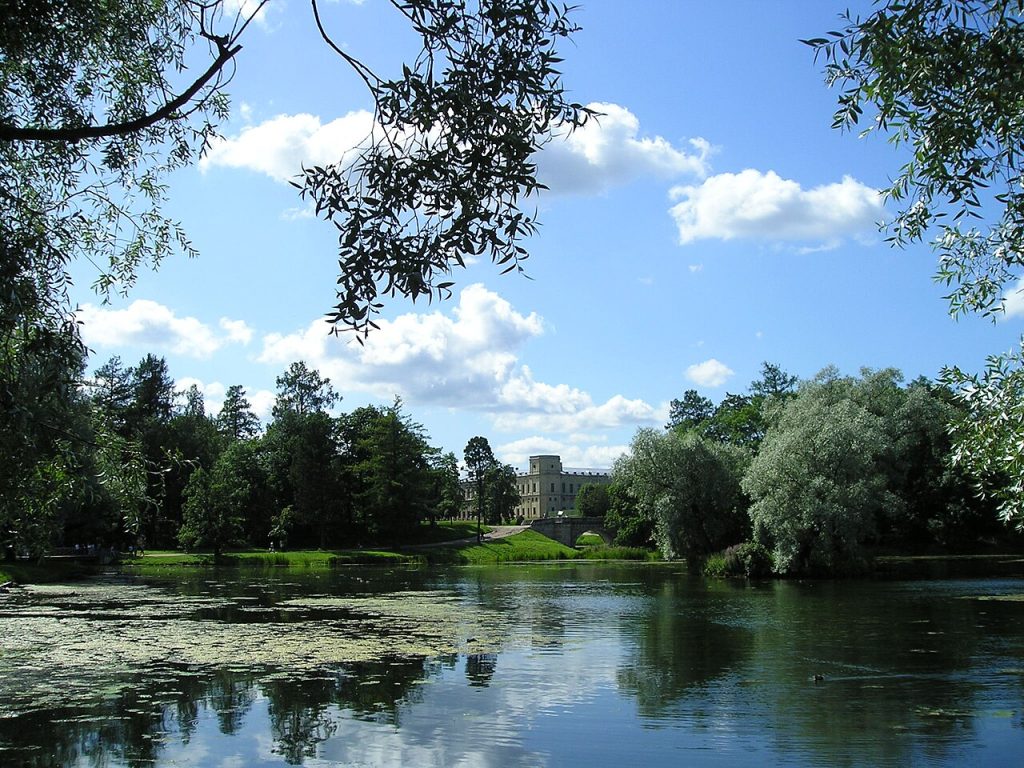
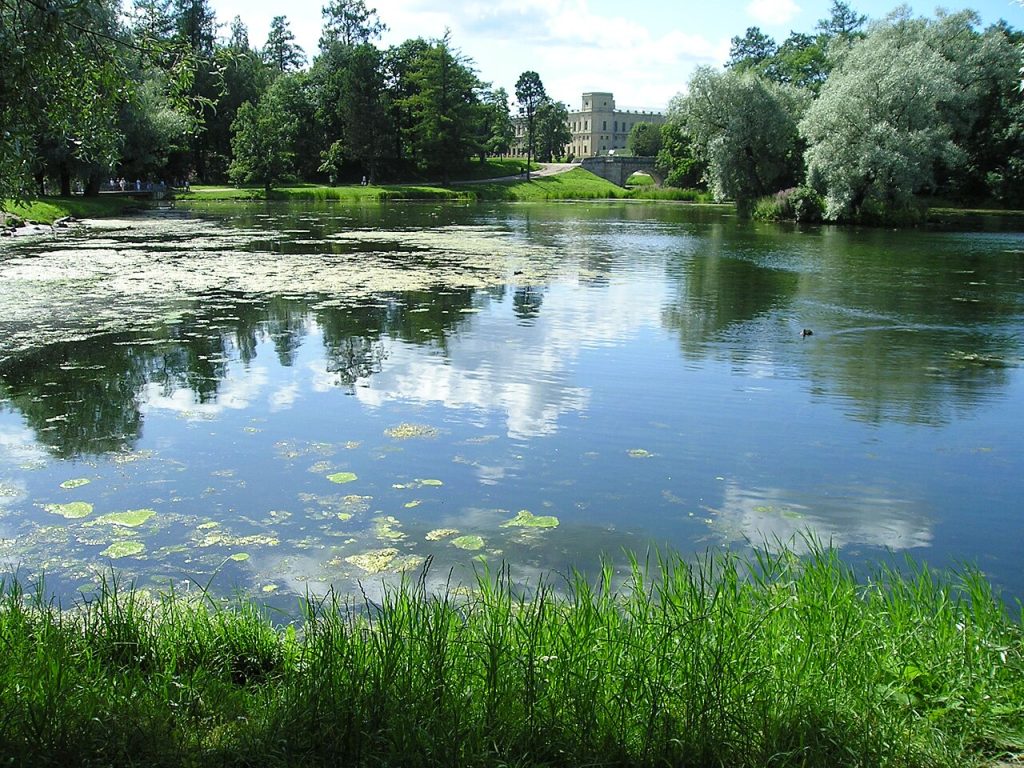
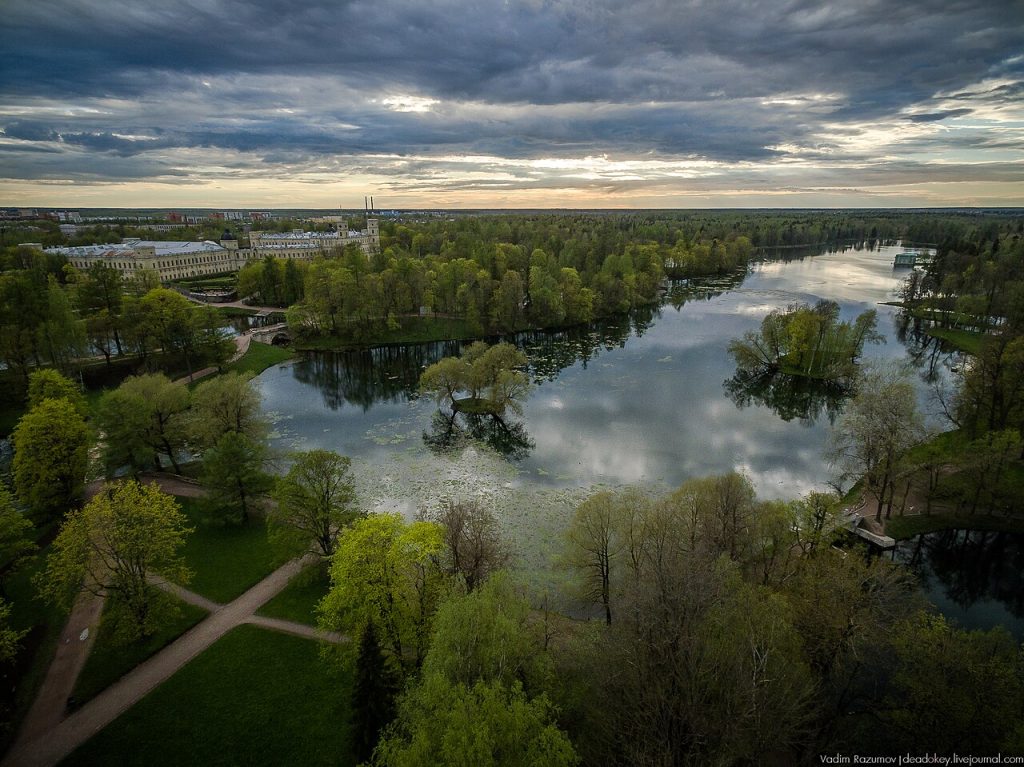
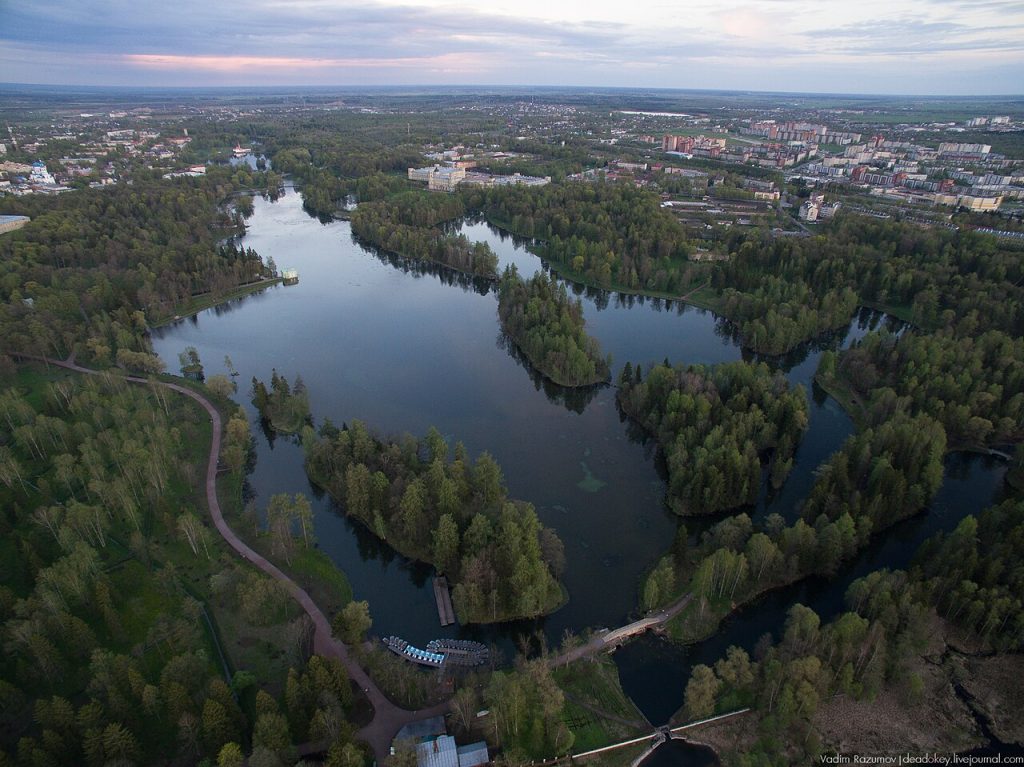
Gatchina’s parks hold the purest water landscape of all the imperial estates. The White Lake and Silver Lake, spring-fed and famously transparent, form the heart of the Palace Park, their shores and islands linked by a collection of bridges and crossed in season by rowboats and a little ferry. Rinaldi’s and later architects’ pavilions stand at the water’s edge.
The Birch House presents a pile of stacked birch logs that opens into a jewel-box interior of mirrors and gilt, a courtly joke on rustic fashion; the austere Birch Gate beside it is a small triumphal arch. On an island stands the Temple of Venus, brought in spirit from Chantilly, and the Terrace-Quay walls the lake in stone below the palace windows.
Beyond the Palace Park spread the Priory Park around its own lake and the wilder Sylvia and Menagerie districts, once hunting grounds. The ensemble covers seven hundred hectares, most of it free to enter, and locals treat it as the region’s finest place simply to walk, swim-adjacent in summer and ski-crossed in winter.
The Priory Palace
Across the lakes from the castle stands Gatchina’s second famous building, and the oddest footnote of Paul’s reign. The emperor, romantic defender of chivalry, took the Knights of Malta under Russian protection after Napoleon seized their island, and was elected the order’s Grand Master. For the order’s priory he commissioned a residence outside the capital: the Priory Palace of 1799.
The architect Nikolai Lvov used the commission to prove a technique: the Priory is built of rammed earth, compressed soil pressed in forms, the only earthen palace in Russia. Its white walls, red roofs, and single tower above the Black Lake compose a view so convincingly monastic that generations have assumed it medieval. Lvov’s earthworks have now stood for well over two centuries, outliving the skeptics who predicted ruin within a decade.
The Priory survived war better than the main palace and today holds a small museum of its own history. The walk around the Priory Park to its lakeside front at sunset is a Gatchina ritual, and the little palace, not the great one, serves as the town’s emblem.
Alexander III’s Fortress Home
Gatchina’s second imperial age began with a bomb. After revolutionaries assassinated Alexander II in March 1881, his son Alexander III moved his family out of the capital within weeks, and the castle behind its lakes, easily guarded and far from the city’s conspiracies, became the principal home of the Russian autocracy for thirteen years.
The giant emperor chose, characteristically, not Brenna’s state floors but the low mezzanine rooms of the Arsenal block, where he lived with an unpretentiousness that startled visitors: plain furniture, family clutter, dogs everywhere. Court mockers called him the Gatchina prisoner, but the family’s own memories of the palace were of their happiest years, skating on the lakes, fishing, and walks in the Menagerie.
Gatchina in these years was effectively Russia’s capital. Ministers traveled out for reports, ambassadors presented credentials in the Throne Room, and the future Nicholas II grew up in the mezzanine’s modest rooms, acquiring there his lifelong preference for living small inside grand walls that he would repeat at the Alexander Palace.
Last Years of the Old Regime
After Alexander III’s death in 1894 the court returned north, but Gatchina remained the beloved home of his widow, the Dowager Empress Maria Feodorovna, and a museum-like storehouse of dynastic treasures, its rooms sealed in the taste of three different reigns. The town around it prospered as a railway junction and garrison, with Russia’s pioneering aviation school drawing the empire’s first pilots.
In 1917 the palace brushed against revolution twice. Kerensky made it his base during his attempt to retake Petrograd from the Bolsheviks that October, and the palace saw the negotiations and the collapse of the last government counterattack; days later the new authorities sealed the collections.
In 1919 the civil war reached the park when General Yudenich’s White army took Gatchina on its drive toward Petrograd and lost it again within weeks. When the front moved away, the palace, almost miraculously intact through all of it, opened to the public as a museum, advertised as the suburban Hermitage for the richness of its contents.
Museum, War and Ruin
Between the wars Gatchina was the largest palace museum around Petrograd, with collections of arms, paintings, and furniture that filled hundreds of rooms. Its curators, like their colleagues at Pavlovsk, met 1941 with packing crates, saving tens of thousands of objects before the Germans arrived in September; much more, immovable, stayed behind.
The occupation lasted twenty-eight months and ended in fire. The retreating forces burned the palace in January 1944, leaving inscriptions on its walls mocking any hope of return; the parks were cut and mined, the pavilions wrecked. Of the prewar interiors, photographs and fragments remained.
For three decades afterward Gatchina was the forgotten palace. While Pavlovsk and Peterhof rose again, the castle housed military and research institutes, its halls partitioned into offices, its name absent from tourist maps. Restorers’ hopes were kept alive by a handful of specialists who refused to let the documentation scatter.
The Long Rebirth
Restoration finally began in 1976, and the first three state rooms opened in May 1985, a date Gatchina celebrates as its second birth. Progress has run ever since, hall by hall: the Throne Room, the Chesme Gallery, Paul’s private rooms, the Marble Dining Room, and the mezzanine apartments of Alexander III have each returned in recent decades.
The palace joined the city of St Petersburg’s UNESCO World Heritage listing and, in 2015, the state museum system’s front rank, with attendance climbing as restoration advances. The underground passage, the towers, and ever more of the nine hundred rooms open each season.
Gatchina’s comparative lateness has one advantage for visitors: the palace still feels like a discovery. Crowds remain a fraction of Peterhof’s, and standing alone in the White Hall or on the Terrace-Quay at dusk, you can possess an imperial residence in a way no longer possible at its famous siblings.
Gatchina Today
Modern Gatchina wears its layers openly. The town of nearly a hundred thousand, capital of the Leningrad region, wraps the parks in ordinary Russian life, and the palace’s parade ground hosts festivals where Paul’s battalions once wheeled. Aviation history, the Priory’s Maltese romance, and the castle’s film-set looks keep the estate busy with reenactors and wedding parties.
The museum has leaned into the palace’s peculiarities. Night tours visit the underground passage by lantern; the towers open for rooftop views across the lakes; exhibitions explore Paul’s Malta obsession and Alexander III’s domestic world. The parks, free and vast, absorb any crowd the trains deliver.
Among the palace towns around St Petersburg, Gatchina offers the strongest sense of a real place rather than a stage set, a working town around a wounded and healing monument. For many travelers it ends up the unexpected favorite of the whole imperial ring.
Watch Gatchina Palace on Film
Visiting Gatchina Palace Today
Gatchina lies about forty-five kilometers south of St Petersburg. Suburban trains run from Baltiysky station to Gatchina-Baltiyskaya, steps from the palace, in about an hour; buses and minibuses leave from Moskovskaya metro station. The palace is open daily except Mondays, with separate tickets for the state halls, the towers, and the underground passage, and the parks are free. Allow a full day to include the Priory Palace and a lake circuit on foot or by rowboat; winter visits trade the boats for skis and silence. You can find the palace on the map here: Gatchina Palace on Google Maps.
Palaces Nearby
You May Like

Pavlovsk Palace and the Most Elegant Park in Russia