At the western end of the chain of palaces along the Gulf of Finland, just past Peterhof, lies an estate with a distinction none of its grander neighbors can claim. Oranienbaum, in the town of Lomonosov, was the only imperial residence around Leningrad never captured in the Second World War. Its palaces kept their original eighteenth-century interiors while Peterhof and Tsarskoye Selo burned, making this quiet park a reliquary of the genuine article.
The estate’s founder was not a tsar at all but Peter the Great’s right hand, Prince Alexander Menshikov, whose Grand Palace here outshone his master’s Peterhof. After Menshikov’s fall, Oranienbaum passed to the future Peter III and then to Catherine the Great, who built in its upper park her most personal creation, the Chinese Palace, the finest rococo interior in Russia.
This guide tells the story of the pie-seller who built a palace, the toy fortress of a doomed emperor, Catherine’s porcelain-and-silk retreat, the Sliding Hill pavilion that survives from the empress’s favorite amusement, and all the practical advice for reaching the least crowded and most authentic of the imperial estates.
- Menshikov’s Grand Ambition
- The Orange Tree Estate
- The Fall of the Favorite
- Peter III and Peterstadt
- The Coup of 1762
- Catherine’s Own Dacha
- The Chinese Palace
- The Glass Beads Salon
- The Sliding Hill
- The Upper and Lower Parks
- The Oranienbaum Bridgehead
- What Survival Preserved
- Lomonosov and the Estate Today
- Watch Oranienbaum on Film
- Visiting Oranienbaum Today
- Palaces Nearby
Menshikov’s Grand Ambition
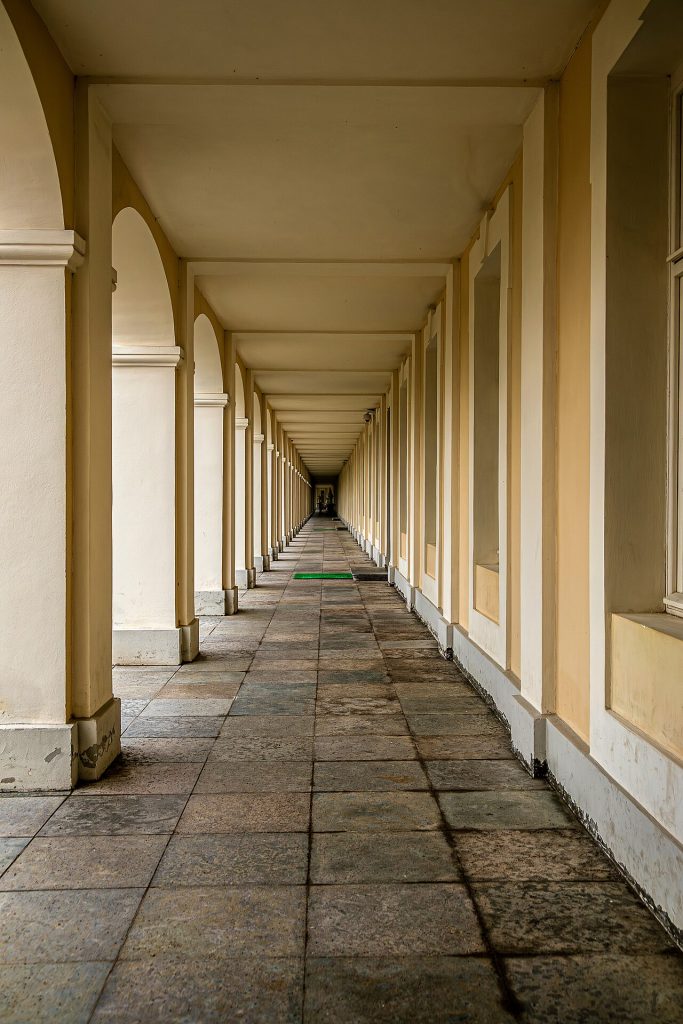
Alexander Menshikov began life, if the legends are true, selling pies in Moscow’s streets, and ended it the richest subject of the Russian crown. Peter the Great’s closest friend, general, and governor of the new capital received lands along the gulf opposite Kronstadt, and from 1711 he built there a residence meant to announce that the tsar’s favorite was second to no European prince.
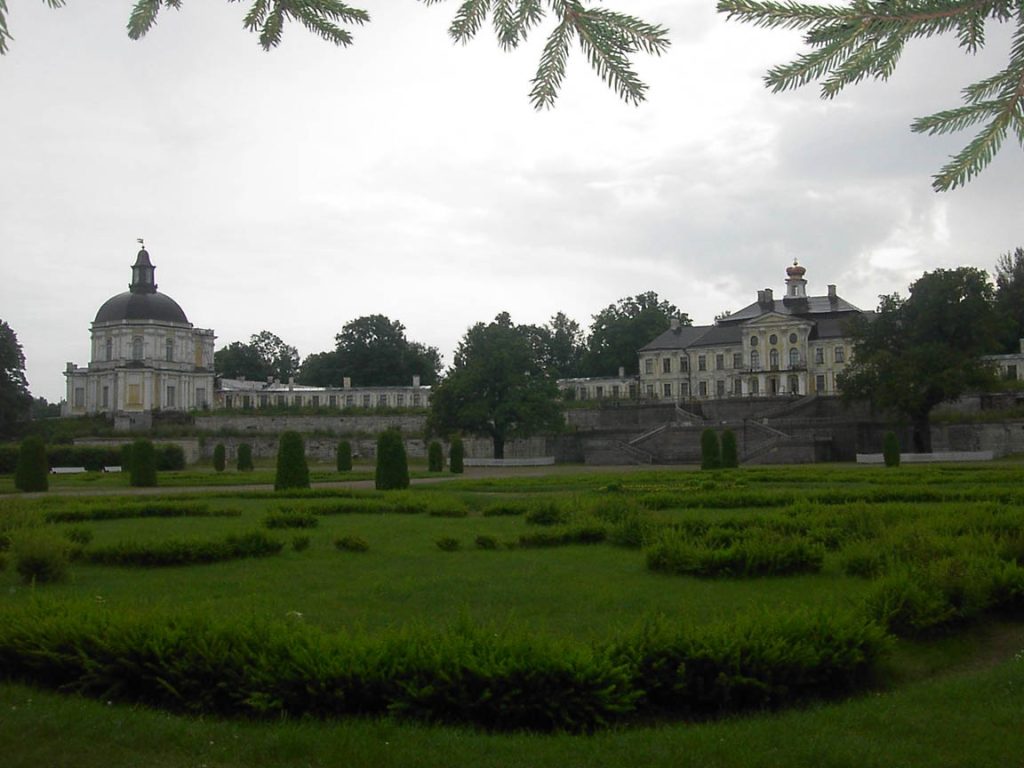
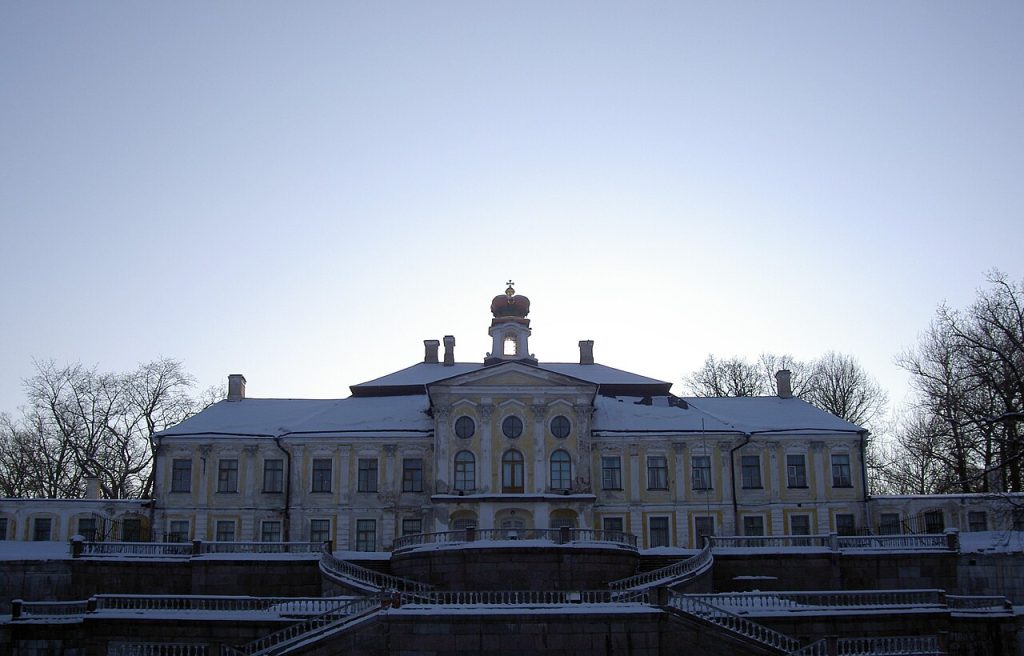
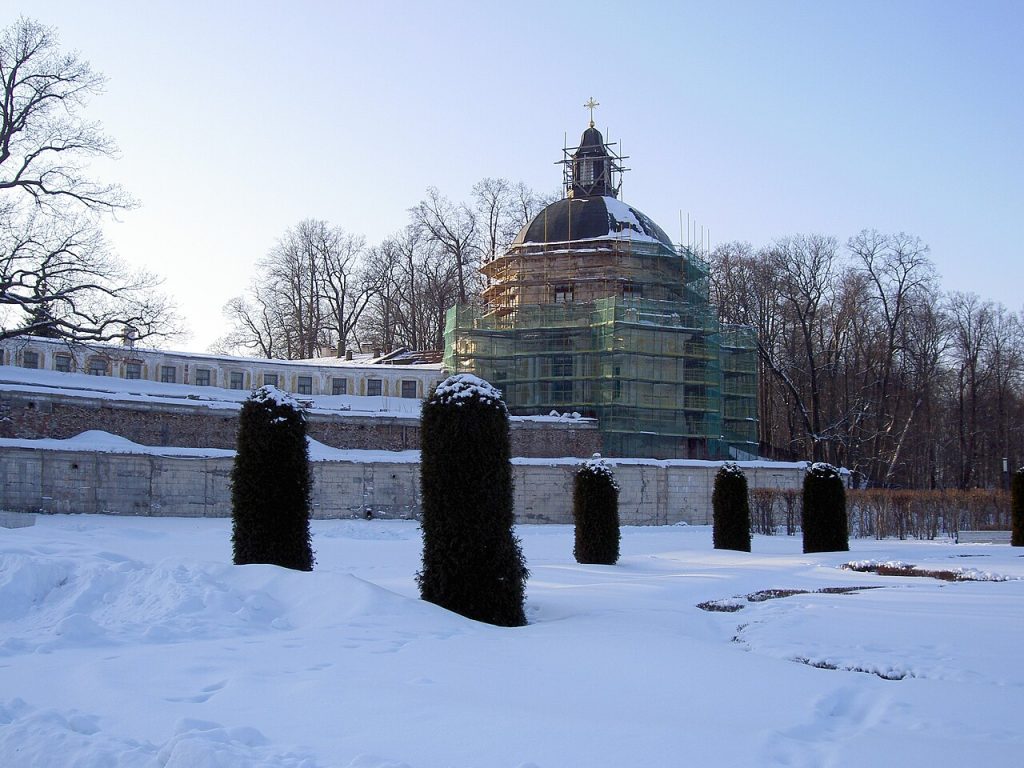
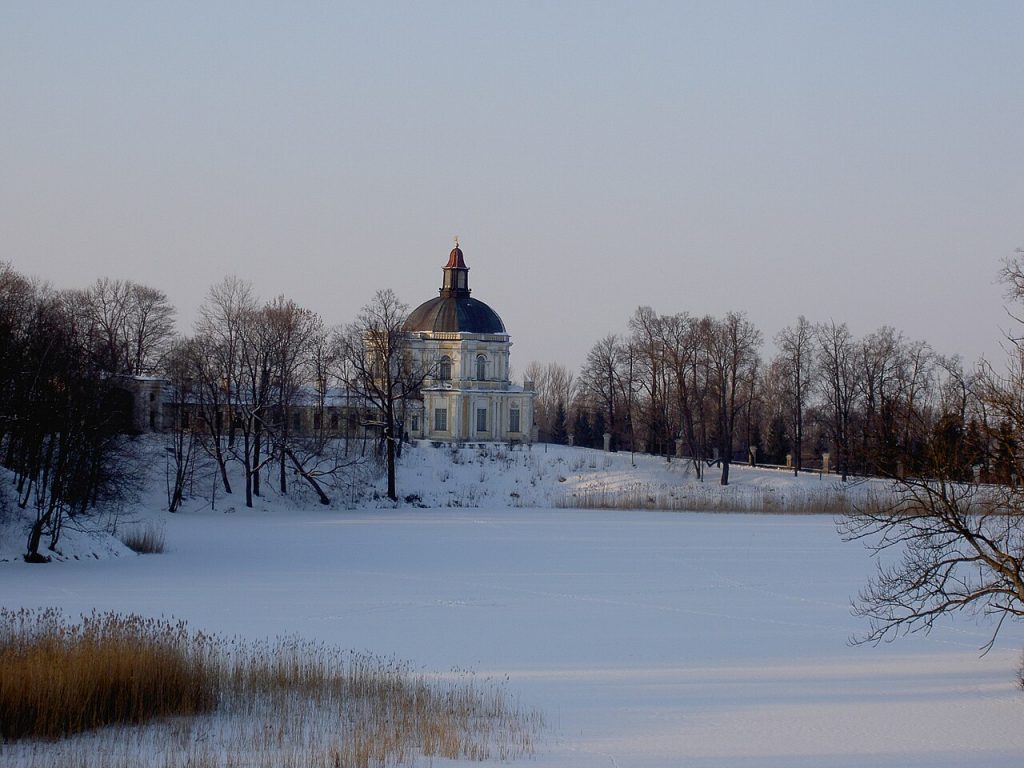
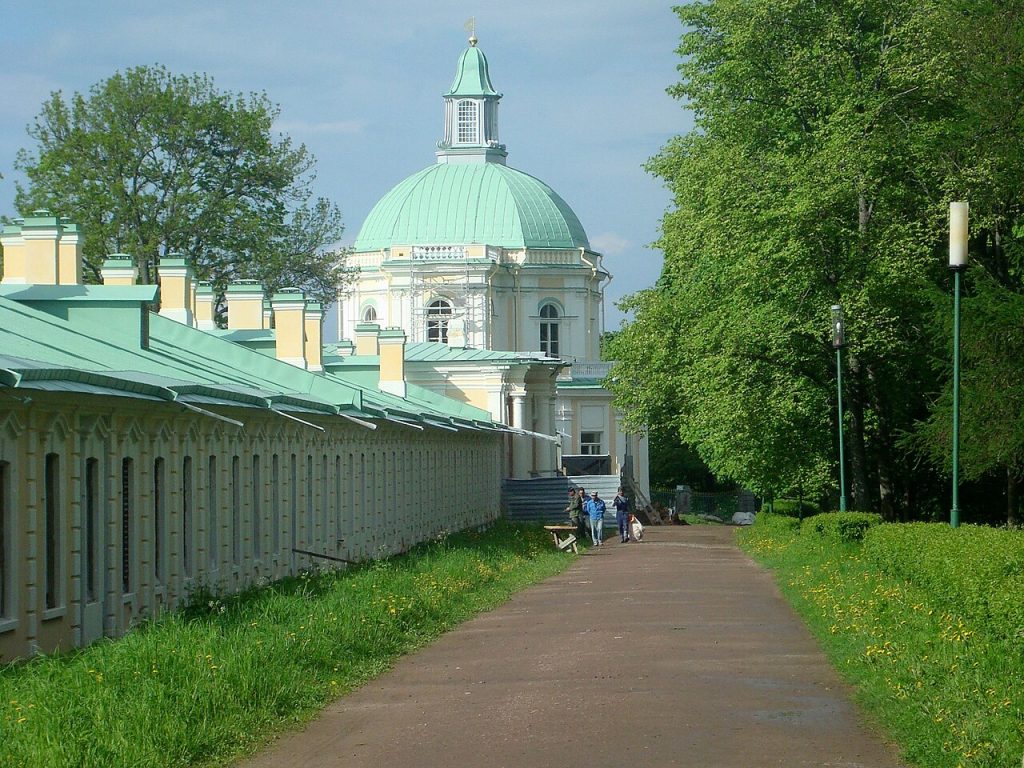
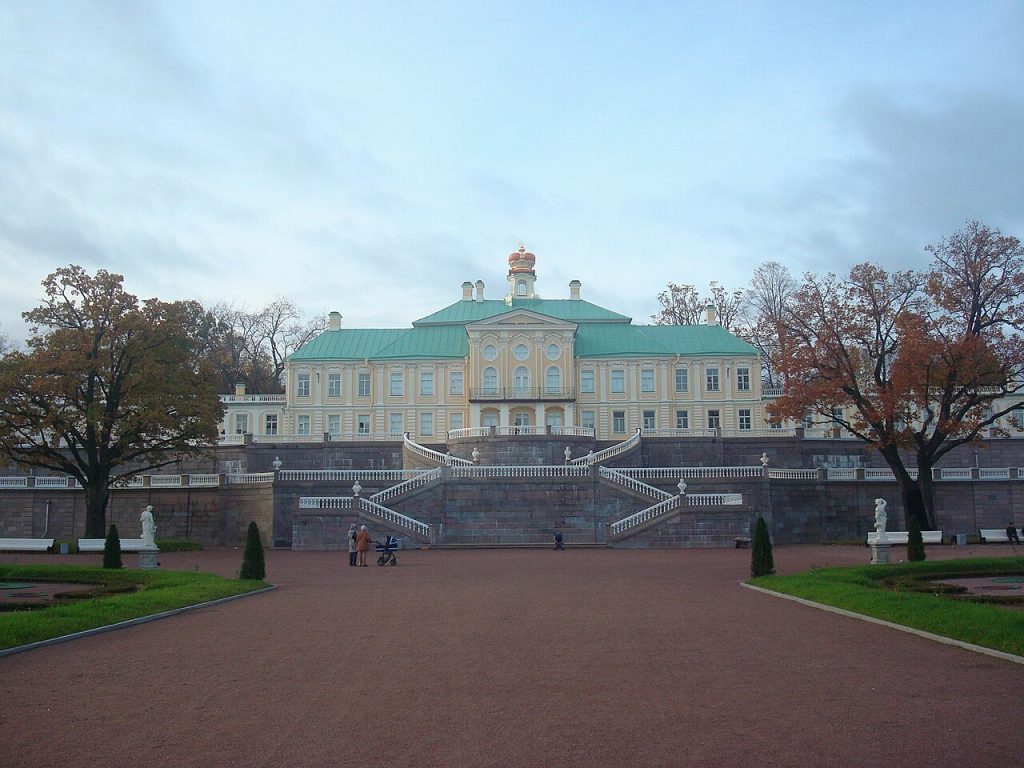
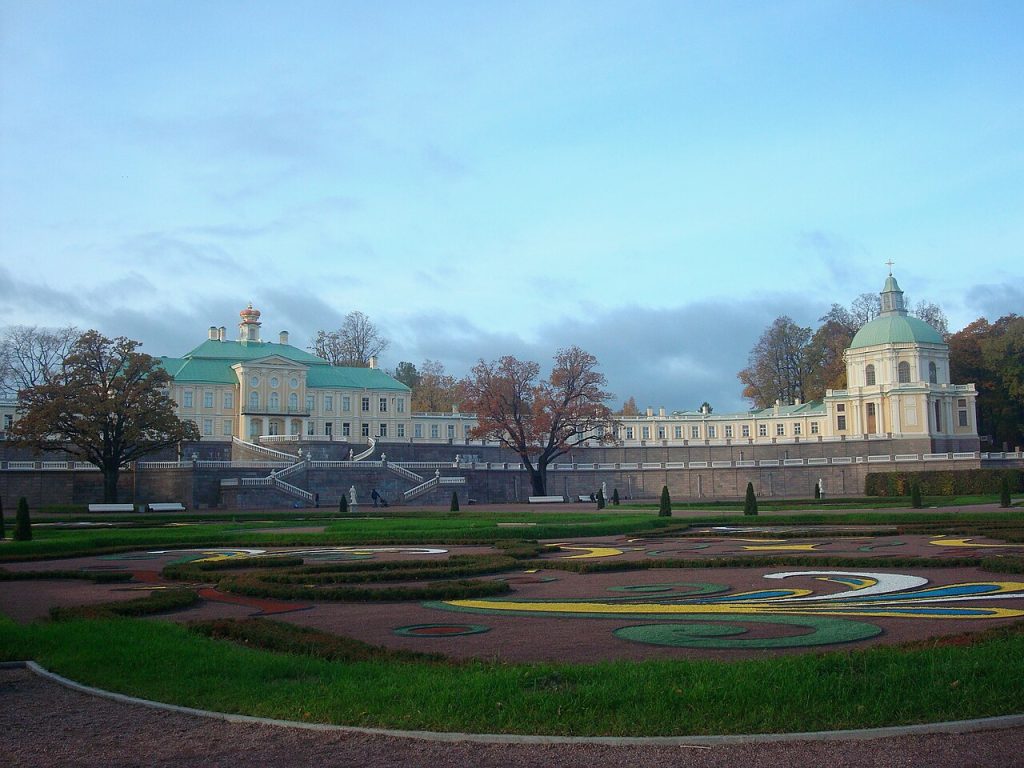
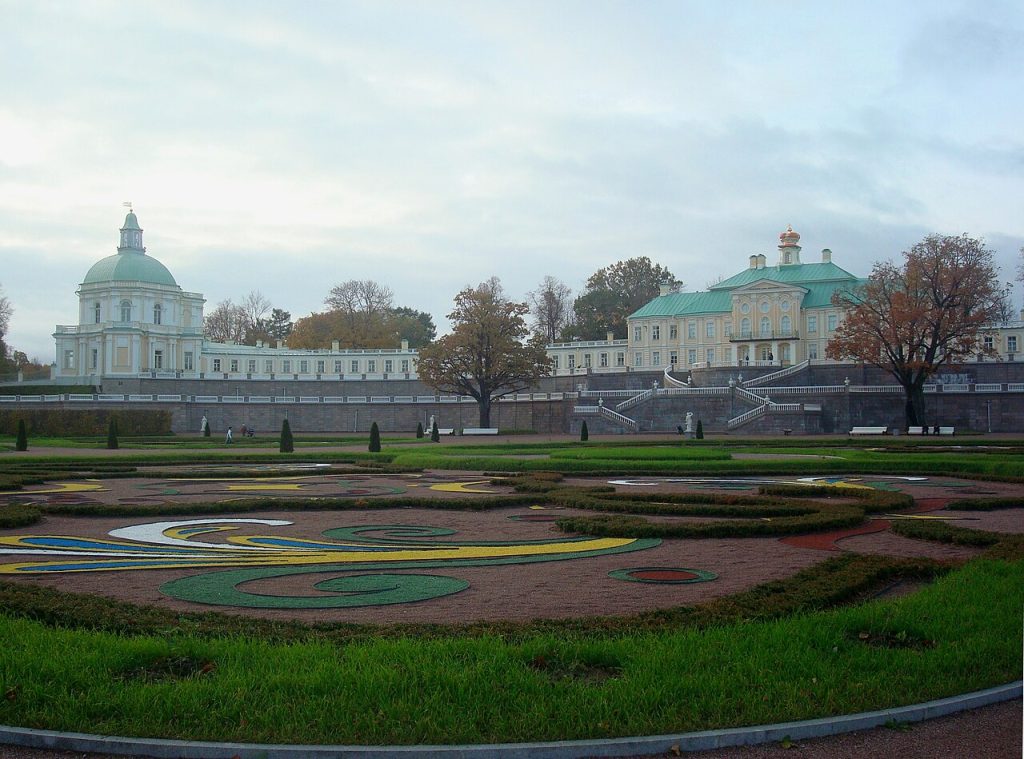
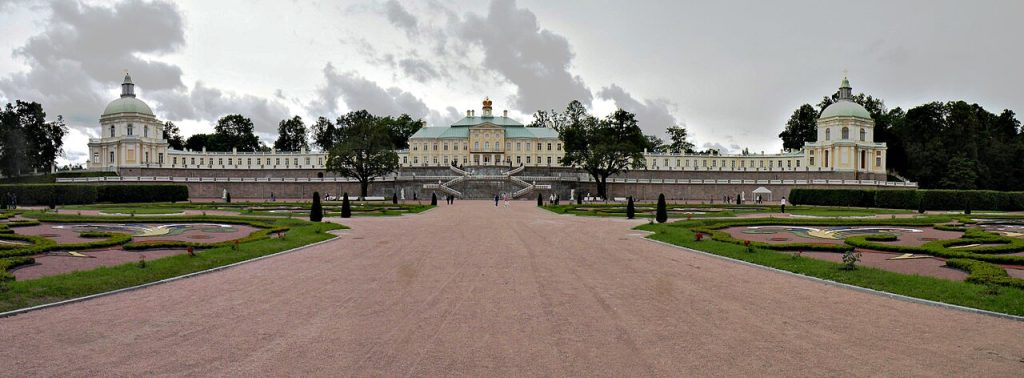
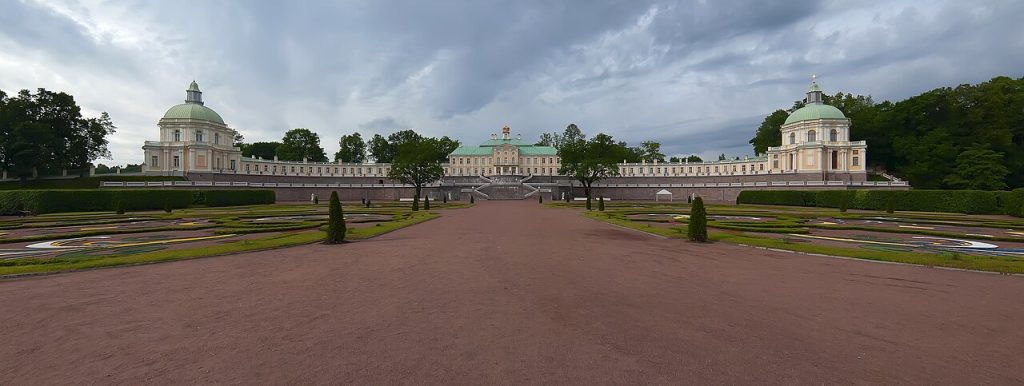
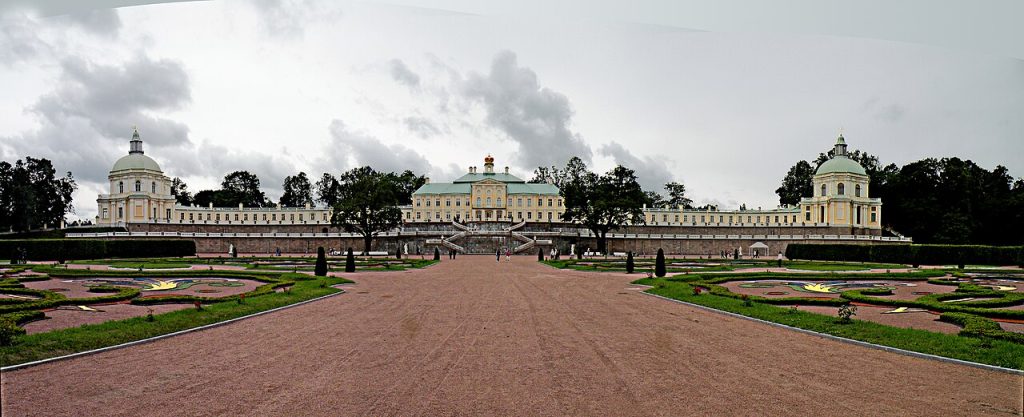
His architects, Giovanni Maria Fontana and Gottfried Schadel, raised the Grand Palace on the coastal ridge: a domed central block with curving galleries sweeping out to two round pavilions, the church and the Japanese pavilion, the whole front stretched along the crest for over two hundred meters and visible far out to sea.
Contemporaries agreed that Oranienbaum surpassed anything the tsar himself had built, including Peterhof next door. A canal led from the gulf to a lower garden of parterres and fountains beneath the palace; dignitaries arriving by boat climbed terraces to be received by a host whose table, plate, and orchestra outshone the court’s.
The Orange Tree Estate
The estate’s curious name, German for orange tree, acquired its own legend: greenhouses of orange trees supposedly found on the land when Menshikov received it, each tree labeled Oranienbaum, delighting Peter the Great. More prosaically, the name flattered the fashion for orangeries and echoed Oranienbaum in Germany, with a possible bow to Prince William of Orange, whom Peter admired.
Menshikov leaned into the emblem. An orange tree appears in the estate’s decorative vocabulary, and his greenhouses genuinely raised citrus, pineapples, and other improbabilities on the Baltic shore, the eighteenth century’s favorite proof that money could correct geography.
The name outlasted its inventor, the dynasty, and very nearly the twentieth century, until 1948, when the town was renamed Lomonosov after the great Russian scientist, who had operated a colored-glass factory nearby. The palaces and park, however, kept the old name, and Oranienbaum they remain.
The Fall of the Favorite
Menshikov’s luck ran out two years after his master’s death. Having effectively ruled Russia under Catherine I and betrothed his daughter to the boy emperor Peter II, he overreached; rivals toppled him in 1727, and the man who had governed an empire was exiled to Siberia, where he died in 1729, having reportedly helped build a village church with his own hands.
Oranienbaum, confiscated with the rest of his unimaginable fortune, passed to the crown with its palace barely finished. For a decade the estate idled under the Admiralty, its fountains stilled, a monument to the dangers of standing too close to a throne.
The confiscation preserved what a family’s later remodelings might have destroyed. The Grand Palace kept its early-Petrine bones, and today it is the chief surviving monument of the capital’s founding generation of architecture, the style of Peter’s own age, which fires and fashion erased almost everywhere else.
Peter III and Peterstadt
In 1743 Empress Elizabeth granted Oranienbaum to her nephew and heir, the future Peter III, and the estate became the stage for one of history’s strangest courts. The grand duke, Prussian by upbringing and inclination, built himself a miniature fortress in the upper park, Peterstadt, complete with earthworks, a garrison of Holstein soldiers, and a tiny palace by Antonio Rinaldi.
Peterstadt was a toy, but a fully armed one: five bastions, a moat, barracks, and a commandant, where the heir to all the Russias drilled a few hundred imported troops and played at the Prussian soldiering he loved better than the empire awaiting him. His wife, the future Catherine the Great, endured summers here that her memoirs describe with lethal dryness.
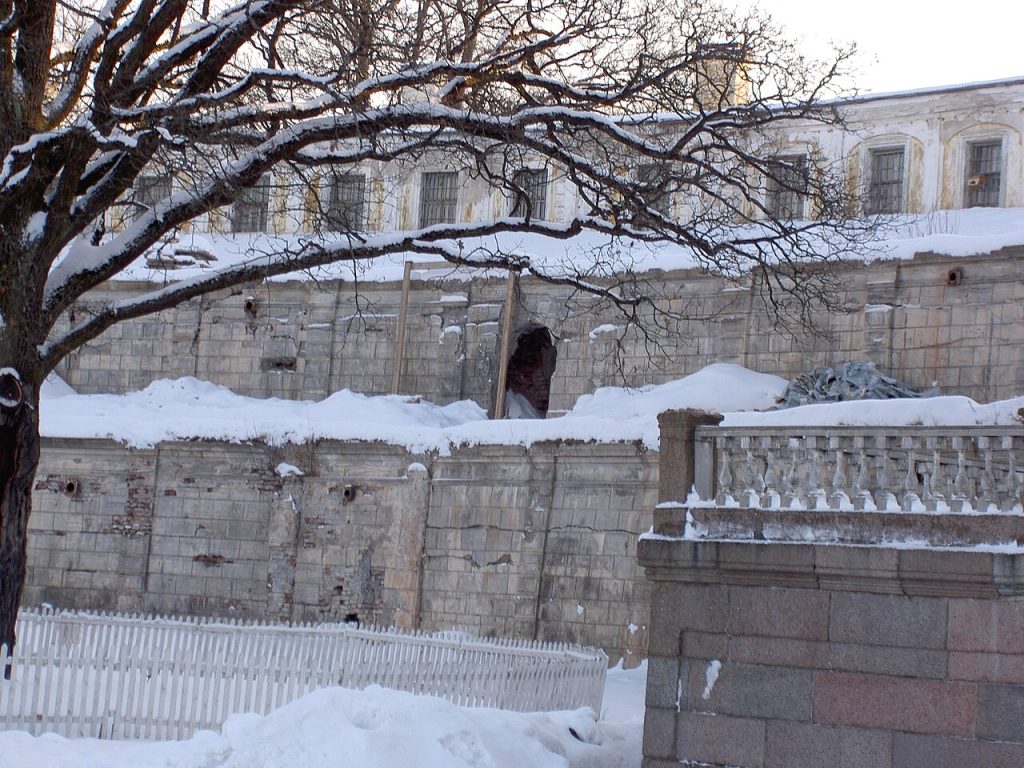
Of Peterstadt the moats and gate of honor survive, along with Rinaldi’s little Palace of Peter III, a graceful two-story pavilion whose lacquered study and silk walls make it the most charming small building of the estate, and a poignant one: its owner enjoyed it for less than a year as emperor.
The Coup of 1762
Oranienbaum witnessed the end of its owner’s reign. In June 1762, six months after his accession, Peter III was at the estate with his Holsteiners while his wife rallied the guards regiments in the capital. The coup unfolded between the two shores: Catherine proclaimed in St Petersburg, Peter dithering at Oranienbaum, his attempt to reach the fortress of Kronstadt turned back from the harbor mole.
The emperor returned to his estate, refused his advisers’ urgings to fight, and signed the abdication brought to him by Catherine’s envoys. Taken from Oranienbaum to the nearby estate of Ropsha and the custody of his wife’s allies, he was dead within days, officially of colic, convincingly of murder.
Catherine’s memoirs pass lightly over the week that made her empress, but Oranienbaum’s role marked the estate. She never lived in her husband’s palaces here, building her own retreat on the far side of the upper park instead, as if to keep the ghost at a distance.
Catherine’s Own Dacha
Catherine the Great called her corner of Oranienbaum her own dacha, and she built it in the 1760s as the first great commission of her reign, with Antonio Rinaldi as architect. The ensemble in the upper park comprised the Chinese Palace by its pond, the Sliding Hill pavilion, and gardens threading the woods between them.
The dacha was emphatically private. State ceremony stayed at Peterhof; here the empress entertained small parties, showed chosen guests her porcelain and her follies, and tested the classical taste that would remake Russian architecture. Rinaldi’s work at Oranienbaum stands exactly on the hinge between rococo playfulness and the new severity, which is much of its fascination.
Her attachment faded as Tsarskoye Selo claimed her summers, and later generations used Oranienbaum lightly, a neglect that proved the estate’s second stroke of preserving luck: no nineteenth-century owner was interested enough to modernize Rinaldi’s interiors out of existence.
The Chinese Palace
The Chinese Palace is the treasure of Oranienbaum and, room for room, perhaps the most precious interior ensemble in Russia. A modest single story from outside, it unfolds within as seventeen rooms of original 1760s decoration: molded ceilings by Italian masters, inlaid floors of astonishing woods, silk walls, and the chinoiserie fantasies that give the building its name.
The eastern wing culminates in the Large Chinese Study, its walls inlaid with wood-and-walrus-ivory scenes of imagined Cathay; ceiling paintings came from Venice, floors tie whole rooms into single ornaments, and every chandelier, sconce, and silk is the one the empress saw. Nothing is reconstruction; everything is survival.
Because the building was a summer pavilion without heating, the palace opens only in the warm months and closes on damp days to protect its silks and glues, and visits run as guided groups. The reward for planning around its schedule is standing in the genuine eighteenth century, an experience no rebuilt hall at Tsarskoye Selo can quite provide.
The Glass Beads Salon
One room of the Chinese Palace has no equal anywhere. The Glass Beads Salon’s walls are hung with panels embroidered over roughly two million tubes of milky glass bugle beads, made at the nearby factory the scientist Lomonosov founded, with silk chenille pictures of fantastic birds and gardens worked over the shimmering ground. The effect, as light moves, is of walls woven from pearl.
Twelve panels in carved gilt frames survive in place, the embroidery attributed to nine Russian needlewomen under a French mistress of works, the beads to Lomonosov’s Ust-Ruditsa factory. Nothing else of the factory’s art survives on this scale, making the room a monument of Russian craft as much as of rococo taste.
The salon alone justifies the trip to Oranienbaum for many visitors, and conservators treat it accordingly: numbers, humidity, and light are controlled, and the room’s restoration, completed with modern laboratory care, took years. Photographs flatten its shimmer; only presence works.
The Sliding Hill
Russian courts loved sliding hills, ancestors of the roller coaster: towering wooden ramps down which gilded cars flew for the length of a garden. Catherine’s at Oranienbaum was the marvel of its age, with a track over five hundred meters long flanked by colonnades, launched from a pavilion that still stands, the sky-blue and white Katalnaya Gorka at the park’s northern edge.
Rinaldi’s pavilion rose in the 1760s as the hill’s banqueting house and launch tower: three stories crowned with a bell-shaped roof, holding a round hall of extraordinary finish, with a floor of artificial marble and the Porcelain Study, whose walls carry Meissen figures on gilded brackets. Guests dined, then flew.
The wooden slopes decayed and were dismantled in the nineteenth century, leaving the pavilion as one of Europe’s most elegant monuments to vanished fun. Restored inside and out, it opens in season, and from its upper balcony you can trace the long meadow where the track once ran and imagine the shrieks.
The Upper and Lower Parks
Oranienbaum’s grounds divide like its history. Below the Grand Palace, the small formal Lower Garden recalls Menshikov’s parterres, with the sea canal’s line running toward the gulf; everything else is the vast Upper Park, one hundred sixty hectares of romantic landscape grown around Catherine’s dacha and Peterstadt, with ponds, winding streams, and bridges under old firs and oaks.
The park rewards wandering more than any checklist: the Chinese Palace appearing across its pond, the Stone Hall concert pavilion, Pergola arbors by the water, and the quiet earthworks of the toy fortress in the trees. Red squirrels own the alleys, and weekday mornings can feel private even in July.
Entry to the park is ticketed in season but modest, and locals use it as Lomonosov’s green lung. The scale is gentler than Pavlovsk’s and the crowds thinner than anywhere else on the imperial ring, which has made Oranienbaum the connoisseur’s choice for a slow afternoon.
The Oranienbaum Bridgehead
In September 1941 the German advance cut off a pocket of Soviet-held coast around Oranienbaum, defended by the guns of Kronstadt across the water. The Oranienbaum bridgehead held for twenty-eight months, a besieged strip some sixty kilometers wide, supplied across the ice and water while the front line stood a few kilometers from the palace park.
The estate paid a price, shelled and stripped by hardship, its collections partly evacuated across the gulf, but it was never occupied, never mined, never burned. In January 1944 the Second Shock Army massed secretly in the bridgehead and broke out, the first blow of the offensive that freed Leningrad from the siege.
The bridgehead’s stand is why Oranienbaum means something particular in Russian memory, and why the town received honors for its defense. For the history of art, the meaning is simpler: when the war ended, one imperial estate still held its genuine interiors, and this was it.
What Survival Preserved
Oranienbaum’s escape made it the reference collection for everything rebuilt elsewhere. Restorers of Peterhof and Tsarskoye Selo studied Rinaldi’s authentic ceilings, floors, and silks here to relearn what the photographs could not teach, and curators across the region borrowed its surviving objects as models.
Survival did not mean health. The twentieth century left the estate shabby, under-funded, and partly closed, with naval institutions long occupying the Grand Palace. Full-scale restoration arrived only in the 2000s, when the estate joined the Peterhof museum federation, and campaign after campaign has since returned the Grand Palace’s halls, the Chinese Palace’s rooms, and the Sliding Hill pavilion to view.
The paradox pleases guides: the estate that was never destroyed was the last to be restored, and the work continues. Each season opens another room that is not a recreation but a rescue, which remains Oranienbaum’s calling card among the palaces.
Lomonosov and the Estate Today
The town around the park, renamed Lomonosov in 1948, is a quiet railway suburb with a naval past, and the estate is its pride and its park bench. The museum has grown steadily: the Grand Palace shows Menshikov’s restored suites and exhibitions, Peter III’s palace and the Chinese Palace open their seasons, and festivals fill the meadows where courtiers once flew down the sliding hill.
Oranienbaum belongs to the UNESCO World Heritage listing of St Petersburg’s ensembles and, administratively, to the Peterhof museum, so combined planning is easy: many visitors pair Peterhof’s fountains in the morning with Oranienbaum’s interiors after lunch, trading crowds for quiet in a ten-minute ride.
What stays with you is the authenticity. In a region of heroic reconstructions, Oranienbaum offers floors Catherine walked, silks she chose, and a park where the eighteenth century survives ungilded. It is the quietest of the great estates, and for many, the most moving.
Watch Oranienbaum on Film
Visiting Oranienbaum Today
Oranienbaum lies in the town of Lomonosov, about forty kilometers west of St Petersburg and ten minutes beyond Peterhof. Suburban trains from Baltiysky station reach Oranienbaum-1 station near the park gates in about an hour, and minibuses run from Avtovo and Prospekt Veteranov metro stations. The park opens daily; the Grand Palace keeps museum hours year-round, while the Chinese Palace and Sliding Hill pavilion open roughly from late May to September, with the Chinese Palace closing in wet weather, so check the Peterhof museum site before traveling. Pairing the estate with Peterhof makes a full and contrasting day. You can find the palace on the map here: Oranienbaum on Google Maps.
Palaces Nearby
You May Like
Gatchina Palace and the Castle Moods of Emperor Paul