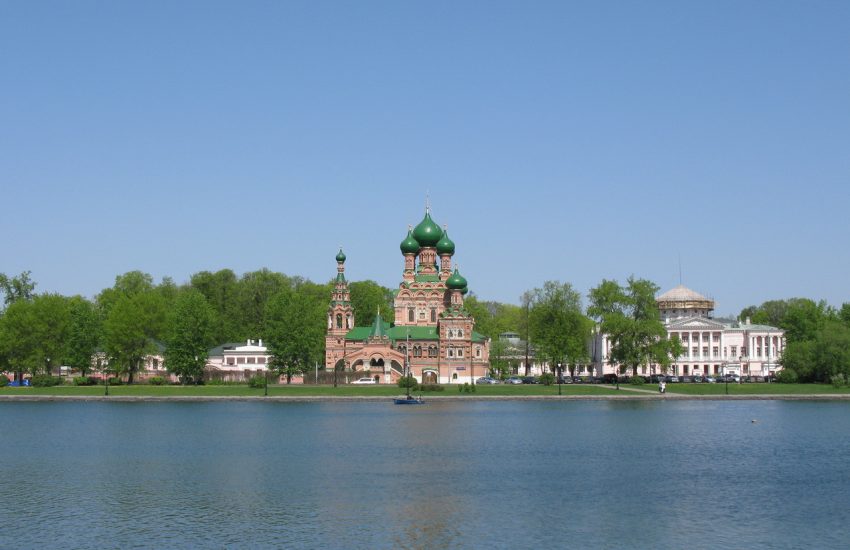
In eastern Moscow, ringed by a pond the tsars dug and shaded by lindens they planted, lies an island where modern Russia can fairly be said to have started twice. The Izmaylovo estate was the seventeenth-century Romanovs’ great experimental farm, a royal laboratory of glassworks, vineyards, and mechanical mills centuries ahead of its neighbors; and in one of its barns, in 1688, a sixteen-year-old named Peter found a derelict English sailing boat, asked what it was for, and set in motion everything Russians mean by the words navy and empire.
The island today is one of the city’s strangest and most rewarding time capsules: the white Intercession Cathedral with domes of flowered tile, the Bridge Tower that is the estate’s oldest survivor, the ceremonial gates of Tsar Alexei’s palace, and around them the ring of Nicholas I’s almshouse for the veterans of 1812, all marooned in quiet water a few metro stops from Red Square, with the sprawling wooden Izmailovo Kremlin market glittering across the pond like a theatrical echo.
This guide untangles the island’s layers: the boyar village of the Romanovs before the throne, Tsar Alexei’s astonishing farm with its glass factory and hop gardens, the childhood of Peter the Great and the boat now called the grandfather of the Russian navy, the royal hunts and the empress who was discovered here, the soldiers’ almshouse and the Soviet commune, and the practical details of a visit that pairs history with Moscow’s best souvenir bazaar.
- The Romanovs’ Home Village
- Tsar Alexei’s Model Farm
- Making the Island
- Glass, Linen and Clever Machines
- Gardens of Eden on the Serebryanka
- The Intercession Cathedral
- The Bridge Tower
- Young Peter on the Island
- The Boat That Launched a Navy
- Hunts, Menageries and an Empress Found
- The Soldiers’ Almshouse
- Commune, Park and Survival
- The Island and the Market Today
- Watch Izmaylovo on Film
- Visiting Izmaylovo Today
- Palaces Nearby
The Romanovs’ Home Village
Izmaylovo belonged to the Romanovs before the Romanovs belonged to Russia. The village on the little Serebryanka river appears in documents of the sixteenth century, and in 1573, by most accounts, it passed to Nikita Romanovich Zakharyin, brother-in-law of Ivan the Terrible and the dynasty’s ancestor, a boyar so popular that folk songs cast him as the people’s intercessor at the terrible tsar’s court.
Through the Time of Troubles and the first Romanov reign the estate remained the family’s private patrimony, a hunting village of woods and ponds east of Moscow. Its meaning changed with the dynasty’s second generation: for Tsar Alexei Mikhailovich, who inherited in 1645, Izmaylovo was ancestral ground on which to demonstrate what a well-governed Orthodox household could be, and he chose it for the most ambitious economic experiment of old Russia.
The choice carried symbolism the court understood: while Kolomenskoye to the south displayed the dynasty’s ceremonial splendor, Izmaylovo to the east would display its stewardship, the tsar as master farmer, feeding and clothing his house from his own fields as scripture advised. That a working farm would incidentally become young Peter’s playground, and thus the hinge of Russian history, no one could have planned.
Tsar Alexei’s Model Farm
From the early 1660s Alexei rebuilt Izmaylovo into what historians have called the first experimental agricultural station in Russia. Peasant households were resettled from across the realm to work it; fields were reorganized, seven linked ponds dug for fish and mills, and specialists, Russian, Ukrainian, and foreign, imported for every branch: orchardists from Kiev, melon masters from Astrakhan, glassblowers from Venice’s scattered diaspora.
The scale amazed contemporaries. Accounts list dozens of orchards and kitchen gardens, apiaries, flax fields, hop yards supplying the court’s brewing, a menagerie, and barns of experimental crops: the tsar’s gardeners attempted grapes, melons, watermelons, even mulberries for silk and cotton, in Moscow’s climate, with heated pits and glass frames, and sometimes succeeded. Harvest figures went to the sovereign personally; Izmaylovo was governed, literally, from the throne.
The farm fed more than the court’s table: it fed an idea, that the realm could be improved by method, measurement, and imported skill, decades before Peter made that idea a revolution. Historians love the continuity: the future reformer grew up inside his father’s reform, among foreign craftsmen and ingenious machines, on an island that was itself an engineered landscape.
Making the Island
The estate’s boldest stroke was geographic: Alexei’s engineers dammed the Serebryanka and Robka streams to merge two ponds into one broad ring of water, turning the knoll with the manor into an island of about twenty hectares, reached by a stone bridge over a hundred meters long, the greatest of its kind in seventeenth-century Russia. The water served mills, fish, defense, and magnificence at once, the thrift of genius.
On the island rose the sovereign’s court: a sprawling wooden palace of the old chambered type, the stone Intercession Cathedral beside it, service buildings, and the Bridge Tower guarding the crossing. Around the water spread the farm’s quarters, and the Silver-Grape pond ring they created remains today’s boundary: the island’s shoreline is the seventeenth century’s drawing, still legible on any city map.
The ensemble’s layout embodied the estate’s double soul: from the bridge, a visitor saw first the church, then the palace, then the barns, faith, family, and husbandry in one perspective. Foreign envoys taken on tours, and Alexei loved giving them, reported a princely residence that was also, unmistakably and proudly, a farm, something no Versailles would have permitted and no visitor forgot.
Glass, Linen and Clever Machines
Izmaylovo manufactured as well as grew. Its glassworks, founded in 1668 with imported masters, ranked among Russia’s first and best, producing table crystal and the curious amusement vessels, trick goblets and vessels with internal fountains, that delighted the court; surviving Izmaylovo glass in museums counts among the earliest fine glass made in Russia. A linen mill worked the estate’s flax, and the seven ponds turned mills for grain, fulling, and more.
The estate’s machinery fascinated visitors: water-raising wheels, a threshing machine decades before such things were common anywhere, heated greenhouses, and the famous Babylon labyrinth garden. The tsar’s own curiosity drove acquisitions, clocks, optical instruments, foreign books on husbandry, and the island’s barns stored novelties alongside seed grain, a royal cabinet of useful wonders.
This workshop character gave Izmaylovo its special place in Peter’s education before anyone knew it mattered: the boy who would make Russia build ships and factories first watched water drive machines and foreigners blow glass on his father’s farm. When historians seek the roots of Petrine industry, they point here, to an island where a tsar had already decided that making things was royal work.
Gardens of Eden on the Serebryanka
The gardens were Izmaylovo’s poetry. Contemporary inventories describe orchards of thousands of trees, rose and medicinal gardens, and showpieces laid out in emblematic patterns, one garden planted as a crown, another as the double-headed eagle, hedged labyrinths, and arbors where the royal family took the air among imported scents. The famous grapes ripened under glass, and Astrakhan melon masters won wagers growing their crop in Moscow’s summer.
Foreign craftsmen left a precious record: the Dutch traveler and artist Cornelis de Bruijn and others described and sketched the estate, and palace accounts preserve the gardeners’ names and salaries, the seeds ordered from Holland and Persia, the oranges attempted and lost. For old Russia, which wrote little about pleasure, Izmaylovo’s garden papers are a rare window onto delight.
Something of Eden clung to the island’s reputation ever after: eighteenth-century memoirists recalled childhood visits to the overgrown paradise, and the Soviet-era forest park that now surrounds the estate, among Europe’s largest urban woods, descends directly from the royal groves and hunting preserve, so a walker today moves through the ghost of Alexei’s garden empire for kilometers.
The Intercession Cathedral
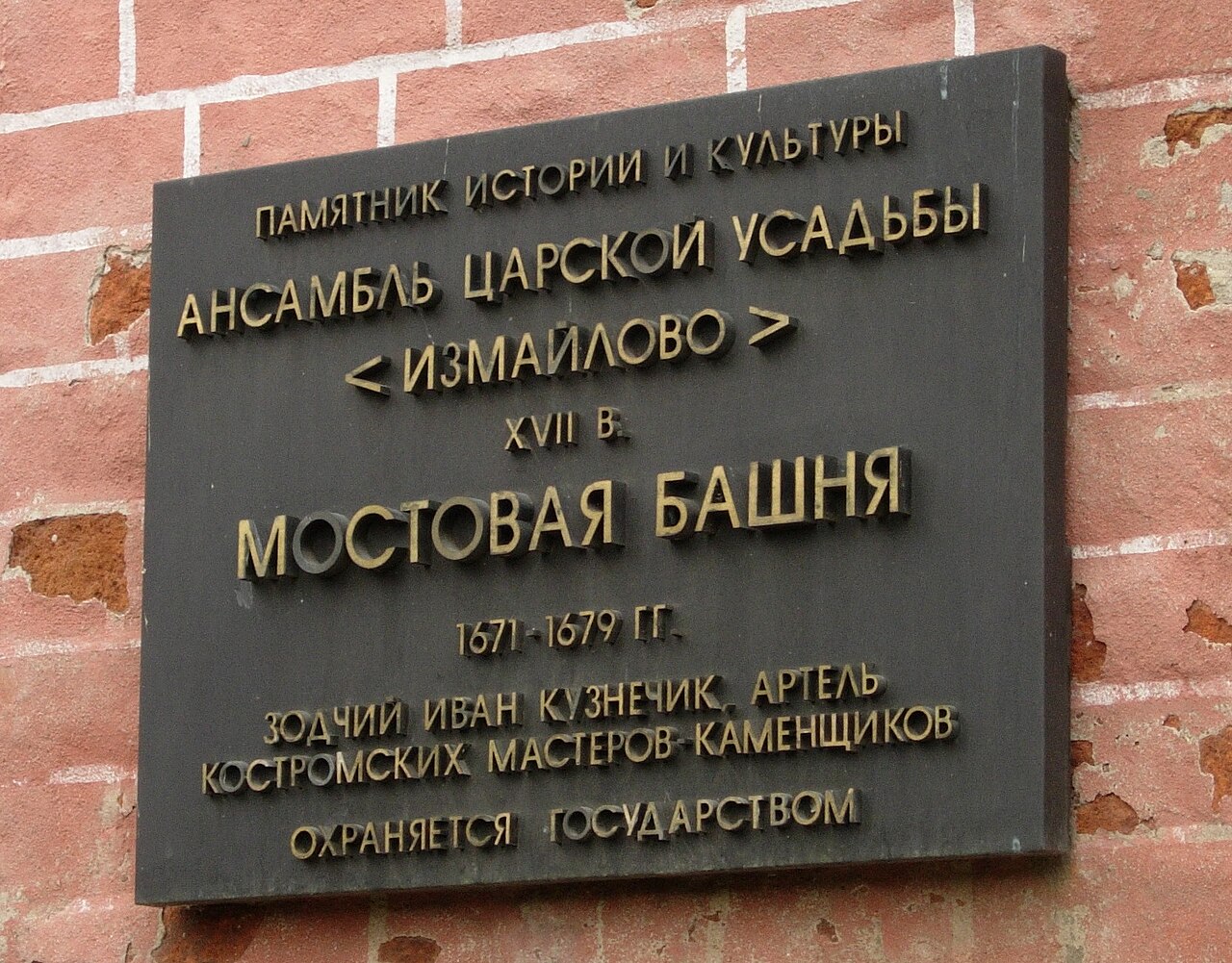
The island’s architectural crown is the Cathedral of the Intercession, built 1671 to 1679 by the stonemaster Ivan Kuznechik on the site of an older church. It is a giant of the late Muscovite manner: a white five-domed cube in the lineage of the Kremlin’s Assumption Cathedral, its vast onion domes shingled in that distinctive seventeenth-century green-and-ochre scale, and its upper walls and gables carpeted with polychrome tile.
The tiles are the glory: friezes of the pattern called peacock’s eye, iridescent discs and flowers by the great ceramicist Stepan Polubes, whose nickname means half-devil, earned, legend says, by skill too vivid for a plain Christian name. The same master’s peacock tails glow on churches across Moscow, but Izmaylovo’s spread is the broadest, a meadow of ceramic flowers lifted into the sky.
The cathedral served the estate, then the almshouse that grew around it, was closed and stripped under the Soviets, storing vegetables, then archives, and returned to worship in the 1990s with its tiles intact and interior slowly refurnished. It remains the island’s working heart, and the view of its domes across the pond, framed by the almshouse’s long wings, is one of eastern Moscow’s finest sights.
The Bridge Tower
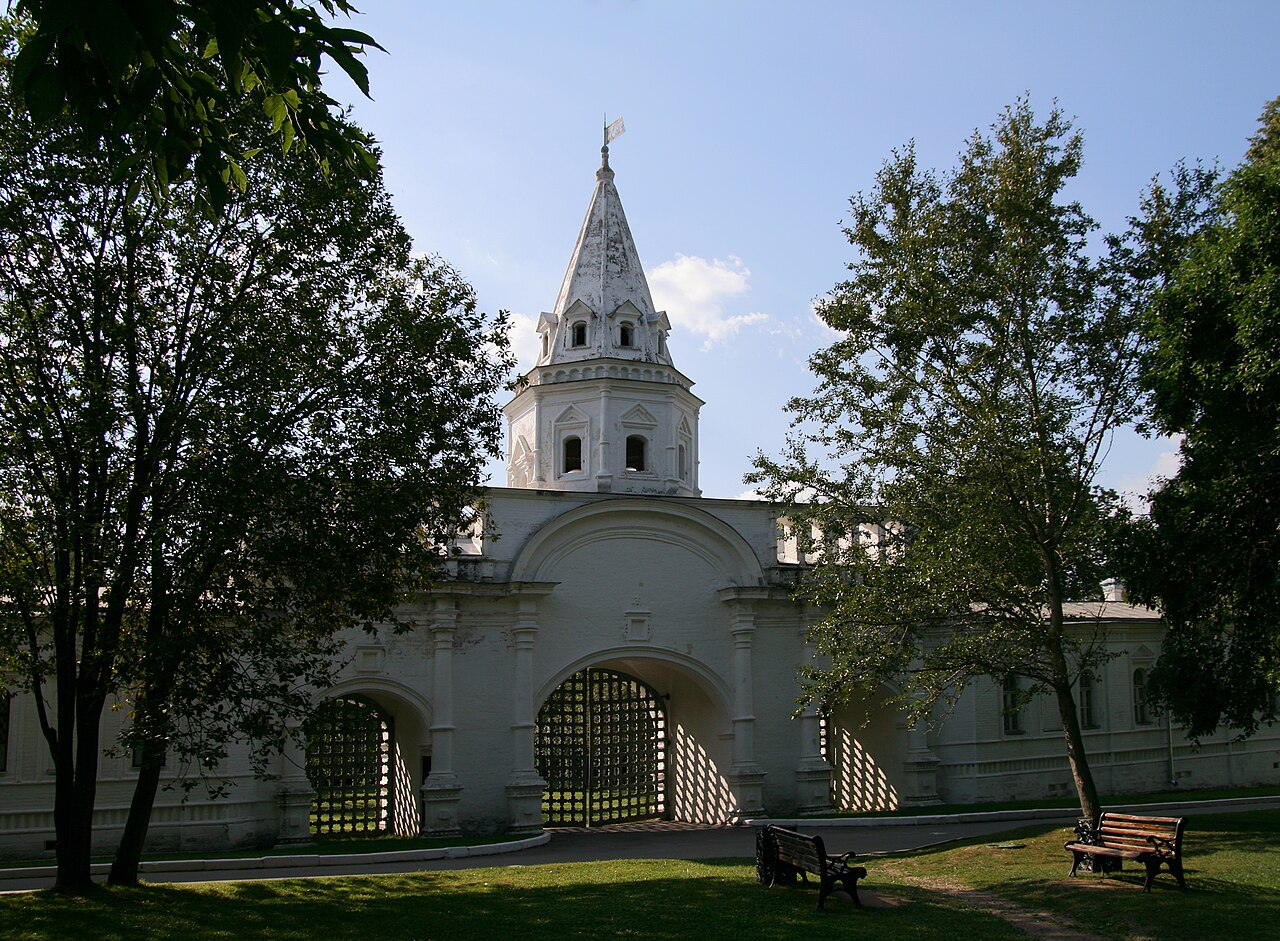
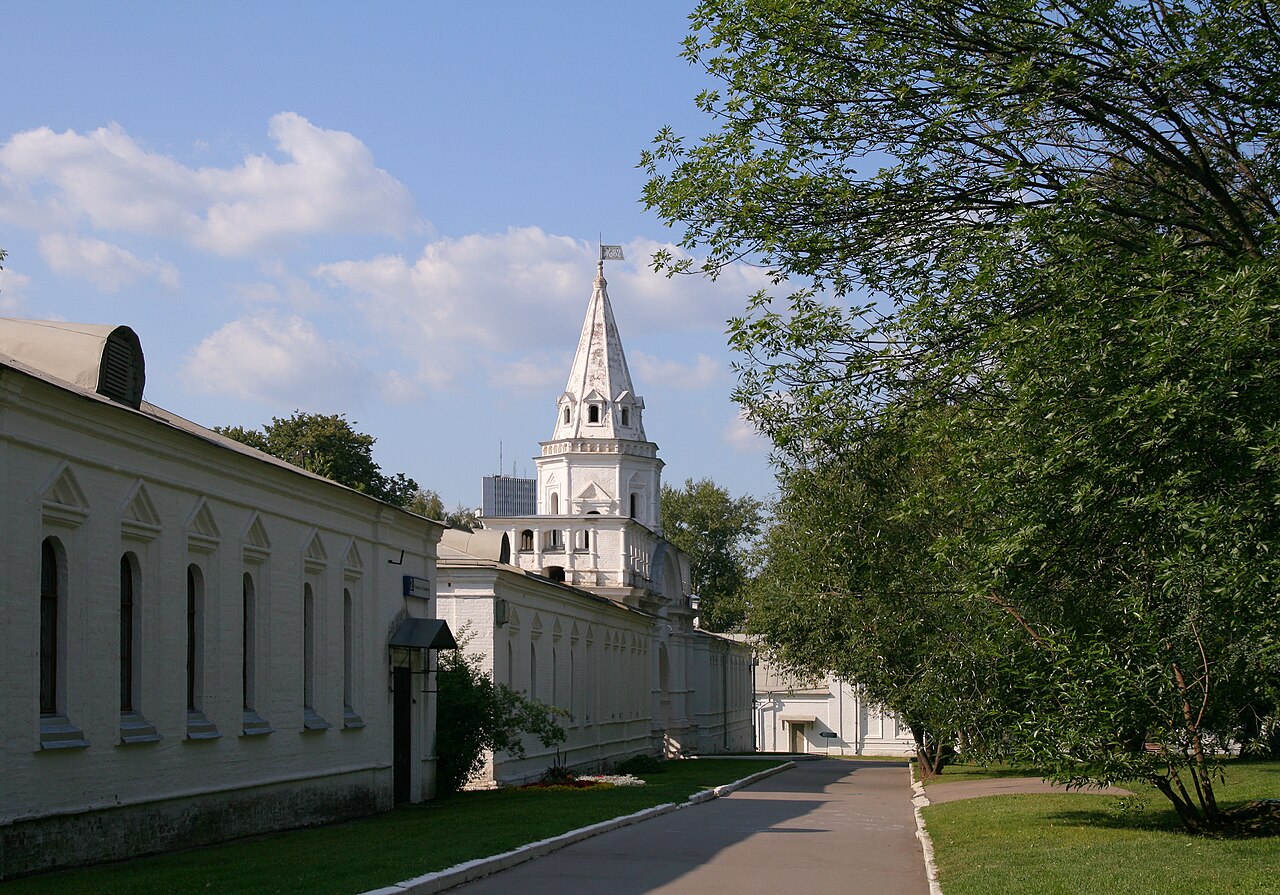
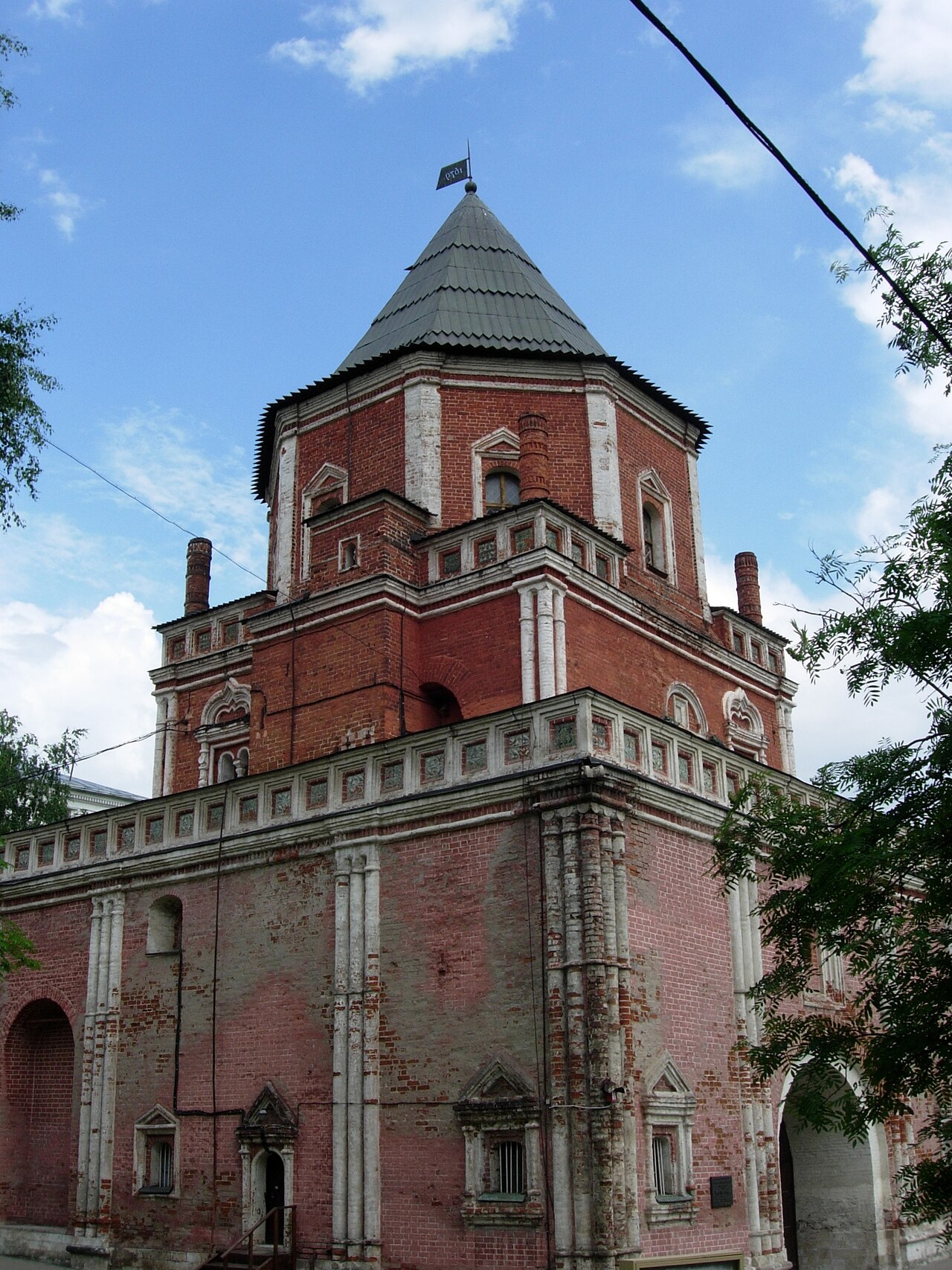
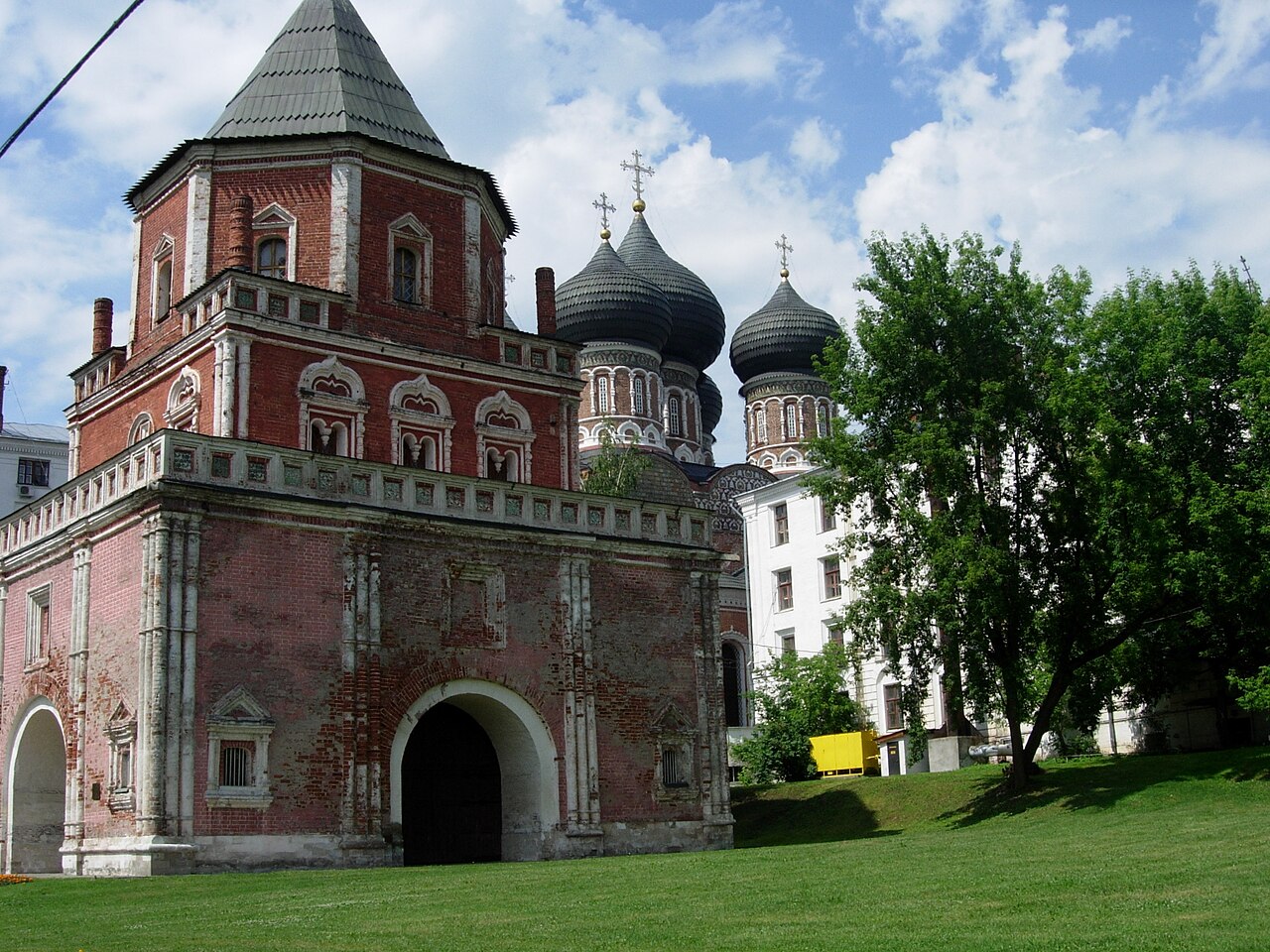
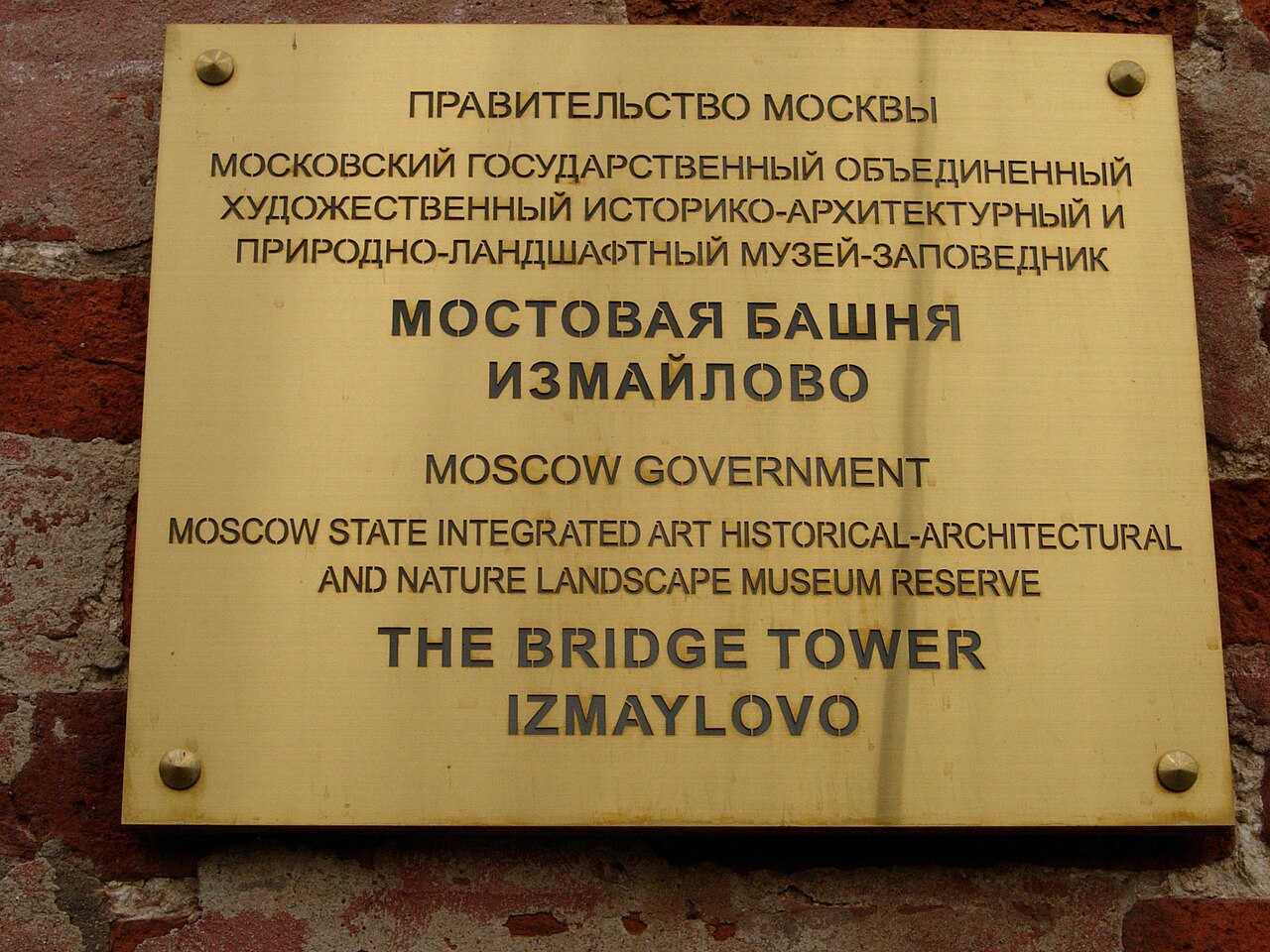
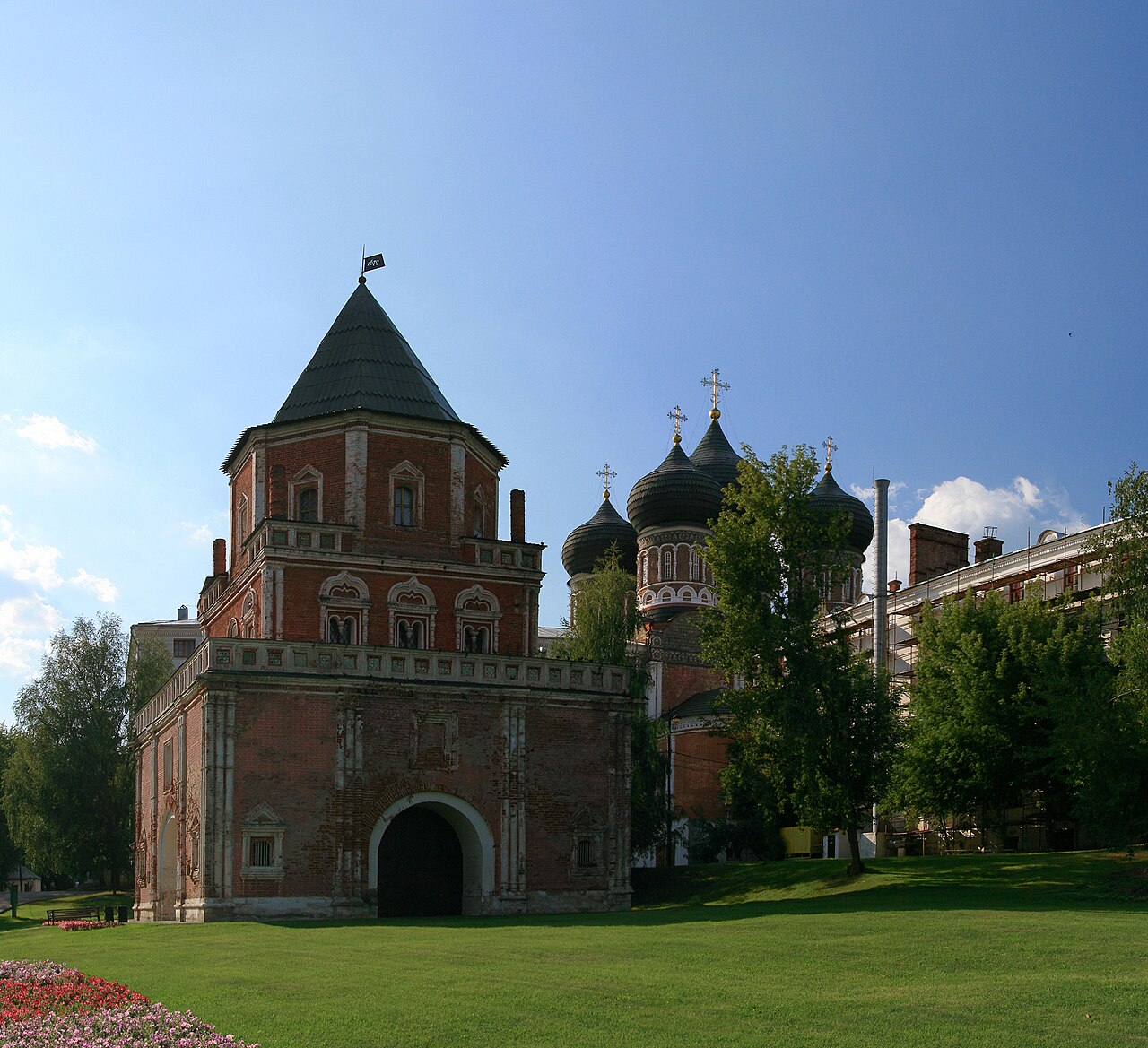
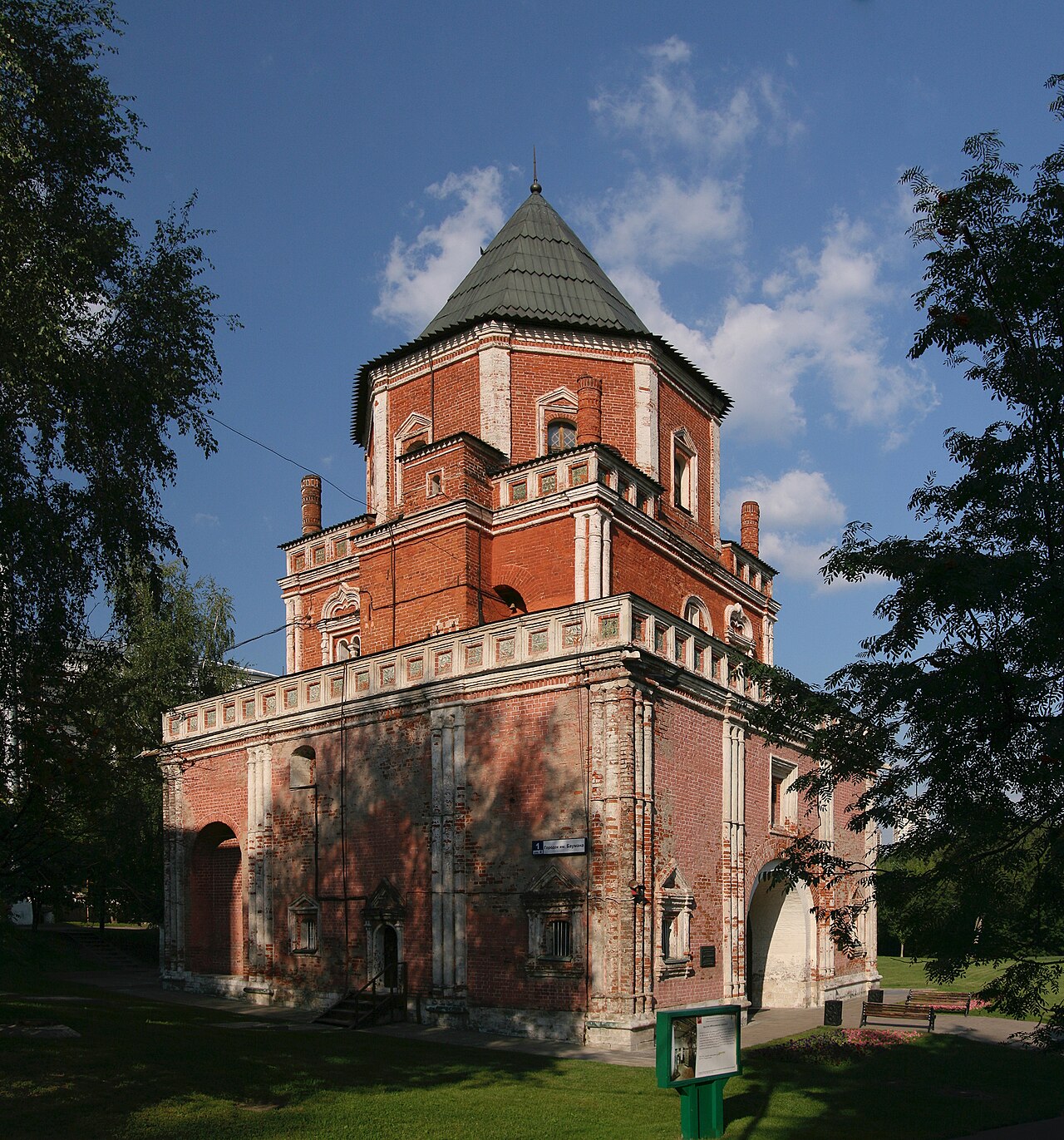
At the island’s edge stands the estate’s oldest complete survivor: the Bridge Tower of 1671, the fortified gatehouse that anchored the great stone bridge. Three tiers of brick and white stone under a tented roof, it held guard chambers below, chambers where, tradition holds, the boyar duma sometimes sat in summer, and a belfry for the cathedral above; the bridge it guarded vanished in the eighteenth century, leaving the tower moored alone by the water like a ship that outlived its fleet.
The tower’s rooms preserve seventeenth-century vaults and today host the island museum’s exhibitions, including glass from the royal works and tiles from Polubes’s workshop; its upper gallery gives the best view of the ensemble’s geometry, pond ring, cathedral domes, and the almshouse’s nineteenth-century embrace.
Architectural historians prize the tower as a dated, documented example of the estate style of Alexei’s builders, kin to Kolomenskoye’s gates and the Kremlin’s towers; Muscovites prize it as the island’s storybook silhouette. Either way it is the building that best remembers the estate’s great age, having watched everything since, including a boy sailing his first boat on the pond below.
Young Peter on the Island
Peter was born in 1672, Alexei’s son by his second wife Natalia Naryshkina, and Izmaylovo belonged to his childhood’s geography: the family’s summers rotated through the eastern estates, and after his father’s death the widowed tsaritsa and her son, pushed from power by court rivals, lived much at Preobrazhenskoye next door, with Izmaylovo’s barns, ponds, and workshops as the boy’s unsupervised kingdom.
The island fed the young tsar’s famous obsessions. Here were foreign craftsmen to interrogate, machines to dismantle, and water, above all water, in engineered abundance; his play regiments drilled across these fields in the 1680s, boys with real muskets building real earthworks, the embryo of the Guards that would win Poltava. The court saw games; the musketeers who would face those boys grown saw, too late, an army being born.
Izmaylovo’s place in Peter’s own mythology was fixed by a single afternoon in May 1688, when the sixteen-year-old, rummaging, by his own account, through the storehouses of the linen yard with the Dutchman Franz Timmermann, found an old boat unlike any Russian craft and asked the question that changed the state: what is this, and what is it for?
The Boat That Launched a Navy
The boat was an English dinghy, brought to Russia decades earlier, perhaps for Alexei’s household, and forgotten in the Izmaylovo linen yard. Timmermann explained that unlike the flat river craft Peter knew, this hull could sail against the wind; the old shipwright Karsten Brandt was found to repair and rig it, and on Izmaylovo’s ponds, then the Yauza, the tsar learned to tack, graduating with his growing fleet to the great lake at Pereslavl and, in time, to the sea Russia barely touched.
Peter himself canonized the moment. In his preface to the Naval Regulations of 1720 he told the story of the botik, the little boat, as the navy’s origin, and in 1723 he staged its apotheosis: the boat was carried in triumph to St Petersburg, where the entire Baltic fleet, a hundred ships that had not existed thirty years earlier, saluted it at Kronstadt, the aged tsar at the botik’s helm and his admirals at the oars. He named it then what Russians call it still, the grandfather of the Russian navy.
The botik survives, honored, in the Central Naval Museum of St Petersburg, and Izmaylovo wears the launching proudly: a monument to Peter by the pond, the anniversary pageants, and the island’s claim, argued politely against Pereslavl’s, to be the navy’s true cradle. On the question itself the record is kind to Izmaylovo: here was the finding, the question, and the first sailing; everything after was consequence.
Hunts, Menageries and an Empress Found
After Peter moved capital and energy to the Baltic, Izmaylovo passed to the family’s left-behind court: the widows and daughters of his co-tsar brother Ivan lived here, and the estate’s fields reverted from experiment to pleasure. Empress Anna, Ivan’s daughter, had spent girlhood summers on the island; as sovereign in the 1730s she returned with her notorious passion for shooting, keeping guns loaded at the windows, her court’s memoirists claim, and reviving the menagerie as a hunting park of imported beasts.
The island’s strangest historical service came in 1741 in reverse: it was at Izmaylovo’s chapel, legend insists, that the guards officers’ plot found Elizabeth at prayer, hesitating before the coup that made her empress, though sober histories stage the night in Petersburg; the tale’s persistence shows how naturally Moscow attached destiny to the old island. More solidly, Elizabeth and later Catherine the Great hunted here, and the young Catherine’s memoirs record Izmaylovo rides during her Moscow seasons.
The palace, though, was wood, and absence is wood’s one unbeatable enemy: surveys of the later eighteenth century found the chambers past saving, and demolitions cleared most of the island’s old court, leaving cathedral, tower, and gates among orchards gone wild. By 1812, when Napoleon’s foragers reached the estate, there was little left to loot; the island waited, half-asleep, for its next emperor.
The Soldiers’ Almshouse
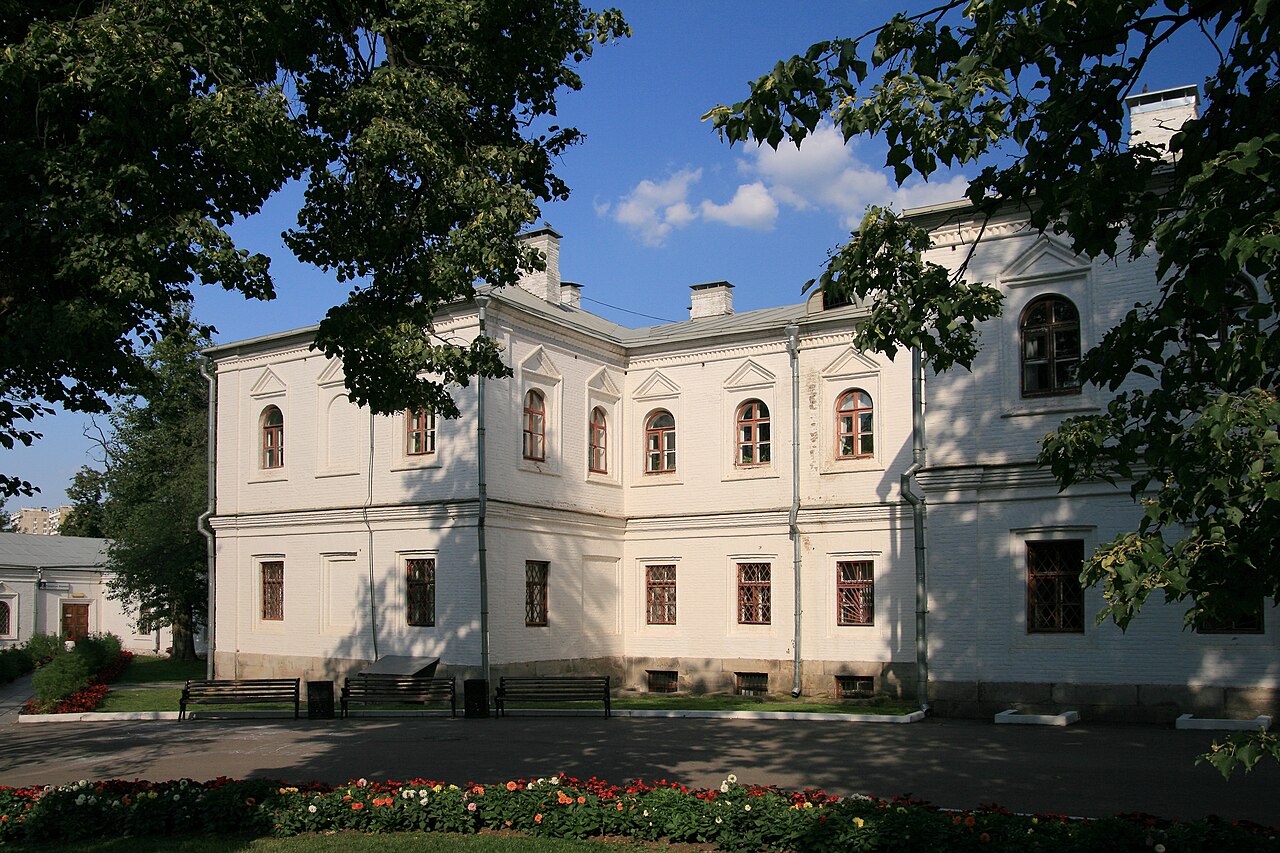
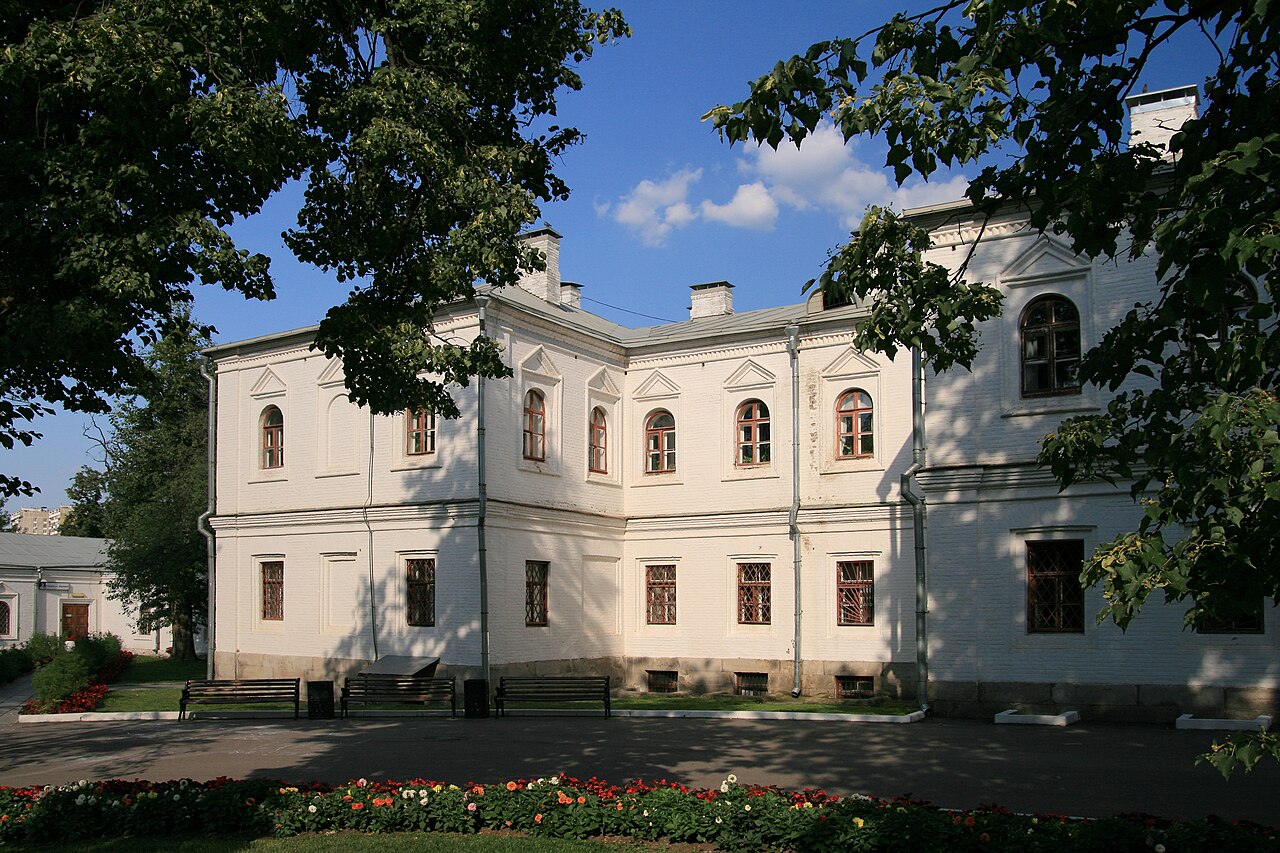
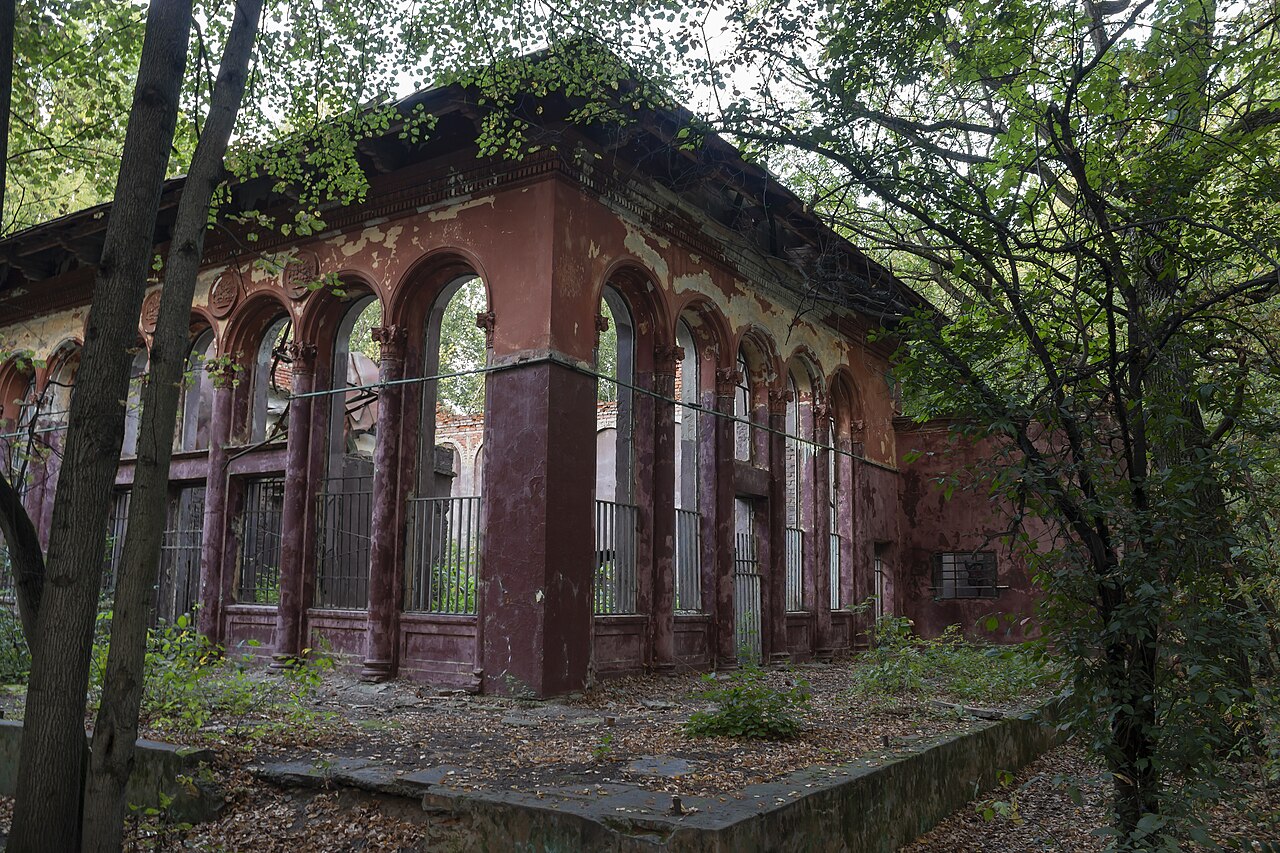
Nicholas I gave the island its second architecture. In 1837 he founded the Izmaylovo Military Almshouse for aged and crippled veterans, above all of 1812, and his architect Konstantin Thon, builder of the Grand Kremlin Palace, wrapped the old cathedral on three sides with long brick wings, joining seventeenth-century domes to nineteenth-century barracks-classicism in a single, startling ensemble; service buildings, officers’ houses, and the restored gates completed a veterans’ town of up to a thousand souls.
The almshouse worked for eight decades: pensioned soldiers in long coats tending gardens where tsars had farmed, church parades under Polubes’s tiles, and the fountain square where the estate’s ceremonial heart had beaten. Moscow approved; the institution ranked among the empire’s model charities, and the island’s name came to mean the soldiers’ home as much as the Romanovs’ farm.
The conjunction has troubled purists ever since, Thon’s wings press hard on the cathedral, but time has made the ensemble itself historic: the island now preserves, wall to wall, the dynasty’s beginning and its long afternoon, the family farm of the first Romanovs and the care of the armies that kept their empire, which is more continuity than any planner could have designed.
Commune, Park and Survival
The revolution emptied the almshouse and refilled the island with the new world: from 1924 it housed a workers’ commune named for the Baumann district, the cathedral became a vegetable store and club, chambers became communal flats, and the island’s name on maps read Commune Town; at its peak thousands lived in the old wings and new barracks, a complete Soviet settlement inside a seventeenth-century moat.
The surrounding royal forest fared better: declared a park of culture and rest in the 1930s, Izmaylovo’s woods became and remain one of Europe’s largest city parks, and wartime years saw the island’s buildings serve hospitals and workshops. Postwar decades brought slow clearance of the commune, listed-monument status, and from the 1970s restoration campaigns that returned tower, gates, and cathedral tiles to view.
In 2007 the island passed to the Moscow State United Museum-Reserve, joining Kolomenskoye under one administration, and systematic restoration, exhibitions in the Bridge Tower, and the revival of the fountain square followed. The commune’s ghosts are acknowledged rather than erased, one more layer on an island that has been farm, court, barracks, and town, and is now, gracefully, a museum of all four.
The Island and the Market Today
Modern Izmaylovo pairs the authentic island with its flamboyant echo: across the pond rises the Izmailovo Kremlin, a 2000s wooden fantasy of towers and painted gables housing the famous vernissage flea market, craft museums, and wedding halls. Purists wince; visitors, sensibly, do both, the market for nesting dolls, Soviet relics, and carved toys, the island for the real seventeenth century in quiet water.
The island itself asks a slow half-day: the Bridge Tower’s exhibitions, the cathedral’s tiles, the ceremonial gates, the veterans’ wings, and the shoreline circuit with its views and fishermen. Information boards tell the farm’s and the botik’s stories, summer brings festivals and craft fairs to the fountain square, and the vast forest park beyond absorbs any remaining energy with bike paths under Alexei’s descendant lindens.
What stays with visitors is the island’s scale of meaning against its modesty of size: twenty hectares that held Russia’s first experimental farm, the childhood of its reformer, the grandfather of its navy, and the old age of its soldiers. Moscow has grander monuments; it has nowhere that tells the national story more compactly, or in more peace.
Watch Izmaylovo on Film
Visiting Izmaylovo Today
The Izmaylovo estate island lies in eastern Moscow between the Partizanskaya and Izmaylovskaya metro stations, each a ten-minute walk; Partizanskaya also serves the Izmailovo Kremlin market, making the classic combined route market first, then across the pond to the island. The island grounds are free and open daily; the Bridge Tower exhibitions and the estate’s museum displays sell modest tickets through the Moscow museum-reserve, with Mondays the usual closing day, and the Intercession Cathedral opens for services. Allow a half day, more with the market and forest park, and consider renting a bike in season for the woods. You can find the estate on the map here: Izmaylovo Estate on Google Maps.
Palaces Nearby
You May Like
The Petrovsky Palace and Napoleon’s Refuge from the Flames