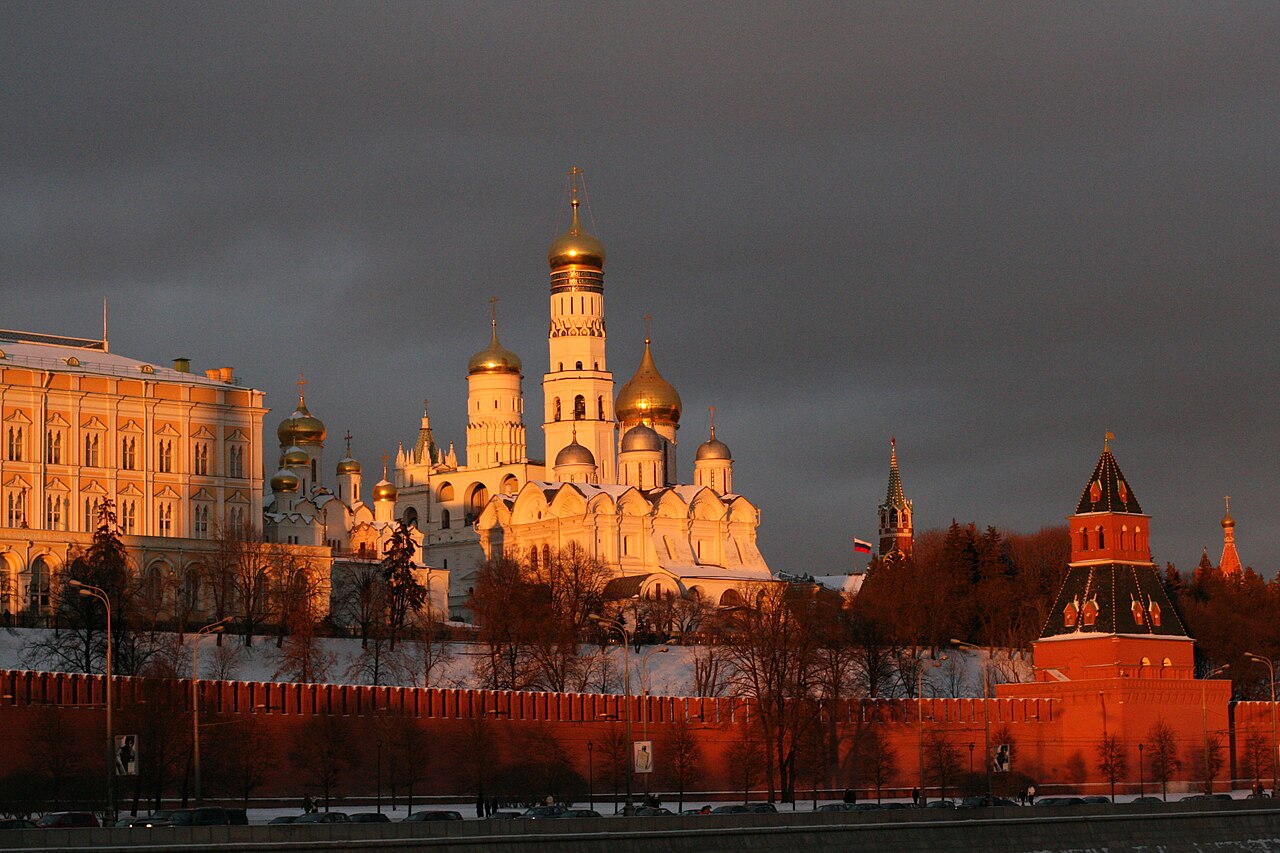
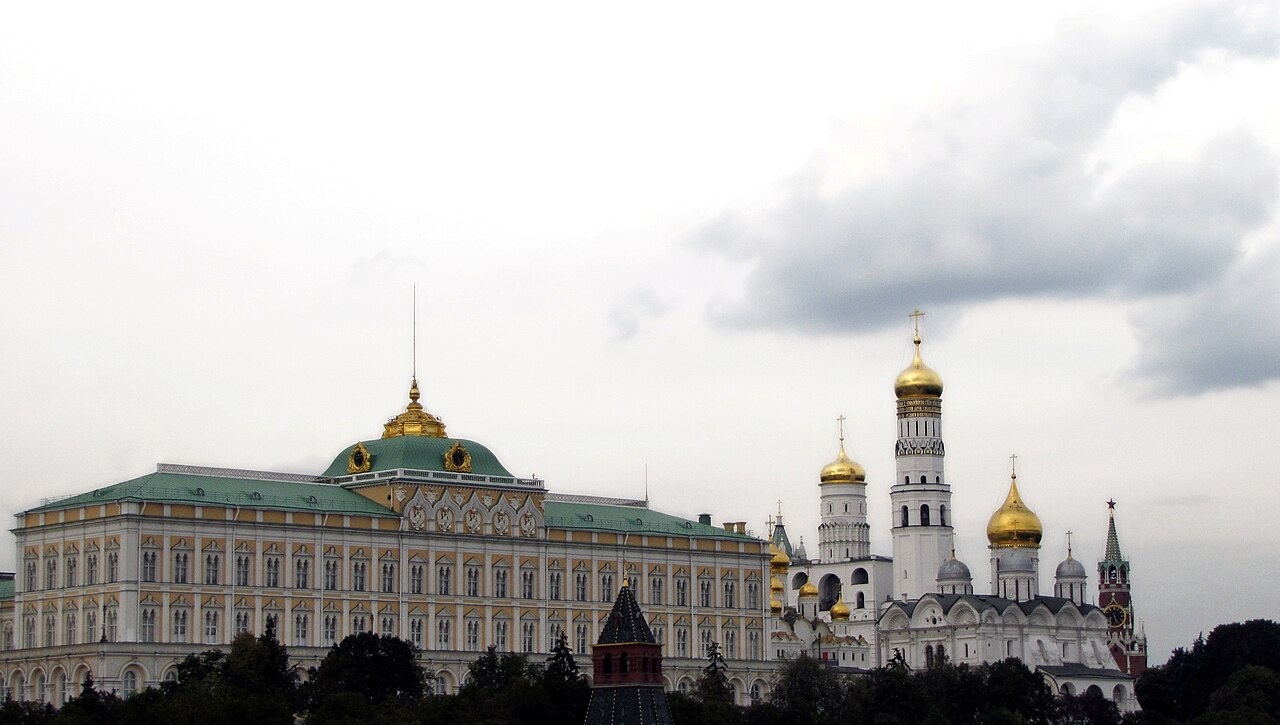
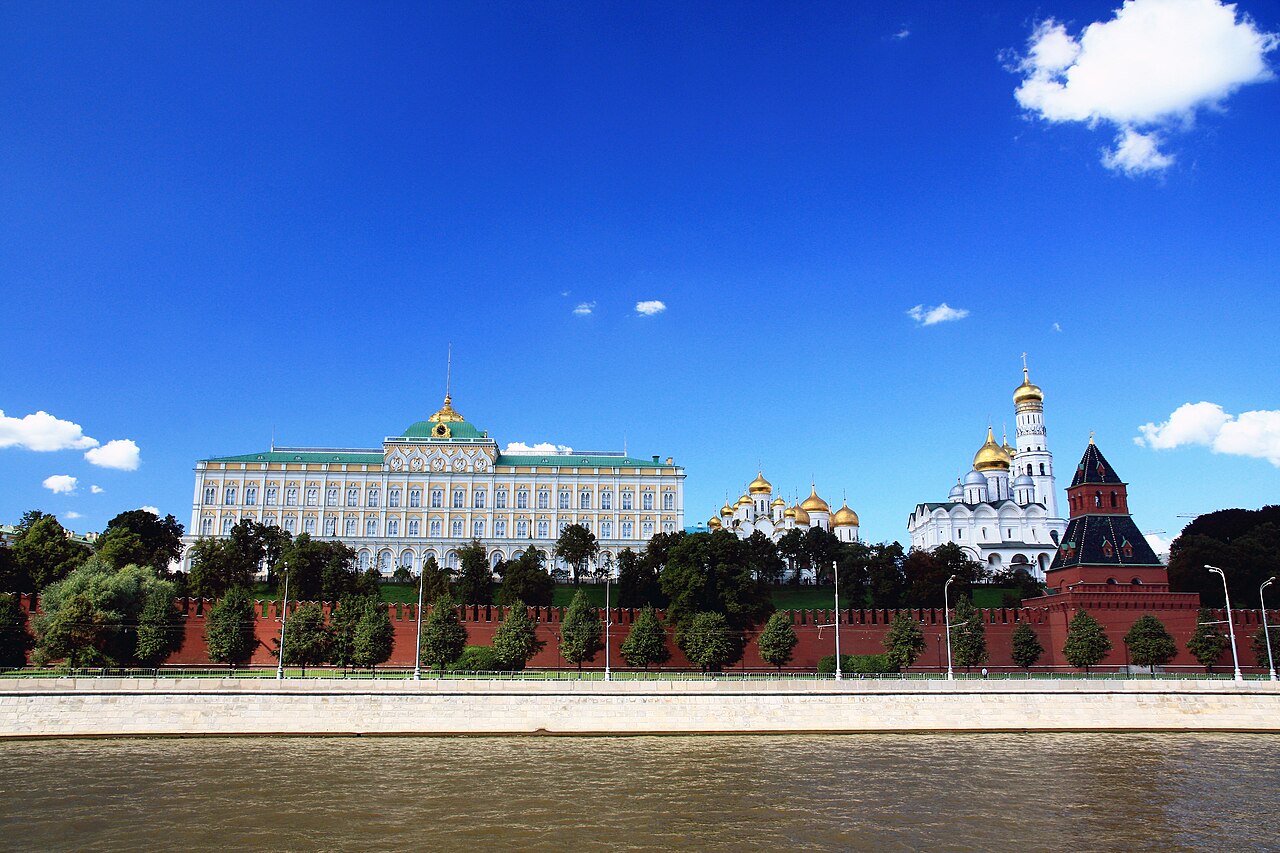
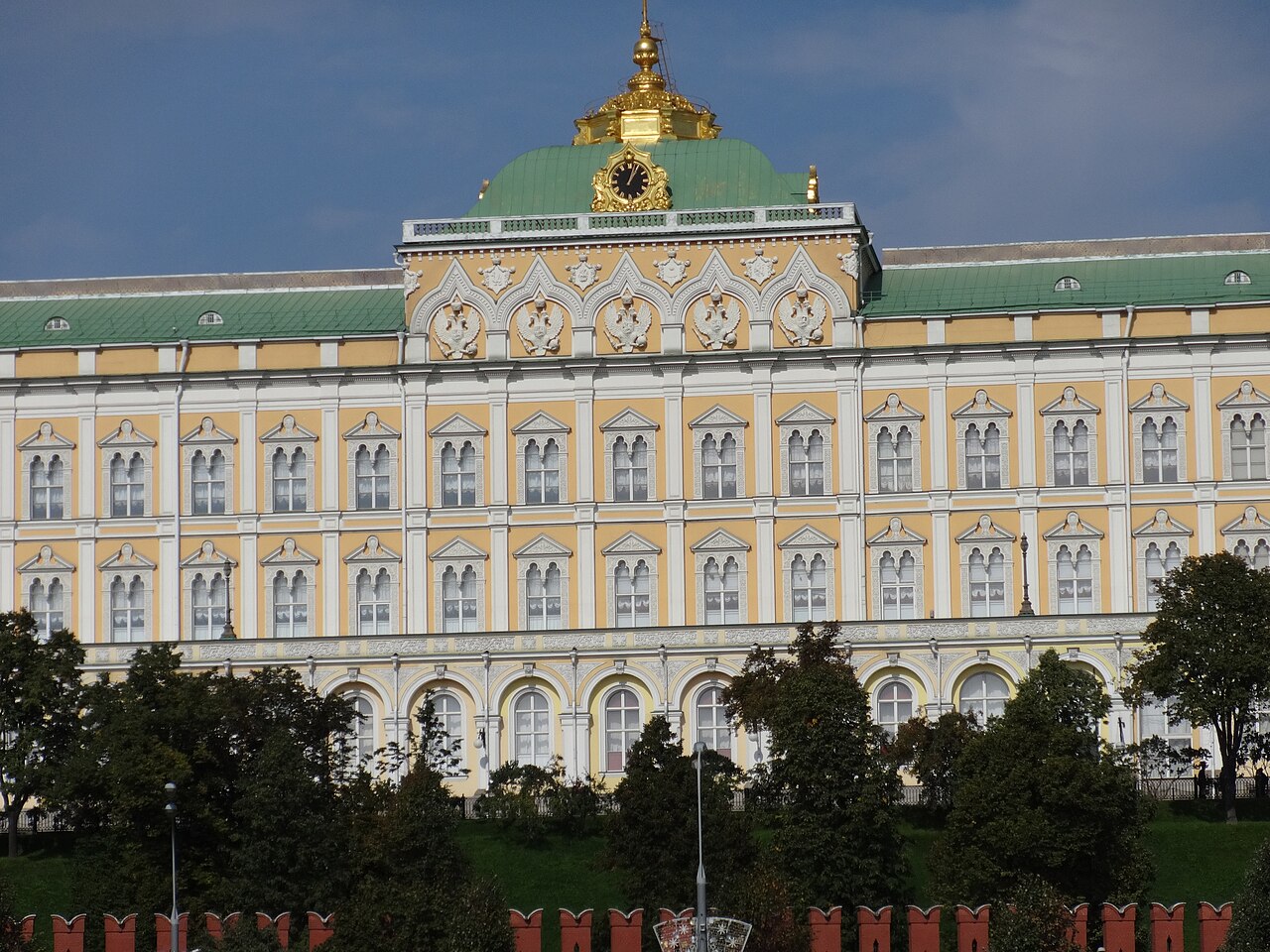
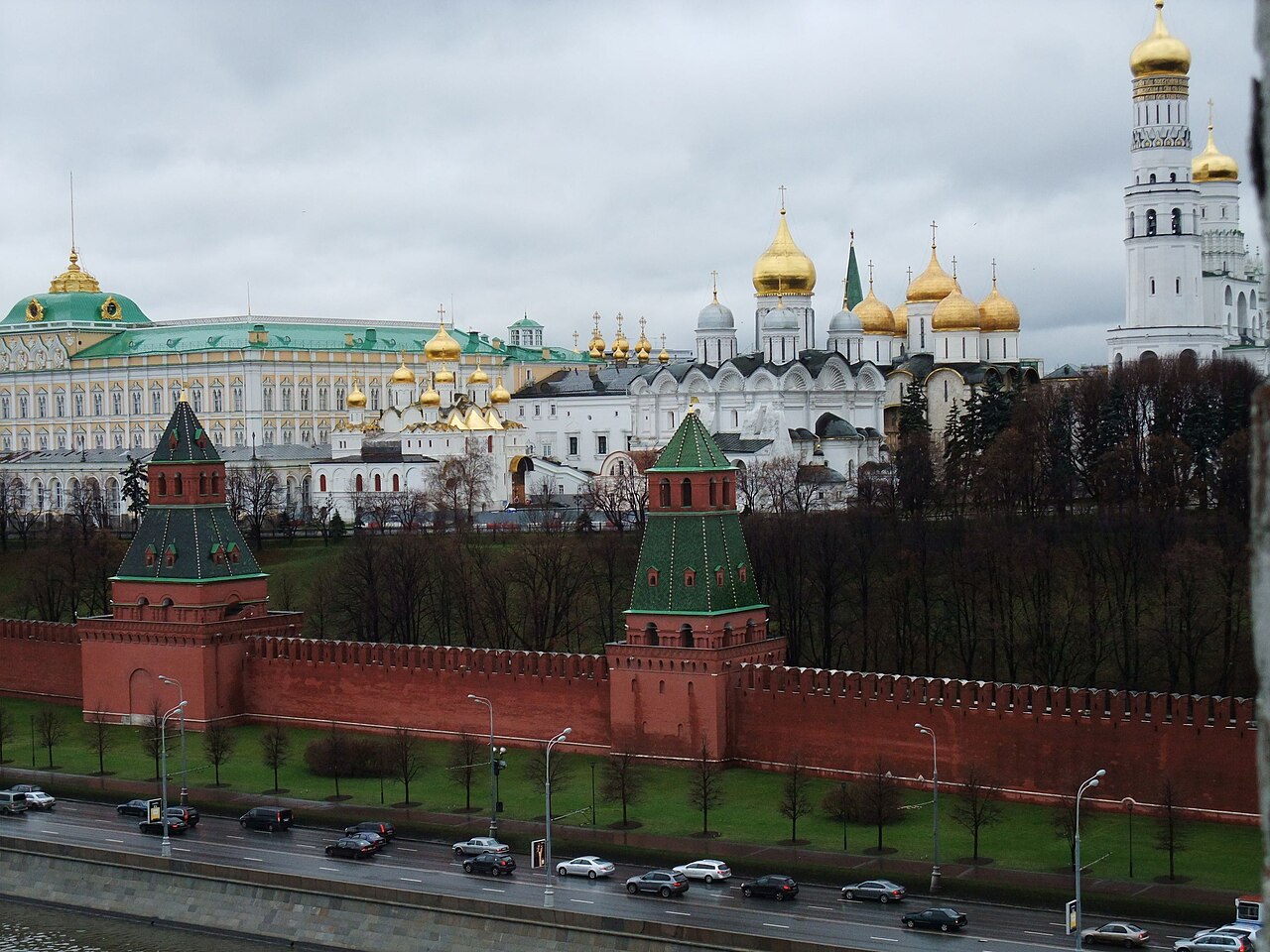
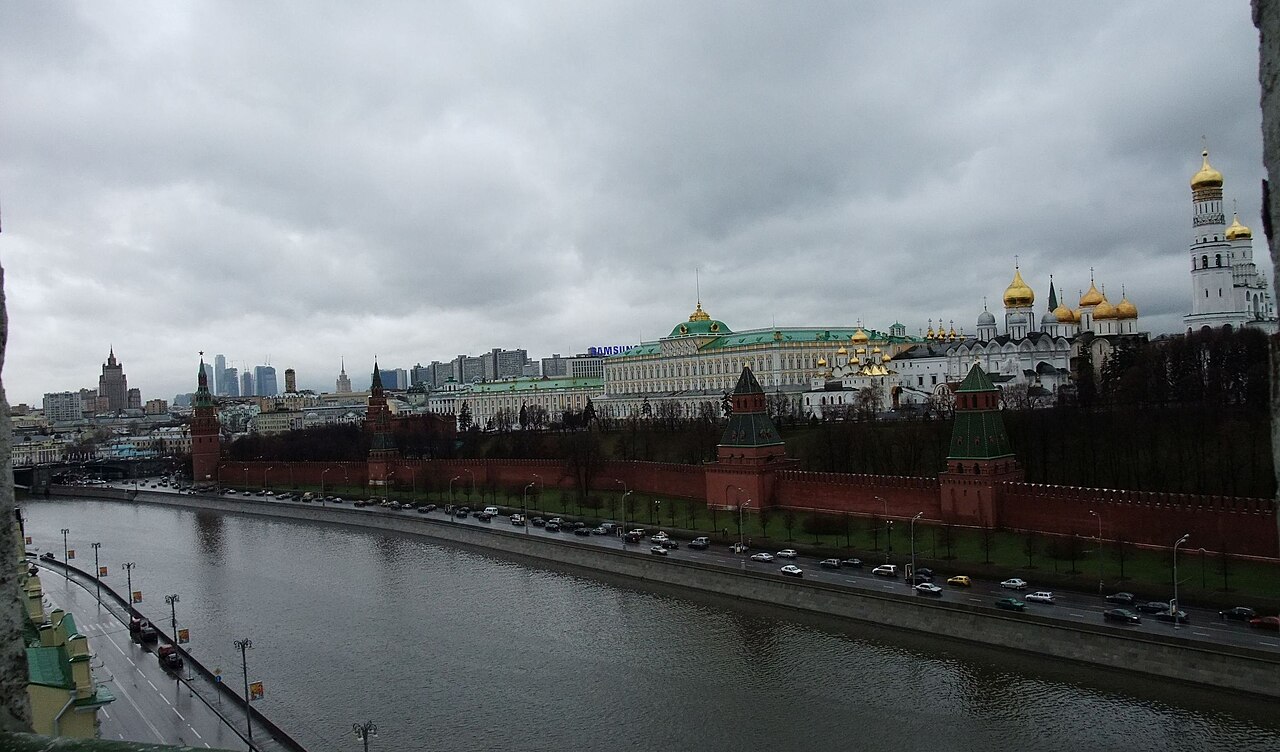
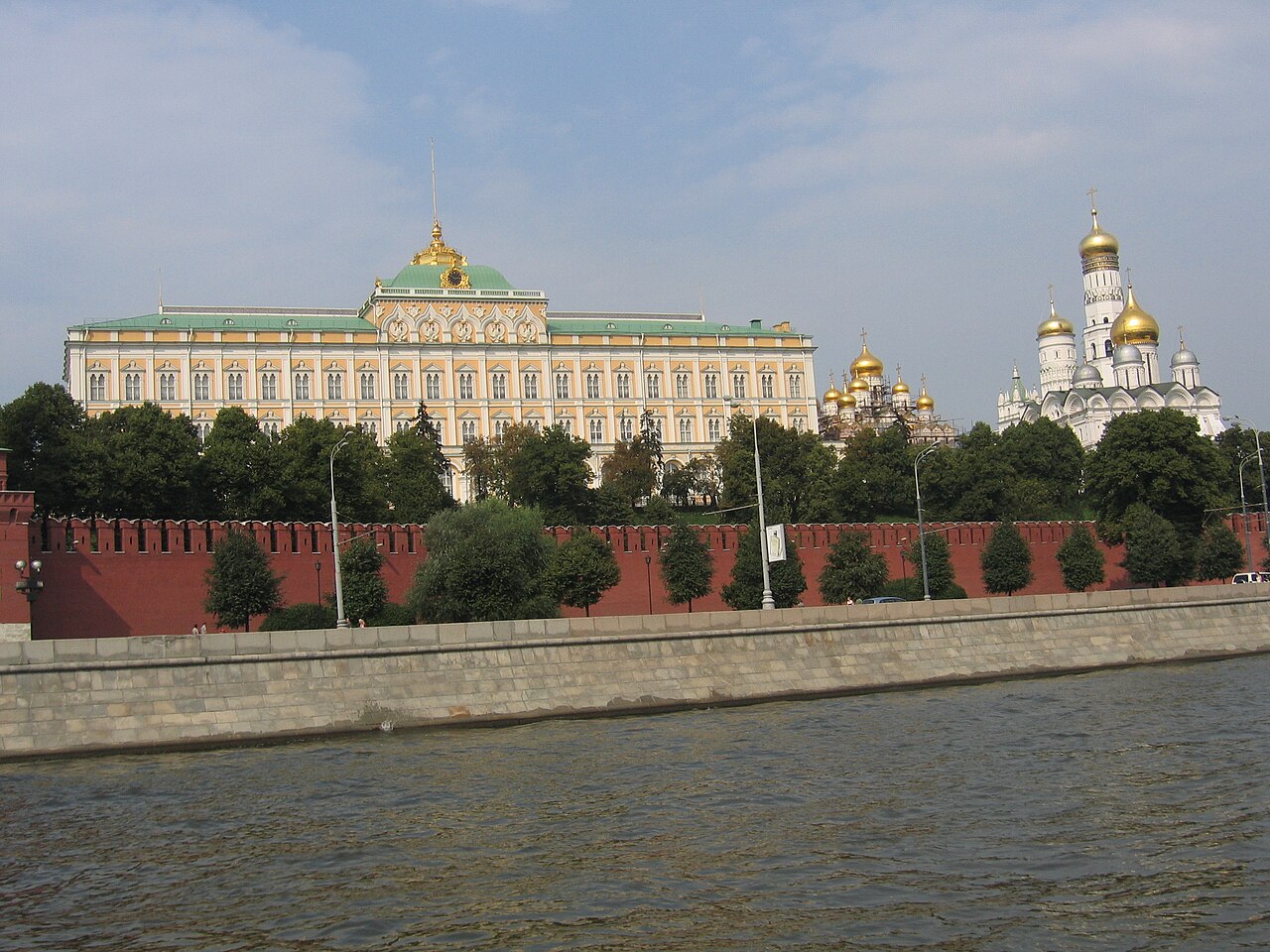
From the Moscow River embankment, one building dominates the Kremlin’s southern face: a long yellow-and-white palace stretched along the hilltop between golden-domed cathedrals, with the Russian flag flying above its green roof. The Grand Kremlin Palace is the ceremonial heart of the Russian state, the place where emperors were feasted after coronations, where Soviet congresses rewrote the world, and where presidents are inaugurated today. Almost no building on earth has hosted so much concentrated history, and almost none is harder to get into.
Nicholas I ordered the palace in 1838 to replace a decayed predecessor, and his architect Konstantin Thon delivered, in one enormous campaign, seven hundred rooms wrapped around five of the most spectacular ceremonial halls ever constructed, each named for an order of imperial chivalry. Yet the palace is more than the nineteenth century: Thon deliberately built his new residence over and around the surviving medieval palaces of the tsars, so that behind the uniform facade hide churches from the 1390s, the golden chambers of Ivan the Terrible’s era, and the fairy-tale Terem Palace of the first Romanovs.
This guide walks you through the whole complex: the centuries of palaces that stood here before, Thon’s imperial machine and its five great halls, the coronation banquets and Soviet transformations, the dramatic days the palace has witnessed from Napoleon’s occupation to the fall of the USSR, and the practical steps, for this is a working presidential residence, that a determined visitor can take to see inside.
- The Palace Hill of Moscow
- Medieval Palaces of the Grand Princes
- Ivan the Terrible’s Golden Chamber
- Napoleon in the Kremlin
- Nicholas I and the Great Rebuilding
- Thon’s Architecture of Empire
- The Hall of St George
- Four More Halls of the Orders
- Coronation Days
- The Old Palaces Within
- The Soviet Palace
- Inaugurations and State Ceremony
- Treasures and Neighbors
- Watch the Grand Kremlin Palace on Film
- Visiting the Grand Kremlin Palace Today
- Palaces Nearby
The Palace Hill of Moscow
Borovitsky Hill, the pine-covered rise where the Moskva and Neglinnaya rivers met, has carried the residence of Moscow’s rulers for as long as Moscow has had rulers. The first recorded mention of the town, in 1147, is an invitation to a feast: Prince Yuri Dolgoruky summoning an ally with the words come to me, brother, to Moscow. Hospitality on this hill, in other words, predates every wall and tower, and the Grand Kremlin Palace continues a tradition of state dining nearly nine centuries old.
The southwestern corner of the hill, where the palace now stands, was always the princes’ own quarter. Wooden mansions rose and burned here generation after generation, for medieval Moscow burned with terrible regularity; chronicles record the city reduced to ash dozens of times, and each time the princely halls rose again, larger, on the same commanding terrace above the river.
The site’s logic is unchanged today. From the palace’s windows the view sweeps across the river to the old merchant quarter and south toward the steppe roads from which Tatar raiders once came, while behind the palace stands Cathedral Square, where the rulers were crowned, married, and buried. Power, faith, and the river road: the palace sits exactly where those three lines of Russian history cross, and always has.
Medieval Palaces of the Grand Princes
The first stone palace on the hill belongs to the era when Moscow was swallowing its rivals. Grand Prince Ivan III, having married the last Byzantine emperor’s niece Sophia Palaiologina and shaken off the Tatar yoke at the Ugra River in 1480, rebuilt his capital to match his new claims. Italian masters raised the Kremlin’s present walls and cathedrals, and in 1487 to 1491 the architects Marco Ruffo and Pietro Antonio Solari built him a banqueting hall that still stands: the Palace of Facets, named for its diamond-cut stone facade.
The Palace of Facets witnessed scenes that define Russian history. Ivan the Terrible celebrated the conquest of Kazan here in 1552 with a feast that lasted three days; in 1653 the assembly that accepted Ukraine under the tsar’s hand gathered here; and foreign envoys, watched from a concealed window by the terem’s secluded royal women, reported banquets of hundreds of dishes served on gold. The hall remains in ceremonial use today, which makes it one of the oldest state dining rooms in the world still doing its original job.
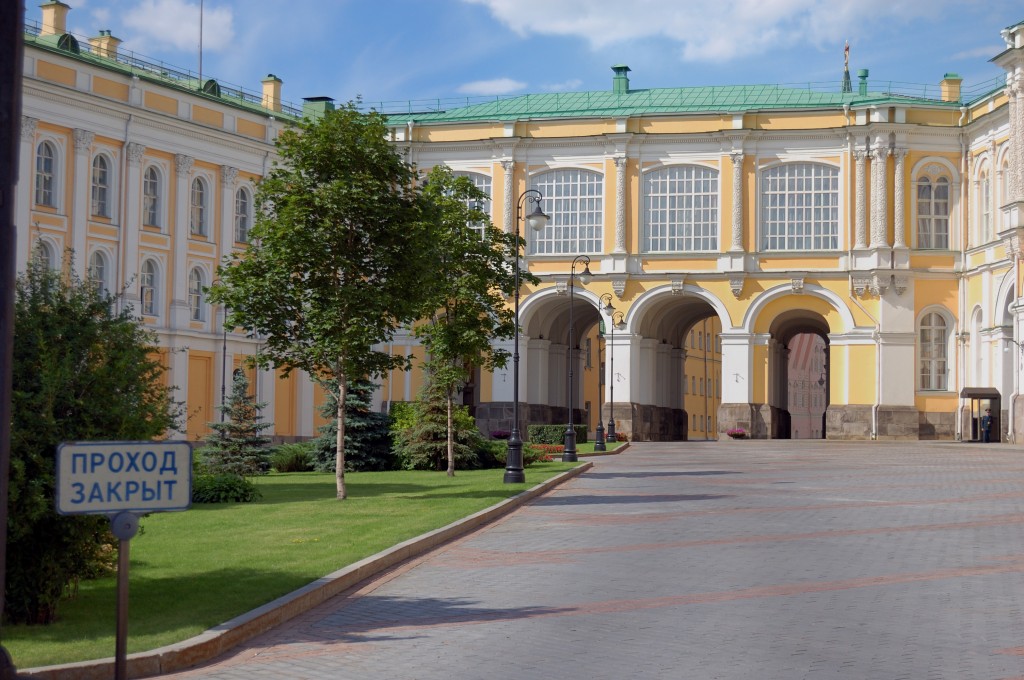
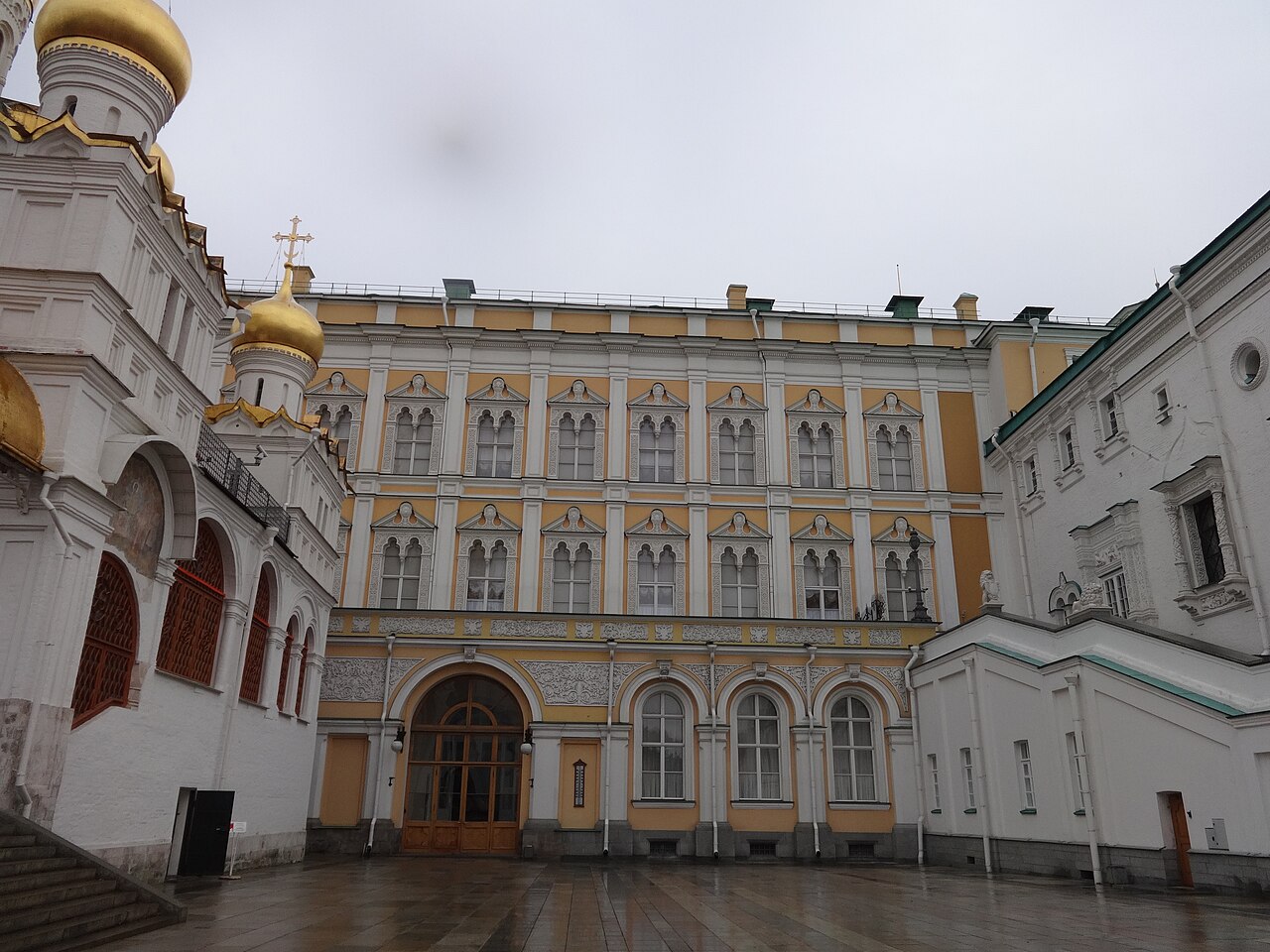
Around the Facets grew a whole city of palace buildings: the Golden Tsaritsa’s Chamber for the tsar’s wife, embankment chambers along the river, staircases, and passage galleries, all linked to the private Terem Palace above. The Grand Kremlin Palace did not replace this medieval labyrinth; it absorbed it, and a tour today moves without warning from the nineteenth century into the sixteenth, one doorway deep.
Ivan the Terrible’s Golden Chamber
Among the preserved interiors, the Golden Tsaritsa’s Chamber carries the strangest stories. Decorated in the 1580s for Irina Godunova, wife of the saintly, feeble Tsar Fyodor and sister of the ambitious Boris Godunov, its walls glow with gold-ground frescoes of holy queens and empresses, a painted argument that a woman could stand near the throne. Irina received foreign churchmen here in state, an almost unheard-of role for a tsaritsa in a culture that normally hid royal women from view.
The chamber passed through the Time of Troubles, the dynastic collapse that followed the end of Ivan the Terrible’s line in 1598, when false pretenders claiming to be Ivan’s dead son Dmitry marched on Moscow with Polish armies, and the Kremlin itself endured occupation and siege. The militia of Minin and Pozharsky retook the fortress in 1612, an event Russia still marks with a national holiday, and the battered palace buildings greeted the first Romanov tsar, sixteen-year-old Mikhail, elected in 1613.
That the Golden Chamber survived everything, Troubles, fires, Napoleon, and the nineteenth-century rebuilding, is close to miraculous. Thon’s engineers simply built the new palace’s state floor above and around it, and the little golden room sits today encased in the imperial giant like a pearl in a very large shell, open to those lucky enough to tour the complex.
Napoleon in the Kremlin
On 14 September 1812, a week after the carnage of Borodino, Napoleon rode through the Kremlin’s gates expecting the ritual surrender of a capital. Instead he found Moscow emptied, its governor gone, its people fled, and within a day the city was burning around him, set alight, most historians agree, by Russian incendiaries on the governor’s orders. The emperor of the French watched from the old palace windows as a sea of fire closed on the fortress.
His secretary recorded Napoleon pacing the tsars’ apartments through the night of 15 September, exclaiming at the horror of the scene, mountains of red, rolling flames. By morning the fire threatened the Kremlin’s powder stores, and Napoleon escaped through smoke along the river to the Petrovsky Palace outside the city, the same travel palace Catherine the Great had built for rest stops on the road from St Petersburg. He returned days later to a charred capital and spent a futile month waiting for a peace offer from Alexander I that never came.
The departure was vindictive. Leaving in October, Napoleon ordered the Kremlin mined; explosions wrecked towers, stretches of wall, and parts of the palace ensemble, though rain, hurrying sappers, and brave Muscovites who cut fuses spared the cathedrals and much else. The repairs that followed patched the old palaces one more time, but the damage, and the memory of 1812, prepared the ground for the idea that the ancient fortress deserved an entirely new imperial residence.
Nicholas I and the Great Rebuilding
Nicholas I, the gendarme of Europe, had precise ideas about architecture’s duty to the state. Crowned in Moscow in 1826 amid the aftershocks of the Decembrist revolt, he found the Kremlin’s residential buildings, a patchwork of medieval chambers and a cramped eighteenth-century palace, unworthy of the empire’s sacred capital. In 1838 he ordered a new palace whose brief was ideological: it should express, in his ministers’ famous formula, Orthodoxy, autocracy, and nationality.
The emperor followed the project obsessively, reviewing drawings, rejecting economies, and insisting that the new building honor the old. The medieval churches and chambers on the site were to be preserved and integrated, an early and remarkable act of architectural conservation; the new state halls would be dedicated not to pagan gods or French fashions but to the Russian orders of chivalry, saints George, Andrew, Alexander, Vladimir, and Catherine.
Eleven years of construction employed thousands of craftsmen and the empire’s newest technology: iron roof trusses, early central heating, and concrete vaults stood behind facades carved with old-Russian window frames. When the palace was consecrated at Easter 1849, Nicholas had his argument in stone, a residence that claimed descent from Byzantium and Muscovy while out-scaling anything in Europe. The cost, legend says, made even the autocrat wince.
Thon’s Architecture of Empire
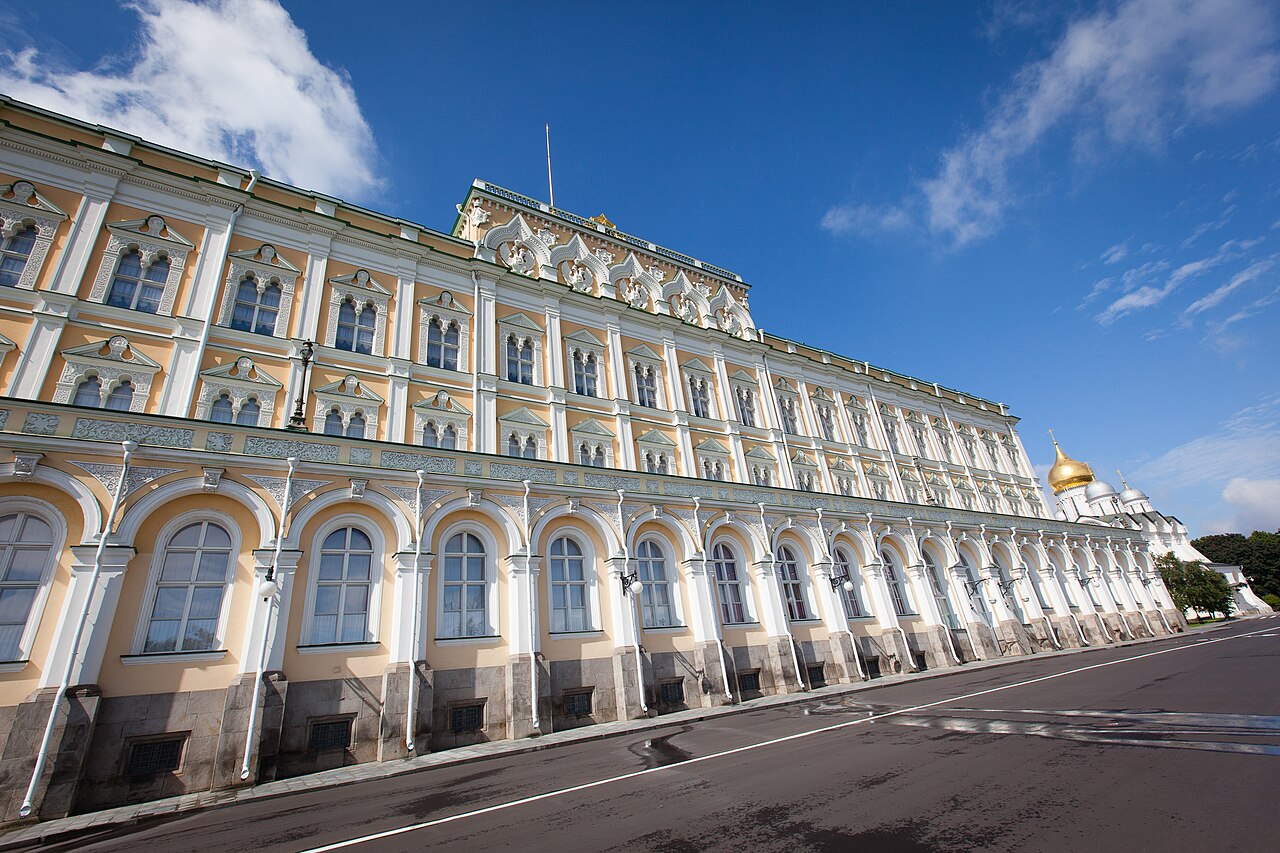
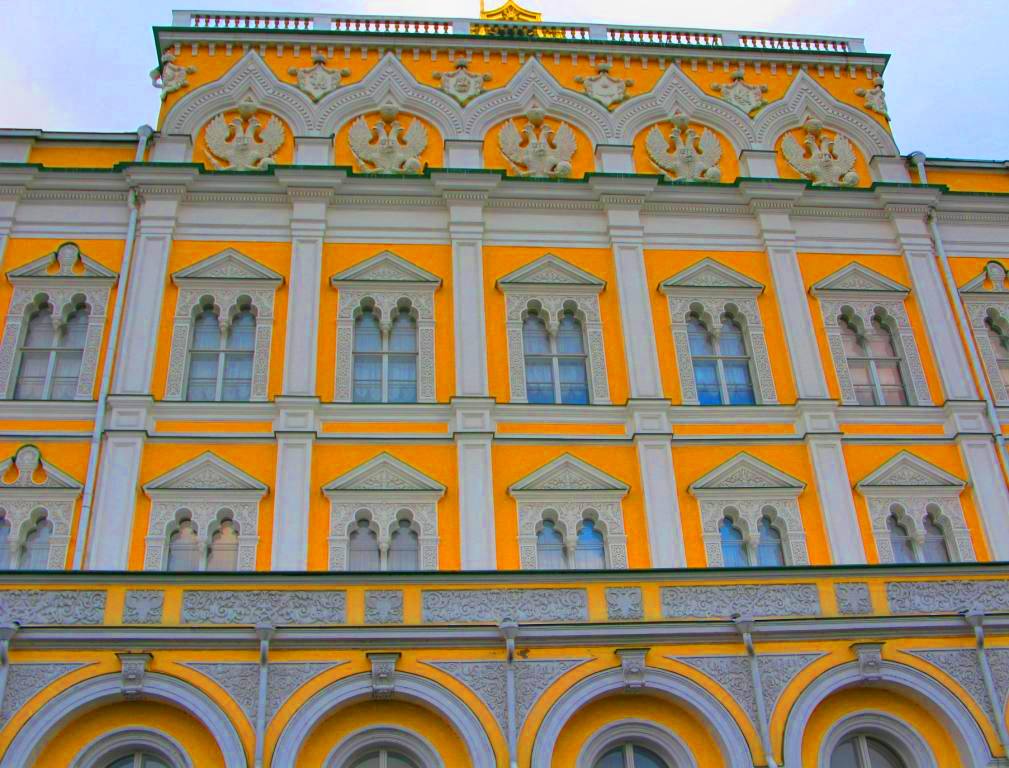
Konstantin Thon was the perfect instrument for the imperial program. German-Russian, academically trained, and already building the colossal Cathedral of Christ the Savior across the river, he invented for Nicholas what became known as the Russo-Byzantine style: classical discipline dressed in motifs from old Russian churches, arched window pairs, kokoshnik gables, and tent-roofed accents, mass-produced at imperial scale.
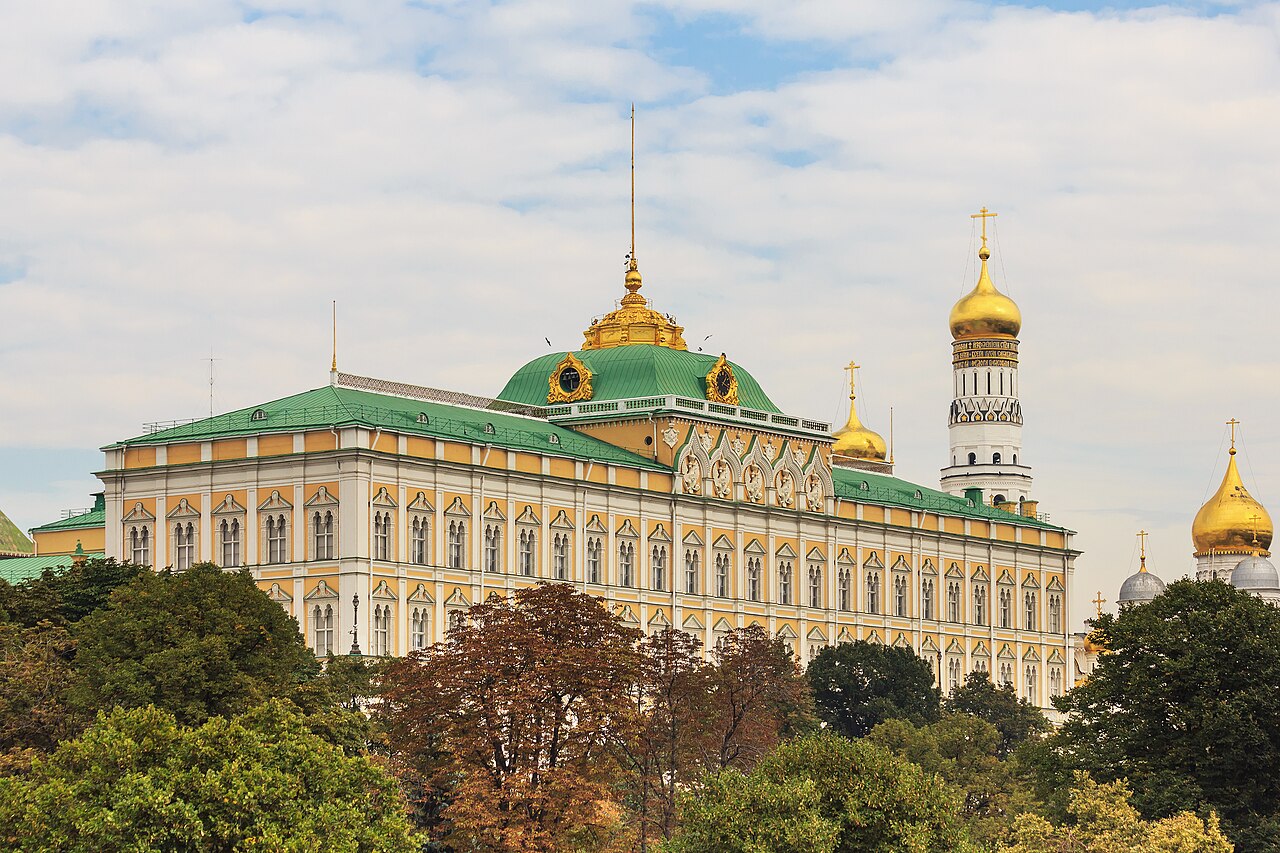
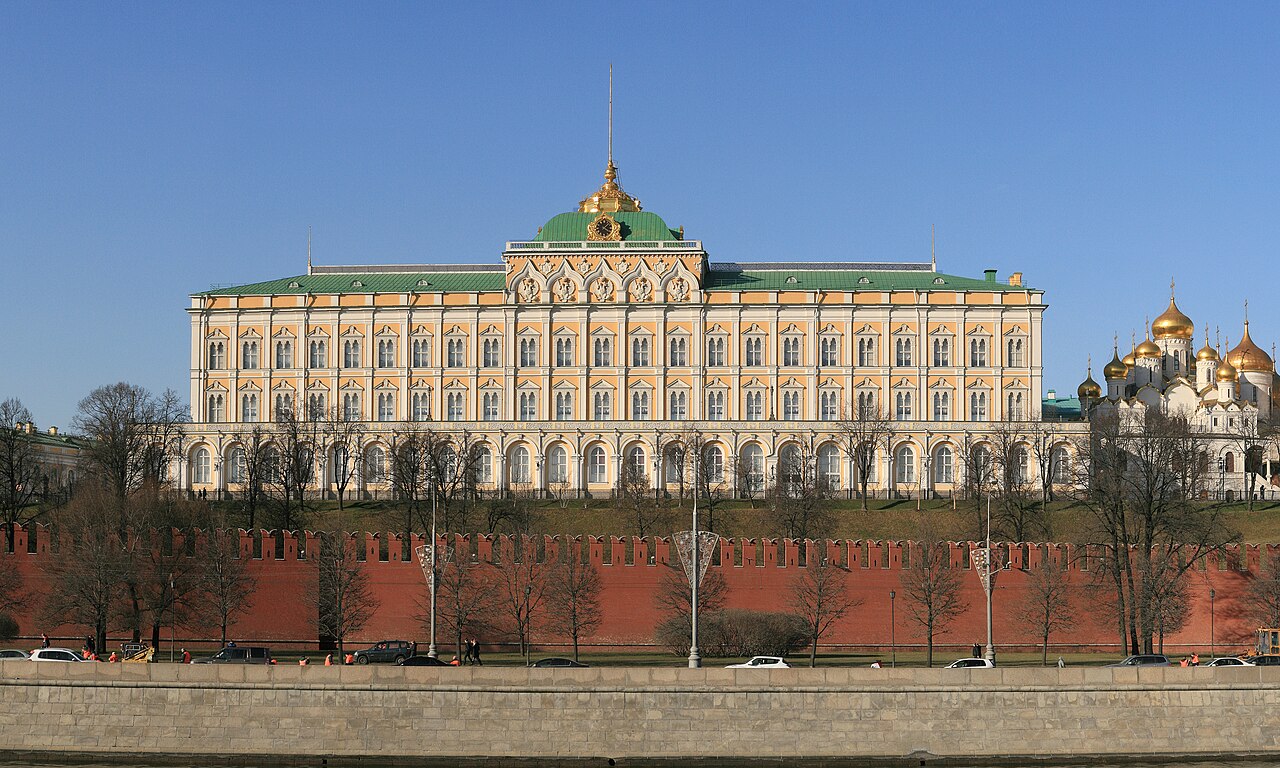
His palace is a rectangle of seven hundred rooms around internal courtyards, its river front 125 meters long. A visual trick governs the facade: it reads as three stories but holds only two, the upper state floor rising through two tiers of windows beneath its gilded balustrade. The main entrance opens into a vestibule of polished granite columns, from which a ceremonial staircase of sixty-six marble steps climbs toward the halls, a route designed to make every arriving dignitary feel the machine of empire closing around them.
Thon coordinated an army of decorators, sculptors, and furniture makers, and the palace’s unity of effect, every door handle and parquet pattern drawn into one system, remains its most astonishing feature. Later architects added little; the building was complete as an idea on the day it opened, which is perhaps why it has served tsars, general secretaries, and presidents without needing to change its face.
The Hall of St George
The Georgievsky Hall is the palace’s heart and Russia’s hall of military fame. Sixty-one meters long and dazzling white, it is dedicated to the Order of St George, the empire’s highest award for valor, and its walls and eighteen spiral-wrapped columns carry marble plaques gilded with the names of every St George regiment and more than ten thousand individual knights of the order, from Suvorov and Kutuzov to the sailors of forgotten frigates.
The hall’s statistics suit its purpose: six gilded bronze chandeliers of three thousand candles’ power, a parquet of twenty precious woods, and zinc victory statues over the doors. But its force is in the names. Russian officers still come to find ancestors on the walls, and when new cavaliers of the restored order are honored here, they stand quite literally surrounded by every predecessor since 1769.
History has used the room hard. Imperial coronation banquets filled it with gold plate; in 1945 the victory reception for marshals and soldiers of the Great Patriotic War brought Stalin’s toasts echoing off the columns; Yuri Gagarin danced here after his flight in 1961; and nuclear treaties and state visits have been signed beneath its chandeliers. To be received in the Georgievsky Hall remains, in Russian protocol, the summit of honor.
Four More Halls of the Orders
Beyond the Georgievsky open the other halls of the orders, each a different world. The Vladimirsky Hall, octagonal under a soaring ribbed dome of gilded stucco, honors the Order of St Vladimir and serves as the hinge between the new palace and the medieval buildings; treaties are often signed beneath its single hanging lantern. The Alexandrovsky Hall, rose marble and gold mosaic domes, celebrates the Order of St Alexander Nevsky with the warrior-saint’s deeds painted overhead.
The Andreyevsky Hall is the throne room. Dedicated to the Order of St Andrew, the empire’s oldest, it blazes with gold on blue, and at its eastern end, beneath an ermine canopy, stand three throne chairs used at the last coronations. The Soviet state gutted the Andreyevsky and Alexandrovsky halls in the 1930s, merging them into a plain assembly chamber for party congresses; their restoration in the 1990s, from photographs and surviving fragments, returned the suite to Nicholas I’s design and remains one of the largest reconstruction projects in modern Russia.
The fifth hall, the Ekaterininsky, dedicated to the women’s Order of St Catherine, served as the empresses’ throne room, its pilasters set with malachite and its silk walls woven with the order’s motto. Smaller and more intimate, it is today the setting for presidential meetings with delegations, continuing its old role as the palace’s drawing room of highest rank.
Coronation Days
Every Russian emperor, wherever he lived, had to come to Moscow to be crowned, and the palace existed above all for those days. Coronations followed a script centuries old: the procession across Cathedral Square under a brocade canopy, the crowning in the Assumption Cathedral, and then the new sovereign’s banquet in the Palace of Facets, where the tsar dined alone on a dais while the great of the realm served him by hand.
Alexander II’s coronation in 1856 inaugurated the finished palace with festivities that dazzled Europe’s press; Alexander III’s in 1883 filled the halls with such crowds that electric lighting, a novelty, was strung through the courtyards. The last coronation, Nicholas II’s in May 1896, began in splendor here and ended in horror days later when a crowd at the Khodynka field festivities, almost within sight of the Petrovsky Palace, stampeded for souvenir cups and more than a thousand people died, an omen Russians never forgot.
The palace’s coronation role left permanent traces: the throne hall’s three chairs stand as they did in 1896, the Facets’ frescoes were repainted for the ceremonies, and the great kitchens below the halls were built to feed thousands of guests at a sitting. When modern Russia stages its presidential inaugurations along the same staircases and through the same halls, the choreography is, consciously, the old coronation route in a new key.
The Old Palaces Within
The deepest magic of the Grand Kremlin Palace is that its corridors lead backward in time. A door from the Vladimirsky Hall opens into the Holy Vestibule and the Palace of Facets of 1491; a staircase descends to the Golden Tsaritsa’s Chamber of the 1580s; and above them rises the Terem Palace of 1635 to 1636, the checkerboard-roofed, red-and-white residence of the first Romanov tsars, its five tiers crowned with a golden-domed teremok where the young heirs took their lessons.
Oldest of all is the Church of the Nativity of the Virgin on the Senya, founded in 1393 by Princess Eudoxia, widow of Dmitry Donskoy, the prince who first beat the Tatars at Kulikovo. The little church, rebuilt but never destroyed, has stood through every fire, siege, and rebuilding; it is the most ancient surviving building in the Kremlin and one of the oldest in Moscow, hidden completely inside the nineteenth-century palace, invisible from any street.
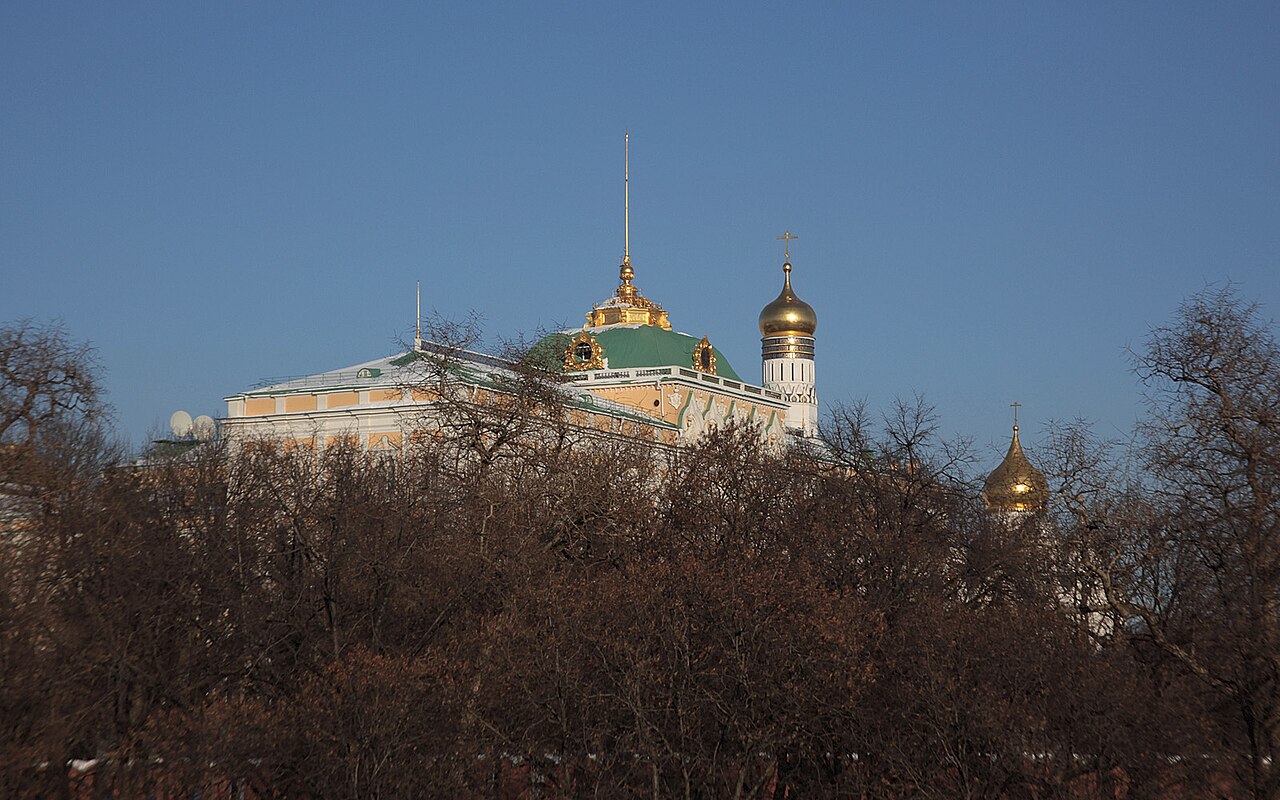
Eleven palace churches in all survive within the complex, their golden domes clustering behind Thon’s roofline where the river view catches them. The ensemble, imperial halls wrapped around a medieval core, makes the Grand Kremlin Palace less a single building than Russian history in cross-section, which was precisely the effect Nicholas I paid for.
The Soviet Palace
In March 1918, with German armies near revolutionary Petrograd, Lenin moved the Soviet government to Moscow and into the Kremlin, and the palace of the tsars became the stage of a new regime. Congresses of Soviets met in the converted halls; the Comintern gathered world revolutionaries beneath the chandeliers; and in 1936 the merged Andreyevsky-Alexandrovsky chamber heard Stalin proclaim his constitution.
The palace saw the Soviet century’s turning points. The Supreme Soviet confirmed the industrial plans and, in time, the leaders who succeeded Stalin; in the Georgievsky Hall the 1945 victory banquet toasted the Red Army’s marshals; Gagarin’s reception in 1961 brought the space age into the hall of St George. Khrushchev added a modernist Palace of Congresses next door in 1961 for party gatherings, sparing Thon’s halls further remodeling.
The ending came where so much had begun. In December 1991 the Soviet flag over the palace ensemble came down, and the agreements dissolving the USSR left the Grand Kremlin Palace the residence of a new Russian state. The 1990s restoration of the gutted halls followed, and the palace emerged into its third political life with its imperial face returned.
Inaugurations and State Ceremony
Today the Grand Kremlin Palace is the ceremonial residence of the President of Russia, and its halls carry the state’s highest theater. Presidential inaugurations process through the Georgievsky, Alexandrovsky, and Andreyevsky halls to the oath; ambassadors present credentials beneath the Alexandrovsky mosaics; treaties, state dinners, and the reception of new St George cavaliers fill the calendar the tsars began.
The working palace also houses, in its reconstructed wing, the president’s representational offices, while the state apartments along the river front, the parade suite once kept for the imperial family, serve visiting heads of state. Security is correspondingly absolute: the palace stands inside the Kremlin’s guarded zone, and entry is possible only on official business or pre-arranged group tours vetted in advance.
Television has made the halls familiar to every Russian: the long walk down the Georgievsky carpet is the modern image of power’s threshold. For the visitor who manages to stand there in person, the surprise is the silence, seven hundred rooms of history holding their breath between ceremonies.
Treasures and Neighbors
The palace anchors a treasury quarter. Its western service wing connects to the Armoury Chamber, the oldest museum in Russia, where the crowns, thrones, carriages, and Faberge eggs of the dynasty are displayed, including the Monomakh Cap, the fur-trimmed golden crown of Muscovy’s rulers, and the coronation gowns worn a few hundred meters from where they rest. The Diamond Fund next door guards the imperial regalia’s great stones.
Around the palace spreads everything that made the Kremlin: the Assumption Cathedral of the coronations, the Archangel Cathedral where pre-Petrine tsars lie in carved sarcophagi, Ivan the Great’s bell tower, the Tsar Bell and Tsar Cannon, and the walls and twenty towers themselves, built by Italians five centuries ago and still the emblem of Russian statehood. A palace ticket, when obtainable, is thus a key to the densest historical precinct in the country.
The ensemble is a UNESCO World Heritage site, and the palace its least accessible jewel, which only sharpens the appetite. Many visitors content themselves with the river view at dusk, when the facade turns gold and the domes behind it catch fire; it is, fittingly for a palace of ceremonies, one of the great staged pictures of Europe.
Watch the Grand Kremlin Palace on Film
Visiting the Grand Kremlin Palace Today
The Grand Kremlin Palace stands inside the Moscow Kremlin, reached through the visitor entrances at Kutafya Tower; the nearest metro stations are Biblioteka imeni Lenina, Aleksandrovsky Sad, and Borovitskaya. The palace interior is not on the standard Kremlin ticket: it opens only to pre-arranged excursions booked through accredited agencies, with passport details submitted in advance, limited dates, and prices far above ordinary museum entry, so plan weeks ahead if the halls are your goal. The Kremlin grounds, cathedrals, and Armoury Chamber are ticketed normally and fill a full day on their own; the classic palace view is from the Sofiyskaya embankment across the river, best at sunset. You can find the palace on the map here: Grand Kremlin Palace on Google Maps.
Palaces Nearby
You May Like
Ropsha Palace and the Darkest Secret of the Romanovs