Ariassos, one of the cities of the Pisidia Region, is located fifty kilometers north of Antalya, one kilometer away from Akkoç village, west of Çubukbeli, the strait connecting the Antalya coast to the Anatolian Plateau. The official founding year of the city is 189-188 BC in connection with the expedition of Manlius Vulso and the Peace of Apameia.
It is known that the city continued to mint coins from the 1st century BC until the Gallienus period (253-267). The city is shown in the Pamphylia Province in the Late Antique Period by the Byzantine geographer Hierocles. In church documents called Notitiae Episcopatum, it was referred to as the bishopric of the Pamphylia Region until the 12th century. Ariassos, which was in unity with other Pisidian cities, lived on tolls and tribute due to its location on the connection roads. Life in the city ended after the Byzantine period.
Antalya Provincial Directorate of Culture and Tourism
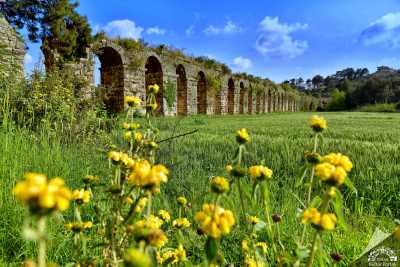
When the city plan of Ariassos is examined, firstly, from east to west, there is a necropolis area, the southern corner of the city walls and civil buildings, the city gate, a possible columned street extending from the gate to the west, the main city settlement on the north side of this street, and a necropolis area in the west. The city was placed on terraces created on the northern slope parallel to this street extending in the east-west direction. The most important structures are the city gate, mausoleum-type tomb structures, city walls, Roman Road, waterway, nymphaion, bouleuterion, gymnasium, bath and theater structures.

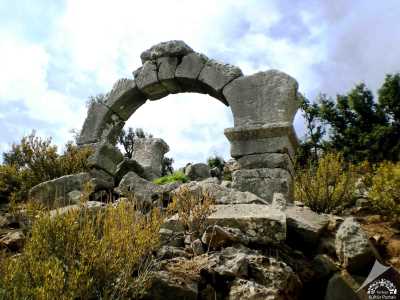
At the beginning of the valley where you enter the City of Ariassos, the monumental entrance gate, the most magnificent ruin of the city, rises. It is understood that the three-arched city gate, which is almost intact, was used during the time of Roman Emperor Severus Alexander.
Antalya Provincial Directorate of Culture and Tourism
In addition, three small church buildings were identified, two on the colonnaded street assumed to exist between the city gate and the fountain building, and one in the northwestern part of the city. There are ruins of an ancient Roman road on the western slope of the city, intersecting today’s Akkoç village road. The road was built with properly laid large blocks and extends from Termessos to the western gate of Ariassos. The most eye-catching structures of Ariassos after the city gate are the monumental tombs.
Antalya Provincial Directorate of Culture and Tourism

There are two necropolis areas on the east and west sides, integrated with the city settlement. There are nine mausoleum-type tombs on the north side of the western necropolis. These are covered with a double vault over a podium with an orthostat resting on a two-crepis stylobate. Six stairs between the antes lead to the rooms where the sarcophagus is located. In the western necropolis, forty simple-structured tomb buildings with direct entrances, built on rectangular planned platforms with one or two steps, were identified. In the eastern necropolis, we encounter nine tomb structures. Apart from these, sarcophagi made of limestone, with tabula ansata on the sides, and Pisidian-type shielded sarcophagi on narrow faces, and simple burial forms carved directly into the rock were also used.
Source: “Ariassos”, Antalya From Past to Present II. Volume, Antalya Provincial Directorate of Culture and Tourism (2012)
Places to Visit in Antalya
Source: Antalya Provincial Culture and Tourism Directorate