Sillyon was located in the Pamphylia Region in ancient times and today in the Yanköy neighborhood of Serik district of Antalya. It is an accepted view that the name Sillyon is derived from Šalluša mentioned in Hittite texts and is not a Greek name.
During the Persian rule in Anatolia, the Pamphylia Region, where Sillyon is located, remained under Persian rule, and this situation continued until the time of Alexander the Great. During this period, Sillyon, with its fortified structure, became the epicenter where the Persian navy and garrison troops gathered. Ancient writer Arrianus tells that Alexander the Great came to Pamphylia in 334 BC and surrounded Sillyon with a unit of his army, but could not take it. It is understood that archaeological data about Sillyon increased in the Hellenistic period after Alexander the Great and from these findings, Sillyon now showed a city character. In the 4th century BC, Sillyon was a powerful and autonomous city that minted coins.
During the Roman period, Sillyon expanded and became a large city, and during this period, the philanthropist Menodora, one of the richest families of the city, made large donations to the city. With the help of Menodora, many religious and public buildings were built in the city and the city became magnificent.
In Byzantine Pamphylia, Sillyon became a bishopric center and maintained this status for a long time. It is known that two patriarchs named Konstantinos and Antonius served in Sillyon. It is also understood that Sillyon has an important place in the region in terms of Christian history, as its name is mentioned in different meetings and councils of the bishops of the city. The names Neon of Sillyon are mentioned in the consul of Chalcedon, and Plusianus of Sillyon in the consul of Constantinople.
Sillyon hosted some historical developments as Karahisar-ı Teke Castle, one of the important centers of Teke province during the Turkish-Islamic period, and was inhabited until the 17th century. The castle mosque structure, located at the northwest point of the Sillyon acropolis, is the greatest evidence of the Turkish-Islamic presence in the city. This structure is among the earliest Turkish-Islamic works in the Antalya Region.

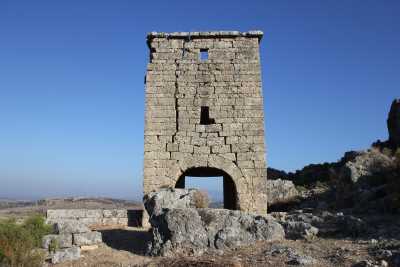
Sillyon stands out as one of the rare ancient cities in Anatolia that can present traces of all historical periods in the same frame. The fact that the hilly area where the city was built consists of a large rock mass increased the strength of the buildings and enabled many of the buildings to remain intact until today. The Main City Gate is located at the southwestern foot of the acropolis and where the Ramped Street leading to the acropolis begins. Five towers in different plans were built on the lower city walls of the city and four in different plans in the defense of the acropolis. The Hellenistic tower in the Lower City has been preserved down to the roof level. There is a door on the ground floor of the three-storey tower, and this door provides a secondary entrance to the city.
The stadium structure is located on the western slope of the city. Sillyon stadium is the largest stadium in the Pamphylia Region with a length of 254 meters. There is a Roman bath to the east of the stadium. According to the current plan scheme of the Roman bath, it is understood that it consists of five sequential halls. The building was used until late antiquity.
Kastron is located in the western part of the acropolis. Inside the kastron, there is a praitorion leaning against the northern wall. There are visor areas on the remaining intact walls of the kastron. The kastron functioned as the commander’s palace or administrative headquarters building. It is thought that the kastron was built immediately after the city was moved to the acropolis during the Byzantine period and continued to be used as a mansion during the Turkish-Islamic period.
Churches A and B are located in the center of the acropolis. Sillyon Theater is located in the southern part of the Acropolis. Located in a view overlooking the Pamphylia Plain and the Mediterranean, the theater has a magnificent viewing angle. As a result of the earthquake and landslides, the stage building and some of the seating steps of the theater were destroyed. Currently, only twelve seating steps and the western wall remain intact. The Terrace of Temples is located to the south of the city acropolis. There are magnificent temples on two different terraces separated by stairs.

The city is a special city that presents historical processes from ancient times to the present day, together with its magnificent structures. The fact that almost all the structures are standing offers a unique tour experience in the city and allows us to fully understand the ancient city.
Source: Sillyon Excavation Directorate
Places to Visit in Antalya
Source: Antalya Provincial Culture and Tourism Directorate