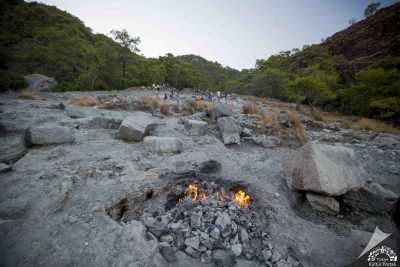
Located a few kilometers southwest of Olympos Ancient City, Yanartaş is a natural formation that has been the subject of legends with its ever-burning fire since ancient times. It is also known as the Chimera, after the legendary beast that is the source of the flames.
From the entrance of Olympos Ruins, after about half an hour of walking, you can reach the hill with these glowing stones. The area, approximately 300 meters above the slopes of Çıralı beach in Antalya’s Kemer district, is within the borders of Beydağları Coastal National Park.
TGA
Olympos is considered one of the important settlement centers of the Lycian Union. Commander Servilius Isauricus cleared this city, which was founded in the Hellenistic period, from pirates and annexed it to Roman territory in 78 BC. The city became famous for its self-burning fire and became an important religious center; It maintained this importance in the Roman and Byzantine periods as well.
This natural phenomenon, which takes place in Olympos, occurs when methane gas coming out of the cracks of a thousands-year-old natural gas source reaches the earth and burns. The fire, which was stronger in the past, turned into small but numerous flames over time. The flames, which are faint during the day, are quite visible at night. These flames have guided sailors like a beacon for thousands of years.
“The unquenchable fire of Lycia” is identified in Greek mythology with the mythical creature Chimera (Khimaira, Chimaera, Chimera), which breathes fire from its mouth; In this way, Olympos hosted the Legend of Bellerophontes. This legend, which has been told for thousands of years in Anatolia, was first told by Homer in the Iliad. According to the legend:

Hipponoes, the son of Ephyra King Glaukos, killed his brother Belleros in a hunting party and took the name Bellerophontes, meaning “Eater of Belleros”. Bellerophontes, who was exiled from Ephyra, takes shelter with the King of Argos. Unable to kill this young man who took refuge in him, the King of Argos sends him to the King of Lycia.
The King of Lycia does not want to kill this pitiful young man and sends him to fight with Chimera, a monster with a lion head, a goat body, a snake tail and a flaming mouth that lives on Mount Olympus. Bellerophontes goes to fight Chimera by riding his winged horse named Pegassos. When the Chimera attacks, Pegassos takes off and Bellerophontes lands on the ground, burying the monster seven floors underground with his spear. But Chimera continues to spread flames from seven floors below the ground.
The flames that still burn today are the flames of Chimera gushing from seven layers underground…
A race is organized in Olympos to celebrate Bellerophontes’ victory. The athletes run to the city of Olympos, igniting their torches with the sacred fire of Chimera. Thus, the first example of the Olympic Games in Anatolia, which lasted several days and different sports branches were added later, was realized.
The surroundings of this fire, which was mentioned in legends in ancient times, turned into a cult center shaped around the belief of the Blacksmith God Hephaestus over time. According to mythology, Hephaestus was thrown from Mount Olympus by Zeus because he had an ugly appearance when he was born. Hephaestus, who was despised by the other gods due to his ugliness and lameness, escaped from the earth and the sky, settled under the volcanoes and took up blacksmithing as a profession. Hephaistos was the chief god of the city of Olympos during the Roman period. Next to the flames, a temple was built in the name of Hephaistos. For this reason, another name given to Yanartaş is Hephaisteion.
Yanartaş was able to preserve its sanctity for a long time after the transition to Christianity and the end of the Hephaistos cult. A large basilica was built on the temple, some inscriptions and altar ruins of which can be seen even today, during the Byzantine period. There are ruins of some buildings from the Roman and Byzantine periods around the sacred road and the flames, whose original blocks can be seen in places in the area.

Olympos and its surroundings, which are among the “Ancient Cities of the Lycian Civilization” (2009) recommended to the UNESCO World Heritage List, are located on the 24th stage of the Lycian Way walking route.
Sources:
Antalya Provincial Directorate of Culture and Tourism. “Olympus.” Antalya Promotion Book, 2017.
Ministry of Culture and Tourism. Lycian Way website. “Sheet 24: Çıralı-Chimaera-Maden Separation Area.”
Kemer District Governorship website. “Chimera/Yanartaş.”
Source: Antalya Provincial Culture and Tourism Directorate