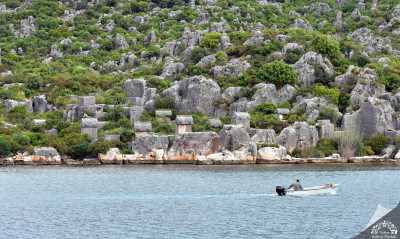
The road heading south from the 20th kilometer of the Kaş-Demre highway leads to the Ancient City of Theimiussa, which is known as Üçağız Village today. The ruins are on the east side of the village, where the houses begin to thin out. According to an inscription found there, Theimiussa is not a city but a village settlement in terms of administration.
Servet Uygun
The grave inscriptions state that the penalties for violent crimes should be paid to Myra or Kyaneai, indicating that there was a naval unit affiliated to these cities. The first ruin is a miniature castle with basset, rectogonal walls right on the shore. This castle was enlarged in diameter in the Byzantine Era and formed into a shape surrounding the city, with a wall that may have existed before.
Servet Uygun

In the place where the city borders Tybersissos, an acropolis with basal and rectogonal wall construction must have been considered together with Tybersissos as the last place to be defended. As you move east from the pier, you come across a pair of house-type rock tombs a little inland from the beach, the entrance door of which has been destroyed. A young man or child figure is seen standing on the right side of the tomb on the east side. There is an inscription in Lycian language above the door stating that the owner of the tomb is Kluwanimi. To the east of the tomb building, many sarcophagi from the Late Hellenistic and Roman Ages are lined up around the canal, which is lined with cut stone walls on both sides. The end point of this canal, that is, its northern end, ends with an Early Byzantine Period structure whose purpose is unclear.
Gulcan Acar
Theimiussa is among the “Ancient Cities of the Lycian Civilization” (2009) recommended to the UNESCO World Heritage List.

Source: “Theimiussa” Antalya from Past to Today [II. Volume], Antalya Provincial Directorate of Culture and Tourism (2012)
Places to Visit in Antalya
Source: Antalya Provincial Culture and Tourism Directorate