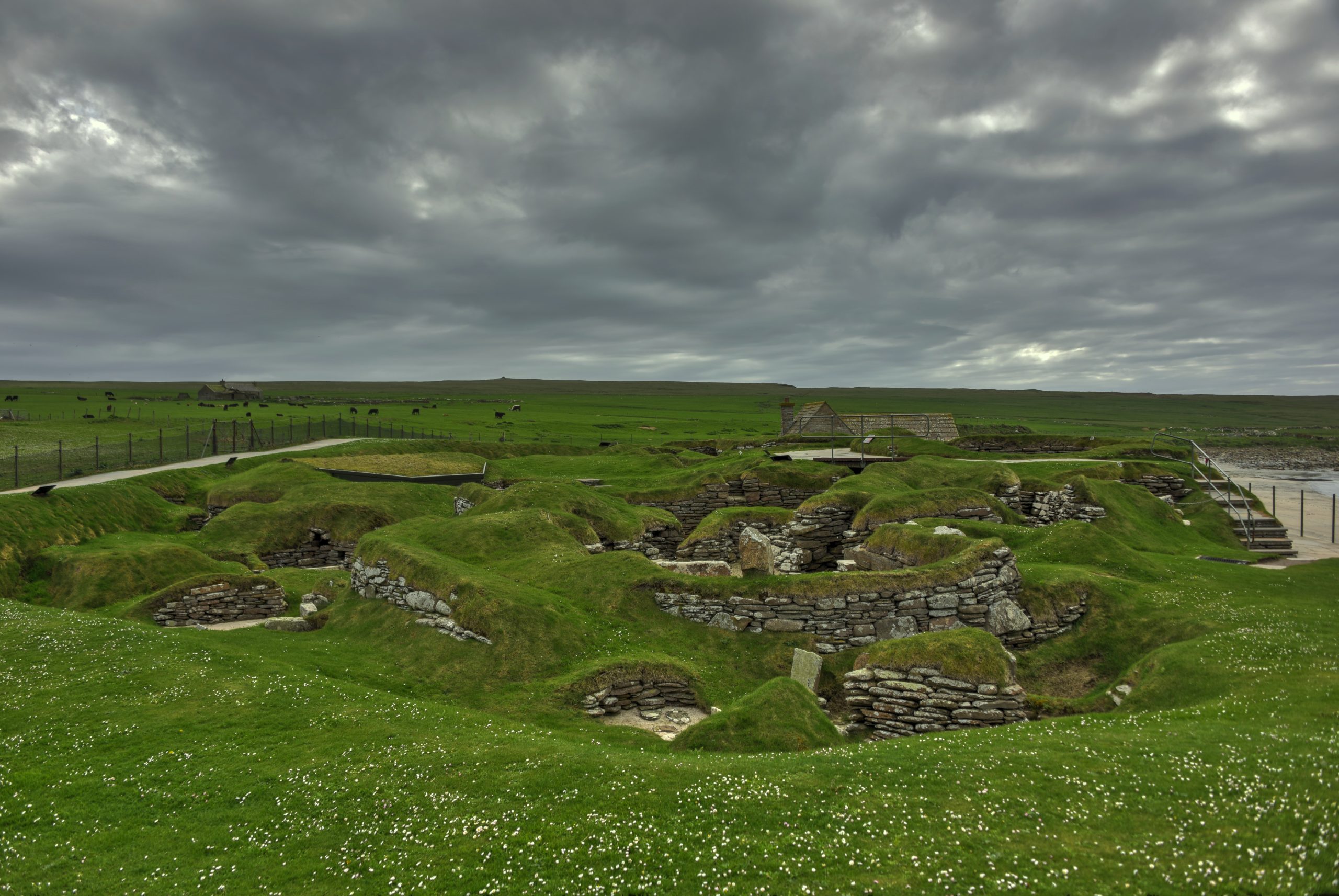
Imagine a storm so fierce it strips the grass and sand clean off a hillside overnight. That’s more or less what happened on a wild stretch of Orkney coast, off the north of Scotland, in the winter of 1850. When the wind finally died down, the locals found that the gale had peeled back the dunes to reveal something extraordinary underneath: the stone walls of houses that had been hidden for thousands of years. That accidental unveiling was the world’s introduction to Skara Brae, a Neolithic village so astonishingly well preserved that people often call it the “Scottish Pompeii.” And it is older than the pyramids.
In this article:
A village frozen in time
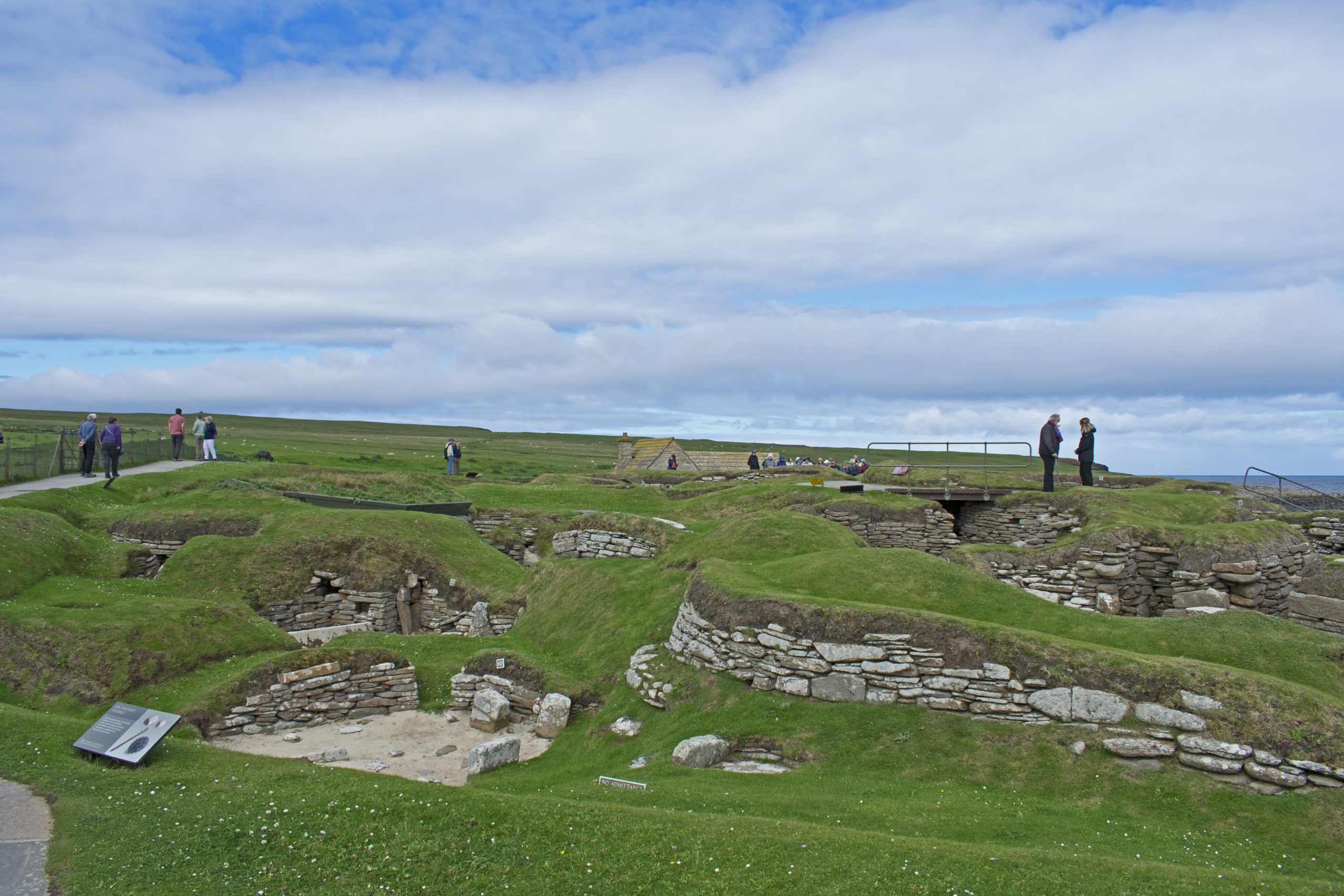
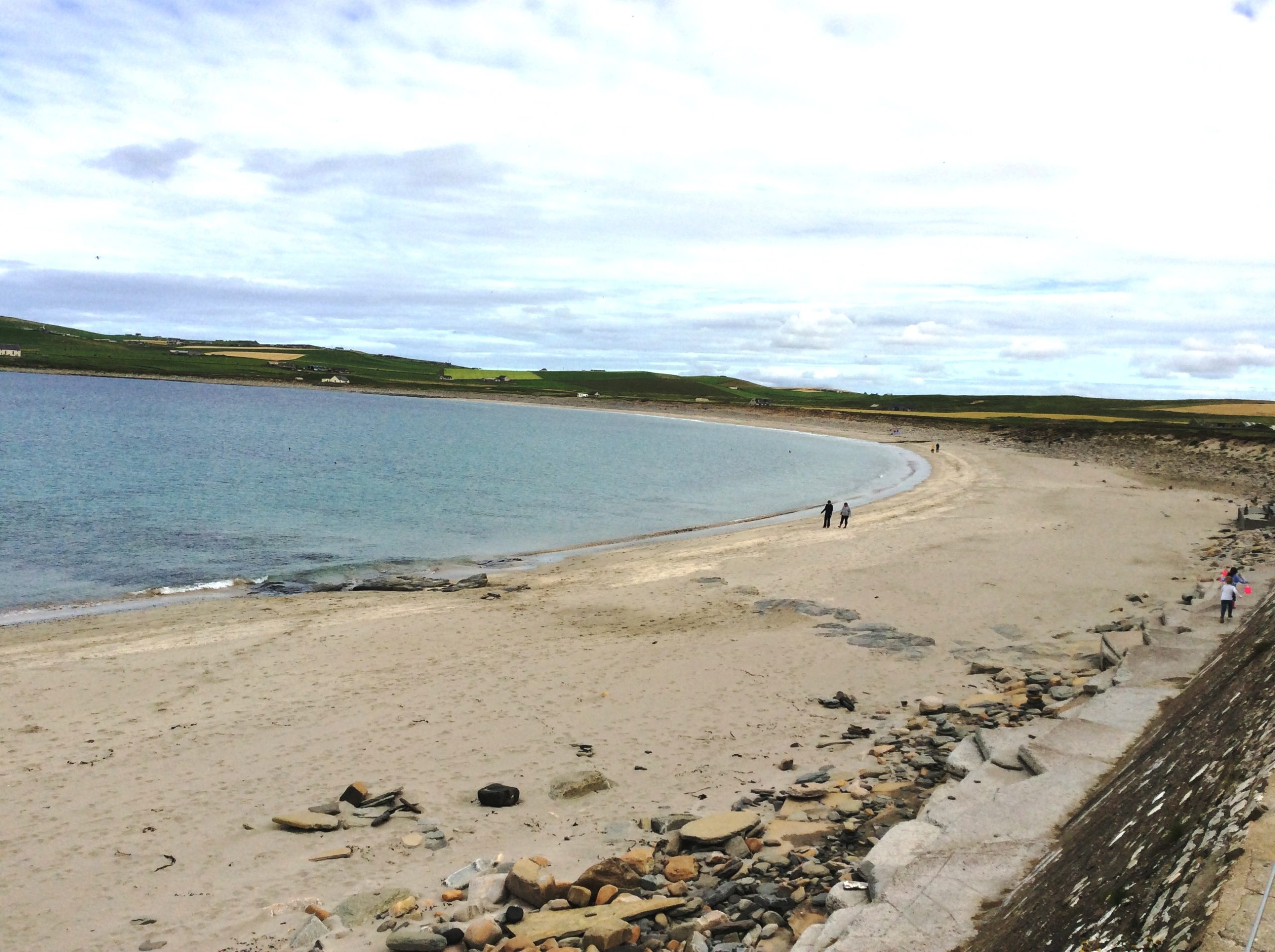
Skara Brae sits right on the edge of the Bay of Skaill, on Mainland, the largest of the Orkney Islands. People lived here from around 3200 to 2500 BC, which means the village was thriving at the same time as the temples of Malta and well before Stonehenge’s great stone circle and the Egyptian pyramids. What makes it unique isn’t its age alone, though. It’s the preservation. Most prehistoric settlements survive only as faint outlines in the soil, a few postholes and stains where wooden huts once stood. Skara Brae survives as actual rooms you can stand in front of and peer into.
The reason is simple and rather poetic. There are very few trees on windswept Orkney, so the people built almost everything out of the local flagstone, a stone that splits naturally into flat slabs. Stone walls, stone roofs, and, incredibly, stone furniture. And after the village was abandoned, sand drifted over it and sealed it like a time capsule for nearly five thousand years. We didn’t just inherit their walls. We inherited their living rooms.
Step inside a 5,000-year-old home
This is where Skara Brae goes from interesting to genuinely magical. Walk up to one of the houses and look in, and you’re looking at a complete Stone Age home, with its built-in furniture still in place. Each house is a single roughly square room, with thick stone walls, and inside you can see, in stone, the same things you’d find in any home: a central hearth for the fire, beds built into the walls on either side, and, against the back wall facing the door, a two-shelved stone “dresser.”
That dresser is the detail that always gets people. It sits directly opposite the entrance, the first thing you’d see walking in, and most archaeologists think it was used to display prized possessions, exactly as we use a mantelpiece or a shelf today to show off the things we treasure. There are also stone boxes set into the floors, carefully sealed with clay, which may have been used to keep fishing bait or to store water. These weren’t rough shelters. They were thoughtfully designed, cosy, surprisingly comfortable homes.
What life was like
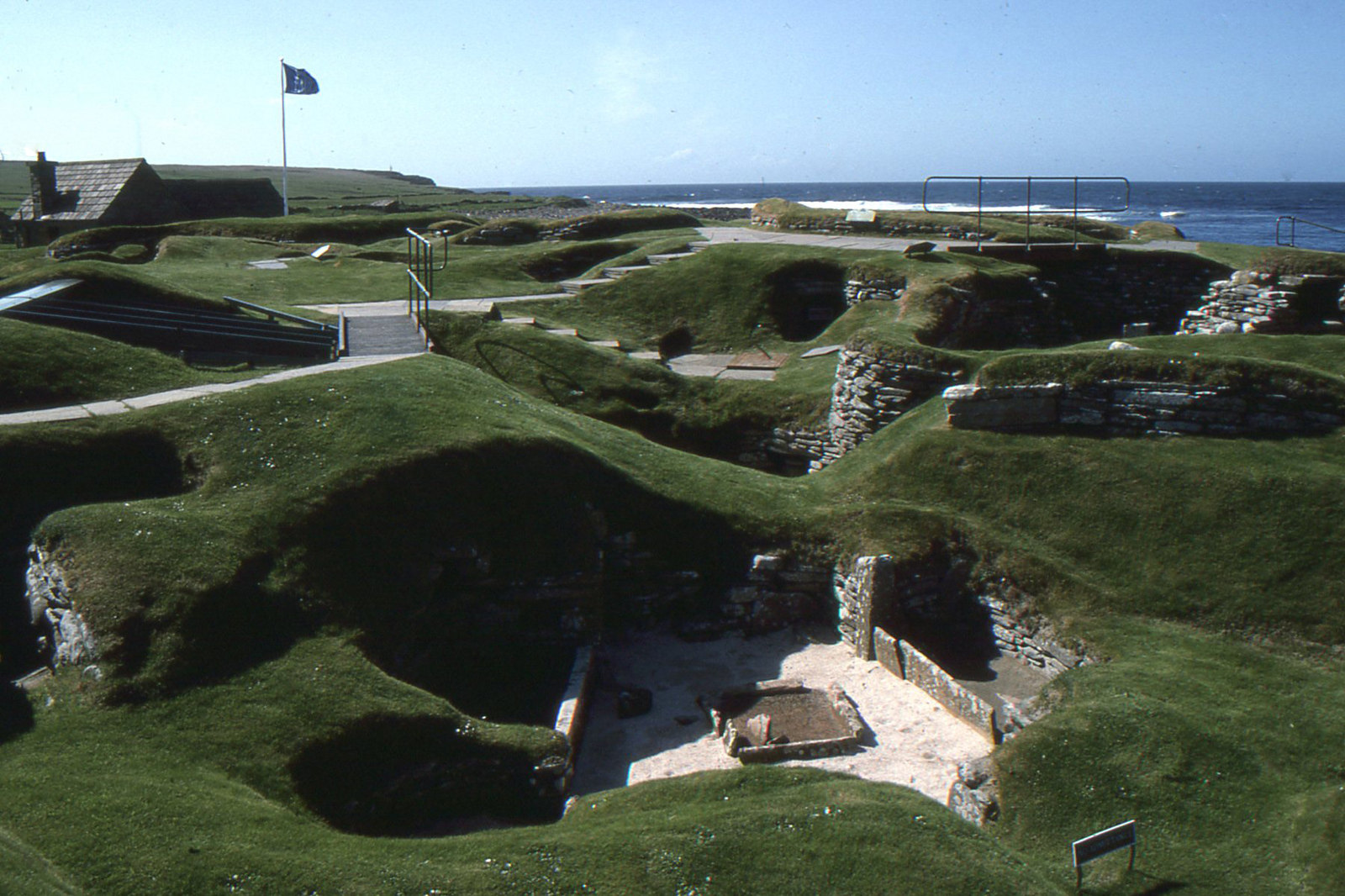
The people of Skara Brae were farmers and herders who also made the most of the sea and shore. They kept cattle and sheep, grew barley and wheat, and gathered shellfish and caught fish from the rich coastal waters. The houses were connected to one another by covered passageways, so in the teeth of an Orkney winter storm, you could move between homes without ever stepping out into the gale. Picture the whole village as a single snug, interlinked warren, smoke curling from the hearths, sheltered against the wind.
They left behind everyday objects that make them feel wonderfully close: tools of bone and stone, beads and pendants they wore as jewellery, and pottery decorated with patterns. Most intriguing of all are mysterious carved stone balls, beautifully worked spheres with knobs and spirals, whose exact purpose still baffles everyone. Were they symbols of status, ritual objects, weights, or something we’ll never guess? Like the spirals at other ancient sites, they’re a reminder that these people had a whole world of meaning we can only glimpse.
Why did they leave?
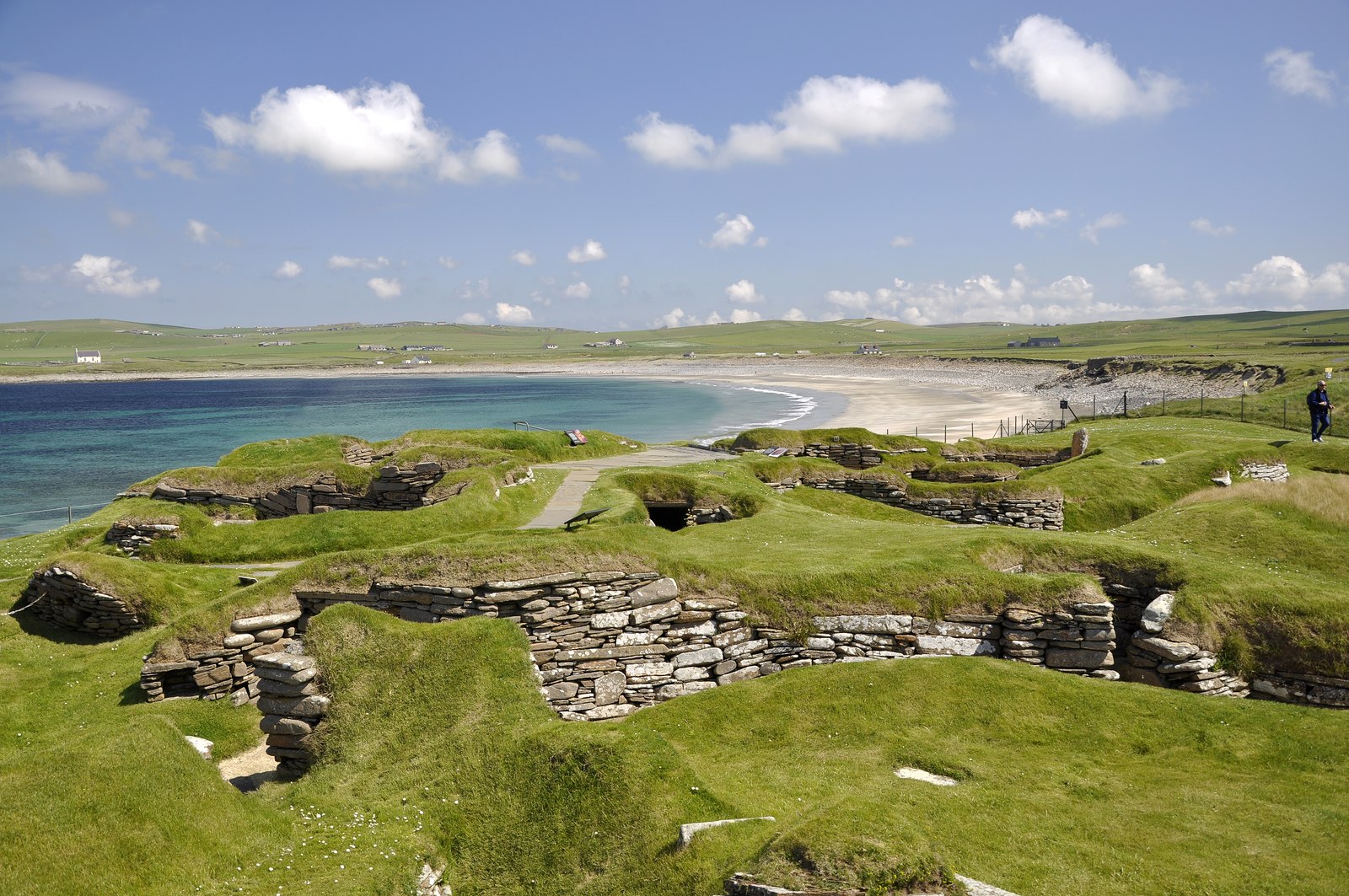
After around six or seven centuries of life, Skara Brae was abandoned, and as with so many ancient sites, we don’t know exactly why. The romantic version, that a single catastrophic sandstorm buried the village suddenly and the people fled, makes for a dramatic story, but the evidence points to something more gradual. The encroaching sand and shifting coastline probably made the spot harder to live in over time, and the community likely drifted away bit by bit rather than vanishing in one night.
Whatever the cause, their leaving was our gain. The sand that drove them out is the very thing that preserved their homes so perfectly for us to find. There’s a strange poignancy in that. The misfortune that ended their village handed down to us the most intimate snapshot of Stone Age domestic life anywhere in northern Europe.
From storm to “Scottish Pompeii”
The story of how Skara Brae came back into the light is almost as good as the site itself. After that great storm of 1850 exposed the first stone walls, the local laird took an interest and some early digging uncovered a handful of houses. But it was further storms and erosion, and then proper excavation in the 1920s led by the archaeologist Vere Gordon Childe, that finally revealed the village in full and recognized just how old and important it was.
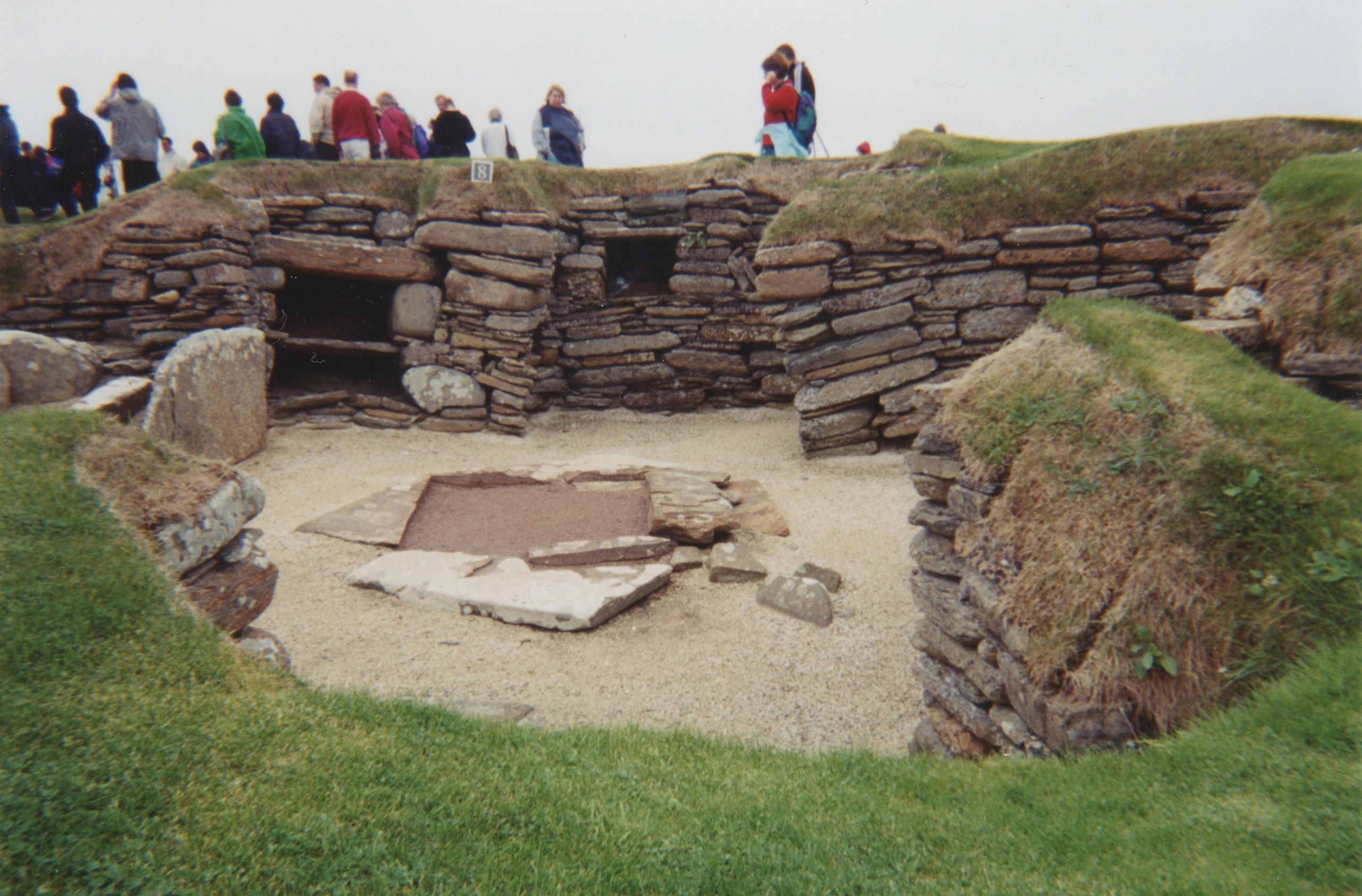
The nickname “Scottish Pompeii” is a little playful, since no volcano was involved, but it captures the essential magic of the place. Like Pompeii, Skara Brae was sealed and preserved by a natural force, and like Pompeii, it lets us walk into the ordinary lives of people from the deep past, not just admire their grandest monuments. You’re not looking at a king’s tomb or a temple of the gods. You’re looking at where regular families ate, slept, and kept warm. That ordinariness, preserved so perfectly, is precisely what makes it priceless. Ironically, the same coastal erosion that uncovered the site now threatens it, and a great deal of careful work goes into protecting Skara Brae from the very sea that once revealed it.
Part of a remarkable ancient landscape
Skara Brae doesn’t stand alone. It’s the jewel of an entire prehistoric landscape on Orkney that, together, forms a UNESCO World Heritage Site called the Heart of Neolithic Orkney. Nearby stand two great stone circles, the Ring of Brodgar and the Stones of Stenness, along with a huge chambered tomb called Maeshowe, which, like Newgrange in Ireland, is aligned so the midwinter sun shines into its heart. There’s even a large temple-like complex at the Ness of Brodgar that has been rewriting ideas about how important and sophisticated Neolithic Orkney really was.
Put it all together and a striking picture emerges. Far from being a remote backwater, Orkney was a vibrant, connected, and influential center of Neolithic Britain, possibly even a place whose ideas and styles spread southward to the rest of the islands. These windswept northern islands were, five thousand years ago, somewhere genuinely special.
Why Skara Brae stays with you
Most ancient sites impress us with their scale, the towering pyramid, the giant stone circle, the colossal temple. Skara Brae works the opposite way. It moves you with its smallness, its ordinariness, its sheer humanity. There’s no grand monument here. There’s a hearth where a family once warmed themselves, a bed where someone slept, a shelf where they proudly displayed the things they loved. It’s home, five thousand years ago.
And that’s exactly what makes it unforgettable. Standing at Skara Brae, you don’t feel the distance of deep time so much as the closeness of it. These were people who wanted to be warm, who decorated their belongings, who arranged their furniture so the nicest thing faced the door. Strip away the millennia and they were doing what we all do: making a home, together, against the cold and the dark. Few places on Earth let you feel that kinship across five thousand years quite so vividly.
Related reading on this site: This article is part of a series on the world’s oldest sites and discoveries. You might also enjoy Newgrange, Stonehenge, the megalithic temples of Malta, Çatalhöyük, Jericho, Göbekli Tepe, and the world’s oldest cave paintings. And discover Uruk and Sumer, the first cities and the birth of writing. Also explore Karahan Tepe, the sister of Göbekli Tepe. Browse more under Ancient History and Archaeology.
See also: Mohenjo-daro: The 4,500-Year-Old City That Was Centuries Ahead of Its Time.
See also: Liangzhu: The 5,000-Year-Old Water City That Rewrote China’s History.
And on the far side of the world, you can meet Caral, the oldest city in the Americas, which rose in the Peruvian desert at the very same time as the pyramids of Egypt.
And on the island of Crete you can explore Knossos, the Minoan palace behind the myth of the Minotaur, the labyrinthine home of Europe’s first great civilization.
And out in the salt deserts of India, you can discover Dholavira, the Indus city that beat the desert with water engineering.
You might also wander out to Nan Madol, the black-basalt city islanders raised on a flooding Pacific reef. It pairs well with Chavin de Huantar, a 3,000-year-old sanctuary built to produce awe. It pairs well with Cucuteni-Trypillia, the 6,000-year-old mega-settlements of the Ukrainian plains. It pairs well with Cerro Sechin, a 3,600-year-old temple of stone reliefs on the Peruvian coast. It pairs well with Poverty Point, a 3,700-year-old earthwork complex in the American South. You might also enjoy the story of Sarazm in Tajikistan, an early metalworking hub that traded precious stones across vast distances. You might also enjoy the deep prehistory of Mehrgarh in Balochistan, where people practiced dentistry and worked copper thousands of years ago. You might also enjoy the story of Tell Brak, one of the world’s earliest cities, hidden in the plains of Syria. The story of the first villages leads straight to Aşıklı Höyük, where people entered their homes through the roof. The deep roots of music lead straight to Jiahu, where crane-bone flutes still make melodies after nine thousand years. The deep roots of astronomy lead straight to Chankillo, where a row of desert towers still tracks the sun. If early farming towns fascinate you, don’t miss Kalibangan, where a five-thousand-year-old field still shows its furrows. Don’t miss the Cairn of Barnenez, one of Europe’s oldest and largest stone monuments. Don’t miss Vinča, whose nine-metre mound holds a thousand years of European prehistory. Don’t miss Gavrinis, the 6,000-year-old carved passage tomb on a drowned Breton island. Don’t miss Los Millares, the 5,000-year-old Copper Age stronghold of Almería. It pairs beautifully with the story of Bougon, where farming communities built stone tombs nearly seven thousand years ago. The same ancient impulse echoes at the Almendres Cromlech, one of the oldest megalithic monuments in all of Europe. The same ancient ambition rises at the Ġgantija temples, raised on Gozo around 3600 BC. The same deep past unfolds at Knowth, a great Boyne Valley tomb with two passages and a ring of smaller mounds. The same ancient devotion shines at the Tarxien temples, home to a colossal statue and remarkable carvings. The same ancient sky-watching shines at Mnajdra, whose stones catch the sun at the turning points of the year. For another chapter in the same deep past, visit Ħaġar Qim, Malta’s great cliff-top temple. For another chapter in the same ancient story, visit Dowth, the overlooked third mound of the Boyne. For another chapter in the same deep past, wander the endless rows of Carnac in western France. For another chapter in the same deep past, visit Callanish, Scotland’s great circle at the edge of the sea. For another face of prehistory, visit Filitosa, where ancient stone figures still watch over the hills. For another face of the ancient world, visit Ale’s Stones, Scandinavia’s great ship traced in standing boulders.
You May Like
The Bardo, a Palace of the Beys Filled With Roman Mosaics


11 thoughts on “Skara Brae: The 5,000-Year-Old Village Known as the Scottish Pompeii”