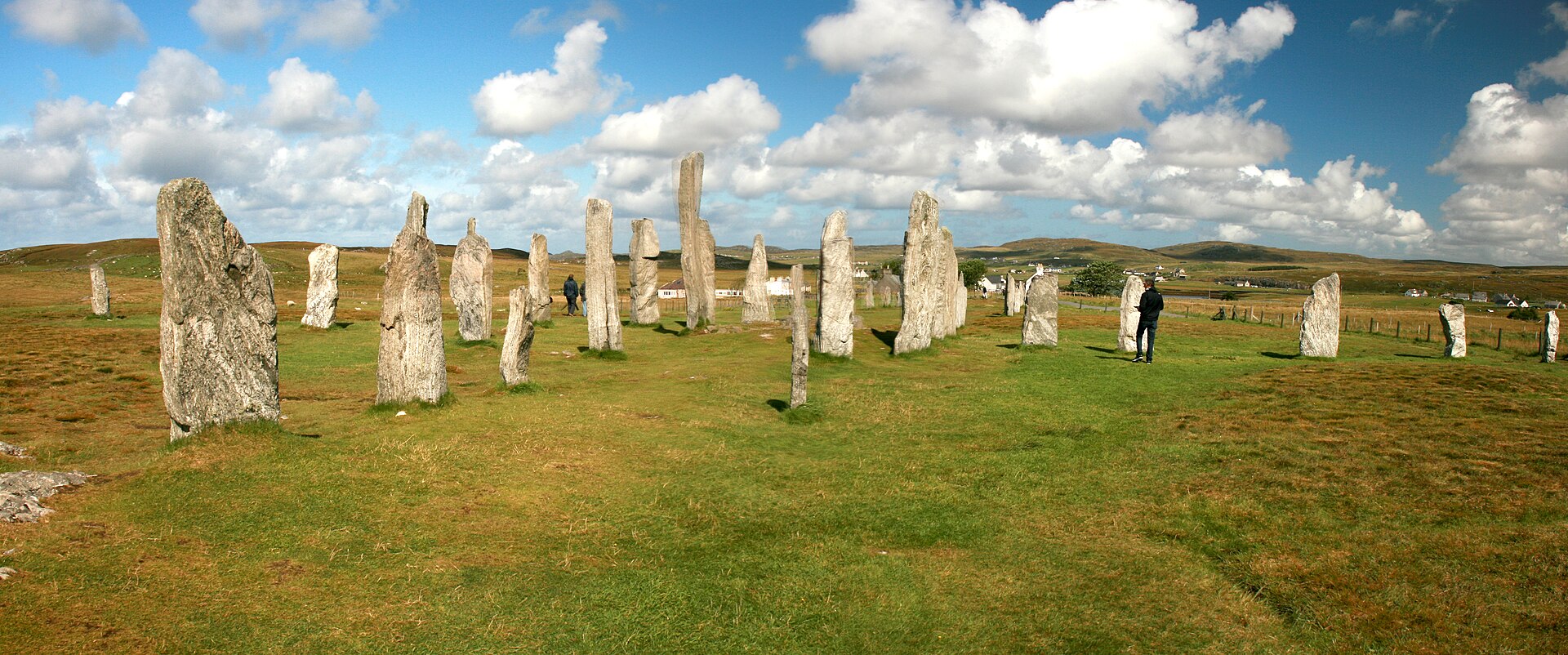
Far out in the North Atlantic, on the windswept Isle of Lewis in the Outer Hebrides, there is a place where thirteen tall stones stand in a ring, with long rows of others reaching out from it like the arms of a cross. This is Callanish — Calanais in Gaelic — and it has been standing on its low ridge above a sea loch for around five thousand years, watching the light and the weather roll in off the ocean.
I find Callanish quietly overwhelming in a way that even grander sites are not. It is remote, it is exposed, and it is astonishingly complete. Where so many stone circles have been reduced to a few survivors, here the design still reads clearly, its central monolith towering over a small chambered tomb, its avenue marching off into the moor. Standing inside it, you feel you have walked into the middle of an idea five millennia old.
- A ring at the edge of the world
- The cross-shaped plan
- Stones of ancient gneiss
- The moon and the far horizon
- The people of the Hebrides
- Buried, forgotten, revealed
- How old is the circle?
- Giants and the shining one
- A landscape of stones
- Callanish among the circles
- The tomb at the heart
- Living with the Atlantic
- Reading meaning into stone
- The name and the language
- Caring for the stones
- Visiting the stones today
- Why Callanish stays with you
A ring at the edge of the world
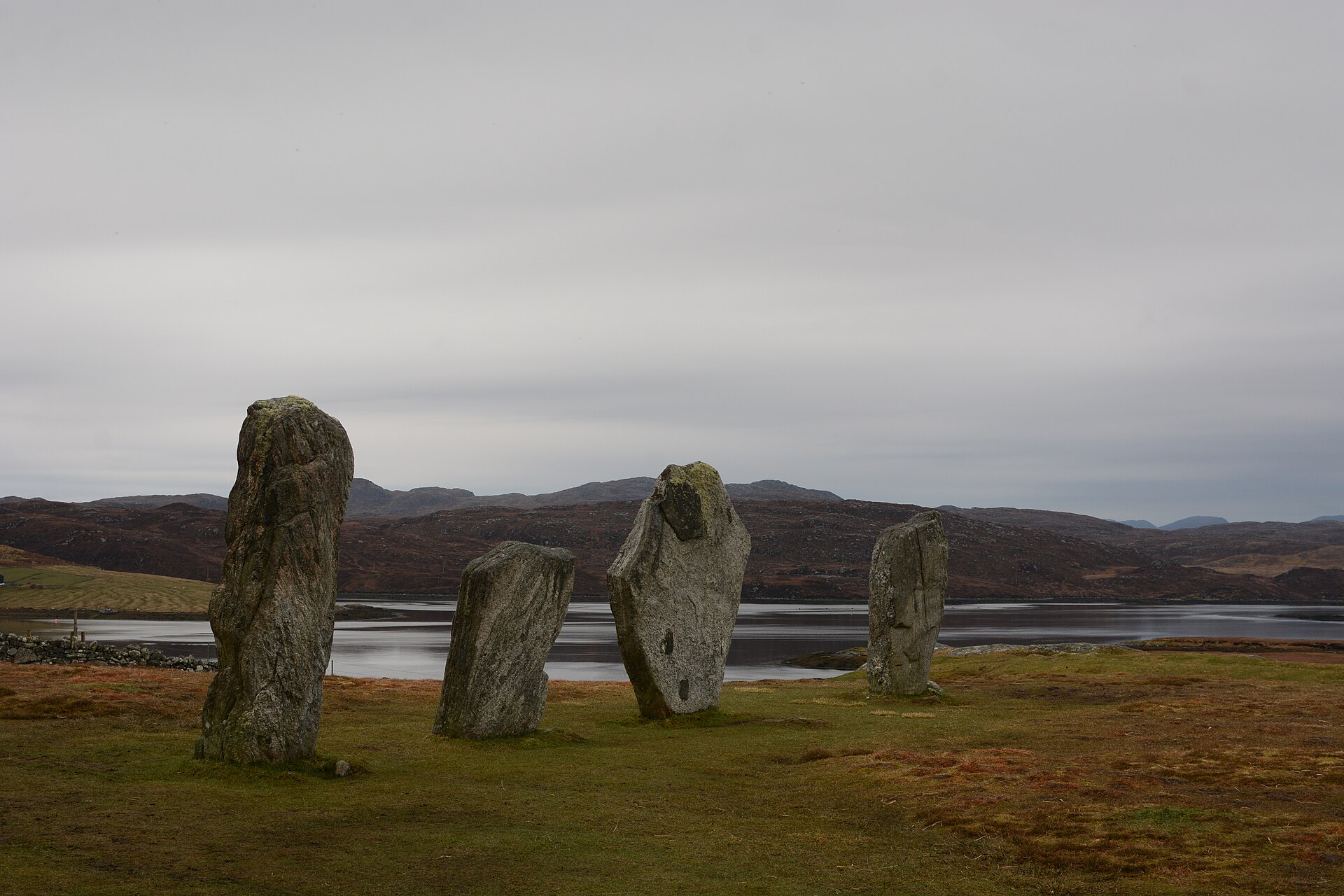
Callanish sits on the western side of Lewis, on a spine of land above the waters of Loch Roag, with the hills of Great Bernera and the open Atlantic beyond. It is about as far out on the edge of Europe as you can get, and that remoteness is part of its power. This was never a monument in the middle of a bustling world; it stood then, as now, in a vast and elemental landscape.
The main site, known to archaeologists as Callanish I, is the great one, but it does not stand alone. Scattered across the surrounding moorland are smaller circles and settings — Callanish II, III, and more — suggesting that this whole stretch of Lewis was, in the Neolithic, a sacred landscape studded with standing stones.
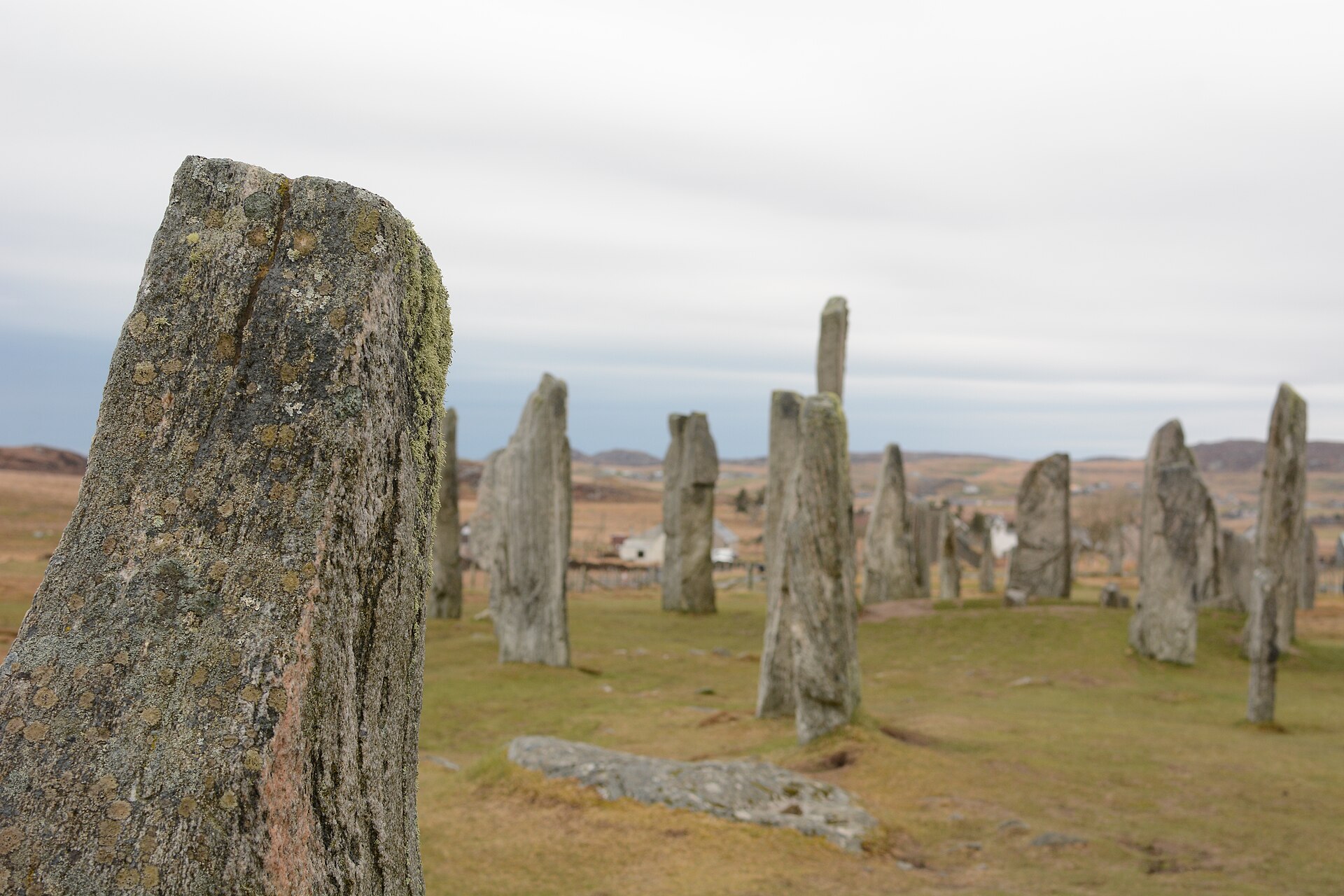
To reach it, the builders and worshippers would have crossed the same wild country you cross today, under the same enormous skies. Few ancient sites keep their original setting so intact. There are no city walls here, no modern sprawl — just stone, moor, water, and weather.
The cross-shaped plan
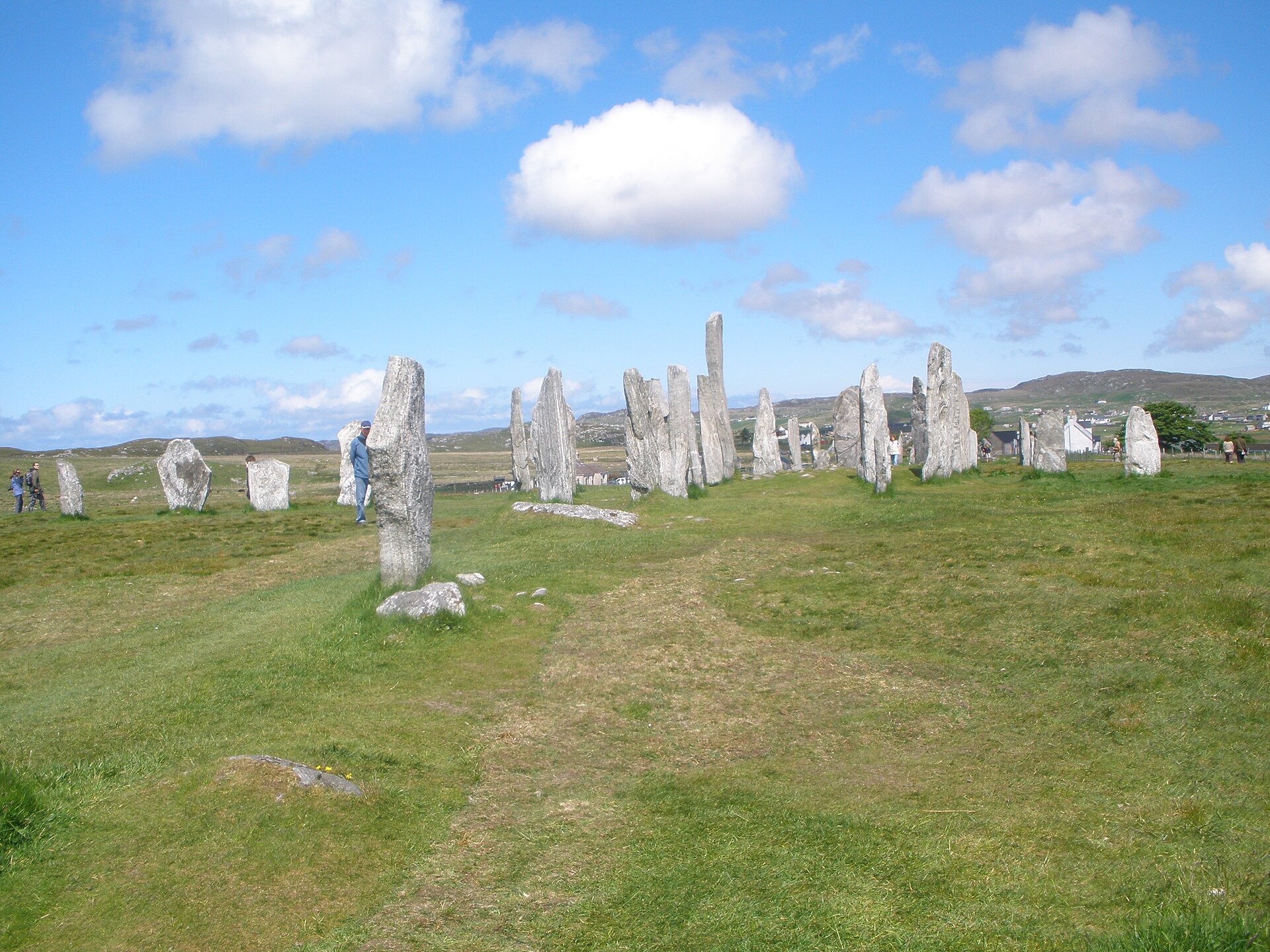
What makes Callanish immediately distinctive is its layout. At the heart stands a ring of thirteen stones around a towering central monolith nearly five metres tall. From this ring, rows of stones radiate outward: a long avenue of paired stones stretching to the north, and shorter single rows to the east, south, and west, giving the whole plan the rough shape of a cross.
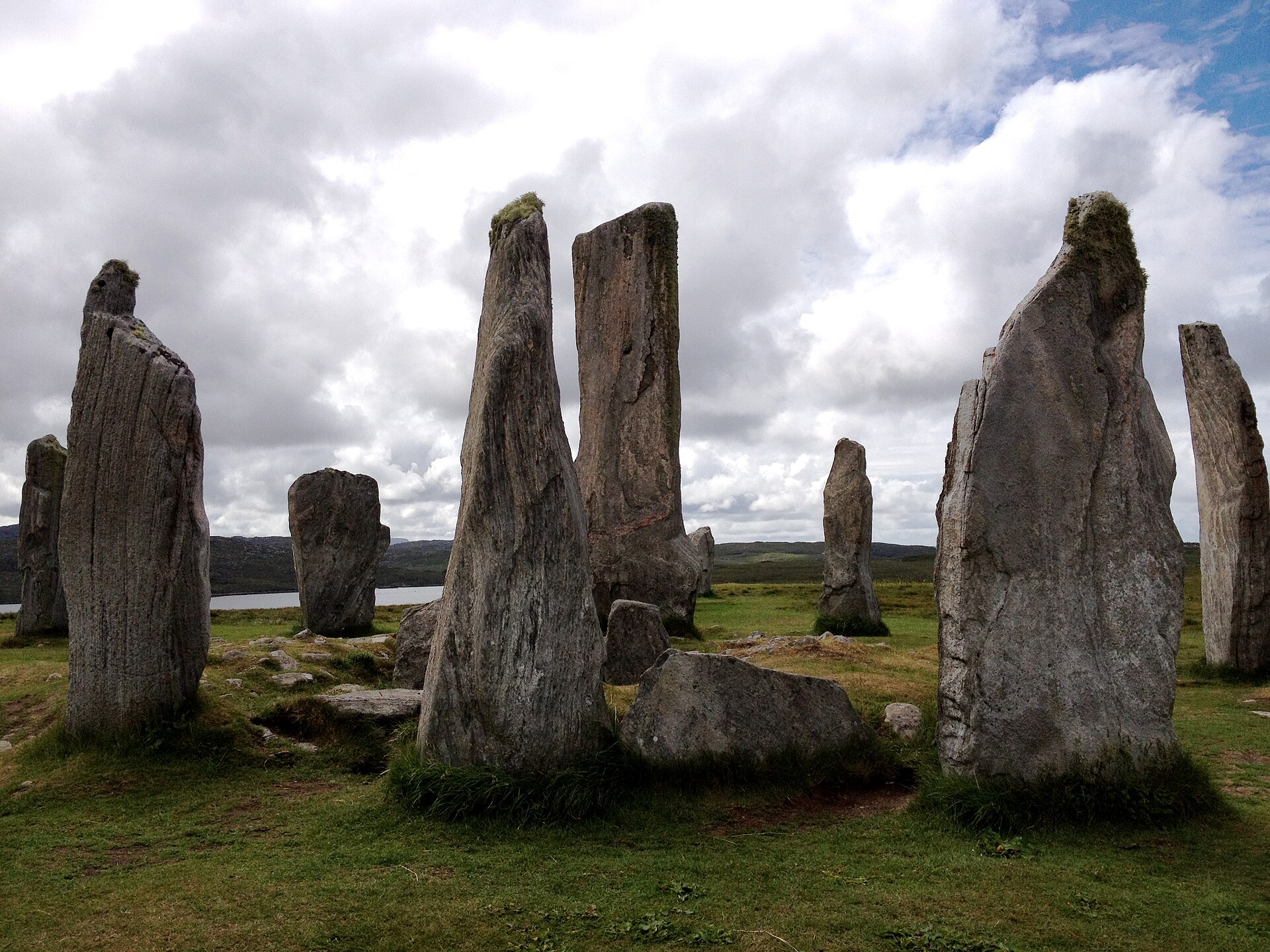
This cruciform arrangement is unusual and deliberate. Walking up the northern avenue toward the ring, with the great central stone drawing you in, you understand that this was designed as an approach, a processional route leading to a focal point. Whatever happened here, movement through the monument was part of it.
Tucked against the base of the central monolith is a small chambered tomb, added at some point in the site’s long history. So Callanish is not one monument but a layered one: a ring, an avenue, and a grave, woven together over generations into a single sacred whole.
Stones of ancient gneiss
The stones themselves are Lewisian gneiss, one of the oldest rocks on the surface of the Earth, formed billions of years before any human walked the Hebrides. There is a strange poetry in that: monuments built to mark human time, raised from stone almost unimaginably older than our whole species.
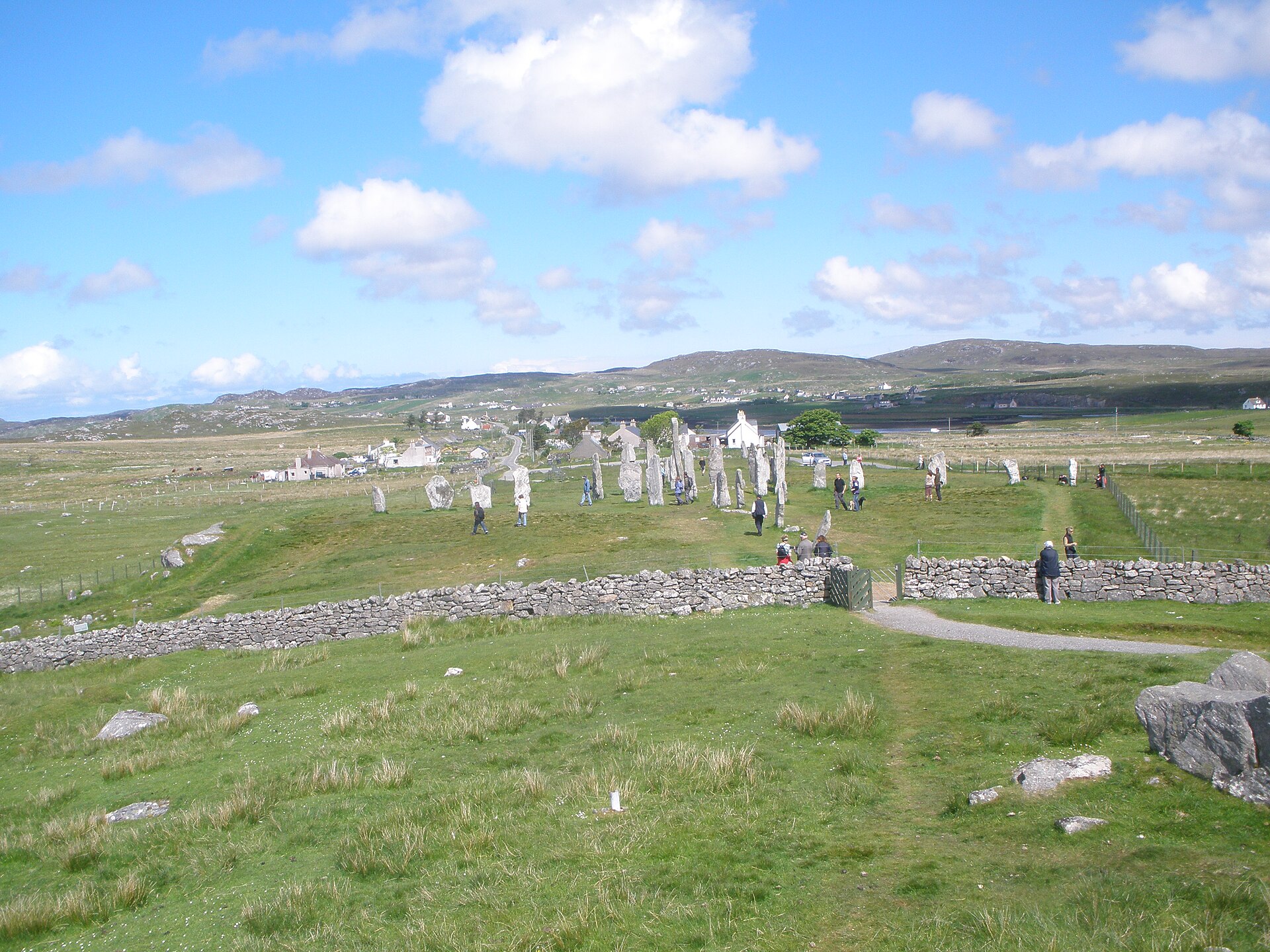
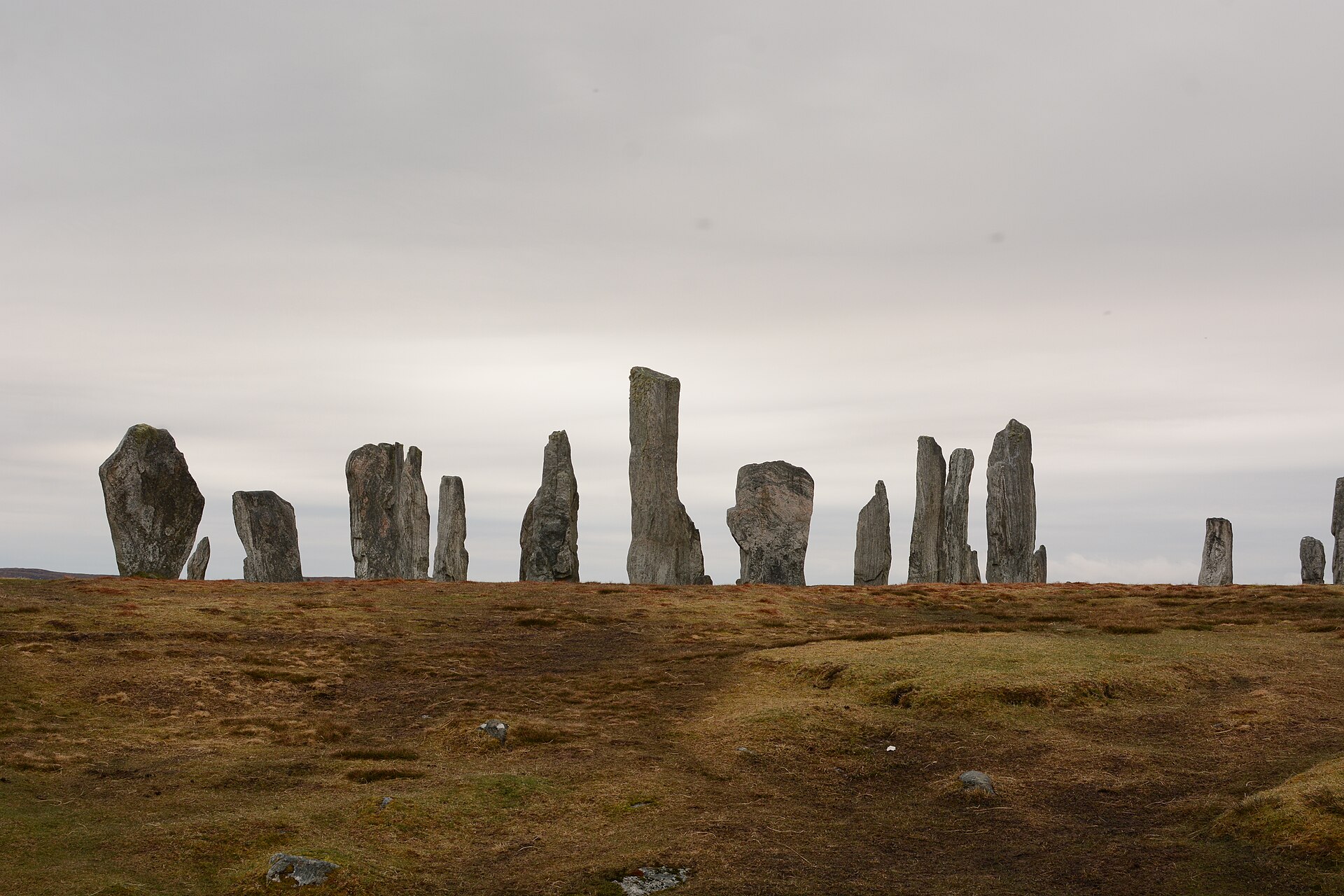
The gneiss is beautifully banded, streaked with pale veins that catch the low northern light, and the tall stones have weathered into slender, blade-like forms. Some lean; all are pitted and lichened by five thousand years of Atlantic weather. They feel less like objects placed in the land than like things that have grown out of it.
Raising these slabs on this exposed ridge, with Neolithic tools and techniques, was no small feat. The builders quarried or gathered the stones locally, moved them with muscle and ingenuity, and set them upright to stand against the fiercest weather the Atlantic could throw at them. And stand they have.
The moon and the far horizon
Callanish has long fascinated those interested in ancient astronomy, and for good reason. Its builders clearly cared about the sky. One striking phenomenon connects the site to the moon: every so often, in a cycle lasting about eighteen and a half years, the full moon skims unusually low along the southern hills, an event sometimes linked to the alignments of the stones.
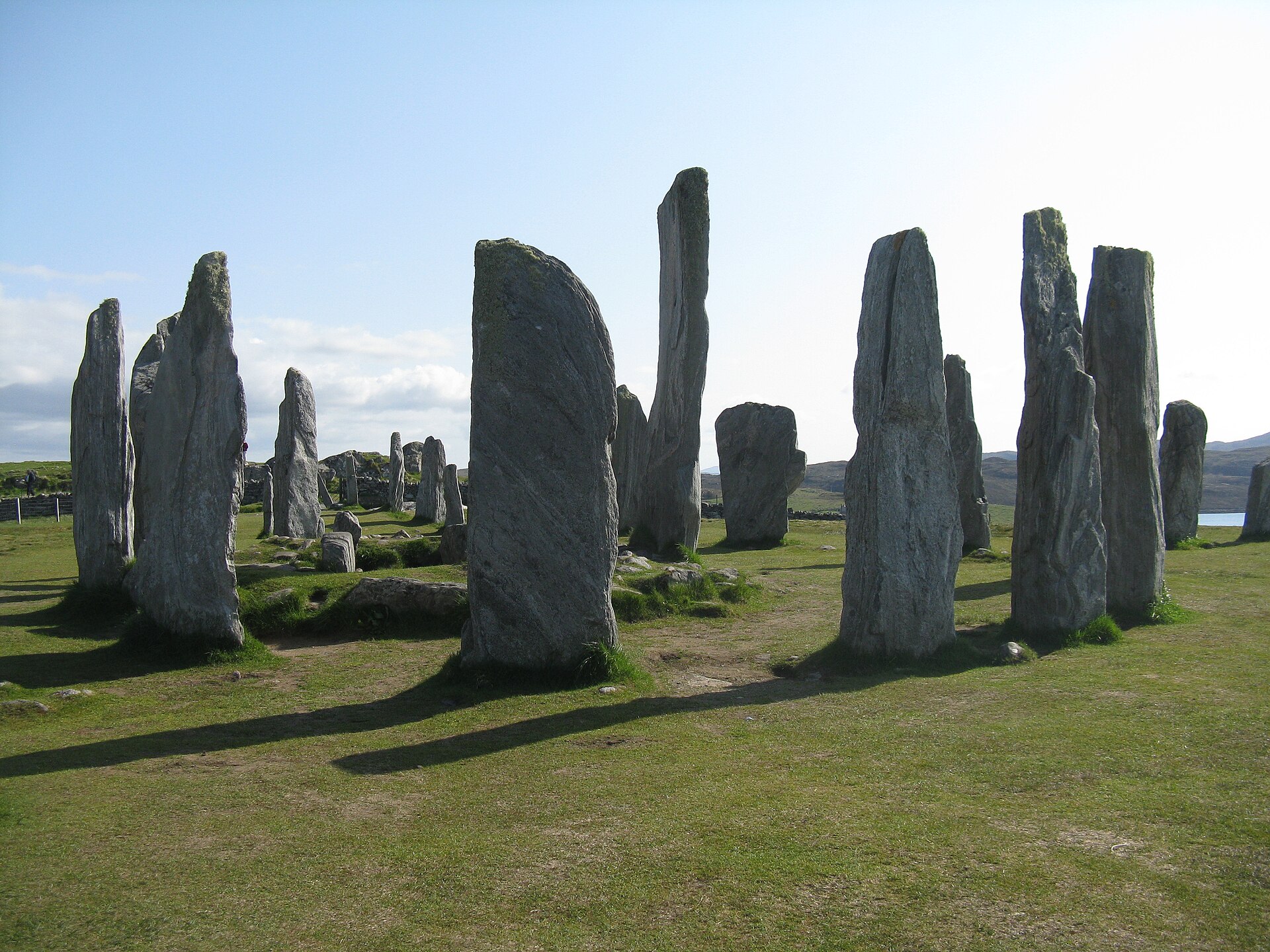
Local tradition preserved a memory of something special happening when “the shining one” walked the stones, a phrase that may echo this rare lunar event. Whether the builders tracked the moon with precision or simply built in awareness of its dramatic behaviour on this latitude, the sky was plainly bound up with the meaning of the place.
As always, I try to hold these ideas lightly. It is easy to over-read alignments into ancient stones. But at Callanish, so far north, where the sun and moon do such extreme things across the year, it would be stranger if the builders had ignored the heavens than if they had watched them closely.
The people of the Hebrides
The people who raised Callanish were Neolithic farmers eking out a living on the thin soils of Lewis, growing what crops they could and keeping animals in a harsh, beautiful, marginal land. That such a community found the resources and the will to build something so ambitious tells you how central it must have been to their lives.
There were no cities out here, no dense populations, no obvious surplus of labour. And yet they built. They gathered, they hauled, they raised the stones, and then they returned, generation after generation, to use the monument they had made. The devotion behind that is humbling.
Buried, forgotten, revealed
For much of its later history, Callanish slowly vanished. Over the centuries, blanket peat crept across the moor and buried the stones to a depth of well over a metre, leaving only their tops showing. The great monument became a half-remembered curiosity, wrapped in local legend rather than understood as prehistory.
In the nineteenth century the peat was cut away, and the stones stood revealed in their full height for the first time in ages, along with the small chambered tomb at the centre that the peat had hidden. Suddenly the true scale and complexity of Callanish came back into view.
That burial and rediscovery is oddly moving. The stones waited under the peat, patient as ever, until people came looking again. There is something in that patience that feels like the essence of the place.
Why Callanish stays with you
Callanish matters because it is one of the most complete and evocative stone monuments to survive from the Neolithic anywhere in Britain, set in a landscape that has barely changed. It lets you stand where the builders stood, under skies they would recognise, and feel the reach of their intention across five thousand years.
But more than that, it is simply unforgettable. The tall, blade-like stones, the great central monolith, the avenue leading in, the endless Hebridean light and weather — they fuse into an experience that stays with you long after you leave. If any place can make the deep past feel present, it is this ring of ancient stone at the edge of the sea.
How old is the circle?
Establishing the age of Callanish has taken careful work, since standing stones themselves are hard to date directly. Excavation of the site and the surrounding deposits has yielded evidence placing the erection of the main stones in the Neolithic, broadly around 3000 BC, with activity continuing and evolving over a long span afterward.
That makes Callanish a contemporary of the great passage tombs of Ireland and roughly aligned with the earlier phases of Britain’s more famous circles. It belongs to a burst of monument-building that swept across these islands in the later Neolithic, a time when communities everywhere seemed gripped by the urge to mark the land in stone.
The small chambered tomb added at the centre shows that the site was not built and then left. It was returned to, altered, and reinterpreted over centuries, a living monument rather than a finished statement. Callanish grew and changed with the people who used it.
Giants and the shining one
Like all great prehistoric sites, Callanish gathered legends once its true origins were forgotten. One tradition held that the stones were giants who refused to be converted to Christianity and were turned to stone for their defiance, frozen forever in their ring on the moor.
Another, more evocative memory spoke of a shining figure who came to the stones along the avenue, heralded by the call of a cuckoo, at a special time. Scholars have wondered whether this preserves a folk memory of the dramatic low moon that skims the southern hills every eighteen years or so — the sky itself walking the stones.
We cannot prove that link, but I love the possibility. It would mean that a scrap of Neolithic astronomical awareness survived, transformed into legend, for thousands of years — a whisper from the builders reaching us through the mouths of storytellers.
A landscape of stones
It is a mistake to think of Callanish as a single ring in isolation. The main site is the greatest of a whole family of monuments scattered across this part of Lewis. Within a few kilometres lie other circles and settings, some intervisible with the main site, hinting at a coordinated sacred geography spread across the moor.
What that network meant, we can only guess. Perhaps the smaller sites played supporting roles in ceremonies centred on the great ring, or marked stages in journeys across the land, or served separate communities who shared a tradition. The sheer density of monuments tells us this was a landscape saturated with meaning.
Seeing Callanish this way — as the crown of a whole ceremonial region rather than a lone curiosity — deepens its mystery. These were not isolated eccentrics but a society that organised its entire landscape around stone and sky.
Callanish among the circles
Britain and Ireland are rich in stone circles, from the massive to the modest, and Callanish holds a special place among them. What sets it apart is the combination of features: the tall central monolith, the surrounding ring, the radiating rows, and above all the cruciform avenue, which is rare and gives the site its unmistakable character.
Where some circles feel like enclosures, defined spaces set apart, Callanish feels directional, built to be approached and entered along its northern avenue. That sense of movement toward a centre distinguishes it from many of its cousins and hints at ceremonies involving procession rather than mere gathering.
Comparing it to other great sites only sharpens its individuality. Callanish is unmistakably part of the wider megalithic tradition, yet it speaks in its own distinct dialect of stone, shaped by its remote island setting and the extreme northern sky.
Visiting the stones today
Reaching Callanish takes effort, which is part of the reward. It means a journey to the Outer Hebrides, out to the western edge of Lewis, along single-track roads through a landscape of moor and loch. When you arrive, the stones are simply there, open to the sky, free to walk among.
Unlike some heavily managed monuments, Callanish can still be experienced with a rare intimacy. In the right weather — or the wrong one, depending on your taste — you might have the whole ring to yourself, with only the wind and the cry of seabirds for company. That solitude among the stones is unforgettable.
Go at the edges of the day, or in the long half-light of a northern summer evening, when the gneiss glows and the shadows stretch across the moor. That is when Callanish is at its most magical, and when the distance between you and its builders feels thinnest.
The tomb at the heart
One of the most intriguing features of Callanish is the small chambered tomb nestled against the base of the great central stone. It was not part of the original design but added later, a burial place set at the very heart of the ring, and it changes how we read the whole site.
Its presence ties Callanish firmly to the theme that runs through so much of megalithic Europe: the binding together of the living, the dead, and the movements of the heavens. The circle was not only a place of gathering or observation but, in time, a place of burial too, its centre given over to the ancestors.
That layering — a ring, then an avenue, then a tomb — reminds us that these monuments were not static. Each generation added its own meaning, quite literally building on what came before, until the site became a dense accumulation of belief and memory.
Living with the Atlantic
You cannot understand Callanish without reckoning with its weather. Out here, the Atlantic sets the terms. Rain sweeps in horizontally, the wind rarely rests, and the light changes minute by minute, from blazing clarity to brooding grey and back. The stones have stood through five thousand years of this, and it shows in their weathered, streaming surfaces.
For the builders, this weather was not a backdrop but a daily reality that shaped everything — when they could work, what they could grow, how they understood the sky. A monument raised here had to be built to endure, and it was. The gneiss simply shrugs off the storms.
Visiting, you feel that elemental exposure yourself. There is no shelter among the stones, no softening of the landscape. It is you, the ring, and the vast Hebridean sky, and that rawness is precisely what makes the place so moving.
Reading meaning into stone
It is worth being honest about how much we do not know. We can measure the stones, date the deposits, map the alignments, and record the legends, but the actual beliefs of the people who built Callanish are lost. We are reading a text whose language died thousands of years ago.
That does not make the effort pointless — far from it. Careful archaeology tells us a great deal about how and roughly when the site was built and used. But it does mean we should be cautious about confident stories of sun-priests and lunar temples. The stones keep their deepest secrets.
Personally, I find that uncertainty part of the appeal. Callanish does not hand you a tidy explanation. It hands you a question, set in ancient stone under a huge sky, and lets you stand inside it. Some monuments are best appreciated not as solved puzzles but as open ones.
The name and the language
The Gaelic name Calanais, anglicised as Callanish, belongs to the living culture of the Hebrides, where Gaelic is still spoken. The stones carry a name in a language that has clung to these islands through centuries of change, which gives the whole site a continuity you can feel.
There is something fitting in approaching such an ancient monument through a language so deeply rooted in the land. The builders’ own tongue is lost beyond recovery, but the Gaelic names of the moor, the loch, and the stones weave the prehistoric site into a cultural landscape that is still very much alive.
It is a reminder that Callanish is not a dead relic sealed off from the present. It sits in a working landscape, among crofting communities, part of the identity of the people who live within sight of it today.
Caring for the stones
Today Callanish is a protected monument, cared for by Scotland’s heritage bodies, with a visitor centre nearby to interpret the site for those who make the long journey. The challenge, as always, is to balance access with preservation, letting people experience the stones while protecting them and the fragile ground around them.
The peat that once buried the stones is a reminder of how landscapes change, and careful management now keeps the setting close to how it appeared when the peat was first cleared. Conservation here is a quiet, ongoing task, mostly invisible to visitors, and all the more valuable for it.
After five thousand years, the goal is simply to keep faith with the stones — to hold them steady, learn from them gently, and pass them on intact to whoever stands in the ring long after we are gone. It feels like the least these patient stones deserve.
Every time I read about a place like this, I come away rearranged. We flatter ourselves that ambition and wonder are modern things. Then a ring of ancient stone on a Hebridean moor reminds us that people with almost nothing built something that still stops us in our tracks five thousand years on.
Callanish endures because it was built to, and because generations kept faith with it, and because — buried, revealed, studied, loved — it has never quite let go of us. Stand inside that ring once and you will understand why.
If Callanish has drawn you into the world of standing stones and the first builders, there is a whole trail to follow. Its fellow British and Irish monuments — Stonehenge: How and Why This Ancient Stone Circle Was Really Built, Newgrange: The 5,000-Year-Old Tomb Built to Catch the Solstice Sun, Skara Brae: The 5,000-Year-Old Village Known as the Scottish Pompeii, Vinča: The Danube Culture That May Have Written Before Anyone Else, Knowth: Europe’s Greatest Collection of Neolithic Art, Hidden Beside Newgrange and Dowth: The Forgotten Third Mound of Ireland’s Boyne Valley — share its spirit, while France answers with The Cairn of Barnenez: Europe’s Colossal Stone Monument Older Than the Pyramids, Gavrinis: The 6,000-Year-Old Carved Passage They Sealed in the Dark, Los Millares: The 5,000-Year-Old Fortified Town at the Edge of Europe and Carnac: The 6,000-Year-Old Field of a Thousand Standing Stones. The great Maltese temples The Megalithic Temples of Malta: Older Than the Pyramids, Tarxien: Malta’s Most Elaborate Prehistoric Temple, Carved 5,000 Years Ago, Mnajdra: The 5,000-Year-Old Maltese Temple That Tracks the Sun and Ħaġar Qim: Malta’s Cliff-Top Temple Older Than the Pyramids push the same instinct in another direction. For where it all began, few places rival Göbekli Tepe: The World’s Oldest Temple and How It Rewrote History and Karahan Tepe: The Astonishing Sister of Göbekli Tepe in Anatolia, or the walled town of Jericho: The World’s Oldest City and Its 10,000-Year-Old Wall. And the wider human story unfolds through Çatalhöyük: The 9,000-Year-Old Town With No Streets, The World’s Oldest Art: Inside the Painted Caves of Lascaux and Chauvet, Uruk and Sumer: The First Cities and the Birth of Writing, Mohenjo-daro: The 4,500-Year-Old City That Was Centuries Ahead of Its Time, Liangzhu: The 5,000-Year-Old Water City That Rewrote China’s History, Caral: The 5,000-Year-Old City That Rose As the Pyramids Were Built, Knossos: The 4,000-Year-Old Palace Behind the Myth of the Minotaur, Dholavira: The 4,500-Year-Old City That Beat the Desert With Water Engineering, Nan Madol: The Ancient City Built on a Coral Reef in the Middle of the Pacific, Chavin de Huantar: The 3,000-Year-Old Andean Temple Built to Overwhelm the Senses, Cucuteni-Trypillia: Europe’s 6,000-Year-Old Mega-Settlements That Might Be the First Cities, Cerro Sechin: The 3,600-Year-Old Peruvian Temple Carved With Warriors and Their Victims, Poverty Point: The 3,700-Year-Old Earthworks Built by Hunter-Gatherers, Not Farmers, Sarazm: The 5,500-Year-Old Town in Tajikistan That Rewrites Central Asia’s Past, Mehrgarh: The 9,000-Year-Old Village Where South Asia Learned to Farm, Tell Brak: The Syrian Mound That May Rewrite Where Cities Began, Aşıklı Höyük: The 10,000-Year-Old Village That Came Before Çatalhöyük, Jiahu: The 9,000-Year-Old Chinese Village Whose Flutes Still Play, Chankillo: The 2,300-Year-Old Peruvian Towers That Are the Americas’ Oldest Solar Observatory, Kalibangan: The Indus Town With the World’s Oldest Ploughed Field, Bougon: The 7,000-Year-Old Burial Mounds Older Than the Pyramids, Almendres Cromlech: Europe’s Oldest Stone Circle, 2,000 Years Before Stonehenge and Ġgantija: The Giant Temples of Gozo, Older Than the Pyramids. Each one adds another line to the same long story. In a quiet Corsican valley, the carved stone warriors of Filitosa tell a strikingly different chapter of the same deep past. On a Swedish clifftop, the great stone ship of Ale’s Stones carries the same ancient impulse out toward the sea.
You May Like
Norse Explorers Reached Canada 500 Years Before Columbus


One thought on “Callanish: Scotland’s 5,000-Year-Old Stone Circle at the Edge of the Sea”