Imagine holding a musical instrument that is nine thousand years old, and then imagine lifting it to your lips and actually playing a tune on it. That is not a fantasy. At a Neolithic village in central China called Jiahu, archaeologists unearthed flutes carved from bird bone that are among the oldest playable musical instruments ever found anywhere on earth, and some of them still work. Researchers have coaxed real notes and even recognizable melodies out of them. It is one of the most spine-tingling discoveries in all of archaeology: the sound of music reaching us, almost unbroken, across nine thousand years.

But the flutes, extraordinary as they are, are only part of the story. Jiahu was a thriving village at the very dawn of Chinese civilization, a place where people grew rice, brewed a kind of ancient beverage, buried their dead with care, and scratched mysterious symbols onto tortoise shells that some scholars think may hint at the distant origins of Chinese writing. For a settlement most people have never heard of, Jiahu packs an astonishing number of firsts into one small mound in Henan province, and each of them changes how we think about the depth and richness of early human life.
Where is Jiahu?
Jiahu lies in Wuyang County, in Henan province in central China, on the flat, fertile plains where the Yellow River and its tributaries have deposited rich soils over countless millennia. This is one of the great heartlands of early Chinese civilization, a region where many of the country’s foundational cultures took root. The village sat in a well-watered landscape of rivers, marshes, and lakes, an environment that offered an abundance of food from the water as well as fertile ground for early farming.
That watery setting shaped everything about life at Jiahu. The people fished, hunted waterbirds, gathered wild plants, and, crucially, cultivated rice in the damp lowlands. It was a place of plenty, the kind of environment where a community could settle, prosper, and find the time and security to develop the crafts, music, and rituals that make Jiahu so remarkable. Location, as so often in the ancient world, was destiny.
How old is it?
Jiahu belongs to what archaeologists call the Peiligang culture, and its occupation dates to roughly 7000 to 5700 BCE. That makes the village around nine thousand years old, placing it among the very earliest Neolithic settlements in China. It flourished for well over a thousand years, long enough to develop a rich and distinctive way of life, before being abandoned, partly, it seems, because of flooding from the nearby rivers.

To put that age in perspective, Jiahu is roughly contemporary with the great Neolithic sites of the Near East, flourishing at around the same time as places like Çatalhöyük. It reminds us that the Neolithic revolution, the shift to farming and settled life, was not confined to one region of the world. It was happening independently across the globe, and China was one of its great independent centers. Jiahu is one of the clearest and richest windows we have onto that Chinese chapter of the human story.
The oldest playable flutes
Let us come back to those flutes, because they truly are something special. Excavators at Jiahu found more than thirty flutes carved from the wing bones of cranes, hollow tubes with a series of small holes drilled along their length. These are not crude noise-makers. They were carefully made, with the holes positioned to produce specific notes, and they represent a genuine, sophisticated musical tradition already flourishing nine thousand years ago.
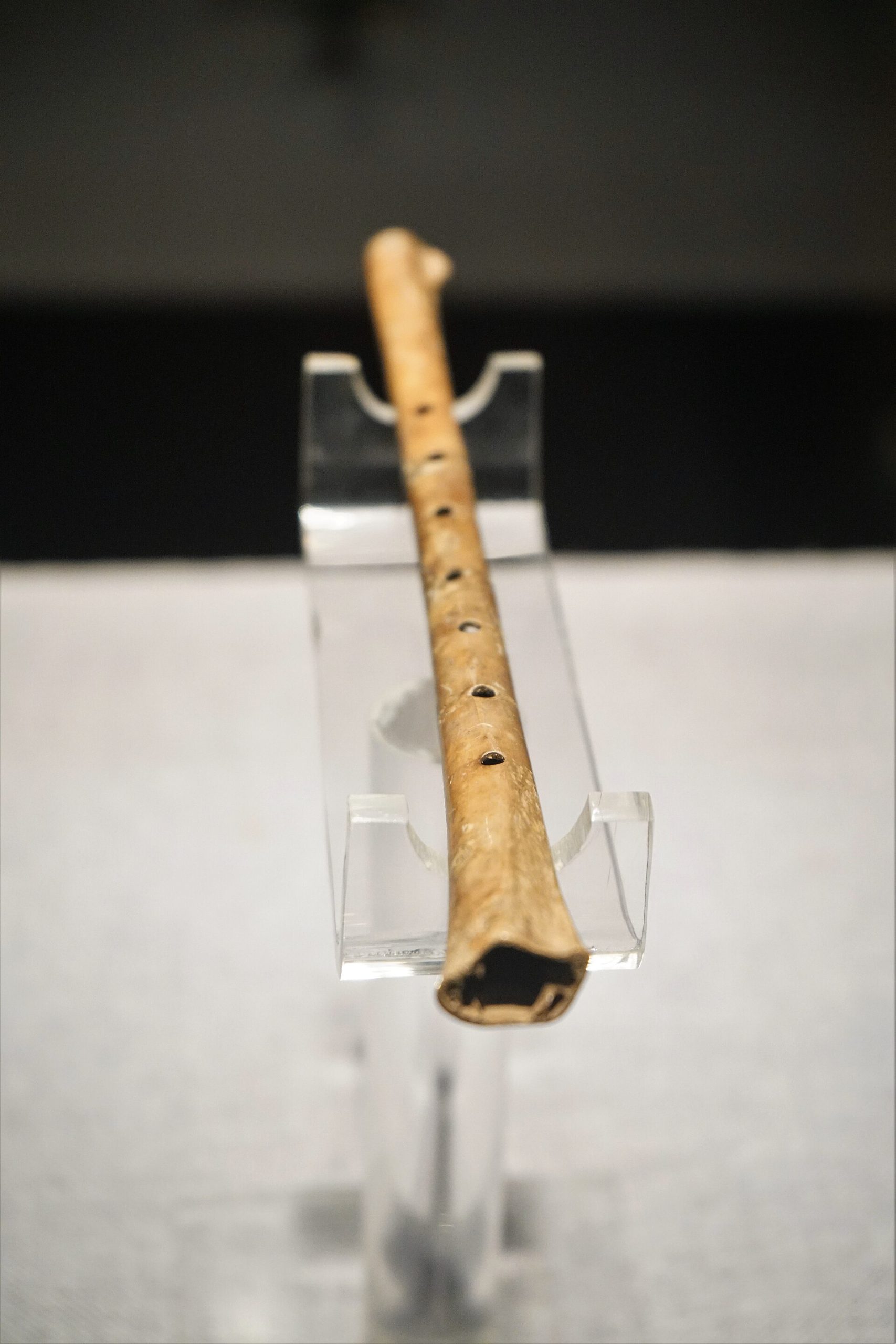
What makes them so remarkable is that some are complete and well-preserved enough to be played. When researchers studied them, they found that the flutes could produce a musical scale, and one especially fine example was shown to be capable of playing a range of notes that would let a musician perform actual melodies. Think about what that means: the people of Jiahu had not just invented a way to make sound, but a genuine system of music, with a scale and the ability to play tunes. Music, one of the most human of all our arts, was already highly developed at the very dawn of settled life in China.
The flutes also seem to have developed over time. Earlier examples have fewer holes, and later ones more, suggesting that over the centuries the musicians of Jiahu refined their instruments, adding notes and expanding their musical range. You can almost trace the evolution of an entire musical tradition through these bones, from simpler early flutes to more sophisticated later ones. It is one of the most intimate glimpses we have into the inner, artistic life of a prehistoric people.
What the music tells us
Why does it matter so much that the people of Jiahu made music? Because art and music are windows into the mind and spirit of a culture in a way that tools and pots alone can never be. Making music serves no immediate survival purpose; you cannot eat a flute or defend yourself with a melody. And yet the people of Jiahu devoted real skill and care to creating these instruments, which tells us they valued beauty, ritual, and expression as deeply as they valued food and shelter.
We can only guess at the role music played in their lives, but it was surely woven into their most important moments. The flutes may have accompanied rituals and ceremonies, marked the changing seasons, celebrated births and mourned deaths, or simply brought joy and comfort around the fire at night. Some were found in graves, hinting that music and the musicians who made it held a special, perhaps even sacred, status in the community. Whatever the specifics, the message is clear: these were people with a rich inner life, who reached for beauty and meaning just as we do.
There is something profoundly moving about this. When we hear a note played on a Jiahu flute, we are hearing, in a very real sense, the same sound that echoed through a Chinese village nine thousand years ago. Music becomes a bridge across the vast gulf of time, connecting us directly to the emotional and artistic life of people who lived unimaginably long ago. Few discoveries collapse the distance between past and present so completely.
Symbols on tortoise shells
If the flutes are Jiahu’s most enchanting discovery, its most tantalizing may be the symbols. Among the finds were tortoise shells and other objects marked with deliberate engraved signs, simple shapes and marks that were clearly made on purpose. Some of these symbols bear an intriguing resemblance to characters that would appear in much later Chinese writing, and this has led to a fascinating and much-debated question: could these be among the earliest roots of the Chinese writing system?

Now, it is important to be careful here. Most scholars do not believe these marks constitute true writing in the sense of a full system that records language. There is a huge gap in time between Jiahu and the earliest undisputed Chinese script, and we cannot read the Jiahu symbols or know exactly what they meant. But whether or not they are the direct ancestors of Chinese characters, they show that the people of Jiahu were already using symbols to convey meaning, an early step on the long road toward writing.
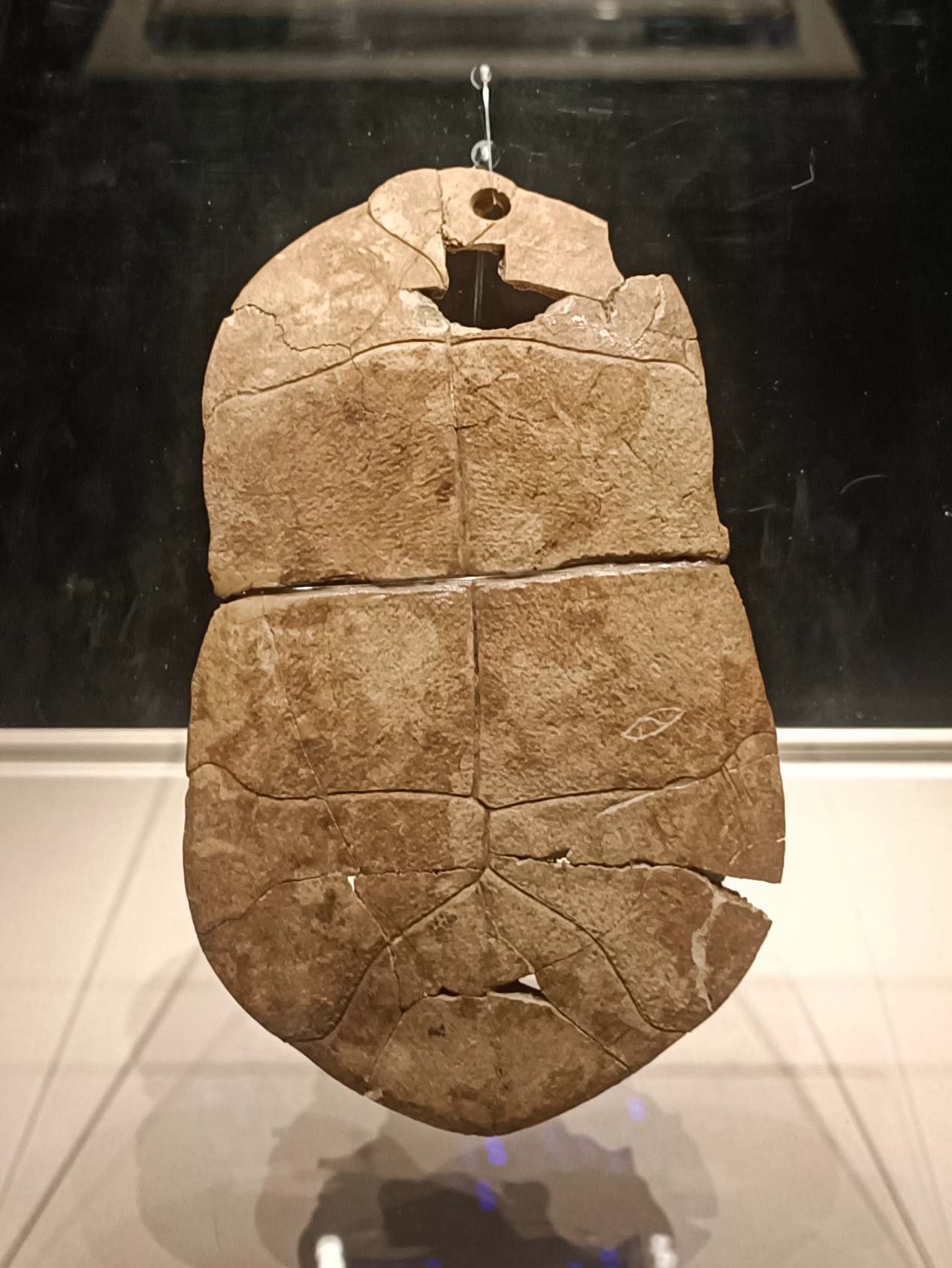
The use of tortoise shells is itself significant, because in much later Chinese history tortoise shells were used for divination, with cracks and marks read as messages from the ancestors or the spirit world. It is tempting, though speculative, to see in the Jiahu shells a very distant ancestor of that tradition. At the very least, these engraved symbols reveal a people grappling with the powerful idea that a mark can carry meaning, one of the intellectual foundations of everything that writing would later make possible.
Rice, fishing and daily life
Underneath the music and the mysterious symbols, Jiahu was first and foremost a farming and fishing village, and its people were skilled at wringing a living from their rich, watery environment. They cultivated rice, one of the earliest communities in the region to do so, taking part in the momentous domestication of the crop that would go on to feed much of humanity. This was cutting-edge agriculture for its time, and it helped underpin the prosperity that made everything else at Jiahu possible.

But the people did not rely on rice alone. The surrounding rivers and lakes teemed with fish, which they caught in quantity, and they hunted animals and gathered wild plants and nuts as well. This mixed economy, combining early farming with abundant wild resources, gave them a varied and secure food supply. They made pottery for cooking and storage, ground grain with millstones, and produced a range of tools from bone and stone, all the equipment of a settled, industrious community.

Daily life at Jiahu, then, would have been busy and rich. Picture people tending rice paddies in the wet lowlands, casting nets into the rivers, grinding grain, shaping clay, and drilling holes into crane bones to make flutes, all against a backdrop of marshes alive with birds. It was a world of plenty and of skill, and out of that security grew the art, ritual, and experimentation that make the site so extraordinary.
The world’s oldest “beer”?
Here is another Jiahu first that never fails to raise a smile. Chemical analysis of residues found inside pottery jars from the site revealed traces of a fermented beverage, a concoction made from rice, honey, and fruit. In other words, the people of Jiahu were brewing a kind of ancient alcoholic drink around nine thousand years ago, making it one of the earliest known examples of fermented beverages anywhere in the world.
This is more than just a fun fact. Fermented drinks have played a central role in human social and ritual life for a very long time, and their presence at Jiahu adds yet another layer to our picture of a rich communal culture. Perhaps these drinks were shared at feasts and ceremonies, accompanied by the music of those bone flutes. It is lovely to imagine a Jiahu gathering: people coming together, the flutes playing, cups of the honeyed rice brew passing from hand to hand, the whole community bound together in celebration.
The discovery also speaks to the sheer inventiveness of these people. Working out how to ferment a pleasant drink from rice, honey, and fruit takes observation, experimentation, and know-how. Combined with their music, their pottery, their farming, and their mysterious symbols, it paints a portrait of a community bursting with creativity and curiosity, endlessly experimenting with the possibilities of their world.
Burials and beliefs
Like so many of the ancient communities in this series, the people of Jiahu buried their dead with evident care, and those burials tell us a great deal. Graves were furnished with goods, including tools, pottery, and, tellingly, some of the flutes themselves. The inclusion of a flute in a grave is deeply suggestive. It hints that music was so bound up with a person’s identity, or so important to the community’s beliefs about death and the afterlife, that an instrument was thought a fitting companion for the journey beyond.

The burials also reveal differences between individuals, with some graves richer than others. This suggests that Jiahu society had begun to develop distinctions of status or role, an early hint of the social complexity that would grow over the following millennia. The people buried with flutes, in particular, may have been individuals of special importance, perhaps ritual specialists or respected musicians whose skills gave them a distinctive place in the community.
Taken together, the burials open a window onto the beliefs and values of the people of Jiahu. They cared for their dead, equipped them for whatever came next, and marked out certain individuals as special. Behind these customs lies a whole world of belief about life, death, and the unseen, a spiritual life every bit as real as their material one, even if its details are now lost to us.
At the dawn of Chinese civilization
Jiahu holds a special place in the long story of China because it sits so close to the very beginning. This was one of the earliest settled, farming communities in the region that would eventually give rise to Chinese civilization, and many of the threads first spun here, rice farming, pottery, music, ritual, and the use of symbols, would be woven through the whole of Chinese history that followed.
It is worth remembering that Chinese civilization, like all the great civilizations, did not appear fully formed. It grew, over many thousands of years, out of countless Neolithic communities like Jiahu, each contributing to the slowly accumulating store of knowledge, technology, and culture. Jiahu represents one of the earliest and richest of these foundational communities, a place where we can see the deep roots of a civilization that would go on to shape the world.
When we place Jiahu in this longer perspective, its significance becomes clear. It is not just a collection of remarkable individual finds, wonderful as those are. It is a snapshot of the very foundations of one of humanity’s greatest civilizations, captured at the moment when the essential elements, settled farming life, craft, art, ritual, and the first stirrings of symbolic thought, were coming together. Few sites let us stand so close to a beginning of such consequence.
Why Jiahu matters
So why should Jiahu, a modest Neolithic village in Henan, occupy such an outsized place in our imagination? Because it hands us an astonishing bundle of the earliest examples of some of the most defining human achievements. The oldest playable musical instruments in the world. Some of the earliest evidence of rice cultivation and of fermented beverages. Mysterious symbols that may hint at the deep prehistory of writing. Rarely does a single site preserve so many firsts, and so much of the richness of early human life.
More than that, Jiahu reminds us of something easy to forget: that the people of the deep past were fully, richly human. They did not merely survive; they made music, brewed drinks for their feasts, adorned their world with symbols, and honored their dead. They pursued beauty and meaning with the same passion we do. The bone flutes of Jiahu are, in a sense, a message from those distant people, telling us that the human love of music, celebration, and expression is as old as settled life itself.
When I picture Jiahu now, I hear it as much as see it: the clear notes of a crane-bone flute drifting over marshes alive with birds, the murmur of a feast, cups of honeyed rice brew passing around, symbols scratched onto a tortoise shell by firelight, and a whole community, nine thousand years gone, living a life full of skill, ritual, and song. For a place so few have heard of, Jiahu may bring us closer to the beating heart of our ancient ancestors than almost anywhere else on earth.
How Jiahu was found
Jiahu came to wider attention through excavations that gathered pace from the 1980s onward, as Chinese archaeologists systematically investigated the mound and revealed the extraordinary richness of what it held. Season after season, the finds accumulated: the flutes, the inscribed shells, the pottery, the traces of rice and fermented drink, the graves. Piece by piece, a portrait emerged of a community far more sophisticated than anyone might have expected from so early a date.
What makes the excavation of Jiahu so valuable is the care with which the finds were studied using modern scientific techniques. It was chemical analysis that revealed the ancient fermented beverage lurking in the residue of the pots. It was careful acoustic study that showed the flutes could still play a musical scale. It was meticulous comparison that sparked the debate over the engraved symbols. Jiahu is a wonderful example of how modern science can wring astonishing stories out of ancient remains, hearing music in old bones and tasting brews in the stains inside broken jars.
The result is that a village abandoned nine thousand years ago, and lost for almost all of that time, has been brought back to vivid life. We can now speak with real confidence about what the people of Jiahu ate and drank, how they made music, how they buried their dead, and how they marked meaning onto shells and bone. That is a remarkable achievement, and it is a reminder of how much the deep past still has to tell us, if only we dig carefully and look closely enough.
Jiahu in the story of the world
It is worth stepping back to see how Jiahu fits into the global picture of the Neolithic. Around the same time that the people of Jiahu were playing their crane-bone flutes, communities on the other side of the world were raising the great temple pillars of Anatolia, building the first streetless villages of the Near East, and taking their own first steps toward farming. The Neolithic revolution was a truly worldwide phenomenon, unfolding independently in different regions, each with its own distinctive character.
What is striking is how each of these early centers combined shared human impulses with its own local flavor. The urge to settle, to farm, to make art, and to honor the dead appears again and again across the globe, yet it expresses itself differently in each place, shaped by local environments, resources, and cultures. At Jiahu, that universal human creativity took the form of rice paddies, bone flutes, fermented rice brew, and engraved tortoise shells, a uniquely Chinese expression of a shared human awakening.
Seeing Jiahu in this global context makes it all the more meaningful. It is at once utterly distinctive, a product of its particular time and place, and deeply familiar, an expression of the same creative, social, spiritual impulses that drove people everywhere. In that double character lies much of the fascination of the ancient world: we recognize ourselves in these distant people even as we marvel at how different their lives were from our own.
The craft behind a crane-bone flute
It is worth lingering on just how much skill went into making a Jiahu flute, because the more you think about it, the more impressive it becomes. First, the maker had to select the right material: the wing bone of a crane, naturally hollow, straight, and strong, but also delicate and easy to crack. Preparing the bone, cleaning it out and cutting it to length, required a steady hand and real knowledge of the material.
Then came the truly demanding part: drilling the finger holes. The position and size of each hole determines the note it produces, so getting them right meant understanding, at least intuitively, the relationship between the holes and the sounds. Some of the Jiahu flutes even show small marks that appear to be measurements or guides, suggesting the makers planned the placement of the holes carefully rather than drilling them at random. This is craftsmanship of a high order, combining manual skill with a grasp of what we would now call acoustics.
All of this had to be done with stone-age tools, without metal drills or precision instruments, working on a fragile bone that could shatter with one wrong move. That the makers of Jiahu succeeded, and produced instruments capable of playing a musical scale, is a testament to their patience, skill, and understanding. Every one of these flutes represents hours of careful, knowledgeable work by someone who cared deeply about the sound it would make. In them we meet not just musicians but master craftspeople, artists in the fullest sense.
Hearing across nine thousand years
Of all the ways we reach back into the deep past, few are as powerful as sound. We are used to seeing the ancient world: ruins, artifacts, images. But to hear it is something else entirely. When a musician lifts a nine-thousand-year-old Jiahu flute and plays a melody on it, we are not looking at a reconstruction or an interpretation; we are hearing, quite literally, the same tones that filled the air of a Neolithic Chinese village. The centuries collapse, and for a moment the ancient and the modern share a single note.
That experience carries a quiet philosophical weight. It reminds us that beneath all the vast differences between their world and ours, the people of Jiahu were moved by the same things that move us. A melody that pleased a listener nine thousand years ago can still please a listener today, because human ears and human hearts have not fundamentally changed. Music is one of the great constants of our species, and Jiahu proves how deep its roots run.
Perhaps that is the most precious gift Jiahu offers. It does not just add facts to our knowledge of the past; it lets us feel our kinship with people who lived unimaginably long ago. Through their music, their feasts, their symbols, and their care for the dead, the villagers of Jiahu reach across the millennia and touch something in us. They remind us that to be human has always meant more than mere survival, that from the very beginning we have made music, sought meaning, and reached for beauty. And that, in the end, is a song worth listening to.
Next time you hear a simple tune played on a flute, spare a thought for the anonymous musicians of Jiahu, who first drilled holes into a crane’s wing bone by a Chinese marsh and, in doing so, gave the world one of its oldest surviving songs.
It is one of the oldest melodies we can still play, and a haunting reminder that the human song has been going on, unbroken, for a very, very long time indeed.
If the world of Jiahu has enchanted you, it is just one stop on a much longer journey through humanity’s ancient beginnings. Staying in China, you can follow the story forward to the water city of Liangzhu. To meet Jiahu’s contemporaries elsewhere, wander to Çatalhöyük and its forerunner Aşıklı Höyük, or the first farmers of Mehrgarh. For the oldest temples of all, there is Göbekli Tepe and Karahan Tepe, and for the first cities, Uruk, Tell Brak, Mohenjo-daro, Dholavira, Sarazm and Caral. If you love monuments, do not miss Stonehenge, Newgrange, the temples of Malta, the walls of Jericho, and the village of Skara Brae. And for pure wonder, explore the palace of Knossos, the painted caves of Lascaux and Chauvet, the reef city of Nan Madol, the temple of Chavín de Huántar, the towns of Cucuteni-Trypillia, the carved stones of Cerro Sechín, and the earthworks of Poverty Point. Together they tell the sweeping, deeply human story of how we first learned to build a world, and, at Jiahu, to fill it with music. It is well worth visiting Chankillo, the ancient Peruvian calendar written in stone and sunlight, too. See also Kalibangan, the Rajasthan mound that farmed a river, survived a quake, and left the oldest ploughed field on Earth. See also the Cairn of Barnenez, whose eleven stone chambers predate Egypt’s pyramids by millennia. See also Vinča, one of the most advanced cultures of Neolithic Europe. See also Gavrinis, whose walls of engraved stone are unlike anything else in the Neolithic world. The deep past continues at Los Millares, a fortified Copper Age town at the edge of Europe. The same reaching-for-permanence runs through Bougon, a cluster of ancient French burial mounds well worth meeting. It sits well beside the story of Almendres, a Portuguese stone circle built eight thousand years ago. It pairs beautifully with the story of Ġgantija, a temple older than the pyramids themselves. It pairs beautifully with the story of Knowth, a five-thousand-year-old tomb in the heart of Ireland. It pairs beautifully with the story of Tarxien, Malta’s most elaborate temple, carved over five thousand years ago. It pairs beautifully with the story of Mnajdra, a coastal temple older than the pyramids and aligned with the sun. The clifftop sanctuary of Ħaġar Qim offers yet another window onto the world of the first builders. The brooding tomb of Dowth offers yet another window onto the world of the first builders. The great stone rows of Carnac offer yet another window onto the world of the first builders. The remote ring of Callanish offers yet another window onto the world of the first builders. The stone warriors of Filitosa offer yet another window onto the world of the first builders. The clifftop stone ship of Ale’s Stones offers yet another window onto the monuments of the deep past.
You May Like
Norse Explorers Reached Canada 500 Years Before Columbus


2 thoughts on “Jiahu: The 9,000-Year-Old Chinese Village Whose Flutes Still Play”