On the crowded island of Malta, hemmed in now by the houses of a modern town, lies a temple complex that once stood at the very heart of one of the ancient world’s most extraordinary religious cultures. Tarxien is the most elaborately decorated of all the Maltese temples, a place of carved spirals, animal friezes, and a colossal statue whose lower half still survives. It is more than five thousand years old, and it is a genuine masterpiece of prehistoric art.
What draws me to Tarxien above the other Maltese temples is its sheer artistry. Where Ġgantija impresses with scale, Tarxien dazzles with detail: relief carvings, decorated screens, and sculpture that reveal a rich spiritual world. Let me walk you through this remarkable site and the culture that created it.

- What Tarxien actually is
- How old the temples are
- The layout of the complex
- The colossal statue
- The carved reliefs
- Rituals and offerings
- The people who built it
- Why Tarxien still matters
- The mystery of the spirals
- A world of animals and sacrifice
- The rise and fall of a temple culture
- Building and decorating in stone
- How Tarxien came to light
- A temple that became a tomb
- Tarxien among the Maltese temples
- The question of the goddess
- Tarxien and the Neolithic world
- Visiting Tarxien today
- The enduring legacy of Tarxien
- Protecting a fragile masterpiece
What Tarxien actually is
Tarxien is a complex of interconnected temples, several structures joined together into a single sprawling monument. Like the other Maltese temples, each has the characteristic plan of rounded chambers, or apses, opening off a central corridor. But Tarxien is unusually elaborate, with multiple temples woven together and richly decorated throughout.
It belongs to the same remarkable phenomenon as Ġgantija: the Maltese Temple Period, when communities across these small islands raised a whole family of monumental temples. Tarxien represents this tradition at its most developed and ornate, a high point of Maltese prehistoric architecture and art.

How old the temples are
The temples at Tarxien were built and elaborated over a long period, with the main construction dating to around 3600 to 2500 BC. That makes them more than four and a half thousand years old at the least, and their roots reach back over five thousand years, older than the Egyptian pyramids and Stonehenge alike.
What is especially poignant about Tarxien is that it captures the temple culture near its peak, shortly before it faded. Later, the site was even reused as a cremation cemetery by a different people, layering yet another chapter onto its long history. Tarxien is, in effect, a record of both the flourishing and the twilight of Malta’s temple builders.

The layout of the complex
Walking through Tarxien, you move through a series of linked temples and chambers, each opening into the next. The plan can feel like a maze at first, but it reflects a deliberate progression from outer, more public spaces toward inner, more sacred ones. Great stone thresholds and doorways mark the transitions.
Throughout the complex, the builders combined massive structural megaliths with finer decorated stones, screens, altars, and basins. The result is a space that was clearly designed not just to shelter ritual but to stage it, guiding worshippers deeper into an increasingly charged and sacred environment.
The colossal statue
One of the most famous discoveries at Tarxien is the lower portion of a truly colossal statue. Only the legs and feet, draped in a pleated skirt, survive, but they suggest a figure that once stood far larger than life, a monumental presence dominating its chamber. It is often called the “Fat Lady,” part of a wider tradition of rounded human figures found across the Maltese temples.
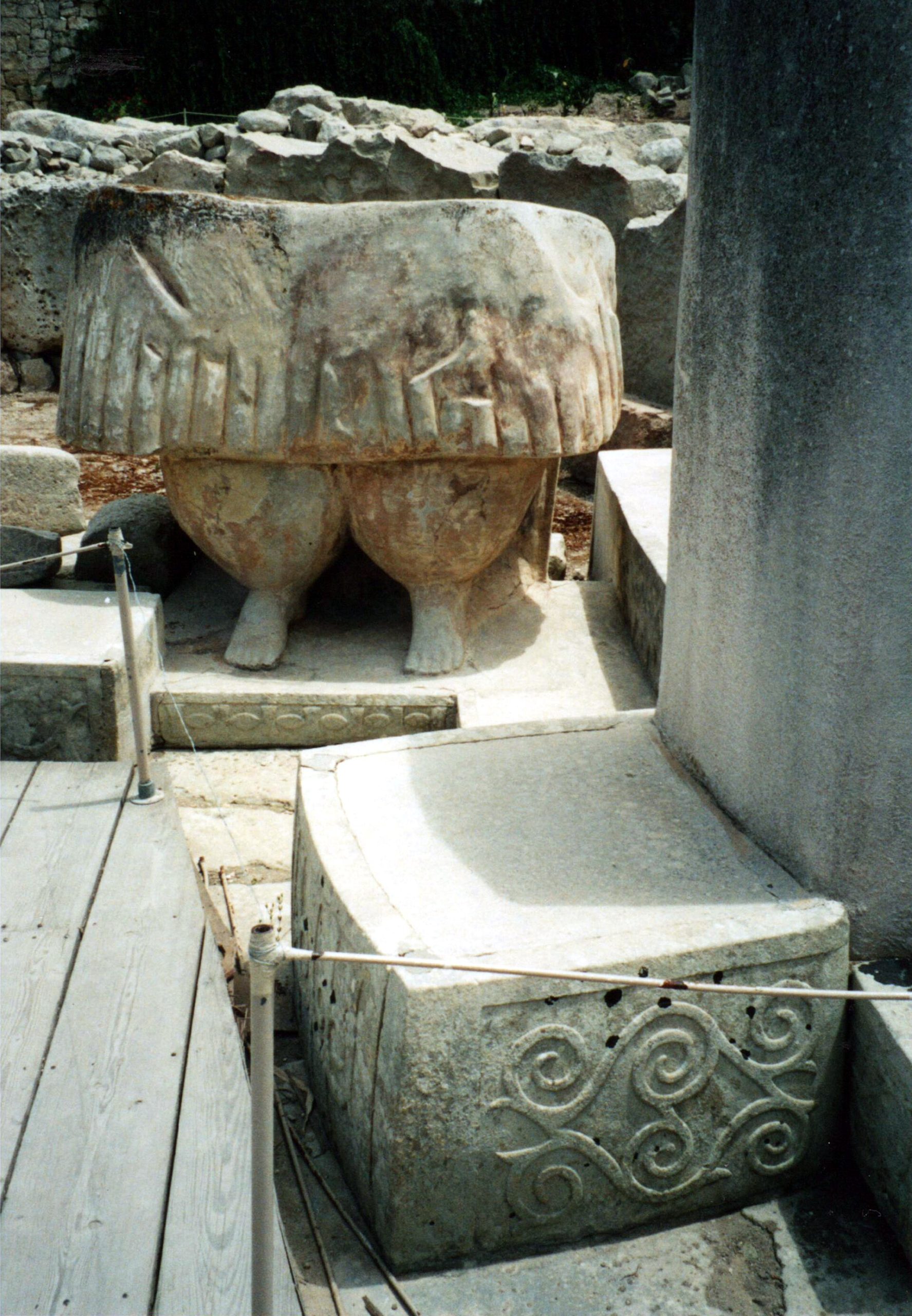
What did this giant figure represent? Many connect these rounded forms with fertility, abundance, or a mother-goddess tradition, though we should hold such readings lightly. Whatever its exact meaning, the statue tells us that the people of Tarxien could conceive and create monumental sculpture, and that some powerful figure or deity stood at the centre of their worship.
The carved reliefs
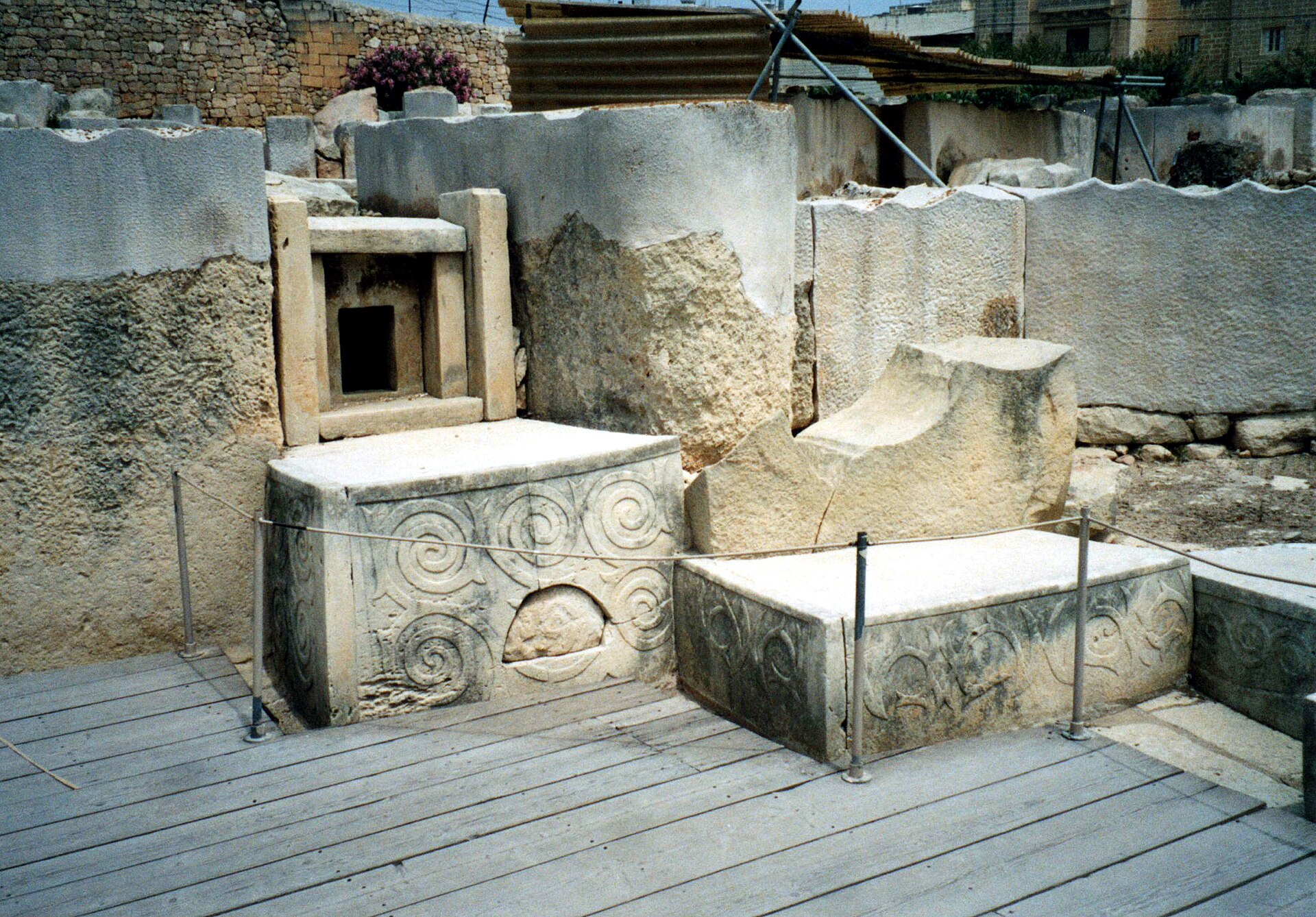
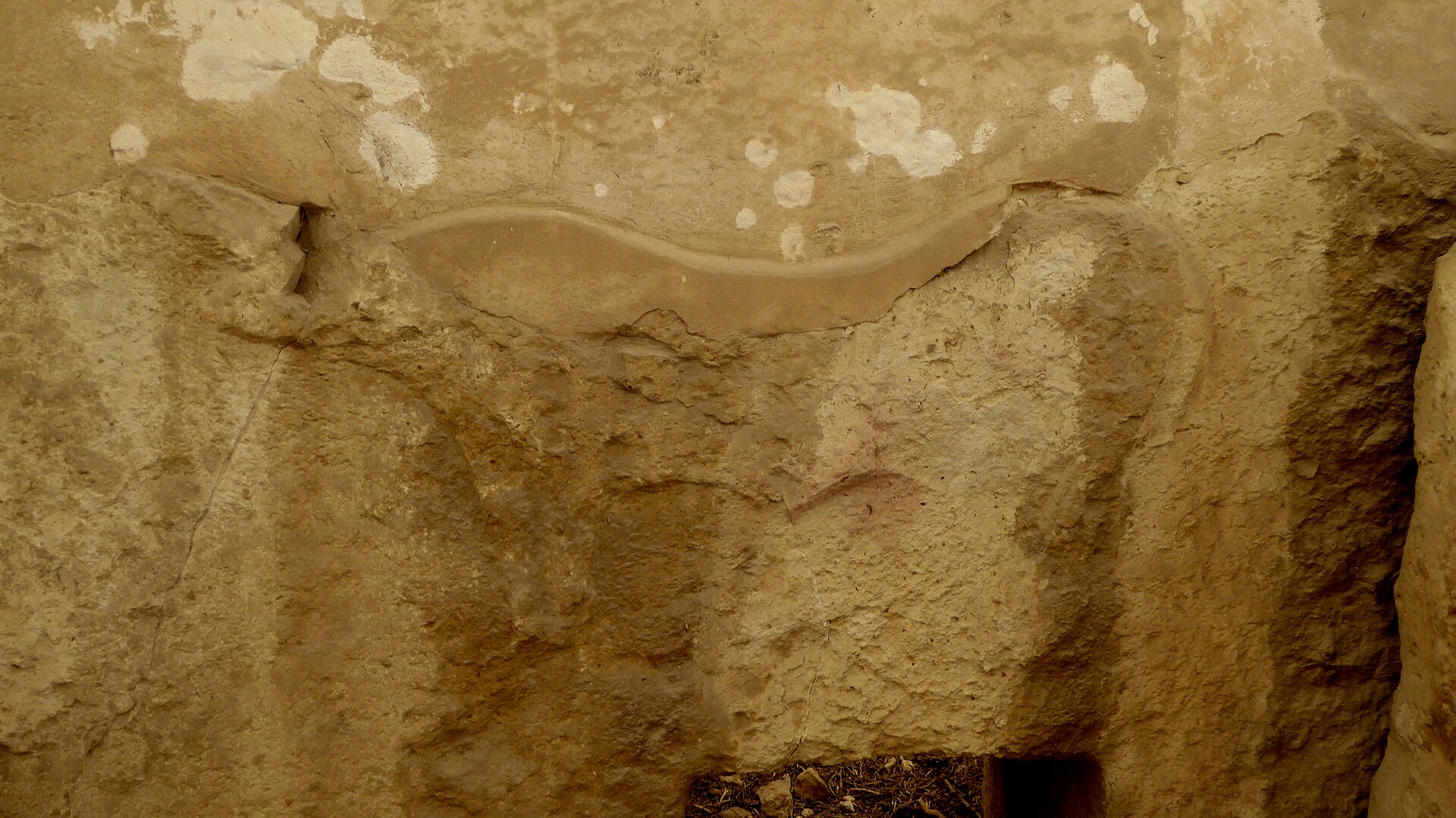
Tarxien is above all famous for its carvings. Spirals swirl across decorated screens and altars, and remarkable animal reliefs, including bulls, a sow, and other beasts, are carved in low relief on the great stones. These are among the earliest such animal depictions on Malta, and they bring the temple’s stone surfaces vividly to life.

The spiral motifs, echoing those found at sites across prehistoric Europe, may have held deep symbolic meaning, perhaps connected to life, growth, or the cosmos. The animals likely reflect the importance of livestock and sacrifice in temple ritual. Together they make Tarxien a gallery of prehistoric art, carved by hands more than five thousand years ago.
Rituals and offerings
The physical evidence at Tarxien paints a vivid picture of ritual life. Altars, hearths, and basins survive, along with clues pointing to animal sacrifice and offerings. One carved altar was even found to contain flint knives and animal bones, strongly suggesting that creatures were sacrificed as part of the temple’s ceremonies.
Picture the scene: worshippers gathering in these decorated chambers, offerings laid on the altars, animals sacrificed, and rituals enacted before that colossal statue. Whatever exact beliefs animated them, the people of Tarxien clearly poured enormous devotion into this place. It was a living centre of their spiritual world.
The people who built it
The builders of Tarxien were, like all the Maltese temple builders, farming communities on small Mediterranean islands. That makes their achievement all the more astonishing. A relatively small island population created not only monumental architecture but a sophisticated tradition of sculpture and relief carving.

To build and decorate Tarxien required more than muscle. It demanded skilled artisans, organised labour, and a shared spiritual vision strong enough to sustain the effort across generations. The complex is a portrait of that society: devout, creative, cooperative, and capable of turning stone into art on a monumental scale.
Why Tarxien still matters
Tarxien matters because it shows the artistic heights that Malta’s temple culture reached. It is not just an impressive pile of stones but a richly decorated sacred space, proof that prehistoric islanders created art of real power and subtlety. It expands our sense of what early societies were capable of.
It also matters because so much survived, the carvings, the statue, the altars, so that we can still read something of the beliefs behind them. At Tarxien, prehistory becomes vivid and human. You stand among the very stones where a vanished people worshipped, and their artistry reaches across five thousand years to meet you.
The mystery of the spirals
The spiral is one of the great recurring motifs of prehistoric art, and at Tarxien it appears again and again, coiling across screens and altars. There is something hypnotic about these designs, and it is impossible not to wonder what they meant to the people who so carefully carved them.
Spirals turn up at ancient sites across Europe, from the tombs of the Boyne Valley to the temples of Malta, which hints that they carried some shared or widely felt significance. They may have symbolised life and growth, the cycles of the sun and seasons, or spiritual journeys we can no longer reconstruct. Their exact meaning is lost, but their power is not.
What strikes me most is the sheer effort behind them. Carving hard stone with stone tools to produce such flowing, deliberate designs took skill, patience, and purpose. These were not idle doodles. They were meaningful symbols, worked into the fabric of a sacred space, and they still hold our gaze five thousand years later.
A world of animals and sacrifice
The animal reliefs at Tarxien open a window onto the daily and spiritual life of its builders. Bulls, a sow with piglets, and other creatures are carved into the great stones, reflecting the central importance of livestock to these farming communities. Their animals were their wealth, their food, and, it seems, their offerings.
The evidence for animal sacrifice, flint knives and bones found within a carved altar, ties these images directly to ritual. Animals were not just depicted; they were offered. The temple was a place where the community’s most precious living resources were given up in acts of devotion, binding the people to whatever powers they believed governed their world.
Seeing these carvings, I am struck by how they collapse the distance between the sacred and the everyday. The same animals that sustained daily life were woven into the deepest rituals, carved lovingly into stone. For the people of Tarxien, farming, feasting, and faith were all part of one seamless world.
The rise and fall of a temple culture
Tarxien belongs to one of the most remarkable episodes in all of prehistory: the Maltese Temple Period, when the small population of these islands raised a whole constellation of monumental temples over many centuries. It was a burst of creativity and devotion with few parallels anywhere in the ancient world.
And then, mysteriously, it ended. The vibrant temple culture that produced Tarxien and Ġgantija faded, for reasons still debated, environmental strain, social upheaval, or some combination lost to time. The temples fell silent, and a different people later reused Tarxien as a burial ground, marking the close of one era and the opening of another.
That rise and fall gives Tarxien a haunting quality. It captures a civilisation at the height of its artistic powers, just before the light went out. Standing among its carvings, you feel both the brilliance of what these people achieved and the poignancy of how completely their world eventually vanished.
Building and decorating in stone
Creating Tarxien was a double achievement: monumental construction and refined artistry combined. The builders had to quarry, move, and raise enormous megaliths, then shape and carve many of them with intricate designs. Doing all this without metal tools or wheeled transport as we know them required real ingenuity.
Stone spheres found at Maltese temple sites hint at how the great blocks were moved, rolled beneath heavy stones like primitive bearings. Once in place, softer limestone was carved with patient skill into spirals, animals, and screens. The combination of heavy engineering and delicate art within one project is genuinely impressive.
None of this happened by chance. Behind Tarxien lay planning, specialised skill, and coordinated labour sustained across generations. The people who built it were engineers and artists at once, and their surviving temple is the proof of a sophisticated tradition passed down by hand and example rather than by writing.
How Tarxien came to light
For a long time, Tarxien lay hidden and forgotten beneath the soil, its greatness unsuspected. It was uncovered in the early twentieth century when a local farmer kept striking large stones while ploughing his field. That chance discovery led to excavations that revealed one of the richest prehistoric sites in the Mediterranean.
The digs uncovered the interconnected temples, the carved reliefs, the altars, and the great statue, transforming Tarxien from an anonymous field into a world-famous monument. It is a wonderful reminder of how much of the deep past can lie just beneath our feet, waiting for a plough or a spade to bring it back into the light.
Since then, careful study and conservation have helped protect the fragile carvings and stones. To shield the most vulnerable areas from the weather, parts of the site are now sheltered, a modern effort to ensure that a monument five thousand years old survives for generations still to come.
A temple that became a tomb
One of the most intriguing chapters in Tarxien’s story came after the temple builders were gone. A later people, arriving in a new era, reused the site as a cremation cemetery, burying their dead among the old sacred stones. The place of worship became a place of the dead.
This reuse tells us that the power of the site outlasted the culture that created it. Even to newcomers who did not share the temple builders’ beliefs, Tarxien clearly remained a place of significance, worthy of their dead. Sacred landscapes have a way of holding their meaning long after the original meaning is lost.
That layering, temple then tomb, gives Tarxien a special depth. It is not the record of a single moment but of successive worlds, each leaving its mark on the same ground. When you visit, you are walking through more than one vanished society, their stories stacked one upon another in the stones.
Tarxien among the Maltese temples
It helps to see Tarxien alongside its siblings. Ġgantija on Gozo is the oldest and most massive, overwhelming with sheer scale. Others, like the temples by the sea at the southern coast, are famous for their dramatic settings and solar alignments. Tarxien’s distinction is its artistry, the richest carving and sculpture of them all.
Comparing them is not about ranking but about appreciating the range of a single remarkable culture. Across these small islands, communities built temple after temple, each with its own character, together forming one of the greatest concentrations of prehistoric monumental architecture anywhere in the world.
Placed in that company, Tarxien stands out as the artistic jewel. If Ġgantija shows the raw ambition of the temple builders, Tarxien shows their refinement, their spiritual imagination, and their skill in turning stone into meaningful, beautiful art. Together, they reveal a civilisation of astonishing depth.
The question of the goddess
The rounded human figures found across the Maltese temples, including the colossal statue at Tarxien, have inspired endless discussion. Many see in them evidence of a fertility cult or the worship of a great mother goddess, an earth-centred spirituality fitting for a farming people deeply concerned with abundance and the cycles of life.
It is a compelling idea, and it may well be right, but honesty requires caution. We have no written records from these people, so we cannot know exactly who or what these figures represented. They might be deities, ancestors, priests, or symbols of something we cannot even name. The temptation to read our own assumptions into them is strong.
What we can say is that some powerful figure or force stood at the heart of Tarxien’s worship, important enough to be rendered on a monumental scale. Whether goddess, ancestor, or something else entirely, it commanded devotion, and the great statue that once towered in its chamber is the surviving trace of that lost faith.
Tarxien and the Neolithic world
To place Tarxien in context, remember the broader revolution it belongs to. Across the Neolithic world, people had taken up farming, settled into permanent communities, and begun to think in new ways about time, the sacred, and the ancestors. From that settled life came the surplus and the motivation to build and decorate on a grand scale.
The Maltese temples are among the most spectacular expressions of that revolution, and Tarxien is its artistic pinnacle. It shows that even a small island society could achieve extraordinary sophistication, combining monumental building with a rich tradition of sculpture and relief. Far from a backwater, prehistoric Malta was a place of remarkable creativity.
Seen this way, Tarxien is more than a Maltese wonder. It is a vivid chapter in the global story of how settled farming communities everywhere began to raise sacred monuments, binding together the living, the dead, the land, and the divine. It is one of the most beautiful expressions of that universal human impulse.
Visiting Tarxien today
A visit to Tarxien today is a rewarding experience, and the site is set up to help you understand what you are seeing. Walkways guide you through the interconnected temples, and displays explain the history, the carvings, and the rituals that once took place here. Many of the most precious original carvings and the great statue are protected, with copies shown in place.
As you move through the chambers, take time to notice the details: the flowing spirals, the animal reliefs, the great thresholds, and the sheer complexity of the plan. It is easy to rush, but Tarxien rewards slow looking. Each carved stone is a small window into a spiritual world that vanished thousands of years ago.
What stays with most visitors is a feeling more than a fact, a sense of standing at the heart of an ancient faith, surrounded by the art of a people who poured their deepest beliefs into stone. Tarxien turns abstract prehistory into something intimate and vivid, and that is exactly what makes it unforgettable.
The enduring legacy of Tarxien
What does Tarxien leave us, beyond its stones and carvings? For me, its greatest legacy is a kind of proof: evidence that people five thousand years ago were every bit as artistic, thoughtful, and spiritually rich as we imagine ourselves to be. They built, sculpted, carved, and worshipped with extraordinary sophistication.
They also left us a direct, physical link to a world that would otherwise be almost unimaginable. Without written records, the temple builders would be little more than a shadow. Because they carved their beliefs into stone, we can still stand in their sacred spaces and feel, however faintly, the presence of the people who gathered there.
That is the quiet power of Tarxien. It carries meaning across an almost unthinkable gulf of time, one careful generation of preservation at a time. We have become the latest custodians of a masterpiece older than history itself, and how long it endures depends, in part, on whether we keep believing it matters.
Protecting a fragile masterpiece
Tarxien is irreplaceable, and its survival is not guaranteed. Soft limestone carvings that have lasted five thousand years are vulnerable to weather, pollution, and the simple pressure of many visitors over time. That is why so much care now goes into sheltering the site, displaying copies of the most delicate pieces, and managing how people move through it.
Every effort to conserve the temple, and every respectful visitor who treats it gently, helps ensure that Tarxien endures. These carvings belong not just to us but to everyone who comes after, and preserving them is a way of keeping faith with both the ancient builders and the generations still to come.
In a very real sense, we have become the current guardians of one of humanity’s great prehistoric masterpieces. Whether Tarxien still stands, its spirals and animals intact, in another thousand years depends on choices made now. That thought turns a simple visit into something meaningful, a small act of care passed forward through time.
There is one final image I carry from Tarxien: the great carved stones standing quietly under their protective shelter, the spirals and animals still crisp after five thousand years, and the modern town pressing right up to the edge of this ancient sacred ground. Whoever these builders were, they made something so powerful that it has outlasted their entire world, and still stops visitors in their tracks today.
Since Malta’s temple culture built more than one masterpiece, the natural next step from Tarxien is its great sister site Ġgantija: The Giant Temples of Gozo, Older Than the Pyramids, along with the temples of The Megalithic Temples of Malta: Older Than the Pyramids. From there, follow the megalith trail to Stonehenge: How and Why This Ancient Stone Circle Was Really Built, Newgrange: The 5,000-Year-Old Tomb Built to Catch the Solstice Sun, Gavrinis: The 6,000-Year-Old Carved Passage They Sealed in the Dark, Bougon: The 7,000-Year-Old Burial Mounds Older Than the Pyramids, Almendres Cromlech: Europe’s Oldest Stone Circle, 2,000 Years Before Stonehenge, and the carved tomb of Knowth: Europe’s Greatest Collection of Neolithic Art, Hidden Beside Newgrange. Reach back to the beginning with Göbekli Tepe: The World’s Oldest Temple and How It Rewrote History and Karahan Tepe: The Astonishing Sister of Göbekli Tepe, and trace the first towns through Çatalhöyük: The 9,000-Year-Old Town With No Streets, Jericho: The World’s Oldest City and Its 10,000-Year-Old Wall, Skara Brae: The 5,000-Year-Old Village Known as the Scottish Pompeii, and Aşıklı Höyük: The 10,000-Year-Old Village That Came Before Çatalhöyük. The great river and valley civilisations unfold at Uruk and Sumer: The First Cities and the Birth of Writing, Mohenjo-daro: The 4,500-Year-Old City That Was Centuries Ahead of Its Time, Liangzhu: The 5,000-Year-Old Water City That Rewrote China’s History, Dholavira: The 4,500-Year-Old City That Beat the Desert With Water Engineering, Tell Brak: The Syrian Mound That May Rewrite Where Cities Began, and The Cairn of Barnenez: Europe’s Colossal Stone Monument Older Than the Pyramids, while across the seas you’ll meet Caral: The 5,000-Year-Old City That Rose As the Pyramids Were Built, Chavin de Huantar: The 3,000-Year-Old Andean Temple Built to Overwhelm the Senses, Cerro Sechin: The 3,600-Year-Old Peruvian Temple Carved With Warriors and Their Victims, Poverty Point: The 3,700-Year-Old Earthworks Built by Hunter-Gatherers, Not Farmers, Chankillo: The 2,300-Year-Old Peruvian Towers That Are the Americas’ Oldest Solar Observatory, and the remarkable Nan Madol: The Ancient City Built on a Coral Reef in the Middle of the Pacific. For still more deep history, wander through The World’s Oldest Art: Inside the Painted Caves of Lascaux and Chauvet, Knossos: The 4,000-Year-Old Palace Behind the Myth of the Minotaur, Cucuteni-Trypillia: Europe’s 6,000-Year-Old Mega-Settlements That Might Be the First Cities, Sarazm: The 5,500-Year-Old Town in Tajikistan That Rewrites Central Asia’s Past, Mehrgarh: The 9,000-Year-Old Village Where South Asia Learned to Farm, Jiahu: The 9,000-Year-Old Chinese Village Whose Flutes Still Play, Kalibangan: The Indus Town With the World’s Oldest Ploughed Field, Vinča: The Danube Culture That May Have Written Before Anyone Else, and Los Millares: The 5,000-Year-Old Fortified Town at the Edge of Europe. Every one is another chapter in the same astonishing human story. For a temple that turns sunlight into a calendar, visit Mnajdra, aligned with the equinox and solstice sun on Malta’s coast. On the cliffs of Malta, the temple of Ħaġar Qim tells a strikingly similar story of stone and devotion. In Ireland’s Boyne Valley, the quiet mound of Dowth tells a strikingly similar tale of stone and the setting sun. In Brittany, the thousand standing stones of Carnac tell a strikingly similar story of stone and devotion. Far out in the Hebrides, the ring of Callanish tells a strikingly similar story of stone and sky. In a quiet Corsican valley, the carved stone warriors of Filitosa tell a strikingly different chapter of the same deep past. On a Swedish clifftop, the great stone ship of Ale’s Stones carries the same ancient impulse out toward the sea.
You May Like
Norse Explorers Reached Canada 500 Years Before Columbus


2 thoughts on “Tarxien: Malta’s Most Elaborate Prehistoric Temple, Carved 5,000 Years Ago”