On a green clifftop in the far south of Sweden, overlooking the grey swell of the Baltic, fifty-nine great boulders stand in the shape of a ship. This is Ales stenar — Ale’s Stones — and it is one of the most striking and enigmatic monuments in all of Scandinavia. Sixty-seven metres from prow to stern, it sits above the little fishing village of Kåseberga like a vessel forever setting sail into the sea and sky.
I have always found stone ships one of the most poetic ideas the ancient world produced. Not a real boat, not a carving of one, but a full-sized ship traced out in standing stones on the land, pointing at the water. Ale’s Stones is the grandest surviving example, and standing inside its stone hull, with the wind off the Baltic and gulls wheeling overhead, is an experience that goes straight past the intellect and lands somewhere deeper.
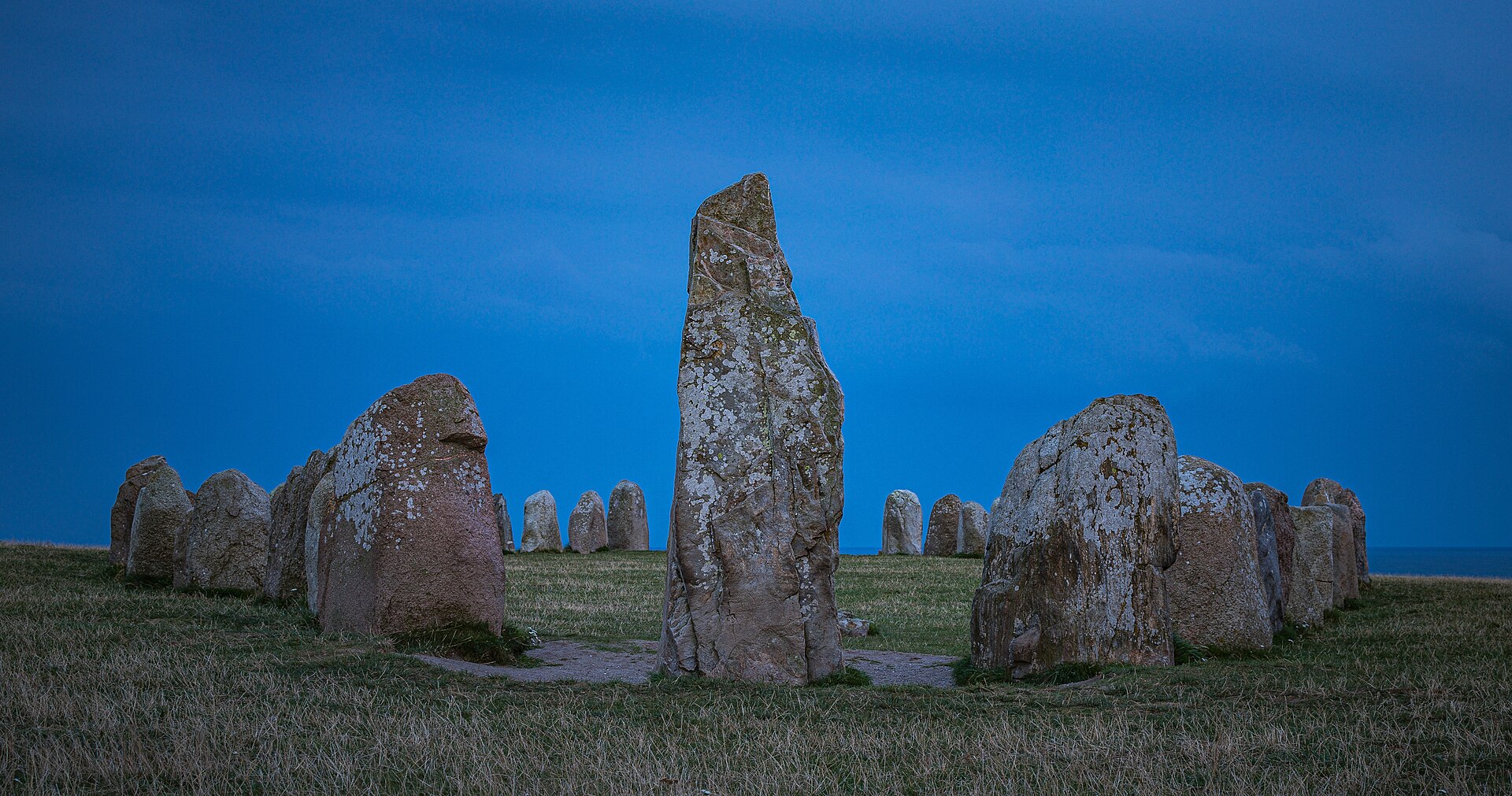
- A ship of stone above the sea
- The form of the vessel
- How old is it, really?
- The tradition of stone ships
- Grave, monument, or calendar?
- The legend of King Ale
- The people of Iron Age Skåne
- The sun and the stones
- Digging into the ship
- A monument in its setting
- The ship in the northern mind
- The dating debate
- Protecting the stone ship
- The meaning of the name
- Among the monuments of the north
- Visiting Ale’s Stones today
- Why Ale’s Stones still moves us
A ship of stone above the sea
The setting is half the magic. Ale’s Stones crowns a flat-topped ridge on the coast of Skåne, Sweden’s southernmost province, with the land falling away to the Baltic on one side and rolling farmland on the other. To reach it you climb from the harbour at Kåseberga up onto the exposed clifftop, and the monument rises before you against the enormous coastal sky.
There is no shelter up here. The wind is almost always blowing, the light is forever shifting, and the sea stretches away to the horizon. Whoever chose this spot wanted drama, wanted the meeting of land and water, wanted a place that felt like an edge. The monument and its setting are inseparable.
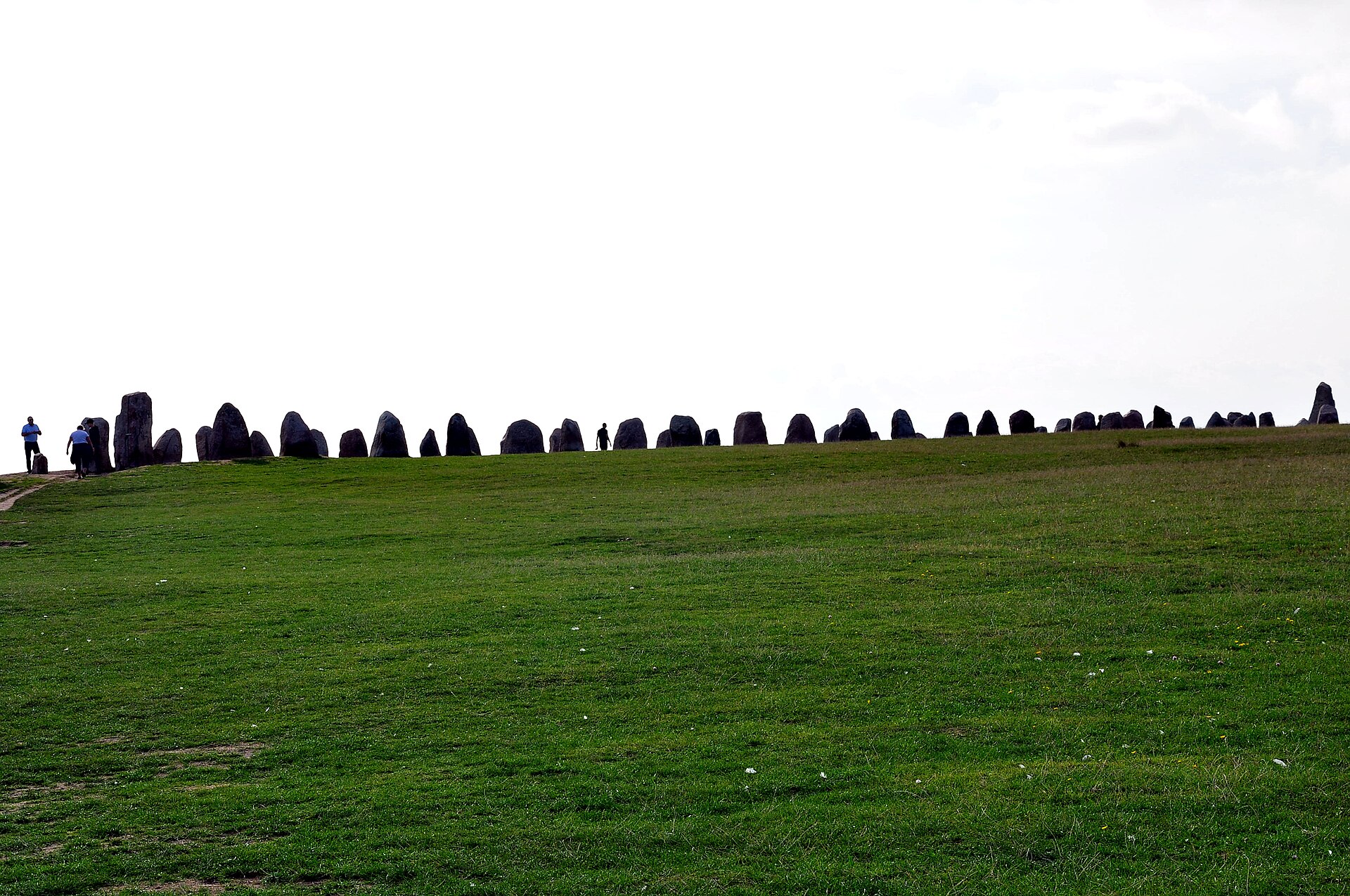
It is the kind of place that changes with the weather and the hour. On a calm summer evening it can feel serene, almost gentle; in a Baltic gale it feels wild and elemental. Either way, the great stones hold their formation, patient and unmoving, as they have for well over a thousand years.
The form of the vessel
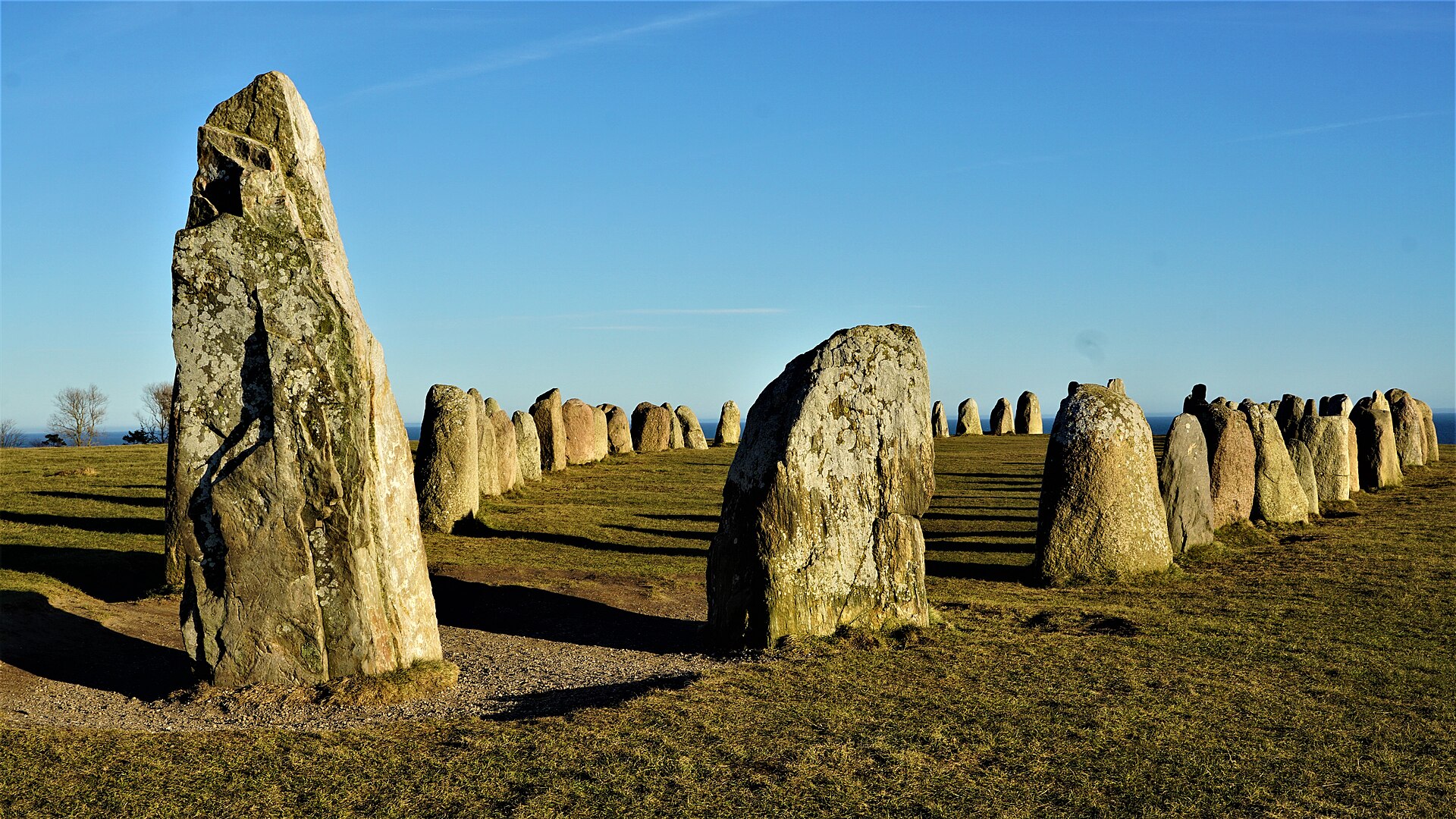
The monument consists of fifty-nine large boulders arranged in the unmistakable outline of a ship, some sixty-seven metres long and around nineteen metres at its widest. Two larger stones mark the prow and stern, the pointed ends of the vessel, giving the whole formation its clear nautical shape when seen from above.
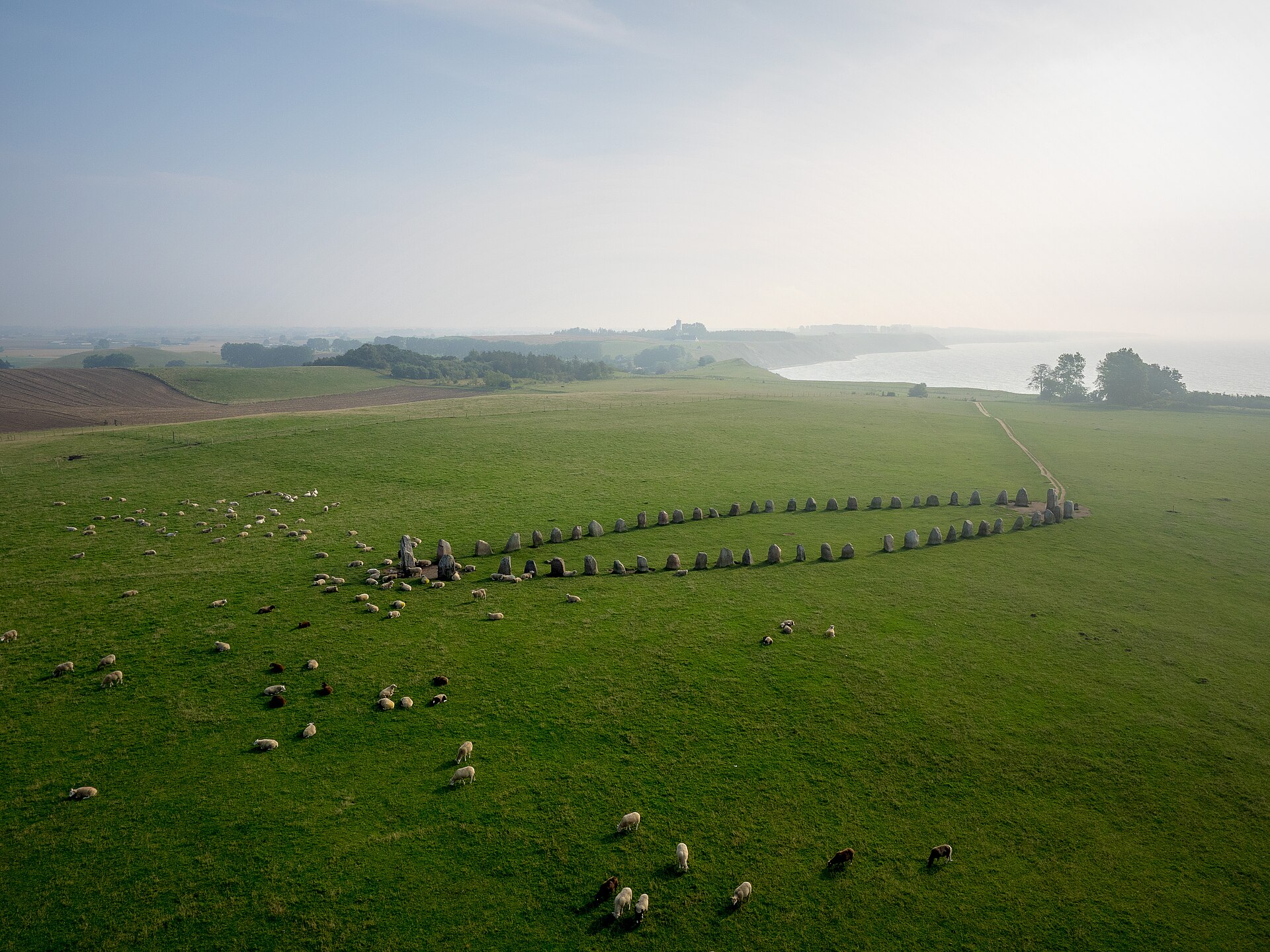
From ground level, walking among the stones, the ship shape is harder to grasp; you see a long oval of standing boulders and have to imagine the vessel. But climb a little, or view it from the air, and the design leaps out. This was clearly meant to be read as a ship, a form loaded with meaning for the seafaring peoples of the north.
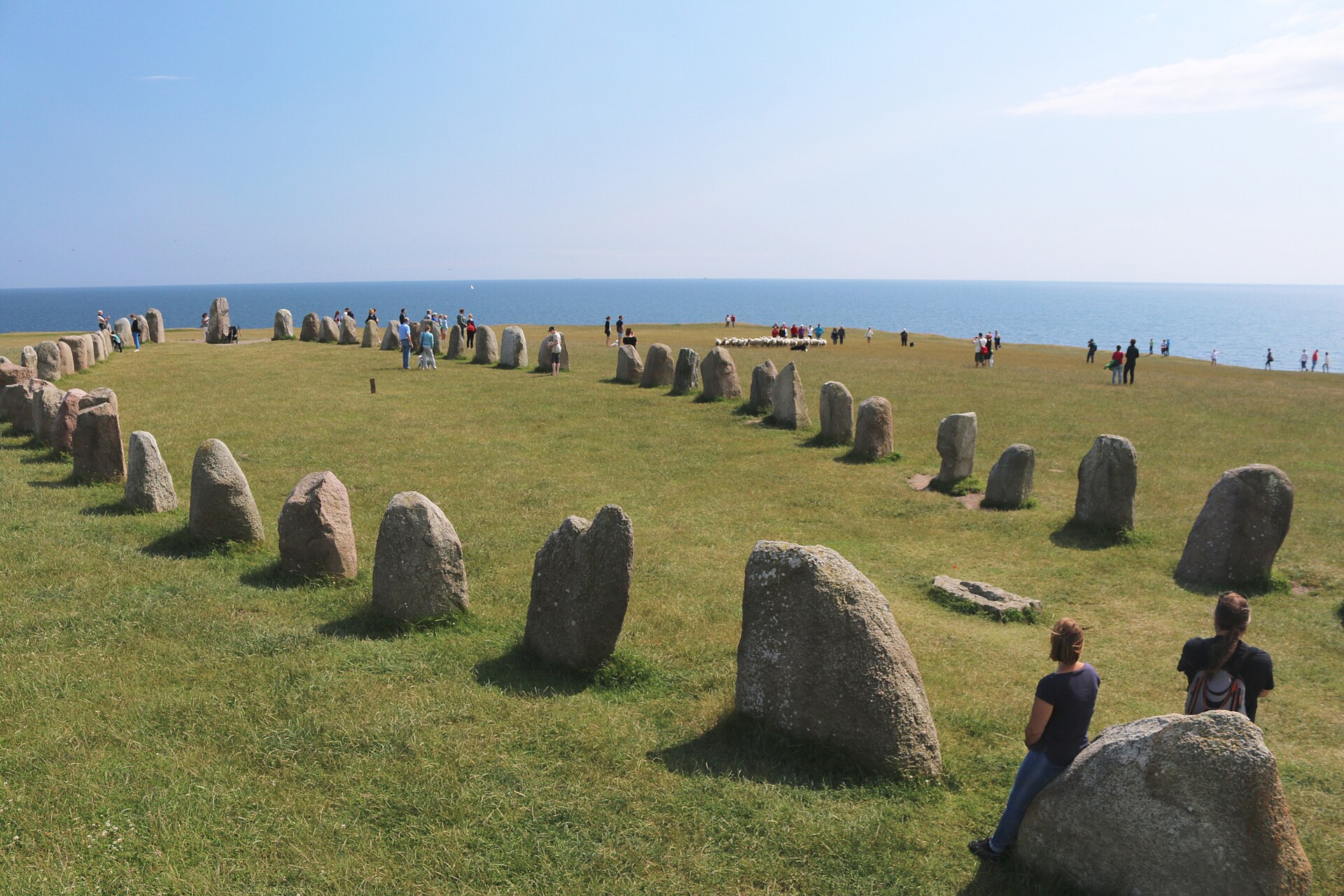
The stones themselves are substantial, some weighing a couple of tonnes, hauled to this clifftop and set upright with considerable effort. As with every megalith, the labour involved tells you how much the monument mattered to the community that raised it.
How old is it, really?
Dating Ale’s Stones has been tricky and a little contentious. For a long time its age was uncertain, but modern investigations, including radiocarbon dating of material from the site, point to it being built toward the end of the Nordic Iron Age, around 1,400 years ago, in the centuries before the Viking Age proper.
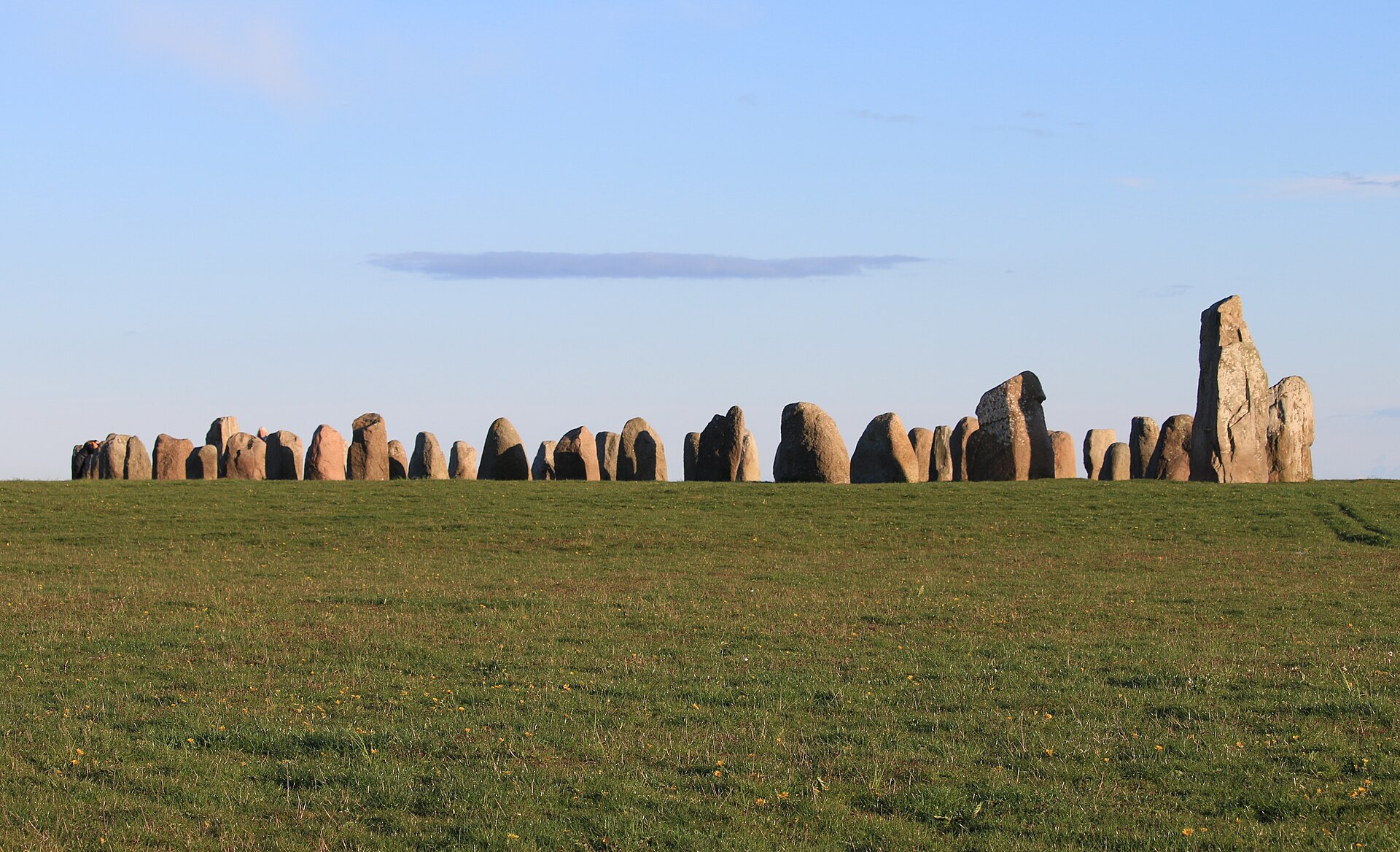
That makes Ale’s Stones considerably younger than the Neolithic temples and tombs of western Europe, but no less remarkable. It belongs to a different world — the Germanic Iron Age, a society of farmers, warriors, and seafarers whose descendants would become the Vikings. The stone ship is a monument of that maritime culture.
Some researchers have argued for an even older origin, suggesting the site may have been used or marked long before the surviving arrangement. As so often with these monuments, the ground may hold more chapters than the stones alone reveal.
The tradition of stone ships
Ale’s Stones is the largest and most famous of its kind, but it is not alone. Stone ships — boat-shaped settings of standing stones — are found across Scandinavia and the Baltic, raised over a long span of prehistory. They range from modest settings a few metres long to grand monuments like this one.
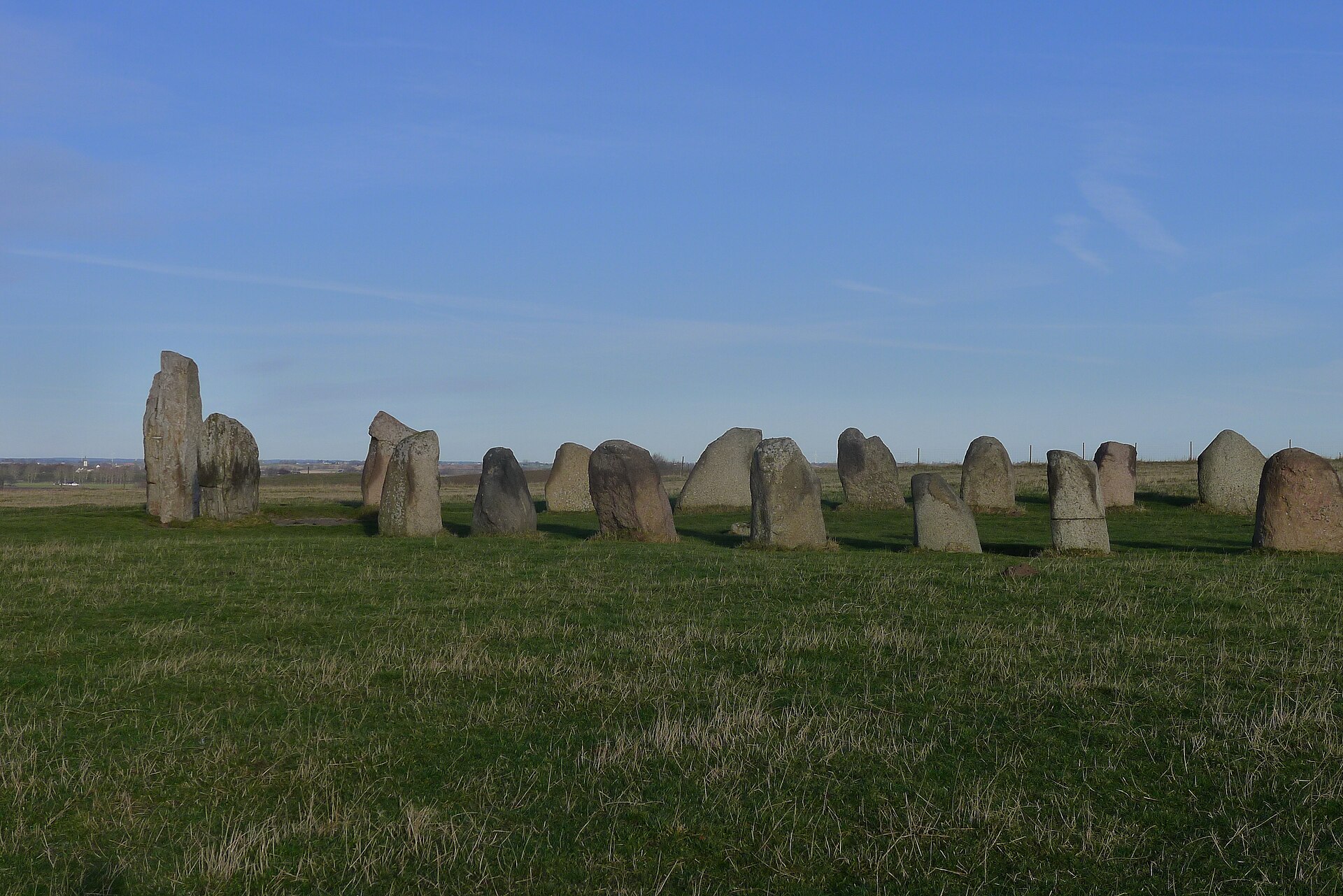
The ship was central to the northern imagination. It was the vehicle of trade, war, and exploration, and it carried powerful symbolic weight — associated with journeys, with status, and, in many contexts, with death and the passage to the afterlife. To build a ship in stone was to make that symbolism permanent.
Seen against this tradition, Ale’s Stones is the supreme expression of an idea that ran deep through Scandinavian culture for millennia. It is the monument where the stone-ship form reached its most ambitious and enduring form.
Grave, monument, or calendar?
What was it for? The most common interpretation is funerary. Many stone ships mark graves, and Ale’s Stones may have been a burial monument, a grand memorial to an important person or group, the vessel meant to carry them symbolically onward. Excavations have found traces consistent with such use, though no rich burial has settled the question.
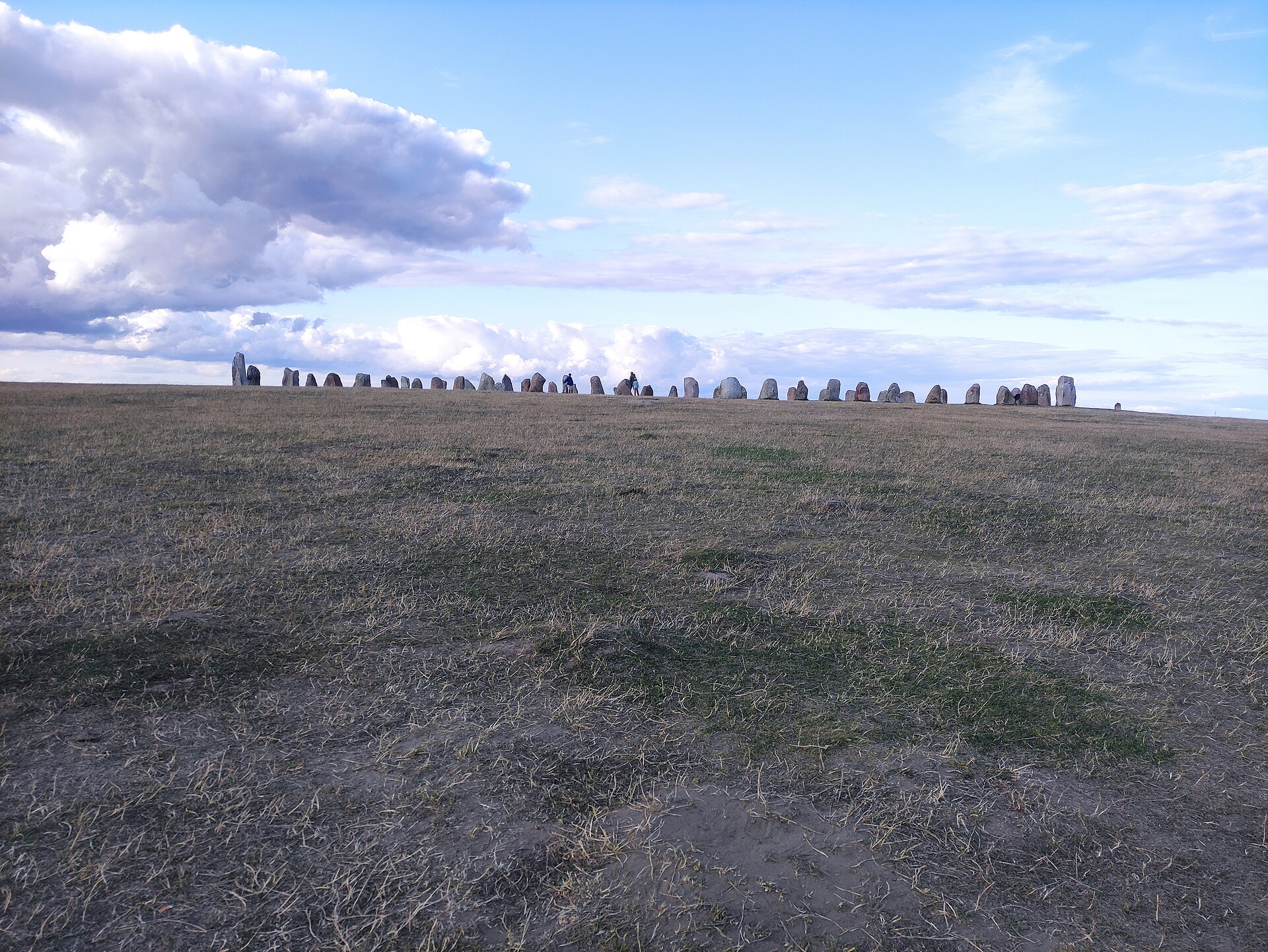
Others have proposed astronomical functions, suggesting the alignment of the prow and stern stones marks the rising and setting of the sun at the solstices, turning the ship into a kind of calendar as well as a monument. The idea is attractive, though, as with many such claims, it is debated and hard to prove definitively.
Most likely the monument served more than one purpose, as great monuments usually do. A memorial, a gathering place, a statement of power and belief, perhaps tied to the sky — these functions need not exclude one another. The stone ship could carry many meanings at once.
The legend of King Ale
The monument’s name points to legend. Ale’s Stones is traditionally linked to a King Ale, a semi-legendary figure said to be buried at the site, the great stone ship serving as his final resting place and memorial. Whether such a king ever existed, and whether he has anything to do with the actual monument, is entirely uncertain.
Like the Roman-army legend at Carnac or the petrified-giants tale at other stone circles, the story of King Ale is a later attempt to explain a monument whose true origins had been forgotten. These legends are not history, but they are a kind of evidence — proof that the stones have compelled people to tell stories about them for a very long time.
There is something fitting in a stone ship acquiring the legend of a buried king. The ship-as-grave, carrying a leader into the beyond, is exactly the kind of meaning the monument may originally have carried. The folklore, in its way, may echo a genuine ancient idea.
Why Ale’s Stones still moves us
Ale’s Stones matters because it fuses monument and landscape into a single unforgettable image: a ship of stone sailing forever along a clifftop above the sea. It captures the maritime soul of the north, the deep link between these peoples and the water, made permanent in granite on the edge of the land.
Stand within its hull, with the Baltic wind in your face and the great prow pointing out to sea, and you feel the pull of it — the journeys, the farewells, the beliefs of a vanished world. Whatever its exact purpose, Ale’s Stones still does what its builders surely intended: it stops you, moves you, and sends your imagination sailing out across the water.
The people of Iron Age Skåne
The men and women who raised Ale’s Stones lived in the late Iron Age of southern Scandinavia, a society of farming communities strung along a coast that was also a highway. The sea connected them to the wider world, bringing trade, ideas, and sometimes conflict, and shaping a culture in which ships and seafaring were central.
These were the ancestors, culturally and often literally, of the Vikings who would burst onto the wider European stage a few centuries later. Already they were skilled sailors and builders, organised enough to marshal the labour needed to haul and raise fifty-nine great boulders on an exposed clifftop.
To such a people, a ship was far more than transport. It was the vehicle of ambition and adventure, the symbol of a way of life, and, in death, perhaps the means of the final voyage. Building one in stone, permanent and monumental, was a natural expression of who they were.
The sun and the stones
One of the more intriguing suggestions about Ale’s Stones concerns the sky. Some researchers have proposed that the monument is aligned to the sun, with the stones at the prow and stern marking the points where the sun rises and sets at the solstices, turning the great ship into a solar calendar as well as a memorial.
If true, this would place Ale’s Stones in the long northern tradition of monuments attentive to the turning of the year, a tradition stretching back through the Neolithic. It would mean the builders wove the rhythm of the sun into the very geometry of their stone ship.
As always, I hold such claims loosely. Alignments can be real and meaningful, or they can be coincidences we read too much into. But on a coast where the sun’s low winter path across the sea is so dramatic, it would be no surprise if the builders had it in mind.
Digging into the ship
Archaeological investigation of Ale’s Stones has sought to pin down its date and purpose. Excavations and dating work have recovered material that helps place the monument in the late Iron Age and hint at its use, though the site has kept much of its mystery, yielding no single dramatic find to settle every debate.
This is common with stone monuments. They are frustratingly reticent, offering shape and setting and the odd fragment, but rarely a neat explanatory label. What excavation can do is anchor the monument in time and rule out the wilder theories, narrowing the field even when it cannot close it.
The result is a monument we understand better than we once did but still cannot fully explain — which, honestly, is part of what keeps drawing people back to the clifftop to stand among the stones and wonder.
A monument in its setting
It is impossible to separate Ale’s Stones from its landscape. The clifftop, the sea, the sweep of sky, the little harbour below — all are part of the experience and, surely, were part of the builders’ intent. A stone ship makes most sense in sight of the water it symbolically sails, and here the Baltic is always present.
The surrounding area of Skåne is rich in prehistoric remains, and the coast has drawn human settlement for a very long time. Ale’s Stones is the crown of this landscape, the monument that gathers up the region’s deep relationship with the sea and gives it enduring form.
To stand there is to feel the logic of the choice. This is where land meets water most dramatically, where a ship of stone belongs. The setting is not a backdrop to the monument; it is half the meaning.
Visiting Ale’s Stones today
Ale’s Stones is one of Sweden’s most visited ancient monuments, and reaching it is straightforward: a drive to the coast near Ystad, a stop at Kåseberga harbour, and a short but steep walk up onto the clifftop. The reward at the top is immediate and unforgettable.
Because it stands in the open, the monument can be experienced freely, walked around and among at any hour. Go at sunrise or sunset if you can, when the low light gilds the stones and the ship seems truly to be sailing into the glow. In winter, snow and storm lend it a stark, elemental grandeur.
Bring a windproof jacket and give yourself time. Ale’s Stones rewards those who linger, who walk its length, who sit within its hull and let the sea and sky do their work. It is a monument best absorbed slowly, the way a voyage unfolds.
The ship in the northern mind
To understand Ale’s Stones you have to understand what a ship meant to the peoples of the north. In a world of scattered coasts, islands, and river routes, the ship was the great enabler — of trade, of raiding, of migration, of contact with distant lands. Whole economies and reputations were built on the water.
So it is no wonder the ship became a charged symbol, appearing in art, in burial customs, and in monuments like this. Ships carried the living to fortune and the dead, in belief, to whatever lay beyond. A ship set in stone gathered up all of that meaning and fixed it permanently in the land.
Later, the Vikings would take this maritime culture to its dramatic height, their longships carrying them across the known world. Ale’s Stones stands on the threshold of that age, a monument to a people already thinking in ships, already gazing at the horizon.
The dating debate
Few aspects of Ale’s Stones have generated more discussion than its age. Early guesses ranged widely, and the monument’s bare stones offered little to date directly. Modern scientific methods narrowed the picture, pointing to the late Iron Age, but scholars have continued to debate the details and the possibility of earlier phases.
This kind of debate is healthy, and typical of how our understanding of ancient sites evolves. Each new study, each refinement of dating techniques, sharpens the picture a little further. What once was vaguely “ancient” becomes a monument we can place, with growing confidence, in a real historical moment.
For visitors, the debate need not spoil the experience — if anything it adds to it. To stand among stones whose exact story is still being written is to feel part of an ongoing conversation with the past, rather than a finished lecture.
Protecting the stone ship
As a beloved and heavily visited monument, Ale’s Stones faces the familiar pressures of popularity: footfall, erosion of the clifftop, and the sheer wear of many feet over the delicate ground. Swedish heritage authorities manage the site to balance open access with the need to protect both the stones and their setting.
The exposed coastal location brings its own challenges, from weathering to the slow work of the sea on the cliff below. Careful monitoring and sensible management aim to keep the monument stable and the experience of it intact for future generations.
After more than a thousand years on its clifftop, the stone ship deserves that care. The goal is simple: to let people go on climbing up to stand within its hull, moved as visitors have surely always been, while ensuring the great vessel keeps its formation for centuries to come.
The meaning of the name
The Swedish name Ales stenar, Ale’s Stones, ties the monument to the legendary King Ale, but the deeper resonance is in that word stenar — stones. Like so many ancient monuments, once its true purpose faded from memory, people named it plainly for what it was: the stones, set apart, demanding a name of their own.
Attaching a king to the site gave the anonymous stones a story and a hero, a very human response to a mystery. Whether or not any King Ale ever existed, the name has stuck for centuries, weaving the monument into the folklore and identity of this stretch of Swedish coast.
There is a quiet continuity in that. The builders’ own words for the monument are lost, but the Swedish name carries their creation forward, keeping it alive in language as well as stone.
Among the monuments of the north
Scandinavia is rich in prehistoric monuments — burial mounds, rune stones, stone settings, and ship formations of many sizes. Ale’s Stones stands among the greatest of them, the largest and most celebrated stone ship, a landmark of the region’s ancient heritage.
Set beside the great megaliths of western Europe, it speaks a related but distinct language. Where the Neolithic builders raised circles, rows, and tombs, the peoples of the north gave the standing-stone tradition a maritime turn, shaping their monuments like the vessels that defined their world.
That local twist is what makes Ale’s Stones so evocative. It is unmistakably part of Europe’s long fascination with raising great stones, yet it carries the salt and wind of the north, the unmistakable stamp of a seafaring people, in every line of its granite hull.
Every time I picture Ale’s Stones, it is the image of the ship that stays with me — that great stone vessel poised forever on the edge of the land, prow to the sea. It says something true about the people who built it, and perhaps about all of us: the pull of the horizon, the longing to set out, the hope that some journey continues beyond the last shore.
Maybe that is why stone ships move us so. They freeze in granite a feeling we still recognise. A thousand years and more after the builders raised these boulders, their ship is still sailing, and we are still standing on the shore, watching it go.
If Ale’s Stones has drawn you into the world of standing stones and ancient monuments, there is a whole trail to follow. Europe’s great megaliths — Stonehenge: How and Why This Ancient Stone Circle Was Really Built, Newgrange: The 5,000-Year-Old Tomb Built to Catch the Solstice Sun, Skara Brae: The 5,000-Year-Old Village Known as the Scottish Pompeii, Vinča: The Danube Culture That May Have Written Before Anyone Else, Knowth: Europe’s Greatest Collection of Neolithic Art, Hidden Beside Newgrange, Dowth: The Forgotten Third Mound of Ireland’s Boyne Valley, Callanish: Scotland’s 5,000-Year-Old Stone Circle at the Edge of the Sea, The Cairn of Barnenez: Europe’s Colossal Stone Monument Older Than the Pyramids, Gavrinis: The 6,000-Year-Old Carved Passage They Sealed in the Dark, Los Millares: The 5,000-Year-Old Fortified Town at the Edge of Europe, Carnac: The 6,000-Year-Old Field of a Thousand Standing Stones and Filitosa: Corsica’s Ancient Stone Warriors Carved with Faces and Swords — share its spirit, while the Maltese temples The Megalithic Temples of Malta: Older Than the Pyramids, Tarxien: Malta’s Most Elaborate Prehistoric Temple, Carved 5,000 Years Ago, Mnajdra: The 5,000-Year-Old Maltese Temple That Tracks the Sun and Ħaġar Qim: Malta’s Cliff-Top Temple Older Than the Pyramids push the same instinct in another direction. For where monumental building began, few places rival Göbekli Tepe: The World’s Oldest Temple and How It Rewrote History and Karahan Tepe: The Astonishing Sister of Göbekli Tepe in Anatolia, or the walled town of Jericho: The World’s Oldest City and Its 10,000-Year-Old Wall. And the wider human story unfolds through Çatalhöyük: The 9,000-Year-Old Town With No Streets, The World’s Oldest Art: Inside the Painted Caves of Lascaux and Chauvet, Uruk and Sumer: The First Cities and the Birth of Writing, Mohenjo-daro: The 4,500-Year-Old City That Was Centuries Ahead of Its Time, Liangzhu: The 5,000-Year-Old Water City That Rewrote China’s History, Caral: The 5,000-Year-Old City That Rose As the Pyramids Were Built, Knossos: The 4,000-Year-Old Palace Behind the Myth of the Minotaur, Dholavira: The 4,500-Year-Old City That Beat the Desert With Water Engineering, Nan Madol: The Ancient City Built on a Coral Reef in the Middle of the Pacific, Chavin de Huantar: The 3,000-Year-Old Andean Temple Built to Overwhelm the Senses, Cucuteni-Trypillia: Europe’s 6,000-Year-Old Mega-Settlements That Might Be the First Cities, Cerro Sechin: The 3,600-Year-Old Peruvian Temple Carved With Warriors and Their Victims, Poverty Point: The 3,700-Year-Old Earthworks Built by Hunter-Gatherers, Not Farmers, Sarazm: The 5,500-Year-Old Town in Tajikistan That Rewrites Central Asia’s Past, Mehrgarh: The 9,000-Year-Old Village Where South Asia Learned to Farm, Tell Brak: The Syrian Mound That May Rewrite Where Cities Began, Aşıklı Höyük: The 10,000-Year-Old Village That Came Before Çatalhöyük, Jiahu: The 9,000-Year-Old Chinese Village Whose Flutes Still Play, Chankillo: The 2,300-Year-Old Peruvian Towers That Are the Americas’ Oldest Solar Observatory, Kalibangan: The Indus Town With the World’s Oldest Ploughed Field, Bougon: The 7,000-Year-Old Burial Mounds Older Than the Pyramids, Almendres Cromlech: Europe’s Oldest Stone Circle, 2,000 Years Before Stonehenge and Ġgantija: The Giant Temples of Gozo, Older Than the Pyramids. Each one adds another line to the same long story.
You May Like

The Bardo, a Palace of the Beys Filled With Roman Mosaics