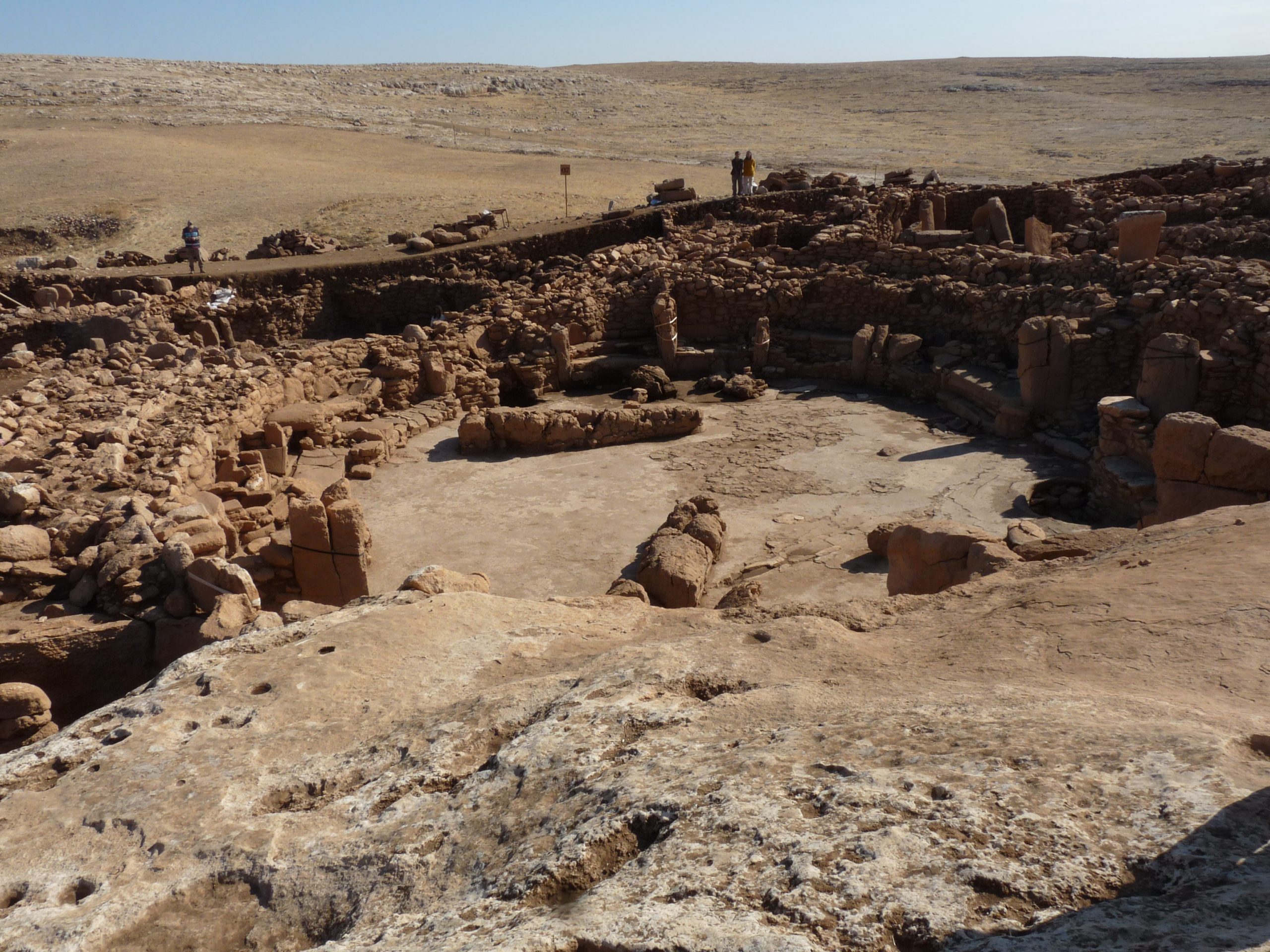
When Göbekli Tepe burst into the world’s imagination, it came with a thrilling implication that quietly nagged at archaeologists: surely a site that sophisticated couldn’t be a lonely one-off. Builders that skilled, with that much shared symbolism, must have had neighbours. They were right. Just over thirty kilometers away, across the same rolling hills of southeastern Turkey, lies Karahan Tepe, a site every bit as ancient and arguably even stranger than its famous sibling. If Göbekli Tepe rewrote the story of human civilization, Karahan Tepe is the gripping next chapter, and it’s only just being uncovered.
In this article:
A whole landscape of stone hills
Here’s the big realization that has reshaped how we think about this region. Göbekli Tepe was never alone. It belongs to a whole cluster of related sites scattered across the hills around Şanlıurfa, which Turkish archaeologists have grouped under the wonderful name “Taş Tepeler,” meaning the “Stone Hills.” There are roughly a dozen of these sites, and Karahan Tepe is the most spectacular of them after Göbekli Tepe itself.
What this tells us is profound. The achievement at Göbekli Tepe wasn’t a freak accident, a single inexplicable spark. It was the product of an entire culture, spread across the landscape, sharing a common language of architecture and carving more than eleven thousand years ago. These hunter-gatherer communities were connected, building monumental sites again and again across a whole region, thousands of years before farming, writing, or cities. Karahan Tepe is the proof that we’re not looking at one genius site, but at a lost world.
Older than almost everything
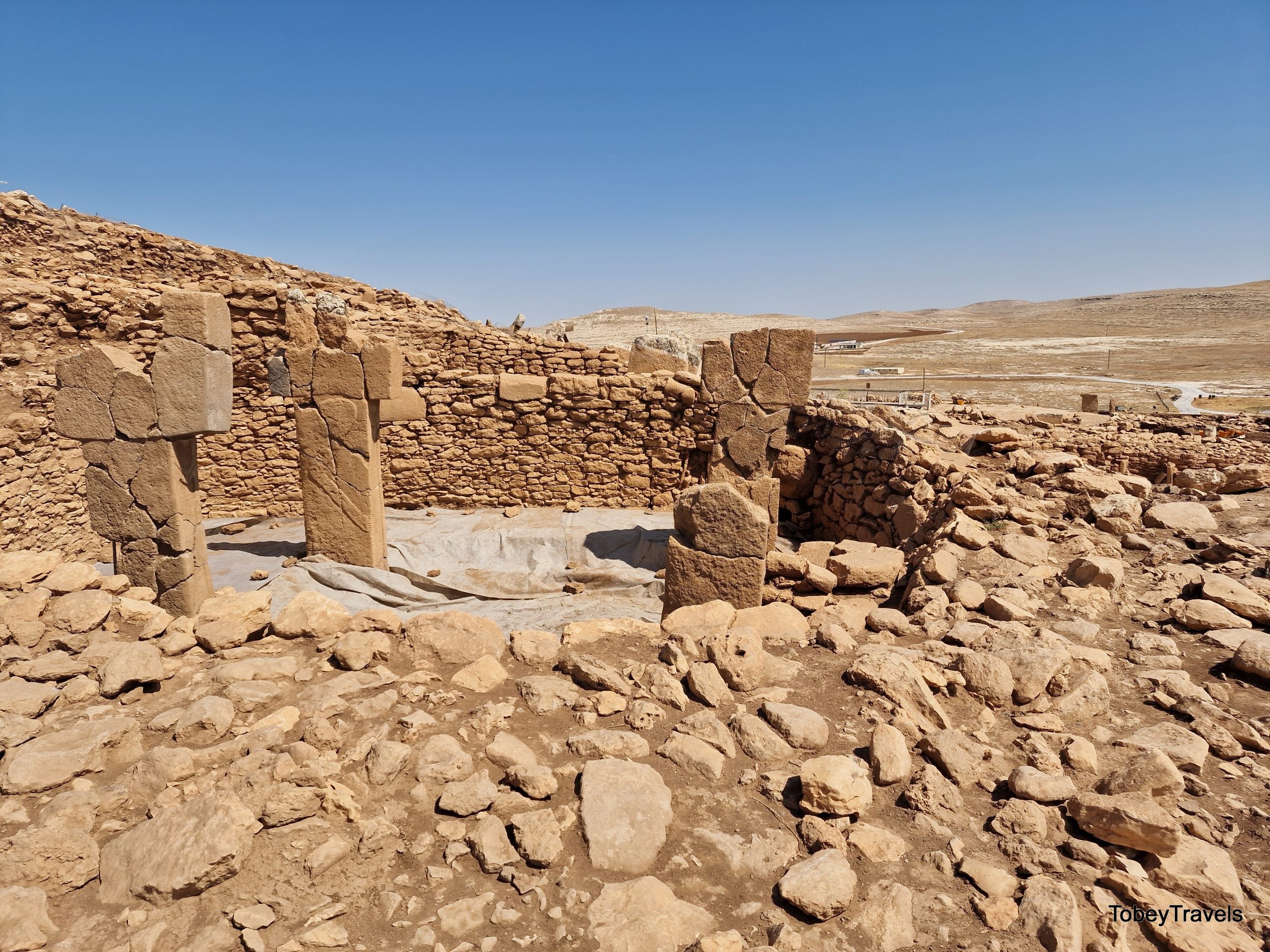
Karahan Tepe dates to roughly the same era as Göbekli Tepe, around 9500 BC, which makes it about eleven and a half thousand years old. Let that settle in. This is a site built before pottery, before metal, before the wheel, before the domestication of crops and animals had really taken hold. Its builders were, as far as we can tell, still primarily hunter-gatherers, and yet they carved and raised stone monuments with confidence and care.
To keep the scale in mind: Karahan Tepe is around seven thousand years older than the Egyptian pyramids and the great circle of Stonehenge. When you stand among its pillars, you are standing at the absolute dawn of monumental human building, in one of the very places where the impulse first took shape. There are precious few spots on Earth that take you this far back into the story of what we are.
The chamber of pillars
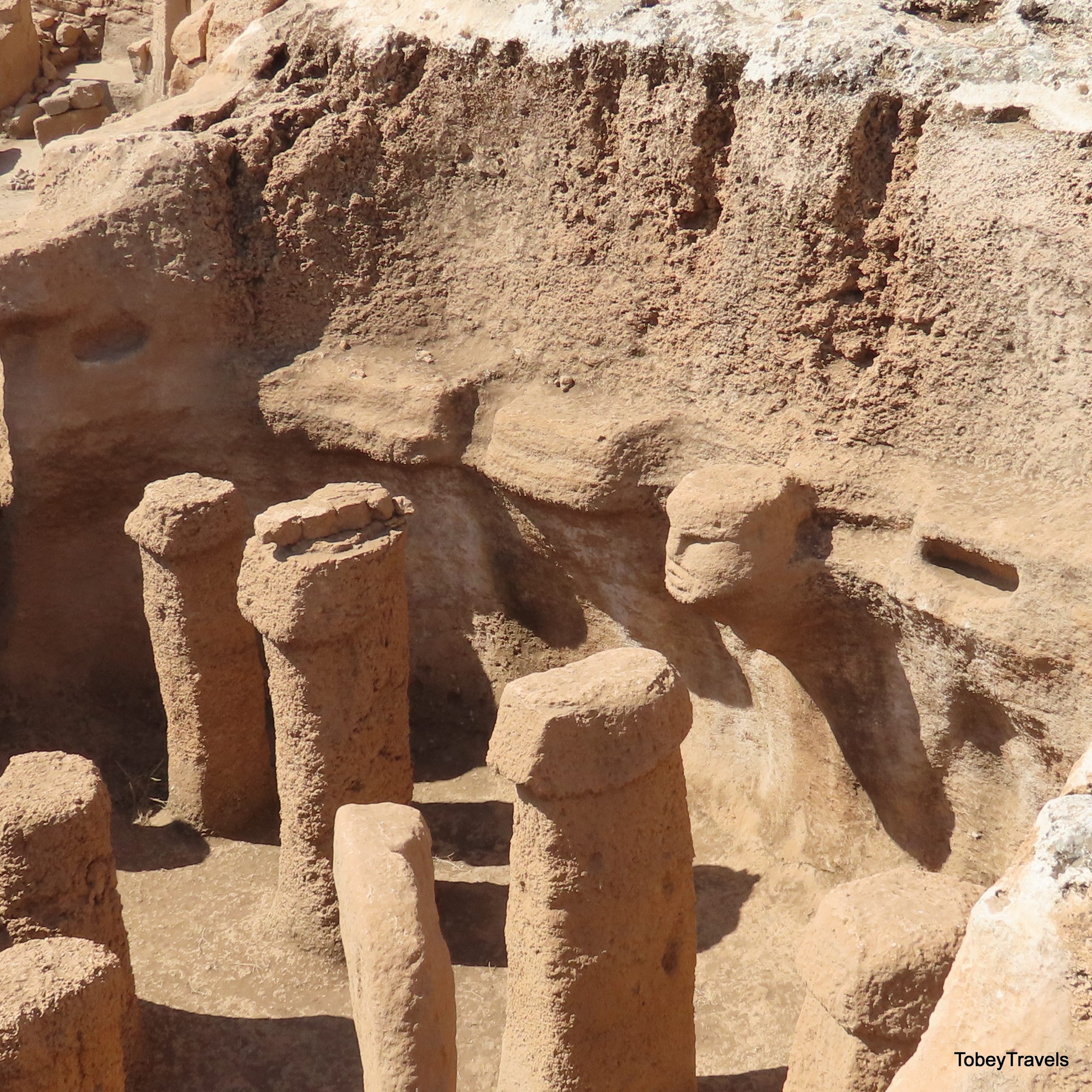
Karahan Tepe’s most jaw-dropping feature is a remarkable room carved partly into the bedrock, sometimes called the “Pillars Shrine” or the room of the standing stones. Inside this space, archaeologists uncovered something that genuinely stops you in your tracks: a cluster of tall, narrow stone pillars rising directly out of the rock floor, standing close together like a frozen forest, or like a group of figures gathered in the dark.
There are around ten of these pillars, and the effect is haunting and deliberate. They were carved in place from the living rock, an enormous amount of skilled work, and arranged in a way that clearly meant something powerful to the people who made it. Standing before a photograph of that chamber, it’s impossible not to feel that you’re looking into a sacred space, a place designed to provoke awe, even if its exact purpose is lost to us. Whatever rituals happened here, they happened by firelight, eleven thousand years ago.
The watching head and the human figures
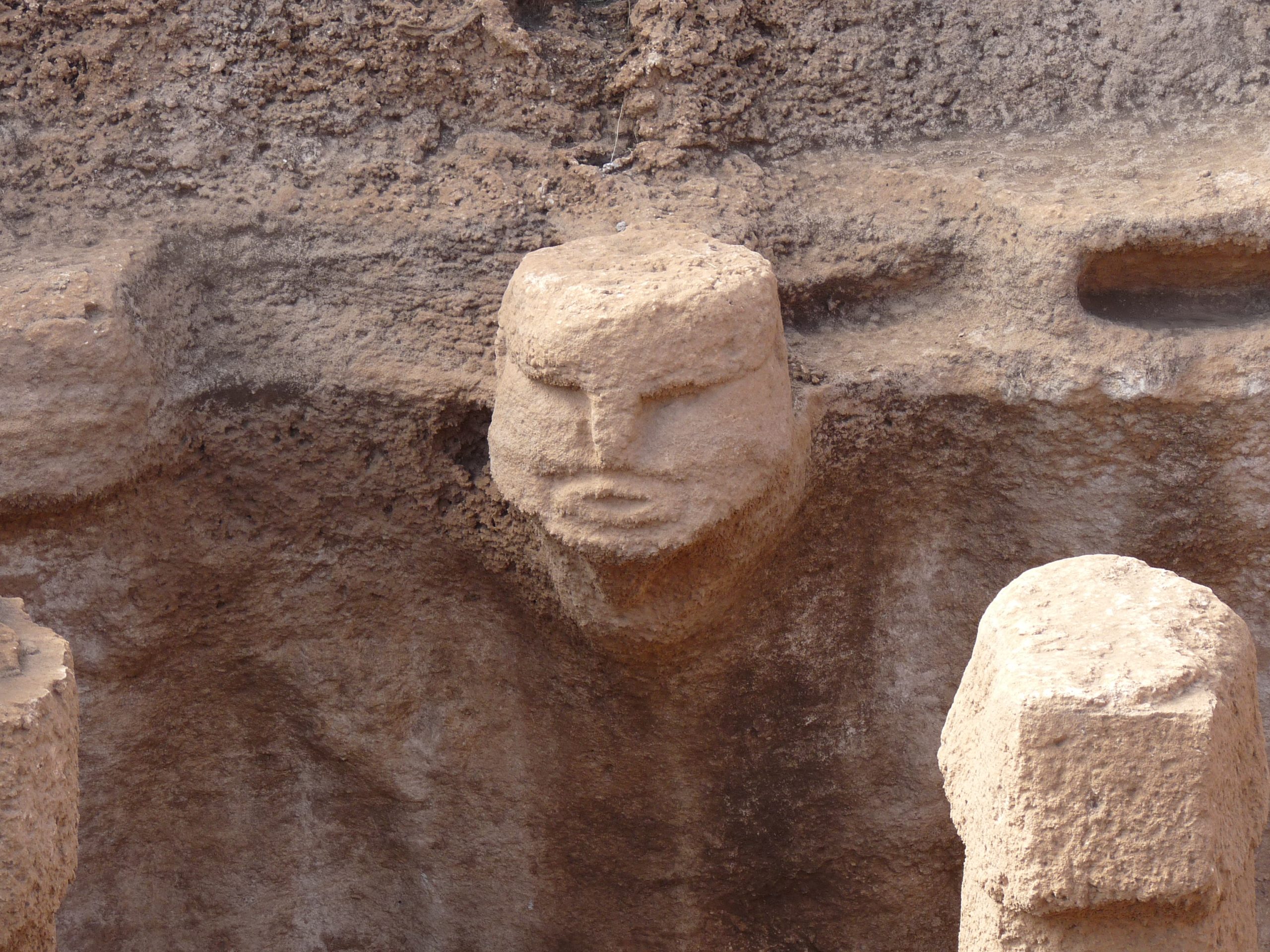
One of the most extraordinary discoveries at Karahan Tepe is intensely human, and a little eerie. Set into the wall of that pillared chamber, beside a porthole-like opening, is a carved human head and neck that seems to project out of the rock, gazing into the room. It’s startlingly lifelike for its age, and it transforms the whole space, as though an ancestor or a guardian is watching over whatever took place there.
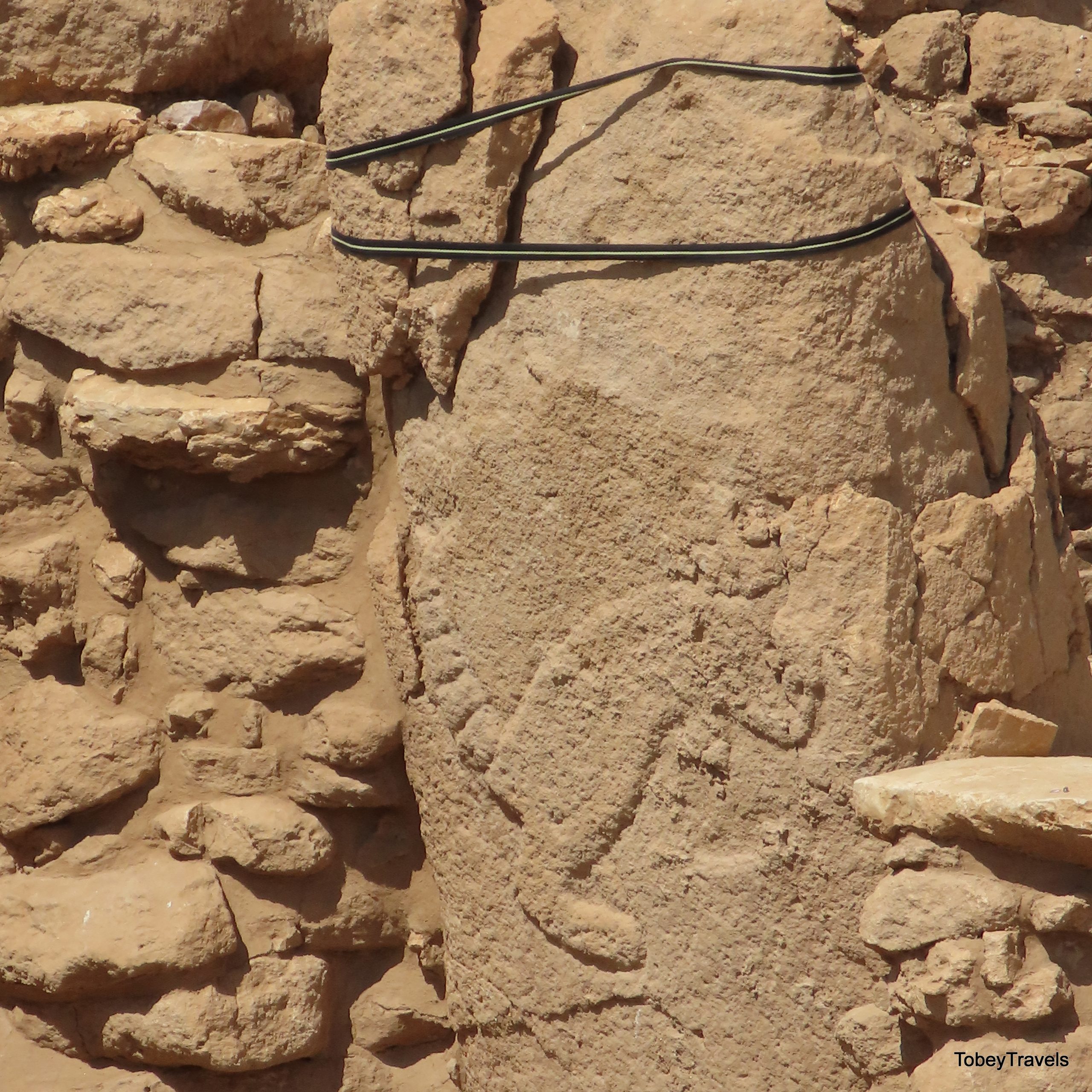
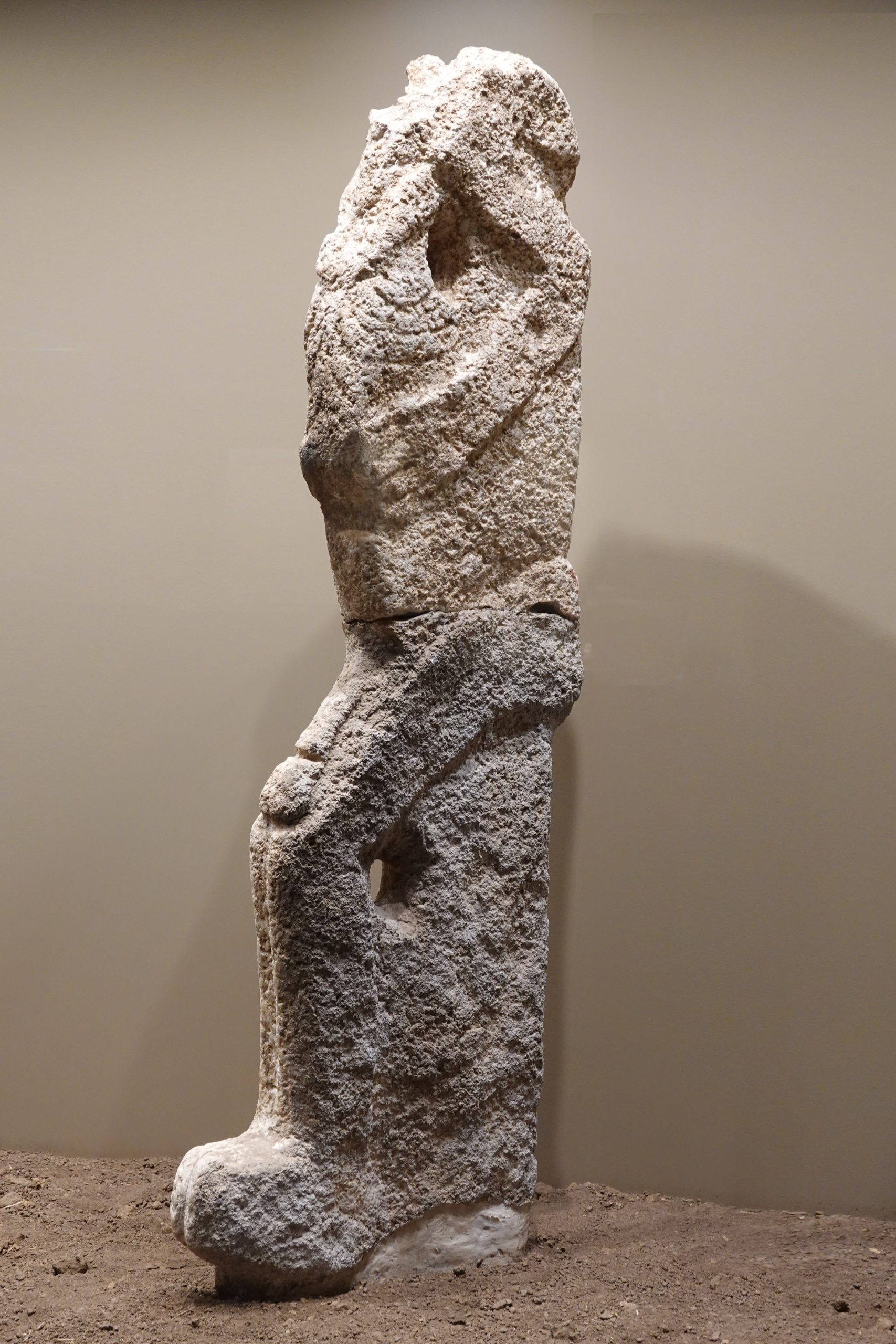
This focus on the human figure is one of the things that sets Karahan Tepe apart from its sibling. While Göbekli Tepe is dominated by animals, Karahan Tepe has yielded a remarkable number of realistic human depictions, including a stunning, almost life-sized statue of a seated man, his hands held to his torso, his expression strangely intent. These are among the earliest realistic human sculptures ever found. The art here seems to turn, more than anywhere else of its time, toward people themselves, toward who these communities were and how they saw their own kind.
How did hunter-gatherers build this?
It’s worth pausing on the sheer improbability of it all. The people who built Karahan Tepe had no metal tools to carve stone, no pottery, no draft animals, no farming to guarantee a steady food supply, and no writing to plan or pass on complex instructions. They worked with stone tools, fire, rope, wood, and their own hands. And yet they quarried bedrock, shaped tall pillars, carved lifelike human heads and detailed animal reliefs, and arranged whole chambers with evident intention.
Doing this required something we don’t usually associate with hunter-gatherers: large numbers of people, cooperating over long periods, organized around a shared purpose. Somebody had to feed the workers. Somebody had to coordinate the effort. Somebody held the vision of what the finished space should be and kept the community committed to it across what may have been years of labour. That level of social organization, achieved without any of the props we think of as the foundations of complex society, is exactly what makes the Taş Tepeler sites so revolutionary. They show that the human capacity for ambitious, coordinated, meaningful work was fully present at the very dawn of our settled history. The tools were simple. The minds behind them were anything but.
What was it all for?
And now the honest part, which is also the most exciting part: we mostly don’t know. Karahan Tepe is still being excavated, with new discoveries emerging season after season, so any confident pronouncement risks being overturned by next year’s dig. What we can say is that these were clearly special places, charged with meaning, built for gathering and ritual rather than ordinary daily living, at least in the parts uncovered so far.
The big questions echo those raised by Göbekli Tepe. Why did hunter-gatherers pour such immense effort into monumental building before they farmed? Did the need to feed people gathering at these sacred sites help nudge humanity toward agriculture? Were these places temples, meeting grounds, sites of initiation, homes of the dead, or something we don’t have a word for? The presence of so many human figures, the watching head, the forest of pillars, all hint at a rich symbolic and spiritual world. But the people who built it left no writing, only stone. We’re reading their deepest thoughts through carvings, and we can only catch fragments.
How it compares to Göbekli Tepe
It’s natural to treat Karahan Tepe as Göbekli Tepe’s little brother, but the relationship is more interesting than that. The two sites clearly belong to the same culture and era, they share the same distinctive T-shaped pillars, the same passion for carving animals into stone, and the same instinct for building gathering places of obvious power. If you saw their pillars side by side, you’d immediately recognize them as cousins.
But each has its own personality. Göbekli Tepe is famous for its grand circular enclosures and its bestiary of foxes, snakes, vultures, and boars prowling across the stone. Karahan Tepe, by contrast, leans harder into the human form, with that unforgettable chamber of upright pillars and its watching carved head, and a striking emphasis on depicting people. Some researchers have even suggested the sites may have had different roles within the same wider community, perhaps used for different ceremonies, seasons, or social groups. We’re still piecing that together.
What’s certain is that neither site makes full sense alone. They’re parts of a single, sprawling phenomenon, and the discovery of Karahan Tepe has made it clear that Göbekli Tepe was the headline, not the whole story. As more of the Taş Tepeler sites are excavated in the years ahead, our picture of this astonishing lost world is only going to grow richer, and almost certainly stranger. The most exciting thing about Karahan Tepe may be that its biggest revelations are still buried, waiting.
Why Karahan Tepe matters
What moves me about Karahan Tepe is that it’s rewriting history in real time. We tend to think of the ancient world as long settled, its big questions answered. But here is a site that, just a few years ago, was barely known, now pouring out discoveries that push the origins of monumental art and architecture back further and make them richer than we dreamed. We are genuinely watching the textbooks change.
Together with Göbekli Tepe and the rest of the Taş Tepeler, Karahan Tepe is forcing us to completely rethink the dawn of civilization. The old story said farming came first, and everything else, religion, art, monuments, society, followed. These hills suggest the opposite may be closer to the truth: that the urge to gather, to worship, to build, and to make meaning together may have come first, and helped drag the rest of civilization into being. If that’s right, then these quiet Turkish hills aren’t just old ruins. They’re the place where the human story as we know it truly begins, and we’re only just learning how to read it.
Related reading on this site: This article is part of a series on the world’s oldest sites and discoveries. You’ll especially want to read its famous sibling, Göbekli Tepe, the world’s oldest temple. You might also enjoy Çatalhöyük, Jericho, Uruk and Sumer, Skara Brae, the temples of Malta, Stonehenge, Newgrange, and the world’s oldest cave paintings. Browse more under Ancient History and Archaeology.
See also: Mohenjo-daro: The 4,500-Year-Old City That Was Centuries Ahead of Its Time.
See also: Liangzhu: The 5,000-Year-Old Water City That Rewrote China’s History.
And on the far side of the world, you can meet Caral, the oldest city in the Americas, which rose in the Peruvian desert at the very same time as the pyramids of Egypt.
And on the island of Crete you can explore Knossos, the Minoan palace behind the myth of the Minotaur, the labyrinthine home of Europe’s first great civilization.
And out in the salt deserts of India, you can discover Dholavira, the Indus city that beat the desert with water engineering.
And nothing quite prepares you for Nan Madol, a megalithic city floated into place on a Micronesian reef. And nothing quite prepares you for Chavin de Huantar, where architecture itself was engineered to overwhelm. And few places rival Cucuteni-Trypillia, where thousands lived together apparently without kings. And few sites unsettle like Cerro Sechin, an early Andean temple faced with hundreds of carved stones. And few sites surprise like Poverty Point, built by North American foragers over 3,000 years ago. The same urge to build, trade, and connect turns up thousands of miles away at Sarazm in the Zravshan valley. If origins fascinate you, take a detour to Mehrgarh, a 9,000-year-old farming village near the Bolan Pass. If early cities fascinate you, take a detour to Tell Brak, a rival to Uruk in the Mesopotamian north. It is well worth visiting Aşıklı Höyük, the Anatolian village that pioneered a whole way of life, too. It is well worth visiting Jiahu, the Neolithic Chinese village of flutes, rice and mysterious symbols, too. It is well worth visiting Chankillo, the ancient Peruvian calendar written in stone and sunlight, too. See also Kalibangan, the Rajasthan mound that farmed a river, survived a quake, and left the oldest ploughed field on Earth. See also the Cairn of Barnenez, whose eleven stone chambers predate Egypt’s pyramids by millennia. See also Vinča, one of the most advanced cultures of Neolithic Europe. See also Gavrinis, whose walls of engraved stone are unlike anything else in the Neolithic world. The deep past continues at Los Millares, a fortified Copper Age town at the edge of Europe. The same reaching-for-permanence runs through Bougon, a cluster of ancient French burial mounds well worth meeting. It sits well beside the story of Almendres, a Portuguese stone circle built eight thousand years ago. It pairs beautifully with the story of Ġgantija, a temple older than the pyramids themselves. It pairs beautifully with the story of Knowth, a five-thousand-year-old tomb in the heart of Ireland. It pairs beautifully with the story of Tarxien, Malta’s most elaborate temple, carved over five thousand years ago. It pairs beautifully with the story of Mnajdra, a coastal temple older than the pyramids and aligned with the sun. The clifftop sanctuary of Ħaġar Qim offers yet another window onto the world of the first builders. The brooding tomb of Dowth offers yet another window onto the world of the first builders. The great stone rows of Carnac offer yet another window onto the world of the first builders. The remote ring of Callanish offers yet another window onto the world of the first builders. The stone warriors of Filitosa offer yet another window onto the world of the first builders. The clifftop stone ship of Ale’s Stones offers yet another window onto the monuments of the deep past.
You May Like
Norse Explorers Reached Canada 500 Years Before Columbus


5 thoughts on “Karahan Tepe: The Astonishing Sister of Göbekli Tepe”