Imagine a town with no streets. None at all. Instead of walking down a road and turning into your front door, you climb a ladder onto your neighbour’s roof, then your own, and drop down through a hole in the ceiling into your house. The roofs are the streets. Everyone’s home is pressed up against everyone else’s, like a giant honeycomb of mudbrick. Now imagine that this town was home to thousands of people about nine thousand years ago, long before kings, temples as we usually picture them, or anything we’d call a city. That’s Çatalhöyük, in central Turkey, and it might be the closest thing we have to a snapshot of humanity learning, for the very first time, how to live together in a crowd.
In this article:
A town without streets
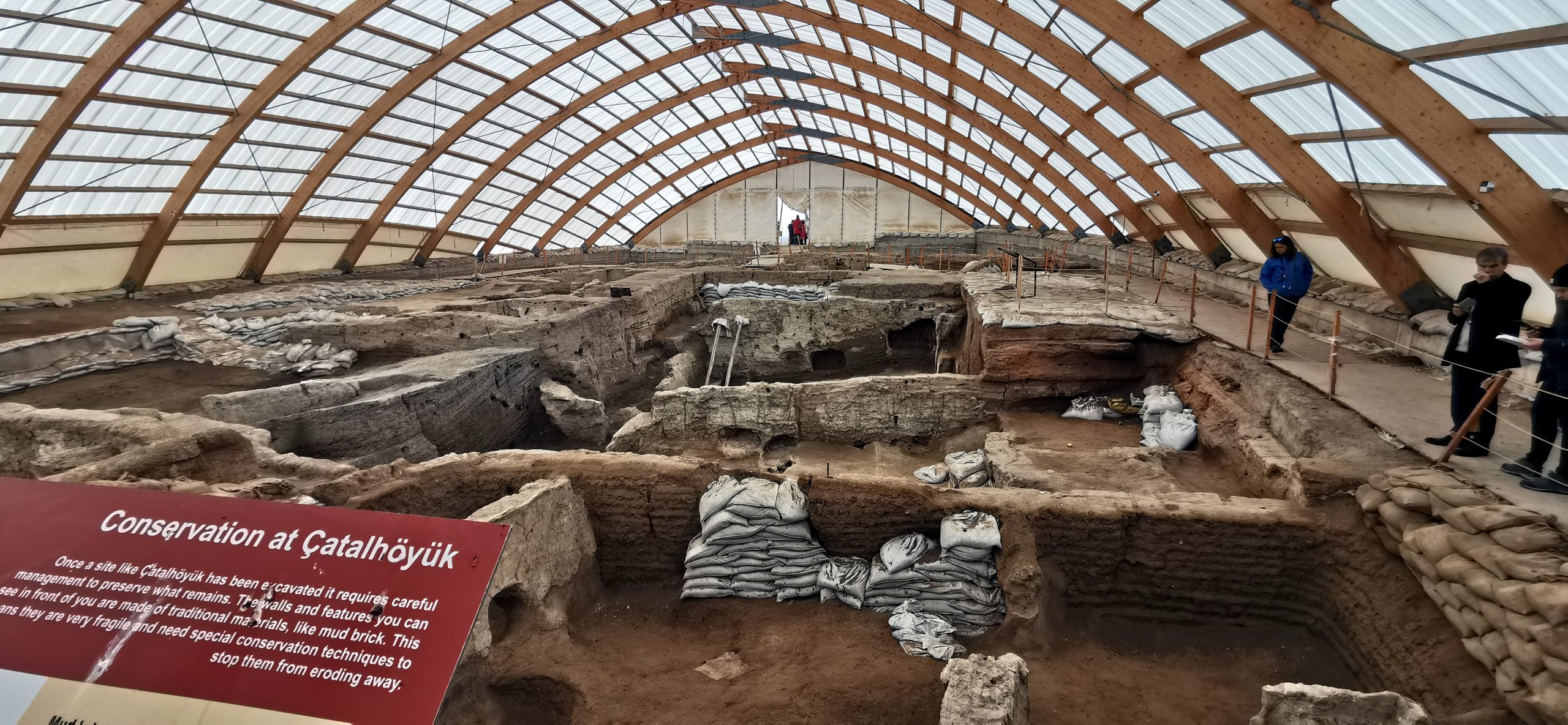
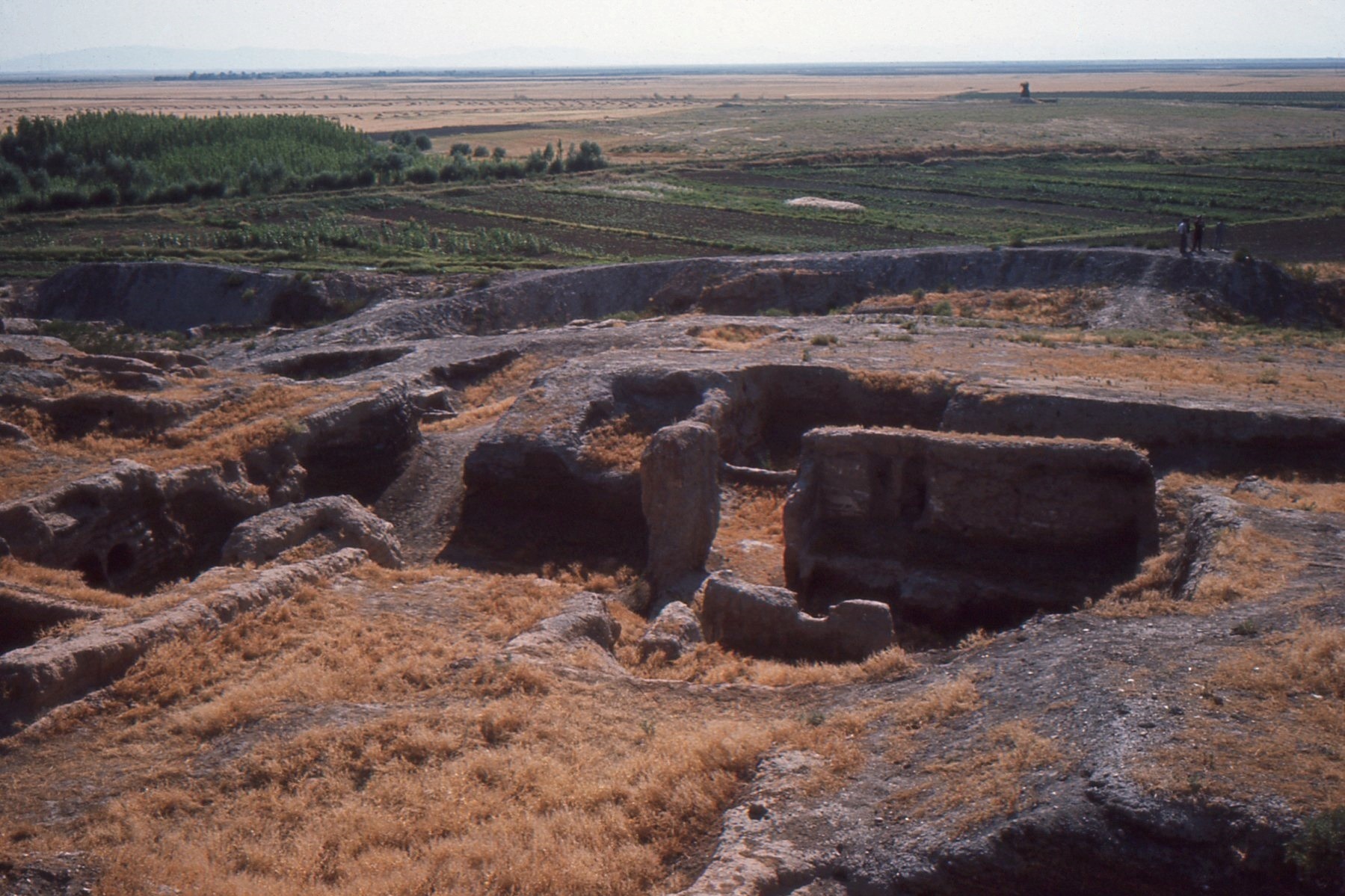
Çatalhöyük (you can say it roughly as “cha-tal-hoy-yook”) sits on the Konya Plain, and it was lived in from around 7100 BC for well over a thousand years. At its peak it may have held somewhere between five and eight thousand people. To put that in perspective, that’s a serious population for any era, let alone the Stone Age. And they all lived in tightly packed rectangular houses made of mudbrick, sharing walls, with no alleys or roads winding between them.
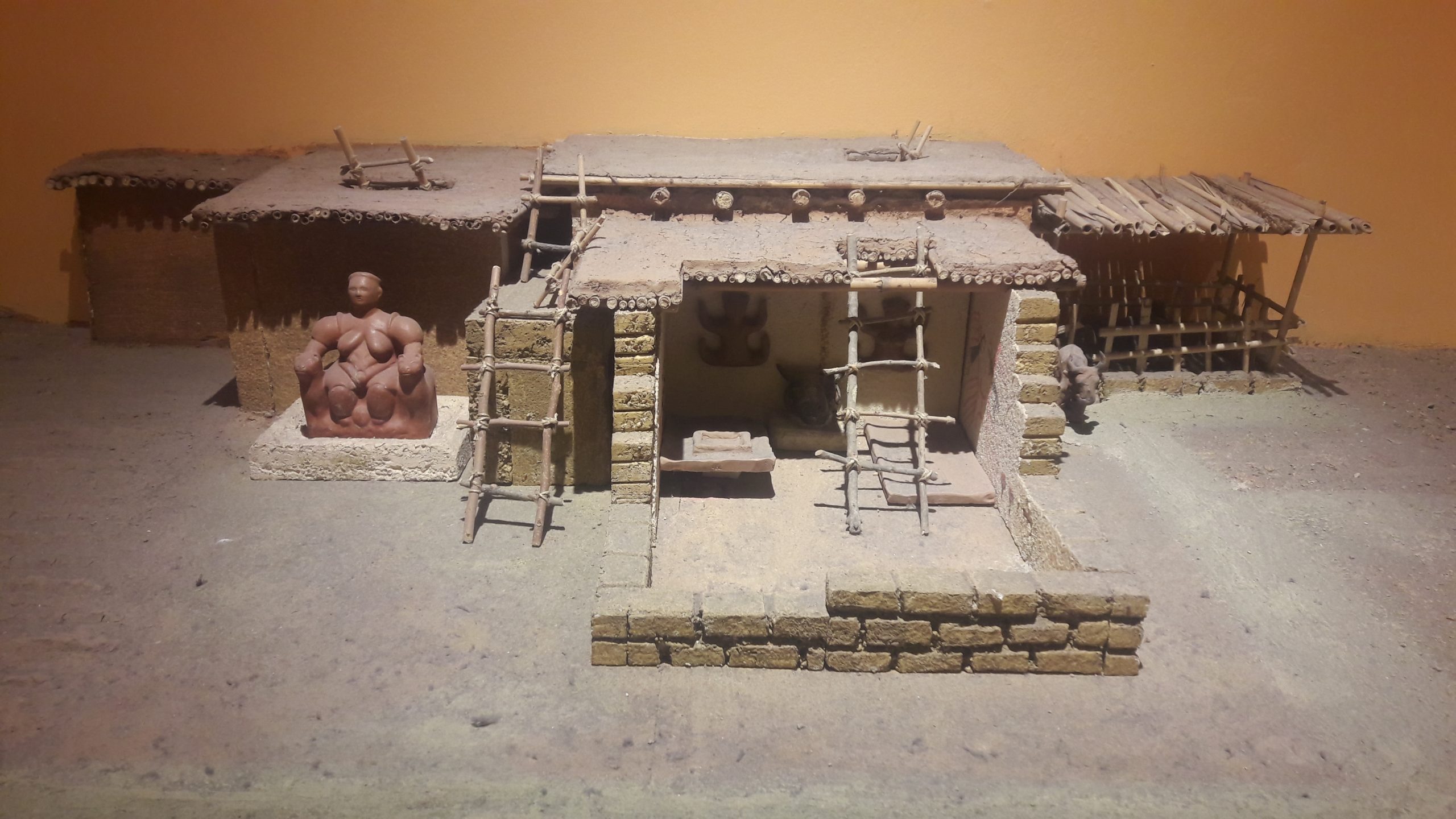
The way in was through the roof. People moved across the settlement by walking over the rooftops, and entered their homes by climbing down a wooden ladder set against the south wall, usually near the hearth and oven. It sounds strange to us, but it was a clever, defensible, efficient way to fit a lot of people into a small footprint. The outer walls of the settlement formed a continuous blank face to the world, with no obvious gates, which may also have helped with security.
Life inside the houses
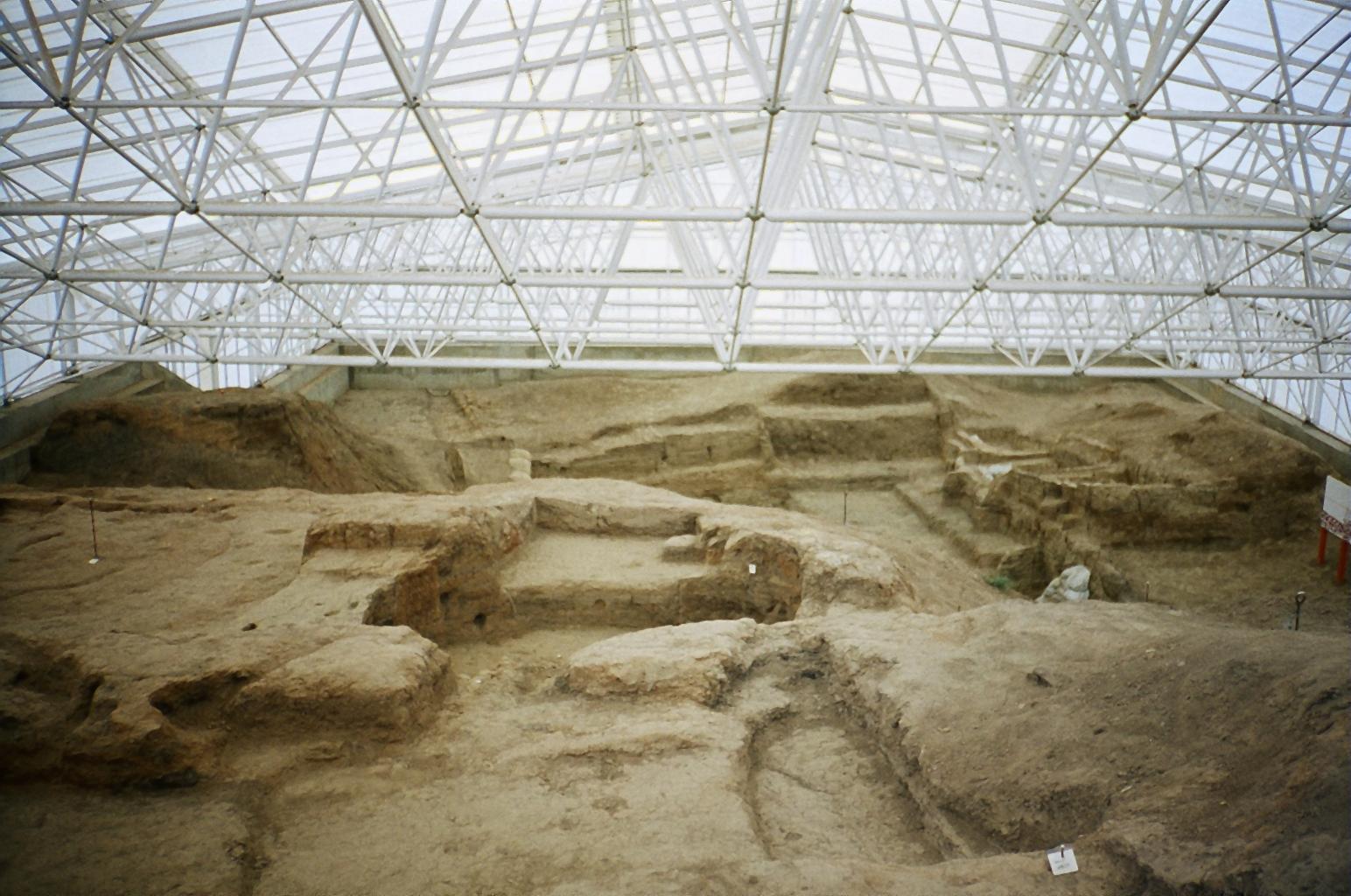
Step down that ladder and you’d find a surprisingly orderly home. There was a main room with raised platforms for sitting and sleeping, a hearth, an oven, and storage areas. The walls were plastered smooth and often painted, sometimes with bold geometric patterns, hunting scenes, or hand prints. Some houses had relief sculptures and the moulded heads or horns of cattle built right into the walls and benches, which must have made the rooms feel charged with meaning.
Here’s one of the most striking and slightly haunting parts. The people of Çatalhöyük buried their dead beneath the floors of their own homes, often right under those sleeping platforms. Generations slept above the bones of their ancestors. It sounds eerie to modern ears, but it speaks to a powerful bond between the living, the dead, and the house itself. The home wasn’t just shelter. It was a living family record, a shrine, and a tomb, all in one.
A surprisingly equal society
One of the things that fascinates researchers most is what Çatalhöyük seems to lack. There are no obvious palaces. No grand temples standing apart from ordinary homes. No district of the rich versus a district of the poor. The houses are remarkably similar to one another in size and contents. There’s little sign of a ruling class or kings lording it over everyone else.
That suggests a society that was, for its time, strikingly egalitarian, organized around households and shared customs rather than a steep pyramid of power. Studies of the bones also hint that men and women ate similar diets and did broadly similar amounts of physical work, which points to relatively balanced roles. It’s a useful corrective to the lazy assumption that early human societies were always brutal hierarchies. Sometimes, it seems, people just lived together more or less as equals.
The famous seated figure
If you’ve ever seen a small clay statue of a heavy-set woman seated on a throne flanked by two big cats, you’ve met one of Çatalhöyük’s most famous finds. People often call her a “mother goddess” or fertility figure, and for a long time she fuelled grand theories about a peaceful, goddess-worshipping matriarchy at the dawn of civilization.
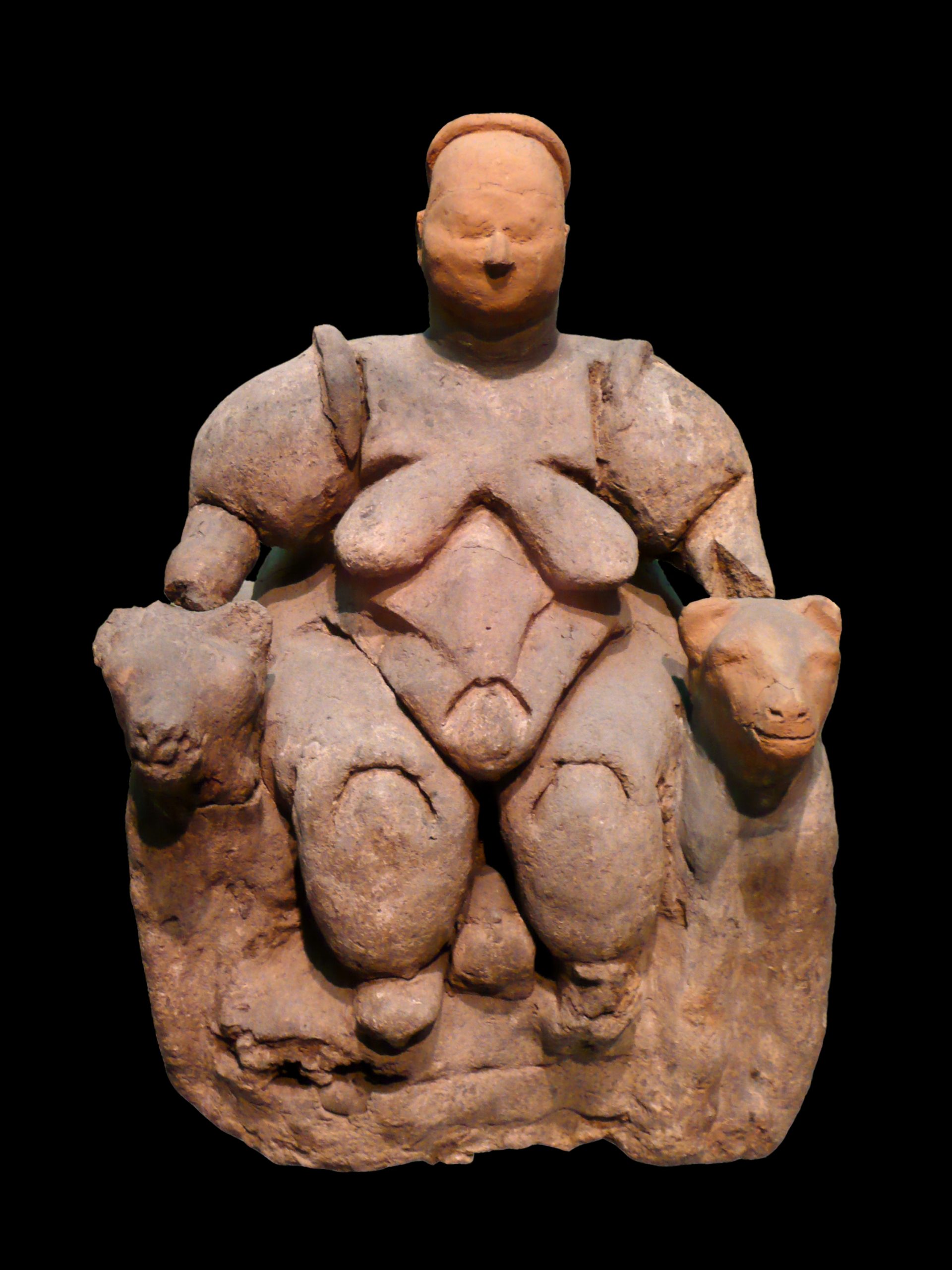
It’s a gorgeous object and an irresistible story, but it’s worth being a little careful here. We genuinely don’t know exactly what she meant to the people who made her. She might be a goddess, an ancestor, a symbol of fertility or status, or something we have no word for. The “ancient matriarchy” idea is a beautiful theory but not something the evidence firmly proves. What we can say is that the people of Çatalhöyük clearly had a rich symbolic and spiritual life, woven through their homes and art, even without grand separate temples.
How they actually lived
The people here were early farmers and herders, but they hadn’t fully left the old ways behind. They grew wheat, barley, and other crops, kept sheep and goats, and gradually domesticated cattle, yet they still hunted wild animals and gathered from the land. In a sense they were caught in a fascinating in-between moment, one foot in the hunter-gatherer past and one stepping into the farming future.
They were also connected to a wider world. Çatalhöyük was a hub for obsidian, the glassy volcanic stone prized for making razor-sharp tools, sourced from nearby volcanoes and traded across the region. Beautiful obsidian mirrors, beads, and finely worked tools turn up in the digs. So this wasn’t an isolated village. It was a busy, productive, connected community with craft, trade, and a strong sense of its own customs.
Building on the bones of the old house
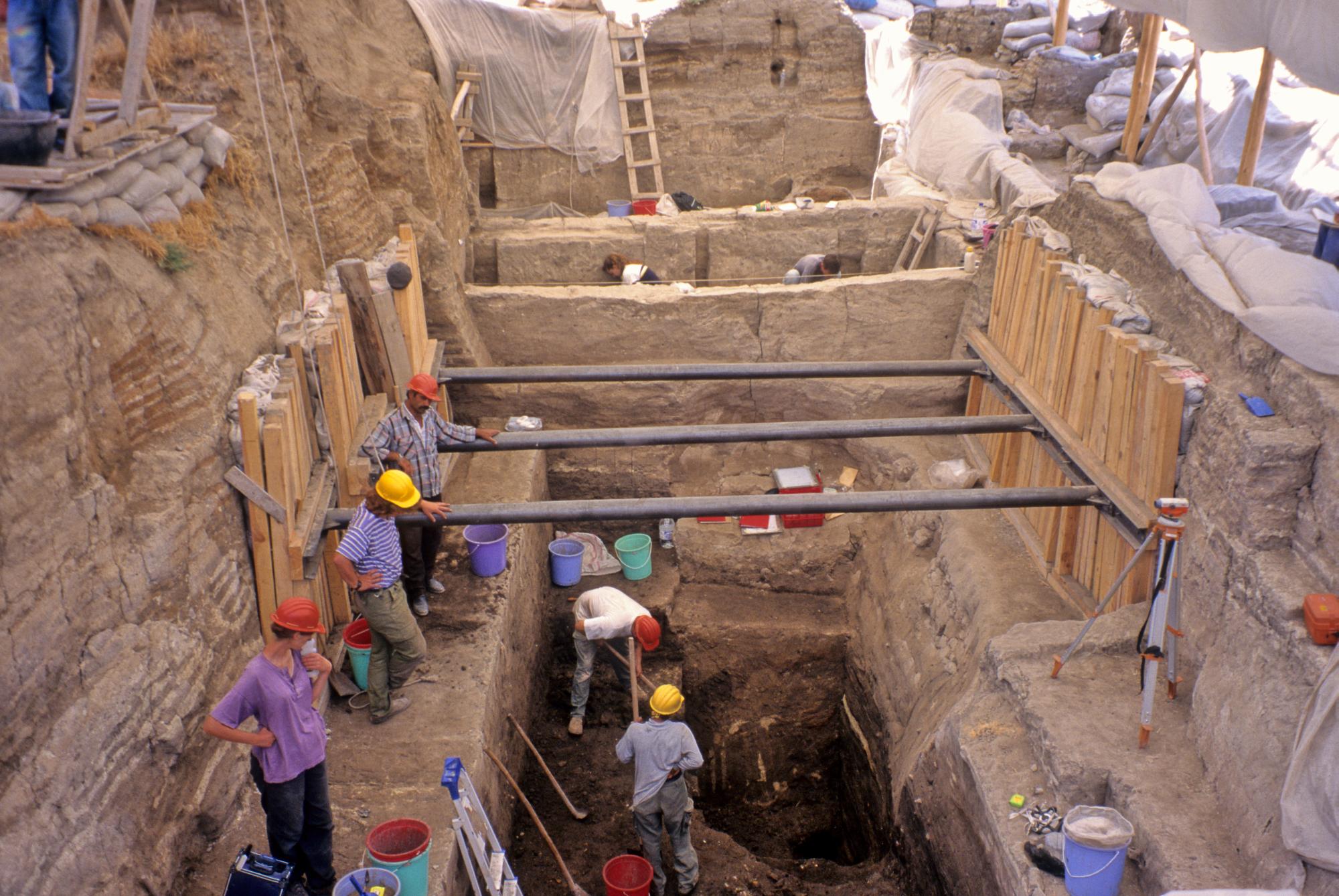
One of the most remarkable rhythms of life here was how the houses themselves lived and died. A home wasn’t kept standing forever. After a few generations, people would carefully fill in the old house, sometimes deliberately knocking down the upper walls, and then build a new one directly on top, following almost exactly the same floor plan. Over centuries this stacking created the great mound, or “höyük,” that gives the site its name. Dig down and you find house upon house upon house, like the pages of a book pressed together.
This wasn’t random. The repetition suggests that the house and its location carried deep significance, passed down like an inheritance. Some homes, which researchers nicknamed “history houses,” held far more burials and elaborate symbolic features than others, hinting that certain families or lineages may have served as anchors of memory and tradition for the wider community. It’s a beautiful idea, that a building could be a kind of living archive, rebuilt again and again so the thread of family and place was never broken.
And because they rebuilt so faithfully, Çatalhöyük gives archaeologists an almost unbelievable gift: a continuous, layered record of daily life spanning more than a thousand years in one spot. You can literally watch tastes in wall painting change, watch the slow shift from hunting toward herding, watch a community evolve, floor by buried floor.
There’s also a quieter point worth sitting with. Living that closely packed, with no streets and shared walls, must have demanded an enormous amount of social skill. Thousands of people, every day, negotiating noise, smells, smoke, disputes, and the simple friction of crowded life, without police, written laws, or a king to hand down rulings. Whatever held Çatalhöyük together for over a millennium was woven out of custom, ritual, kinship, and a shared way of seeing the world. In a way, the real technology on display here isn’t the mudbrick or the obsidian tools. It’s the social fabric itself, the invisible web of agreements that let so many people coexist.
Why Çatalhöyük matters
Çatalhöyük matters because it catches us in the act of becoming social on a large scale. It’s one of the earliest and best-preserved examples of a large, dense human settlement, and it lets us peer into the everyday texture of life right at the threshold of urban living. How do thousands of people share space, settle disputes, raise children, honor the dead, and make meaning together when there’s no template to follow? Çatalhöyük is one of humanity’s first long experiments in exactly that.
The site was first excavated in the 1960s by James Mellaart and then studied in much greater depth by a long-running international project led by Ian Hodder from the 1990s onward. It became a UNESCO World Heritage Site in 2012. Decades of careful work have turned it into one of the most thoroughly understood Neolithic sites anywhere, and it keeps reshaping how we think about the origins of community.
What moves me about Çatalhöyük is how intimate it feels. These weren’t faceless “early humans.” They painted their walls because they liked how it looked. They kept their loved ones close, even in death. They lived crammed together and somehow made it work, mostly as equals, for over a thousand years. Long before the first city with that name, the people on this quiet Turkish plain were already figuring out the oldest puzzle there is: how to live alongside one another. We’re still working on it.
Related reading on this site: This article is part of a series on the world’s oldest sites. You might also enjoy Göbekli Tepe, the world’s oldest temple, and Stonehenge: how and why it was really built, and Newgrange. You might also like Jericho, the world’s oldest city and the world’s oldest cave paintings. Don’t miss the megalithic temples of Malta, older than the pyramids. See also Skara Brae, the Scottish Pompeii. And discover Uruk and Sumer, the first cities and the birth of writing. Also explore Karahan Tepe, the sister of Göbekli Tepe. Browse more under Ancient History and Archaeology.
See also: Mohenjo-daro: The 4,500-Year-Old City That Was Centuries Ahead of Its Time.
See also: Liangzhu: The 5,000-Year-Old Water City That Rewrote China’s History.
And on the far side of the world, you can meet Caral, the oldest city in the Americas, which rose in the Peruvian desert at the very same time as the pyramids of Egypt.
And on the island of Crete you can explore Knossos, the Minoan palace behind the myth of the Minotaur, the labyrinthine home of Europe’s first great civilization.
And out in the salt deserts of India, you can discover Dholavira, the Indus city that beat the desert with water engineering.
You might also wander out to Nan Madol, the black-basalt city islanders raised on a flooding Pacific reef. It pairs well with Chavin de Huantar, a 3,000-year-old sanctuary built to produce awe. It pairs well with Cucuteni-Trypillia, the 6,000-year-old mega-settlements of the Ukrainian plains. It pairs well with Cerro Sechin, a 3,600-year-old temple of stone reliefs on the Peruvian coast. It pairs well with Poverty Point, a 3,700-year-old earthwork complex in the American South. You might also enjoy the story of Sarazm in Tajikistan, an early metalworking hub that traded precious stones across vast distances. You might also enjoy the deep prehistory of Mehrgarh in Balochistan, where people practiced dentistry and worked copper thousands of years ago. You might also enjoy the story of Tell Brak, one of the world’s earliest cities, hidden in the plains of Syria. The story of the first villages leads straight to Aşıklı Höyük, where people entered their homes through the roof. The deep roots of music lead straight to Jiahu, where crane-bone flutes still make melodies after nine thousand years. The deep roots of astronomy lead straight to Chankillo, where a row of desert towers still tracks the sun. If early farming towns fascinate you, don’t miss Kalibangan, where a five-thousand-year-old field still shows its furrows. Don’t miss the Cairn of Barnenez, one of Europe’s oldest and largest stone monuments. Don’t miss Vinča, whose nine-metre mound holds a thousand years of European prehistory. Don’t miss Gavrinis, the 6,000-year-old carved passage tomb on a drowned Breton island. Don’t miss Los Millares, the 5,000-year-old Copper Age stronghold of Almería. It pairs beautifully with the story of Bougon, where farming communities built stone tombs nearly seven thousand years ago. The same ancient impulse echoes at the Almendres Cromlech, one of the oldest megalithic monuments in all of Europe. The same ancient ambition rises at the Ġgantija temples, raised on Gozo around 3600 BC. The same deep past unfolds at Knowth, a great Boyne Valley tomb with two passages and a ring of smaller mounds. The same ancient devotion shines at the Tarxien temples, home to a colossal statue and remarkable carvings. The same ancient sky-watching shines at Mnajdra, whose stones catch the sun at the turning points of the year. For another chapter in the same deep past, visit Ħaġar Qim, Malta’s great cliff-top temple. For another chapter in the same ancient story, visit Dowth, the overlooked third mound of the Boyne. For another chapter in the same deep past, wander the endless rows of Carnac in western France. For another chapter in the same deep past, visit Callanish, Scotland’s great circle at the edge of the sea. For another face of prehistory, visit Filitosa, where ancient stone figures still watch over the hills. For another face of the ancient world, visit Ale’s Stones, Scandinavia’s great ship traced in standing boulders.
You May Like
Norse Explorers Reached Canada 500 Years Before Columbus


6 thoughts on “Çatalhöyük: The 9,000-Year-Old Town With No Streets”