For a long time, one of the great empires of the ancient world was almost completely forgotten. The Hittites, who once ruled much of Anatolia and challenged the mighty powers of Egypt and Mesopotamia, vanished so thoroughly from memory that for centuries they survived only as a few puzzling references in ancient texts. Then archaeologists began digging at a windswept site in the highlands of central Turkey, and out of the ground came the capital of a lost superpower, complete with palaces, temples, towering gates, and an archive of clay tablets that let a silent civilization speak again.
That capital was Hattusa, a great fortified city sprawled across a rugged landscape of rocky outcrops and steep ravines. At its height it was the nerve center of an empire that helped shape the politics of the entire ancient Near East, a place of kings, priests, scribes, and soldiers. Its ruins today stretch over a vast area, encompassing monumental gateways, the foundations of enormous temples, and miles of defensive walls, all set against a stark and beautiful upland scenery that has changed little in thousands of years.

This is the story of Hattusa and the empire it commanded: how it rose to dominate its world, how it governed through writing and diplomacy, how it vanished with startling suddenness, and how the patient work of archaeology finally restored the Hittites to their rightful place among the great powers of antiquity.
Contents
- An Empire Written on Clay
- The Gates Where Stone Lions Still Watch
- A City Wrapped in Miles of Wall
- Temples for a Thousand Gods
- The Rock Sanctuary of Yazilikaya
- A Bureaucracy That Buried Its Records
- Diplomacy, War, and the First Peace Treaty
- The Sudden Silence of an Empire
- Rediscovering the Hittites
- Standing in Hattusa Today
- Nearby Places
- Last Thoughts
An Empire Written on Clay
The Hittites built their power in the highlands of central Anatolia during the Bronze Age, gradually expanding from a core kingdom into an empire that reached across much of what is now Turkey and into the lands to the south and east. At their peak they were one of the dominant forces of the ancient Near East, standing alongside Egypt and the great Mesopotamian states as a power that others had to reckon with. Their kings styled themselves as great rulers, and their armies campaigned far from home in pursuit of territory and influence.
What makes the Hittites so recoverable to us, despite their long eclipse, is that they were a civilization of writing. They kept extensive records on clay tablets, using a script borrowed and adapted from Mesopotamia, and they preserved these documents in archives at their capital. When these tablets were finally excavated and deciphered, they opened a direct window into the workings of the empire: its laws, its treaties, its religious rituals, its royal correspondence, and its historical annals. A civilization that had been little more than a rumor suddenly acquired a detailed voice.
The language they wrote in turned out to be of enormous significance, for it was recognized as an early member of the vast Indo-European family of languages, related distantly to tongues spoken across much of the world today. This discovery reshaped understanding of the deep history of languages and peoples, placing the Hittites at a crucial juncture in the story of how certain language families spread. Their tablets were not just administrative records but a key to some of the largest questions about the ancient past.
Through these documents we can reconstruct a surprisingly vivid picture of Hittite society: a state governed by kings who were also chief priests, bound by codes of law, engaged in constant diplomacy and warfare, and deeply concerned with pleasing an enormous pantheon of gods. Few Bronze Age civilizations left such a rich written legacy, and it is largely thanks to their habit of writing on durable clay that the Hittites have been raised from obscurity to their proper standing among the great empires of their era.

The Gates Where Stone Lions Still Watch
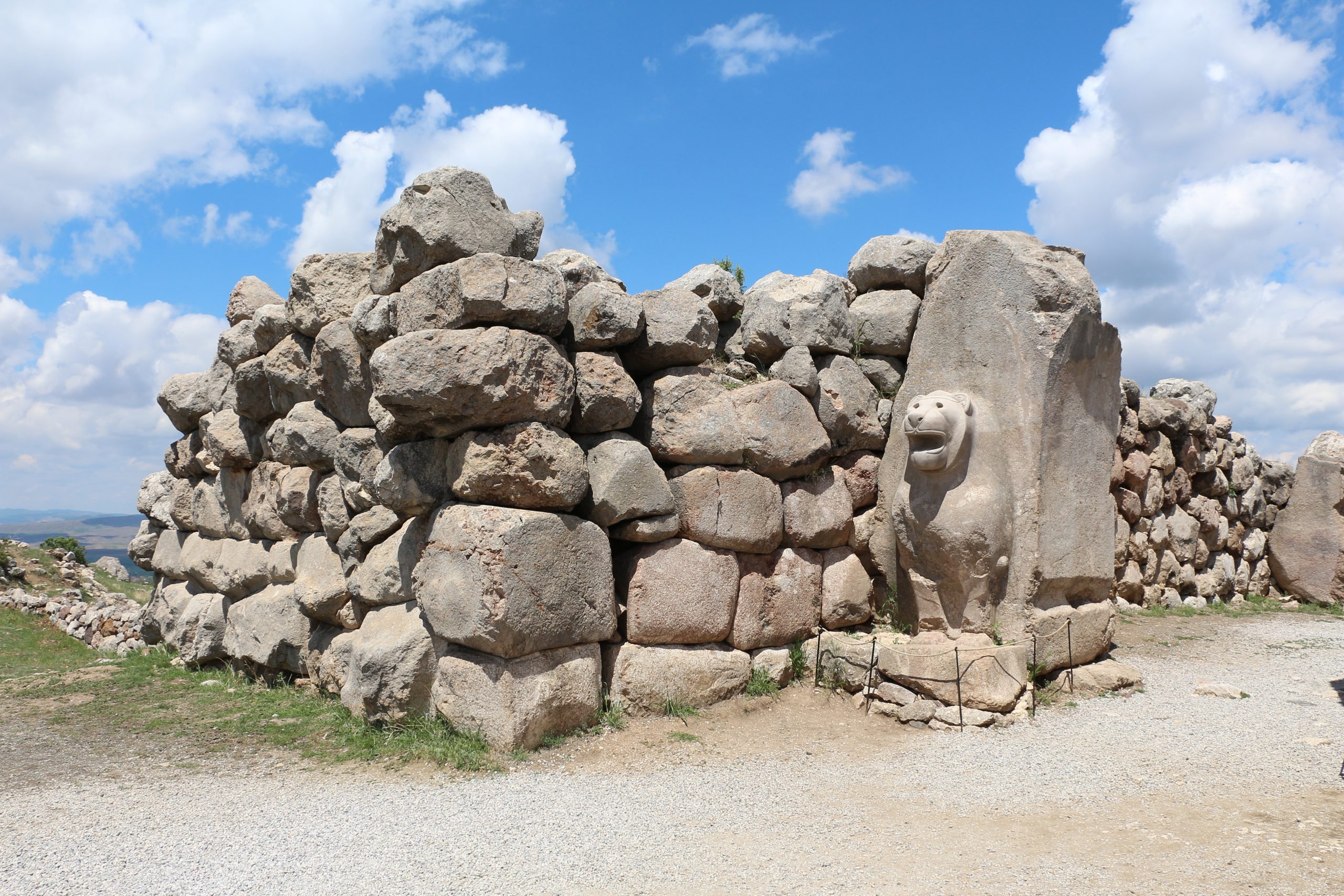
The most famous features of Hattusa are its monumental gateways, and chief among them is the one guarded by a pair of great stone lions. Carved from massive blocks and set into the city’s defensive wall, these lions faced outward to confront anyone approaching, their open jaws and alert postures serving both to intimidate enemies and to ward off evil. Even in their weathered state they retain a startling presence, and they have become the enduring symbol of the Hittite capital.
These gates were not merely functional openings in a wall but powerful statements of royal authority and protection. Placing fearsome guardian figures at the entrances to a city was a widespread practice in the ancient Near East, expressing the belief that thresholds were vulnerable points requiring both physical defense and supernatural protection. The lions of Hattusa stood watch over one of the busiest approaches to the capital, a reminder to all who passed that they were entering the seat of a mighty power.
At the highest point of the city stood another remarkable gate, adorned with sphinxes and pierced by a long tunnel running beneath the ramparts. The combination of monumental sculpture, massive stonework, and clever engineering shows how much thought the Hittites gave to the design of their gateways. These were ceremonial as well as defensive structures, stages on which the power and piety of the kingdom were displayed to visitors, subjects, and enemies alike.
Walking up to these gates today, across the same ground trodden by Hittite soldiers and priests, is one of the most evocative experiences the site offers. The lions have watched this landscape for well over three thousand years, through the empire’s glory, its fall, and the long centuries when its very existence was forgotten. That they still stand at their posts, gazing out over the highlands, gives the ruins a sense of continuity that bridges the vast gulf of time separating us from the people who raised them.
The engineering behind the sphinx-adorned gate at the summit deserves particular admiration. To reach it, the Hittites raised an artificial rampart and drove a long corbelled tunnel through its base, so that the approach combined ceremony with defense in a single audacious structure. Climbing to this high point, a visitor passes through the same dramatic sequence of ramp, gate, and tunnel that Hittite kings and priests once used, and the effort of the ascent still heightens the sense of arriving somewhere sacred and important.

A City Wrapped in Miles of Wall
Hattusa was above all a fortress city, defended by an elaborate system of walls that ran for miles around and through it, taking advantage of the rugged terrain to create a stronghold of formidable strength. The Hittite engineers built their fortifications from stone foundations topped with mudbrick, incorporating towers, gates, and cleverly designed features to make the city as difficult to attack as possible. The scale of these defenses reflects both the wealth of the empire and the dangerous world in which it existed.
The walls did not simply encircle a compact town. As the city grew, its defenses expanded to enclose a large area of varied terrain, climbing over rocky heights and following the contours of the land. This produced a sprawling fortified zone rather than a tidy walled square, with different districts, sanctuaries, and public buildings distributed across the protected space. To defend such a perimeter required real organization and resources, testifying to the administrative capacity of the Hittite state.
A modern reconstruction of a section of the wall gives visitors a vivid sense of how these defenses once appeared, rising in mudbrick above their stone base. Seeing even a fragment rebuilt to its original height transforms the understanding of the ruins, replacing low lines of foundation with the towering barrier that ancient attackers would have faced. It is a powerful reminder that the scattered stones of an archaeological site were once part of structures built on a genuinely monumental scale.
Among the most intriguing features associated with the fortifications is a curious postern tunnel that runs beneath a great rampart, allowing passage through the defenses. Such tunnels demonstrate the sophistication of Hittite military architecture, providing sally ports or ceremonial passages built with impressive stonework. Together, the walls, towers, gates, and tunnels of Hattusa amount to one of the great fortified complexes of the Bronze Age, a physical expression of an empire determined to protect its heart.

The choice of this rugged location for a capital was itself a strategic decision. The broken terrain of ridges and ravines gave the defenders natural advantages, forcing any attacker to fight uphill against walls that followed the high ground. Water sources within the fortified area helped the city withstand a siege, and the surrounding highlands offered both protection and a commanding position over the routes that crossed the plateau. Hattusa was not placed here by accident but chosen with a soldier’s eye for defensible ground.
Temples for a Thousand Gods
Religion saturated Hittite life, and the ruins of Hattusa are dense with the remains of temples. The Hittites famously worshipped an enormous number of deities, drawn from their own traditions and absorbed from the many peoples they encountered and ruled, so that their pantheon came to be described as embracing a thousand gods. This inclusiveness reflected an empire comfortable with incorporating the beliefs of others, adding conquered gods to its own rather than suppressing them.
The largest temple in the lower city was a vast complex dedicated to the chief deities of the state, its extensive foundations still clearly visible spread across the ground. Surrounding the central sacred building were numerous storerooms and administrative spaces, reflecting the temple’s role not only as a place of worship but as a major economic institution that managed goods, offerings, and the practical business of a great religious center. Ancient temples were often as much about wealth and organization as about ritual.
Beyond this great temple, the upper part of the city contained many more sanctuaries, so that Hattusa was studded with sacred buildings honoring its multitude of gods. The sheer number of temples underlines how central religion was to the identity and functioning of the Hittite state. The king himself served as the chief priest, responsible for maintaining the proper relationship between the people and their gods through an elaborate calendar of festivals and rituals recorded in meticulous detail on the clay tablets.
This religious intensity was not merely a matter of piety but of survival, for the Hittites believed the wellbeing of the empire depended on keeping the gods satisfied. Neglecting a deity or performing a ritual incorrectly could, in their view, bring disaster, and much royal effort went into ensuring that every god received proper honor. The temples of Hattusa were thus the machinery through which the state managed its crucial and anxious relationship with the divine, a relationship on which they believed everything else depended.

The Rock Sanctuary of Yazilikaya
A short distance from the city lies one of the most remarkable Hittite monuments of all, an open-air sanctuary set among natural rock formations. Here, on the smoothed faces of the living stone, the Hittites carved long processions of gods and goddesses, creating a sacred gallery unlike anything else that survives from their world. The figures advance across the rock in solemn ranks, each identified by symbols and distinctive attributes, forming a kind of assembled portrait of the vast Hittite pantheon.
The reliefs are extraordinary both as art and as religious documents. They show the deities in characteristic Hittite style, wearing tall headdresses and pointed shoes, arranged in a great convergence that culminates in the meeting of the principal gods. Interpreting exactly what ceremonies took place here has occupied scholars for a long time, but the sanctuary was clearly a place of major religious importance, perhaps connected with the new year or with rituals surrounding kingship and the afterlife.
One chamber in particular has drawn special attention, containing reliefs that seem to relate to the memory of a king and possibly to funerary or commemorative rites. The imagery here, including a striking depiction associated with the underworld and a figure of a king embraced by a god, hints at beliefs about death, succession, and the divine protection of rulers. These carvings offer a rare and moving glimpse into how the Hittites imagined the relationship between their kings and their gods.
What makes Yazilikaya so affecting is the way it fuses human art with the raw natural landscape. Rather than building a temple from scratch, the Hittites sanctified a place where nature had already created enclosed spaces among the rocks, adding their carvings to what the earth provided. The result feels intimate and elemental, a sacred site where the divine seems to emerge directly from the stone. Standing among these silent processions of gods is one of the most haunting experiences the Hittite world has to offer.
The very act of carving gods into the living rock, rather than housing them in a built temple, says something profound about how the Hittites related to their landscape. They seem to have recognized certain natural places as inherently charged with the sacred, and their response was not to replace nature with architecture but to work with it, letting the divine procession emerge from the stone the mountain provided. Sanctuaries of this kind blur the line between the made and the found, and they remain among the most atmospheric religious sites anywhere in the ancient world.

A Bureaucracy That Buried Its Records
One of the greatest treasures Hattusa yielded was not gold or sculpture but information, in the form of thousands of clay tablets recovered from the city’s archives. These documents, baked hard and preserved through the millennia, constitute one of the most important written records to survive from the Bronze Age. They reveal an empire run by a literate bureaucracy that recorded laws, rituals, treaties, letters, and administrative details with impressive thoroughness, giving historians an unusually rich basis for reconstructing Hittite life.
The range of the tablets is remarkable. There are legal codes that reveal how the Hittites dealt with crime and punishment, often with a notable emphasis on compensation rather than harsh physical penalties. There are ritual texts describing in painstaking detail how festivals were to be conducted and gods appeased. There are royal annals recording the campaigns and achievements of kings, and there is diplomatic correspondence with other great powers, allowing us to eavesdrop on the international relations of the age.
These archives functioned as the memory of the state, a repository of the accumulated knowledge and precedents on which the government relied. Trained scribes, masters of a difficult writing system, were essential to the running of the empire, and their work has become our chief means of understanding it. Without their diligence, and without the durability of clay as a writing material, the Hittites might have remained forever a shadowy footnote rather than a fully documented civilization.
It is a strange and wonderful irony that a bureaucracy’s paperwork, the most mundane product imaginable, should be the thing that rescued an entire empire from oblivion. The soldiers, temples, and treasures of the Hittites might have left only ambiguous ruins, but their obsessive record-keeping gave them a voice that reaches across more than three thousand years. In the tablets of Hattusa, the administrators of a lost empire speak to us still, patiently explaining the world they built.
Reading the laws in particular offers a surprisingly humane portrait of the society that produced them. Where some ancient codes leaned toward severe physical punishment, the Hittite approach frequently favored restitution, requiring wrongdoers to compensate their victims rather than simply suffer in kind. This preference does not make the Hittites gentle by modern standards, but it reveals a legal culture concerned with restoring balance and repairing harm, and it complicates any simple picture of Bronze Age justice as uniformly brutal. Details like these are exactly what the archives give us: not just the grand outlines of empire but the texture of ordinary life and law.

Diplomacy, War, and the First Peace Treaty
The Hittites were a great military power, and their armies fought campaigns across a wide arena, clashing with rivals over the rich and strategically vital lands of the ancient Near East. Their chariots and soldiers were feared, and their kings recorded their victories with pride. But the Hittites were also skilled diplomats, and some of their most important legacies come not from the battlefield but from the negotiating table, where they managed relationships with the other great powers of their world.
The most celebrated episode in Hittite diplomacy concerns their long rivalry with Egypt, which culminated in one of the most famous battles of the Bronze Age and, more importantly, in a formal peace agreement between the two empires. This treaty, preserved in versions from both sides, is often described as one of the earliest surviving international peace agreements in history. It laid out terms of peace, mutual defense, and the return of fugitives, and it stands as a landmark in the history of diplomacy.
That such an agreement was reached and recorded tells us a great deal about the sophistication of Bronze Age international relations. These were not primitive states blundering into mindless conflict but organized powers capable of negotiation, compromise, and the maintenance of long-term relationships. The correspondence between rulers, the exchange of gifts and even royal marriages, and the careful wording of treaties all reveal a mature diplomatic culture spanning the great courts of the age.
The Hittite achievement in diplomacy has resonated into modern times, with the famous treaty celebrated as a symbol of peacemaking between nations. That an agreement struck between two Bronze Age empires should still be invoked as an example of diplomacy speaks to its enduring significance. The Hittites, for all their martial prowess, understood that lasting security came as much from skilled negotiation as from military strength, a lesson that has lost none of its relevance across the intervening millennia.

The Sudden Silence of an Empire
For all its power, the Hittite empire came to an end with remarkable abruptness. Around the end of the Bronze Age, in a period of widespread upheaval that saw many of the great states of the eastern Mediterranean collapse or contract, Hattusa was abandoned and the empire it had ruled dissolved. The precise combination of causes remains debated, but the disappearance was so complete that the Hittites faded almost entirely from historical memory for thousands of years.
This collapse was part of a broader catastrophe that struck the ancient Near East and Aegean at the close of the Bronze Age, a mysterious cascade of destruction, migration, and systemic breakdown that toppled multiple civilizations in a relatively short span. Scholars have proposed many contributing factors, from invasions and internal strife to drought, famine, and the disruption of trade networks. Whatever the exact mix, the Hittite state proved unable to withstand the pressures, and its capital was left to the elements.
Interestingly, the evidence suggests that Hattusa may not have fallen in a single violent sack so much as been progressively abandoned, its population and administration draining away as the empire lost cohesion. Valuable items appear to have been removed, and the great city was gradually emptied rather than simply destroyed in flames. The end of the Hittite capital may have been less a sudden apocalypse than a slow unraveling, as the systems that sustained the empire failed one by one.
Whatever the precise sequence, the result was the same: a great empire vanished, its cities emptied, its language forgotten, its very name reduced to obscure references in the records of others. The completeness of this erasure is itself remarkable, a sobering example of how even a dominant power can be swept away and lost to memory. The silence that fell over Hattusa lasted for millennia, until the modern age finally began to piece together the story of the empire that had ruled from these highland ruins.
Rediscovering the Hittites
The recovery of the Hittites is one of the great detective stories of archaeology. For centuries their existence was suspected only from scattered mentions in ancient texts, tantalizing references to a people whose identity and importance were unclear. It was only when excavations at Hattusa uncovered the ruins of a great city and its archives of clay tablets that the true scale of the lost empire began to emerge from the ground.
The decipherment of the Hittite language was a crucial breakthrough, transforming the mute tablets into a flood of information. Once scholars could read the documents, the Hittites were revealed not as a minor people but as one of the major powers of their era, a rival of Egypt and a shaper of the ancient Near East. Each season of excavation and each advance in understanding the texts added detail to the portrait, gradually restoring a civilization that had been almost entirely forgotten.
This rediscovery reshaped understanding of Bronze Age history, adding a whole missing power to the map of the ancient world and enriching knowledge of everything from ancient diplomacy to the history of languages. The Hittites’ return from oblivion stands as a testament to the power of archaeology to recover the lost, to give voice to the silent, and to correct the gaps and distortions of historical memory. An empire that had vanished utterly was made real again through patient excavation and scholarship.
Standing in Hattusa Today
Visiting Hattusa today means walking through a vast and open archaeological landscape, spread across a dramatic upland of rocky ridges and valleys. Unlike a compact ruin that can be taken in at a glance, the site demands time and movement, as its gates, temples, and walls are distributed over a large area that follows the rugged contours of the land. The scale is part of the experience, conveying the sheer extent of the ancient capital and the ambition of the people who built it here.
Recognized as a UNESCO World Heritage site, Hattusa is protected for its outstanding importance as the capital of the Hittite empire and as a source of unparalleled information about that civilization. Reconstructions, such as the rebuilt section of city wall, help visitors visualize the ancient city, while the nearby rock sanctuary of Yazilikaya adds a profound religious dimension to any visit. Together they offer a rounded encounter with the Hittite world, from its defenses to its gods.
The setting itself is unforgettable. The stark beauty of the central Anatolian highlands, with their wide skies and weathered rock, provides a fitting backdrop for the remains of an empire that has largely returned to the earth. There is a powerful sense of solitude and antiquity here, of standing amid the bones of a forgotten superpower in a landscape that feels timeless. For those drawn to the deep past, few places convey so strongly the rise and fall of human greatness.
Nearby Places
The Anatolian plateau holds some of humanity’s oldest settlements, reaching back thousands of years before the Hittites raised their capital. If the ancient depth of this land intrigues you, these earlier sites carry the story back toward the very dawn of settled life.
- Çatalhöyük: The 9,000-Year-Old Town With No Streets
- Aşıklı Höyük: The 10,000-Year-Old Village That Came Before Çatalhöyük
- Göbekli Tepe: The World’s Oldest Temple and How It Rewrote History
Last Thoughts
Hattusa is a monument to both the heights and the fragility of human achievement. Here was the capital of an empire that stood among the greatest of its age, a city of mighty walls, thronged temples, and archives full of the accumulated wisdom of a state. And yet it fell so completely that its people were nearly erased from history, their empire dissolving into silence and their name surviving only in the records of strangers. Few places illustrate so starkly how much can be lost.
But Hattusa is also a monument to recovery. Through the labor of archaeologists and the durability of clay, the Hittites have been brought back, their voices restored, their empire mapped, their place in history reclaimed. To stand among the stone lions and the temple foundations, in that vast and silent highland, is to feel both the weight of what time can destroy and the wonder of what patient inquiry can bring back to light. The empire that vanished has, in the end, been found again.
You May Like

Mafra, the Palace a King Built From a Vow


7 thoughts on “Hattusa: Highland Capital of the Forgotten Hittite Superpower”