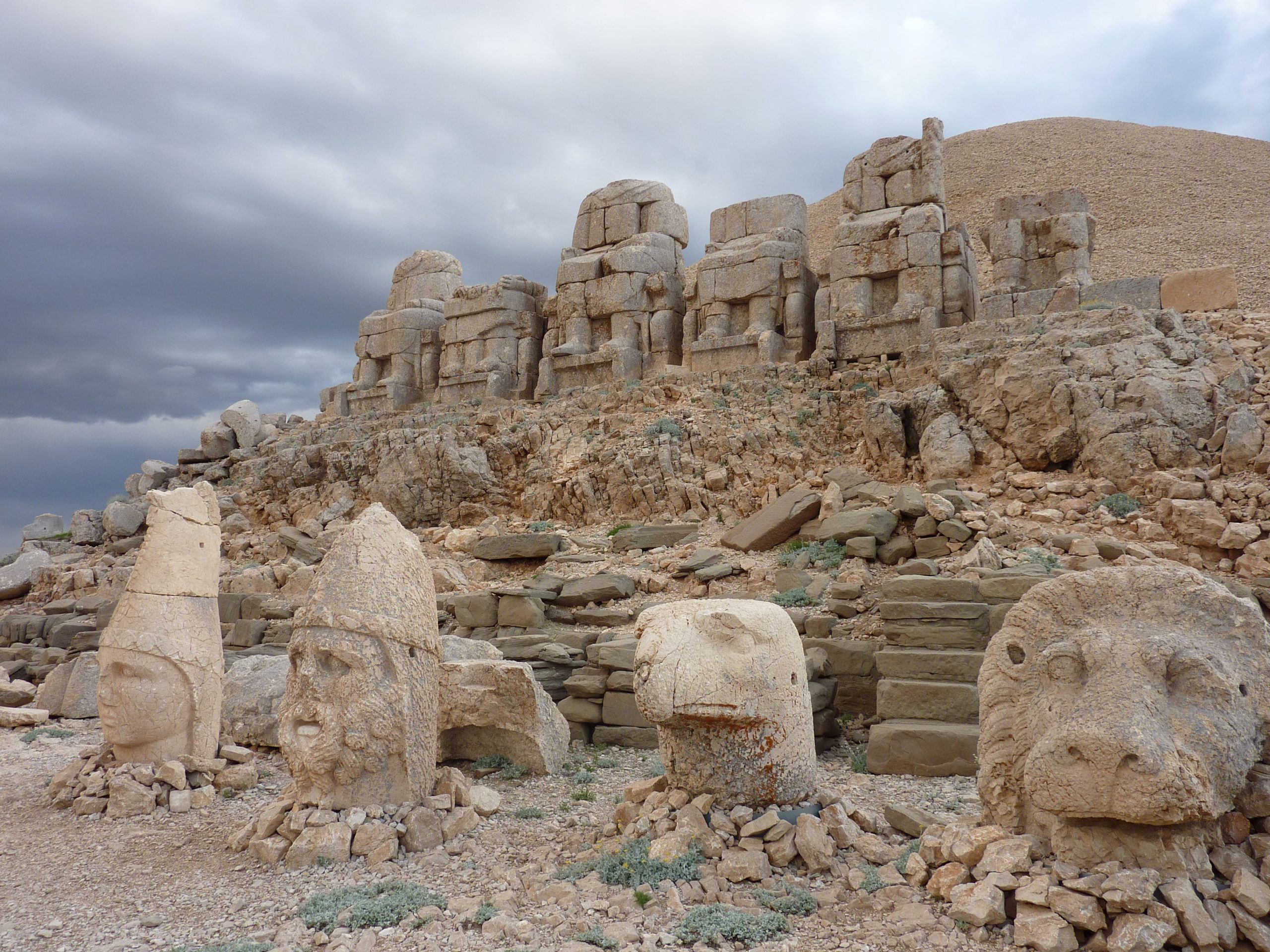
Mount Nemrut is a mountaintop tomb sanctuary in southeastern Turkey where colossal statues of a king and his gods, carved over two thousand years ago, still gaze across the Anatolian highlands. Their bodies remain enthroned in a row, but their enormous heads have long since tumbled to the ground, where they now rest in the gravel like fallen moons, each one taller than a standing person. Behind them rises an artificial cone of crushed stone almost fifty meters high, a man-made summit heaped on top of a natural one. This is Mount Nemrut, and it is one of the strangest and most haunting monuments left by the ancient world.
What makes Nemrut so arresting is not only its scale but its loneliness. There was never a great city here, no bustling capital, no crowded marketplace. The monument was raised for a single purpose by a single ruler, a king who decided that his tomb should stand higher than any other in his land and that he should spend eternity seated among the gods themselves. The result is a place that feels less like an archaeological site than a message from one confident man to the distant future, delivered in limestone across two thousand years.
The king was Antiochus I of Commagene, and the mountain sanctuary he built has outlived his kingdom, his dynasty, and nearly all memory of both. Today travelers climb the last stretch of the peak before dawn to watch the sun come up behind the shattered statues, and the experience has a strange power that guidebook descriptions rarely capture. This is the story of who built Nemrut, why, and how a modest kingdom on the edge of empires produced one of history’s most audacious monuments.
Contents
- A Mountain Crowned by Giants
- The King Who Wanted to Sit Among the Gods
- Commagene: A Small Kingdom Between Two Worlds
- How the Terraces Were Built
- The Gods of a Blended Pantheon
- The Handshake Reliefs and the Royal Line
- A Tomb Nobody Has Ever Found
- Rediscovery and the Slow Work of Study
- Why the Heads Fell
- Watching the Sun Rise on the Summit Today
- Nearby Places to Explore
- Why Nemrut Endures
A Mountain Crowned by Giants
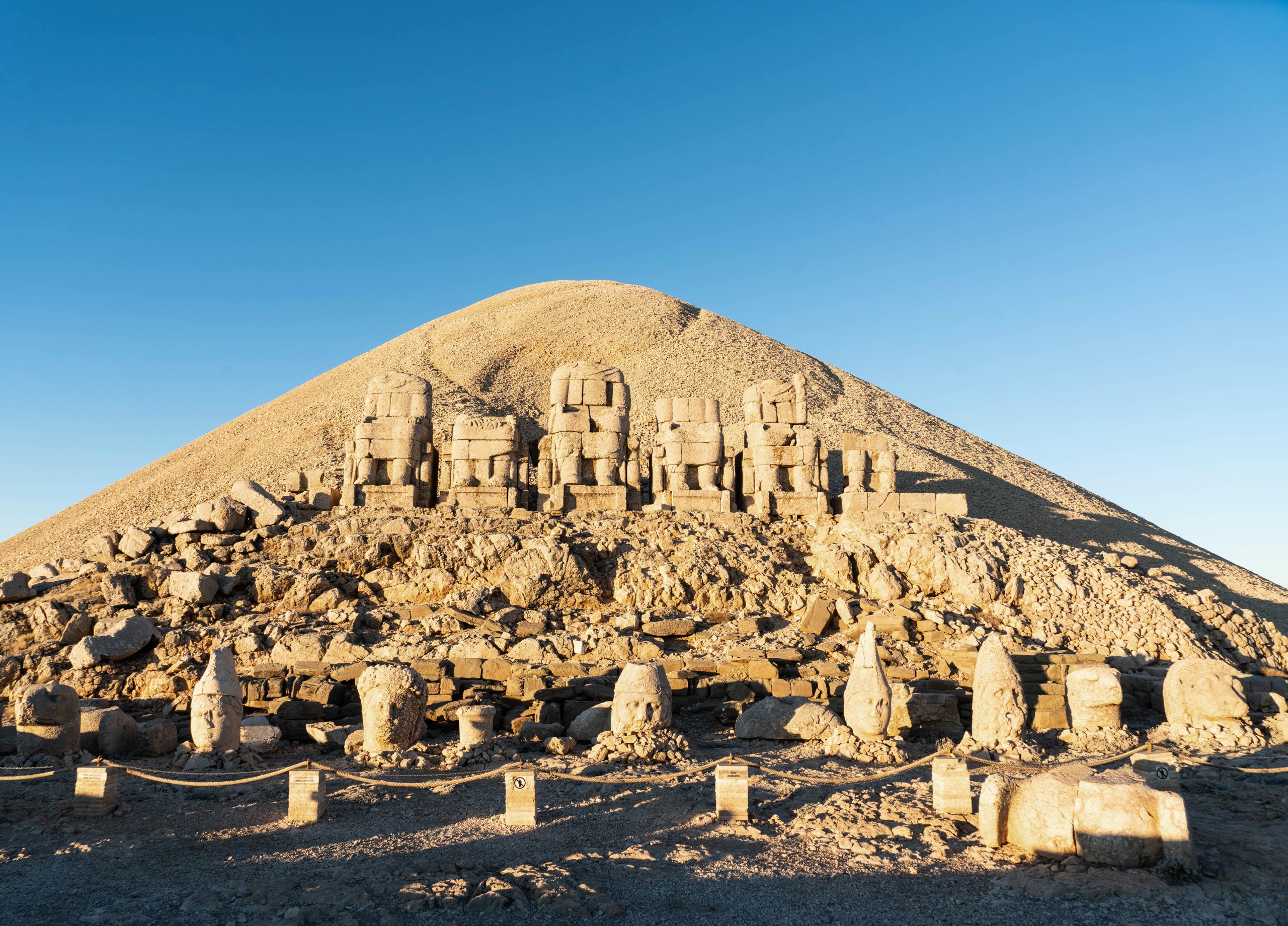
The summit of Nemrut is dominated by two great terraces, one facing east and one facing west, with a smaller one to the north. On each of the main terraces a row of seated statues once stood shoulder to shoulder, five colossal figures flanked by guardian animals, a lion and an eagle at either end. When they were complete these statues stood perhaps eight or nine meters tall, carved in courses of limestone blocks stacked to build up the enormous seated forms.
Between the two terraces rises the tumulus, the artificial mound of fist-sized broken stones that gives the peak its distinctive shape. From a distance it looks like a natural cone, but it is entirely built, a deliberate heaping up of rubble to raise the mountain higher and, almost certainly, to cover and protect a tomb somewhere beneath. The scale of the earthwork is staggering when you consider that every stone had to be carried up to the summit by hand.
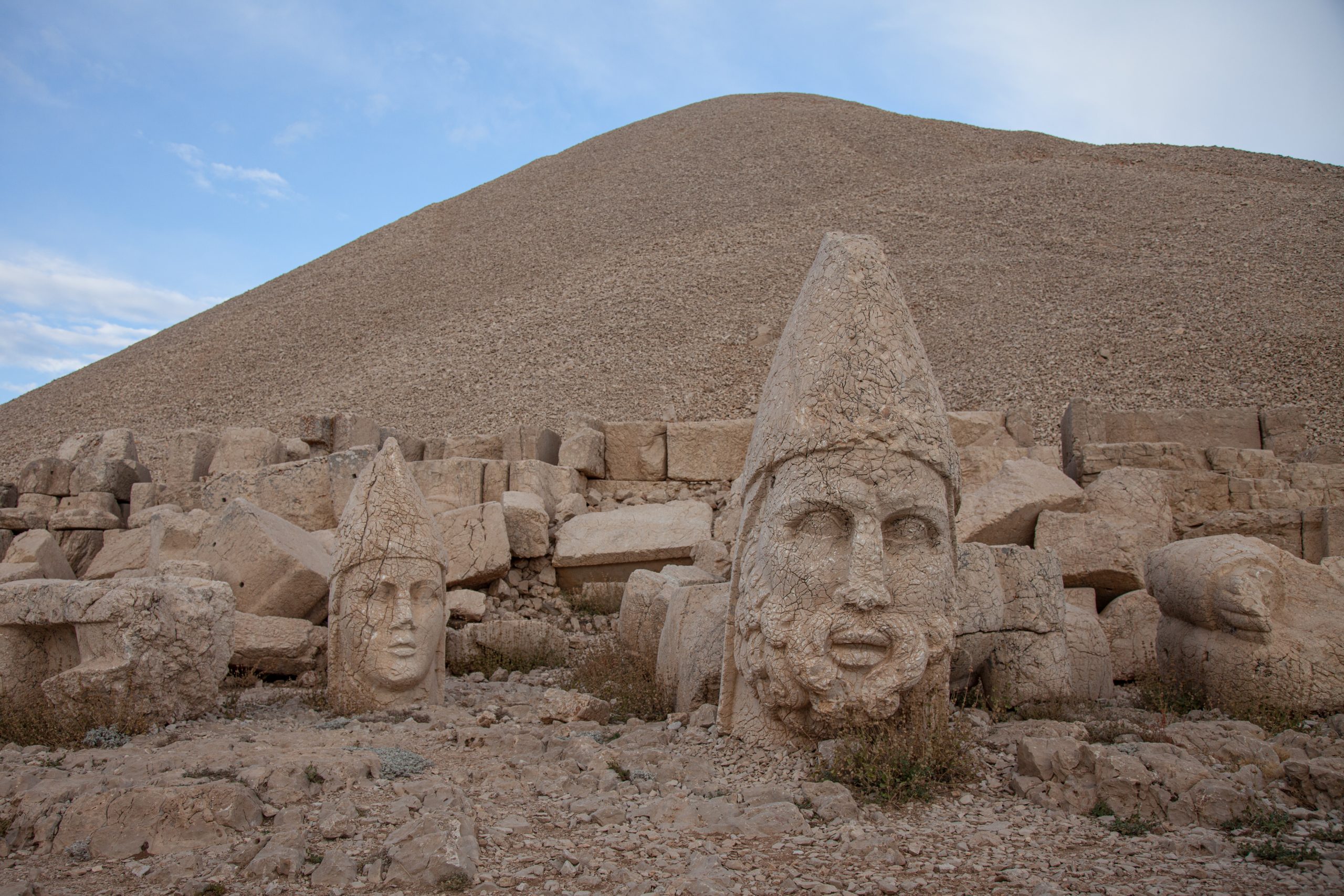
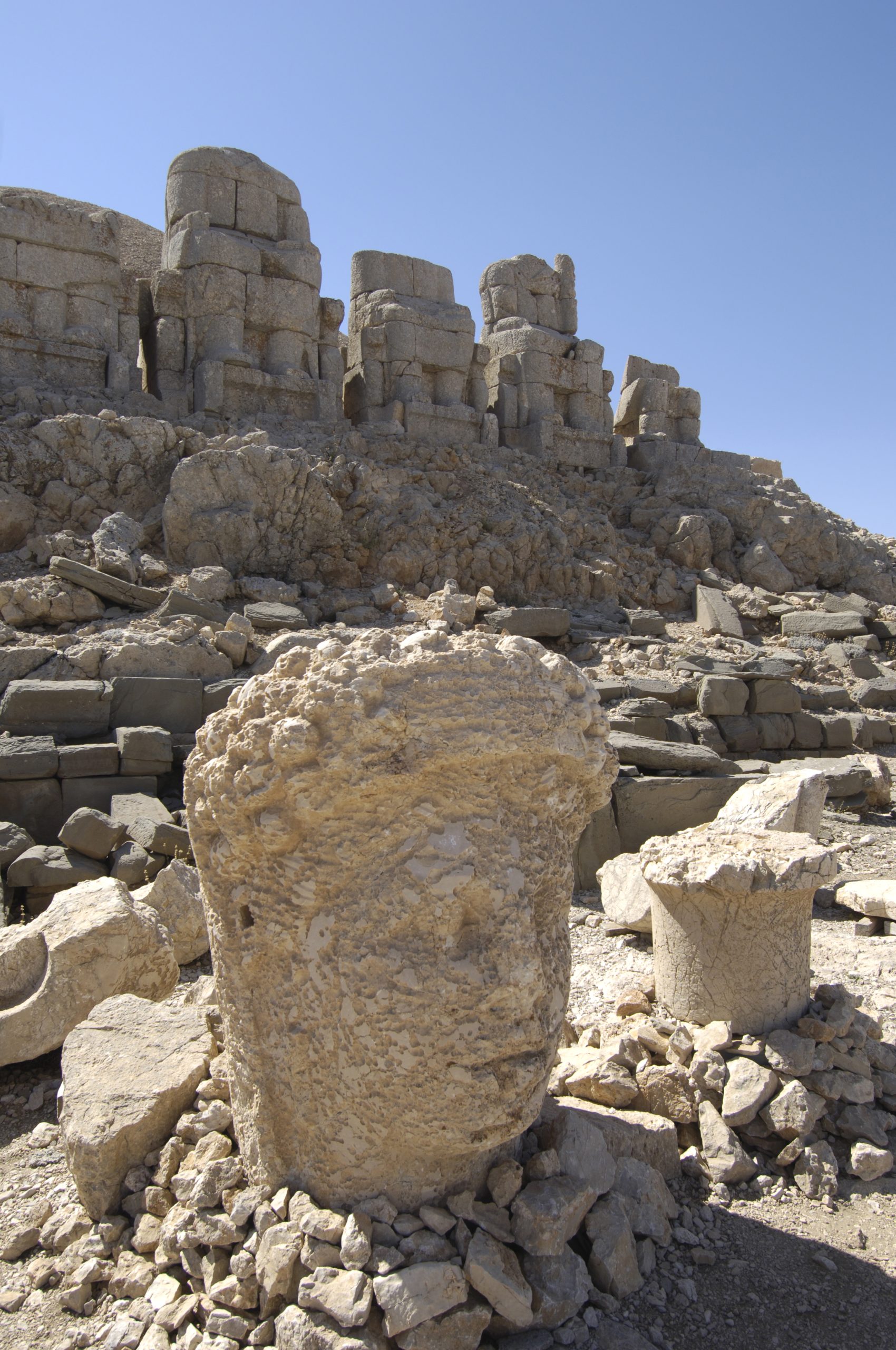
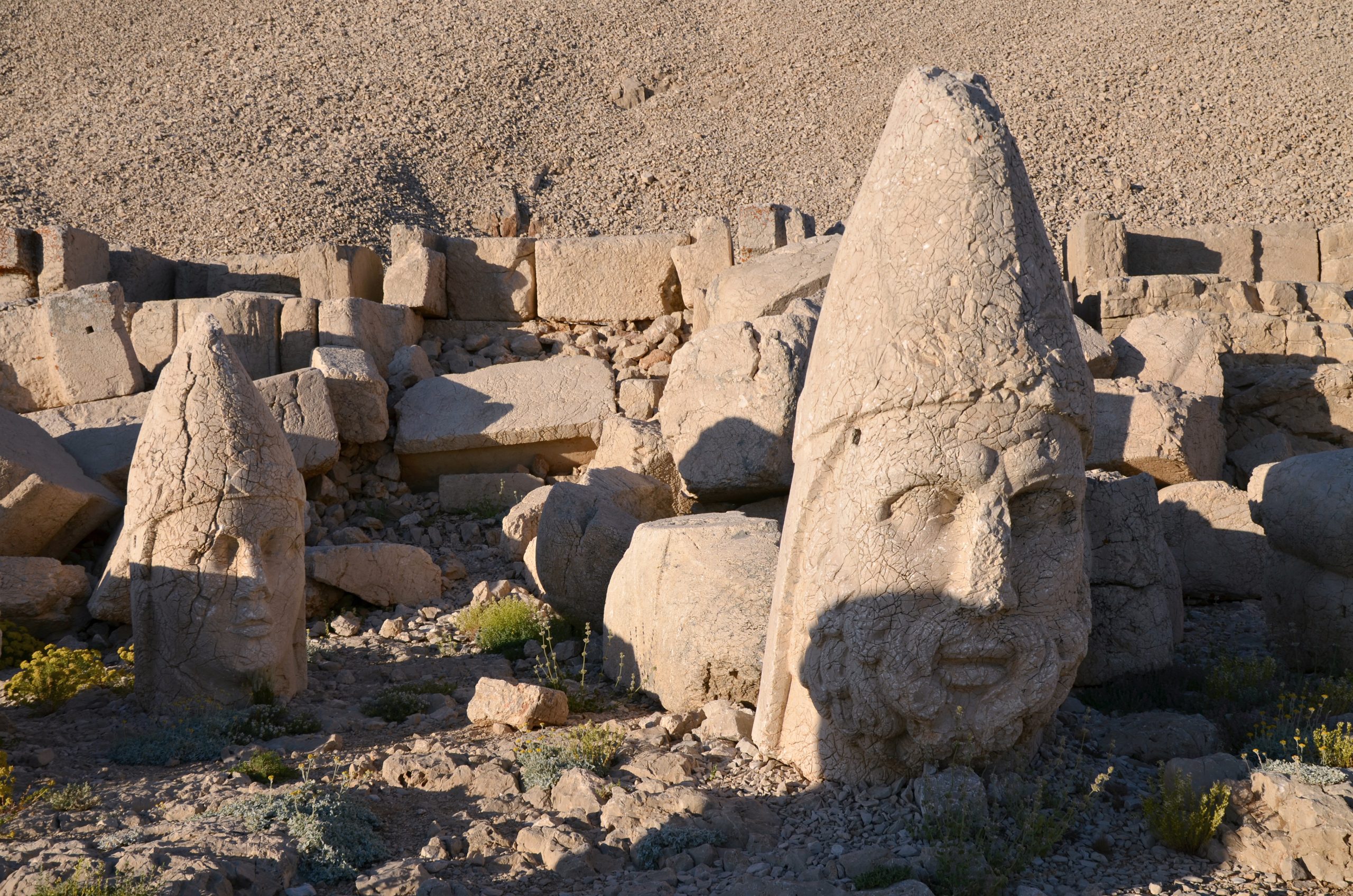
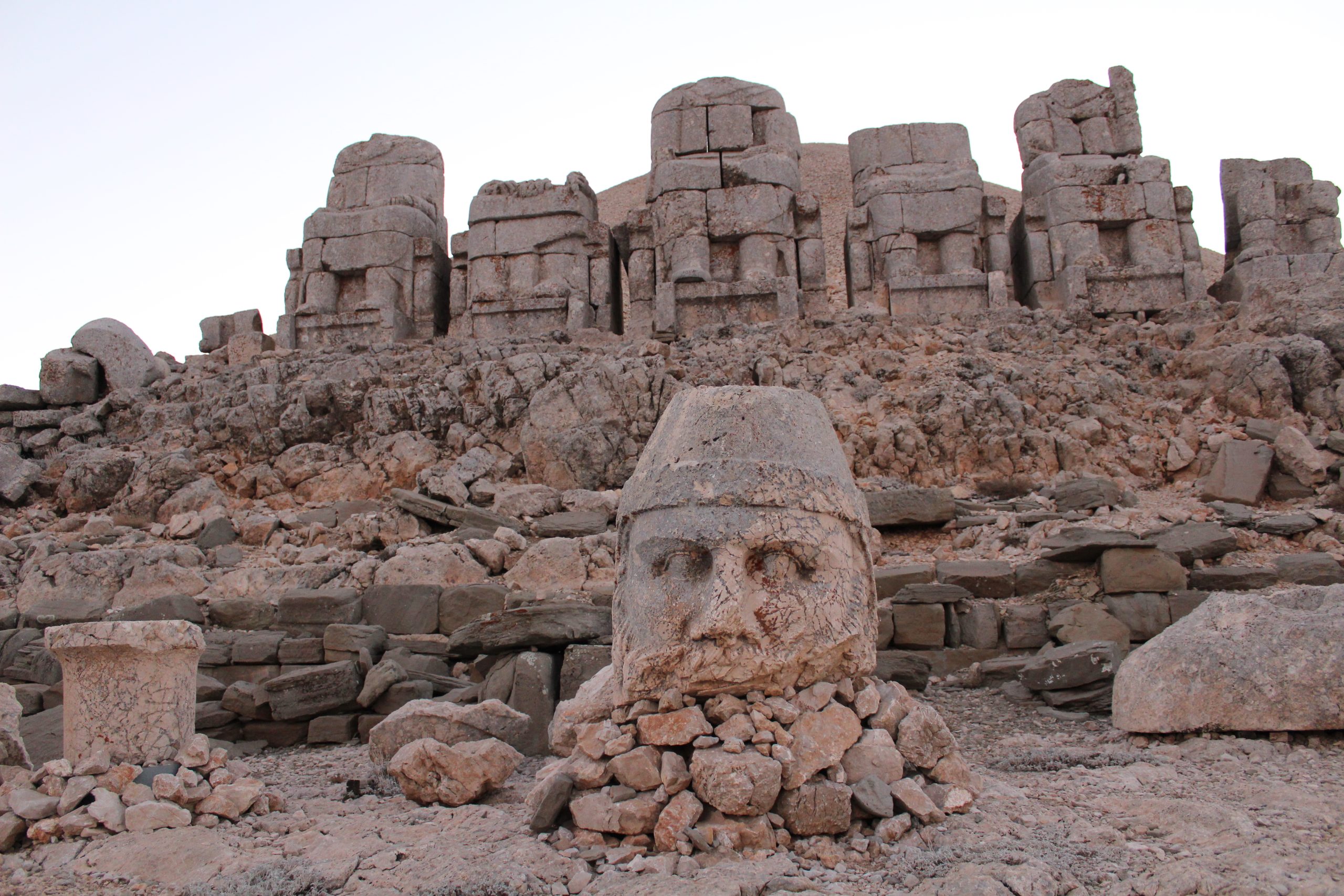
Standing on the terraces today, you are surrounded by the wreckage of this ambition. The bodies of the gods remain in place, weathered but recognizable, while their heads lie scattered on the ground before them, arranged now by archaeologists into rough rows so that visitors can see their faces. The effect is unforgettable: a council of giant deities, decapitated by time, still keeping their silent watch over the valley.
The choice of location was not accidental. Nemrut is one of the highest points in the region, visible from far away, catching the first and last light of the sun. For a king who wished to associate himself with the heavens, no ordinary hilltop would do. He chose a peak that would put his monument closer to the sky than anything his subjects had ever built.
The approach adds to the drama. As the path winds up the last slope, the tumulus looms ahead like a pale pyramid, and it is only when you crest the ridge onto the terrace that the statues suddenly reveal themselves. That staged reveal, whether intended by the builders or an accident of the terrain, gives arriving at the summit the quality of stepping onto a stage set by someone with a keen sense of theater.
The King Who Wanted to Sit Among the Gods
Antiochus I Theos of Commagene ruled in the first century before the common era, in the decades when the Roman Republic and the Parthian Empire were carving up the ancient Near East between them. He was a minor king by the standards of those giants, but he was a king with an unusually grand sense of his own place in the cosmos, and the surname he took, Theos, means simply the god.
Antiochus did not claim divinity out of thin air. He traced his ancestry, or claimed to, back to both the Persian kings of the Achaemenid line and the Macedonian conquerors descended from Alexander’s generals. In his own telling he stood at the meeting point of two of the greatest royal traditions the world had known, and this double inheritance became the foundation of a personal religion he devised and inscribed across his kingdom.
Long inscriptions carved at Nemrut and other Commagenian sites spell out this program in detail. Antiochus established a ruler cult centered on himself, decreed festivals to be held on the days of his birth and coronation, and instructed that his memory be honored forever. The monument on the mountain was to be his eternal dwelling, a hierothesion, a sacred tomb-sanctuary where the dead king would rest in the company of the gods he claimed as kin.
It is easy to read all this as mere vanity, and there is certainly vanity in it. But the project also had a political logic. By fusing Greek and Persian traditions into a single cult centered on his own person, Antiochus was trying to bind together the mixed population of his kingdom and to assert its independent identity in a world where larger powers were always threatening to swallow it.
There is a paradox at the heart of his self-presentation. A truly secure and powerful king rarely needs to insist so loudly on his greatness, and the very extravagance of Antiochus’s claims hints at the anxiety of a small ruler surrounded by giants. The monument is at once a boast and a form of insurance, an attempt to fix in permanent stone a status that the shifting politics of the age could never guarantee.
Commagene: A Small Kingdom Between Two Worlds
Commagene was a small kingdom occupying a stretch of fertile land where the Taurus Mountains meet the Euphrates, in what is now the province of Adiyaman and its neighbors. It emerged as an independent state when the great Seleucid empire, one of the successor kingdoms of Alexander, began to fall apart, and its local rulers seized the chance to break away and govern in their own right.
Its position was both its fortune and its danger. The kingdom sat on important routes between Anatolia, Syria, and Mesopotamia, which brought trade and wealth. But it also lay directly on the shifting frontier between Rome to the west and Parthia to the east, which meant that its kings had to be perpetual diplomats, playing the two great powers against each other to preserve their small patch of independence.
For a time the strategy worked, and under Antiochus I the kingdom reached a peak of prosperity and confidence that made a project like Nemrut possible. But Commagene’s independence was always fragile. Within a century or so of Antiochus, the kingdom was absorbed into the Roman Empire, its royal line pensioned off, and its distinctive cult forgotten. The mountain sanctuary was left to the wind and the snow.
That brevity is part of what makes Nemrut so poignant. It is the monument of a kingdom that flared brightly and briefly, a statement of eternal permanence built by a state that would not survive many more generations. The gods on the terrace were meant to guard a dynasty that history had already nearly finished with.
Commagene’s culture reflected its in-between position in everything from its coinage to its art. Greek was the language of its inscriptions, yet Persian dress and iconography ran through its royal imagery, and the blend was not a muddle but a considered identity. The kingdom presented itself as heir to both civilizations at once, and Nemrut is the most complete surviving expression of that carefully cultivated dual heritage.
How the Terraces Were Built
The engineering of Nemrut was ambitious but not mysterious. The statues were not carved from single monstrous blocks but built up from stacked courses of limestone, each layer shaped and set so that the whole assembled into a seated figure. This method allowed the builders to achieve enormous size without needing to quarry and move impossibly large stones, though the logistics of hauling everything to a remote summit were still formidable.
Each terrace followed the same basic plan. In the center sat the row of great gods, with Antiochus himself included among them as an equal. At either end stood the guardian lion and eagle. In front of the seated figures ran rows of stone slabs carrying reliefs and inscriptions, including a remarkable series depicting the king’s ancestors, both the Persian and the Macedonian lines, stretching back generation by generation to legendary founders.
The two main terraces mirrored each other, east and west, so that the sanctuary could function through the whole arc of the sun’s daily journey. Ceremonies and offerings were prescribed in the inscriptions, and priests were to maintain the cult in perpetuity, dressed in Persian style and tending the sacred fires. The whole complex was a carefully choreographed stage for a religion of one man’s design.
Above and behind it all rose the tumulus, sealing whatever lay beneath. The builders seem to have understood that the loose stone of the mound would be nearly impossible to excavate without collapse, which may have been precisely the point. If a tomb lies within, its architect gave it the best protection available: not a locked door but a mountain of rubble that resists every attempt to dig through it.
The symmetry of the layout was almost certainly meaningful rather than merely decorative. Mirroring the arrangement across an eastern and a western terrace tied the cult to the movement of the sun, the very body that the sanctuary’s solar god embodied. A worshipper could greet the gods at dawn on one side and take leave of them at dusk on the other, the ritual day mapped onto the architecture itself.
The Gods of a Blended Pantheon
The gods enthroned on the terraces are not the familiar deities of Greece or Persia in their pure form. They are hybrids, deliberate fusions that reflect Antiochus’s project of blending the two traditions into one. Each figure carries a double or even triple identity, a Greek god merged with a Persian counterpart, so that a single statue could speak to worshippers from either background.
So the supreme sky god appears as Zeus fused with the Persian Ahura Mazda; the sun god combines Apollo with Mithra and the Greek Helios; the mighty hero god unites Heracles with the Persian Artagnes. Alongside them sits a goddess who personifies the fertile land of Commagene itself, and Antiochus, seated among them, claims his place in this invented pantheon as a god in his own right.
This syncretism was not simply eccentric. It was a sophisticated piece of religious politics. By showing that the great gods of the Greeks and the Persians were really the same divine powers under different names, Antiochus offered his mixed subjects a shared religious language, and he placed himself at the center of it as the living link between the two worlds his ancestry supposedly joined.
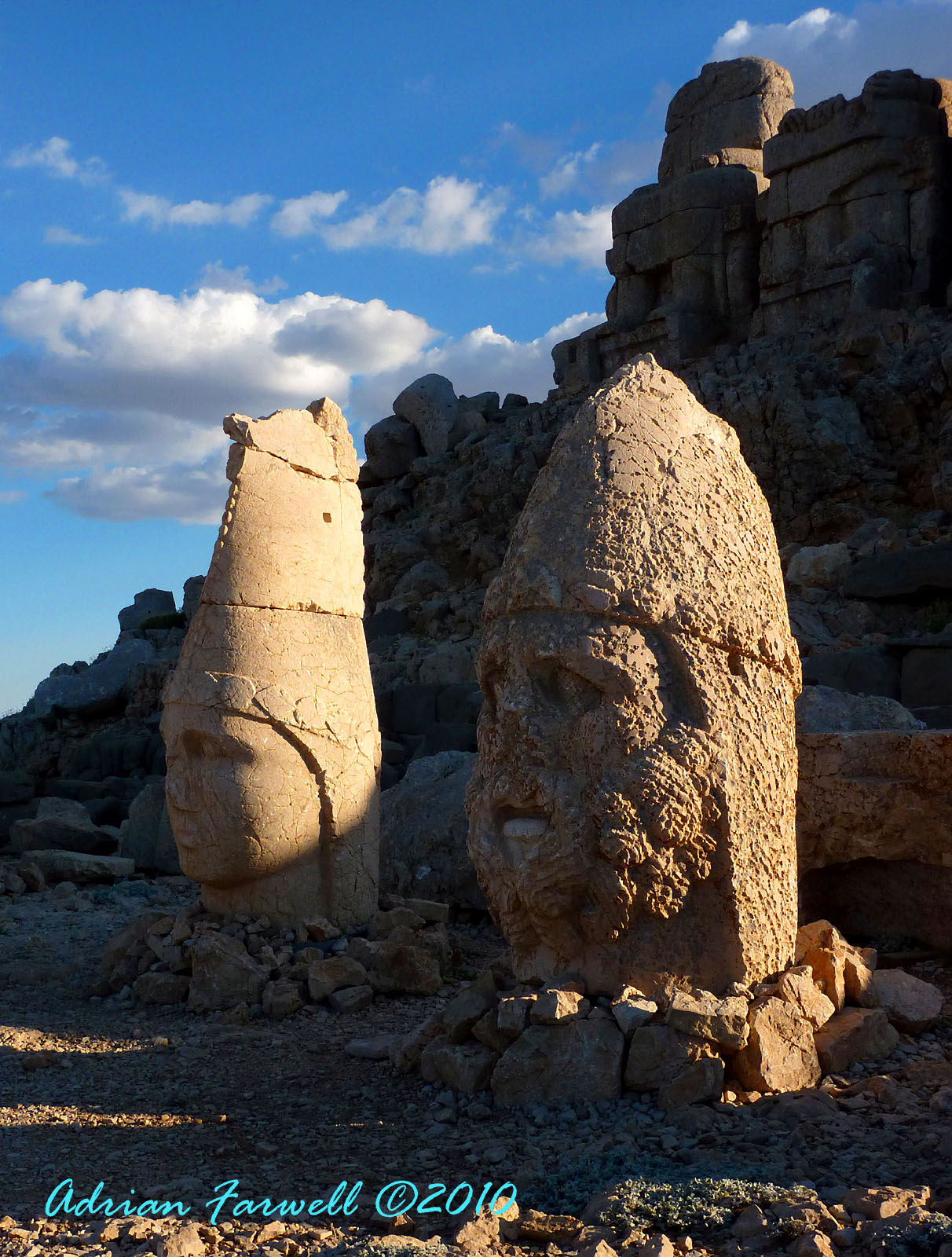
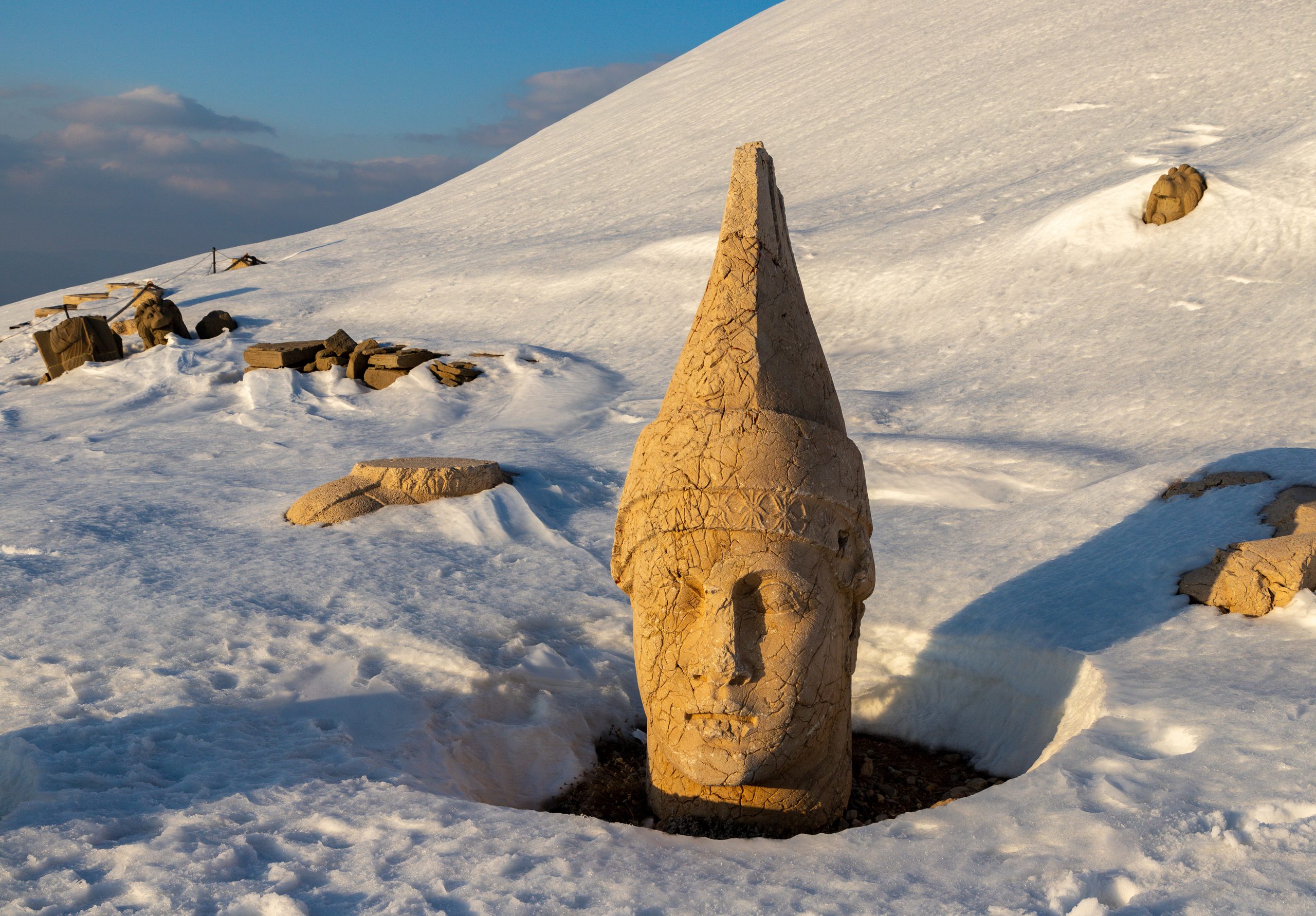
The fallen heads let us look these strange composite gods in the face. Their features blend Greek serenity with Persian details of dress and headgear, the tall pointed tiaras marking the eastern element in their identity. Weathered and cracked though they are, the heads still convey the calm, remote dignity their sculptors intended, a divinity meant to look down on mortals from an unreachable height.
For modern visitors the blended deities can be disorienting, since the statues do not match the tidy categories of any single mythology. But that is exactly the point. Antiochus was not preserving an old religion; he was inventing a new one, tailored to his kingdom and his person, and its unfamiliarity today is a direct measure of how original, and how personal, his theological experiment really was.
The Handshake Reliefs and the Royal Line
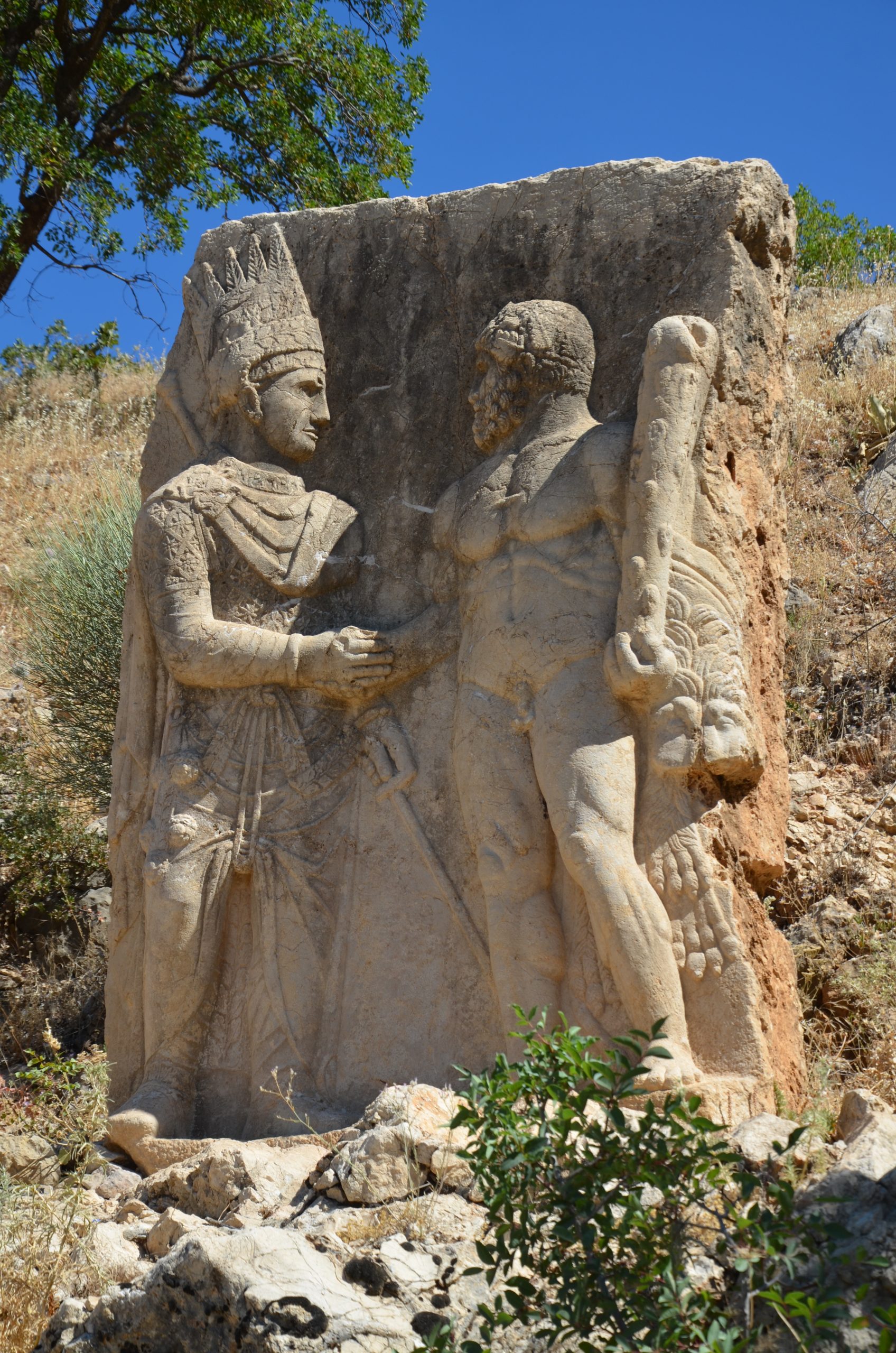
Among the most important carvings at Nemrut and the related Commagenian sites are the dexiosis reliefs, scenes showing the king clasping hands with a god. The handshake was an ancient gesture of alliance and equality, and by having himself depicted greeting the gods as a peer, Antiochus made his claim to divine kinship visible in stone. These images appear at Nemrut and, in especially fine form, at the nearby site of Arsameia.
The ancestor galleries were equally significant. Along the terraces ran rows of stelae, each showing one of the king’s forebears, with inscriptions naming them and tracing the descent. On one side marched the Persian ancestors back to the Achaemenid kings; on the other, the Macedonian line back toward Alexander’s world. Together they formed a stone family tree designed to prove that Antiochus united the two greatest royal bloodlines of the age.
Whether every link in that genealogy was genuine is doubtful. Ancient kings were rarely shy about improving their ancestry, and Antiochus had strong motives to emphasize connections that flattered his claims. But the reliefs are invaluable regardless, because they preserve a detailed picture of how a Hellenistic-era ruler wished to present his lineage, and they give art historians a rare gallery of royal portraiture from a kingdom that left few other images.
Reading the inscriptions that accompany these carvings, one is struck by the sheer confidence of the language. Antiochus speaks of his monument enduring for all time, of his cult being maintained forever, of his name never being forgotten. There is something moving in that certainty, given how completely his kingdom vanished, and something almost vindicated in it too, since the monument did survive to make him remembered after all.
A Tomb Nobody Has Ever Found
The central mystery of Nemrut is the one thing the whole monument was built to house: the tomb of Antiochus himself. The inscriptions make clear that this was intended as his burial place, and the vast tumulus surely covers something. Yet despite more than a century of study, no burial chamber has ever been located, and the king’s body has never been found.
The problem is the tumulus itself. It is made of loose, small stones piled to a great height, and any tunnel driven into it tends to collapse as the rubble flows back to fill the gap. Early attempts to dig into the mound were defeated by this simple physics, and modern archaeologists have been reluctant to risk destabilizing the monument or endangering workers in pursuit of a chamber that may lie deep and well hidden.
Various surveys using less destructive methods have tried to peer inside the mound, hoping to detect a hidden void or passage, but the results have been inconclusive. The tomb, if it is there, keeps its secret. Some scholars have even wondered whether the king was buried elsewhere and the mound is symbolic, though the weight of evidence still points to a real burial somewhere beneath the crushed stone.
There is a certain justice in this. Antiochus wanted to rest for eternity undisturbed among his gods, and so far the mountain has granted his wish more completely than he could have imagined. The very inaccessibility that frustrates archaeologists is exactly the protection the king seems to have designed. His tomb has kept him hidden for two thousand years and counting.
The unsolved tomb has inevitably attracted its share of speculation and romance, and it is often cited among the great unopened burials of the ancient world. Yet the responsible archaeological view counsels patience over spectacle. Whatever lies beneath the mound has waited two thousand years, and it can wait longer still until methods exist to reach it without destroying the very monument that has kept it safe.
Rediscovery and the Slow Work of Study
After Commagene fell and its cult was abandoned, Nemrut slipped out of history. The remote summit was known to local people but forgotten by the wider world, its statues toppling slowly as earthquakes and frost did their work. It was only in the later nineteenth century that the monument came to the attention of outside researchers, when a survey brought back astonishing reports of colossal statues on a mountaintop.
Systematic study came in stages over the following decades, with expeditions recording the inscriptions, mapping the terraces, and puzzling out the identities of the gods and the meaning of the ruler cult. The long Greek inscriptions proved especially valuable, since they laid out Antiochus’s own explanation of what he had built and why, a rare case of a monument that comes with its builder’s own commentary attached.
Piecing together the story was painstaking work. The heads had to be matched to their bodies, the ancestor stelae identified, the blended deities untangled into their Greek and Persian components. Scholars gradually reconstructed the whole religious program from the scattered fragments, turning what had looked like a field of broken giants into a coherent, if eccentric, statement of one king’s theology.
Recognition of the site’s importance grew steadily through the twentieth century, culminating in its listing as a World Heritage Site. That status brought both protection and pressure, as the fragile summit had to be managed for the growing number of visitors who wanted to see the statues for themselves, especially at sunrise, without loving the monument to death.
Each generation of researchers has brought new tools to the mountain, from early hand-drawn surveys to modern photographic and remote-sensing techniques. The picture has grown steadily more detailed, yet the essential character of the place has never been fully explained away. For all that scholarship has recovered, Nemrut retains an aura of enigma that no amount of measurement seems able to dispel.
Why the Heads Fell
One of the first questions every visitor asks is why the heads have fallen. The statues were designed to sit intact, their heads crowning the seated bodies, so their present decapitated state is the result of damage over the centuries rather than the original plan. The most likely culprit is a combination of earthquakes, which are common in the region, and the relentless freeze-and-thaw of the harsh mountain winters.
Seismic shocks would have shaken the heavy heads loose from bodies built up in courses of stone, and once cracked, the joints would have been prised further apart each year as water froze and expanded within them. Over the long centuries after the cult was abandoned and no one remained to maintain the statues, gravity finished the job, and one by one the great heads came down to rest on the terraces where they lie today.
There has sometimes been speculation about deliberate destruction, about iconoclasts toppling the pagan gods, and a little damage of that kind cannot be ruled out. But the pattern of the fallen heads fits natural causes far better than human vandalism. This was not a monument destroyed in anger; it was one slowly dismantled by the ordinary violence of weather and time on an exposed peak.
The fallen state has, paradoxically, become part of the monument’s appeal. A row of intact seated statues would be impressive, but there is something far more powerful about the giant faces lying on the ground at eye level, where a visitor can stand before them and meet their weathered gaze directly. The ruin has given Nemrut an intimacy that the finished sanctuary never had.
Watching the Sun Rise on the Summit Today
Visiting Nemrut today means a journey into the highlands of southeastern Turkey, usually based in the town of Kahta or the provincial center of Adiyaman. The road climbs high into the mountains, and the final approach to the summit is made on foot, a walk of some minutes up a stony path to reach the terraces. The altitude and the exposure mean it is cold and windy at the top even when the valleys below are warm.
The classic experience is to arrive before dawn and watch the sun rise from the eastern terrace, its first light striking the fallen heads and throwing the seated bodies into sharp relief. Many visitors also return for sunset on the western terrace, when the low light gilds the statues from the opposite side. Between the two, the play of light on the ancient stone is the real spectacle, and it is easy to see why Antiochus chose this luminous peak.
The site is managed as a national park and World Heritage location, and visitors are asked to keep to the paths and treat the fragile statues with care. The mountain environment is punishing, and every winter takes its slow toll, so conservators work to stabilize what remains without erasing the weathered character that gives the place its atmosphere.
For all the effort it takes to reach, few who make the climb come away unmoved. To stand among the broken gods as the sun rises over the Euphrates highlands is to feel the strange ambition of a long-dead king reaching across two millennia. Antiochus wanted to be remembered forever among the gods, and on his cold, bright mountain, in a way he never could have foreseen, he still is.
Practical visitors plan around the weather as much as the light. Snow can close the summit road for much of the year, so the season for reaching the top is relatively short, and even in the warm months the pre-dawn cold on the exposed terrace surprises the unprepared. A little discomfort, though, is a small price for the sight that rewards those who make the effort to be there when the first light arrives.
Nearby Places to Explore
Anatolia is layered with the capitals and sanctuaries of civilizations that rose and fell across thousands of years, and several of them make natural companions to a visit to Nemrut. Each shows a different chapter in the long story of the land between the Aegean and the Euphrates.
- Hattusa — the mountain capital of the Hittite empire, whose kings ruled much of Anatolia more than a thousand years before Antiochus built his sanctuary.
- Gordion — the Phrygian royal city where a great burial mound covers a tomb linked to the legend of King Midas.
- Arslantepe — an ancient mound on the upper Euphrates where some of the earliest evidence for organized states and metal weapons has been found.
Why Nemrut Endures
Mount Nemrut is a monument to a paradox. It was built to guarantee permanence by a kingdom that proved anything but permanent, and it survives precisely because so much of it fell down. The toppled heads that mark the failure of Antiochus’s engineering are the very thing that draws travelers up the mountain today, and the ruler cult that time erased is remembered chiefly through the ruins meant to sustain it forever.
In that sense the mountain kept a stranger version of the promise Antiochus carved into its stones. His dynasty is gone, his religion is a scholarly curiosity, and his tomb remains sealed and unseen. Yet his name is spoken by every visitor who climbs to the summit, his blended gods still gaze out over the highlands, and his audacious mountain sanctuary endures as one of the most unforgettable sights the ancient world has left us. Few kings who wished to be remembered forever have come so close to getting their wish.
You May Like
Mafra, the Palace a King Built From a Vow