Some of the most important places in human history do not look like much. Arslantepe is a low, grassy mound on the fertile plain near Malatya, in eastern Turkey, the kind of gentle rise a passing traveler might not glance at twice. Yet buried in that mound is one of the great turning points of the human story: the place where, more than five thousand years ago, some of the earliest known forms of centralized power, palace administration, and organized inequality took shape.
The name Arslantepe means ‘lion hill’ in Turkish, after the stone lions found guarding a later gateway on the site. But the mound’s real importance lies far deeper than those lions, in the layers that record the slow, momentous transformation of a farming village into something resembling a small state, complete with rulers, record-keeping, and a monumental building that many archaeologists regard as one of the oldest palaces in the world.

In 2021 Arslantepe was inscribed as a World Heritage site, recognized for the exceptional evidence it preserves about the emergence of state society. For anyone interested not in the glamour of famous ruins but in the deep question of how human societies first became complex, hierarchical, and organized around power, few places on earth have more to say than this quiet hill on the banks of a tributary of the Euphrates.
Contents
- A Mound That Held Five Thousand Years
- The Birthplace of the Palace
- The Oldest Swords Ever Found
- How Power Was Invented
- Seals, Records, and the Roots of Bureaucracy
- Painted Walls and a New Kind of Building
- A Later Kingdom of Stone Lions
- Malatya, the City of the Lion
- Decades Beneath the Turkish Sun
- Visiting Arslantepe
- Nearby Places to Explore
- Where a Whole Idea Began
A Mound That Held Five Thousand Years
A mound like Arslantepe, known in Turkish as a hoyuk, is not a natural hill but the accumulated debris of human settlement. For thousands of years people built here in mud brick, and when their houses fell or were demolished, they simply leveled the rubble and built again on top. Layer by layer, century by century, the settlement rose above the plain, until it formed the artificial hill we see today, a stack of successive towns.
Excavation has peeled back these layers to reveal an astonishing span of occupation, from the fifth millennium BC through the Bronze Age and into the Iron Age and beyond, some four to five thousand years of more or less continuous life. Each phase left its mark, and the mound preserves, in vertical sequence, the story of how a community grew, organized itself, was destroyed and rebuilt, and changed its whole way of life over the millennia.
The most celebrated layers date to the late fourth millennium BC, a period archaeologists call the Late Chalcolithic, the age when copper was coming into wide use and when, across the Near East, the first cities and states were beginning to appear. At Arslantepe this was the moment when a monumental administrative complex rose on the mound, and when the seeds of a new kind of society were planted.
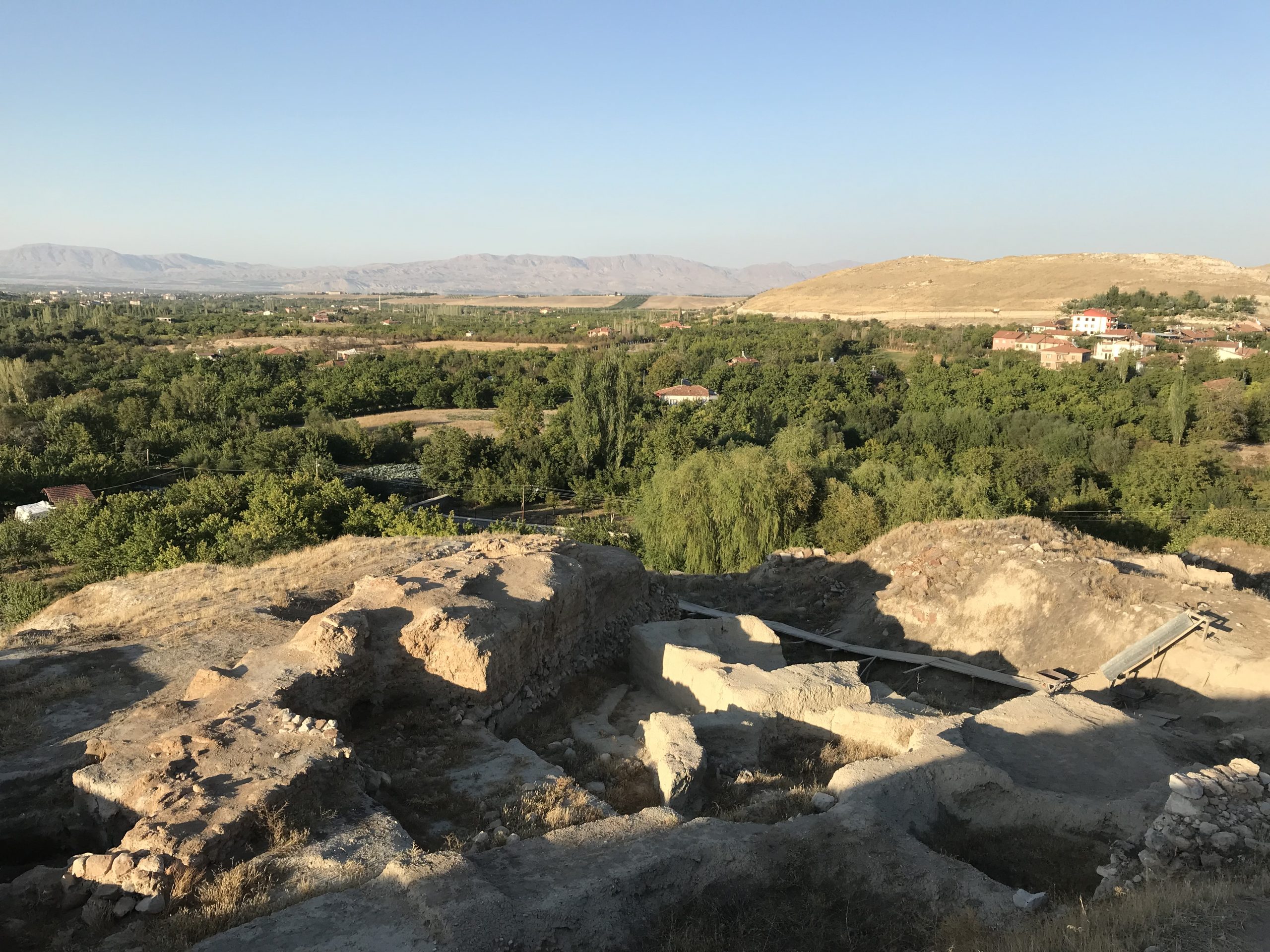
What makes the site so valuable is that it captures this transformation not as a finished result but as a process caught in the act. The layers show a society experimenting with new forms of authority, building and rebuilding, and eventually collapsing, all recorded in the mud brick and the objects sealed within it. Arslantepe is less a monument to power than a record of power being invented.
The stratigraphy of the mound is, in effect, a book of the region’s history written from bottom to top. Reading it correctly is a painstaking business, because a single misjudged layer can throw off the dating of everything above and below. Decades of careful excavation have allowed archaeologists to establish a firm sequence, so that finds from Arslantepe now serve as a reference point for understanding sites across a wide part of the ancient Near East.
The Birthplace of the Palace
The heart of Arslantepe’s fame is a large mud-brick complex built around 3300 BC, which excavators have interpreted as one of the earliest palaces yet discovered. This was not a palace in the later sense of a royal residence full of luxury, but something arguably more significant: a purpose-built center of administration and authority, distinct from ordinary houses, where the affairs of the community were controlled and managed.
The complex included storerooms, courtyards, corridors, and rooms decorated with wall paintings, all laid out on a deliberate plan. Its scale and organization set it apart from anything a family household could produce; this was a building designed by and for an emerging elite, a physical expression of the idea that some people now stood above others and controlled the resources of the whole community.
Crucially, the palace was a place of storage and redistribution. Its rooms held large quantities of goods, and the movement of those goods in and out was carefully controlled and recorded. This is the archaeology of an early economy in which a central authority gathered surplus, perhaps as tribute or taxation, and redistributed it, taking a share and using control over resources as a foundation of its power.

To call this structure a palace is partly a matter of definition, and scholars debate the exact terms. But whatever we name it, its meaning is clear: at Arslantepe, more than five thousand years ago, human beings built one of the first structures whose entire purpose was the exercise of centralized power over other people. In the long story of how societies became states, this mud-brick complex marks a genuine beginning.
It is important to stress how early all this is. The Arslantepe complex belongs to roughly the same broad era as the very first cities and writing systems of southern Mesopotamia, yet it lies far to the north, in a different landscape and cultural world. This shows that the emergence of centralized power was not confined to a single heartland but was happening, in different forms, across a wide region, with Arslantepe representing a distinctive northern path toward complexity.
The Oldest Swords Ever Found
Among the most extraordinary finds at Arslantepe is a group of metal weapons that rank among the oldest true swords ever discovered anywhere in the world. Recovered from the palace complex, this hoard of long metal blades, made of an arsenical copper alloy, dates to around 3300 BC and pushes back the origins of the sword as a weapon far earlier than most people would guess.
Before this discovery, the sword was generally thought to be a considerably later invention, born of the Bronze Age proper. The Arslantepe blades show that already at the very dawn of metal-rich societies, weapons designed specifically for close combat between people, rather than for hunting, were being made. Some of the swords were even decorated with inlaid silver, marking them as objects of prestige as well as instruments of war.
The presence of these weapons in the palace is deeply telling. They were found stored within the administrative complex, which suggests that control of force, of the means of violence, was bound up from the very beginning with the control of goods and administration. The people who ran the storerooms and kept the records also, it seems, controlled the weapons, a chilling early hint of how power and coercion would be intertwined ever after.

There is something sobering in the thought that some of humanity’s earliest swords appear at almost exactly the same moment as its earliest palaces and record-keeping. The tools of administration and the tools of violence emerge together, hand in hand, at Arslantepe. The birth of centralized power and the birth of organized weaponry seem, on this hill, to be two faces of the same profound and troubling transformation.
The metallurgy behind the swords is itself remarkable. Producing long, straight blades of consistent quality required real control over the smelting and casting of copper alloys, a technical achievement that placed metalworkers among the skilled specialists an early elite would want to command. The weapons are thus evidence not only of emerging violence but of emerging craft specialization, another hallmark of a more complex society.
How Power Was Invented
What Arslantepe lets us watch, more clearly than almost any other site, is the invention of social inequality and centralized authority. In the earlier layers of the mound we see a relatively egalitarian farming community, its houses similar in size, its wealth broadly shared. In the later fourth-millennium layers, that world gives way to one dominated by a central complex and an elite who controlled it. Something fundamental had changed.
Archaeologists have long argued about how and why such hierarchies first arose. Was it control of trade, of irrigation, of surplus food, of religion, of force? Arslantepe suggests that at least here the answer lay in administration itself, in the ability of a few people to gather, store, and redistribute the community’s resources, and to keep track of who owed and received what. Control of the economy became control of society.
This early state, if we can call it that, was not a large kingdom but a modest center dominating its immediate region. Yet the principles it embodied, of a central authority standing above ordinary households, extracting surplus, keeping records, and monopolizing certain goods and weapons, are the very principles on which all later states would be built. In miniature, and very early, Arslantepe shows us the machinery of power taking shape.

And then, strikingly, it collapsed. The palace complex was destroyed by fire around 3000 BC, and the sophisticated administrative system it housed vanished. The society that followed was different, simpler in some ways, organized around new elites who buried their dead in rich tombs rather than ruling from a palace. Arslantepe thus records not only the rise of early centralized power but its fragility, its capacity to fail and be replaced.
Comparisons with other early centers help put Arslantepe in perspective. In some regions, monumental temples seem to have anchored the first centralized institutions; in others, it was palaces or the households of chiefs. Arslantepe’s particular contribution is the clarity with which it shows an administrative and economic apparatus, seals, storerooms, redistribution, at the very core of early authority, reminding us that power has always rested partly on the mundane machinery of counting and control.
Seals, Records, and the Roots of Bureaucracy
One of the most important classes of find at Arslantepe is also one of the smallest: thousands of clay sealings. Before writing existed here, people controlled and recorded the movement of goods by pressing carved seals into lumps of clay used to close containers, storeroom doors, and bundles. When a sealed container was opened, the clay sealing was broken and discarded, and at Arslantepe these discarded sealings survived in enormous numbers.
Each seal carried a distinctive design, and different designs seem to have belonged to different officials or functions. By studying which seals appear on which kinds of goods, and in which contexts, archaeologists can reconstruct an entire administrative system, a web of officials, transactions, and controls operating without any written documents at all. It is bureaucracy in its purest, pre-literate form.
This matters enormously for understanding the deep origins of administration. We often assume that record-keeping and bureaucracy required writing, but Arslantepe shows that a complex system for tracking and controlling goods could operate through seals and sealings alone. The impulse to record, to verify, and to control came before the alphabet, before even the earliest scripts, and it is preserved here in humble lumps of fired clay.

The seals themselves are also small works of art, carved with animals, geometric patterns, and scenes that give us a glimpse of the imagery this early society valued. Together with the sealings they closed, they form one of the richest bodies of evidence anywhere for how an early administration actually functioned, day to day, transaction by transaction, at the very moment such systems were being invented.
The sheer quantity of sealings recovered is part of what makes the evidence so powerful. Isolated seals turn up at many sites, but at Arslantepe the excavators found the discarded sealings in their thousands, in the very rooms where goods were stored and controlled. This concentration lets researchers study not just individual objects but the workings of a whole system, tracing patterns across many transactions in a way that single finds never allow.
Painted Walls and a New Kind of Building
The walls of the Arslantepe palace were not left bare. Some of its rooms and corridors were decorated with painted plaster, geometric designs and figural scenes in red, black, and other colors, among the earliest wall paintings of their kind in the region. These decorations transformed the administrative complex from a mere set of storerooms into a designed, impressive space meant to convey status and authority.
The very act of decorating certain rooms tells us something about how this early elite thought about space and power. Painted walls marked out special areas, distinguishing the rooms where authority was exercised or where important people gathered from the plain, functional storerooms around them. Architecture and decoration were being used, perhaps for the first time here, as tools to express and reinforce a social hierarchy.
The architecture itself was innovative. The builders developed new techniques for constructing large, complex structures in mud brick, with substantial walls, planned circulation, and specialized rooms. This was a genuine architecture of administration, purpose-built for a new kind of social organization, and it represents a real leap beyond the domestic building traditions of the earlier village.
Fragments of these paintings, recovered and conserved by excavators, are among the treasures displayed in the nearby museum. They let us see, in actual color, the visual world of one of humanity’s first centralized societies, a world in which even the walls were pressed into the service of expressing who held power and who did not.
A Later Kingdom of Stone Lions
The story of Arslantepe did not end with the collapse of its early palace. The mound continued to be occupied through the Bronze Age, and in the Iron Age, in the early first millennium BC, it rose again as an important center, this time as the capital of a small Neo-Hittite kingdom in the region known as Malatya or Melid. It is from this later period that the site gets its evocative name.
The Neo-Hittite states were successors to the great Hittite Empire, small kingdoms that kept alive elements of Hittite culture, art, and hieroglyphic writing after the empire itself had fallen. At Arslantepe, the rulers of this later city built a monumental gateway guarded by carved stone lions and decorated with relief sculptures showing kings, gods, and scenes of ritual and war, in the distinctive Neo-Hittite style.
These stone lions and reliefs, discovered by early excavators, are the source of the modern name Arslantepe, the lion hill. The sculptures depict the local kings performing religious ceremonies and receiving the favor of the gods, and they carry inscriptions in the hieroglyphic script that the Neo-Hittite kingdoms continued to use. They are among the finest examples of this regional art tradition.

So the mound bridges two great chapters in the story of power. In its deepest important layers it shows us the very birth of centralized authority around 3300 BC; in its later Iron Age levels it shows a fully formed small kingdom, with kings, gods, monumental gates, and royal propaganda in stone. Few sites let you climb, quite literally, from the dawn of the state to the age of kings within a single hill.
The shift from the fourth-millennium palace to the Iron Age kingdom was not a simple continuation but a series of transformations, with the mound rising, falling, and rising again across the intervening centuries. Each rebirth adapted to new circumstances, new peoples, and new sources of power, so that the lion hill preserves not one story of the state but several, layered one atop another like the mud brick itself.
Malatya, the City of the Lion
The Iron Age city on the mound was the center of the kingdom of Melid, one of a patchwork of Neo-Hittite states that flourished across southeastern Anatolia and northern Syria after the collapse of the Bronze Age empires. Positioned on the fertile Malatya plain, near routes that crossed the upper Euphrates, it commanded good farmland and important lines of communication.
Like its neighbors, Melid eventually fell under the shadow of the expanding Assyrian Empire to the southeast. Assyrian records mention campaigns and tribute involving the kingdom, and in time the independent Neo-Hittite state was absorbed into the Assyrian world, as were so many small kingdoms of the region. The carved gate and its lions belong to the proud, independent phase before that absorption.
The modern name of the nearby city, Malatya, descends ultimately from the ancient Melid, a linguistic thread connecting the bustling Turkish city of today with the Iron Age kingdom whose capital stood on the mound. The continuity of the name across nearly three thousand years is a quiet reminder of how deep the roots of settlement run in this fertile corner of Anatolia.

After the Iron Age, the focus of settlement gradually shifted away from the mound toward other centers, and Arslantepe slowly faded from a living city into an archaeological site. But the fertile plain around it was never abandoned, and the ancient name lived on in the region, waiting for excavators to rediscover the extraordinary depth of history hidden in the lion hill.
Decades Beneath the Turkish Sun
Systematic excavation at Arslantepe began in the early twentieth century, when French archaeologists first uncovered the stone lions and reliefs of the Iron Age gate. But the work that revealed the site’s true importance came later, through a long-running Italian archaeological mission that began in the 1960s and has continued for decades, one of the great sustained excavations of the ancient Near East.
It was this patient, meticulous work that uncovered the fourth-millennium palace complex, the hoard of early swords, the wall paintings, and the thousands of clay sealings that together transformed our understanding of how early states arose. Digging a deep, complex mud-brick site like Arslantepe demands extraordinary care, since the mud brick can be hard to distinguish from the soil around it, and every layer must be recorded before it is removed.
The excavators have also invested heavily in conservation and presentation, protecting the fragile mud-brick architecture from the elements and creating an open-air museum that allows visitors to see the ancient structures in place. This combination of world-class research and careful stewardship was central to the site’s recognition as a World Heritage location.

Research continues to this day, with new scientific techniques applied to old questions: analyzing the metal of the swords, the residues in vessels, the diet and origins of the people buried here. Like the best long-term excavations, Arslantepe keeps yielding fresh insight, deepening a story that already reaches back to the very foundations of organized human society.
The long Italian mission has trained generations of specialists and published a stream of detailed studies that have made Arslantepe a touchstone in debates about the origins of complex society. Its approach, combining careful excavation with scientific analysis and a strong commitment to conservation, has become a model for how such a fragile and important site can be studied responsibly over the long term.
Visiting Arslantepe
A visit to Arslantepe today is a quieter, more contemplative experience than a trip to Turkey’s grand classical ruins. There are no towering columns or vast theaters here; the drama is subtler, written in mud-brick walls, ancient corridors, and the deep sense of standing at the beginning of something. Walkways lead visitors through the excavated palace complex, with explanations of what each space once was.
Protective shelters cover the most important mud-brick structures, allowing the fragile ancient architecture to be seen up close without exposing it to the weather. Walking through the remains of the palace, past its storerooms and painted rooms, you are moving through one of the oldest buildings of its kind on earth, a place where centralized power was, in a sense, first given walls.
To fully appreciate the site, most visitors also see the collections in the nearby Malatya museum, where the swords, seals, wall paintings, and Iron Age reliefs are displayed. The objects and the site illuminate each other: the mound shows where these things were found and used, while the museum lets you examine the fine detail of the swords and seals that make Arslantepe so important.
Arslantepe rewards visitors who come with some understanding of what they are seeing. To the casual eye it is a modest archaeological park; to anyone who grasps its significance, it is one of the most profound places in the world, a hill where the great human experiment of centralized society first took a recognizable form. It is a site not for the eye alone but for the imagination and the mind.
Nearby Places to Explore
Arslantepe lies in eastern Anatolia, in a landscape shaped by some of the greatest powers of the ancient Near East and the classical world. If the story of humanity’s first palaces and states has drawn you in, these neighboring sites carry the wider history of Anatolia forward, from the Hittite heartland to the great cities of the west.
- Hattusa — the mountain capital of the Hittite Empire, whose culture the later kingdom at Arslantepe helped to keep alive after the empire fell.
- Pergamon — the towering Hellenistic capital of the west, a striking contrast in style and age to the deep antiquity of the lion hill.
- Ephesus — the celebrated marble metropolis of the Aegean coast, one of the grandest classical cities of Anatolia.
Where a Whole Idea Began
Arslantepe will never draw the crowds that flock to Ephesus or Troy, and it does not try to. Its greatness lies not in spectacle but in significance. On this unassuming mound near Malatya, more than five thousand years ago, human beings assembled the pieces of a new kind of society: a central authority, a monumental building for administration, a system of records, control over goods and weapons, and the stark inequality that came with them. Here, as clearly as anywhere on earth, we can watch the state being born.
That is a heavier and more human story than any tale of marble and columns. The swords stored beside the storerooms, the sealings that tracked the surplus, the painted walls that marked out the seats of power, all of it speaks to the beginning of a way of organizing human life that still shapes our world today, for better and for worse. To stand on the lion hill is to stand at a genuine hinge of history, a place where an idea that would remake humanity first found its walls, its records, and its rulers.
You May Like

Mafra, the Palace a King Built From a Vow


4 thoughts on “Arslantepe: The Anatolian Mound Where the State Was Born”