Few ruins in the world manage to feel this alive. Walk into Ephesus early in the day, before the crowds thicken along the marble, and the city almost hums. Grooves worn into paving stones by ancient cartwheels run beneath your feet, columns catch the morning light, and the great facade of the Library of Celsus rises at the end of a sloping street as if the whole town had been arranged for that one dramatic reveal. This was one of the largest and most sophisticated cities of the Roman east, and even in ruin it carries itself with the confidence of a place that once mattered enormously.
Situated on the Aegean coast of what is now western Turkey, Ephesus was a port, a religious capital, a commercial powerhouse, and at various moments a center of gravity for entire belief systems. Its story stretches back long before Rome, reaches a dazzling peak under imperial rule, and ends not with a dramatic destruction but with a quiet, almost geological betrayal by the very sea that had made it great. To understand Ephesus is to watch a city thrive on a coastline that would eventually abandon it.
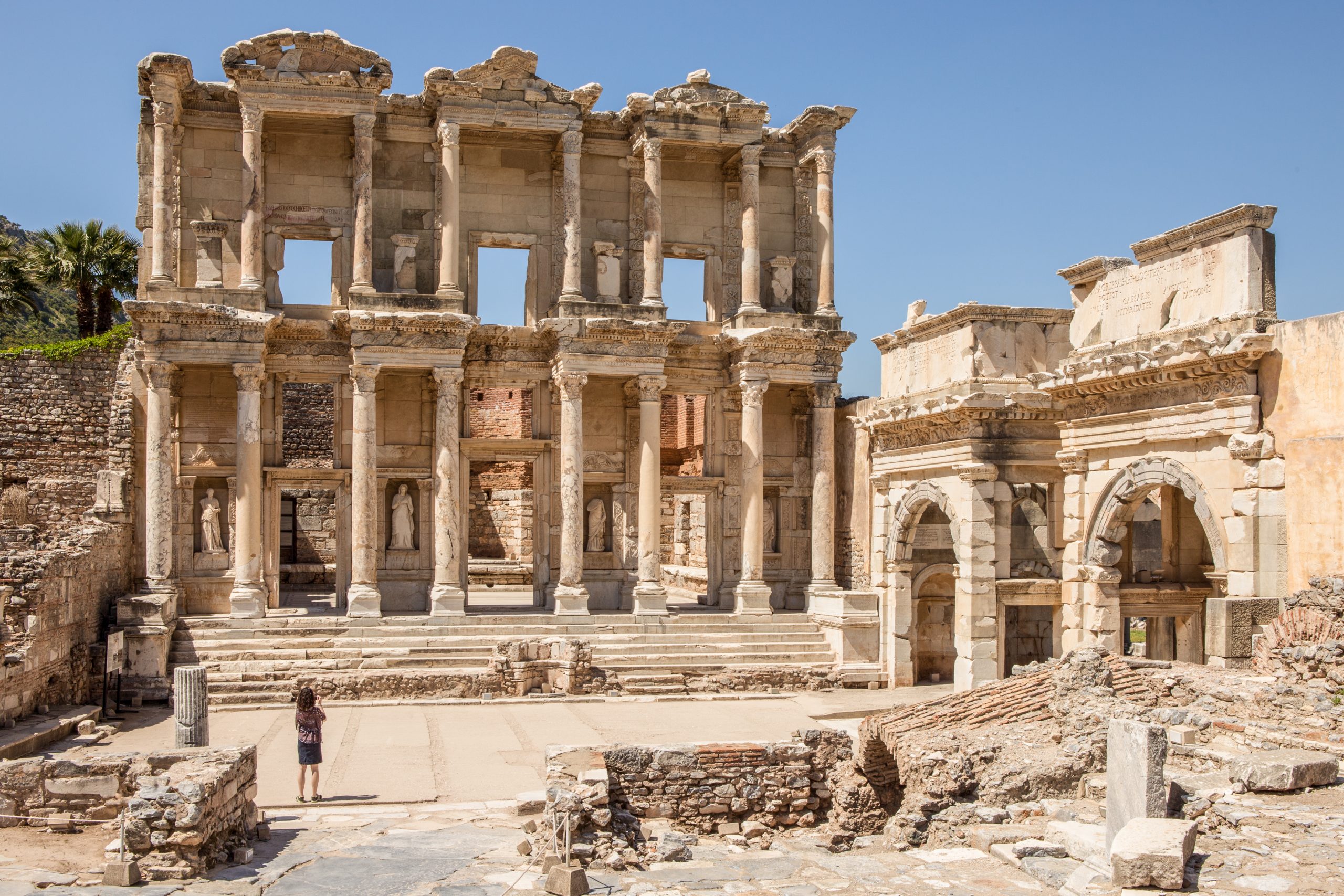
What follows is a walk through that long life, from the sanctuary that first drew pilgrims to the harbor that silted into marsh, taking in the streets, houses, and monuments that make Ephesus one of the most rewarding archaeological sites anywhere in the Mediterranean world.
Contents
- The Harbor City That Watched the Sea Retreat
- A Temple That Made the World Come to Worship
- Marble Streets and the Business of Being Rich
- The Library Everyone Photographs
- Homes of the Wealthy on the Slope
- Where Twenty-Five Thousand People Could Gather
- Faiths in Collision and Conversation
- Water, Waste, and the Machinery of a City
- The Long, Slow Silence
- Walking Ephesus Now
- Nearby Places
- Final Reflections
The Harbor City That Watched the Sea Retreat
Ephesus owed its existence to the sea, and in the end the sea is what doomed it. For most of its history the city sat beside a fine harbor that opened onto the Aegean, giving it direct access to the maritime trade routes that were the lifeblood of the ancient Mediterranean. Ships arrived laden with goods from across the known world, and the wealth they brought paid for the marble avenues and grand public buildings that still astonish visitors today. A city like this could not have existed without deep water at its doorstep.
But the harbor was fed by a river, and rivers carry silt. Over centuries the sediment washed down from the interior, slowly filling the bay and pushing the coastline steadily westward. The people of Ephesus fought this process for as long as they could, dredging the harbor and even relocating parts of the city to stay close to navigable water. It was a losing battle against geology. Every generation of engineers won a temporary reprieve, and every generation of the river quietly undid their work.
Today the ruins sit several kilometers inland, stranded amid fields where ships once docked. The transformation is genuinely disorienting once you understand it, because so much of the city’s grandeur only makes sense in relation to a harbor that no longer exists. The broad ceremonial avenue that once led from the docks into the heart of town now points toward farmland. The sea that built Ephesus withdrew so gradually that no one could name the year the city truly lost it, and yet lose it they did.
This slow strangulation shaped everything about the city’s fate. Ephesus did not fall to a conquering army or vanish beneath a volcano; it was slowly cut off from the water that gave it purpose. In that sense its story is less a tragedy of violence than one of patient environmental change, a reminder that geography writes the longest and most implacable chapters of any city’s history. The people adapted brilliantly for a while, and then the river simply outlasted them.
A Temple That Made the World Come to Worship
Long before the Romans laid their marble streets, Ephesus was famous for one thing above all: a colossal sanctuary dedicated to a great goddess whom the Greeks identified with Artemis. This temple was so vast and so magnificent that ancient writers counted it among the wonders of the world, a building meant to overwhelm anyone who approached it. Pilgrims travelled great distances to worship there, and the offerings they left made the sanctuary and the city around it fabulously wealthy.
The goddess of Ephesus was not quite the Artemis of Greek mythology familiar from elsewhere. Her local form drew on much older Anatolian traditions of a powerful mother deity, and her cult statue, covered with rows of mysterious rounded protrusions whose meaning is still debated, presented her as a figure of overwhelming fertility and power. This blending of Greek and indigenous Anatolian religion is characteristic of the region, where new arrivals repeatedly absorbed and reshaped the beliefs they found already rooted in the land.
The temple was rebuilt more than once across its long history, each version grander than the last, and its destruction and reconstruction became legendary in their own right. One notorious tale holds that the building was deliberately burned by a man seeking eternal fame through the enormity of his crime, an act so infamous that the Ephesians tried to erase his name from memory, only to have it survive anyway. Whatever the truth of such stories, the temple’s repeated resurrection shows how central the goddess was to the city’s identity and prosperity.
Almost nothing of that wonder survives today. Where the mighty temple once stood, a single reconstructed column rises from a marshy field, a lonely marker of vanished magnificence. The contrast between the ancient descriptions and the near-empty site is one of the most poignant things in the whole region. An entire wonder of the world reduced to a solitary pillar and a scatter of stones is a humbling lesson in how completely even the greatest human achievements can be undone by time.
The economic footprint of the sanctuary is easy to underestimate. A pilgrimage center on this scale functioned rather like a modern destination that lives on visitors, generating demand for lodging, food, transport, and above all religious keepsakes that pilgrims could carry home. Craftsmen who produced small images of the goddess, guides who led worshippers through the rituals, and merchants who supplied the crowds all depended on her continuing fame. When later religious change threatened the goddess, it therefore threatened an entire ecosystem of livelihoods, which helps explain why the tensions that arose could turn so bitter and so public.

Marble Streets and the Business of Being Rich
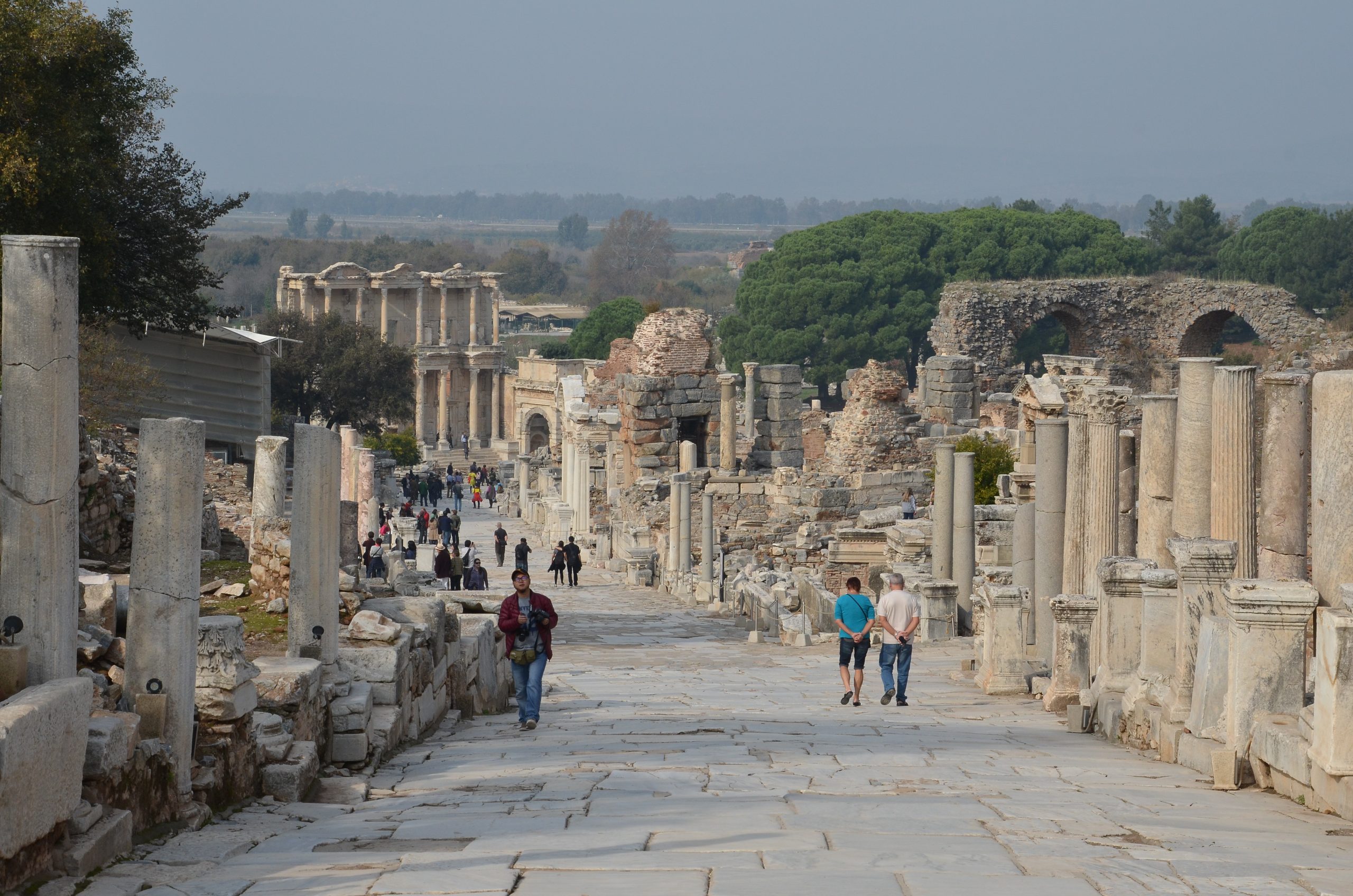
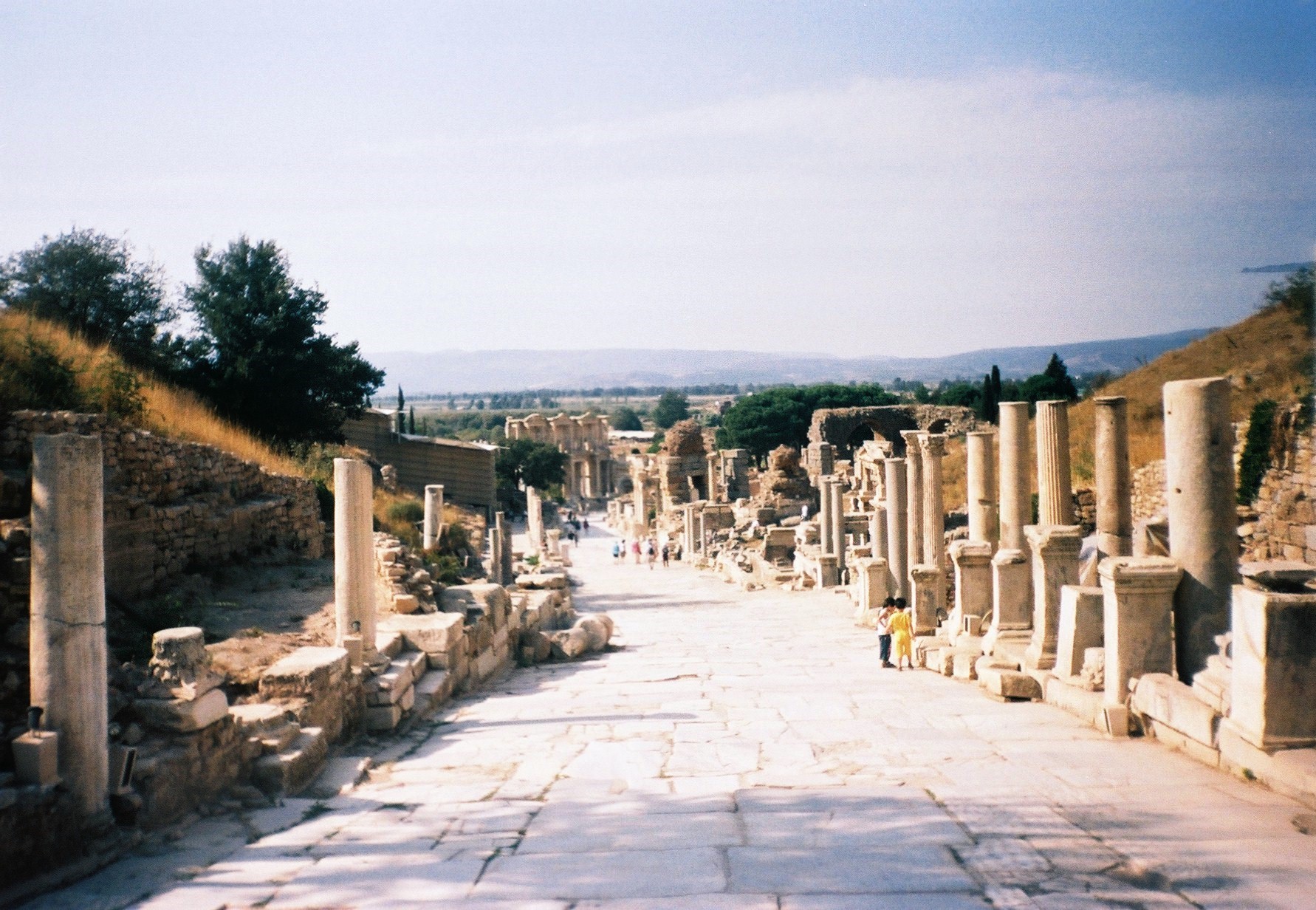
The heart of Roman Ephesus was its network of grand paved streets, and chief among them was the sloping avenue that ran through the center of the city, lined with monuments, fountains, shops, and statues. Walking it today gives an unusually vivid sense of what an ancient urban thoroughfare actually felt like. The paving is worn smooth, the column bases and fragments of statuary still stand along the edges, and you can easily imagine the noise and press of a crowded commercial street at the height of the city’s fortunes.
This was not just decoration. The streets were the arteries of a serious economy. Ephesus grew rich as a hub where goods from the Anatolian interior met goods from across the sea, and the marble avenues were lined with the establishments that made money from all that traffic: shops, workshops, and the offices of merchants. Public fountains provided water, honorific monuments flattered the powerful, and the whole ensemble advertised the wealth and sophistication of a city that clearly thought very well of itself.
Scattered along and beneath these streets are the details that bring the past to life. Latrines with rows of stone seats reveal the plumbing of a great city; inscriptions record the boasts and benefactions of the elite; even a famous carving that some visitors interpret as an ancient advertisement points toward the everyday commerce and appetites of the population. These small human traces are often more affecting than the grand monuments, because they show a living city rather than a museum of official grandeur.
The overall impression is of a place obsessed with display. Wealthy Ephesians competed to fund public buildings and monuments, stamping their names on the city in stone, and the result was an urban landscape of remarkable density and splendor. To stroll these avenues is to move through the physical residue of centuries of that competitive generosity, a city built as much from vanity and civic pride as from practical need. The rich wanted to be remembered, and to a striking degree the marble has obliged them.
The Library Everyone Photographs
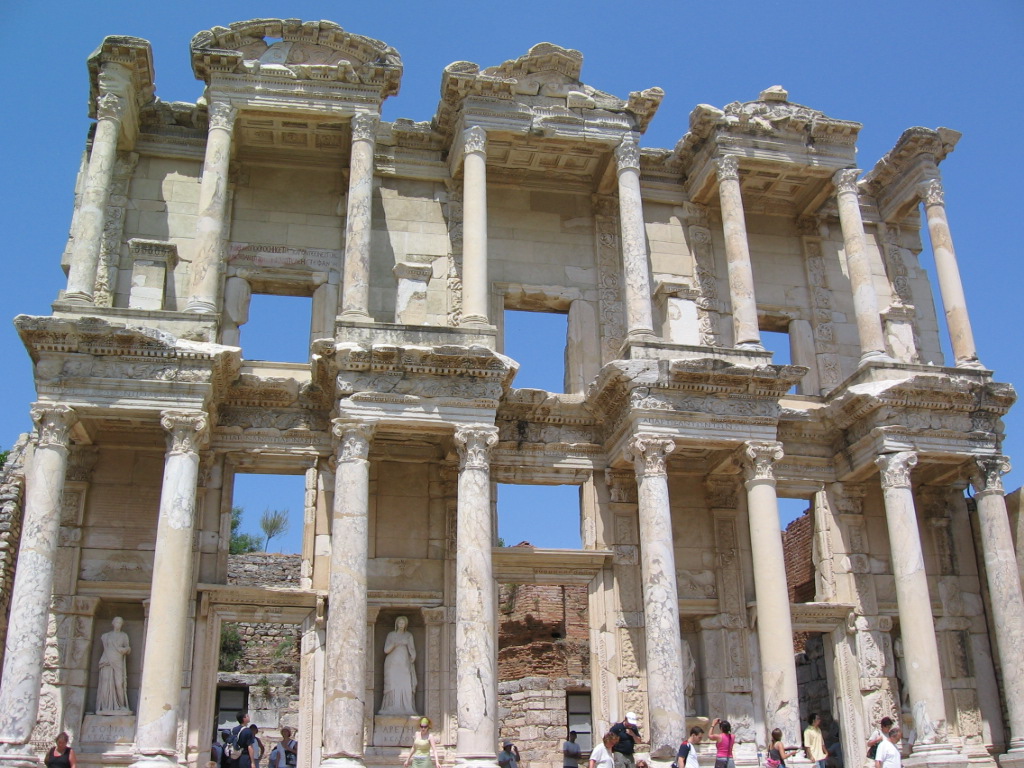
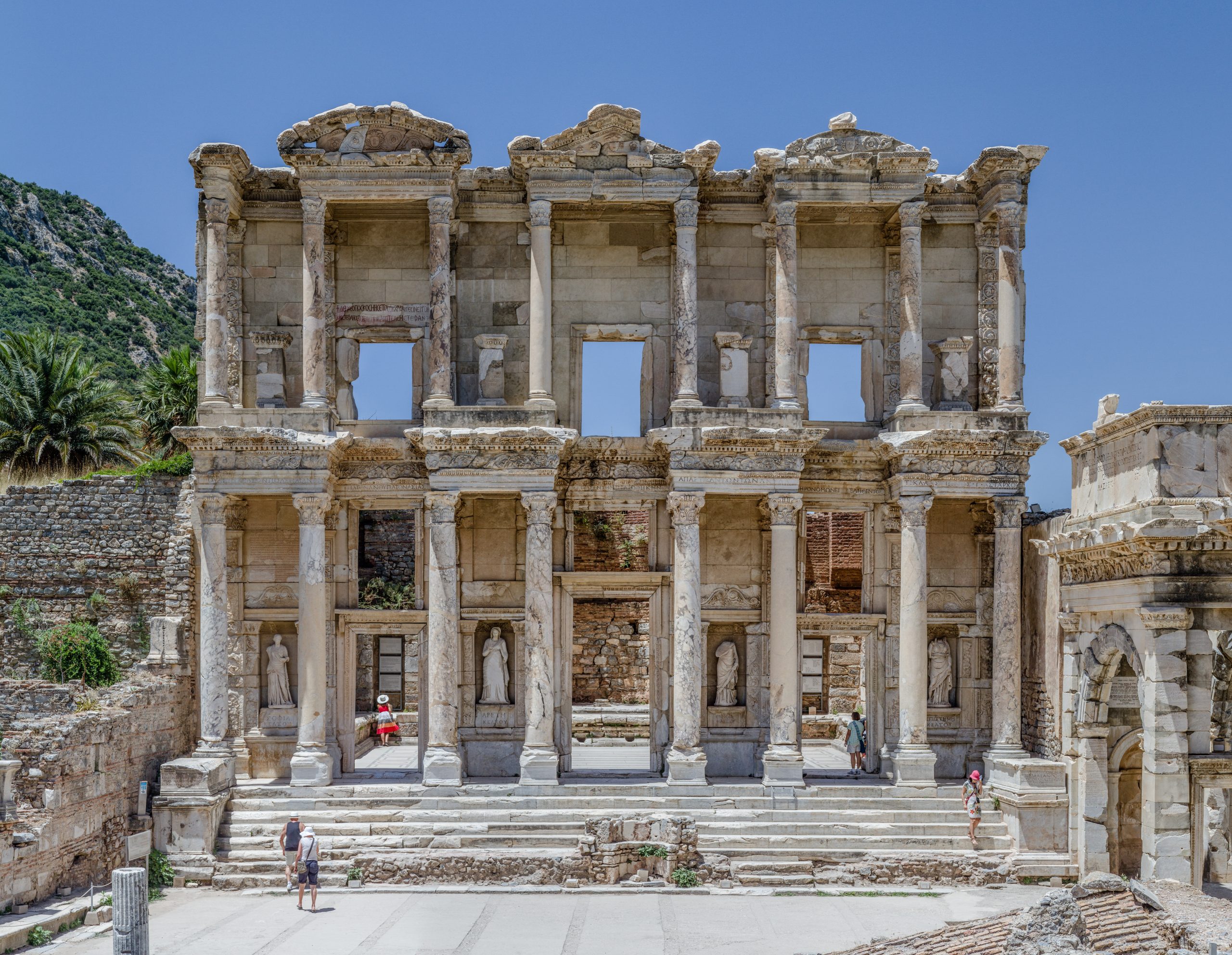
If Ephesus has a single iconic image, it is the facade of the Library of Celsus. Reconstructed from its fallen fragments in the twentieth century, this two-story front of columns, niches, and statuary is one of the most photographed sights in the entire ancient world, and for good reason. Rising at the foot of the main street, it presents a masterclass in the theatrical architecture the Romans loved, all calculated proportions and clever visual tricks designed to make the building look even grander than it is.
The library was built as a monument as much as a repository of knowledge. It honored a distinguished Roman official and served as his tomb, his sarcophagus placed within the structure itself, so that the building fused the functions of memorial, mausoleum, and public institution. In its day it held thousands of scrolls, protected against damp by a clever double-walled construction, and it stood as a proud statement that Ephesus was a city of learning as well as commerce and religion.
The statues set into the facade personify virtues such as wisdom and knowledge, a fitting decorative program for a house of books. The whole design plays subtle games with perspective, the spacing and sizing of its elements arranged to draw and satisfy the eye. Standing before it, you understand why Roman architects were so admired: they were not merely builders but stage designers, shaping stone to produce a calculated emotional effect on anyone who approached.
That the facade survives at all is thanks to painstaking modern reconstruction, which reassembled the collapsed pieces into the towering front visitors see today. It is worth remembering that what you are admiring is a careful restoration rather than an untouched ancient survival, but the fragments are genuine and the result is faithful. Few reconstructions in archaeology have paid off so spectacularly, giving the modern world a direct, breathtaking encounter with the ambition of imperial Ephesus.
It is also worth appreciating the library as a piece of civic theatre in a broader sense. Positioned where a busy street meets an open square, it was designed to be encountered suddenly and from below, so that visitors emerging from the crowded avenue would be confronted with its full height all at once. Ancient architects understood the drama of approach and revelation as well as any modern filmmaker, and the placement of this building shows a city that knew exactly how to stage its own magnificence for maximum effect on the people moving through it.
Homes of the Wealthy on the Slope
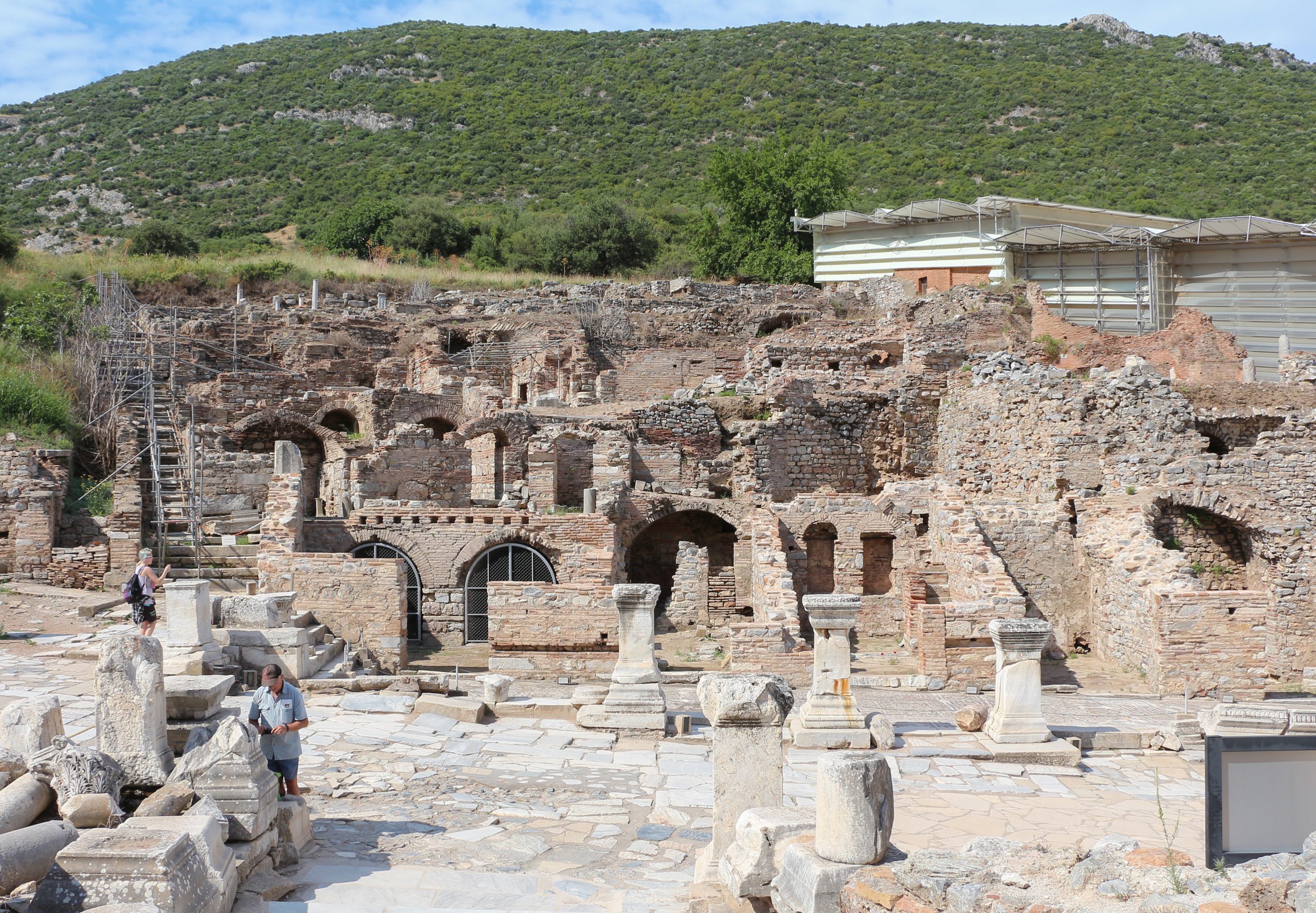
For all its grand public monuments, some of the most revealing discoveries at Ephesus are private. On a hillside overlooking the main street stand the so-called terrace houses, the luxurious residences of the city’s wealthiest inhabitants. Protected today beneath a modern shelter, these homes preserve an extraordinary level of detail, from mosaic floors and painted walls to the layout of rooms arranged around bright interior courtyards. They offer a rare, intimate glimpse into how the elite of a Roman city actually lived.
The decoration is sumptuous. Floors are laid with intricate mosaics, walls are covered with frescoes depicting mythological scenes and elegant patterns, and the arrangement of the rooms speaks of comfort, privacy, and a deep concern for beauty. These were not merely shelters but statements of status, designed to impress guests and to insulate their owners from the noise and dirt of the streets below. Living here meant belonging to a very small and very fortunate slice of the population.
What makes the terrace houses so valuable to historians is their completeness. Because they were buried and preserved together, they capture a whole domestic world rather than isolated fragments, allowing researchers to reconstruct patterns of daily life, decoration, and household organization in remarkable detail. The ongoing conservation work here is painstaking, with specialists reassembling fallen wall paintings piece by piece like enormous, faded jigsaw puzzles.
Wandering the walkways above these houses, you feel the gap between the city’s rich and poor with unusual clarity. The grandeur of the public streets was shared by everyone, but these private luxuries belonged to a privileged few. In their mosaics and frescoes we meet the tastes, aspirations, and self-image of the Ephesian upper class, and the effect is oddly personal, as though we had been let into their homes while they briefly stepped out.
Where Twenty-Five Thousand People Could Gather
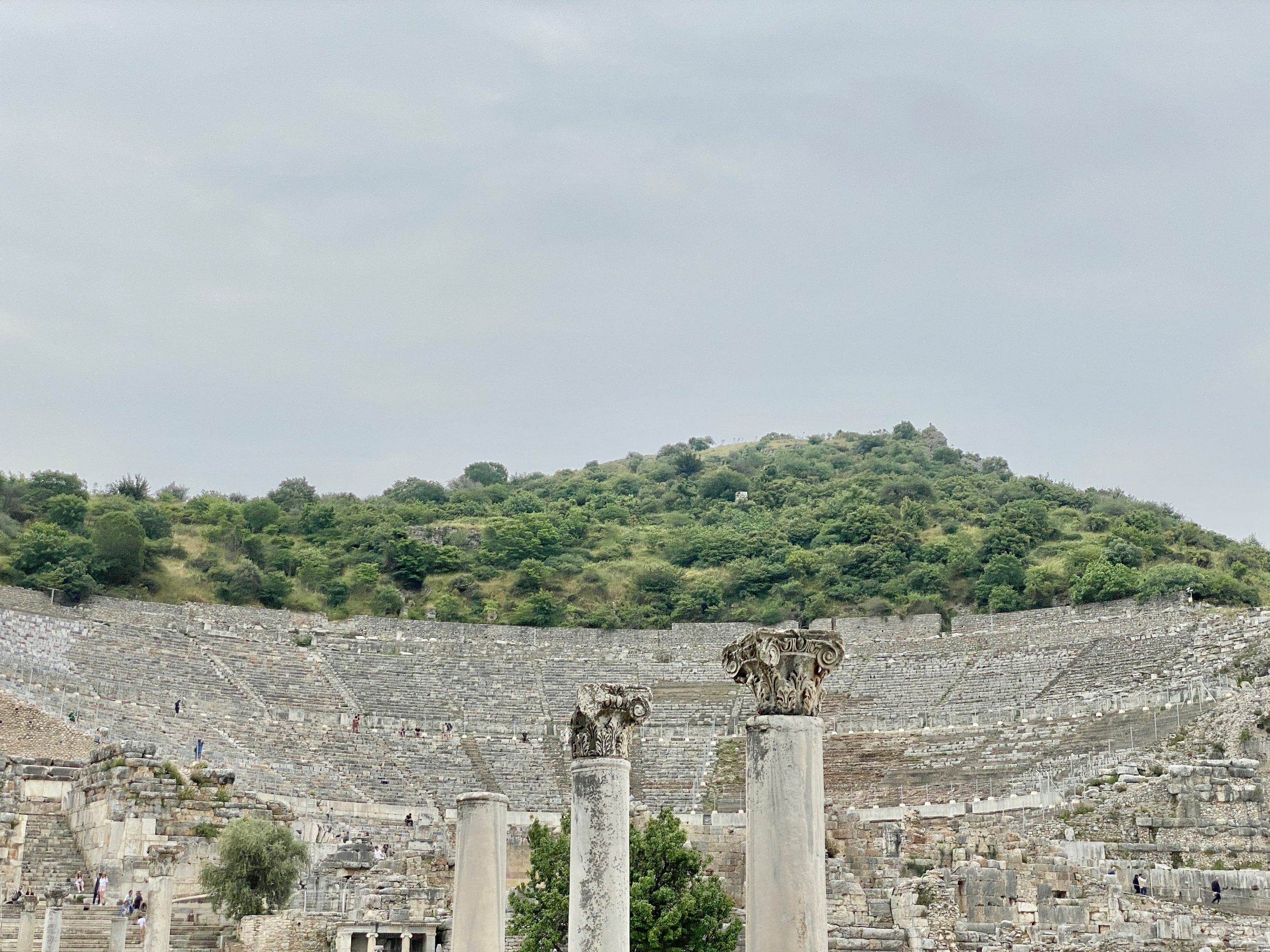
Dominating one end of the city is the great theatre, an enormous semicircle of stone seating cut into the flank of a hill. Capable of holding many thousands of spectators, it was among the largest theatres of the ancient world, and it served as far more than a venue for drama. Here the citizens of Ephesus gathered for civic assemblies, public spectacles, and the great communal events that bound an ancient city together. To sit high in its ranks of seats today is to command a sweeping view over the ruins toward the vanished harbor.
The scale of the theatre is a direct measure of the city’s population and importance. A structure built to seat a crowd this large implies a metropolis of considerable size, one of the great urban centers of its era. Its acoustics, designed so that a speaker’s voice could carry to the highest rows without amplification, reflect a sophisticated understanding of sound that ancient builders had refined over generations. Standing on the stage and speaking, modern visitors are often startled by how far a normal voice travels.
The theatre also carries a particular historical weight because of the dramatic public confrontations tradition places within it. As the city became a center of early Christian activity, its established religious and commercial interests clashed with the new faith, and the theatre is remembered as the setting for a great tumult when a crowd, alarmed at the threat to the cult of the goddess and the trade that depended on her, filled the seats in furious protest. Whether or not the details are exact, they capture a city at a moment of profound tension.
Beyond the drama, the theatre simply worked as the beating civic heart of Ephesus. It was where the community became visible to itself, where thousands of individuals became a single audience, a single assembly, a single crowd. In an age without mass media, a space like this was how a city thought and felt collectively. Its survival gives us not just an impressive ruin but a stage on which we can still imagine the full, roaring life of the ancient population.
Faiths in Collision and Conversation
Ephesus sat at a genuine crossroads of belief, and its religious history is unusually rich. For centuries the city was defined by the cult of its great goddess, whose temple drew worshippers from across the ancient world and whose image adorned the coins and hearts of the population. This deep-rooted devotion was not merely spiritual but economic, since an entire industry of pilgrimage, offerings, and religious souvenirs depended on the goddess’s fame. Faith and commerce were tightly braided together.
Into this world came Christianity, and Ephesus became one of the most important centers of the early church. Tradition connects several major figures of the new faith to the city, and it grew into a hub of Christian teaching and controversy, later hosting significant church gatherings that helped shape doctrine. The transition was not smooth, because the new religion threatened both the prestige of the old goddess and the livelihoods of those who profited from her cult, and the friction between the two left its mark on the city’s memory.
This layering of faiths is part of what makes Ephesus so compelling. Within a single site you can trace the shift from Anatolian mother-goddess worship, through Greek and Roman religion, to the rise of Christianity, each phase leaving physical and legendary traces. The city becomes a kind of stage on which one of the great religious transformations of the ancient world played out, complete with tension, adaptation, and eventual change. Few places let you read that transformation so directly in stone and story.
Even after the old goddess faded, Ephesus retained a powerful sacred aura, drawing Christian pilgrims to sites associated with the new faith. The city’s identity as a holy place simply migrated from one religion to another, its fundamental role as a destination for the devout remaining strangely constant even as the object of devotion changed completely. There is something profound in that continuity: a place can keep its sacred character across centuries even while the beliefs it houses are utterly transformed.

Water, Waste, and the Machinery of a City
Behind the marble splendor of Ephesus lay an unglamorous but essential achievement: the infrastructure that allowed hundreds of thousands of people to live together in relative comfort. The city was supplied with fresh water through a system of aqueducts and pipes that brought it from distant sources, feeding public fountains, baths, and private homes. Managing water at this scale was one of the great triumphs of ancient engineering, and Ephesus did it well enough to sustain a genuinely large population.
The public latrines are among the most visited and most humanizing ruins on the site. Rows of stone seats set over a channel of running water reveal a communal approach to sanitation that strikes modern visitors as both practical and startlingly public. Beneath the seats, water carried away waste; in front of them, another channel provided water for washing. It is a system that speaks of real hygienic sophistication, even as its complete lack of privacy reminds us how different ancient social norms could be from our own.
Bathhouses were central to civic life, functioning as places to clean the body but also to socialize, do business, and simply pass the time. Heated by furnaces that sent warm air beneath the floors and through the walls, the baths represent another impressive feat of engineering, one repeated in cities across the empire. The remains of these complexes at Ephesus, with their pools, changing rooms, and heating systems, show how thoroughly the technology of comfort had been mastered.
All of this machinery is easy to overlook amid the temples and libraries, but it is arguably the truer measure of the city’s greatness. Grand monuments announce ambition; working aqueducts, drains, and baths announce competence. Ephesus was not merely beautiful but functional, a densely populated metropolis kept alive by an invisible network of pipes and channels. The genius of the place lay as much in its plumbing as in its porticoes, and the two together made the good life possible for its citizens.
The Long, Slow Silence
The decline of Ephesus was not a single catastrophe but a gradual unraveling, and its central cause was the relentless silting of the harbor. As the coastline crept away and the port choked with sediment, the city lost the maritime trade that had made it rich. A great commercial center cut off from the sea cannot remain great for long, and Ephesus slowly slid from a metropolis of the first rank to a diminished shadow of its former self, its population shrinking as its economic reason for existing withered away.
Other pressures accelerated the fall. Earthquakes damaged the city repeatedly, and the wider instability of the late ancient world, with its raids, economic disruptions, and shifting powers, took its toll. As the population fell, the great public buildings were no longer maintained, and materials were scavenged from older structures for new and humbler purposes. The city contracted, its inhabitants retreating to smaller, more defensible areas as the sprawling classical metropolis became too large to sustain.
In time the center of settlement shifted away from the ancient site entirely, gravitating toward a nearby hill and the sacred associations that had grown up around it. The old marble city was gradually abandoned, its monuments left to the silt, the scrub, and the slow work of collapse. There was no single dramatic ending, no final battle or eruption, only the accumulating weight of change until the streets fell silent and the fields crept in over the stones.
It is a peculiarly modern kind of death, the story of a city undone by environmental change and economic obsolescence rather than by sword or fire. In an age increasingly aware of how landscapes and climates shape human fortunes, the fate of Ephesus feels newly resonant. The city did everything right by the standards of its time and still could not outrun the river that was quietly burying its harbor. Sometimes the slow forces are the ones that win.
Walking Ephesus Now
Today Ephesus is one of the most visited archaeological sites in the region, and with good reason. The scale and preservation of the ruins, combined with the drama of that reconstructed library facade, make it an unforgettable place to walk. A well-marked route leads visitors down the ancient streets, past the theatre, the fountains, and the monuments, allowing the city to reveal itself gradually in the way its builders intended. It rewards a slow, attentive visit far more than a hurried one.
Ongoing excavation and conservation continue to add to what is on view, from the painstaking work in the terrace houses to the study of the wider urban landscape. The site is a UNESCO World Heritage property, recognized for its outstanding value as a record of ancient urban life across many centuries. Each season of work refines the picture, uncovering new details and preserving fragile remains for the future, so that the Ephesus of today is subtly different from the one visitors saw a generation ago.
For the modern traveler, the great gift of Ephesus is immersion. Because so much survives and because the streets still connect one monument to the next, it is unusually easy to feel yourself inside a living city rather than looking at scattered ruins. Stand in the theatre, walk the marble avenue, gaze up at the library, and the ancient world stops being an abstraction. Few places make the distant past feel this close, or this human.
Nearby Places
The western coast and heartland of Anatolia are studded with sites that reach far deeper into the past than even Ephesus. If the ancient layers of this landscape fascinate you, these settlements trace the story back thousands of years further.
- The Hill Above the Dardanelles Where Legend Turned Out to Have Foundations: The Story of Troy
- Göbekli Tepe: The World’s Oldest Temple and How It Rewrote History
- Çatalhöyük: The 9,000-Year-Old Town With No Streets
Final Reflections
Ephesus is a city of contradictions that somehow add up to a coherent whole. It was worldly and sacred, commercial and spiritual, Greek and Anatolian and Roman all at once. It grew rich from the sea and was ultimately ruined by it. It housed one of the great wonders of the ancient world and now offers a single lonely column in its place. To walk its streets is to feel the full arc of an ancient city’s life, from soaring ambition to quiet abandonment.
Perhaps that is why the site moves people so deeply. In Ephesus you can read, in marble and mosaic, the whole cycle that every great city eventually runs: the rise, the golden age, the slow decline, the silence. And yet the ruins are anything but mournful. Bright with sunlight and worn smooth by two thousand years of footsteps, they feel less like a graveyard than like a city merely resting, its streets waiting for a crowd that will never quite return but never quite feels absent either.
You May Like
Norse Explorers Reached Canada 500 Years Before Columbus


5 thoughts on “Ephesus: A Marble Metropolis the Sea Slowly Abandoned”