Some cities are remembered for their armies, others for their gods. Sardis is remembered for its gold. Long before it became a Roman provincial town or a stop on the early Christian map, it was the shining capital of Lydia, a kingdom in western Anatolia whose wealth became so legendary that its last king’s name still turns up in the English phrase “rich as Croesus.” The gold, it turned out, was real, and so was the city that grew fat on it.
Set at the foot of Mount Tmolus in what is now Manisa Province, Turkey, Sardis sat where the plain of the Hermus River meets the hills. That location gave it farmland, defensible high ground, and a river that carried something more valuable than water. For centuries the place hummed with merchants, moneylenders, temple priests, and kings, and the ruins that survive today still hint at how busy and how confident this city once was.

Walking the site now, you move between eras without much warning. A Roman gymnasium stands beside a synagogue from late antiquity, both of them a short distance from the tumbled columns of a temple begun by Greeks and never quite finished. Sardis was never a single thing. It was a place that kept reinventing itself for well over a thousand years, and the layers are still there for anyone willing to look.
Contents
- Where the Golden River Ran
- A Capital Built on Trade and Tribute
- The King Whose Name Meant Wealth
- The Day Cyrus Came Over the Wall
- Persians, Greeks, and a Burning Grudge
- Under Rome, and the Great Rebuilding
- A Synagogue Unlike Any Other
- Coins That Changed the World
- Digging Up the Lydian Story
- What Still Stands at Sardis
- Nearby Places to Explore
- A City That Refuses to Be Forgotten
Where the Golden River Ran
The secret of Sardis was a stream called the Pactolus, which ran down from the mountains and straight through the edge of the city. Its bed carried electrum, a natural alloy of gold and silver, washed out of the rock upstream. The Lydians learned to collect it, and later to separate the two metals, and that simple technical trick turned a regional town into one of the richest places in the ancient world.
Ancient writers wrapped the story in myth, claiming the river had run with gold ever since King Midas washed his golden touch away in its waters. The truth was more chemical than magical, but the result was the same. A city that controlled a river full of precious metal did not need to conquer neighbors to grow wealthy. The wealth came to it, grain by grain, in the current.
That flow of electrum funded palaces, walls, and temples, and it gave Lydia’s kings the means to hire soldiers, buy alliances, and impress foreign visitors. When Greek traders and travelers came east and saw what Lydian money could do, they carried the reputation home. By the time the classical world had settled its stories, Sardis and staggering wealth had become almost the same idea.

Modern geologists have confirmed the essentials of the tale. The Pactolus really did carry gold, and excavation has uncovered installations near the stream where the Lydians refined it, using heat and clay to strip the silver away and leave nearly pure gold behind. It is one of the earliest known industrial metallurgy operations anywhere, and it sat right in the middle of a living city.
There is something fitting about a civilization whose fortune came from a river rather than a conquest. Lydia did not build its wealth by plundering neighbors so much as by patiently harvesting what the mountains sent downstream, then adding the skill to refine it. That combination of luck and craft gave the kingdom a kind of stability that pure military power rarely brings, and it let Sardis flourish while other capitals rose and fell around it.
The refined gold did not stay in Sardis, of course. It flowed outward as gifts, payments, and coins, financing everything from mercenary armies to the lavish offerings Lydian kings sent to distant Greek shrines. In a sense the whole eastern Mediterranean felt the pull of that small river, as Lydian wealth rippled through the economies and politics of a dozen neighboring peoples.
A Capital Built on Trade and Tribute
Wealth alone does not make a capital. What turned Sardis into the center of a kingdom was its position on the roads. It stood at the western end of what would later become the Persian Royal Road, the great overland route that connected the Aegean coast to the heart of the Near East. Goods, messengers, and armies all passed through, and Sardis taxed and served them all.
The Lydians are often credited with a quieter revolution than conquest. Somewhere in this city, probably in the seventh century BC, someone struck the first true coins, small standardized lumps of electrum stamped with an official mark. Instead of weighing out metal for every transaction, merchants could trade with pieces of guaranteed value. It was a small object with enormous consequences.
With coinage came a marketplace culture that Greek visitors found both dazzling and slightly scandalous. Sardis had shops, retail trade, and a reputation for luxury that moralists back in Athens loved to complain about. The city’s craftsmen worked gold and produced textiles dyed in bright colors, and its markets pulled in goods from across Anatolia and beyond.
The city itself was divided between a lower town on the plain and a fortified citadel high on a spur of the mountain. The citadel gave the kings a stronghold that looked, to contemporaries, almost impossible to storm. Below it spread the houses, workshops, and sanctuaries of a population that lived well off the trade the location guaranteed.

The Greeks who wrote about Lydia could never quite decide whether to admire it or moralize about it. They borrowed its music, its coinage, and its fashions, yet they also treated its softness and luxury as a cautionary tale, a warning of what happened to people who had grown too comfortable. That ambivalence tells us as much about anxious Greek observers as it does about the Lydians themselves, who seem simply to have enjoyed the good things their position brought them.
The King Whose Name Meant Wealth
The most famous of Lydia’s rulers was Croesus, who came to the throne around 560 BC and pushed the kingdom to its greatest extent. He brought the Greek cities of the Anatolian coast under his influence, and rather than treating them as enemies, he cultivated them, sending lavish gifts to Greek sanctuaries and earning a reputation for generosity that traveled far beyond his borders.
Croesus is the man behind the temple of Artemis and behind much of the monumental building that later visitors admired. He also plays a starring role in one of the most quoted stories in ancient history. According to Herodotus, the Athenian sage Solon visited Sardis, and Croesus, showing off his treasures, asked who the happiest man in the world was. Solon refused to name the king, warning that no life should be called happy until it had ended well.
The king did not take the lesson to heart at the time, but events would soon force it on him. His wealth had made him confident, perhaps overconfident, and he began to look east toward the rising power of Persia. An oracle, famously ambiguous, told him that if he attacked he would destroy a great empire. He did not stop to ask which empire the god had in mind.
That miscalculation would end the independence of Lydia and become, for later Greek writers, a kind of parable about pride and the limits of good fortune. Croesus had turned his city into a byword for riches. He was about to turn it into a byword for the way great wealth can blind a ruler to danger.

Herodotus, our main source for all of this, was writing generations later, and he shaped Croesus into a character in a larger drama about the dangers of pride. How much of the Solon story is history and how much is moral fable is impossible to say. What is certain is that the real Croesus was a shrewd and ambitious king whose reign marked both the height of Lydian power and the moment when its luck ran out.
The Day Cyrus Came Over the Wall
When Croesus marched against Cyrus the Great of Persia, the campaign went badly. After an inconclusive battle, Croesus withdrew to Sardis for the winter, expecting the fighting to pause as ancient campaigns usually did. Cyrus refused to play by that schedule. He pursued the Lydian king and laid siege to the capital while Croesus still thought himself safe behind his walls.
The citadel of Sardis was reckoned unassailable, and for two weeks the siege stalled. Then, as the story goes, a Persian soldier watched a Lydian defender climb down a steep, unguarded section of the cliff to retrieve a fallen helmet. If one man could climb down, others could climb up. The Persians scaled the rock at that neglected spot, and the fortress that no one could take fell from the side no one had thought to defend.
With the citadel taken, the city was lost. Croesus was captured, and the fabulously rich kingdom of Lydia became a Persian province almost overnight, around 546 BC. Later legend gave the fallen king a dramatic near-execution on a pyre and a last-minute rescue, but the political reality was simpler and starker. The age of independent Lydia was over.
The fall of Sardis rippled outward. With Lydia gone, the Greek cities of the coast that had answered to Croesus now answered to Persia, setting up tensions that would eventually explode into the long wars between Greeks and Persians. A single climb up an unguarded cliff had helped redraw the map of the ancient world.
The image of the unguarded cliff has become one of the classic lessons of military history, repeated in countless later sieges: the strongest wall is only as good as its weakest, least-watched point. Whether the tale is literally true or a memorable way of explaining a real breach, it captured something that later commanders would learn again and again, often at terrible cost.
Persians, Greeks, and a Burning Grudge
Under Persian rule Sardis became the seat of a satrap, the western capital of the empire in Anatolia and the terminus of the Royal Road that ran all the way to Susa. The city kept its wealth and its importance; it simply answered to a new master. Persian governors lived on the citadel, and the road that started at Sardis carried royal couriers who, an admiring Herodotus wrote, let neither snow nor rain nor darkness stop their appointed run.
That relative calm shattered early in the fifth century BC. When the Greek cities of Ionia rose in revolt against Persia, they marched inland and attacked Sardis, and in the fighting the lower town went up in flames. The temple of the local goddess burned with it, an act that Persians remembered bitterly and used to justify their later invasions of the Greek mainland.
The burning of Sardis became one of those events that neither side could forget. For the Greeks it was a bold strike at the heart of Persian Anatolia; for the Persians it was an insult that demanded revenge. The road between Sardis and the Aegean, once a route for trade, had become a route for armies marching in both directions.

Sardis remained a Persian stronghold for another century and a half, until Alexander the Great swept through Anatolia in 334 BC. The city surrendered to him without a fight, and with that it passed into the Greek-speaking world of Alexander’s successors. Its Lydian identity was fading now, but its strategic value never did.
The Royal Road that began at Sardis deserves a moment of its own. Stretching roughly two and a half thousand kilometers to Susa, with way stations and fresh horses spaced along it, it let the Persian king’s messengers cross an empire in a matter of days rather than months. Sardis was its western anchor, the point where the Persian world reached out to touch the Greek one, and that role kept the city at the center of events long after its own kings were gone.
Under Rome, and the Great Rebuilding
After Alexander, Sardis passed through the hands of his successors and then, in the second century BC, into the Roman orbit. Roman Sardis was a prosperous provincial city, no longer the capital of anything grand but comfortable, well connected, and generously endowed with the public buildings that Roman civic life demanded.
Disaster struck in AD 17, when a massive earthquake devastated much of western Anatolia and left Sardis in ruins. The emperor Tiberius responded with a large grant of money and relief from taxes, and the city rebuilt itself on a Roman plan. Much of what a visitor sees today, including the great bath-gymnasium complex, dates from this era of imperial reconstruction rather than from the age of Croesus.
The rebuilt city was a showcase of Roman urban comfort. There were baths, a gymnasium where young men trained and studied, colonnaded avenues, and shops lining the main streets. Marble was quarried, columns were raised, and inscriptions recorded the gifts of wealthy citizens who wanted their generosity remembered. Sardis in the Roman peace was a good place to live.

Christianity took root here too. Sardis appears in the Book of Revelation as one of the seven churches of Asia, addressed with a warning to wake up and strengthen what remained. The city that had once symbolized worldly wealth now found itself on the map of a very different kind of movement, and it kept its importance well into the Byzantine centuries.
Earthquakes would remain a recurring theme in the city’s long life. Western Anatolia sits on a restless stretch of the earth’s crust, and Sardis was shaken, damaged, and rebuilt more than once across the centuries. Each recovery reshaped the town a little, burying older streets and raising new ones, which is one reason the archaeology here is so layered and so rewarding to excavate.
A Synagogue Unlike Any Other
One of the most surprising discoveries at Sardis is a synagogue, and not a modest one. Built into a wing of the great bath-gymnasium complex, it is among the largest ancient synagogues ever found, a long hall lined with marble and paved with mosaics that could hold a substantial congregation. Its scale tells us something important about the Jewish community that lived here in late antiquity.
That community was not tucked away on the margins of the city. The synagogue occupied prime civic real estate, right in the heart of the public quarter, sharing a wall with the gymnasium where the wider population exercised and gathered. Inscriptions found inside name donors who were also citizens and officials, people fully woven into the life of the Roman city around them.
The building went through several phases before reaching its final grand form in the late Roman period, and it stayed in use for centuries. Its mosaics and marble revetments, many of them recovered and restored by excavators, give a vivid picture of a confident, prosperous community that saw no contradiction between its faith and its place in a cosmopolitan town.

For historians of ancient Judaism the Sardis synagogue is a treasure, because it complicates the old assumption that Jewish communities in the Roman world lived quietly apart. Here, instead, was a congregation that had built one of the grandest houses of worship in the city, in full public view, and kept it running through good times and bad. Few single buildings have done more to reshape our sense of how these communities actually lived.
The presence of such a prominent Jewish community also reminds us how diverse a Roman city could be. Alongside the synagogue stood temples, and later churches, and the ordinary shops of merchants who might have belonged to any of these communities. Sardis in late antiquity was a place where different faiths and traditions lived side by side within the same walls, sharing streets, baths, and a marketplace, in a coexistence that the modern imagination too often assumes was impossible.
Coins That Changed the World
It is worth pausing on the single Lydian invention that changed the world more than any temple or fortress. Before coinage, large transactions meant weighing lumps of precious metal and trusting their purity, a slow and easily cheated process. The first Lydian coins solved both problems at once by stamping a fixed mark of authority onto standardized pieces of electrum.
Croesus is credited with taking the idea a decisive step further. Because natural electrum varied in its gold content, its value was hard to pin down. His mints began issuing separate coins of pure gold and pure silver, with reliable weights, so that a piece was worth exactly what it claimed. This bimetallic system made Lydian money trustworthy across borders and helped it spread.
From Sardis the idea traveled fast. Greek cities adopted coinage within a couple of generations, and from there it spread across the Mediterranean and eventually the world. Nearly every coin and banknote in every pocket today descends, in a sense, from those first stamped lumps of river gold minted beside the Pactolus.
It is a strange kind of immortality. Lydia’s kings are half-legend now, its language long dead, its temples fallen. Yet the everyday act of paying for something with standardized money, an act so ordinary we never think about it, began here, in a city that grew rich enough to imagine that value itself could be guaranteed with a stamp.
Economists still debate exactly why coinage caught on so quickly, but its advantages are easy to feel. A coin you can trust removes friction from every exchange; it lets strangers trade without weighing, testing, or haggling over purity. In a trading city like Sardis, sitting astride the roads between the Aegean and the interior, that convenience must have been worth a fortune in itself.
Digging Up the Lydian Story
Serious excavation at Sardis began in the early twentieth century, when an American expedition first cleared parts of the temple of Artemis and probed the Lydian levels beneath. Work stopped during the upheavals of the First World War and the years that followed, and much of what had been uncovered slipped back under earth and neglect.
A new and far larger campaign began in the late 1950s and has continued, season after season, ever since. It is one of the longest-running archaeological projects in Turkey, and it has transformed a scatter of ruins into one of the best-understood ancient cities in Anatolia. Excavators have traced the gold refineries by the Pactolus, reconstructed sections of the gymnasium, and painstakingly restored the synagogue’s marble and mosaics.
Digging at Sardis is complicated by exactly the thing that makes it fascinating: its depth in time. Lydian, Persian, Greek, Roman, and Byzantine layers sit stacked on top of one another, and reaching the earliest levels means carefully recording and removing everything above. Every trench is a slice through a thousand years, and reading it correctly takes patience and skill.

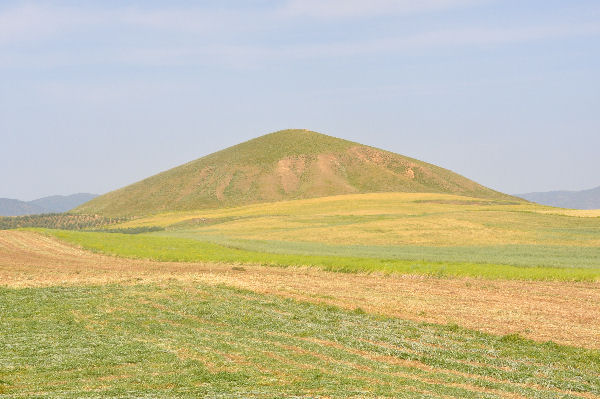
Nearby, the archaeologists also work at Bin Tepe, the royal cemetery on the plain across the river. Its enormous burial mounds, including one traditionally identified as the tomb of a Lydian king, dot the landscape like man-made hills. Together the city and its cemetery let researchers study not just how Sardis lived but how its rulers chose to be remembered.
The finds from these long seasons of work now fill museum cases and study collections, from delicate gold jewelry to humble cooking pots, from inscribed marble to fragments of painted wall. Taken together they let researchers reconstruct not only the grand narrative of kings and conquests but the quieter texture of daily life: what people ate, how they worshipped, what they bought and sold, and how they buried their dead.
What Still Stands at Sardis
A visitor to Sardis today arrives at a site split into two main areas, a short distance apart. The first centers on the temple of Artemis, where a cluster of towering columns still stands in a quiet valley beneath the acropolis, some of them among the tallest surviving from any ancient temple in Anatolia. The temple was never finished, and that unfinished quality gives it a strange, suspended beauty.
The second area sits beside the modern road and holds the Roman city: the reconstructed facade of the bath-gymnasium, its marble court re-erected to something like its original height, and beside it the long hall of the synagogue with its restored mosaics. Walking from one to the other, past the line of ancient shops, gives a real sense of the everyday texture of a Roman provincial town.
Above it all rises the acropolis, the once-impregnable citadel whose crumbling cliffs still guard the approach. Little of the fortress survives, worn away by earthquakes and erosion, but the climb rewards visitors with a wide view over the Hermus plain and the mounds of Bin Tepe on the horizon. From up here it is easy to see why kings chose this spot.
Sardis is not as crowded as Ephesus or as instantly famous as Troy, and that is part of its appeal. It rewards the traveler who already knows a little of its story, who can stand among the columns and picture the electrum flowing in the Pactolus, the first coins leaving the mint, and a Persian soldier watching a helmet fall. The gold is gone, but the city that gold built still stands, half-explained and still giving up its secrets.
For the traveler willing to make the detour inland from the coast, Sardis offers something the busier sites cannot: space, quiet, and the feeling of discovery. You can often have the temple valley almost to yourself, wandering among fallen column drums and lizard-warmed stones, and the history feels closer for the silence. It is a place to linger rather than to tick off a list.
Nearby Places to Explore
Sardis sits in the rich archaeological landscape of western and central Anatolia, within reach of some of the most remarkable ancient cities in Turkey. If the story of Lydia’s golden capital has caught your interest, these nearby sites carry the tale of the region forward in different directions, from Greek coastal metropolises to the highland heart of an older empire.
- Ephesus — the great marble metropolis on the Aegean coast, whose harbor and temples drew traders and pilgrims for a thousand years.
- Pergamon — the vertical city of kings whose library and terraced acropolis made it one of the cultural capitals of the Hellenistic world.
- Hattusa — the highland capital of the Hittites, a forgotten superpower whose stone gates and archives predate Lydia by centuries.
A City That Refuses to Be Forgotten
Sardis has been many cities in one place: a Lydian capital drunk on river gold, a Persian provincial seat, a Greek and then Roman town rebuilt after earthquakes, and a Christian and Jewish community whose grand synagogue still astonishes visitors. Each of those cities left something behind, and the site today is really a conversation among all of them, carried on in stone.
What lingers most, though, is the gold. It made Croesus a legend, gave the world its first true coins, and drew the attention of an empire that would eventually swallow the kingdom whole. The Pactolus runs clear now, its treasure long since panned away, but the idea it funded, that value can be measured, stamped, and trusted, is still with us every time money changes hands. For a city that fell so completely, Sardis has proven remarkably hard to forget.
You May Like
Mafra, the Palace a King Built From a Vow