Out on the dry central plateau of Anatolia, where the Sakarya River winds through low hills and wheat fields, a great flat-topped mound rises above the plain like an artificial hill. It is the burial place of a king, and around it lies the ruined capital of a kingdom that most people know only through two half-legendary stories: the tale of a king whose touch turned everything to gold, and the tale of a knot no one could untie. The place is Gordion, and the kingdom was Phrygia.
For a few centuries early in the first millennium BC, Phrygia was one of the major powers of Anatolia, and Gordion was its heart. Kings ruled here from a fortified citadel, buried their dead beneath enormous mounds, and left behind an archaeology so well preserved that excavators have recovered everything from monumental gates to the remains of a royal funeral feast. Behind the myths lies a real and remarkable Iron Age civilization.
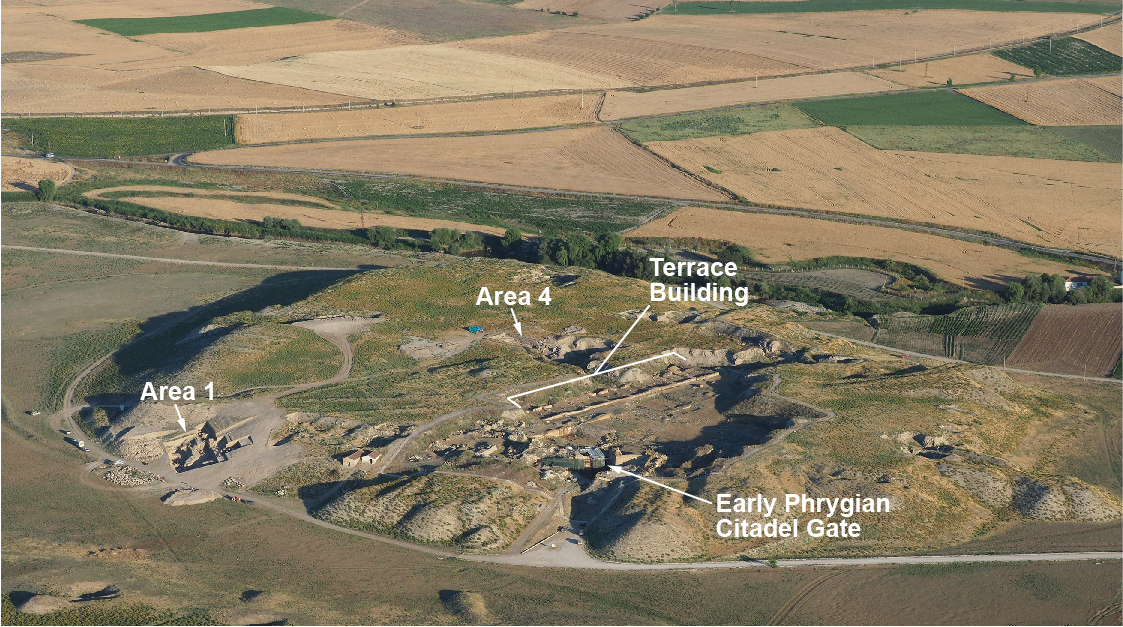
Gordion sits in what is now Ankara Province in central Turkey, and in 2023 it was added to the list of World Heritage sites, a recognition of just how important and well-studied it has become. A visitor today can climb into the heart of the largest burial mound, walk the excavated citadel, and see in a small museum the objects that turn the legends of Midas into something you can almost touch.
Contents
- The Capital of Phrygia
- The Knot That Alexander Cut
- A King Called Midas
- Inside the Great Mound
- The Oldest Standing Wooden Building
- Gates, Walls, and a Terrace of Kilns
- A Feast Preserved for Three Millennia
- From Phrygians to Persians and Beyond
- A Century of Digging on the Sakarya
- The Site and Its Museum Today
- Nearby Places to Explore
- The Kingdom Beneath the Mounds
The Capital of Phrygia
The Phrygians are thought to have arrived in Anatolia from the Balkans in the centuries after the collapse of the Bronze Age, moving into the vacuum left by the fall of the Hittite Empire. By the early first millennium BC they had established a powerful kingdom across the central plateau, with Gordion as its capital, controlling important routes across Anatolia and building a distinctive culture of their own.
Gordion’s position was carefully chosen. It stood beside the Sakarya River, on a natural mound that could be fortified, at a point where routes across the plateau converged. That gave it both defensibility and control over movement and trade, the classic ingredients of a capital. Around the fortified citadel spread a lower town and, on the plains beyond, the great cemetery of royal burial mounds.
At its height the Phrygian kingdom was wealthy and sophisticated. Its craftsmen worked bronze and wood with great skill, its builders raised monumental gates and walls, and its rulers had the resources to organize enormous burial mounds for their dead. Phrygian culture developed its own alphabet, its own religious traditions centered on a great mother goddess, and an artistic style that blended local and imported elements.
The kingdom’s prosperity did not last forever. In the seventh century BC it suffered a devastating blow when nomadic raiders, remembered by later writers as the Cimmerians, swept in from the steppe and overran much of Phrygia. Gordion itself was attacked and damaged, and although the city recovered and continued, the independent Phrygian kingdom never regained its former power. But its capital lived on for centuries under a series of new masters.
The Phrygian language, written in an alphabet related to the Greek one, survives in inscriptions found at Gordion and other sites, though much about it remains imperfectly understood. These texts, carved on stone and scratched on pottery, are among the earliest alphabetic writing in Anatolia, and they hint at a literate court culture that used writing for dedications, ownership marks, and perhaps records now lost to us.
The Knot That Alexander Cut
The most famous story attached to Gordion has nothing to do with the Phrygians directly and everything to do with the man who conquered them centuries later. According to legend, an ancient oracle had declared that whoever could untie a fiendishly complicated knot binding an old wagon in the city would become ruler of all Asia. The knot, made of tough cornel bark with no visible ends, had defeated everyone who tried.
When Alexander the Great passed through Gordion in 333 BC on his campaign against the Persian Empire, he was shown the famous knot and its prophecy. The stories of what happened next differ. In the most memorable version, Alexander, unable or unwilling to pick the knot apart by hand, simply drew his sword and sliced through it, declaring the oracle fulfilled by the stroke of a blade.
Whether he cut it or, as another account suggests, cleverly pulled out the pin that held the yoke to free the ends, the result was the same in the legend: Alexander went on to conquer the Persian Empire and much of the known world, fulfilling the prophecy. The phrase ‘cutting the Gordian knot’ has meant solving an intractable problem by bold, direct action ever since.

The story is almost certainly more legend than history, shaped by later writers eager to add omens to Alexander’s rise. But it fixed the name of Gordion in the Western imagination forever, and it is a reminder that this quiet Anatolian mound was once a place important enough that a conqueror felt he had to make his mark there. Behind the memorable phrase lies a real city that Alexander really did pass through.
It is worth remembering that the wagon and its knot were tied, in legend, to the very founding of the Phrygian royal line. The story went that an oracle had promised the kingship to the first man to arrive in a wagon, and a farmer named Gordias, father of Midas, duly rolled into the city to claim a crown. The knotted wagon was then dedicated in the citadel, linking the founding legend of the dynasty to the prophecy Alexander would later fulfill.
A King Called Midas
The other great legend of Gordion is the story of King Midas, whose name has become a byword for greed and its dangers. In the myth, Midas was granted a wish and asked that everything he touched turn to gold, only to find that his food, his drink, and even his beloved daughter hardened into lifeless metal at his touch. He begged to have the gift removed, and washed it away, so the story goes, in a nearby river.
Another tale gave Midas the ears of a donkey, a punishment for judging a musical contest wrongly, a secret his barber could not keep and whispered into a hole in the ground, from which whispering reeds later betrayed it. These stories made Midas a figure of folly, a king undone first by greed and then by vanity, and they have been retold for well over two thousand years.
Behind the myth stands a real historical king. Phrygian and Assyrian records mention a powerful ruler named Midas who reigned in the late eighth century BC, a king wealthy and important enough to appear in the correspondence of the Assyrian empire and to send lavish gifts to Greek sanctuaries. This historical Midas ruled a genuinely rich kingdom, and it is easy to see how his wealth could have grown, in memory, into a man with a golden touch.

The overlap between legend and history is exactly what makes Gordion so fascinating. Here is a place where a fairy-tale king turns out to have been real, where the archaeology can be set beside the myth. And in the great mound that rises over the plain, excavators found a royal tomb so rich and so well preserved that it seemed, for a long time, to be the very grave of Midas himself.
The historical Midas seems to have been an active player on the international stage of his day. Assyrian sources record dealings with a western king whose name matches his, and Greek tradition remembered him as the first foreign king to send offerings to the sanctuary at Delphi. Far from a mere figure of fable, he emerges as a real monarch who negotiated with the greatest empire of the age and cultivated ties with the Greek world.
Inside the Great Mound
The largest of Gordion’s burial mounds, known to archaeologists as the Great Tumulus, is an enormous artificial hill, tens of meters high and hundreds across, raised over the tomb of a Phrygian king. For centuries it was simply a landmark on the plain, its interior a mystery. In the 1950s excavators tunneled into it and made one of the great discoveries of Anatolian archaeology.
Deep inside the mound they found an intact wooden burial chamber, sealed and undisturbed by robbers, containing the body of an elderly man laid out on a wooden bier surrounded by an astonishing array of grave goods. Here were bronze cauldrons and bowls, elaborately carved wooden furniture, and the remains of the funeral feast held in his honor, all preserved by the dry, sealed conditions inside the mound.
The identity of the man remains debated. Early on the tomb was hailed as the grave of Midas, and it is still popularly known as the Midas Mound. More careful dating has suggested that the burial may actually be that of Midas’s father or another royal predecessor, placing it slightly earlier than the famous king. Whoever he was, he was buried with a splendor that confirms the wealth of the Phrygian royal house.

The tomb is remarkable not just for its riches but for its preservation. Organic materials that almost never survive from antiquity, above all wood, were found here in extraordinary condition, giving archaeologists a window into Phrygian craftsmanship and daily life that few other sites can match. The Great Tumulus turned Gordion from a name in legend into one of the richest sources we have for understanding an early Anatolian kingdom.
Around the Great Tumulus stand dozens of smaller burial mounds, forming one of the most extensive tumulus cemeteries in Anatolia. Excavation of many of these has revealed burials of lesser royalty and nobility spanning centuries, each mound a time capsule of the period in which it was raised. Together they turn the plain around Gordion into a vast open-air record of Phrygian and later funerary customs.
The Oldest Standing Wooden Building
The wooden burial chamber inside the Great Tumulus holds a special distinction: it is often described as the oldest standing wooden structure in the world. Built of squared timbers, juniper, pine, and cedar, fitted together into a sturdy room and then buried beneath the vast mound, it has survived largely intact for nearly three thousand years, protected from decay by the sealed environment around it.
That such a fragile material as wood could last so long is almost miraculous. The chamber was constructed like a log building, its walls and roof of heavy beams, and after the king was laid inside it was packed around with rubble and covered by the enormous mound. Cut off from air, water, and light, the timber neither rotted nor burned, and it waited through the rise and fall of empires until modern excavators reached it.
Studying the wood has given scientists an unexpected bonus. By counting and matching the tree rings in the ancient timbers, researchers have been able to build precise chronologies that help date not only Gordion itself but other archaeological sites across the region. The king’s tomb, in other words, has become a kind of natural calendar, its beams recording the years of growth in trees felled to build a Phrygian grave.

For visitors, the experience of entering the mound is unforgettable. A modern tunnel leads through the heart of the great hill to the ancient chamber, where the massive timbers of the tomb still stand as they were assembled by Phrygian carpenters. Standing inside, surrounded by wood cut when the kingdom was at its height, you are as close to the world of Midas as archaeology can bring you.
Gates, Walls, and a Terrace of Kilns
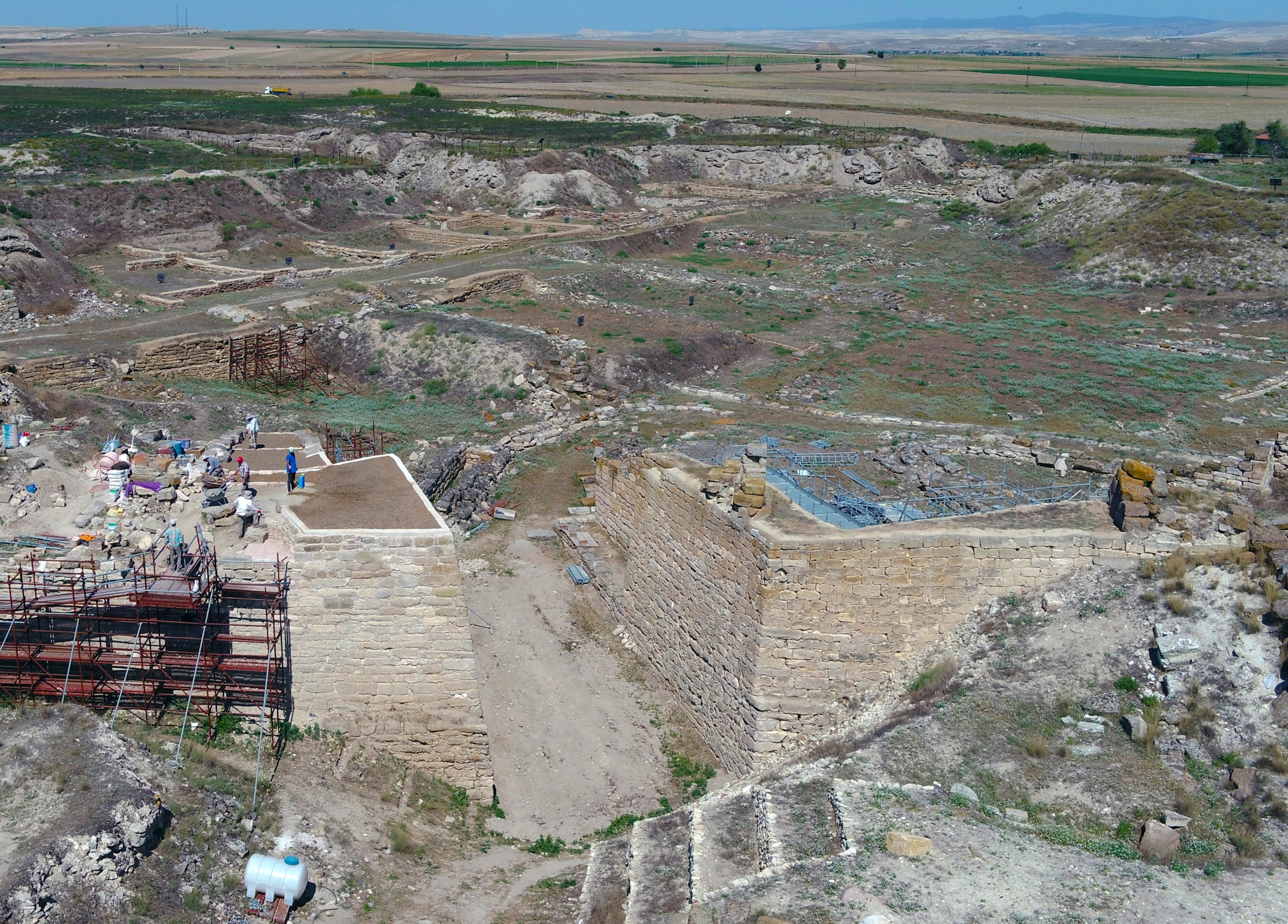
Away from the burial mounds, the excavated citadel of Gordion reveals the working heart of the Phrygian capital. Massive fortification walls and a monumental gateway guarded the approach, built of finely fitted stone and still standing to an impressive height, among the best-preserved Iron Age gates anywhere in Anatolia. Passing through it, you enter the world of the Phrygian kings.
Inside the walls, excavators uncovered a complex of large buildings arranged around courtyards, including great halls with distinctive features known as megarons. Some of these had beautifully patterned pebble-mosaic floors, among the earliest decorative mosaics known, made from carefully arranged colored stones. The scale and quality of the buildings speak to the organization and wealth of the early Phrygian state.
One dramatic chapter of the citadel’s history is written in ash. A great fire, once thought to mark a violent destruction, swept through the early citadel and, ironically, helped preserve it, baking mud brick hard and sealing rooms full of objects under collapsed debris. Excavators found workshops, storerooms, and living quarters frozen at the moment of the fire, a snapshot of the city at a single point in time.

The rebuilt citadel that rose over the burned one continued the tradition of monumental building, and the layers of construction, destruction, and rebuilding give archaeologists a detailed sequence of the city’s life. Terraces held rows of buildings that may have served as workshops or storerooms, evidence of an organized economy producing textiles, food, and crafts on a substantial scale behind the citadel’s protecting walls.
The pebble mosaics found in the citadel deserve special mention, since they are among the oldest known examples of the craft. Made from naturally colored stones set into the floor to form geometric patterns, they represent an early step toward the elaborate mosaic art that would later flourish across the Greek and Roman worlds. That such decoration appears already at Gordion speaks to the sophistication of Phrygian taste.
A Feast Preserved for Three Millennia
Among the most evocative discoveries in the Great Tumulus were the remains of the funeral feast held to mark the king’s burial. Inside the bronze vessels that filled the chamber, chemists were able to identify the residues of the food and drink served at that ancient banquet, allowing them to reconstruct, nearly three thousand years later, what the mourners had eaten and drunk to honor their dead ruler.
The analysis revealed a rich stew of lamb or goat, seasoned and prepared for the feast, and a fermented beverage that combined grape wine, barley beer, and honey mead into a single potent drink. It was a lavish send-off, exactly the kind of generous funeral banquet a wealthy Iron Age court would have staged, and its traces survived in the vessels that had held it since the day of the burial.
This discovery is one of the most vivid examples anywhere of archaeology recovering not just objects but experiences. From dried residues in bronze cauldrons, researchers reconstructed a specific meal eaten at a specific royal funeral, right down to a plausible recipe. Modern brewers and cooks have even recreated versions of the Phrygian feast, letting people today taste something close to what Midas’s mourners raised in his memory.

Details like this are what make Gordion special. Most ancient sites leave us stone and pottery; Gordion left wood, food, textiles, and the residue of a banquet. It is the closeness to lived experience, the sense of a real feast held by real people for a real king, that turns the archaeology here from a study of ruins into something far more human and immediate.
The reconstruction of the funeral drink in particular caught the public imagination, and the collaboration between archaeologists and a modern brewery to recreate it brought the ancient banquet to a wide audience. It was a striking demonstration of how scientific analysis can turn a few chemical traces into a living, tasteable link to the past, and of how much curiosity there is about the everyday realities of ancient life.
From Phrygians to Persians and Beyond
Gordion’s history did not end with the fall of independent Phrygia. After the Cimmerian raids weakened the kingdom, the city came under the sway of the Lydians to the west, and then, when Lydia fell, under the Persian Empire. Through these centuries Gordion remained an inhabited and important place, a stop on the great road that the Persians maintained across Anatolia.
It was as a Persian-era town that Gordion received its most famous visitor, Alexander the Great, and his encounter with the Gordian knot. After Alexander, the city passed into the Hellenistic world of his successors, and later still it saw the arrival of the Galatians, Celtic-speaking migrants who settled in central Anatolia and gave the region the name Galatia.
Under Roman rule the site gradually declined in importance as new centers rose and the old routes shifted. The once-great capital shrank to a modest settlement and eventually faded, its citadel buried, its burial mounds standing silent on the plain. For many centuries Gordion was little more than a name in old texts and a cluster of mysterious hills beside the river.

This long afterlife, through Lydian, Persian, Hellenistic, Galatian, and Roman phases, means that the archaeology of Gordion spans well over a thousand years of continuous history. Excavators digging here are not just uncovering Phrygia but tracing the whole sweep of ancient Anatolian history, layer upon layer, from the age of Midas down to the Roman peace and beyond.
A Century of Digging on the Sakarya
Modern archaeology at Gordion began in earnest in the late nineteenth century and then, far more extensively, with a major American-led expedition that started in the 1950s and has continued ever since. It was this project that tunneled into the Great Tumulus, uncovered the citadel gate, and revealed the wealth of the Phrygian capital, making Gordion one of the most thoroughly excavated Iron Age sites in the world.
Decades of careful work have produced an extraordinarily detailed picture of the city. Excavators have traced the sequence of citadels, mapped the fortifications and buildings, dug into dozens of the burial mounds, and studied everything from the pebble mosaics to the tree rings in the royal tomb. The long continuity of the project has allowed knowledge to build steadily, with each generation refining the work of the last.
Conservation has become as important as excavation. Protecting the exposed mud-brick and stone of the citadel from the harsh plateau weather, stabilizing the ancient wooden chamber inside the mound, and presenting the site to visitors all require constant care. The recognition of Gordion as a World Heritage site reflects both its importance and the sustained effort that has gone into studying and preserving it.
The finds from all this work fill museums in the region and on the site itself, and they continue to be studied with ever more sophisticated scientific methods. New analyses of old material, from the residues in the feast vessels to the isotopes in ancient bones, keep adding to the story, proving that a site excavated for decades can still surprise us. Gordion remains a living research project, not a closed book.
The Site and Its Museum Today
A visit to Gordion today centers on two experiences. The first is the Great Tumulus, where a tunnel leads into the heart of the mound to the ancient wooden burial chamber, one of the most atmospheric places in all of Anatolian archaeology. Standing in that small timber room, deep inside an artificial hill, is an experience quite unlike walking among open ruins.
The second is the excavated citadel, a short distance away, where the monumental gateway and the remains of the Phrygian buildings can be explored on foot. The great stone gate in particular gives a powerful sense of the strength and ambition of the early city, and from the top of the mound the whole landscape of the plain and its scattered burial hills opens out before you.
A museum on the site displays the finds that bring the story to life: bronze vessels from the royal tombs, delicate wooden furniture, fine Phrygian pottery, and explanations of the famous funeral feast and the tree-ring dating. Seeing these objects alongside the mound and citadel ties the whole visit together, connecting the grand monuments outside with the intimate details of Phrygian life.
Gordion is not as instantly spectacular as some of Turkey’s coastal ruins, and it rewards the visitor who comes knowing its story. But for anyone drawn by the legends of Midas and the Gordian knot, or simply curious about the real civilizations behind the myths, it offers a rare and moving encounter with a lost kingdom, preserved with astonishing completeness beneath the mounds of the Anatolian plain.
Reaching Gordion is straightforward from the Turkish capital, and the site makes a rewarding day trip for anyone interested in the deeper layers of Anatolian history. The relatively compact area of the main monuments means a visitor can take in the mound, the citadel, and the museum without a punishing amount of walking, while still coming away with a rich sense of what this place once was.
Nearby Places to Explore
Gordion lies on the central Anatolian plateau, in a region rich with the remains of the great powers that ruled ancient Turkey. If the story of Phrygia and its legendary kings has intrigued you, the neighboring sites broaden the picture, from the older Hittite heartland to the Greek and Roman cities of the west.
- Hattusa — the mountain capital of the Hittite Empire, the older Anatolian superpower whose collapse opened the way for the rise of Phrygia.
- Pergamon — the dramatic Hellenistic capital in the west, whose kings later ruled over much of Anatolia after the age of Alexander.
- Ephesus — the great marble metropolis of the Aegean coast, one of the most celebrated cities of the classical and Roman world.
The Kingdom Beneath the Mounds
Gordion is a place where legend and history meet in the soil. The knot that Alexander cut and the golden touch of Midas are stories the whole world knows, but beneath them lies a real Iron Age kingdom, powerful, wealthy, and skilled, whose capital has been recovered in extraordinary detail. The great mound on the plain really does hold a king’s tomb, and inside it the oldest standing wooden building in the world still stands.
What makes Gordion unforgettable is that closeness to the real people behind the myths. We can walk through the gate their kings passed under, stand in the tomb their carpenters built, and even taste, in reconstruction, the feast their mourners drank. Few ancient sites collapse the distance between us and a lost civilization so completely. The Phrygians are gone, their kingdom a memory wrapped in legend, but at Gordion, beneath the mounds, they are remarkably, movingly present.
You May Like
Mafra, the Palace a King Built From a Vow


2 thoughts on “Gordion: Where the Real King Midas Lies Beneath a Great Mound”