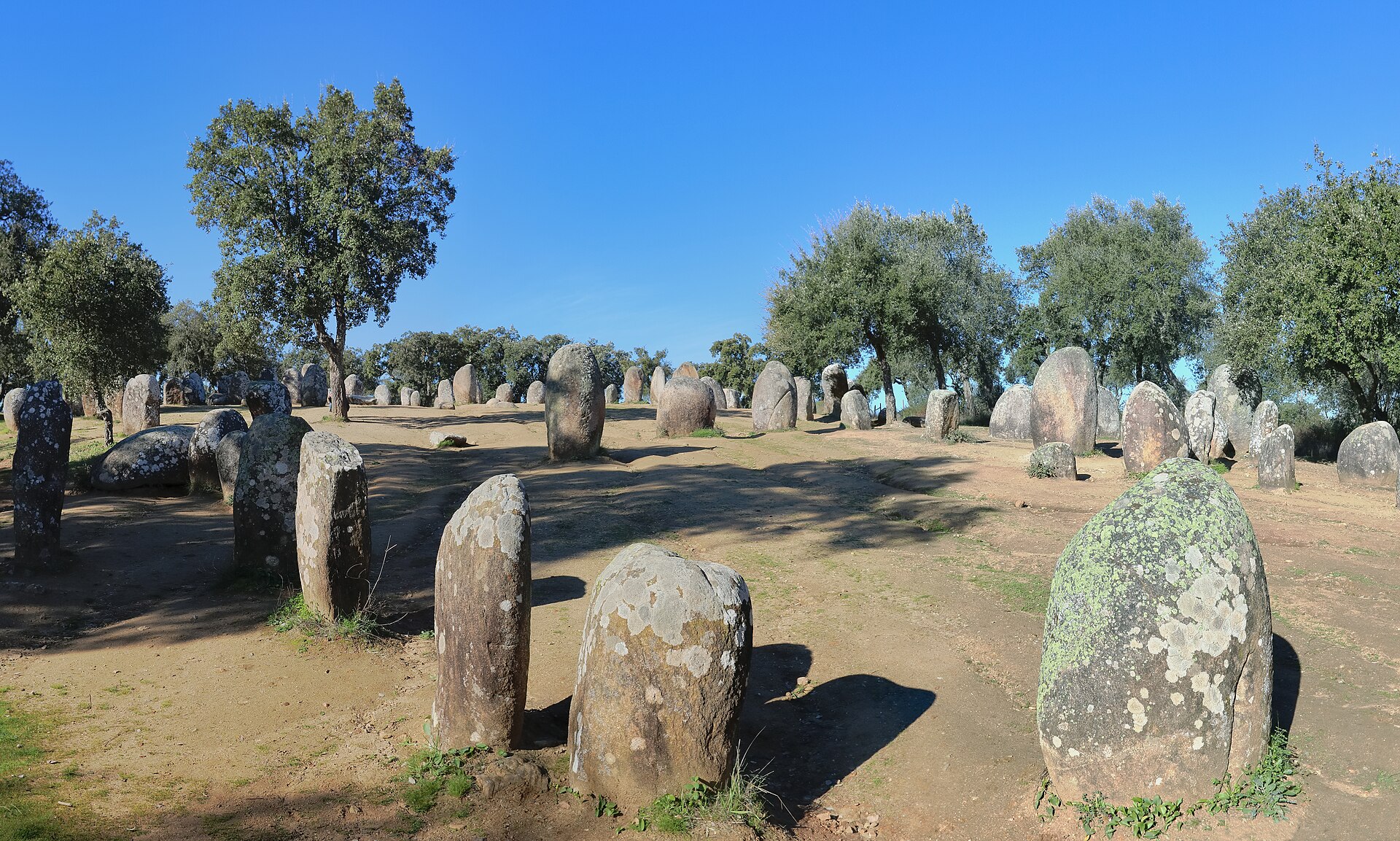
On a quiet hillside near Évora, in the sun-baked Alentejo region of Portugal, there is a gathering of stones that has been waiting in the same spot for the better part of seven thousand years. Almost a hundred of them stand together, rounded and weathered granite, arranged in loops and ovals across the slope. This is the Almendres Cromlech, and it is the largest surviving group of standing stones anywhere on the Iberian Peninsula. The first time you see it, the scale and the silence do something strange to you.
I have always found stone circles quietly overwhelming, and Almendres is one of the best. It is older than Stonehenge, older than the pyramids, and it was built and rebuilt over such a long stretch of time that it is really less a single monument and more a conversation carried on across dozens of generations. Let me take you through it the way I would love to walk it with a friend, slowly and without any jargon.

- What the Almendres Cromlech is
- How old these stones really are
- The shape and the layout
- The stones themselves
- The mysterious carvings
- The lone menhir nearby
- Why it was built
- Why Almendres still matters
- Stones that watched the sky
- Built in phases across millennia
- A monument in its landscape
- Lost, then found again
- The human effort behind the stones
- What it feels like to stand there
- Almendres and the Neolithic revolution
- How Almendres compares to other stone circles
- The quiet legacy of the stones
- Reading the granite itself
- The questions we may never answer
- Protecting a place this old
What the Almendres Cromlech is
The word “cromlech” simply means a circle or arrangement of standing stones, and Almendres is a grand example. It consists of dozens of upright granite stones, called menhirs, set into the ground in a series of rings and oval enclosures on a gentle west-facing slope. Some stand taller than a person; others are more modest. Together they form one of the most important prehistoric sites in all of Europe.
What surprises many people is how alive the place feels despite its age. The stones are not fenced off in a museum. They stand in the open, among cork oaks and wild grasses, exactly where their builders placed them. You can walk right up to them, and that closeness makes the whole experience feel less like sightseeing and more like meeting someone very old.
How old these stones really are
The earliest stones at Almendres were raised around 6000 BC, which is genuinely staggering. That is roughly eight thousand years ago, deep in the early Neolithic, when farming was still a young idea in this part of the world. The site then grew and changed over thousands of years, with stones added, rearranged, and re-erected across several distinct phases.
So when we call Almendres “old,” we are not exaggerating for effect. It predates the great stone circles of Britain by thousands of years. It was already ancient by the time the first pharaohs ruled Egypt. Standing among these stones, you are quite literally in the presence of one of humanity’s earliest surviving attempts at monumental architecture.

The shape and the layout
Almendres is not one neat circle. It is a set of connected enclosures, and the layout seems to have shifted over its long history. The overall arrangement stretches along the slope, and many researchers believe the positioning was deliberate, aligned with the movements of the sun or other points on the horizon.
That possible astronomical alignment is one of the most tantalising things about the site. If the builders were orienting their stones toward sunrise at certain times of year, then this was not just a random cluster of rocks. It was a carefully planned space, tied to the sky and the seasons, built by people who watched the heavens closely because their farming lives depended on the rhythm of the year.

The stones themselves
Up close, the individual stones have a wonderful presence. They are made of local granite, shaped and smoothed, many with a rounded, almost egg-like profile. Standing beside one, you cannot help but wonder how many hands touched it, how it was moved into place, and what it meant to the people who chose it.

Each stone had to be selected, shaped, transported, and set upright, all without metal tools or wheeled transport as we know it. Multiply that effort by nearly a hundred stones, spread across thousands of years, and you begin to grasp the sheer sustained commitment this site represents. It was not built in a season. It was built across an almost unimaginable span of human patience.
The mysterious carvings
Some of the Almendres stones carry markings, and this is where the site becomes truly intriguing. There are cup-shaped hollows, faint engravings, and other worn symbols that have survived the millennia. What they mean, we simply do not know, but their presence tells us the stones were not just structural. They carried meaning, perhaps sacred, perhaps symbolic.

Interpreting marks like these is one of the great humbling tasks of archaeology. We can describe them, measure them, and compare them to marks elsewhere, but we cannot ask the people who made them what they were for. They are messages in a language we have lost, and yet the very fact that someone bothered to carve them speaks across the silence.

The lone menhir nearby
A short walk from the main cromlech stands a single, tall menhir on its own. Set apart from the circles, this solitary stone seems to have had its own role, and some think it lined up with the cromlech in a meaningful way, perhaps marking a sightline toward sunrise on an important day.

There is something poignant about that lone stone standing at a distance from its companions. Whether it was a marker, a gathering point, or part of a wider sacred landscape, it reminds us that the people who built Almendres thought about space on a large scale. They were not just arranging rocks; they were shaping a whole stretch of countryside into something meaningful.
Why it was built
The honest answer is that we are not certain, and I actually like that honesty. The likeliest explanation combines several ideas. Almendres may have been a ceremonial gathering place, a site tied to the farming calendar and the movement of the sun, and a marker that gave the local community a fixed point of identity and belonging in the landscape.
What seems clear is that this was a communal effort with communal meaning. You do not build and maintain a site like this over thousands of years by accident. It mattered to people, deeply and repeatedly, in ways that kept drawing them back to add another stone, realign another ring, and keep the place alive.
Why Almendres still matters
Almendres matters because it pushes the story of monumental architecture back further than many people expect, and it does so in a place that rarely makes the headlines. It shows that the impulse to build lasting, meaningful structures was flourishing in Iberia thousands of years before the famous monuments we usually celebrate.
It also matters because it survived intact enough for us to feel it. Walking among these stones, in the open air, exactly where they were placed, collapses the distance between us and the deep past. You are standing where people stood eight thousand years ago, looking, quite possibly, at the same sunrise they came here to watch.
Stones that watched the sky
The more time you spend thinking about Almendres, the harder it is to see it as anything other than a place built with the sky in mind. For farming communities, the calendar was survival. Knowing when to plant, when to harvest, and when the days would lengthen again was not idle curiosity; it was the difference between plenty and hunger.
A monument that helped track the turning of the year would have been immensely valuable, both practically and spiritually. If the stones marked sunrise on key dates, then Almendres was a kind of instrument, a way of reading the heavens carved into the land. That blend of the useful and the sacred is exactly what we see again and again in the earliest human monuments.
I find that idea genuinely moving. These were people without written records or precise clocks, and yet they found a way to pin the rhythm of the cosmos to a hillside. They turned granite into a calendar, and it still stands.
Built in phases across millennia
One of the most important things to understand about Almendres is that it was never finished in a single burst. Archaeologists recognise several distinct phases of construction and rearrangement, stretching across thousands of years. Earlier stones were repositioned, new ones added, and the overall plan evolved.
This means the site we see today is a layered record, a bit like a building that has been renovated so many times that every era left its fingerprints. Each generation inherited the monument, understood it in their own way, and adapted it to their needs before passing it on again.
That long, cumulative history is part of what makes Almendres so special. It is not a snapshot of one moment. It is a slow-motion portrait of a community’s relationship with a sacred place, unfolding across a span of time that dwarfs most of recorded history.
A monument in its landscape
Almendres does not sit in isolation. The wider Alentejo region is dotted with megalithic sites, standing stones, dolmens, and other monuments, forming a whole prehistoric landscape. The cromlech was one node in a network of meaningful places that early communities moved between and used together.
Seeing it this way changes the picture. Rather than a single strange circle in the middle of nowhere, Almendres becomes part of a living, worked landscape, shaped by people who invested enormous effort in marking their territory and their beliefs across the countryside.
When I imagine standing at Almendres in its heyday, I try to picture not just the stones but the paths leading to them, the other monuments on distant hills, and the people moving between them all. It was a landscape saturated with meaning, and the cromlech was one of its beating hearts.
Lost, then found again
Like so many ancient sites, Almendres slipped out of memory for a long time. Farmers knew the stones were there, of course, but their true age and significance were not recognised until the twentieth century, when researchers finally studied the site properly and revealed just how old and important it was.
That rediscovery is a reminder of how easily the deep past can hide in plain sight. For centuries, one of Europe’s most important prehistoric monuments sat quietly on a Portuguese hillside, waiting for someone to look closely enough to understand it.
Today the site is protected and can be visited, and I think that public access matters enormously. A monument locked away loses much of its power. Almendres, standing open under the sky, lets ordinary people feel the full weight of eight thousand years for themselves.
The human effort behind the stones
It is worth dwelling on the sheer labour Almendres represents. Every stone had to be found, judged suitable, worked to shape, moved into position, and raised upright, then held in place while the earth around it was packed firm. None of this was quick or easy, and it was done by communities without the tools we take for granted.
Projects like this required cooperation on a scale that tells us something about the society behind them. People had to agree on the plan, organise the work, feed the labourers, and sustain the effort across generations. A monument like Almendres is, in a sense, frozen social organisation, the visible residue of countless human agreements.
That is why I never see these stones as merely old rocks. They are evidence of community, of shared purpose, of people choosing to spend precious time and energy on something larger than any individual life. That choice, repeated over millennia, is what built Almendres.
What it feels like to stand there
If you ever make the trip to the Alentejo, give Almendres time. Do not rush the circuit. Let yourself notice the shape of the land, the way the stones catch the light, the cork oaks around the edges, and the great quiet that settles over the whole slope. It is a place that rewards patience.
Standing among the stones, I always feel the years fall away. The same sun rises over the same horizon that guided people here thousands of years ago. The granite has barely changed. For a few minutes, the distance between us and those first farmers feels thin enough to reach through.
That is the real gift of Almendres. It is not just a monument to learn facts about. It is a place to feel time, to stand where the deep past is still physically present, and to remember that the wish to build something lasting and meaningful is as old as settled human life itself.
Almendres and the Neolithic revolution
To make full sense of Almendres, it helps to remember what was happening to humanity around the time it began. People were settling into farming life, tying themselves to particular patches of land, and building the first stable communities. That shift changed everything, including how people thought about time, ownership, and the sacred.
Once you farm, the seasons rule your life, and the land becomes an inheritance worth marking. It is no coincidence that monumental architecture appears alongside farming in so many places. The two go hand in hand: settled people, rooted to the land, with the surplus and the motivation to build things meant to endure.
Almendres is one of the earliest and grandest expressions of that new way of living. It is the Neolithic revolution written in granite, a physical sign that people had begun to think in terms of permanence, community, and the long view of generations to come.
How Almendres compares to other stone circles
Most people, when they think of standing stones, picture the famous circles of Britain. Almendres deserves to sit right alongside them in the popular imagination, and in one crucial respect it outshines them: age. It was raised thousands of years before those better-known monuments, making it one of the true pioneers of the form.
Comparing sites like this is not about deciding which is “best.” It is about noticing a shared human pattern that surfaced independently across Europe and beyond. Wherever settled communities took root, some of them felt the pull to arrange great stones with intention, aligning them to the sky and the land.
Almendres shows that this impulse was alive and thriving in Iberia at a remarkably early date. It is a reminder that the story of monumental building is far wider and far older than the handful of famous names we usually celebrate, and that some of its earliest chapters were written on a Portuguese hillside.
The quiet legacy of the stones
What does a monument like Almendres leave behind, beyond the stones themselves? For me, its deepest legacy is a kind of proof, evidence that people eight thousand years ago were every bit as thoughtful, organised, and spiritually curious as we like to imagine ourselves to be.
They watched the sky and built to match it. They cooperated across generations on a shared vision. They marked their landscape with meaning and returned to it again and again. Strip away the millennia and the missing words, and you find people remarkably like us, reaching for something larger than a single lifetime.
That is the legacy I carry away from Almendres. Not just a set of impressive facts, but a felt sense of connection, a reminder that the human story is long, continuous, and far more ambitious at its roots than we often give it credit for. The stones still stand, and in their patient silence, they still speak.
Reading the granite itself
Spend a while looking at just one stone and it starts to tell its own story. The granite has been shaped by human hands and then by thousands of years of wind, rain, and sun. Lichens patch the surfaces, edges have softened, and every stone carries the marks of both its makers and the long ages since.
That layering of human intention and natural weathering is part of what gives ancient stones their peculiar power. You are looking at something deliberately made, yet also something that has quietly become part of the landscape again. It sits at the boundary between the built world and the natural one, which is exactly where sacred places so often live.
I always encourage people to touch the stones, gently, where that is allowed. There is a strange thrill in resting your hand on granite that human hands raised eight thousand years ago. In that small contact, the abstraction of “prehistory” becomes something solid, cool, and real beneath your fingers.
The questions we may never answer
Honesty demands that I admit how much about Almendres remains unknown. We do not know exactly what ceremonies took place here, what the carvings meant, what stories the builders told about these stones, or how they understood the sky they seem to have tracked so carefully.
Rather than frustrating me, that uncertainty is part of the appeal. Almendres holds on to its secrets. It offers just enough, the stones, the alignments, the marks, to spark our imagination, while keeping the deepest answers to itself. It invites wonder rather than closing the book.
Maybe that is fitting for a place this old. We can measure and study and theorise, but some of the meaning has simply been carried away by time. What remains is the encounter itself: standing among the stones, feeling their age, and letting the unanswered questions remind us how vast and mysterious the human past really is.
There is a final image I keep with me from Almendres: the stones at first light, the sun climbing over the Alentejo horizon exactly as it has done for eight thousand years, and the whole quiet slope glowing gold. Whoever raised these stones is long gone, their names and language lost, but the sunrise they came to meet still arrives on schedule, and the stones still stand to greet it. That, more than any fact or date, is why Almendres stays with everyone who visits it.
Protecting a place this old
Sites like Almendres are irreplaceable, and that carries a responsibility. Once a standing stone is toppled, lost, or its context destroyed, no amount of study can fully bring it back. Careful preservation, respectful visiting, and ongoing research are what allow a monument to keep telling its story for future generations.
Every visitor who treats the stones gently, and every effort to protect the wider landscape around them, helps ensure that people a thousand years from now might still stand here and feel what we feel. In a very real sense, we have become the latest custodians of a monument older than almost anything else humans have made.
That thought turns a simple visit into something quietly meaningful. We are not just looking back at Almendres. We are passing it forward, one careful generation to the next, exactly as its builders did across the thousands of years they spent tending it.
If the stones of Almendres have caught hold of your imagination, you are in good company, and there is a whole trail of ancient wonders to follow from here. Fellow megalith-lovers should head straight for Stonehenge: How and Why This Ancient Stone Circle Was Really Built, Newgrange: The 5,000-Year-Old Tomb Built to Catch the Solstice Sun, The Megalithic Temples of Malta: Older Than the Pyramids, Gavrinis: The 6,000-Year-Old Carved Passage They Sealed in the Dark, and the burial mounds of Bougon: The 7,000-Year-Old Burial Mounds Older Than the Pyramids. To go back to the very beginning, sit with Göbekli Tepe: The World’s Oldest Temple and How It Rewrote History and Karahan Tepe: The Astonishing Sister of Göbekli Tepe, then trace the first towns through Çatalhöyük: The 9,000-Year-Old Town With No Streets, Jericho: The World’s Oldest City and Its 10,000-Year-Old Wall, Skara Brae: The 5,000-Year-Old Village Known as the Scottish Pompeii, and Aşıklı Höyük: The 10,000-Year-Old Village That Came Before Çatalhöyük. The great river and valley worlds unfold at Uruk and Sumer: The First Cities and the Birth of Writing, Mohenjo-daro: The 4,500-Year-Old City That Was Centuries Ahead of Its Time, Liangzhu: The 5,000-Year-Old Water City That Rewrote China’s History, Dholavira: The 4,500-Year-Old City That Beat the Desert With Water Engineering, Tell Brak: The Syrian Mound That May Rewrite Where Cities Began, and The Cairn of Barnenez: Europe’s Colossal Stone Monument Older Than the Pyramids, while across the seas you will find Caral: The 5,000-Year-Old City That Rose As the Pyramids Were Built, Chavin de Huantar: The 3,000-Year-Old Andean Temple Built to Overwhelm the Senses, Cerro Sechin: The 3,600-Year-Old Peruvian Temple Carved With Warriors and Their Victims, Poverty Point: The 3,700-Year-Old Earthworks Built by Hunter-Gatherers, Not Farmers, Chankillo: The 2,300-Year-Old Peruvian Towers That Are the Americas’ Oldest Solar Observatory, and the astonishing Nan Madol: The Ancient City Built on a Coral Reef in the Middle of the Pacific. For still more of the deep past, wander through The World’s Oldest Art: Inside the Painted Caves of Lascaux and Chauvet, Knossos: The 4,000-Year-Old Palace Behind the Myth of the Minotaur, Cucuteni-Trypillia: Europe’s 6,000-Year-Old Mega-Settlements That Might Be the First Cities, Sarazm: The 5,500-Year-Old Town in Tajikistan That Rewrites Central Asia’s Past, Mehrgarh: The 9,000-Year-Old Village Where South Asia Learned to Farm, Jiahu: The 9,000-Year-Old Chinese Village Whose Flutes Still Play, Kalibangan: The Indus Town With the World’s Oldest Ploughed Field, Vinča: The Danube Culture That May Have Written Before Anyone Else, and Los Millares: The 5,000-Year-Old Fortified Town at the Edge of Europe. Each one adds another thread to the same long human story. The same ancient ambition rises at the Ġgantija temples, raised on Gozo around 3600 BC. The same deep past unfolds at Knowth, a great Boyne Valley tomb with two passages and a ring of smaller mounds. The same ancient devotion shines at the Tarxien temples, home to a colossal statue and remarkable carvings. The same ancient sky-watching shines at Mnajdra, whose stones catch the sun at the turning points of the year. For another chapter in the same deep past, visit Ħaġar Qim, Malta’s great cliff-top temple. For another chapter in the same ancient story, visit Dowth, the overlooked third mound of the Boyne. For another chapter in the same deep past, wander the endless rows of Carnac in western France. For another chapter in the same deep past, visit Callanish, Scotland’s great circle at the edge of the sea. For another face of prehistory, visit Filitosa, where ancient stone figures still watch over the hills. For another face of the ancient world, visit Ale’s Stones, Scandinavia’s great ship traced in standing boulders.
You May Like

The Bardo, a Palace of the Beys Filled With Roman Mosaics