Six thousand years ago, on a terrace above the Chan River in what is now Xi’an, a farming community built roughly a hundred houses around a large central hall, ringed the whole settlement with a defensive ditch, and buried their dead with painted pottery bearing a mysterious symbol some researchers have called China’s earliest writing-like marks. This is Banpo, one of the best preserved villages of the Yangshao culture.
Table of Contents
- Found by accident during a factory survey
- A village split by function, not by chance
- Round pits and a communal hall
- A society some archaeologists read as matrilineal
- Fish, faces, and a mark that might be writing
- The twenty-two symbols scholars still argue over
- Millet fields and a ditch to keep the wild world out
- Stone tools and the daily work of the village
- How Banpo buried its dead
- A museum built to protect, not just to display
- Banpo’s place within the wider Yangshao culture
- What Banpo’s residents actually ate
- Firing pottery hot enough to change its color
- How many people actually lived at Banpo?
- The ditch: protection, drainage, or both?
- Jar burials for children, pit burials for adults
- From salvage dig to national showcase
- Banpo beside Jiahu and Liangzhu
- Visiting the Banpo Museum today
- Why the Yellow River valley became a cradle of civilization
- Banpo among the world’s early farming villages
- Marks on pottery: doodles, ownership, or the seeds of writing?
- The matrilineal question and how to read a Neolithic society
- Nearby in China’s ancient story
- Closing thoughts
Found by accident during a factory survey
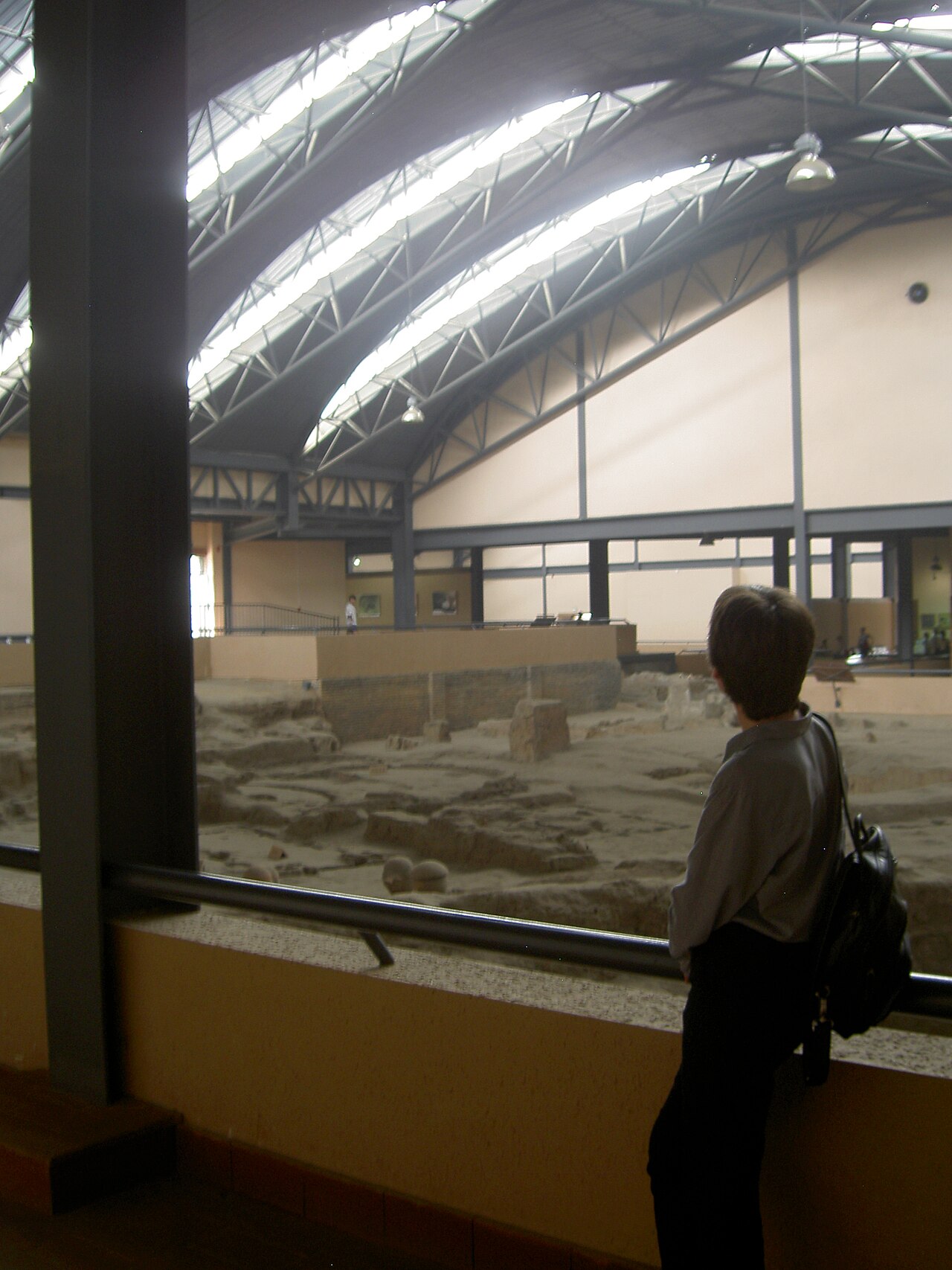
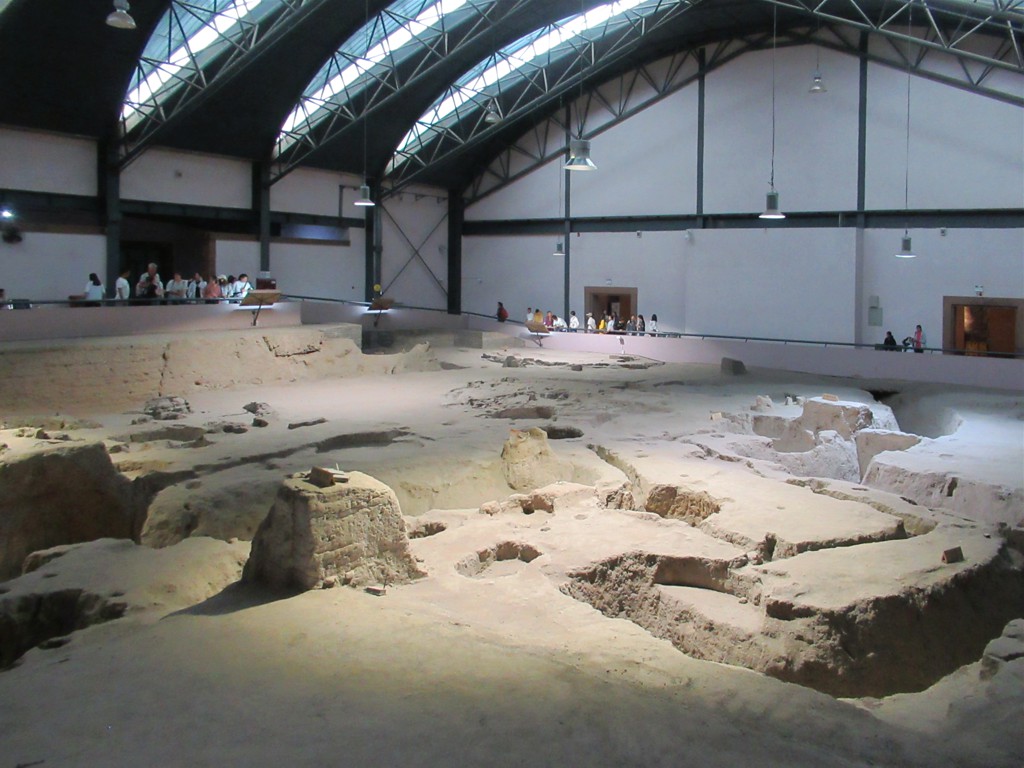
Banpo was discovered in 1953 during a routine construction survey and excavated over the following years, revealing such a complete picture of a single Neolithic settlement that Chinese authorities built a museum directly over part of the dig site, allowing visitors to walk above the original house foundations still in the ground.
The scale and completeness of the excavation, covering roughly ten thousand square meters of the settlement, made Banpo one of the first Neolithic sites in China to be studied with anything approaching modern systematic archaeological methodology, setting a template later applied at many other Yangshao-era sites across the region.
A village split by function, not by chance
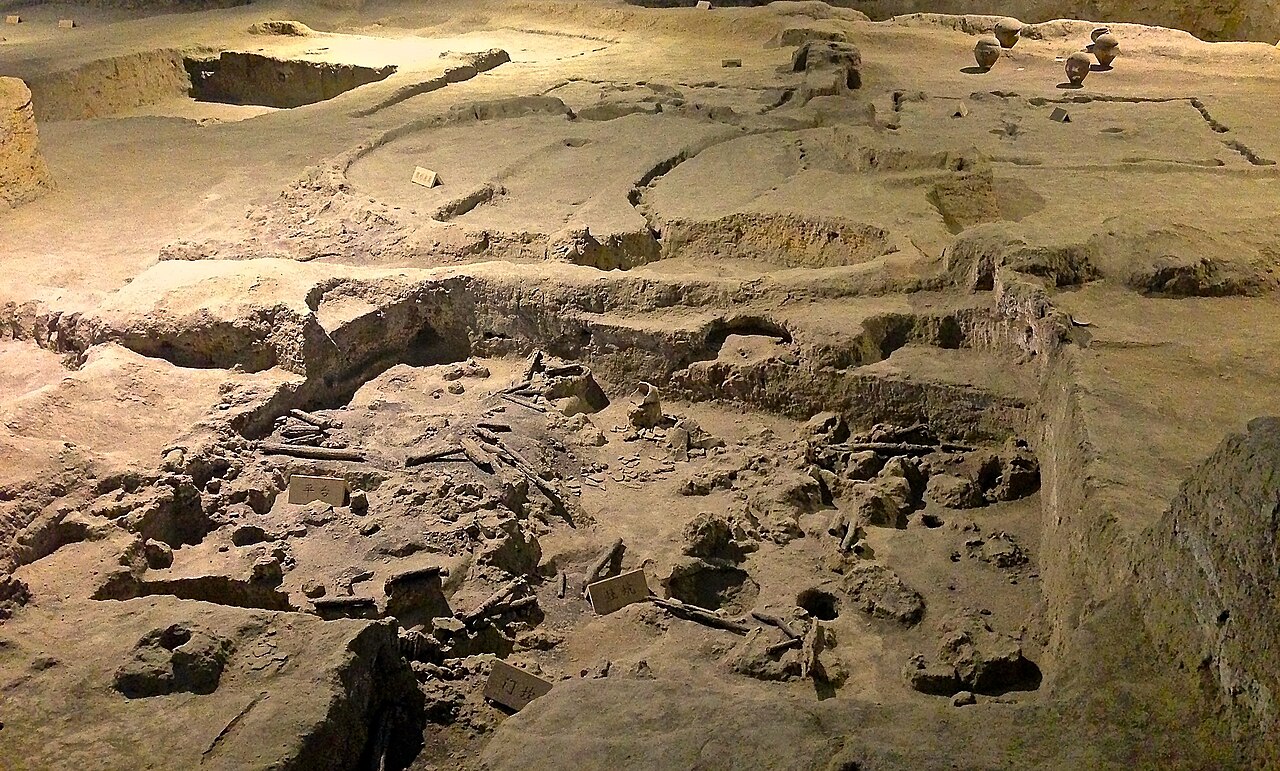
The settlement was carefully zoned: round and square semi-subterranean houses clustered around a large central building likely used for communal gatherings, a separate pottery-making area with kilns sat outside the ditch, and a distinct cemetery lay even further out, keeping the living, the working, and the dead in clearly separate zones.
This zoning suggests a level of collective planning and shared spatial understanding among Banpo’s residents, since maintaining these boundaries over generations of rebuilding implies deliberate community agreement about which activities belonged where, rather than purely incidental or organic growth.
Round pits and a communal hall
Most residential structures were built as shallow circular or square pits, their walls formed from wattle and daub around a timber frame, with a central hearth for cooking and warmth, a construction style well suited to the loess soil terrace on which Banpo was built.
At the settlement’s heart stood a considerably larger rectangular building, likely serving as a communal meeting hall or ceremonial space, its scale suggesting activities involving the wider village population rather than a single household, possibly including councils, feasts, or seasonal rituals.
A society some archaeologists read as matrilineal
Grave goods at Banpo show a marked pattern: burials identified as female tend to be richer and more numerous than male burials, leading some Chinese archaeologists to argue the community was organized along matrilineal lines, an interpretation that remains debated but has shaped decades of popular retellings of the site.
Critics of the matrilineal interpretation point out that grave goods alone are an imperfect proxy for social organization, and that alternative explanations, including different burial customs for different age groups or clans, could also account for the observed pattern without requiring a matrilineal social structure specifically.
Fish, faces, and a mark that might be writing
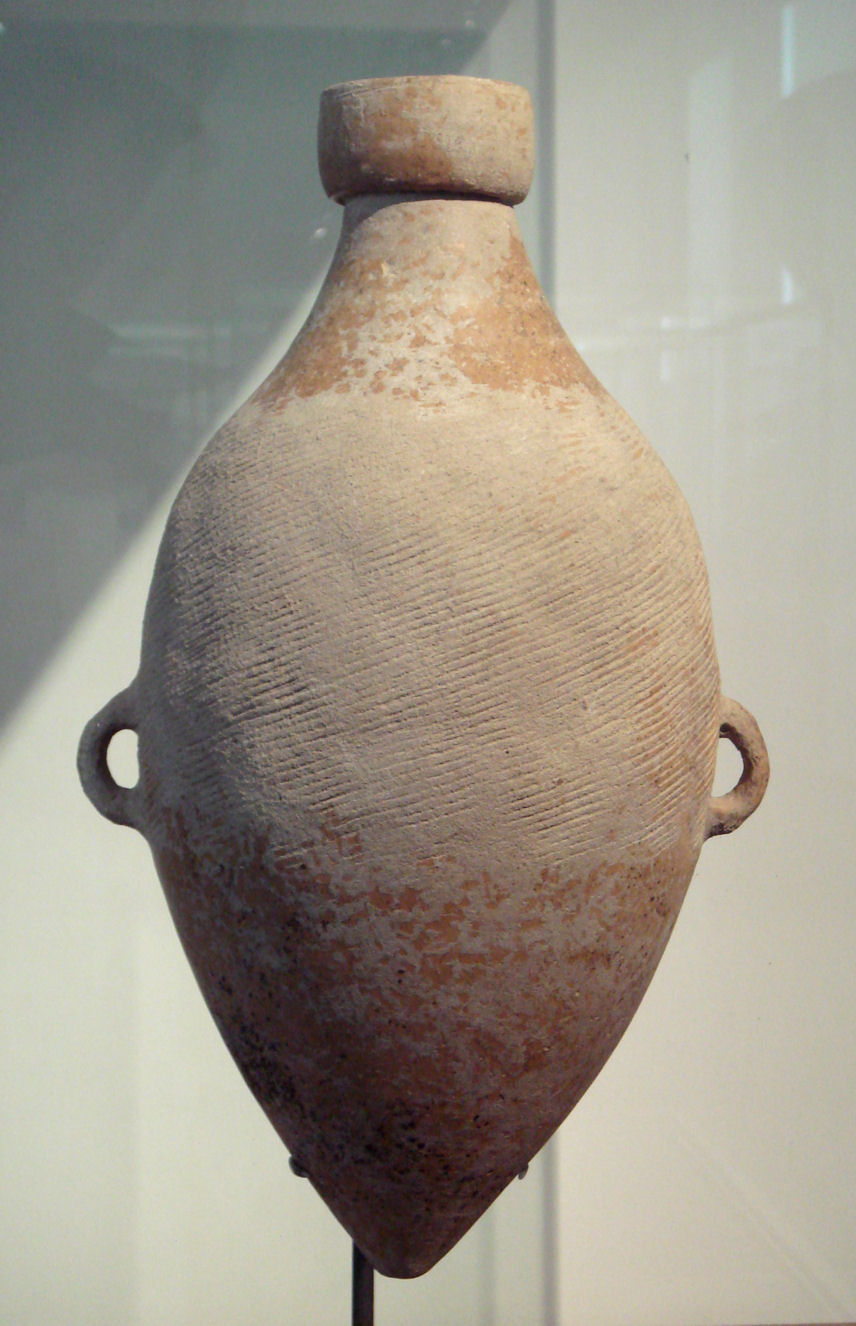
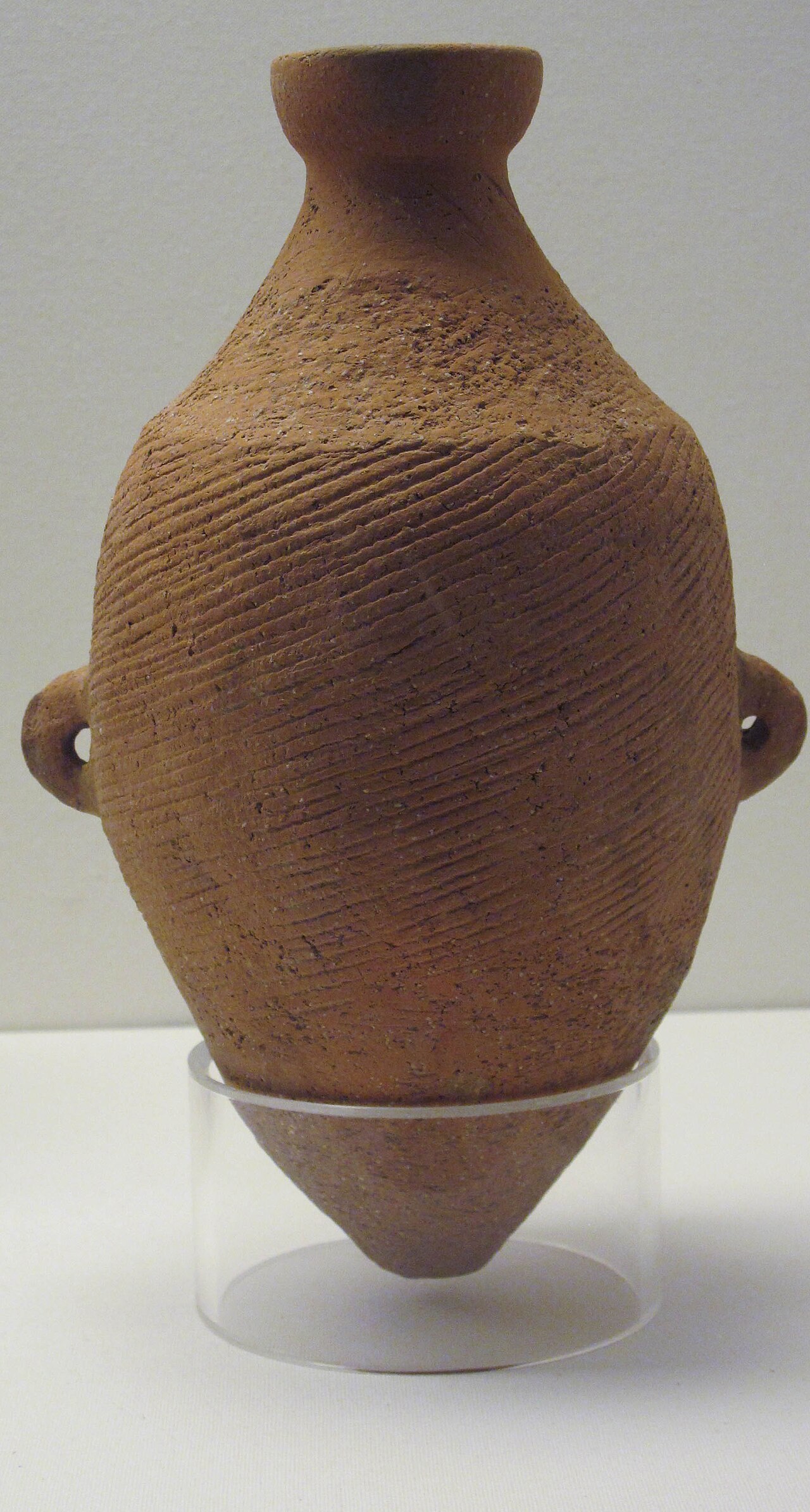
Banpo’s painted red pottery is famous for stylized fish and human-face motifs, along with more than twenty distinct symbols scratched onto pottery rims, which some scholars have proposed as a precursor to Chinese writing, though most specialists remain cautious, since the gap between these marks and the fully developed script that appears over two thousand years later at Anyang is enormous.
The human-face-and-fish motif in particular has become one of the most iconic images associated with Chinese Neolithic art, reproduced widely in museum branding and popular archaeology literature well beyond specialist academic circles.
The twenty-two symbols scholars still argue over
The pottery rim marks found at Banpo, sometimes called the Banpo symbols, appear consistently enough across multiple vessels to suggest shared meaning rather than random marking, though without any confirmed method of reading them, their exact function, whether as clan marks, counting notation, or an early proto-writing system, remains unresolved.
Some Chinese scholars have argued these symbols represent a direct ancestor of later Chinese characters, while others place them in an entirely separate, ultimately unrelated symbolic tradition, a disagreement unlikely to be settled without further comparable finds bridging the substantial chronological gap involved.
Millet fields and a ditch to keep the wild world out
Villagers grew millet and raised pigs and dogs, supplementing their diet with fish from the river and wild plants, while the deep ditch encircling the settlement likely kept out both wild animals and rival groups, a level of defensive planning notable for a community this early.
Analysis of preserved grain and tools suggests millet farming at Banpo was already a well-established practice rather than a recent innovation, implying the settlement’s Yangshao-culture agricultural tradition had deep local roots predating the village’s own particular occupation phase.
Stone tools and the daily work of the village
Excavated tools include polished stone axes and adzes for woodworking, bone needles and awls suggesting textile or leatherworking activity, and grinding stones used to process millet grain into flour, together sketching a picture of a fairly self-sufficient agricultural community handling most of its own production needs locally.
Spindle whorls found among the tool assemblage indicate textile production using spun thread, likely from hemp or similar plant fiber, adding another dimension to the range of domestic craft activity taking place within the settlement’s houses.
How Banpo buried its dead
The cemetery area, kept physically separate from the residential zone, included both adult burials with grave goods and, notably, urn burials for children, in which young remains were placed in large ceramic jars rather than conventional pit graves, a distinct practice suggesting different ritual treatment based on age at death.
This differentiated treatment of child and adult burials offers rare direct evidence of how a Neolithic Chinese community conceptually distinguished between different categories of the dead, a nuance easy to overlook without such carefully preserved and separately excavated cemetery evidence.
A museum built to protect, not just to display
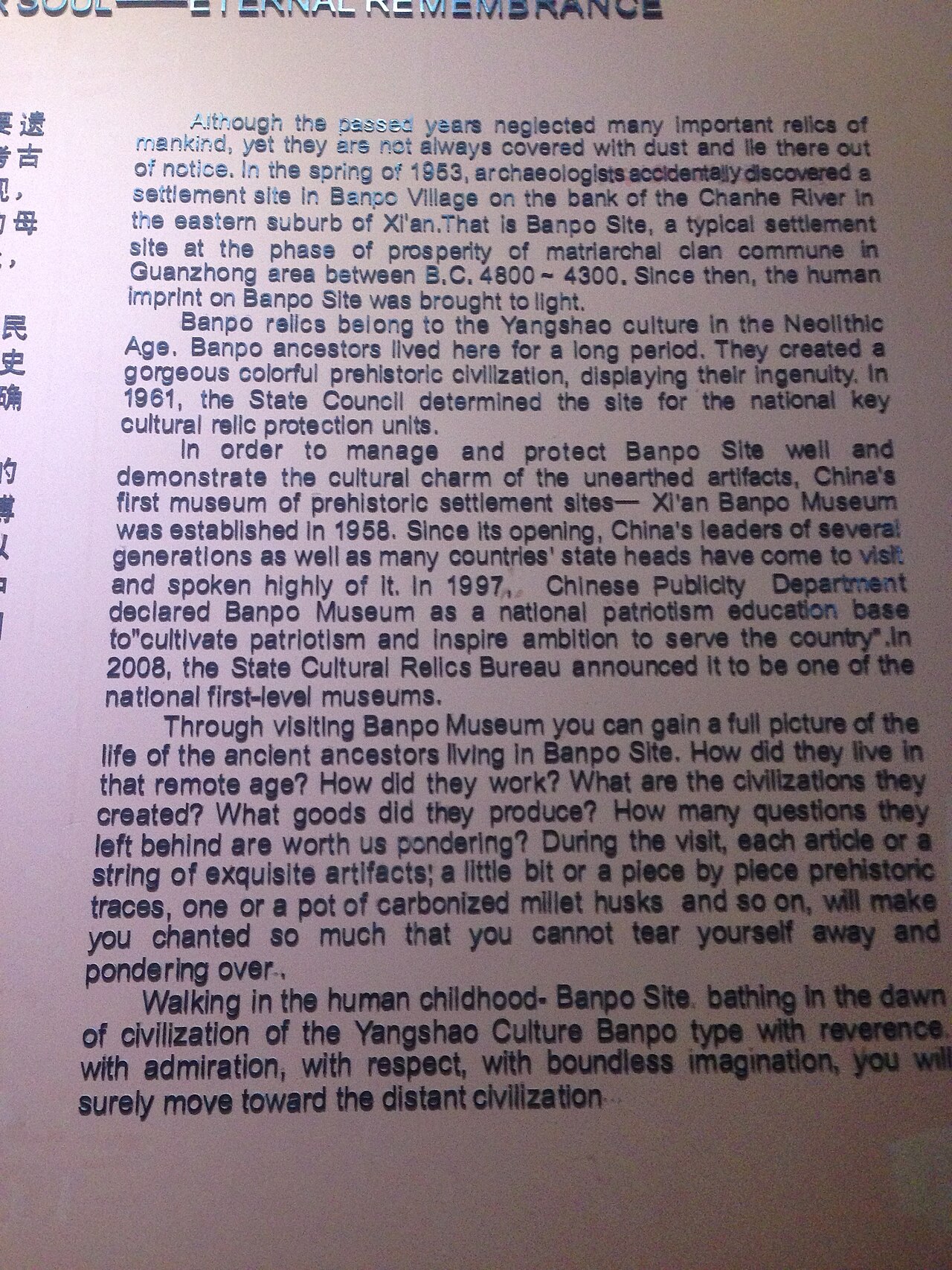
The Banpo Museum, opened in 1958, was China’s first museum built specifically around a prehistoric site, and it helped establish Yangshao culture as a cornerstone of the national story of early Chinese civilization, studied and displayed with a level of state attention few Neolithic villages anywhere receive.
The museum’s design, enclosing excavated house foundations under a protective roof accessible via elevated walkways, has since become a common conservation model applied at other major Chinese archaeological sites seeking to balance public access with protection of fragile in-situ remains.
Banpo’s place within the wider Yangshao culture
Banpo is one of hundreds of known Yangshao culture sites spread across the middle reaches of the Yellow River, a cultural tradition spanning roughly 5000 to 3000 BCE, and while not the largest example, its exceptional preservation and early systematic excavation have made it the reference point most often cited in general discussions of Yangshao village life.
Comparisons between Banpo and later Yangshao sites, along with the subsequent Longshan culture that followed it in the same region, help archaeologists trace a broad trajectory of increasing social complexity leading eventually toward China’s first historically documented dynasties.
What Banpo’s residents actually ate
Analysis of storage pits and charred plant remains at Banpo shows a diet centered on foxtail and broomcorn millet, two hardy grain crops well suited to the semi-arid Loess Plateau climate of the Yellow River valley, supplemented by cultivated vegetables and gathered wild plants including fruits and nuts collected from the surrounding hills. Faunal remains recovered from the site include pig bones in large quantity, indicating domesticated pig-keeping was already well established, alongside dog remains and evidence of hunting deer and other wild game, along with fishing in the nearby Chan River using bone hooks and net weights that have survived in the archaeological record.
Large storage pits, some lined with clay to help control moisture and pests, dot the residential areas of the village, evidence that Banpo’s farmers were producing and storing a genuine surplus rather than living purely hand to mouth, a surplus that likely supported the specialized potters and toolmakers whose workshops have been identified in separate zones of the settlement.
Firing pottery hot enough to change its color
Banpo’s potters worked with a cluster of kilns located outside the village’s defensive ditch, a deliberate separation that kept the heat, smoke, and fire risk of pottery production away from residential and storage areas. These kilns could reach temperatures sufficient to fire the distinctive red-bodied pottery decorated with black painted bands and geometric patterns that define Banpo-phase Yangshao material culture, some vessels finished with a fine burnished slip that gave the surface a smooth, semi-glossy appearance well before the invention of true glazes.
The famous painted fish and human-face motifs found on basins from burial contexts required additional skill beyond basic vessel forming, executed with a brush-like tool before firing, and their recurring appearance on vessels associated specifically with child burials has led many archaeologists to interpret them as protective or ritual symbols tied to specific beliefs about childhood vulnerability and the afterlife, rather than purely decorative art.
How many people actually lived at Banpo?
Estimates of Banpo’s population during its main period of occupation range from a few hundred to slightly over a thousand residents, based on the number of contemporaneous house foundations identified within the excavated area, though archaeologists caution that not every structure was necessarily occupied at the same time across the settlement’s several centuries of use. The presence of one unusually large rectangular structure near the village center, big enough to hold gatherings well beyond a single family, has been interpreted as a communal meeting hall, possibly used for councils, ceremonies, or seasonal redistribution of stored food, functions that would have required some form of recognized collective decision-making beyond individual households.
This picture of a settled, moderately sized farming community with communal facilities but without clear evidence of a ruling elite or monumental architecture fits a broader pattern seen across many early Yangshao culture sites, suggesting that Neolithic China’s earliest large villages organized themselves through kinship and consensus rather than the kind of centralized hierarchy that would emerge in China only much later, during the Bronze Age Shang period more than two thousand years afterward.
The ditch: protection, drainage, or both?
The large encircling ditch that separates Banpo’s residential core from its pottery workshops and cemetery areas is often described in popular accounts simply as defensive, but archaeologists studying its dimensions and construction note that it may have served multiple overlapping purposes at once. At roughly five to six meters wide and deep in places, the ditch would certainly have deterred casual wildlife intrusion and provided some measure of protection against raiding, but its position and the way it channels natural drainage on the sloping site suggest it may also have helped manage seasonal rainfall runoff, protecting the semi-subterranean pit houses from flooding during the region’s concentrated summer rains.
Whatever combination of purposes it served, the ditch represents a substantial investment of communal labor to dig using stone and bone tools, several hundred cubic meters of earth moved and piled into an accompanying bank, work that, much like the causewayed enclosures of Neolithic Britain built around the same broad era, points to a community capable of organizing large collective building projects well before the era of Chinese dynastic bureaucracy.
Jar burials for children, pit burials for adults
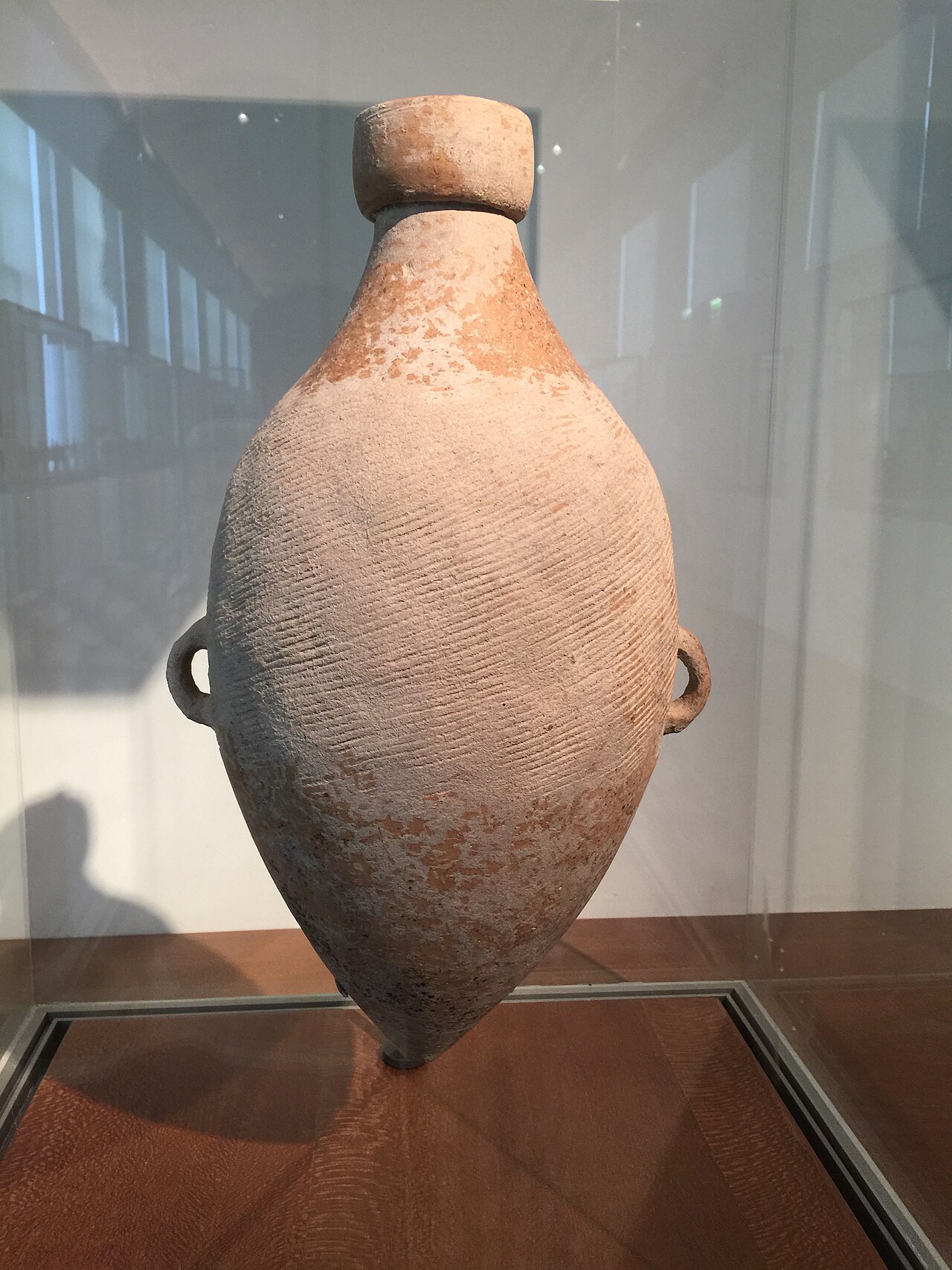
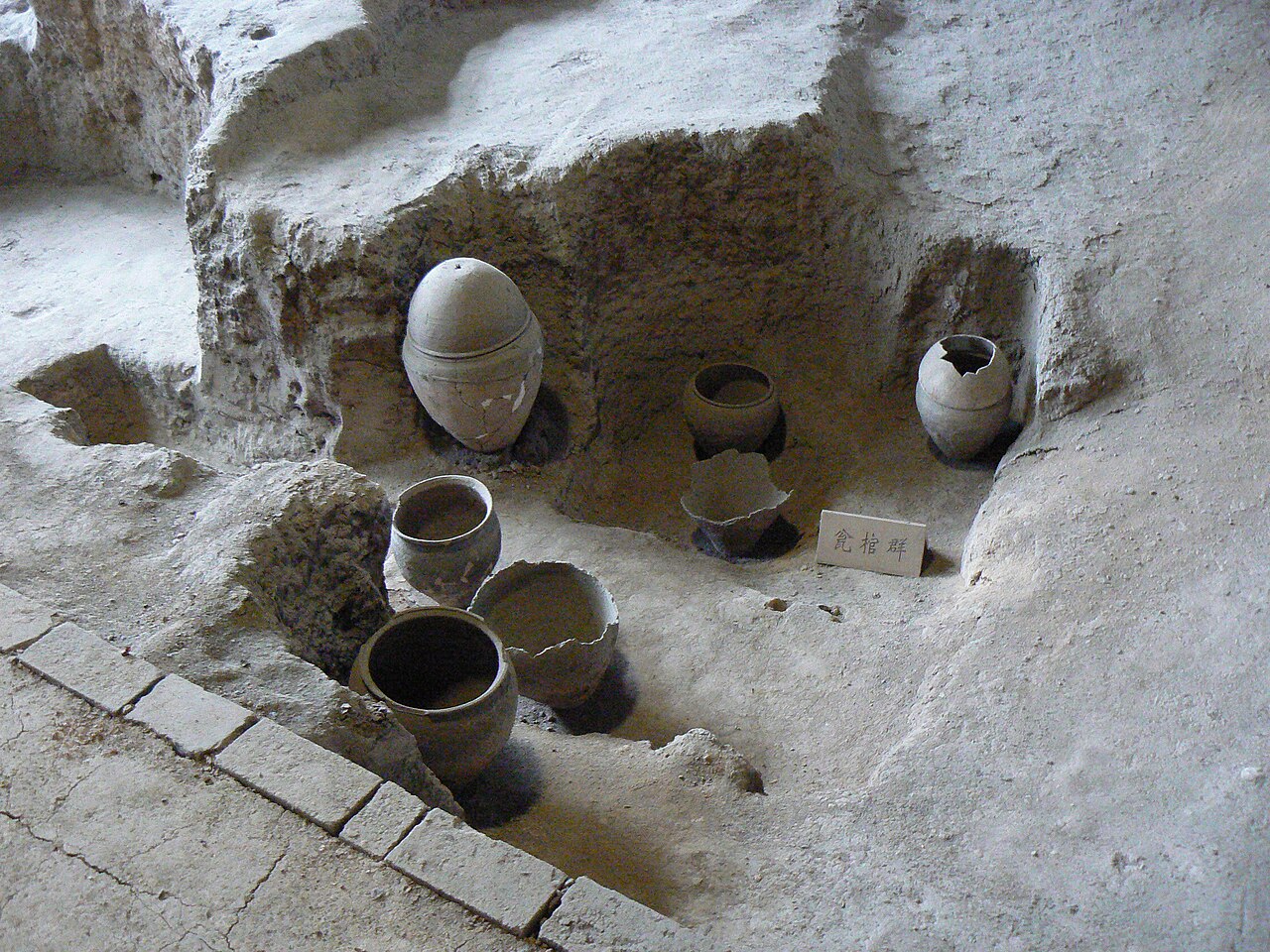
Banpo’s mortuary practice drew a clear distinction between adults and children. Adults were typically buried in individual pits within a cemetery area, laid in an extended position with a modest array of grave goods including pottery vessels and stone tools, while children, particularly younger ones, were frequently buried in large ceramic urns, sometimes placed directly beneath the floors of houses within the residential area rather than in the separate cemetery used for adults. Small holes deliberately pierced in the base of these burial urns are widely interpreted by archaeologists as a passage intended to allow a child’s spirit to move freely in and out, a practical piece of evidence for specific beliefs about death and the soul that would otherwise be completely invisible in the archaeological record.
This differential treatment, adults in a communal cemetery, children close to home beneath the living floor, suggests a community that conceived of childhood mortality, tragically common in any Neolithic farming population, as requiring a distinct kind of ongoing spiritual care and proximity to the family rather than the more distanced burial reserved for adults.
From salvage dig to national showcase
Banpo’s excavation in 1954 and 1955, led by Chinese archaeologists shortly after the establishment of the People’s Republic, quickly became a flagship project for a new generation of Chinese archaeology eager to demonstrate a deep, indigenous prehistoric heritage independent of foreign colonial-era narratives about Chinese civilization. The decision to build a protective museum hall directly over the excavated house foundations and burial areas, opened in 1958, made Banpo one of the earliest in-situ site museums in China, a model later followed at other major Chinese archaeological sites and one that allowed generations of visitors and students to see actual excavated Neolithic house floors rather than only artifacts removed to a distant institution.
Banpo’s prominence in Chinese textbooks and museum culture has made it something of a household name within China itself, frequently cited as a foundational site in the national story of early agricultural civilization along the Yellow River, even as more recent excavations at other Yangshao and pre-Yangshao sites have added considerable nuance to the once-simpler narrative of Banpo as a singular starting point for Chinese civilization.
Banpo beside Jiahu and Liangzhu
Placed alongside the other Neolithic Chinese sites covered in this series, Banpo occupies a middle position both chronologically and technologically. It postdates Jiahu’s early rice-farming and bone-flute-playing communities in the Huai river region by well over a thousand years, and it precedes Liangzhu’s much more socially stratified jade-working culture in the Yangtze delta by a similar span, making Banpo a useful midpoint for tracing how Chinese Neolithic communities changed over time, from early rice cultivation experiments, through the millet-based village society seen at Banpo, toward the more hierarchical, jade-obsessed elite culture that would emerge at Liangzhu and eventually feed into the bronze-age states of the Yellow and Yangtze river valleys.
Where Jiahu is remarkable for how early it demonstrates farming and symbolic culture, and Liangzhu for how dramatically unequal its society had become by the time of its construction of massive earthen platforms and elite jade burial sets, Banpo stands out for its evidence of a relatively egalitarian, communally organized village, a reminder that Chinese Neolithic society did not move in a single straight line toward greater hierarchy, but included long-lasting, stable community structures like Banpo’s that persisted for centuries without producing an obvious ruling class.
Visiting the Banpo Museum today
Today the Banpo Museum in Xi’an allows visitors to walk on raised walkways above the excavated pit house foundations, kilns, and burial areas, protected beneath a large enclosed hall that shields the fragile earthen remains from weather while still presenting them essentially where they were found rather than reconstructed elsewhere. Display cases throughout the hall present recovered pottery, including several of the painted fish-motif basins associated with child burials, alongside stone tools, bone needles, and models illustrating how the pit houses would have looked when timber-framed and thatched roofs still covered the shallow round and square depressions that survive today only as postholes and floor outlines.
Why the Yellow River valley became a cradle of civilization
Banpo did not arise in a vacuum but along one of the great river systems whose fertile floodplains repeatedly nurtured early civilizations across the ancient world. The middle reaches of the Yellow River, blanketed by deep, wind-deposited loess soil that is soft, fertile, and easily worked even with simple tools, offered Neolithic farmers an almost ideal environment for cultivating drought-tolerant millet without the need for the heavy plowing that heavier soils demand. This natural advantage helps explain why the region became dotted with hundreds of Yangshao-culture villages, of which Banpo is simply the most thoroughly excavated and best known.
The same loess that made farming possible also, over millennia, buried and preserved the remains of these early villages, sealing house floors, hearths, and burials beneath protective layers of soil until modern archaeology brought them back to light. In this sense the loess plateau served Chinese prehistory much as the dry sands of Egypt or the silt of Mesopotamia served theirs, both enabling early agriculture and preserving its traces for future discovery.
Banpo among the world’s early farming villages
Placed alongside contemporaries elsewhere in the world, Banpo takes its place among a remarkable global wave of early village life that emerged independently on several continents within a few thousand years of one another. While the farmers of Banpo were cultivating millet along the Yellow River, communities in the Fertile Crescent were growing wheat and barley, villagers in Mesoamerica were beginning to domesticate maize, and settlements along the Danube were making their own transition from foraging to farming. Banpo is a Chinese expression of a transformation that, in its broad outlines, was reshaping human life across the planet.
What is striking is how much these distant communities shared despite having no contact whatsoever: permanent houses, storage of surplus grain, domesticated animals, distinctive local pottery traditions, and communal burial practices all appear independently, suggesting that once people commit to farming a reliable staple crop, a recognizable package of settled village life tends to follow, shaped by local materials and beliefs but recognizably similar in its fundamentals from the Yellow River to the Danube.
Marks on pottery: doodles, ownership, or the seeds of writing?
Among Banpo’s most debated finds are the roughly two dozen simple incised marks found on the rims of pottery vessels, a small repertoire of strokes, crosses, and geometric signs that some Chinese scholars have proposed as possible precursors to later Chinese writing. Because Chinese writing, in its earliest well-documented form, appears on Shang dynasty oracle bones more than two thousand years after Banpo, the temptation to trace a continuous line of development back to these Neolithic marks has been strong, particularly within narratives emphasizing the deep continuity of Chinese civilization.
Most cautious researchers, however, note that these marks are too few, too simple, and too inconsistent to be confidently identified as true writing, which requires a system capable of recording spoken language rather than a handful of isolated symbols. They may instead represent potters’ marks, ownership signs, tallies, or clan emblems, meaningful to their makers but falling short of a genuine script. The debate remains unresolved, and the Banpo marks continue to occupy an ambiguous, tantalizing place in discussions of how and when writing first emerged in East Asia.
The matrilineal question and how to read a Neolithic society
Early interpretations of Banpo, particularly those written in the mid-twentieth century, often described the community as matrilineal, organized around descent through the female line, drawing on burial patterns, the prominence of certain female burials, and theoretical frameworks popular at the time that placed matrilineal organization at an early stage of social evolution. This reading became embedded in many popular accounts of the site and is still frequently repeated in introductory descriptions of Banpo.
More recent scholarship treats these confident claims with considerable caution, noting that inferring specific kinship systems from archaeological remains is extraordinarily difficult and that the evidence at Banpo is open to multiple interpretations. Burial arrangements, grave goods, and house layouts can be read in various ways, and the earlier certainty about matrilineal organization owed as much to the theoretical assumptions of its interpreters as to the evidence itself, a useful reminder of how the questions archaeologists bring to a site shape the answers they find in it.
Nearby in China’s Ancient Story
Banpo belongs to the same deep Chinese Neolithic already explored through other early settlements.
- Jiahu: The 9,000-Year-Old Chinese Village Whose Flutes Still Play
- Liangzhu: The 5,000-Year-Old Water City That Rewrote China’s History
Closing thoughts
Long before any dynasty, any emperor, or any written record, a community on a riverside terrace was already zoning its village into neighborhoods for the living, the working, and the dead.
You May Like

Mafra, the Palace a King Built From a Vow