On a narrow strip of land between two lochs in Orkney, ringed by hills that seem placed on purpose to frame it, stands the Ring of Brodgar, a stone circle so precisely laid out that it remains one of the most accurate circles built anywhere in Neolithic Britain, part of a ceremonial complex so dense that Orkney has been called the ritual capital of prehistoric Britain.
Table of Contents
- A circle drawn with startling precision
- A ditch dug by hand through solid rock
- How many stones survive today
- The heart of a wider ceremonial landscape
- The Ness of Brodgar excavation next door
- No burials, unlike so many of its neighbors
- Fires that still leave their mark
- Astronomical claims and their limits
- Why Orkney became so ceremonially important
- Excavation and protection today
- The Ness of Brodgar and a temple complex no one expected
- The Heart of Neolithic Orkney World Heritage Site
- Eighty thousand hours in the Orkney wind
- Orkney’s outsized influence on the rest of Britain
- The Stones of Stenness, older and stranger still
- Water on every side: the drama of the setting
- Outliers, the Comet Stone, and forgotten alignments
- Vikings who left their names on ancient stones
- Wind, lichen, and the slow work of protecting the ring
- Skara Brae and the homes of the circle-builders
- Barley, cattle, and survival on a northern frontier
- When the great gatherings finally ended
- Giants, dances, and the folklore of the stones
- Nearby in Britain’s ancient story
- Closing thoughts
A circle drawn with startling precision
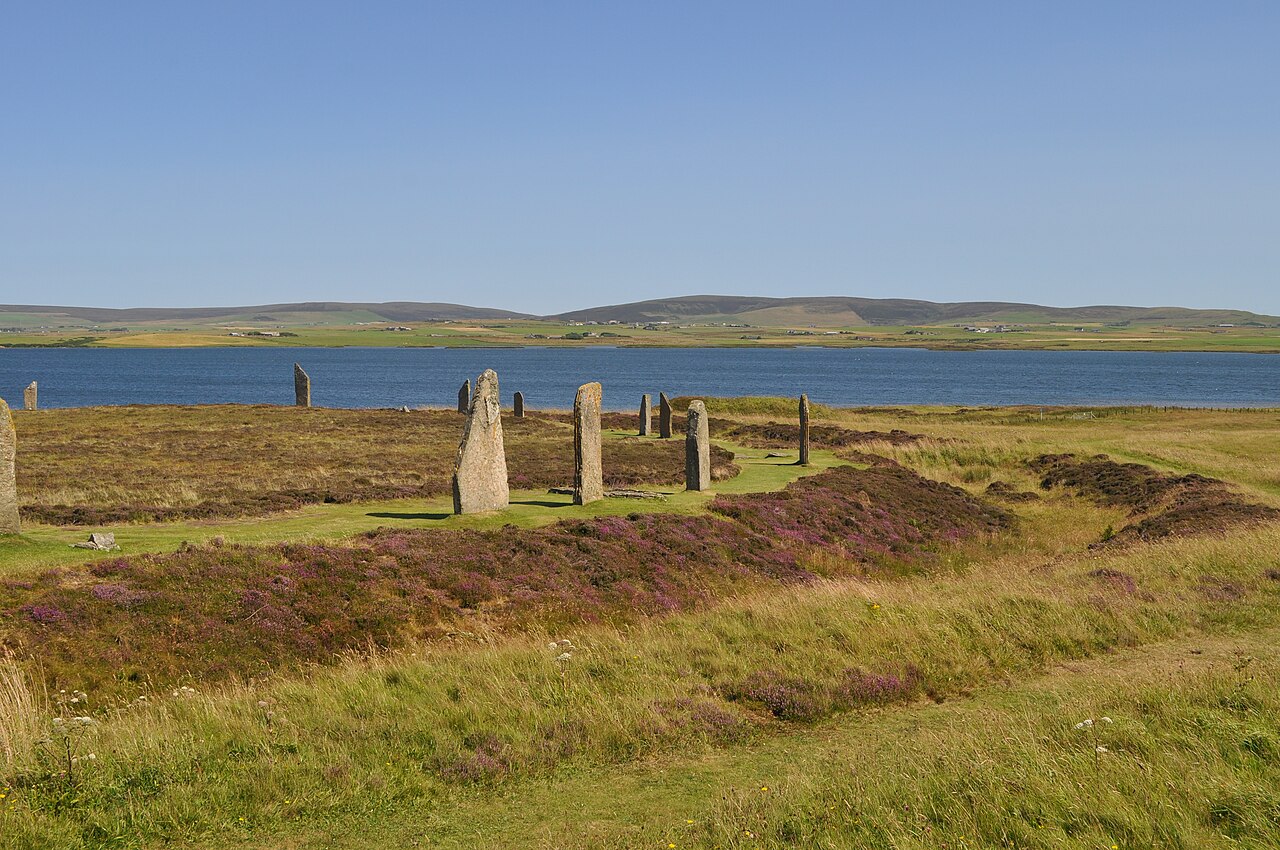
Originally comprising up to sixty stones set within a massive rock-cut ditch, the Ring of Brodgar forms a near-perfect circle 104 meters across, a level of geometric accuracy that suggests its builders, working around 2500 BCE, had developed reliable surveying methods long before any written record of mathematics in Britain.
Achieving this level of circular precision across such a large diameter would have required some consistent method of measurement, likely involving a fixed central point and rope or cord of standard length, a technique simple in principle but demanding careful, coordinated execution across the entire construction process.
A ditch dug by hand through solid rock
The surrounding ditch was carved up to three meters deep directly into bedrock using only stone and bone tools, an estimated eighty thousand hours of labor that produced no defensive wall and no practical function beyond enclosing the circle itself, marking the space as sacred rather than protected.
Rather than a single continuous trench, the ditch was actually cut in a series of adjoining segments, likely reflecting different work parties or construction phases contributing sections to the whole, a detail suggesting the project may have involved several distinct communities collaborating on a shared undertaking.
How many stones survive today
Of the original number of stones, estimated at between fifty and sixty, only around thirty-six remain standing today, with the rest lost to a combination of natural toppling, weathering, and, in at least one documented case, deliberate destruction by an antagonistic nineteenth-century tenant farmer who blamed the stones for obstructing his land.
The surviving stones vary considerably in height, from just over a meter to more than four and a half meters tall, cut from at least three distinct types of local stone, suggesting they may have been sourced from multiple quarries around Orkney rather than a single location.
The heart of a wider ceremonial landscape
Brodgar sits within sight of the Standing Stones of Stenness, the chambered tomb of Maeshowe, and the recently excavated Ness of Brodgar, a sprawling complex of stone buildings between the two circles that has produced some of the most elaborate Neolithic architecture found anywhere in Northern Europe.
This concentration of major monuments within a few kilometers of one another is unusual even by the standards of Neolithic Britain, and it has led archaeologists to treat the entire area, now protected as the Heart of Neolithic Orkney World Heritage Site, as a single interconnected ceremonial landscape rather than a collection of unrelated individual sites.
The Ness of Brodgar excavation next door
Excavations at the Ness of Brodgar, ongoing since 2003, have revealed a remarkable complex of large stone buildings, elaborately decorated with carved and painted designs, enclosed by a massive wall, findings that have substantially reshaped understanding of just how architecturally sophisticated Neolithic Orkney communities had become.
The scale and craftsmanship on display at the Ness site, including painted interior walls and finely worked stone tools left as apparent closing deposits, suggests the wider Brodgar area functioned as a major, possibly seasonal, gathering and ceremonial hub drawing people from across Orkney and potentially further afield.
No burials, unlike so many of its neighbors
Unlike many stone circles associated with burial mounds, no burials have been confirmed within the Ring of Brodgar itself, leading archaeologists to treat it less as a tomb or memorial and more as a gathering place, possibly for seasonal ceremonies drawing communities from across Orkney and beyond.
This absence of burial evidence stands in contrast to nearby Maeshowe, a chambered cairn clearly built for funerary purposes, suggesting a deliberate functional division within the wider ceremonial landscape between spaces dedicated to the dead and spaces reserved for the living community’s gatherings.
Fires That Still Leave Their Mark
Excavation has revealed a burnt mound near the circle and evidence of large-scale fires, hinting at feasting or ritual burning events that may have drawn crowds well beyond the immediate area, echoing the kind of communal gatherings later suggested at sites like Durrington Walls near Stonehenge.
Charcoal and burnt animal bone deposits found in association with these fire features suggest substantial cooking activity consistent with large group feasting, rather than small-scale domestic use, reinforcing the interpretation of Brodgar as a periodic gathering point for sizable numbers of people.
Astronomical Claims and Their Limits
Various researchers have proposed potential solar and lunar alignments involving the Ring of Brodgar and surrounding landscape features, though unlike Newgrange’s well-documented solstice illumination, no single Brodgar alignment claim has achieved the same level of broad scholarly acceptance, and most current interpretations favor a primarily ceremonial and social function over a strictly astronomical one.
As with many stone circle astronomy claims, caution is warranted before accepting any specific alignment as definitively intentional, particularly given the circle’s genuinely near-perfect geometric shape, which naturally creates numerous potential sightlines regardless of whether any particular one was deliberately planned by its builders.
Why Orkney Became So Ceremonially Important
Orkney’s unusually fertile soil and rich marine resources allowed for a relatively dense Neolithic population to develop early, likely providing both the surplus labor and the social motivation needed to construct such an ambitious concentration of monuments within a relatively small geographic area.
Some archaeologists have further proposed that Neolithic architectural and cultural innovations may have spread outward from Orkney toward the rest of Britain, rather than only in the more commonly assumed opposite direction, based on the notably early dates associated with distinctive Orcadian building styles later echoed elsewhere.
Excavation and Protection Today
The Ring of Brodgar has never been fully excavated internally, an unusual and deliberate conservation decision that has preserved whatever archaeological deposits remain within the circle for future study using techniques not yet available today, at the cost of leaving some basic questions about the site’s interior unanswered for now.
Historic Environment Scotland manages the site today alongside the wider Heart of Neolithic Orkney World Heritage designation, balancing public access with ongoing protection of both the standing stones and the largely unexcavated ground they enclose.
The Ness of Brodgar and a temple complex no one expected
Since excavations began there in 2003, the Ness of Brodgar, sitting on the narrow strip of land between the Ring of Brodgar and the nearby Stones of Stenness, has transformed understanding of Neolithic Orkney. Beneath the turf, archaeologists uncovered a dense complex of large stone buildings, some with walls several meters thick, enclosed by a massive stone wall, along with decorated stonework, painted surfaces, and enormous quantities of pottery and animal bone. The scale and sophistication of the structures led some researchers to describe the Ness as a kind of Neolithic temple precinct or ceremonial center, a place whose grandeur rivaled or exceeded anything else known in Britain at the time.
The Ness appears to have been in use for well over a thousand years, and its eventual decommissioning was marked by an extraordinary feast in which hundreds of cattle were slaughtered, their bones deliberately deposited around one of the largest buildings, suggesting a single monumental closing ceremony that drew people and resources from across the region and perhaps beyond, underscoring just how central this small corner of Orkney was to the ceremonial life of Neolithic Britain.
The Heart of Neolithic Orkney World Heritage Site
The Ring of Brodgar does not stand alone but forms one component of a group of monuments collectively inscribed by UNESCO as the Heart of Neolithic Orkney, which also includes the Stones of Stenness, the chambered tomb of Maeshowe, and the remarkably preserved village of Skara Brae. Together these sites represent one of the richest and best-preserved Neolithic landscapes anywhere in Europe, spanning domestic life, burial, and ceremony within a compact area, and offering an unusually complete picture of how a single Neolithic society organized its living, its dead, and its gods.
What makes this concentration so valuable to archaeologists is the way the different monument types illuminate one another: Skara Brae shows how people lived, Maeshowe how they buried and commemorated their dead, and the great stone circles of Brodgar and Stenness how they gathered for communal ceremony, allowing researchers to reconstruct a fuller social world than any single site could reveal on its own.
Eighty thousand hours in the Orkney wind
Estimates of the labor involved in constructing the Ring of Brodgar, particularly the great encircling ditch cut through solid bedrock, run to tens of thousands of hours of work, carried out with antler picks, stone tools, and human muscle in the frequently harsh, wind-blasted climate of the northern Scottish islands. The ditch alone, several meters deep and wide and cut around a circle more than a hundred meters across, represents an immense communal undertaking, one that had no obvious practical function such as defense or drainage and served instead to set apart and elevate the ceremonial space it enclosed.
That a Neolithic community on a group of northern islands, with a limited population, could organize and sustain a project on this scale speaks to the powerful social and religious motivations driving monument-building in the period, and to a level of coordination, planning, and shared purpose that continues to impress the archaeologists who study how such works were achieved without metal tools, draft animals, or writing to organize the effort.
Orkney’s outsized influence on the rest of Britain
Perhaps the most surprising conclusion emerging from decades of Orkney research is that this remote northern archipelago may not have been a peripheral backwater at all, but an influential cultural center whose innovations spread southward across Britain. The distinctive style of pottery known as Grooved Ware, which became widespread across Neolithic Britain and is associated with major ceremonial sites including the henges of Wessex, appears to have origins in Orkney, suggesting that ideas, styles, and perhaps religious practices flowed outward from these islands to influence communities as far away as the builders of Avebury and Stonehenge.
This reframing casts the Ring of Brodgar and its neighbors not as distant imitators of monuments built further south, but potentially as part of the very source of the ceremonial traditions that would culminate in the great henges of southern Britain, a striking reversal of the usual assumption that cultural influence radiates from populous cores to remote margins rather than the other way around.
The Stones of Stenness, older and stranger still
Only a short walk from the Ring of Brodgar stand the Stones of Stenness, a smaller circle whose surviving stones are taller and more dramatic than most of Brodgar’s, and whose construction predates the great ring, making it one of the oldest henge monuments in the British Isles. Where Brodgar impresses through the sheer sweep of its circle, Stenness impresses through the height and slenderness of its individual megaliths, several of which rise well over five meters into the Orkney sky, framing the surrounding lochs and hills like enormous stone fingers.
At the center of the Stenness circle, excavators found the remains of a large hearth, an unexpected feature that has fueled speculation about the ceremonies once performed there, perhaps involving fire, feasting, and gathering, and reinforcing the sense that these monuments were stages for communal ritual rather than silent, empty markers. Together, Stenness and Brodgar bracket the narrow isthmus between the lochs, turning the whole neck of land into a threshold space set apart from ordinary life.
Water on every side: the drama of the setting
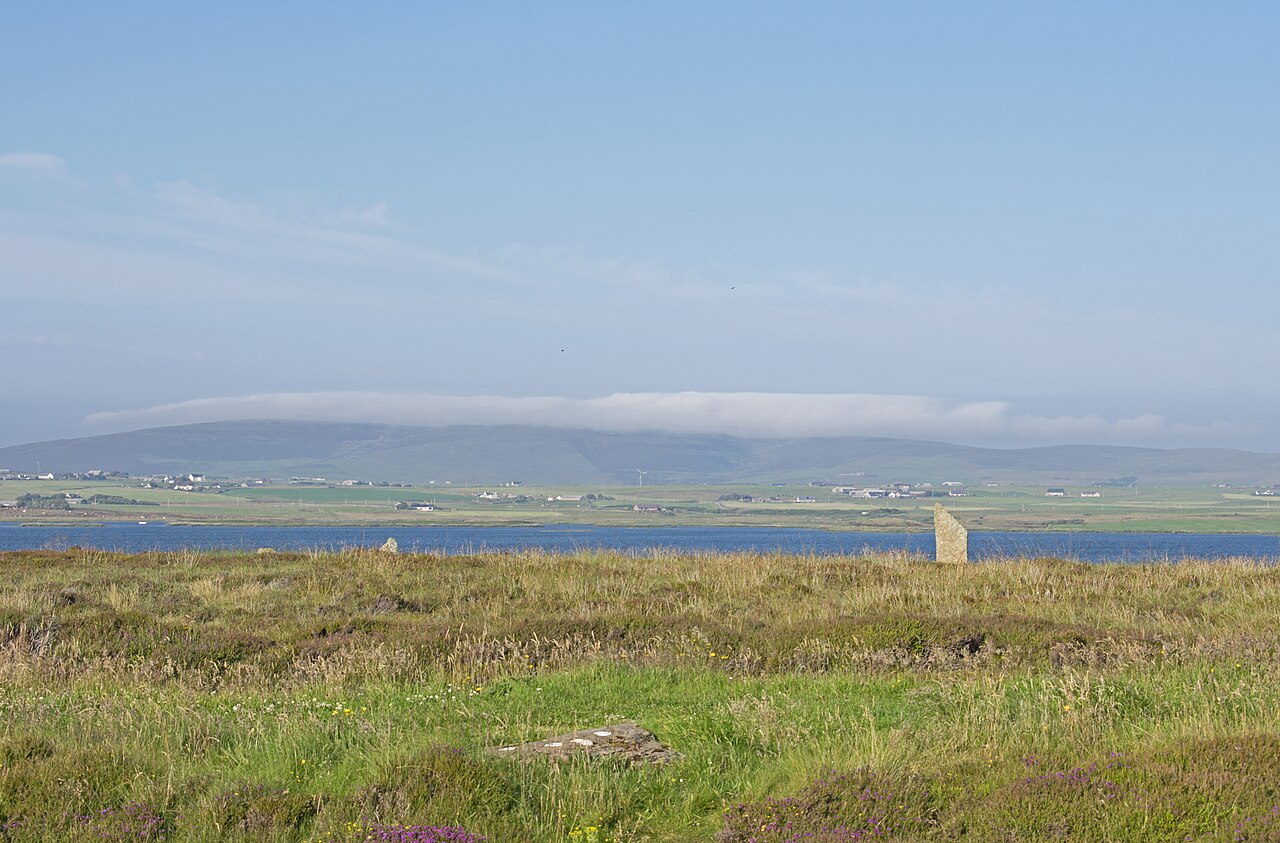
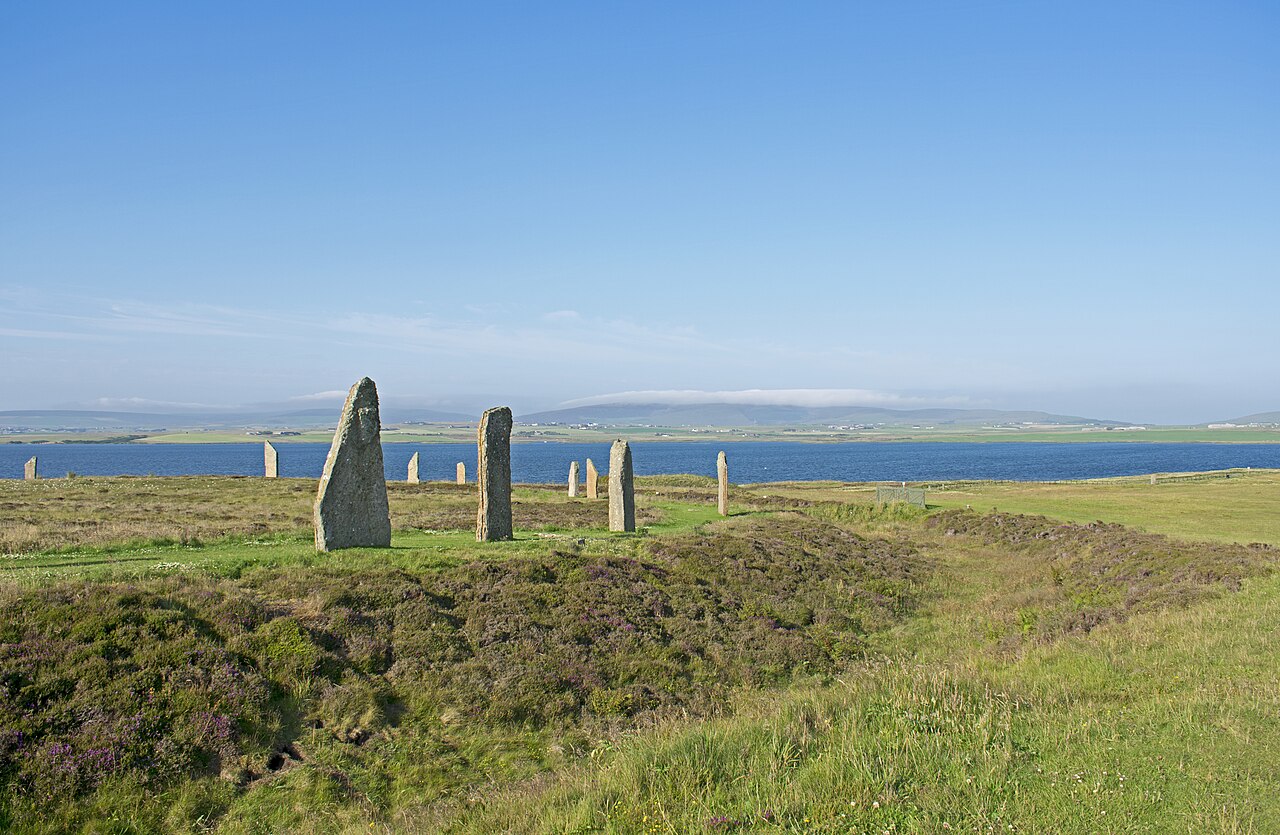
Part of what makes the Ring of Brodgar so affecting, both to modern visitors and, presumably, to the people who built it, is its extraordinary setting on a narrow strip of land nearly surrounded by the waters of the Loch of Harray and the Loch of Stenness. The circle sits within a natural amphitheatre of low hills, with water reflecting the changing northern light on almost every side, so that the monument feels suspended between land, water, and sky in a way that seems unlikely to be accidental.
This deliberate siting, on a liminal boundary between fresh and brackish water, between one body of land and another, fits a broader pattern in Neolithic thought that associated boundaries and thresholds with the sacred and the supernatural. To reach the circle, ancient people had to cross the narrow neck of land between the lochs, a physical journey that may have carried symbolic weight, a passage from the everyday world into a space reserved for the ancestors and the gods.
Outliers, the Comet Stone, and forgotten alignments
The Ring of Brodgar does not end at its circle. Standing a short distance away is an isolated monolith known as the Comet Stone, set on a low platform, along with the stumps of other stones that hint at additional features now largely lost. Outlying stones of this kind are common at major stone circles, and they may have marked approaches, sightlines, or specific alignments toward astronomical events or distant landmarks, though at Brodgar as at many sites the precise intended function remains impossible to prove.
The name Comet Stone is a relatively modern piece of folklore rather than an ancient designation, a reminder of how later generations have continually attached new stories and names to these enigmatic monuments, layering Norse legend, folk tradition, and modern romantic speculation over remains whose original meanings were never written down and can now only be approached through careful archaeology and cautious inference.
Vikings who left their names on ancient stones
Thousands of years after the Ring of Brodgar was built, Orkney became a center of the Norse world, and the Vikings left their own marks on the ancient monuments they found already standing in the landscape. The nearby chambered tomb of Maeshowe famously contains one of the largest collections of Norse runic inscriptions outside Scandinavia, carved by Vikings who broke into the ancient tomb, sheltered there, and scratched their names, boasts, and jokes onto its walls, a vivid reminder that these monuments have been reused, reinterpreted, and wondered at by every culture that has since inhabited the islands.
This long afterlife, in which Neolithic monuments became backdrops for Norse saga, medieval legend, and eventually antiquarian and archaeological study, is part of what gives Orkney’s ancient sites their peculiar resonance, a continuity of human attention stretching from the people who raised the stones through the Vikings who carved them to the visitors and researchers who walk among them today.
Wind, lichen, and the slow work of protecting the ring
Conserving the Ring of Brodgar presents ongoing challenges peculiar to its exposed northern location. The relentless Orkney wind, salt-laden air, and freeze-thaw cycles gradually weather the stones, while lichen growth, footfall erosion around the most-visited stones, and even lightning strikes, one of which shattered a stone in the twentieth century, all threaten the monument’s long-term survival. Managing the site therefore involves a constant balancing act between allowing public access to a place of deep cultural importance and protecting fragile remains from the cumulative damage that heavy visitation can cause.
Historic Environment Scotland, which cares for the monument, has implemented measures including managed pathways to reduce erosion of the ground within and around the circle, and ongoing monitoring of the stones’ condition, part of a wider effort to ensure that the Heart of Neolithic Orkney continues to be experienced by future generations much as it is today, standing open to the sky on its narrow strip of land between the lochs.
Skara Brae and the homes of the circle-builders
To understand who raised the Ring of Brodgar, it helps to look at where they lived, and Orkney offers an answer almost unmatched anywhere in Europe in the village of Skara Brae, a cluster of stone-built houses on the west coast of the Mainland island preserved so completely by the sand that buried them that visitors can still see stone beds, dressers, hearths, and storage boxes exactly where their Neolithic occupants left them. These were not the temporary shelters of nomads but solid, comfortable, interconnected homes, furnished with built-in stone furniture because Orkney’s near-treelessness made stone the natural building material for everything from walls to shelving.
The people of Skara Brae and similar settlements were the farmers, herders, fishers, and potters who, in their ceremonial gatherings, built and used the great circles of Brodgar and Stenness. Seeing their domestic world, the drains beneath their floors, the workshops where they made tools and beads, the middens of shell and bone that accumulated around their homes, transforms the stone circles from abstract monuments into the achievements of a specific, knowable community whose daily lives are unusually well documented for the Neolithic period.
Barley, cattle, and survival on a northern frontier
Farming at the northern edge of Neolithic Europe was no easy matter, yet the communities of Orkney managed it well enough to support the surplus labor and social organization that monument-building required. They grew hardy barley suited to the short growing season and cool climate, kept cattle and sheep, and supplemented their diet with fish, shellfish, seabirds, and their eggs, exploiting the rich resources of the surrounding seas and shores to buffer against the uncertainties of northern agriculture. The bones and grains recovered from settlements and ceremonial deposits alike reveal a mixed economy carefully adapted to a demanding environment.
This economic foundation matters because monuments like the Ring of Brodgar could only be built by societies producing enough surplus to free significant numbers of people from full-time food production, at least seasonally, to labor on projects of no immediate practical benefit. That Orkney’s Neolithic farmers achieved this at such a northern latitude, in a climate less forgiving than the fertile valleys of southern Britain, is itself a testament to their agricultural skill and social cohesion.
When the great gatherings finally ended
Like the ceremonial landscapes of southern Britain, Orkney’s Neolithic monuments eventually fell out of active use, and the elaborate ceremonial life centered on Brodgar, Stenness, and the Ness gradually wound down over the closing centuries of the third millennium BCE. The dramatic closing feast at the Ness of Brodgar, with its slaughter of hundreds of cattle, may mark a deliberate, ceremonial ending to a way of life, a conscious decision by the community to bring an era of monumental gathering to a close rather than simply letting it fade.
The reasons behind this decline are debated and probably multiple, including gradual climatic deterioration, changes in social organization, and the broader transformations sweeping across Britain at the transition into the Bronze Age, when new materials, beliefs, and perhaps new populations reshaped the cultural landscape. Whatever the causes, the stones of Brodgar remained standing long after the ceremonies that gave them meaning had ceased, passing into the realm of legend and, eventually, of archaeology.
Giants, dances, and the folklore of the stones
In the long centuries after their original purpose was forgotten, the stones of Brodgar and Stenness accumulated a rich body of folklore, as ancient monuments across Britain typically did. Local traditions described the stones as giants turned to rock, or as dancers frozen in place, and the monuments became sites for oaths, promises, and rituals of a wholly different character from their Neolithic origins, including customs in which couples would make vows at the stones as part of local marriage traditions.
This folklore, though it tells us nothing reliable about the monuments’ original meaning, is itself a valuable part of their history, showing how each successive community wove the mysterious stones into its own understanding of the world, and how the human impulse to explain and give meaning to these enigmatic structures has continued unbroken from the Neolithic to the present day, when archaeology has become the latest, though surely not the last, framework through which we try to comprehend them.
Nearby in Britain’s Ancient Story
Brodgar belongs to the same island-wide megalithic tradition already explored through Britain’s other great stone monuments.
- Skara Brae: The 5,000-Year-Old Village Known as the Scottish Pompeii
- Stonehenge: How and Why This Ancient Stone Circle Was Really Built



Closing thoughts
Eighty thousand hours of digging through solid rock, for a circle that held no bodies and served no defense, just to give a community somewhere to gather beneath the hills of Orkney.
You May Like
Mafra, the Palace a King Built From a Vow