Nahua people form the largest Indigenous population in Mexico today, the linguistic and cultural heirs of a world that produced the Mexica capital of Tenochtitlan and dozens of other city-states across the highlands of central Mexico. Their language, Nahuatl, has left a permanent mark on global vocabulary, from tomato to chocolate to coyote, while their descendants continue to farm, trade, worship, and celebrate in communities stretching from Puebla to Veracruz to California. This article traces the Nahua story from ancient migration through the rise and fall of the Triple Alliance to the challenges and revitalization efforts shaping Nahua life today.
Contents
- Origins
- Name
- Language
- Homeland
- Old way of life
- Society
- Religion
- Traditions
- Crafts
- Food
- Festivals
- History
- Today
Origins
The Nahua are the largest Indigenous people of Mexico today, and their history reaches back centuries before the empire most people associate with their name. The word “Nahua” describes not a single nation but a broad family of related peoples bound together by a shared language, Nahuatl, and by a shared cultural inheritance that took shape over more than a thousand years in the highlands of central Mexico. Long before any Spanish ship reached the Gulf coast, Nahuatl-speaking groups were already migrating, settling, warring, and trading across the Valley of Mexico and the lands beyond it, building the political and religious world that would eventually produce the Mexica state that outsiders call the Aztec Empire.

Linguists and archaeologists generally trace the deeper roots of Nahuatl speakers to the Uto-Aztecan language family, whose other branches stretch north into the western United States, suggesting a long history of southward migration over many centuries. According to Nahua tradition itself, ancestors of the later Mexica and other Nahua groups came from a homeland called Aztlan, a place whose exact location remains debated among historians and is treated as much as a foundational story as a literal geography. Waves of Nahuatl-speaking migrants are believed to have entered central Mexico across several centuries, arriving in a basin already shaped by earlier civilizations whose monuments, including the pyramids of Teotihuacan, were ancient ruins even to the Nahua newcomers.
By the time later Nahua groups arrived in the Valley of Mexico, the basin was a patchwork of lakes, city-states, and competing powers, none of them Nahua in origin. Groups such as the Toltec, centered at Tula, had already risen and fallen, leaving behind a prestige and a set of political and religious ideas that incoming Nahua rulers would later claim as their own inheritance. This pattern, of migrating groups absorbing and reinterpreting the culture of predecessors, runs through the entire history of the Valley of Mexico and helps explain why Nahua origin stories blend real migration with the borrowed grandeur of older civilizations.
One group of these migrants, the Mexica, arrived comparatively late and comparatively poor, according to their own later chronicles, and were pushed to the marginal, snake-infested islands of Lake Texcoco by groups who were already established. It was on one of these islands that the Mexica are said to have seen the sign that would define their future capital: an eagle perched on a cactus, an image that still appears on the Mexican flag today. From this unpromising beginning, the city of Tenochtitlan grew into the capital of what became the most powerful Nahua state in Mesoamerican history, but it is worth remembering that Tenochtitlan was only one Nahua city among many, and that Nahua identity did not begin or end with it.
Name
The name “Aztec” is far less precise than most people assume, and it is not the name the people themselves used. It derives from Aztlan, the legendary homeland of the migrating Nahua groups, and was popularized centuries later by European and Mexican scholars as a convenient label for the people of the Triple Alliance empire centered on Tenochtitlan. The people who built and ruled that empire called themselves Mexica, a name that itself gave rise to the modern name of the country, Mexico. Using “Aztec” as a catch-all term blurs an important distinction: not every Nahuatl speaker was Mexica, and the Nahua world extended far beyond the borders of any single empire, before, during, and after the years of Mexica dominance.

“Nahua” itself comes from Nahuatl, and it is closely tied to the word tlahtolli, meaning language or speech, and to the root nahua, which carries a sense of “clear” or “audible,” as opposed to the speech of outsiders. In effect, Nahua identity was and is fundamentally linguistic: to be Nahua is to belong to a community defined by a shared, mutually intelligible way of speaking, rather than by a single shared ancestry, ruling dynasty, or territory. This is part of why the Nahua label comfortably includes city-states that were bitter rivals of the Mexica, along with communities founded well after the fall of Tenochtitlan.
Within the larger Nahua world, individual altepetl, the city-state kingdoms that were the basic political unit of central Mexico, carried their own distinct names, often referring to a founding deity, a geographic feature, or a symbolic animal. Tenochtitlan itself split its name between two root ideas, one referring to a stone cactus and another to a leader named Tenoch, while neighboring Tlatelolco, Texcoco, and Tlaxcala each carried names rooted in their own local histories. Spanish colonization layered a further set of names onto these communities, often derived from Catholic saints attached to existing place names, a pattern still visible today in town names such as San Juan Teotihuacan or Santa Cruz Xoxocotlan.
Modern usage has shifted again in recent decades, as scholars, activists, and Nahua communities themselves have pushed to replace the imprecise umbrella term “Aztec” with the more accurate “Nahua” or “Mexica” depending on context, and to refer to the language plainly as Nahuatl rather than by older, more exoticized labels. This shift matters because it moves the conversation away from a single vanished empire and toward the roughly two million people who still identify as Nahua and the more than one and a half million who still speak Nahuatl in Mexico today, making it one of the most widely spoken Indigenous languages anywhere in the Americas.
Language
Nahuatl belongs to the Uto-Aztecan language family, one of the largest language families in the Americas, whose other members include languages spoken as far north as the Great Basin of the United States. This wide distribution supports the idea of a long migration history, with Nahuatl-speaking groups moving south over many generations before establishing themselves as the dominant linguistic community of central Mexico. Within Mesoamerica, Nahuatl stood somewhat apart from neighboring language families such as Mayan, Zapotecan, or Otomanguean, though centuries of contact produced extensive borrowing in vocabulary, place names, and even certain grammatical habits.

Classical Nahuatl, the variety recorded extensively by Spanish friars and Nahua scribes in the sixteenth century, became one of the best-documented Indigenous languages of the early colonial Americas. Franciscan missionaries such as Bernardino de Sahagun worked with Nahua students to produce enormous bilingual compilations of language, history, and custom, most famously the Florentine Codex, which remains a foundational source for understanding Nahua life both before and immediately after conquest. Nahuatl was written using a Latin-based alphabet adapted by these missionaries and their Nahua collaborators, replacing an earlier pictographic and logographic writing system that had recorded history, tribute, and religious calendars in painted books called codices.
Today, Nahuatl survives not as a single uniform language but as a family of related dialects, sometimes different enough that speakers from distant regions have difficulty understanding one another without adjustment. Major variants are spoken in the Huasteca region spanning parts of Veracruz, Hidalgo, and San Luis Potosi, in the mountains of Puebla and Guerrero, and in scattered communities elsewhere in central Mexico, each shaped by centuries of relative isolation from the others. Linguists classify these varieties collectively as part of the Nahuan or Aztecan branch of Uto-Aztecan, and some, particularly the Huasteca and Pipil varieties spoken further south in Central America, are distinct enough to be considered separate languages in their own right by some classifications.
Nahuatl’s influence extends far beyond communities that still speak it, since a remarkable number of everyday Spanish and English words trace back to Nahuatl origins. Tomato comes from tomatl, chocolate is widely believed to derive from a Nahuatl root related to xocolatl, and words such as avocado, coyote, and chili all preserve traces of Nahuatl vocabulary that spread outward with Spanish colonization and global trade. Despite this enormous cultural footprint, Nahuatl itself is classified as vulnerable by UNESCO, as intergenerational transmission has weakened in many communities under pressure from Spanish-language schooling, migration, and social stigma, prompting a range of revitalization efforts in recent decades.
Homeland
The historical center of gravity for Nahua life has always been the Valley of Mexico, the high, enclosed basin roughly 2,200 meters above sea level where Mexico City now sprawls across what were once five interconnected lakes. This basin offered a distinctive combination of fertile volcanic soil, abundant water, and defensible terrain, all ringed by volcanic peaks including Popocatepetl and Iztaccihuatl, which appear throughout Nahua mythology as living, named beings rather than simple geographic features. The lakes themselves, particularly Lake Texcoco, were both a resource and an obstacle, shaping settlement patterns, transportation, and warfare for every group that came to dominate the valley.

Beyond the Valley of Mexico itself, Nahuatl-speaking communities spread outward over the centuries into a much wider footprint, following trade routes, military campaigns, and colonial-era resettlement policies. Nahua populations became established across much of the modern states of Puebla, Tlaxcala, Morelos, Hidalgo, Veracruz, and Guerrero, with smaller communities reaching into Michoacan, Oaxaca, and beyond. Some Nahua migration extended remarkably far south, into what is now El Salvador, where the Pipil people speak a related variety of Nahuat and trace their ancestry to Nahua groups who moved into Central America long before European contact.
The Valley of Mexico’s lake system no longer exists in anything like its historical form, having been progressively drained by colonial and later Mexican engineers who saw the lakes as an obstacle to urban growth and a source of recurring floods. What remains is a fragmentary reminder of that older aquatic world, most visibly at Xochimilco on the southern edge of Mexico City, where a network of canals and chinampas, the artificial farming islands built up from lakebed mud and vegetation, still functions much as it did under Mexica rule, now sustaining both agriculture and a significant tourist trade.
Today the greatest concentration of Nahuatl speakers is found not in Mexico City itself, where language shift to Spanish has been most complete, but in more rural and mountainous zones of Puebla, Veracruz, Hidalgo, and Guerrero, where Nahua communities have maintained stronger patterns of intergenerational transmission. Migration has also carried Nahua communities into the United States in significant numbers over the past several decades, particularly to agricultural regions of California, creating diaspora communities that maintain Nahuatl alongside Spanish and English in daily life.
Old way of life
Before European contact, Nahua economic life rested on an intensive agricultural system built around maize, beans, and squash, a combination so central to Mesoamerican diets that it is often called the “three sisters” by later scholars, since the three crops grow well together and complement one another nutritionally. In the lake-filled Valley of Mexico, this agriculture reached a particularly sophisticated form in the chinampa system, in which farmers built up rectangular garden plots from layers of mud, decaying vegetation, and reeds anchored by willow trees, creating extraordinarily fertile artificial islands capable of yielding several harvests a year.
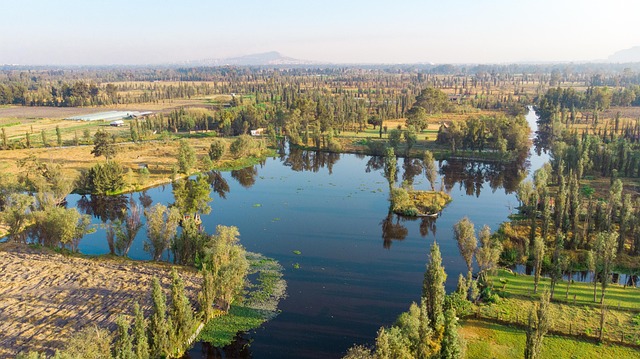
Chinampa agriculture around Tenochtitlan and neighboring cities is estimated to have supported a population in the hundreds of thousands, an extraordinary figure for a pre-industrial city and one that rivaled or exceeded the largest cities in Europe at the time of Spanish contact. Farmers moved between plots by canoe, transported produce to urban markets along canals that functioned much like streets, and rotated crops to maintain soil fertility, all without draft animals, since none of the region’s native fauna were suited to plowing or hauling in the way horses and oxen were used elsewhere in the world.
Outside the lake basin, Nahua communities practiced more conventional rain-fed and terraced agriculture on hillsides and in valleys, adapting techniques to local rainfall, soil, and elevation across the varied terrain of central Mexico. Households supplemented farming with hunting, particularly of deer, rabbits, and waterfowl drawn to the lake system, along with fishing and the harvesting of insects, algae, and other lake products that provided important protein and were far more central to the pre-conquest diet than many outsiders later assumed.
Craft production and trade were woven tightly into everyday Nahua life, with specialized markets, called tianquiztli, operating on a rotating schedule across the region and drawing merchants from great distances to exchange textiles, obsidian tools, feathers, cacao, and salt. The great market of Tlatelolco, adjoining Tenochtitlan, was reportedly large enough to astonish the first Spanish observers who saw it, some of whom compared its scale and organization favorably to the largest markets they knew in Europe, a comparison that speaks to how developed Nahua economic life already was well before conquest.
Society
Nahua political organization centered on the altepetl, a term often translated as “city-state” but carrying a richer meaning as a community bound to a specific territory, a patron deity, and a ruling lineage. Each altepetl was typically subdivided into smaller units called calpolli, neighborhood or kinship groups that organized land use, labor obligations, tribute collection, and military service, and that gave ordinary Nahua people their most immediate sense of civic belonging. Above the calpolli sat the tlatoani, a hereditary ruler whose title literally means “he who speaks,” reflecting the ruler’s role as the voice of the altepetl in dealings with other communities.

By the fifteenth century, three major altepetl, Tenochtitlan, Texcoco, and Tlacopan, had formed the Triple Alliance, the political arrangement that modern historians usually mean when they refer to the Aztec Empire. This was not a centralized empire in the modern sense but a hegemonic system in which conquered altepetl retained their own rulers and internal organization while paying tribute and providing military support to the alliance, a structure that left considerable local autonomy intact even under Mexica dominance. This is an important reason why so many Nahua communities outside Tenochtitlan continued to think of themselves as distinct peoples with their own histories, even while paying tribute to the Triple Alliance.
Nahua society was stratified but not rigidly closed, with a broad distinction between pipiltin, the nobility, and macehualtin, commoners, alongside specialized classes of long-distance merchants called pochteca and a warrior class whose prestige could elevate even a commoner-born man of sufficient battlefield achievement. Education reflected this structure, with separate schools for nobles, the calmecac, emphasizing priestly training, history, and statecraft, and schools for commoners, the telpochcalli, focused more on practical skills and military training, though both aimed to instill discipline, service, and respect for communal obligation.
Gender roles were similarly structured but allowed women meaningful economic and religious roles, particularly in weaving, market trade, and certain priestly and healing functions, and Nahua cosmology assigned complementary rather than strictly subordinate roles to male and female principles in its understanding of the universe. Marriage, inheritance, and property arrangements varied across the many Nahua altepetl, but shared an underlying emphasis on the household and the calpolli as the basic units through which land, labor, and social obligation were organized and passed down across generations.
Religion
Nahua religion before conquest was polytheistic and deeply woven into agricultural cycles, warfare, and the maintenance of cosmic order, with a pantheon that included deities such as Huitzilopochtli, the patron god of the Mexica associated with the sun and war, Tlaloc, the rain god whose favor was essential for maize agriculture, and Quetzalcoatl, the feathered serpent associated with wind, learning, and the priesthood. Nahua cosmology held that the world had already passed through several previous ages, each ending in destruction, and that the current age depended on continued ritual maintenance, including offerings and sacrifice, to keep the sun moving and the world from collapsing again.

Religious life was centered on great temple complexes, the most famous being the Templo Mayor of Tenochtitlan, a twin-staired pyramid dedicated jointly to Huitzilopochtli and Tlaloc that stood at the symbolic heart of the Mexica capital and the wider Triple Alliance. Priests, drawn substantially from the noble class and trained from childhood at the calmecac schools, conducted an elaborate calendar of ceremonies tied to both a 365-day solar calendar and a 260-day ritual calendar, whose interlocking cycles produced a repeating fifty-two year “century” that carried great cosmological significance and anxiety around its completion.
Spanish conquest brought forced conversion to Catholicism, often accompanied by the deliberate destruction of temples, the burning of painted codices, and the suppression of priesthoods, yet Nahua religious practice did not simply vanish so much as it was reshaped and layered beneath a Catholic surface. Many colonial-era churches were built directly on top of former temple sites, using stones taken from the demolished structures, a pattern visible today at sites such as the Metropolitan Cathedral, built over the ruins of the Templo Mayor itself.
Contemporary Nahua religious life is overwhelmingly Catholic in self-identification, but frequently incorporates elements that scholars trace to pre-conquest belief, including particular reverence for certain saints associated with older deities, agricultural blessing ceremonies tied to the maize cycle, and continued respect for specific mountains, springs, and caves treated as sacred or inhabited by spiritual forces. This blended religious landscape, sometimes described as syncretism, reflects centuries of negotiation rather than a simple replacement of one belief system by another.
Traditions
Music and dance have long carried religious and social weight in Nahua culture, from pre-conquest ceremonies accompanied by drums, flutes, and rattles to the later colonial-era fusion traditions that produced genres recognizable across Mexico today. Mariachi, though it developed its familiar modern form in the western state of Jalisco through a long mixture of Indigenous, Spanish, and other influences, is frequently cited as an example of how deeply Nahua and other Indigenous musical sensibilities became entangled with colonial and later national Mexican identity, even where the direct genealogy is difficult to trace precisely.

More directly traceable Nahua performance traditions include the Danza de los Concheros, a ceremonial dance practiced by groups who see themselves as spiritual descendants of pre-conquest warrior societies, performed in elaborate feathered headdresses to the sound of stringed instruments called concha shells, often at sites with pre-conquest religious significance. Similarly, the Voladores ritual, in which participants launch themselves from a tall pole suspended by ropes to spin slowly to the ground while a musician plays atop the pole, though most closely associated with the Totonac people of Veracruz, is also performed by Nahua communities in parts of Puebla and Veracruz and reflects a shared regional ceremonial inheritance.
Oral tradition remains a vital thread of Nahua culture, carrying forward creation narratives, moral instruction, and historical memory in forms that blend pre-conquest content with centuries of subsequent reinterpretation. Elders in many Nahua communities continue to pass down stories about figures such as the culture hero Quetzalcoatl or moral tales warning against greed, laziness, or disrespect for elders, often delivered in Nahuatl and carrying idiomatic and poetic structures that do not translate easily into Spanish or English.
Compadrazgo, the system of ritual kinship formed through godparenthood at baptism, confirmation, and marriage, is another tradition that though introduced through Catholic practice has been thoroughly integrated into Nahua social life, creating dense networks of obligation and mutual aid that extend well beyond blood relations. These godparent relationships often carry specific responsibilities around gift-giving, labor assistance, and moral guidance, and remain one of the most practically important social institutions in many contemporary Nahua communities, shaping who can be called upon for help in times of celebration or hardship.
Crafts
Pre-conquest Nahua craft production reached a remarkable level of sophistication across several distinct fields, most famously in featherwork, where specialist artisans called amanteca assembled brilliantly colored feathers from tropical birds such as the quetzal into elaborate headdresses, shields, and mosaic images, a skill so highly regarded that entire calpolli were organized around its practice in Tenochtitlan. Obsidian, the naturally occurring volcanic glass abundant in central Mexico, was worked with extraordinary precision into blades sharp enough for surgery and warfare, ceremonial knives, and polished mirrors used in divination, and its extraction and trade formed an important economic sector across the Nahua world.

Textile production, overwhelmingly the domain of women, involved backstrap-loom weaving of cotton and maguey fiber into cloth that served not only practical purposes but also functioned as a form of currency and tribute, with finely woven garments signaling status and skill. Dyes derived from cochineal insects, indigo, and various plants produced a vivid palette long before synthetic alternatives existed, and specific weaving patterns and garment styles could identify a wearer’s home altepetl to anyone familiar with regional variation, functioning as a visual language of belonging.
Goldsmithing and metalworking, though metallurgy arrived comparatively late to Mesoamerica relative to other world regions, had developed considerable skill by the time of Spanish contact, producing intricate jewelry, ornaments, and ceremonial objects that Spanish accounts describe with a mixture of admiration and greed, since much of this metalwork was subsequently melted down and shipped to Spain, destroying irreplaceable examples of Nahua artistry in the process. Lapidary work in jade, turquoise, and other valued stones similarly produced masks, mosaics, and ornaments tied closely to religious and elite use.
Many of these craft traditions persist today in adapted form across Nahua communities, with regions such as Puebla and Guerrero maintaining strong reputations for pottery, textiles, and woodworking that draw both on pre-conquest technique and on centuries of subsequent innovation and market adaptation. Amate bark paper, once used for codices and ritual objects, is still produced by artisan communities and has found a modern market as a surface for painted folk art, representing one of several ways that ancient Nahua craft knowledge has been repurposed to sustain artisan livelihoods in the present.
Food
Maize sits at the absolute center of Nahua food culture, both historically and today, prepared in an extraordinary range of forms that reflect centuries of culinary refinement around a single staple crop. Nixtamalization, the process of cooking dried maize kernels in an alkaline solution before grinding, was a Mesoamerican innovation that improved the nutritional value of maize and produced the dough, masa, that underlies tortillas, tamales, and countless other dishes, a technique so fundamental that it likely predates the Nahua’s own arrival in central Mexico but was thoroughly adopted and refined by them.

Beyond tortillas and tamales, Nahua cuisine historically drew on chia and amaranth seeds, both nutritionally dense crops that also carried ritual significance, with amaranth dough figures used in certain pre-conquest ceremonies in ways that alarmed Spanish missionaries enough that the crop’s cultivation was actively suppressed for a period after conquest. Beans and squash rounded out the core agricultural triad, while chili peppers, present in an enormous range of regional varieties, provided both flavor and, in Nahua medical thought, therapeutic properties tied to a broader humoral-style understanding of hot and cold foods.
Chocolate, prepared from cacao beans that had to be imported from tropical lowland regions since cacao does not grow in the highland Valley of Mexico, was a prestige beverage among Nahua elites, typically consumed as a frothy, spiced drink rather than as a solid confection, and was valuable enough that cacao beans also functioned as a form of currency in Nahua markets. Insects, including chapulines, or grasshoppers, and various maguey worms, provided an important and still-valued protein source, prepared with chili and lime in ways that remain popular in Oaxaca and other regions with strong Nahua and neighboring Indigenous populations.
The maguey plant, in addition to its fiber uses, produced pulque, a mildly alcoholic fermented beverage with deep ceremonial associations, regulated in pre-conquest society by strict social rules about who could drink it and when, since public drunkenness outside sanctioned ritual contexts carried serious social penalties. Today, Nahua food culture continues to evolve, blending ancestral staples with ingredients introduced after conquest, such as pork, chicken, and dairy, producing hybrid dishes that nonetheless remain recognizably rooted in the maize-centered foundation established many centuries ago.
Festivals
The pre-conquest Nahua ritual year was organized around eighteen twenty-day months, each associated with specific deities and agricultural stages and marked by distinct ceremonies, some involving elaborate public spectacle and offerings tied closely to the maize cycle, rainfall, and the changing seasons. These festivals were not simply religious observances but major civic events that reinforced political hierarchy, redistributed resources, and drew communities together, with the largest ceremonies in Tenochtitlan drawing participants and tribute from across the wider Triple Alliance territory.

The most internationally recognized Nahua-influenced observance today is Dia de los Muertos, the Day of the Dead, celebrated primarily on November first and second and centered on home and cemetery altars, called ofrendas, built to welcome the spirits of deceased relatives back for a brief visit each year. Scholars debate exactly how much of the modern holiday descends directly from pre-conquest Nahua beliefs about death and the underworld, since the specific November dates and much of the current form were shaped by the Catholic calendar’s All Saints and All Souls observances, but the underlying idea of a permeable boundary between the living and the dead has clear roots in Nahua and broader Mesoamerican cosmology.
Marigold flowers, called cempasuchil in Nahuatl, are central to Day of the Dead altars, believed to guide spirits back to the world of the living through their strong scent and vivid orange color, and their cultivation for this purpose supports significant agricultural activity in parts of central Mexico each autumn. Altars are typically built with photographs of the deceased, their favorite foods and drinks, candles, incense, and pan de muerto, a sweet bread baked specifically for the occasion, reflecting a blend of Indigenous and Catholic elements that has become one of Mexico’s most recognizable cultural exports.
Beyond Day of the Dead, many Nahua communities maintain patron saint festivals, called fiestas patronales, that combine Catholic religious observance with music, fireworks, feasting, and sometimes older ceremonial elements such as the Voladores or Concheros dances described earlier, functioning as major annual gatherings that draw migrants home from distant cities or even from the United States to reaffirm ties to their community of origin.
History
The Triple Alliance, formed in 1428 when Tenochtitlan, Texcoco, and Tlacopan united to overthrow the dominant power of Azcapotzalco, rapidly expanded through a mixture of military conquest and negotiated tribute agreements, eventually controlling or influencing much of central and southern Mexico by the early sixteenth century. This expansion was never absolute, however, since important rival states such as Tlaxcala remained fiercely independent, a fact that would prove decisive when Spanish forces arrived and found ready allies among peoples who resented Mexica dominance and tribute demands.

Hernan Cortes landed on the Gulf coast in 1519 and, through a combination of alliance-building with Tlaxcala and other disaffected Nahua and non-Nahua groups, superior weaponry, internal Mexica political crisis, and the devastating impact of introduced diseases such as smallpox, brought about the fall of Tenochtitlan in 1521 after a brutal siege. The conquest was in significant part a Nahua civil war amplified and exploited by Spanish forces, rather than a simple contest between Europeans and a unified Indigenous population, a nuance often lost in popular retellings that flatten the conflict into two opposing sides.
Colonial rule brought catastrophic demographic collapse across Nahua communities, driven overwhelmingly by epidemic disease rather than direct violence, with some estimates suggesting population losses exceeding eighty percent across the sixteenth century alone. Spanish administrators nonetheless relied heavily on existing Nahua political structures to govern, preserving the altepetl as a unit of colonial administration under the label of the “republica de indios,” and Nahua nobles who cooperated with colonial authorities often retained local status and property, even as the broader population was subjected to forced labor, tribute, and religious conversion.
The nineteenth and twentieth centuries brought further upheaval, as Mexican independence, land reform movements, and the Mexican Revolution repeatedly reshaped Nahua communities’ relationship to land and the state, sometimes redistributing land back to Indigenous communities and sometimes displacing them further through haciendas and later industrial development. Nahuatl place names, foods, and cultural references were meanwhile absorbed into a broader Mexican national identity, sometimes celebrated as heritage while the living Nahua people who carried that heritage forward continued to face poverty, discrimination, and pressure to abandon their language in favor of Spanish.
Today
Nahua people today number roughly two million by ethnic self-identification, with over one and a half million speakers of Nahuatl recorded in recent Mexican censuses, making them by a wide margin the largest Indigenous language community in the country. Concentrations remain strongest in the states of Puebla, Veracruz, Hidalgo, San Luis Potosi, Guerrero, and the State of Mexico, with communities ranging from small mountain villages maintaining strong Nahuatl monolingualism among older residents to periurban and urban populations where Spanish has become dominant among younger generations.

Contemporary Nahua communities face many of the same pressures confronting Indigenous peoples across Mexico, including land disputes tied to mining, agribusiness, and infrastructure projects, out-migration driven by limited local economic opportunity, and the ongoing challenge of maintaining Nahuatl transmission to children growing up in an overwhelmingly Spanish-language school system and media environment. At the same time, recent decades have seen a notable increase in Nahuatl-language publishing, radio broadcasting, and educational materials, alongside university programs and community-led initiatives specifically aimed at documenting and revitalizing regional Nahuatl varieties before further erosion occurs.
Nahua migration to the United States, particularly from Puebla, Guerrero, and Veracruz, has created significant diaspora communities in states such as California, New York, and North Carolina, where Nahuatl continues to be spoken alongside Spanish and English within extended family and hometown association networks. These transnational communities often maintain active ties to home villages through remittances, return visits for patron saint festivals, and organized hometown associations that fund local infrastructure projects, extending Nahua social and economic life across international borders in ways that would have been unimaginable to earlier generations.
Mexico’s broader national identity continues to draw heavily, if often superficially, on Nahua and Mexica imagery, visible in the eagle-and-cactus emblem on the national flag, in place names across the country, and in the vocabulary embedded in everyday Spanish, even as living Nahua communities continue to advocate for greater recognition, land rights, and support for language preservation. The gap between this symbolic prominence and the practical challenges facing contemporary Nahua communities remains one of the more striking tensions in modern Mexican Indigenous politics, and one that Nahua activists, scholars, and community leaders continue to work to close.
Nearby Peoples of Mexico
The Nahua share the highlands and valleys of Mexico with several other peoples covered elsewhere on this site, each with its own distinct history alongside and often intertwined with Nahua and Mexica influence.
You May Like
The Damara, an Ancient People of Namibia