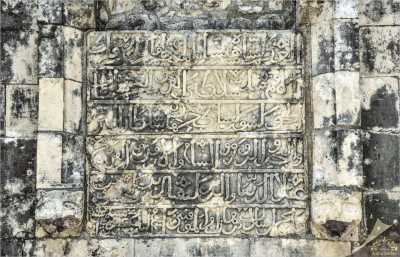
Alara Inn is located on the Antalya-Alanya route, within the borders of Okurcalar town and Çakallar village. According to the six-line inscription placed on the low-arched door opening on the northeast façade, the building was built by the Seljuk Sultan Alaeddin Keykubad I in 1231-1232. The unusual plan arrangement of the building known as Alara Han suggests that it was recorded in the lost inscription block as a ribat built for the purpose of accommodation of the Sultan’s army during their travels on the Alanya, Antalya or Konya routes.
Located on the edge of the Alara Stream, the inn has a rectangular planned seating area extending in the northeast-southwest direction. Apart from the main facade, there are triangular prismatic shaped buttresses on the northwest and southwest facades, placed at regular intervals and rising up to the façade level. Since the southeastern façade was built close to the slope of the earthen hill rising in this direction, it was built with rough and rubble stones to function as a retaining wall. The dendans rising at the eaves level of the building continuously surround the entire roof, including the buttresses, as loophole teeth.
The inn is entered through a low-arched door opening in the middle of the northeast façade and between two rectangular towers. On the low arch, there is the construction inscription of the inn in a round arched and profiled frame, sitting on a stone console with symmetrically placed lion heads. It is noteworthy that in the inscription, it is mentioned that among the titles of Sultan Keykubad, the founder of the building, are “Lord of the Arab and Persian Sultans” and “Sultan of the Greeks, Damascus, Armenians and Franks”. Currently, the gap above the inscription and in the area surrounded by the round arch explains that the upper part of the inscription has disappeared over time.
The entrance of the inn is designed as a small square-shaped courtyard. The semi-open space on the east wing, opening to the courtyard in the form of a pointed arch, is the fountain iwan covered with a star vault. On the east wall, there is a fountain in the form of a rectangular niche covered with an oyster-shaped arch carved from a solid stone. On the lower edge of the niche, there is a water reservoir carved from a single piece of stone and two pipe holes on the front. It is understood that there was a rectangular trough at the bottom, placed between the two blocks of stone forming the iwan bench on both sides, and probably carved from a single piece of stone in the past. Considering the condition of the ruins around the pipe holes, it is thought that they may have been designed in the form of a lion’s head console in the past. The floor of the fountain iwan, the terraces and the fountain trough were destroyed by treasure seekers.

A seven-step stone staircase on the northern wall of the fountain iwan leads to the tower and roof on the eastern wing, which controls the entrance of the inn. Judging by the existing traces, from this tower it was possible to reach the roof on the façade wall, which forms the northern wing of the small courtyard in the entrance section, through a twitch. There is a room covered with a pointed barrel vault at the eastern end of the courtyard and two rooms adjacent to the western wing. The first room covered with a pointed barrel vault adjacent to the west wing is the masjid; It has been suggested that the other two rooms functioned as service spaces.
With a low arched door opening in the southern wing of the courtyard, the middle section is allocated to those staying at the inn and includes a corridor extending deeply in the northeast-southwest direction, and a plan arrangement consisting of mutually placed rooms and iwans, with semi-open and closed spaces opening to the corridor. It is thought that this different spatial arrangement on the long side of the corridor is related to the functions of the rooms during the day. It is understood that the corridor, which looks like an open courtyard with spaces covered with pointed barrel vaults, and which is currently covered with iron construction and a polycarbonate roof, was covered with a pointed barrel vault in the past.
A double-row gallery, connected to a corridor covered with pointed barrel vaults on the east and west wings of the courtyard located on the northeastern wing and forming the entrance section, surrounds the middle section of the inn from three directions. It is thought that the two galleries, covered with a pointed barrel vault and extending in the northeast-southwest direction adjacent to the middle section, were used in the past for unloading caravan loads as well as for resting the people staying at the inn and the servants; It has been claimed that other galleries along the outer edges also functioned as stables.

It is known that the lion-headed stone consoles placed on the arch legs of the galleries were used as structural elements where the oil lamps that provided illumination of the inn were placed. Stonemason’s marks as graffiti can be found on some of the smooth cut stones used in the construction of the inn, as well as red painted zigzag patterns made on plaster among the masonry.
Source: Selçuklu Municipality
Places to Visit in Antalya
Source: Antalya Provincial Culture and Tourism Directorate


One thought on “Alara Han – Travel Guide – Antalya”