Few peoples have made an impression on the world out of all proportion to their numbers as the Irish have. The island of Ireland is small, set out in the Atlantic at the western edge of Europe, and the number of people who actually live there has never been large. Yet ask almost anyone on any continent and they will know something of the Irish, their music and their poets, their saints and their rebels, the green of their fields and the great waves of emigrants who carried Irish names to cities across the world. There are many millions more people of Irish descent scattered across the globe than there are people in Ireland itself, a fact that tells you a great deal about both the warmth of Irish culture and the harshness of Irish history.
To understand the Irish is to hold two things together at once. On one side there is the sheer creative force of a people who gave the English language some of its greatest writers, who preserved learning when much of Europe had fallen dark, and whose songs and stories travelled wherever they went. On the other side there is a long history of conquest, dispossession, famine, and exile, a history of being a small nation living next to a powerful neighbor and paying a heavy price for it. The character of the Irish, by turns lyrical and stubborn, sociable and melancholy, was forged in the space between those two truths.
In This Article
- An island shaped by the sea and the rain
- The Celtic world and its language
- Saints, scholars, and the age of monasteries
- Vikings, Normans, and the long arrival of England
- Conquest, plantation, and the loss of the land
- The Great Famine and the scattering of a people
- The road to independence
- The Troubles in the north
- A people of words
- Faith and its loosening grip
- The diaspora and the Ireland it built abroad
- The transformation of modern Ireland
- The Irish today
- The land, the cattle, and the old way of life
- Myth, magic, and the otherworld
- What the Irish story tells us

An island shaped by the sea and the rain
Ireland is an island of soft, wet, green country, and its famous colour is no accident. The Atlantic weather sweeps in from the west almost without pause, wrapping the land in cloud and rain that keep the grass growing and give the island the nickname of the Emerald Isle. The interior is a wide lowland of fields and bogs, ringed by hills and low mountains, and the coast is wild and broken, especially in the west, where cliffs drop sheer into the ocean and the land frays into headlands and islands. It is a beautiful country and a demanding one, where the soil is good for grass and grazing but the climate gives little quarter.
This geography shaped a rural people. For most of history the Irish lived close to the land, herding cattle, growing what crops the climate allowed, and building their lives around small communities, the parish, and the extended family. The sea was both a barrier and a road, isolating Ireland from the continent while connecting it, through long centuries, to Britain, to the lands of the Vikings, and eventually to the wider Atlantic world toward which so many Irish would one day sail.

The Celtic world and its language
The Irish are, in cultural and linguistic terms, a Celtic people. In the centuries before the Christian era, a Celtic culture spread across much of western Europe, and on the island of Ireland it took root and survived long after it had been overwhelmed elsewhere by Rome and later by Germanic and other migrations. The Irish language, known to its speakers as Gaeilge, belongs to the Celtic branch of the Indo-European family and is one of the oldest written vernacular languages in Europe north of the Alps. For most of Irish history it was the everyday tongue of the great majority of the people.
Ireland was never conquered by Rome, and so it developed along its own lines, a patchwork of small kingdoms ruled by local kings, bound together by a shared language, a learned class of poets and lawyers, and an intricate body of native law. This early Irish society had no cities in the Roman sense and no central state, but it had a rich high culture carried by a professional learned elite who memorized genealogies, laws, and vast bodies of poetry. The reverence for words, for eloquence, and for the storyteller that runs through Irish culture to this day has deep roots in that ancient world.

Saints, scholars, and the age of monasteries
Christianity came to Ireland in the fifth century, and tradition gives the central role to Saint Patrick, a Romanized Briton who, captured as a youth and brought to Ireland as a slave, returned later as a missionary. Whatever the precise truth behind the legend, the island was Christianized over the following generations with remarkable speed and without the martyrdoms that marked conversion elsewhere, and the new faith fused with the old learned culture rather than destroying it.
What followed was one of the most extraordinary chapters in European history. As the western Roman world collapsed into what later ages called the Dark Ages, Irish monasteries became powerhouses of learning and art. Monks copied and preserved the texts of antiquity and produced illuminated manuscripts of breathtaking beauty, of which the Book of Kells is the most famous survivor. Irish missionaries then carried this learning back out across a continent that had largely lost it, founding monasteries from Britain to Italy. For a few centuries a small island at the edge of the world helped keep the lamp of European civilization burning, an achievement the Irish have never forgotten and never let the world forget.
Vikings, Normans, and the long arrival of England
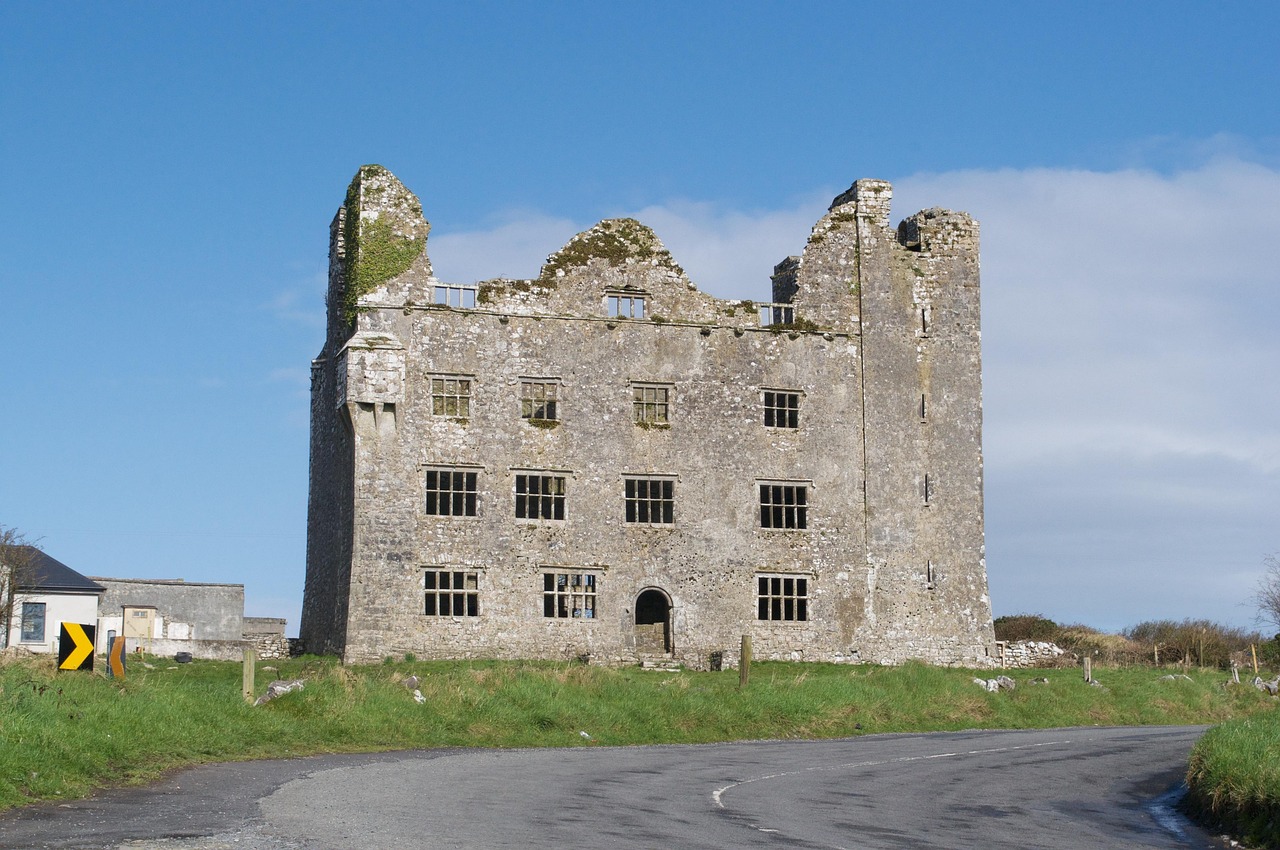
Ireland’s isolation did not last. From the late eighth century Viking raiders struck the coasts and monasteries, and in time they settled, founding the trading towns that became Dublin, Cork, Limerick, and Waterford, Ireland’s first true cities. The Norse were eventually absorbed into Irish life, but they had opened the island to the wider world and its conflicts.
The fateful turn came in the twelfth century, when Anglo-Norman lords, with the blessing of the English crown, crossed from Britain and seized lands across Ireland. This began the long and fraught involvement of England in Irish affairs that would dominate the next eight centuries. At first English control was partial and patchy, confined to an area around Dublin while much of the island remained under Gaelic Irish or hibernicized Norman lords. But the ambition of the English state grew, and from the sixteenth century onward, under the Tudors and their successors, England set out to subdue and control the whole island in earnest.

Conquest, plantation, and the loss of the land
The conquest of Ireland in the sixteenth and seventeenth centuries was brutal and transformative. It was tangled up with the religious wars of the age, for England had become Protestant while the Irish remained overwhelmingly Catholic, and so conquest came wrapped in religious hostility. Through a series of wars, confiscations, and organized settlements known as plantations, vast amounts of Irish land were taken from the native Catholic population and given to Protestant settlers from Britain. The north of the island, in particular, was heavily settled by Protestants, planting there the deep divide that would echo for centuries.
The defeats were crushing and the reprisals savage; the campaigns associated with Oliver Cromwell in the mid-seventeenth century in particular left a memory of massacre and dispossession that has never fully faded. By the early eighteenth century the Catholic Irish majority had been reduced to a largely landless people, governed by a Protestant ruling class and bound by the Penal Laws, a system of legal disabilities designed to keep Catholics out of power, property, and the professions. To be Irish and Catholic was, for generations, to be a stranger and a tenant in one’s own country. This long experience of dispossession lies at the root of much that followed.

The Great Famine and the scattering of a people
The defining catastrophe of modern Irish history struck in the 1840s. By then a large part of the rural population had come to depend almost entirely on the potato, the one crop that could feed a family on a small plot of poor land. When a blight destroyed the potato harvest year after year, the result was the Great Famine, one of the worst demographic disasters of nineteenth-century Europe. Around a million people died of starvation and disease, and another million or more fled the country, many on the overcrowded ships that became known as coffin ships for the deaths aboard them.
What made the famine so bitter in Irish memory was not only the blight but the response to it. Ireland continued to export food even as its people starved, and the government of the day, gripped by the economic dogmas of the era, did far too little far too late. To many Irish then and since, the famine was not merely a natural disaster but a moral indictment of the system that ruled them. Its effects were permanent. The population of Ireland fell sharply and, almost uniquely in Europe, kept falling for generations afterward as emigration became a fixed feature of Irish life. The great Irish diaspora, in the United States, Britain, Canada, and Australia, was born above all from this wound.

The road to independence
The nineteenth century also saw the slow, determined rise of Irish nationalism. Campaigns for Catholic rights, for land reform, and for self-government built a powerful movement, and the Irish question dominated British politics for decades. Constitutional nationalists pressed for Home Rule, a measure of self-government within the United Kingdom, while a more radical, separatist tradition kept alive the dream of a fully independent Irish republic.
That dream burst into the open with the Easter Rising of 1916, a rebellion in Dublin that was militarily crushed within a week. But the execution of its leaders turned defeat into a powerful symbol, and public opinion swung decisively toward independence. A war of independence followed, and in the early 1920s most of Ireland won self-government, eventually becoming the fully sovereign Republic of Ireland. The settlement, however, came at a price that still shapes the island. Six counties in the north, with their large Protestant and unionist population, remained part of the United Kingdom as Northern Ireland, and the new Irish state was born in a bitter civil war between those who accepted the compromise and those who rejected it. Freedom, when it came, was real but partial and hard-won.

The Troubles in the north
The unresolved question of the north erupted into violence in the late 1960s. In Northern Ireland the Catholic, mostly nationalist minority faced discrimination in housing, jobs, and political representation by the Protestant, mostly unionist majority, and a civil rights movement demanding equality met fierce resistance. The conflict spiralled into three decades of violence known simply as the Troubles, a grinding struggle involving paramilitary groups on both sides, the British army, and the security forces, in which thousands of people were killed and many more wounded and scarred.
The Troubles were a tragedy with no clean heroes, marked by atrocities committed by more than one side and by the suffering of ordinary people caught in the middle. After decades of bloodshed, a peace process patiently built across the 1990s led to the Good Friday Agreement of 1998, which created power-sharing institutions and largely ended the violence, though the underlying questions of identity and belonging in the north have not disappeared. The peace remains, for many, one of the great achievements of modern Irish and British history, and a reminder of how long and hard the road from conflict to reconciliation can be.

A people of words
For all the weight of this history, the Irish are perhaps best known to the world for something lighter and more enduring, their extraordinary gift for words. It is a small wonder of cultural history that a country this size has produced so many giants of literature, and in a language, English, that was in part imposed upon it. The list is staggering, from Jonathan Swift and Oscar Wilde to William Butler Yeats, James Joyce, Samuel Beckett, and a long line of poets and playwrights down to the present day. Several of them won the Nobel Prize; all of them helped shape modern literature in English.
This love of language is not confined to the famous. It lives in everyday Irish speech, in the quickness of the wit, the relish for a good story, and the social art of conversation. The Irish pub, at its best, is less about drink than about talk and music, a place where strangers fall into conversation and where the old tradition of the storyteller and the singer continues by other means. Alongside the literary heritage runs an equally rich tradition of music and dance, the fiddles and pipes and bodhrans of traditional Irish music that, like Irish writing, travelled with the emigrants and became loved around the world.
Faith and its loosening grip
For most of its modern history, Ireland was one of the most devoutly Catholic countries in the world, and the Catholic Church was woven into every part of national life, shaping schools, hospitals, attitudes, and the rhythm of the year. Faith had been bound up with national identity during the centuries of Protestant rule, and after independence the Church wielded enormous moral and social authority. To be Irish, for a very long time, was almost by definition to be Catholic.
That has changed dramatically and quickly. In recent decades Ireland has become a far more secular and liberal society, a transformation accelerated by revelations of grave abuses committed within Church-run institutions, which shattered much of the old deference. In a single generation the country moved from one of the most socially conservative in Europe to one that embraced reforms once unthinkable. The Catholic heritage remains a deep part of Irish culture and memory, but its grip on daily life and public morality has loosened in a way that few would have predicted not long ago. The Irish, who share much of their Celtic and Christian inheritance with their neighbors, can be set alongside another old Celtic people of these islands, as told in our piece on the Welsh and their ancient language.
The diaspora and the Ireland it built abroad
No account of the Irish can ignore the tens of millions of people of Irish descent living far from the island. Driven out by famine, poverty, and lack of opportunity, generations of Irish emigrants built new lives in the cities of America, Britain, Canada, and Australia, often starting at the very bottom and facing prejudice and hardship. Over time they rose, entering politics, business, the church, and public life, and shaping the countries they settled in. The Irish presence in the United States in particular became a powerful force, sending presidents and senators of Irish descent to the highest offices and keeping ties to the old country alive across the generations.
This vast diaspora gave Ireland an influence in the world far beyond its size. Irish culture, Irish music, Irish festivals like the global celebration of Saint Patrick’s Day, and a romantic attachment to the idea of Ireland spread to every continent. For the island itself, emigration was a long sorrow, the steady loss of its young people, but it also created bonds and networks that, in time, would help draw investment, visitors, and renewed connection back home. The story of the Irish is, in a real sense, a story that takes place as much abroad as on the island.
The transformation of modern Ireland
The Ireland of the twenty-first century would astonish anyone who knew the poor, rural, emigrant-haunted country of earlier generations. After joining what became the European Union, Ireland transformed itself from one of western Europe’s poorest economies into a prosperous, open, high-technology society. For a period around the turn of the millennium it grew so fast that it earned the nickname of the Celtic Tiger. That boom ended in a painful financial crash, but the country recovered, and Ireland today is a wealthy, well-educated, outward-looking nation, home to the European operations of many of the world’s largest technology and pharmaceutical companies.
For the first time in its modern history, Ireland became a country that people moved to rather than only from, drawing immigrants from across Europe and beyond and becoming markedly more diverse. The change has brought new energy and new challenges, including the strains of rapid growth on housing and services, and debates over identity in a society transforming faster than almost any other in Europe. But the broad arc is unmistakable. A people long defined by what it had lost found, at last, a measure of prosperity and confidence on its own terms.
The Irish today
The modern Irish carry their long and painful history lightly, or seem to, with a humor and warmth that visitors remember as much as the green of the fields. There is, beneath the famous friendliness, a toughness and a wry realism that centuries of hardship instilled, and a complicated relationship with their large neighbor across the sea that mixes resentment, intimacy, and, increasingly, an easy familiarity. The wounds of the north have largely scarred over, even if they have not entirely healed, and the relationship between the Republic and Northern Ireland, and between Ireland and Britain, remains one of the central facts of Irish life.
What endures most strongly is a powerful sense of identity. After everything, the Irish remained recognizably themselves, a people with their own music, their own way with words, their own memory, and their own quietly fierce attachment to a small green island in the Atlantic. The Irish language, though spoken daily by only a minority, is cherished as a national treasure and taught to every child, a deliberate act of holding on to something that conquest tried for centuries to erase.
The land, the cattle, and the old way of life
For most of their history the Irish were a pastoral people, and the rhythms of cattle and grass ran deep in the culture. Ancient Irish wealth was measured in cattle, the great early sagas turn on cattle raids, and the green fields divided by stone walls and hedgerows that still define the Irish landscape are the legacy of countless generations of herders and small farmers. Even in the modern, urbanized Ireland of today, the country retains a powerful rural identity, and a large share of the population can trace their families back only a generation or two to a small farm in the west or the midlands.
This closeness to the land bred a particular relationship with place and with kin. Townlands and parishes carried names and stories going back centuries, and people knew not only their own families but the histories of the families around them. The pull of home, of the particular field and house and graveyard where one’s people belonged, was strong enough that emigrants carried it with them across oceans and passed it to children who had never seen the place. The fierce Irish attachment to roots, to where one is from, is one of the most distinctive things about the culture, and it survived even the great scattering of the famine years.
Myth, magic, and the otherworld
Beneath the Christian surface of Irish culture runs an older current of myth and belief that never entirely went away. Pre-Christian Ireland had a rich mythology of gods, heroes, and an otherworld of the supernatural, and much of it survived in folklore long after the conversion to Christianity. The fairy folk, the sidhe, were believed to inhabit the ancient mounds and ringforts that dot the countryside, and a whole body of custom grew up around not offending them. Holy wells, ancient stones, and sacred places kept a numinous quality that mixed Christian and far older meanings.
This inheritance of myth gave Irish literature and imagination an extraordinary depth to draw upon. When writers and scholars of the modern era set out to revive a sense of Irish identity, they returned again and again to these old stories of Cu Chulainn and the heroes of the sagas, of the legendary cycles of kings and warriors, finding in them a heritage as rich as any in Europe. The sense that the everyday world borders on another, stranger one, that the land itself is haunted by story and memory, runs through Irish culture from the ancient tales to the work of its modern poets, and it is part of what gives the Irish imagination its particular flavour.
What the Irish story tells us
The history of the Irish is, in the end, a story of survival and of creation in the face of loss. Few peoples have endured as much, conquest, dispossession, famine, mass emigration, and decades of conflict, and few have responded by producing so much beauty, in literature, in music, in faith, and in the sheer human warmth that the word Irish has come to suggest around the world. The Irish lost their land, very nearly lost their language, and saw half their people scattered across the earth, and yet they remained, unmistakably, themselves.
Perhaps that is the deepest lesson of the Irish story, that a people can be conquered without being erased, scattered without being dissolved, impoverished without being made poor in spirit. From a small, wet, green island at the edge of Europe, the Irish sent their words and their songs and their descendants out across the world, and in doing so turned one of history’s harshest chapters into one of its most enduring cultural legacies. To raise a glass in an Irish pub while the music plays is to take part, however briefly, in that long act of survival made joyful.
You May Like
The Zaza, a Mountain People of Eastern Anatolia


One thought on “How a Conquered Island People Conquered the World With Words”