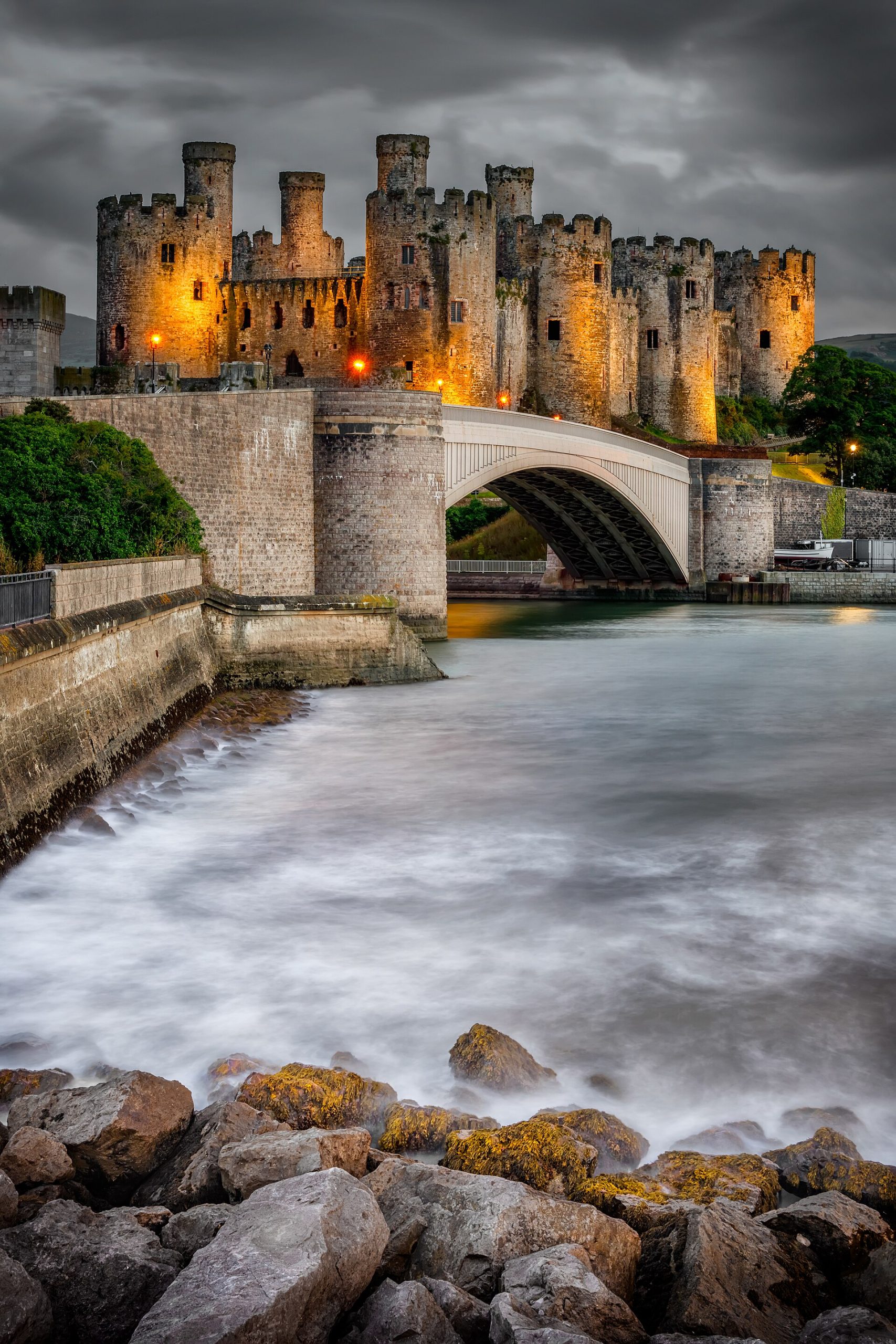
If Caernarfon was Edward I’s imperial showpiece, Conwy was his perfect fortress. Standing on a rock where the River Conwy meets the sea in North Wales, it is, for many people, the most satisfying castle in Britain to look at: eight huge round towers, several crowned with tall watch-turrets, strung along a high curtain wall in a shape so bold and so complete that it looks almost like a model of what a medieval castle should be. And unlike so many castles, it does not stand alone. It is joined to an almost perfectly preserved ring of medieval town walls, so that castle and town together form one of the finest surviving fortified townscapes anywhere in Europe.
Like Caernarfon, Conwy was born of conquest. It was thrown up in a matter of a few years in the 1280s, as part of Edward I’s iron ring of castles built to crush and hold conquered Wales, and it was the work of the same brilliant architect, Master James of St George. But where Caernarfon shouted imperial propaganda, Conwy simply gets on with the job of being one of the strongest and most beautifully sited fortresses of the age, guarding its river, its harbour, and its little English town planted in Welsh soil.
It also has real drama in its past, including a winter when the king of England himself was trapped inside these walls and a daring day when Welsh rebels seized the mighty castle by a trick. So let’s cross into the walled town and climb up into the towers of one of the greatest castles Edward ever built.
We will look at both the fortress and the town, because at Conwy the two really are one creation, planned and built together as a single act of conquest and colonisation. Keep that partnership in mind as we go, and the castle stops being an isolated monument and becomes what it truly was: the stone heart of a whole fortified town, dropped almost overnight into a newly conquered land.
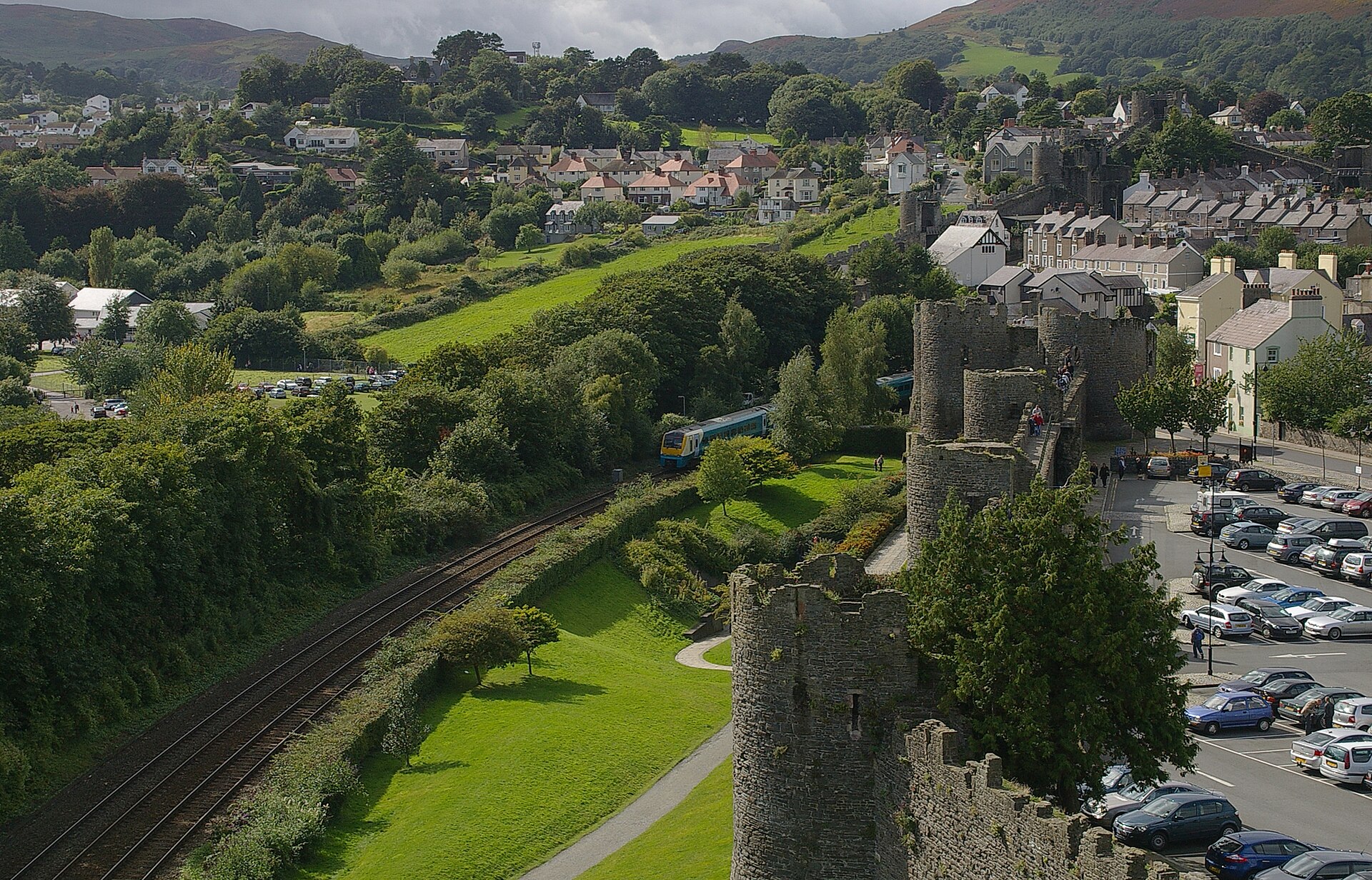
Table of Contents
- Born of Conquest
- Eight Towers on a Rock
- A Feat of Medieval Engineering
- A Ring of Walls Around a Town
- The King Trapped in His Own Castle
- Seized by a Trick
- Decline and a Long Sleep
- Three Bridges and a Famous View
- A Perfectly Preserved Medieval Town
- The Jewel of the Iron Ring
- Visiting Conwy
- Nearby Castles
- Before You Go
Born of Conquest
Conwy Castle came out of the same ruthless project as Caernarfon: Edward I’s determination, in the 1280s, to make his conquest of Wales permanent. Having destroyed the independent princes of Gwynedd, Edward set about ringing their mountainous heartland with a chain of colossal castles, and Conwy was among the first and finest. Work began in 1283, and, astonishingly, the main structure was largely complete within just four or five years, an incredible pace for a fortress of such size.
The location was chosen with real cunning. The castle sits on a long, narrow rock at the point where the River Conwy broadens toward the sea, giving it natural defences on several sides and command of the river crossing and the harbour. Crucially, its position by the water meant it could always be supplied and reinforced by sea, even if the surrounding countryside rose in revolt, a vital feature for an English fortress planted in hostile territory.
To build here, Edward swept away an existing Welsh religious house of great importance and relocated it elsewhere, a telling act that shows how completely he was prepared to remake the landscape to suit his purposes. On the cleared site rose not just a castle but a whole new walled town, an English colony designed to dominate and settle the conquered land.
The speed of the work still amazes historians. To raise a fortress of this size, together with a full circuit of town walls, in just a few short building seasons required an army of workers and a river of money, all organised with military precision. Master James of St George, the Savoyard architect who oversaw Edward’s Welsh castles, drove the project on, and Conwy stands as one of the supreme monuments to his genius and to the sheer organisational power of the medieval English state.
Eight Towers on a Rock
Conwy’s design is beautifully simple and brutally effective. Because it sits on a long rock, the castle is not the usual concentric square but an elongated shape following the ridge, divided into two wards, an outer and an inner, each guarded by four great round towers, eight in all. These massive drum towers, several topped with slender stone turrets from which watchmen could scan the horizon, give Conwy its unmistakable and much-loved silhouette.
The division into two wards reflected how the castle was used. The larger outer ward held the great hall, kitchens, and the main garrison quarters, the busy working heart of the fortress. The smaller, more strongly defended inner ward, at the far end of the rock, contained the private royal apartments, a secure and relatively comfortable residence for the king when he came to Wales, cut off from the rest of the castle by its own gate and defences.
The whole thing is a masterclass in medieval military design, exploiting the natural rock, layering its defences, and turning the castle into a series of strongpoints that an attacker would have to overcome one by one. Even today, walking its walls and climbing its towers, you can read the clear, hard logic of the place, the work of an architect at the very height of his craft.
The great hall in the outer ward gives a real sense of the castle as a place of governance and ceremony, not just war. Long and imposing, it was where the business of holding down North Wales was conducted, where officials gathered and justice was dispensed. Even ruined and roofless, its scale speaks of a fortress that was meant to be a centre of English power and administration, the seat from which a conquered land was to be ruled.

A Feat of Medieval Engineering
It is worth pausing to marvel at how Conwy was actually built. In an age without machinery, everything, the shaping and hauling of thousands of tonnes of stone, the digging of ditches into solid rock, the raising of towers dozens of metres high, was done by hand, by gangs of labourers, masons, carpenters, and smiths gathered from across England and beyond. Timber, lead, iron, and tools were shipped in, and the whole enormous effort was coordinated and paid for by the crown.
The cost was staggering, part of a Welsh castle-building programme that consumed a large share of the royal income for years and pushed even Edward’s finances to the limit. That the king was willing to spend on such a scale shows how vital he judged these castles to be, not as luxuries but as the essential machinery of a permanent conquest.
When you stand in the ward at Conwy and look up at the towers, it is worth remembering the vast human effort frozen in that stone. Each block was cut, lifted, and set by hand, in a building campaign of a size and speed that would be impressive even today, and that was little short of miraculous seven hundred years ago.
A Ring of Walls Around a Town
What makes Conwy truly exceptional is that the castle is only half the story. Attached to it, and built at the same time, is a complete circuit of town walls, ringing the little town in a great loop of stone studded with towers and pierced by fortified gates. This is one of the finest and most complete sets of medieval town walls surviving anywhere in Europe, and you can still walk much of the circuit today, high above the streets and rooftops.
The walls were not an afterthought but an essential part of Edward’s plan. The town they enclosed was a deliberate English plantation, settled with English burgesses who were given privileges denied to the native Welsh, creating a loyal colony to hold down the surrounding country. Castle and walled town were conceived as a single military and political unit, a fortified English enclave in the heart of Wales.
To walk the walls of Conwy is to understand this vision directly. From up on the ramparts you look down into a townscape still shaped by its medieval origins, and out over the castle, the estuary, and the mountains beyond. Few places let you grasp so completely what a medieval walled town actually was, or how castle and community were bound together for defence.
The circuit is punctuated by more than twenty towers and three original gateways, and remarkably it was built to a single plan at the same time as the castle, rather than growing piecemeal over centuries as most town walls did. That unity of design is part of why it survives so coherently, and why walking it feels like stepping into a single, unaltered medieval moment rather than a patchwork of many ages.

The King Trapped in His Own Castle
Barely had the castle been finished when it played a dramatic part in a Welsh revolt. In the winter of 1294 to 1295, a major uprising under Madog ap Llywelyn swept North Wales, and King Edward I himself, campaigning in the region, was caught out and forced to take refuge in Conwy Castle as the rebellion raged around him. For a time the conqueror of Wales found himself besieged in one of his own new fortresses.
It was a difficult and humbling episode. Cut off, with the surrounding country in revolt, the king and his men endured a hard winter, running short of supplies as they waited for relief. According to a famous story, when a little wine was found, Edward insisted it be shared out or reserved for the sick rather than kept for himself, a tale meant to show the king’s solidarity with his hungry soldiers.
In the end the castle held, relief came by sea, the revolt was crushed, and Edward emerged unscathed. But the episode was a sharp reminder that even the mightiest castles could not make conquest entirely safe, and that Wales, for all Edward’s iron ring, remained a dangerous and unsettled land. The very strength of Conwy, though, had proved its worth, sheltering the king through his moment of peril.

Seized by a Trick
Conwy’s most audacious moment came more than a century later, during the great Welsh rebellion of Owain Glyndŵr in the early fifteenth century, the last serious bid for Welsh independence. In 1401, two Welshmen managed to capture the mighty castle not by storming its walls but by a clever ruse. While most of the garrison were away at church on a feast day, the pair talked their way in past a lone guard, overpowered him, and seized the castle for the rebels.
It was a stunning coup, a handful of men taking one of the strongest fortresses in Wales by guile rather than force, and it caused enormous embarrassment to the English crown. The rebels held Conwy for a time and used their prize as a bargaining chip, eventually negotiating terms before giving it up. The castle was recovered, but the episode became a celebrated tale of Welsh daring against the odds.
The story is a lovely counterpoint to Conwy’s brute strength. It shows that no castle, however formidable, was ever entirely safe from human cunning and the lapses of its defenders, and it gave the Welsh a small but satisfying victory in the shadow of the very walls built to subdue them.
The Glyndŵr rebellion that produced this escapade was the last great Welsh rising against English rule, and for a few years it genuinely threatened to undo the whole Edwardian settlement. That it reached even into the mightiest of the conquest castles, if only by a trick, shows how deep the desire for Welsh independence still ran more than a century after Edward’s armies had supposedly settled the matter for good.

Decline and a Long Sleep
After the drama of the Glyndŵr years, Conwy, like the other Edwardian castles, gradually declined in importance as Wales settled into English rule and the age of the great castle passed. It saw some action during the English Civil War in the seventeenth century, when it was held and then taken, but afterwards it was partly slighted and left to decay, its towers unroofed and its interiors stripped.
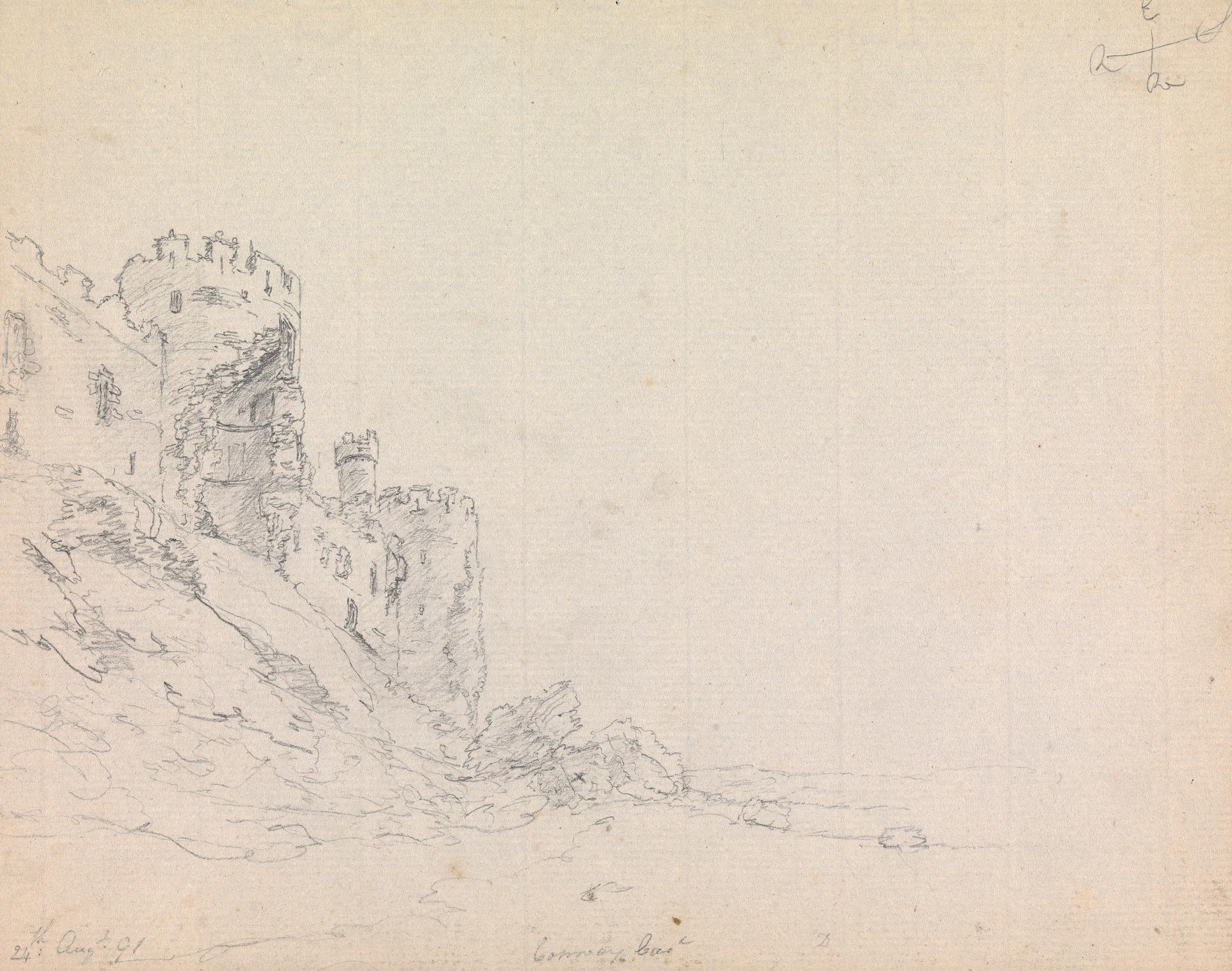
For a long time Conwy stood as a magnificent ruin, its shell largely intact thanks to the sheer quality of its building, but empty and neglected. It became, like so many castles, a subject for artists and travellers of the romantic age, who came to admire its dramatic towers and estuary setting and to paint one of the most picturesque scenes in Wales.
Its very completeness in decay, walls and towers standing to their full height even without their roofs, is part of what makes Conwy so rewarding today. Unlike castles reduced to fragments, it survived as a nearly whole medieval fortress, waiting to be appreciated once again as one of the great achievements of the Middle Ages.

Three Bridges and a Famous View
One of the most charming features of Conwy today is the cluster of bridges beside the castle, spanning the river right next to its walls. The most beautiful is Thomas Telford’s elegant suspension bridge, built in the 1820s and designed with castellated towers to harmonise with the ancient fortress beside it, an early and thoughtful example of engineering built to respect a historic setting. Alongside it run a later railway bridge and a modern road bridge.
The result is a wonderful juxtaposition of the medieval and the modern, the great thirteenth-century castle sitting cheek by jowl with a graceful nineteenth-century bridge, the whole scene doubled in the tidal waters of the estuary. It has become one of the most photographed views in Wales, especially at dusk when castle and bridge are floodlit and reflected in the river.
Telford’s bridge is now in the care of a conservation charity and can be walked across, letting visitors approach the castle much as travellers did two centuries ago. It is a reminder that Conwy’s story did not end in the Middle Ages but continued into the age of industry and travel, gathering new layers of interest around its ancient core.

A Perfectly Preserved Medieval Town
Beyond the castle and its walls, the town of Conwy itself is a delight and an essential part of any visit. Within the medieval circuit you will find narrow streets, old buildings, and several remarkable survivals, including what is often claimed to be the smallest house in Britain, a tiny red cottage on the quay, and a fine medieval merchant’s house that gives a vivid picture of town life in the Middle Ages.
The town’s compact, walled character means it has kept much of its historic feel, and wandering its streets in the shadow of the walls is a pleasure in itself. Castle, walls, town, and quay together form a rare and complete picture of a medieval fortified settlement, which is why the whole ensemble is protected as part of a World Heritage Site.
This completeness is Conwy’s great gift. Many places have a fine castle or a stretch of old wall, but few preserve the entire package, castle, full town walls, and historic town, all together and all so well. It lets you experience not just a fortress but a whole medieval urban world, planted here by a conquering king and somehow surviving the centuries almost whole.
The Jewel of the Iron Ring
Among Edward’s Welsh castles, each has its own character. Caernarfon overwhelms with imperial grandeur, Harlech clings to its dramatic crag, and the later Beaumaris is the most perfectly symmetrical of all. Conwy’s special glory is its combination of a superbly strong and beautiful castle with a complete walled town, making it perhaps the most rewarding of the whole group to explore.
Together these castles represent the high-water mark of medieval military architecture in Britain, and arguably in Europe, and they are jointly protected as a World Heritage Site of outstanding universal value. They were built as instruments of conquest, and there is no escaping the harshness of their purpose, but as works of engineering and design they are simply magnificent.
Conwy sits proudly among them, and many visitors leave convinced it is the finest of all. Whether or not you agree, it offers something none of the others quite matches: the chance to experience not just a great castle but an entire medieval fortified town, castle and community locked together in stone, almost exactly as Edward’s builders left them.
Visiting Conwy
Conwy lies on the north coast of Wales, within easy reach of the Snowdonia mountains and the popular seaside resort of Llandudno. It is well served by road and rail, with its own station just outside the walls, making it one of the more accessible of the great Welsh castles. The setting, where mountains, river, and sea meet, is spectacular, and the town makes an excellent base for exploring the region.
Give yourself time to do the whole ensemble justice. Explore the castle and climb its towers for the views, then walk as much of the town walls as you can for a superb overview of the whole scene. Wander the town, find the tiny house and the merchant’s house, and stroll down to the quay. Combine Conwy with the other Edwardian castles nearby, Caernarfon, Beaumaris, and Harlech, and you will have seen the finest medieval castle-building in Britain in a single memorable trip.
The castle sits at roughly 53.2800, -3.8256. Punch that into Google Maps and it will take you straight to Conwy Castle in North Wales.
Nearby Castles
One of the Great Walled Towns of Europe
Conwy is Edward I’s iron ring at its most complete and most beautiful. Where Caernarfon dazzles with imperial swagger, Conwy simply does everything a great castle should, guarding its rock and its river with eight mighty towers, and then goes one better by keeping its entire walled town wrapped around it. Nowhere in Britain lets you feel the shape of a medieval fortified town quite so clearly.
And beneath the picture-postcard beauty runs real history: a conquering king trapped and hungry through a bitter winter, rebels seizing the impregnable by cunning, centuries of decline, and a graceful old bridge slipping in beside the ancient walls. Stand on the ramparts at dusk, with the castle and Telford’s bridge floodlit and mirrored in the estuary, and Conwy makes its quiet case to be the most perfect castle town in the whole of Wales.
You May Like

Mafra, the Palace a King Built From a Vow