At the heart of Stuttgart, facing the broad Schlossplatz with its fountains and lawns, stands the city’s grandest building. The New Palace was built in the second half of the eighteenth century for Duke Carl Eugen of Wurttemberg and later completed for the first kings of Wurttemberg, and its three mighty wings still define the centre of the Swabian capital.
Burned out in the Second World War and rebuilt in the following decades, the palace today houses state ministries, while its most splendid halls have been recreated for official receptions. Around it, the Schlossplatz is the living room of Stuttgart, where residents meet, relax and celebrate.
In this article we will explore the New Palace from the duke who began it to the kings who finished it, through its architecture, its halls and the square in front of it, and we will finish with practical tips for your visit.
In This Article
- The Palace at the Heart of Stuttgart
- Duke Carl Eugen Builds a New Residence
- Retti, La Guepiere and Thouret
- The Schlossplatz
- The Palace Through the Seasons
- Sculptures on the Roof
- Kings of Wurttemberg in the New Palace
- The White Hall and the State Rooms
- Destruction and Reconstruction
- Views From the Square and the Gardens
- Old Palace, Konigsbau and the Royal Quarter
- The New Palace on Video
- Visiting the New Palace Today
The Palace at the Heart of Stuttgart
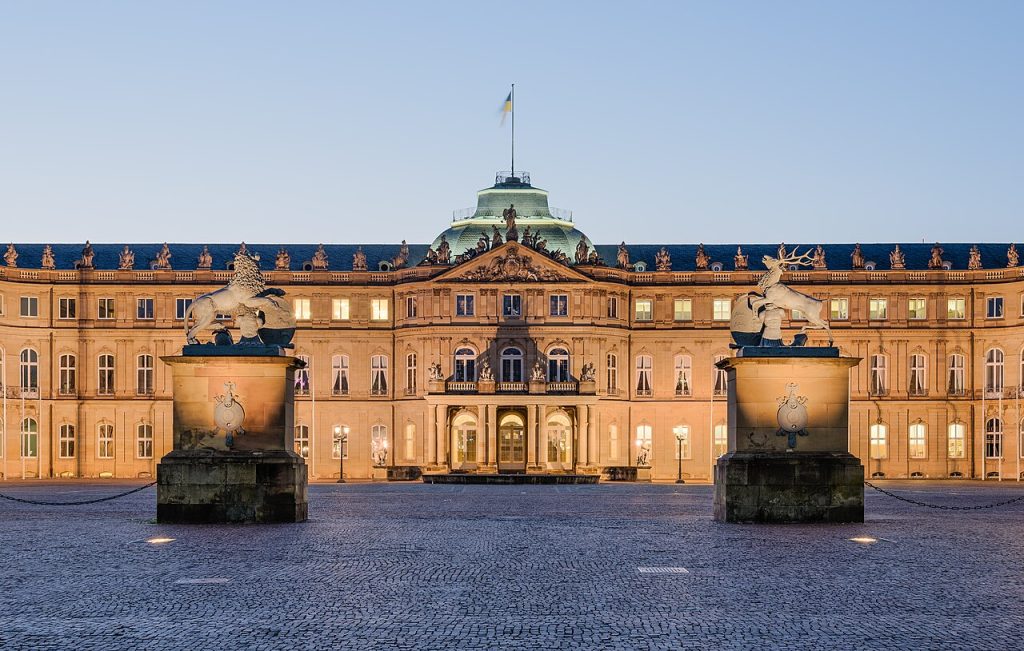
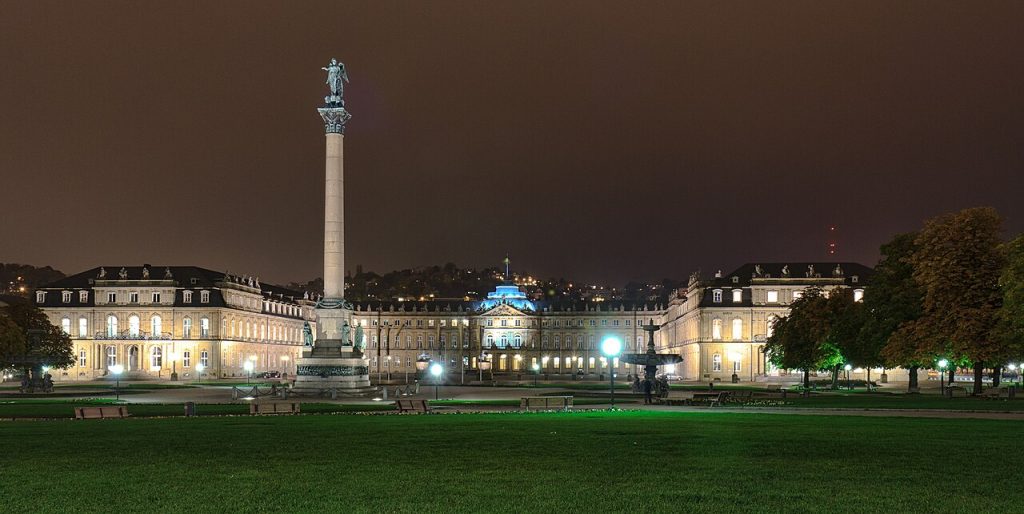
Arriving on the Schlossplatz, you face a vast baroque palace with a central block and two long wings reaching forward to embrace the square. Its pale facades, crowned with sculptures and the royal arms, give the city centre a sense of grandeur and order.
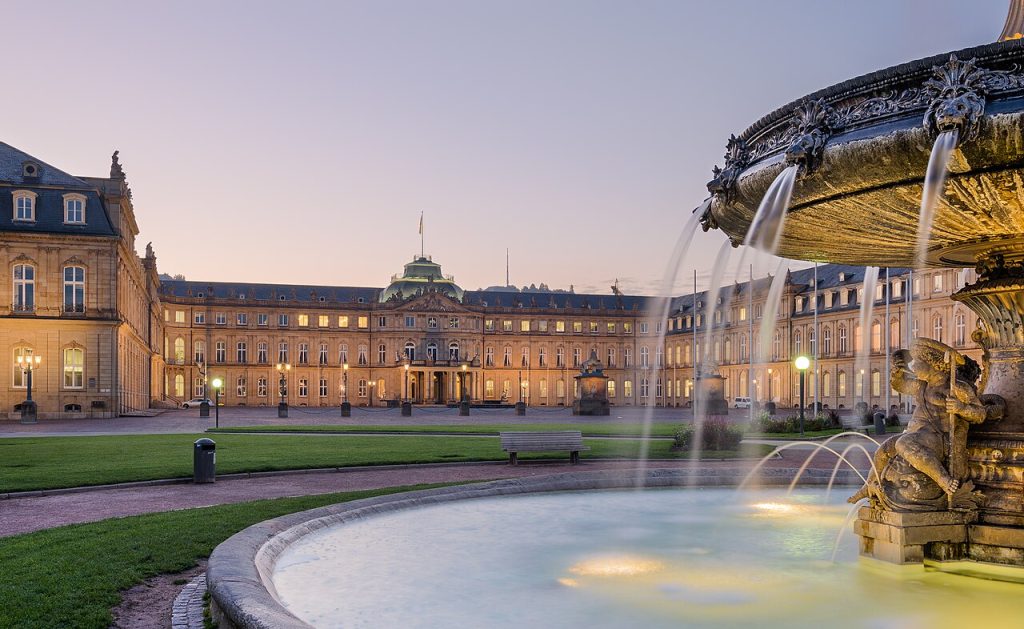
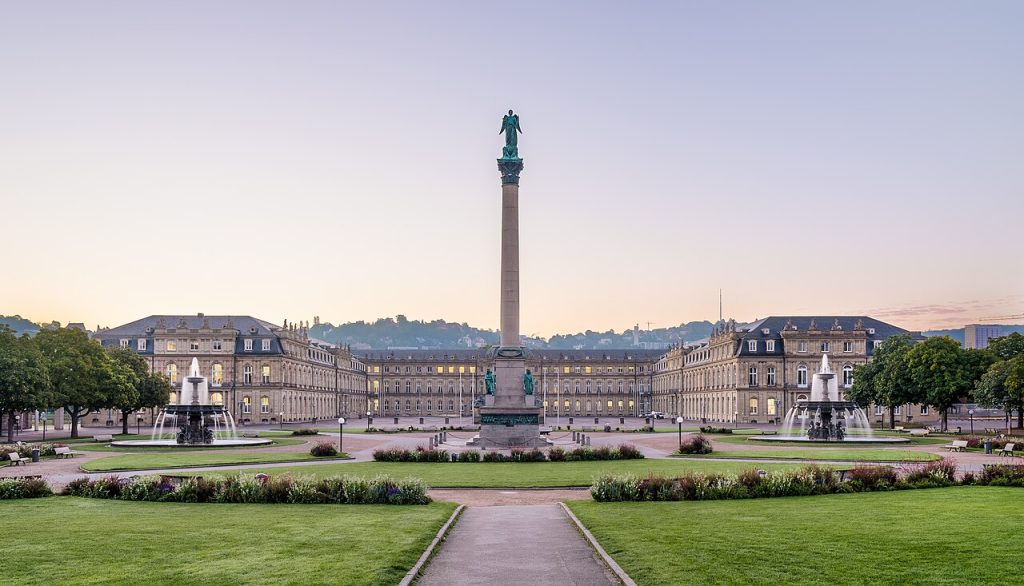
The Schlossplatz in front of the palace is one of the most beautiful squares in Germany, with lawns, flower beds, fountains and a tall column topped by a statue of Concordia. On sunny days it fills with people sitting on the grass, chatting, reading and enjoying the city.
Behind the palace lies the Schlossgarten, a long green park that stretches through the city toward the Neckar, while nearby stand the Old Palace, the collegiate church and the elegant Konigsbau.
What makes the New Palace special is its role as the symbolic heart of Stuttgart. It has witnessed the history of Wurttemberg from duchy to kingdom to modern federal state.
Even if you do not enter the building, simply walking around the square and admiring the facades is one of the essential experiences of a visit to the city.
At night, when the palace is illuminated, the square takes on a magical atmosphere that makes an evening stroll particularly memorable.
The scale of the palace is best appreciated from the middle of the square, where the wings seem to reach out toward you and the central block rises like a stage set behind the lawns and fountains.
Duke Carl Eugen Builds a New Residence
For centuries the dukes of Wurttemberg lived in the Old Palace, a Renaissance castle near the market. In the eighteenth century, however, the court had moved to Ludwigsburg, and the citizens of Stuttgart feared that their city would lose its status as capital.
When Duke Carl Eugen came of age in 1744, the estates of Wurttemberg persuaded him to return to Stuttgart, and as part of the agreement a new palace was to be built in the city. Construction began in 1746.
Carl Eugen was an ambitious and extravagant ruler, and he wanted a palace that would rival the great residences of Europe. The New Palace was designed to express the power and prestige of the house of Wurttemberg.
The duke’s interest in the project waxed and waned, and he moved his court back and forth between Stuttgart and Ludwigsburg several times, so the building progressed slowly over many decades.
A fire in 1762 damaged part of the palace, further delaying its completion, which would not be achieved until the early nineteenth century under a new ruler.
The agreement between the duke and the estates shows how much the presence of the court mattered to a city, bringing prestige, employment and commerce.
The duke’s tumultuous relationship with his subjects and his extravagant spending made him a controversial figure, but the buildings he left behind, including the New Palace, remain among the finest in Wurttemberg.
Retti, La Guepiere and Thouret
The first plans for the New Palace were drawn up by Leopoldo Retti, an Italian architect who had worked in Ansbach and Ludwigsburg. He designed the three wing layout around a court of honour, inspired by the great baroque palaces of France.
After Retti’s death in 1751, the French architect Philippe de La Guepiere took over and refined the design, adding elegant details in the style of the late rococo and early classicism. He also designed Solitude and Monrepos for the duke.
In the early nineteenth century, the interiors were completed for King Frederick I by Nikolaus Friedrich von Thouret, who created splendid rooms in the classical style of the Empire period.
The result was a palace that combines baroque grandeur in its overall form with refined classical interiors, reflecting the long period over which it was built.
The architecture of the New Palace influenced many later buildings in Stuttgart and helped to shape the elegant character of the city centre.
La Guepiere’s elegant facades, with their balanced proportions and restrained decoration, are still admired as some of the finest examples of late baroque architecture in southern Germany.
Thouret’s classical interiors were admired for their elegance, with refined colours, fine furniture and carefully balanced proportions that reflected the taste of the early nineteenth century.
The Schlossplatz
The Schlossplatz in front of the palace was laid out as a formal square and has been the stage for public life in Stuttgart for more than two centuries. Its lawns, paths and fountains make it a favourite meeting place for residents and visitors.
At its centre stands the Jubilee Column, erected in 1841 to celebrate the twenty fifth anniversary of the reign of King Wilhelm I. It is crowned by a statue of Concordia, the goddess of harmony.
Two fountains, representing the rivers and allegories of Wurttemberg, add the sound of water to the square, and in summer their spray cools the air.
The square hosts concerts, festivals and celebrations throughout the year, from summer festivals to Christmas markets, and it is the place where Stuttgart gathers on great occasions.
From the square you can also see the Konigsbau with its long colonnade, the Old Palace and the art museum, making it the perfect starting point for exploring the city.
In December, the Christmas market spreads around the palace and the neighbouring squares, one of the oldest and largest in Germany, filling the air with the scent of mulled wine and roasted almonds.
Many visitors simply sit on the steps or the grass, watching the life of the city unfold in front of the palace, which is one of the best ways to experience Stuttgart.
The square was redesigned several times over the centuries, and its present layout of lawns and paths dates largely from the nineteenth century, when it was opened to the public as a place of leisure.
The Palace Through the Seasons
The New Palace looks different in every season. In spring, the flower beds of the Schlossplatz burst into colour and the trees come into leaf, framing the palace with fresh green.
Summer brings long evenings on the lawns, open air events and crowds of people enjoying the sunshine in front of the palace.
In autumn, golden leaves drift across the square, and the low light brings out the warm tones of the facades.
Winter transforms the square with Christmas markets and lights, and on frosty mornings the palace stands out crisply against the clear sky.
Photographers return again and again to capture the palace in different moods, and every visit offers something new.
Evenings in late spring and early summer are particularly lovely, when the long light falls across the facades and the square is full of life.
In the warmer months, cafes around the square set out tables, and the view of the palace over a cup of coffee is one of the pleasures of Stuttgart.
Sculptures on the Roof
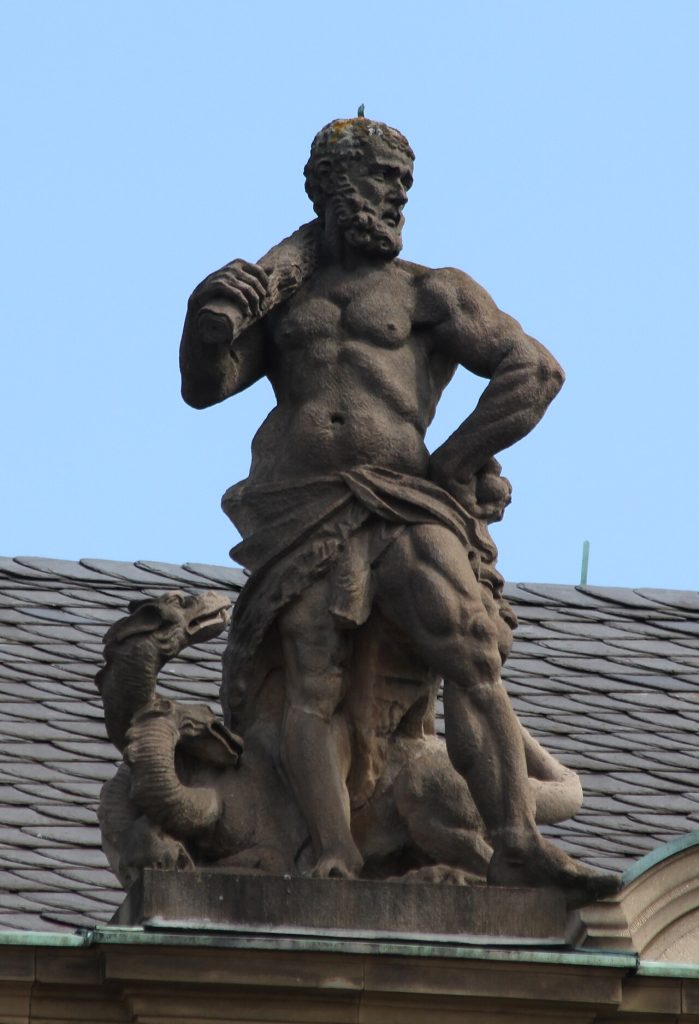
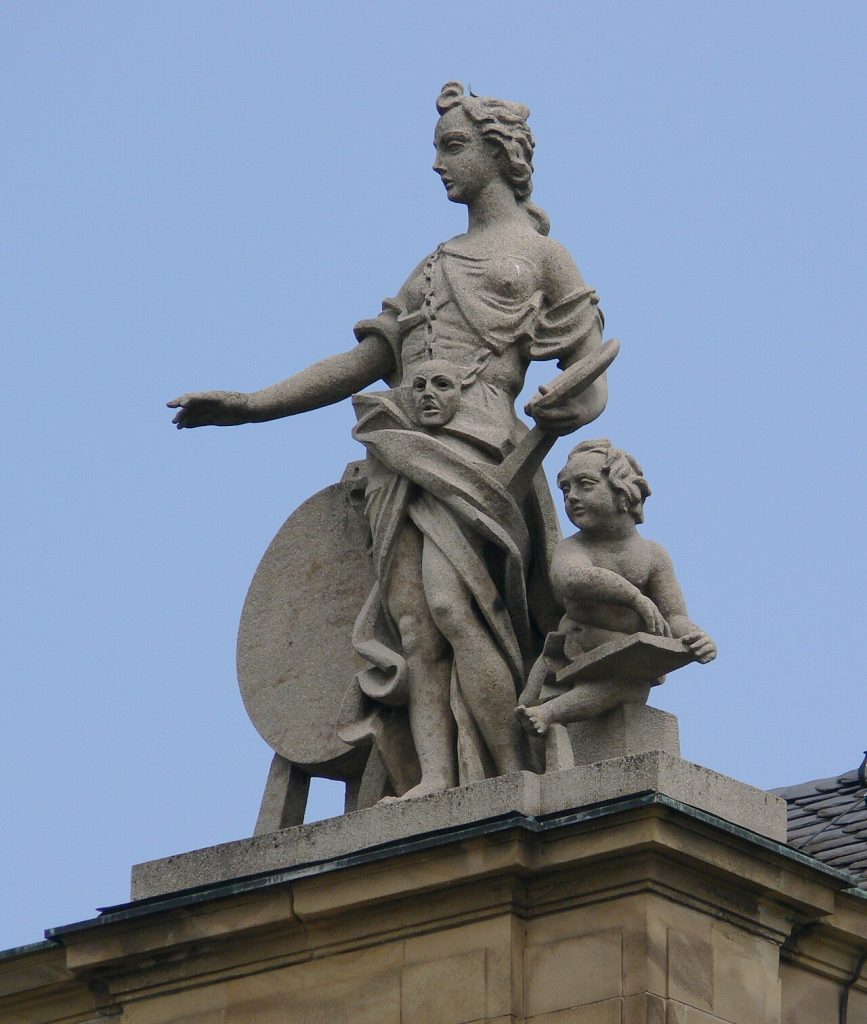
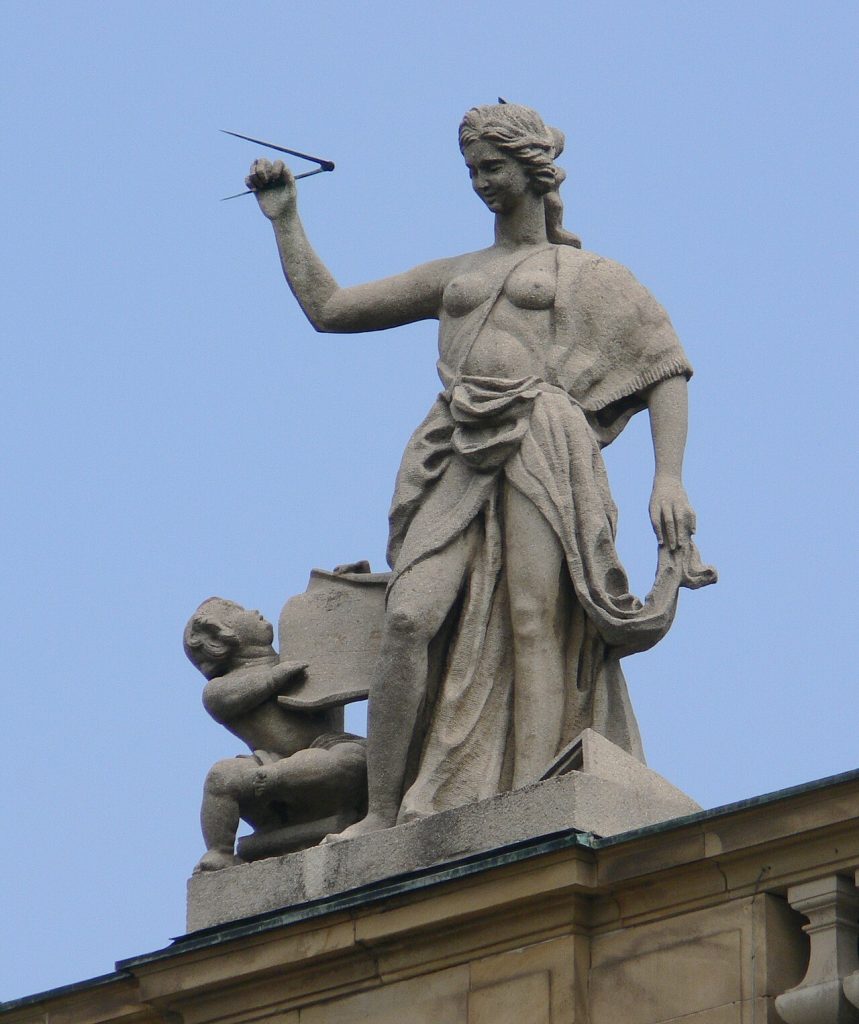
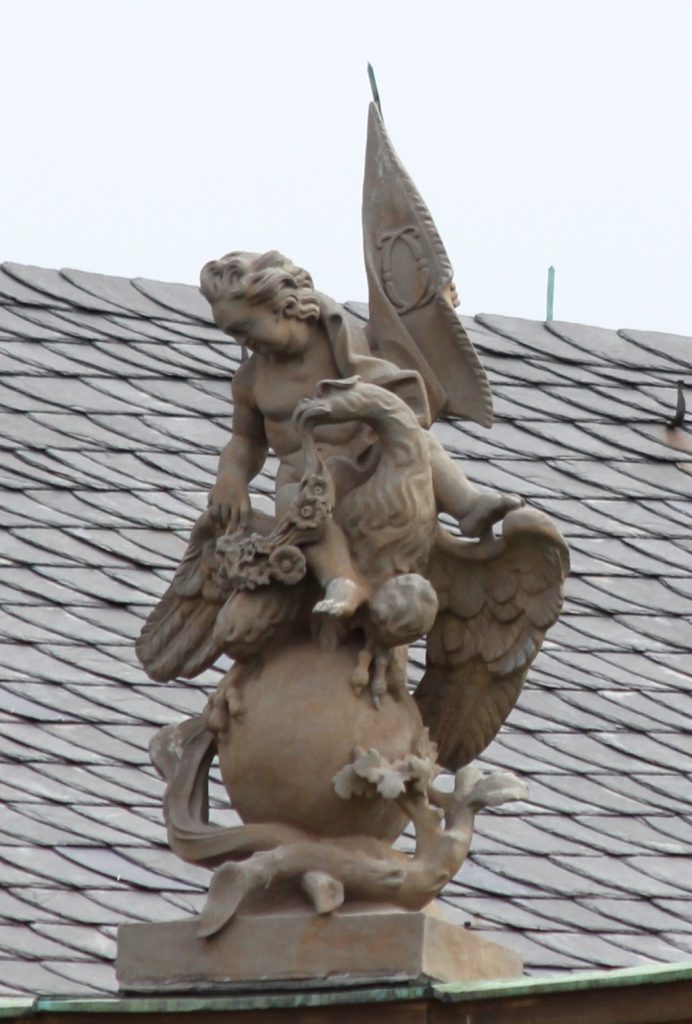
Along the roofline and on the facades of the palace stand numerous sculptures, including allegorical figures, trophies and groups representing virtues and the glory of the ruling house.
These sculptures give the palace a lively silhouette against the sky and reflect the baroque love of combining architecture and sculpture into a single dramatic whole.
Many of the original sculptures were damaged in the war and have been restored or replaced with careful copies, preserving the appearance of the palace as it was in the eighteenth century.
Look up as you walk around the square, and you will discover figures that are easy to miss at first glance, each with its own symbolism.
Among the figures are deer and other symbols of Wurttemberg, recalling the hunting traditions of the ducal court.
The royal coat of arms above the central entrance, with its lions and crown, proclaims the status of Wurttemberg as a kingdom, a title it held from 1806 until 1918.
Restorers used historic photographs and drawings to recreate damaged figures, ensuring that the roofline once again looks as it did before the war.
Kings of Wurttemberg in the New Palace
In 1806, with the support of Napoleon, Wurttemberg became a kingdom, and Duke Frederick became King Frederick I. The New Palace became the main royal residence, and the king completed its interiors in a style befitting his new rank.
Under Frederick and his successors, the palace was the centre of court life, hosting balls, receptions and state ceremonies. King Wilhelm I, who ruled for nearly half a century, used it as his official residence.
The royal family lived and worked in the palace until the end of the monarchy in 1918, when the last king, Wilhelm II of Wurttemberg, abdicated peacefully.
The memory of the kings of Wurttemberg is still present in the palace and the surrounding square, from the royal arms on the facades to the monuments in the city.
Many of the kings were popular rulers, and the Jubilee Column on the square is a reminder of the affection the people of Stuttgart felt for Wilhelm I.
Queen Olga, wife of King Karl, was especially beloved for her charitable work, and her name is still remembered in Stuttgart through hospitals and institutions she founded.
Royal celebrations such as weddings, birthdays and jubilees brought crowds to the Schlossplatz, where people gathered to cheer the royal family as they appeared on the palace balcony.
The White Hall and the State Rooms
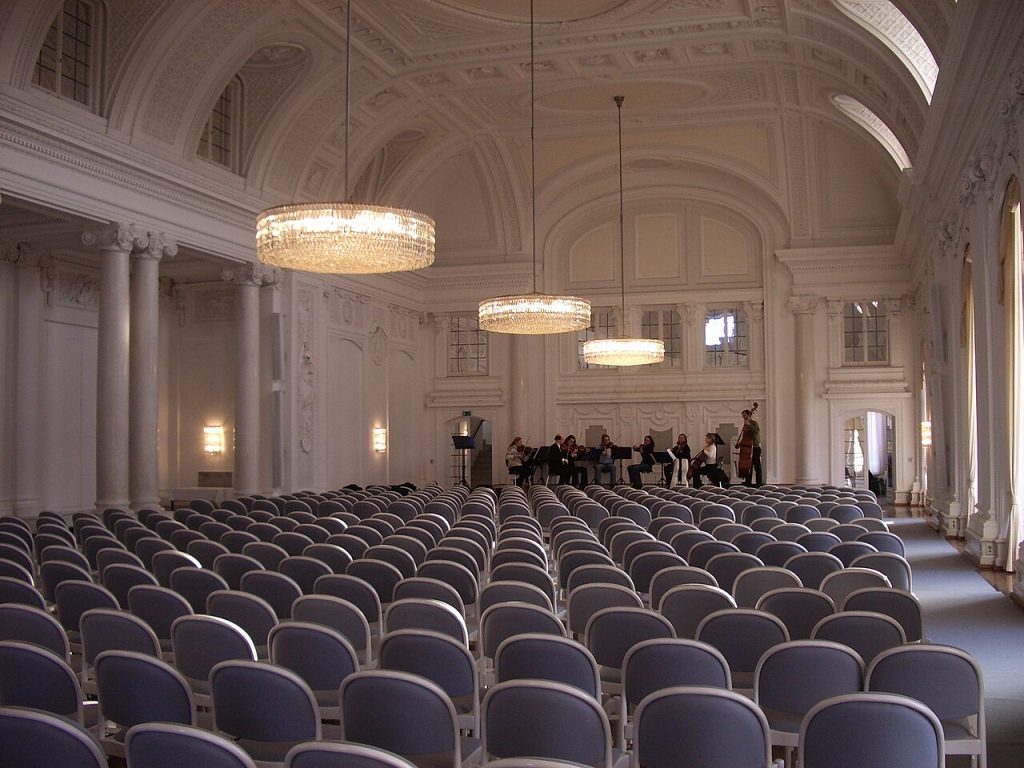
The most splendid room in the New Palace is the White Hall, a grand reception hall decorated in white and gold. Destroyed in the war, it was carefully reconstructed and is now used by the state government for official receptions and events.
Other state rooms, including the Marble Hall, were also recreated, allowing the palace to serve once again as a stage for ceremonial occasions.
The reconstructed rooms combine historic forms with modern craftsmanship, and they give an impression of the elegance of the royal court.
Because these rooms are used for official purposes, they are usually only accessible on special guided tours or during open days, so it is worth checking in advance.
Seeing the White Hall prepared for a state reception, with chandeliers lit and tables set, is a rare glimpse into the continuing ceremonial life of the palace.
The hall has hosted visiting heads of state and other dignitaries, continuing the tradition of royal hospitality in a democratic age.
The decoration of the White Hall follows classical models, with columns, pilasters and fine stucco work, creating an atmosphere of dignified elegance.
Destruction and Reconstruction
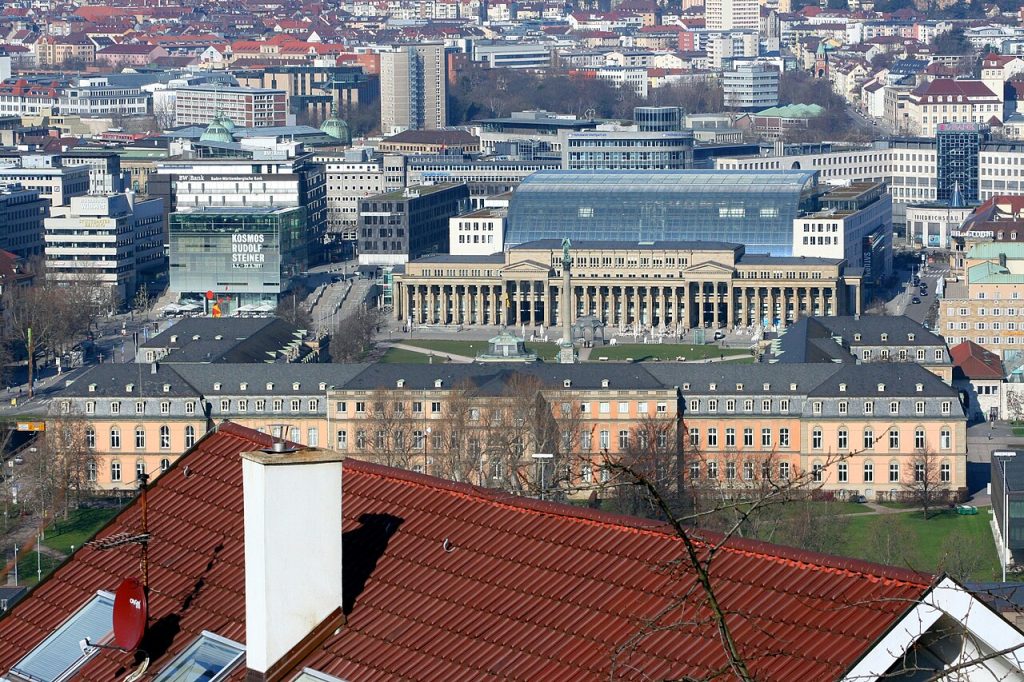
During the Second World War, Stuttgart was heavily bombed, and in 1944 the New Palace was burned out. Only the outer walls remained standing, and for years its future was uncertain.
Some voices argued for demolition, but the state government decided to rebuild the palace, and reconstruction took place between 1958 and 1964.
The exterior was restored to its historic appearance, while the interior was adapted for use by government ministries, with some state rooms recreated for ceremonial use.
Today the palace is home to the Ministry of Finance and the Ministry of Culture of Baden Wurttemberg, so it remains a working building at the centre of political life.
Its reconstruction is a symbol of Stuttgart’s recovery after the war and of the city’s commitment to its history.
Photographs of the ruined palace after the war are a sobering reminder of the destruction suffered by Stuttgart and many other German cities.
The decision to rebuild was controversial at the time, but today most people in Stuttgart are grateful that the palace was saved for future generations.
Views From the Square and the Gardens
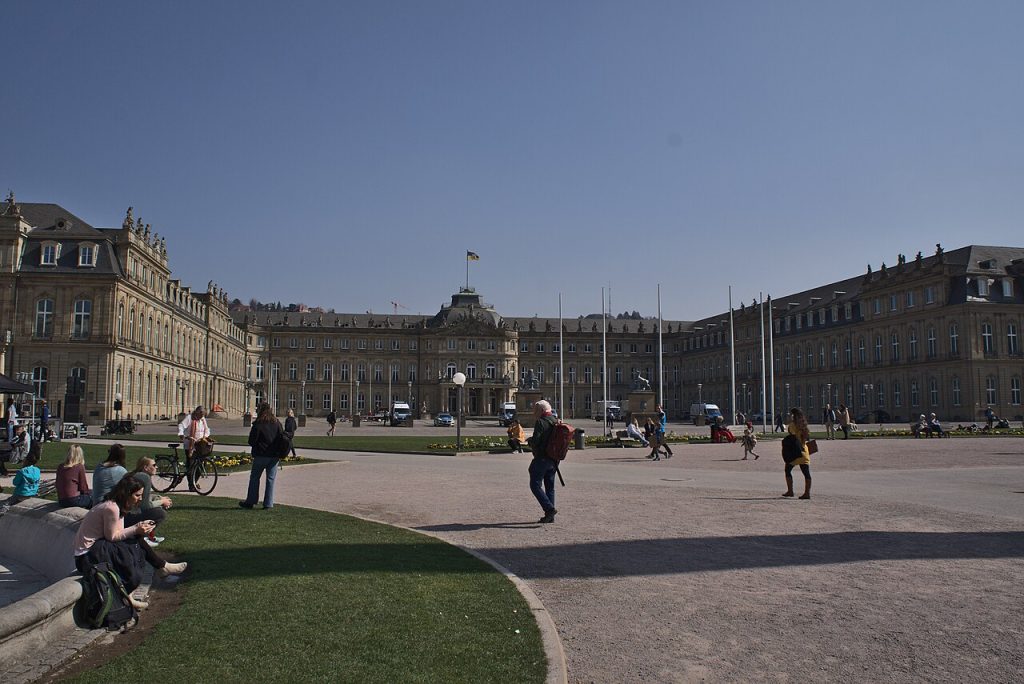
Some of the best views of the New Palace are from the far end of the Schlossplatz, where the whole facade unfolds before you, framed by trees and fountains.
From the Schlossgarten behind the palace, you see a quieter side of the building, with gardens leading toward the theatre and the opera house.
The terraces of the Konigsbau also offer a fine perspective, especially in the evening when the palace is lit up.
Taking time to walk around the palace and see it from different angles helps you appreciate its size and the care with which it was designed.
From the hill of the Karlshoehe or other viewpoints above the city, you can see the palace in its wider setting, surrounded by the green valley and hills of Stuttgart.
Old Palace, Konigsbau and the Royal Quarter
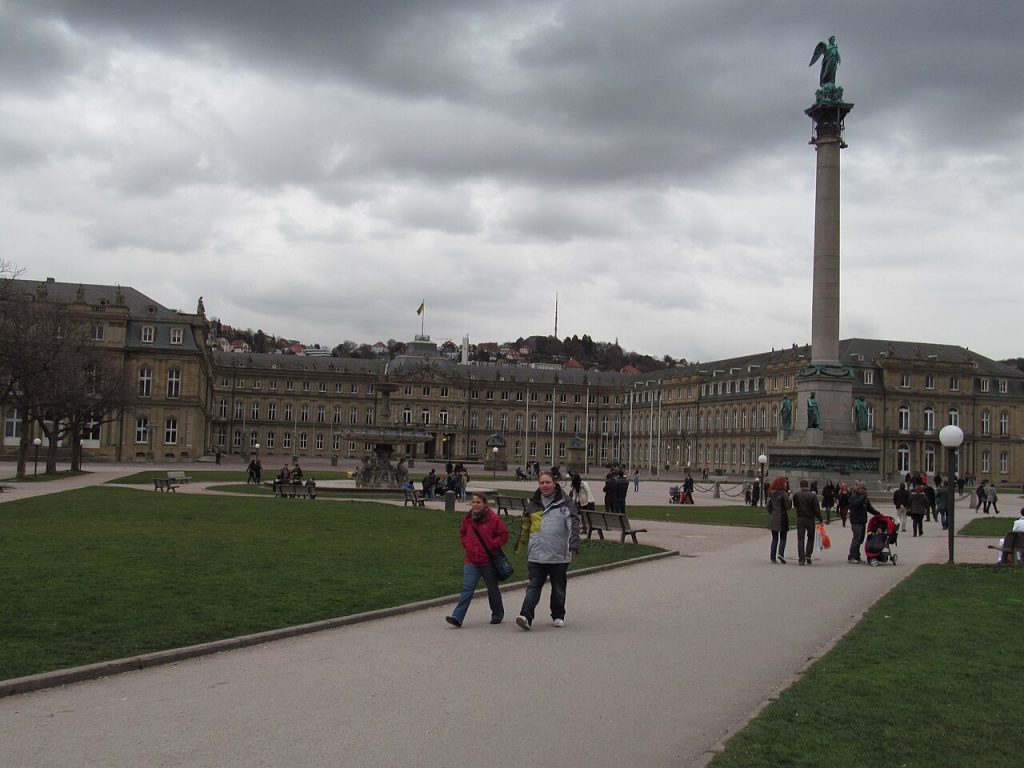
The New Palace is part of a remarkable ensemble of buildings around the Schlossplatz. Just across the street stands the Old Palace, a Renaissance castle with an arcaded courtyard that now houses the State Museum of Wurttemberg.
On the opposite side of the square rises the Konigsbau, a long classical building with a colonnade, built in the nineteenth century for concerts and festivities and now home to shops and cafes.
Nearby are the collegiate church, the Wilhelm Palace and the art museum in its modern glass cube, together creating one of the most varied historic centres in Germany.
Walking between these buildings, you can trace the development of Stuttgart from a medieval town to a royal capital and a modern city.
The Old Palace in particular is worth visiting, as its collections include the crown jewels of Wurttemberg and treasures from the ducal and royal past.
Together, these buildings make the area around the New Palace one of the most rewarding places in southern Germany for anyone interested in history and architecture.
The New Palace on Video
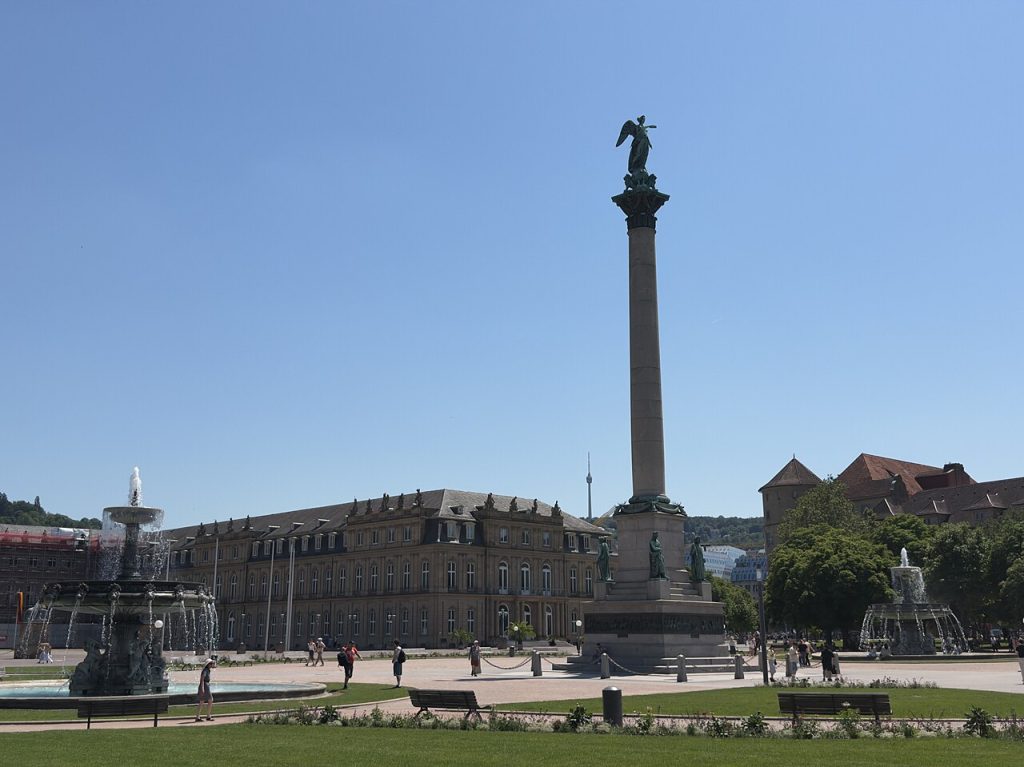
For a look at the palace and the square before your visit, the video below presents the New Palace in Stuttgart.
Watch for the facades, the sculptures and the life of the Schlossplatz.
The video also captures the lively atmosphere of the square, which is as much a part of the palace experience as the building itself.
If the video inspires you, read on for practical tips.
Visiting the New Palace Today
The New Palace stands on the Schlossplatz in the centre of Stuttgart, easily reached on foot from the main station. The square and the exterior can be enjoyed at any time.
Because the palace houses government ministries, the interiors are not regularly open, but guided tours of the state rooms are offered on certain dates and during special events.
Combine your visit with the Old Palace, home to the State Museum of Wurttemberg, the State Gallery and the Schlossgarten, all within a few minutes walk.
For a full picture of the Wurttemberg court, visit Ludwigsburg Palace, Solitude and Monrepos, which together with the New Palace form a remarkable group of ducal and royal residences.
The Schlossplatz is surrounded by cafes and shops, making it easy to combine sightseeing with a relaxed break in the heart of the city.
Whenever you visit, the New Palace offers a powerful sense of history and a lively urban atmosphere, a perfect introduction to the capital of Wurttemberg.
View the location on Google Maps
Palaces Nearby
If the New Palace has impressed you, Wurttemberg holds more remarkable palaces. Here are two more well worth adding to your journey:
- Solitude Palace – the hilltop pleasure palace of Duke Carl Eugen above Stuttgart.
- Monrepos Lake Palace – the rococo lakeside retreat of the dukes of Wurttemberg near Ludwigsburg.
You May Like

Monrepos Lake Palace and the Rococo Retreat of Ludwigsburg


One thought on “The New Palace of Stuttgart and the Royal Heart of Wurttemberg”