There is a small yellow palace on a hill in Potsdam that was never meant to impress anyone. That, oddly, is what makes it unforgettable. When you climb the six curving terraces of vines and figs and finally stand before its low, single-story facade, you are not looking at a monument to power in the way Versailles or Schönbrunn announce themselves. You are looking at the private daydream of a man who happened to be one of the most formidable kings in Europe, and who wanted, above all else, a place where the machinery of state could not follow him.
Its name says everything. Sanssouci, stitched into the cornice above the garden front in gilt letters, is French for “without a care.” Frederick the Great chose those words himself, and he meant them almost as an instruction to the building: here, and only here, he intended to set down the weight of the crown, the army, and the endless correspondence of a working monarch. He called it his “little vineyard house,” and he guarded its intimacy jealously. This was not a palace for the court. It was a palace for one enlightened king, his books, his flute, his greyhounds, and a handful of clever friends.
Yet the story of Sanssouci refuses to stay small. Around this modest summer retreat, over the course of Frederick’s long reign and the reigns that followed, an entire landscape of palaces, temples, follies, and gardens unfolded across the sandy hills west of Berlin. The New Palace rose at the far end of the park as a deliberate show of strength. Chinese pavilions and Roman baths and orangeries appeared among the avenues. What began as one man’s escape became, in time, a sprawling royal park that UNESCO would eventually recognize as one of the great cultural landscapes of Europe.
To walk through Sanssouci today is to move between two truths at once. You feel the deliberate lightness of the Rococo rooms, the playfulness of the sculpted vines and grinning fauns, the sense of a place designed for pleasure and conversation. And underneath it you sense the restless, contradictory man who made it: a soldier who loved music, a cynic who wrote poetry, a king who wanted to be buried on a quiet terrace beside his dogs rather than in a cathedral among his ancestors. This is his story, and the story of the house that carried his wish for peace of mind.
In This Article
- The Restless King Who Longed to Be Left Alone
- A Palace Sketched by a King and Built by His Friend
- The Vineyard Terraces That Turn a Hill Into a Stage
- The Marble Hall at the Heart of the House
- Ten Rooms for a King and His Pleasures
- The Circular Library Where the King Retreated
- Voltaire, and the Court of Wit That Ended in Tears
- The Great Fountain and the Gardens Below
- Chinese Teahouses, Dragons, and Garden Fantasies
- The New Palace: Prussia Flexing Its Muscle
- A Grave on the Terrace, Beside the Greyhounds
- The Miller Who Would Not Sell His Windmill
- Sanssouci Today: A World Heritage Retreat
The Restless King Who Longed to Be Left Alone
To understand Sanssouci, you first have to understand the man who dreamed it up, because no palace has ever fit its owner more precisely. Frederick II of Prussia, remembered by history as Frederick the Great, came to the throne in 1740 and spent much of his reign at war, doubling the size of his kingdom and turning Prussia into a European power that far outweighed its resources. He was a brilliant, ruthless commander, and the campaigns that made his reputation also exhausted him. Sanssouci was the answer to that exhaustion.
What makes Frederick so compelling is how divided he was against himself. He was a hardened soldier who despised the drudgery of court ceremony, yet he wrote French verse, played and composed for the flute, and corresponded with the leading philosophers of the age. His father, the severe “Soldier King” Frederick William I, had beaten the love of music and books out of him, or tried to, and the son spent his adult life quietly reclaiming everything that had been forbidden. Sanssouci is where that reclaimed self lived.
He designed the palace to hold almost no one. There were no grand guest wings for a hovering aristocracy, no throne room for receiving petitioners, no ballroom for dynastic display. The king wanted a house he could fill with conversation and music on his own terms, and empty again the moment the talk grew dull. Women, including his own estranged queen, were essentially absent from daily life here; this was a determinedly masculine world of soldiers, scholars, and wits.
That single-minded vision is why the palace feels so personal even now. Every choice, from the low profile that hugs the hilltop to the private garden gate, reflects a king trying to carve out one small territory where he answered to no one. He signed his letters from here with visible relief. For a man who spent decades in tents and on battlefields, this bright little house on its terrace of vines was the closest thing he ever had to happiness.
A Palace Sketched by a King and Built by His Friend
Sanssouci is unusual among great European palaces because its patron did not merely commission it; he helped design it. Frederick arrived with his own drawings, rough but insistent, showing exactly what he wanted: a long, low building of a single story, opening directly onto a garden terrace with no grand staircase to climb. The task of turning those royal sketches into architecture fell to Georg Wenzeslaus von Knobelsdorff, the gifted architect who was also a genuine friend of the king.
That friendship shaped, and strained, the work. Knobelsdorff argued, on sound professional grounds, that the palace should sit on a raised basement so it could be seen from the park below and so its rooms would stay dry. Frederick overruled him. He wanted to step straight from his rooms onto the terrace without a single stair between him and his vines, and he got his way. The result is a building that hides modestly behind its own hill when seen from the gardens, exactly as the king intended, whatever the architect thought of it.
The style they created together is now called Frederician Rococo, a lighter, more playful, distinctly Prussian cousin of the French Rococo the king admired. The garden facade is famous for its supporting figures: rows of exuberant sculpted bacchic figures, male and female, wreathed in vines and seemingly holding up the cornice with cheerful effort. They set the tone for the whole palace, which never takes itself too seriously and always leans toward pleasure over pomp.
Construction moved quickly. The foundation was laid in 1745, and by 1747 the palace was ready enough for the king to take up residence. For something meant to last centuries, it went up in a remarkable hurry, driven by Frederick’s impatience to have his refuge finished. He would return to it every year for the rest of his life, spending the warm months here and treating the colder court palaces in Potsdam and Berlin as the price he paid for the privilege.
The Vineyard Terraces That Turn a Hill Into a Stage
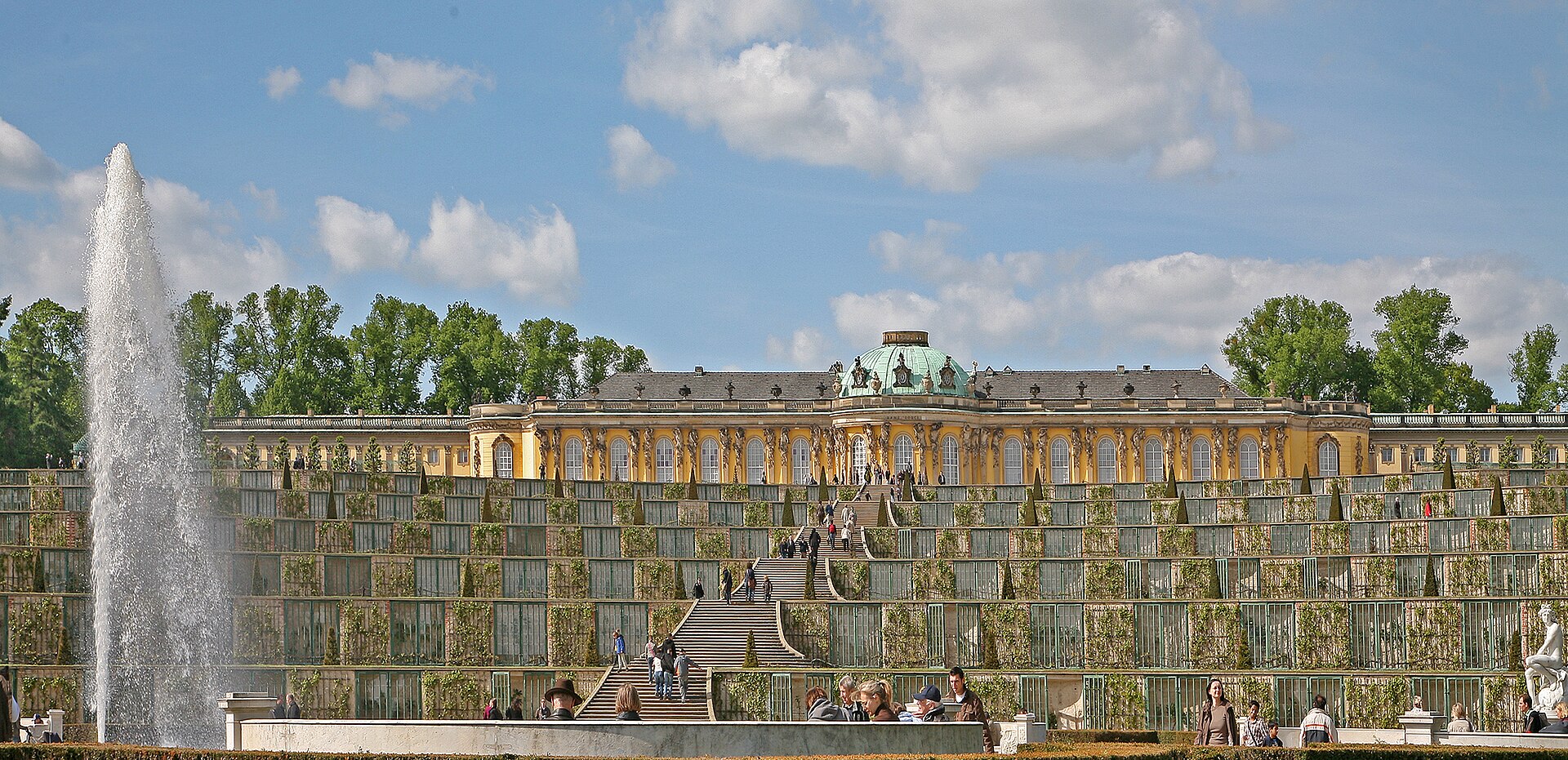
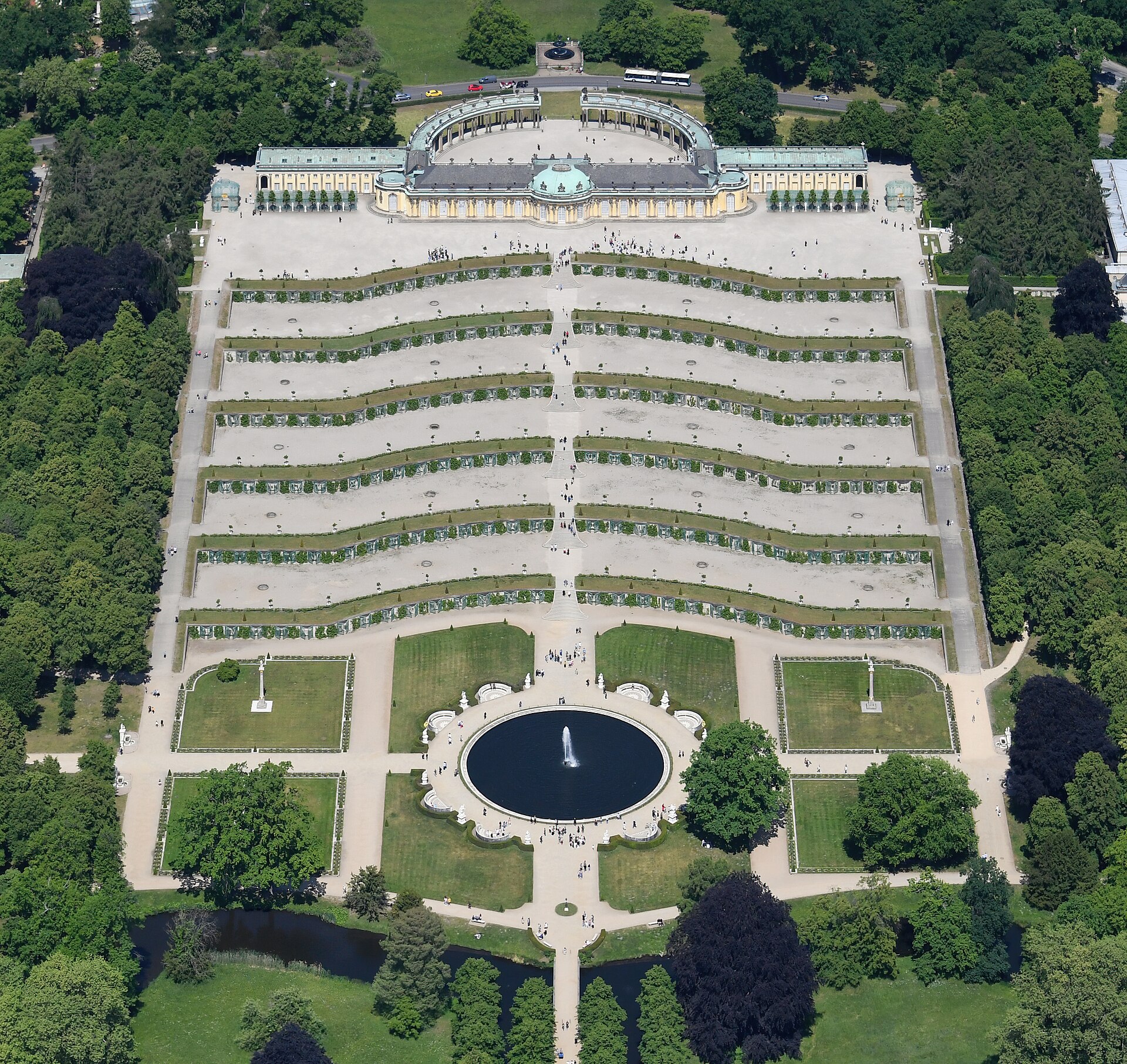
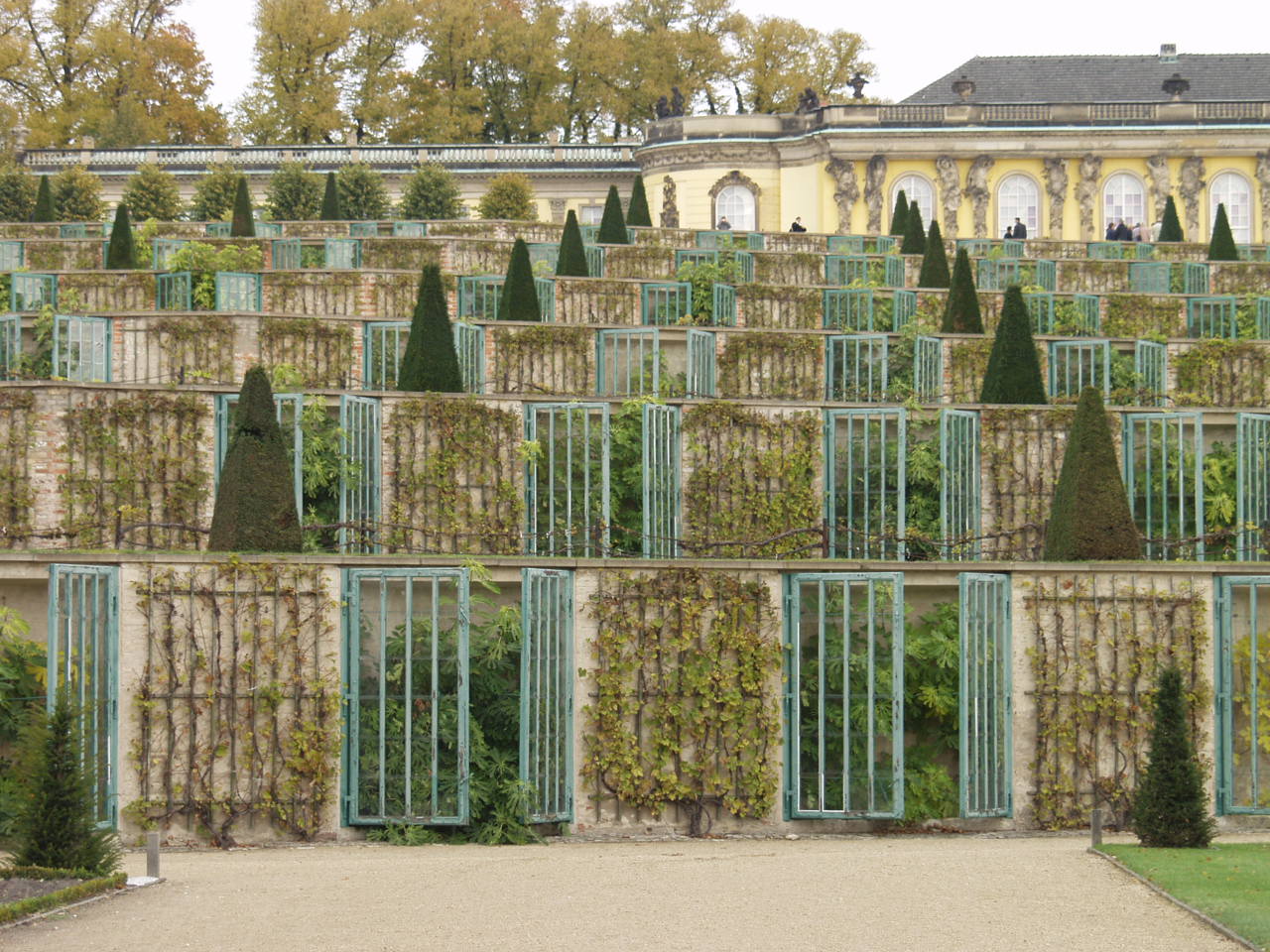
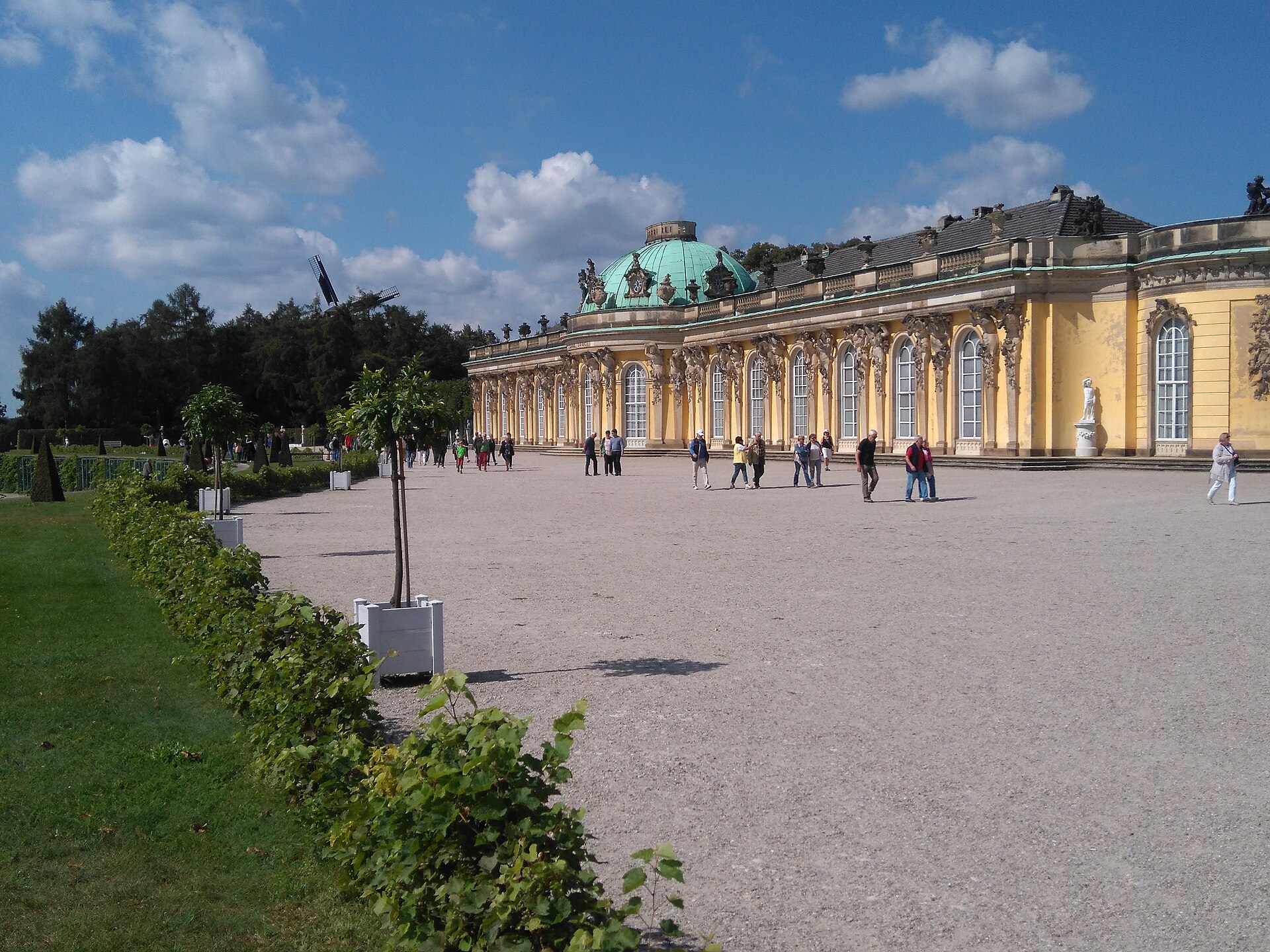
Before the palace itself catches your eye, the terraces do. Sanssouci sits atop a series of six broad, curving terraces cut into the south-facing slope of a hill, and they are not merely decorative landscaping. They were a working vineyard and garden, designed so that the hill itself became the grand approach the palace deliberately lacked. From the Great Fountain at the base, the terraces rise in graceful arcs toward the yellow facade above, and the effect is theatrical in the gentlest possible way.
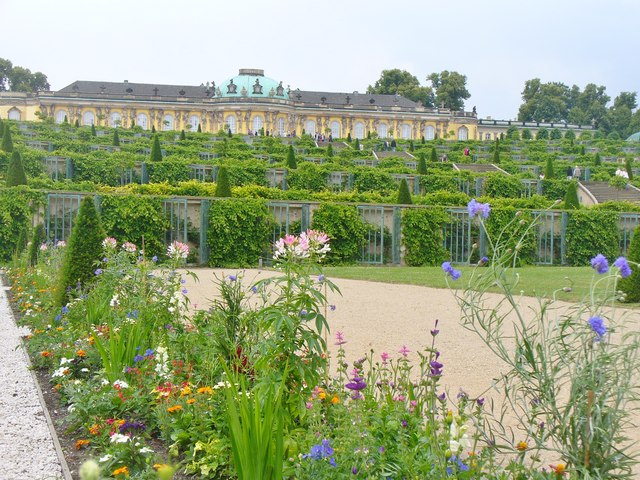
The design was practical as well as beautiful. Each terrace wall was fitted with glazed niches where vines and fig trees could be sheltered and coaxed to ripen in the unpromising climate of Brandenburg. Frederick, who took a real interest in horticulture, wanted fruit that had no business growing this far north, and the sun-trapping terraces were engineered to give it to him. The palace’s very name grew out of this vineyard character; he thought of the whole thing as his little vineyard retreat.
Climbing the terraces is still the proper way to arrive. As you rise, the palace reveals itself slowly, its long low line crowned by that low central dome, the gilt letters spelling Sanssouci coming into focus. It is a sequence designed to build a quiet anticipation rather than to overwhelm, and it works as well today as it did in the eighteenth century. There is nothing that shouts; everything invites.
The terraces also anchor the palace to its landscape in a way few royal residences achieve. Sanssouci does not sit apart from its gardens on a plinth of stone; it grows out of them, the architecture and the horticulture braided together. That fusion of building and vineyard, of pleasure and cultivation, is one of the reasons the whole ensemble feels so coherent, and why later generations kept the terraces lovingly restored even as the vines came and went with the centuries.
The Marble Hall at the Heart of the House
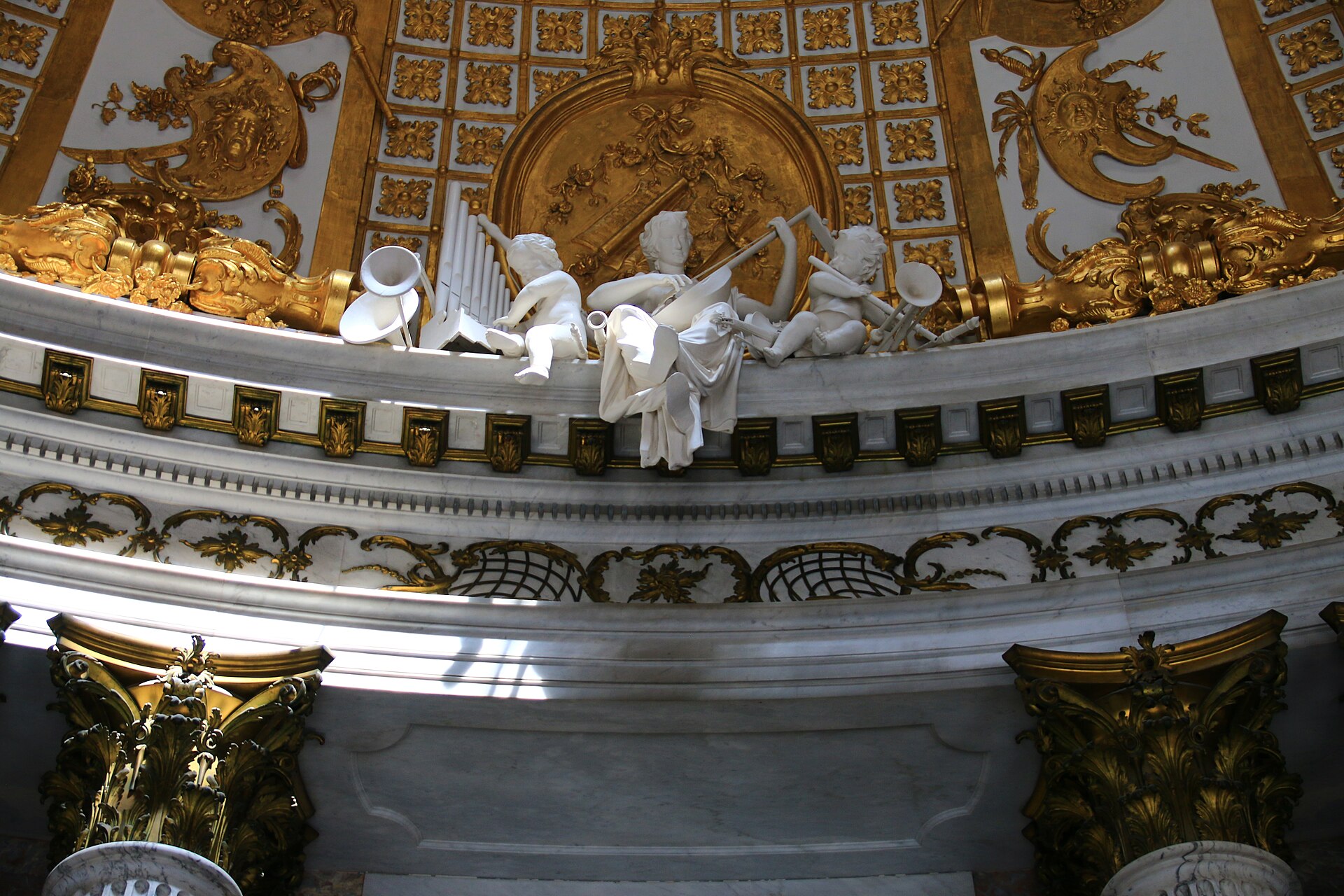
For all its modest scale, Sanssouci has one room that reaches for grandeur, and it does so with confidence. The Marble Hall sits at the center of the palace, directly beneath the low dome, and serves as its principal reception room. Oval in plan and finished in white and yellow Carrara and Silesian marble, it was consciously modeled on the Pantheon in Rome, that ancient temple to all the gods, scaled down to the proportions of a private house.
Light pours in from above and from the tall windows facing the garden, catching the polished columns and the gilded ornament. Paired columns of marble ring the room, and the floor is laid in an intricate pattern of colored stone. Statues in the niches and a richly detailed ceiling complete the effect. It is the one space where Frederick allowed himself to gesture toward the classical grandeur of the great courts, though even here the scale keeps everything human rather than crushing.
The Marble Hall was where the king’s famous dinners took place, the gatherings that were the real social heart of Sanssouci. Around the table sat not a crowd of courtiers but a carefully chosen circle of intelligent men, and the conversation ranged over philosophy, poetry, music, and the follies of the age, conducted largely in French and sharpened by Frederick’s mordant wit. These were meals as intellectual sport, and the room was built to frame them.
Standing in it today, you feel the deliberate balance the whole palace strikes. It is grand enough to signal that a king lives here, yet intimate enough that you can imagine the actual voices around the table. The Pantheon may have inspired its form, but its spirit is entirely secular and entirely Frederician: a temple not to the gods but to conversation, reason, and the pleasures of a sharp mind well fed.
Ten Rooms for a King and His Pleasures
Beyond the Marble Hall, the palace unfolds as a single enfilade of rooms running the length of the garden front, and there are astonishingly few of them. Sanssouci contains only about ten principal rooms, a suite for the king on one side and a handful of guest rooms on the other. After the vast wings of most royal residences, the compactness is startling and completely intentional; this was a house sized for a private life, not a court.
Frederick’s own apartments show the man at his most characteristic. His study and bedroom, remodeled later in his reign, are wrapped in restrained elegance, and it was here that he worked, read, and slept, often at the small hours he preferred. The rooms were arranged so that his beloved dogs could come and go, and so that music was never far away. He treated these spaces less as bedchambers of state than as the quarters of a scholar who happened to rule a kingdom.
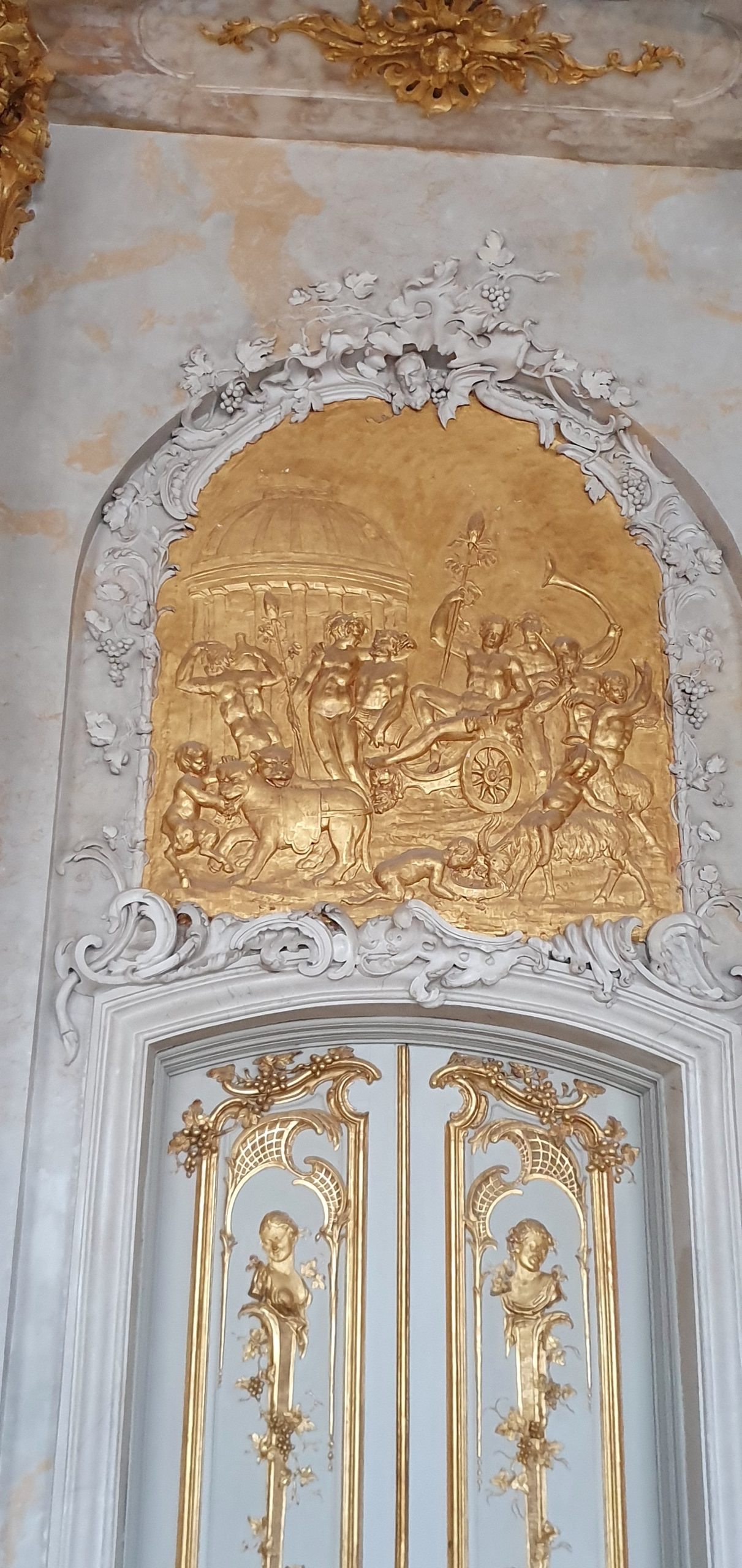
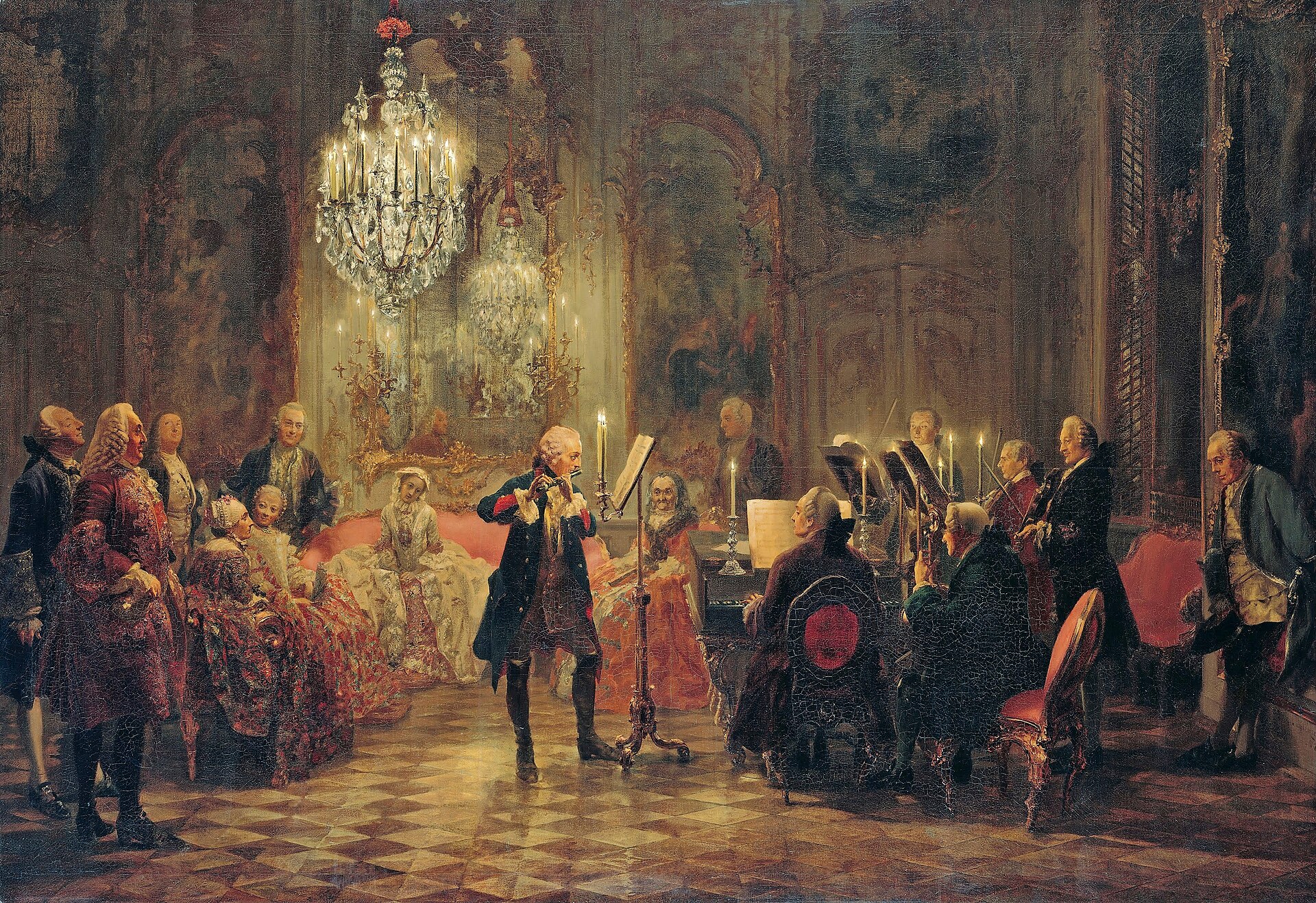
The Concert Room is perhaps the most beguiling space in the palace. Decorated in the lightest, most delicate Rococo, its walls swim with gilded tendrils, musical instruments, grapevines, and a spider improbably worked into the ceiling ornament. Here Frederick played the flute in the evenings, performing his own compositions and those of the musicians he employed, including members of the Bach family. Adolph Menzel’s celebrated nineteenth-century painting of the king playing by candlelight in just such a room fixed the scene forever in the popular imagination.
The guest rooms carried their own charm and, in one case, their own legend. Each was decorated in a distinct decorative theme, and the most famous of them is tied to the palace’s most illustrious visitor. Together these few rooms make up the whole of Sanssouci’s interior, a jewel box rather than a labyrinth, and every surface in them was chosen to delight rather than to impress. You could walk the entire palace in minutes, which is precisely why it feels like a home and not an institution.
The Circular Library Where the King Retreated
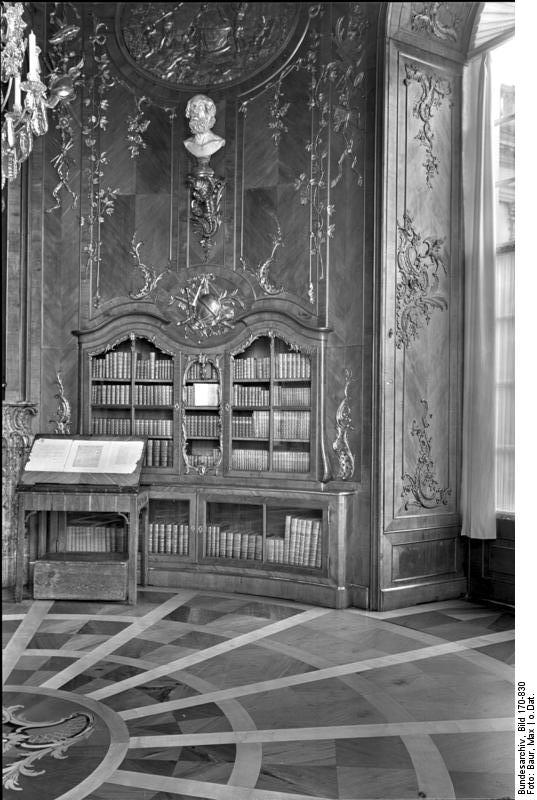
If any single room reveals the private Frederick, it is his library. Tucked into a rounded corner of his apartments and reached through his study, it is a small circular chamber paneled in warm cedar and gilded ornament, its shelves curving around the walls to hold some two thousand volumes. Here the soldier-king became simply a reader, and the room was arranged so that no one could disturb him at it.
The collection tells you where his heart lay. It was overwhelmingly French, filled with the classical authors of antiquity in translation and the writers of the French Enlightenment he prized above all others. Cicero and the ancient historians shared the shelves with Voltaire and the philosophers of his own century. German literature, tellingly, was almost absent; Frederick famously and unfairly dismissed the German writing of his day, preferring the polish of French prose and verse. The library was a monument to that taste.
The circular shape was not a whim. It gathered the books close around a single occupant, turning the room into a kind of cocoon where the king could sit surrounded on every side by the minds he admired. The cedar paneling gave it warmth and a faint fragrance, and the gilding kept it luxurious without ever becoming grand. It is a room built for one person and one purpose, and it succeeds completely.
There is something moving about this space when you consider the life around it. A man who spent decades organizing armies and outmaneuvering enemies carved out, at the very heart of his refuge, a small round room whose only business was quiet reading. It is the clearest possible statement of what Sanssouci was for. The wars were the duty; the library was the reward, and Frederick guarded his hours in it as fiercely as he guarded any fortress.
Voltaire, and the Court of Wit That Ended in Tears
No account of Sanssouci is complete without Voltaire, the most brilliant and most difficult of Frederick’s guests. The king had admired the French philosopher for years, exchanging flattering letters long before they met, and in 1750 he finally lured Voltaire to Prussia to be the ornament of his intellectual court. For a time it was a meeting of two of the sharpest minds in Europe, and the dinners at Sanssouci glittered with their exchanges.
One of the guest rooms is still known as the Voltaire Room, decorated with carved and painted flowers, fruit, birds, and monkeys in a riot of colorful naturalism. Whether the philosopher actually slept in this particular room is debated, but the association has stuck, and the cheerful, slightly mischievous decoration suits the memory of its supposed occupant. It stands as the palace’s tribute to the age of reason that Frederick so wanted to embody.
The friendship, alas, curdled. Two men so vain, so clever, and so accustomed to being the wittiest person in any room could not share the same small palace for long. Quarrels over money, over a lawsuit, over cutting remarks that traveled too far, poisoned the air. Voltaire eventually left Prussia in 1753 under a cloud, was briefly detained on his way out, and the two never met again, though they resumed their barbed correspondence years later. It was a spectacular falling-out between men who genuinely admired each other.
That drama is part of what gives Sanssouci its human texture. This was not a palace of frozen protocol but a place where real friendships were forged and shattered, where ideas were argued fiercely and egos bruised. Frederick’s dream of a court of pure intellect ran aground, as such dreams do, on the vanity of the intellects involved. But for a few years the little palace on the vineyard hill was one of the great salons of the Enlightenment, and the echo of those conversations still clings to its bright rooms.
The Great Fountain and the Gardens Below
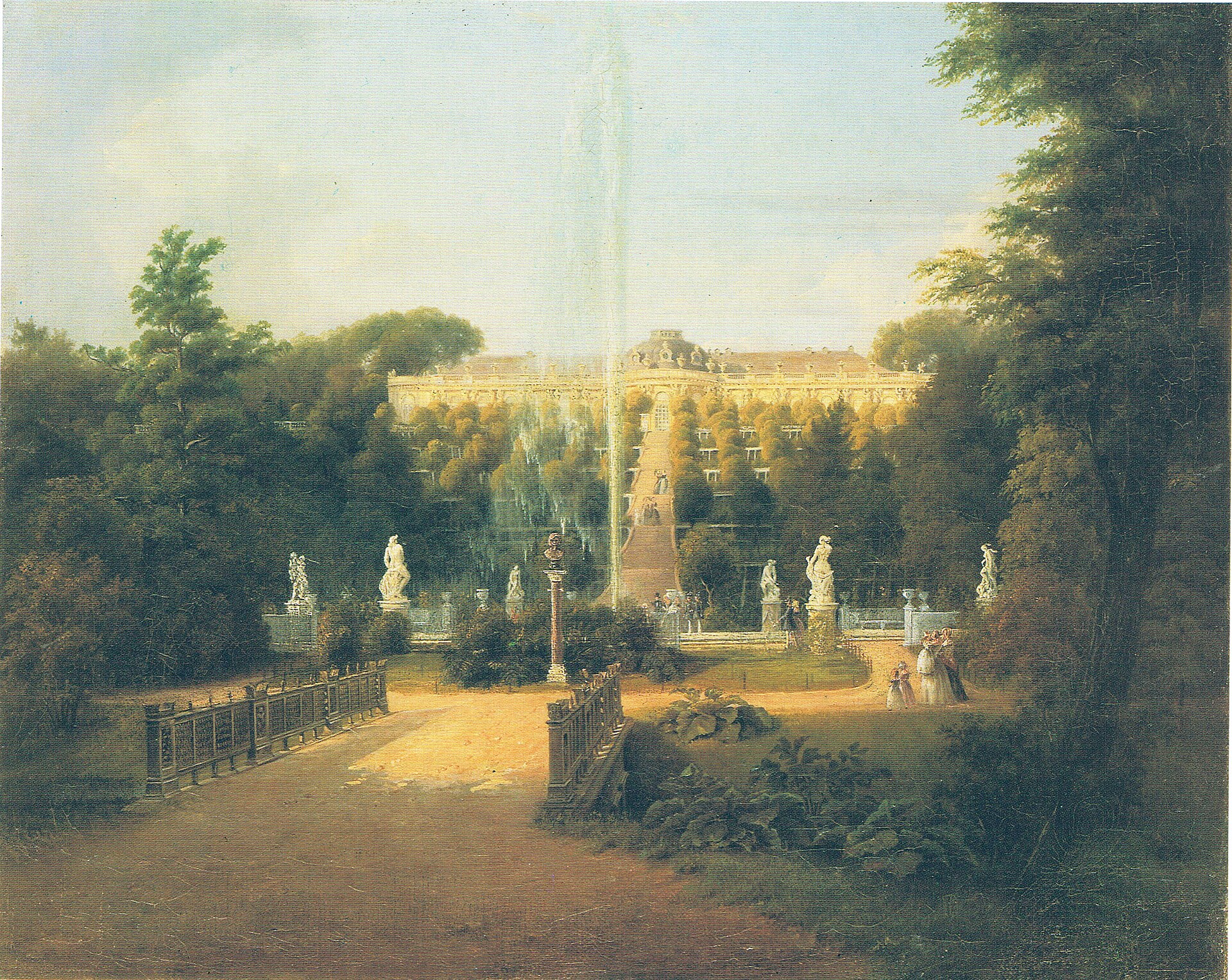
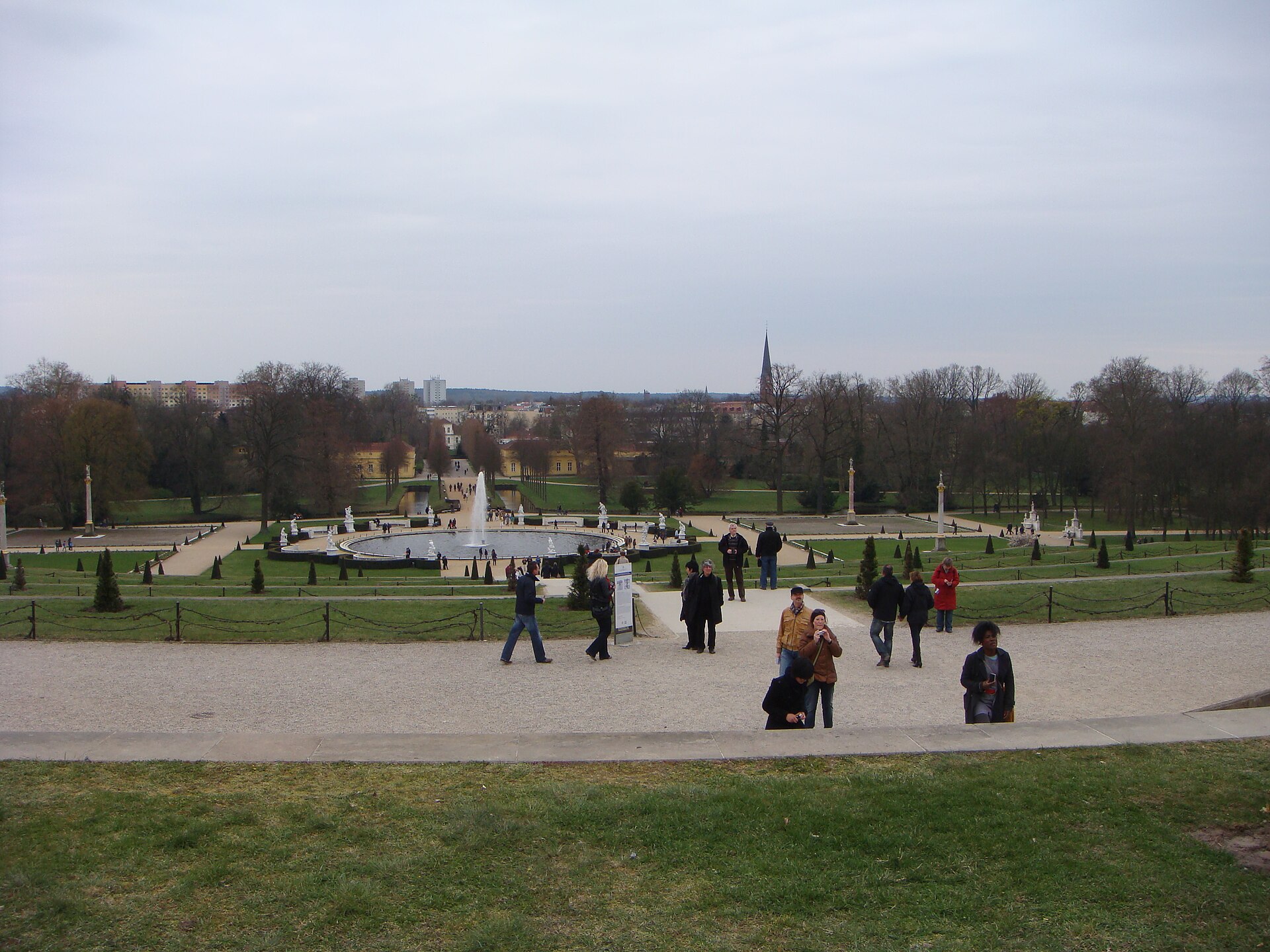
Spread out beneath the terraces lies the ornamental garden that gives the palace its wider setting, and at its center stands the Great Fountain. Frederick built the basin and ringed it with marble statues of the gods and the elements, Venus and Mercury, the allegories of the four elements, arranged in a graceful circle. There was, however, a long-running frustration attached to it: for all his efforts, the king could never get the fountain to actually play. The engineering of the day simply could not force the water high enough, and in his lifetime the great jet stubbornly refused to rise.
That failure was quietly redeemed a century later. In the 1840s, under a later Prussian king, a steam-powered pumping station, disguised charmingly as a Moorish mosque down by the river, was built to supply the pressure the eighteenth century had lacked. At last the Great Fountain leapt into the air as Frederick had always wanted, and it plays today as a belated fulfillment of his original vision. It is a small parable of how the park kept growing and improving long after its founder was gone.
The gardens themselves were laid out in the formal geometric manner Frederick favored, with straight avenues, clipped hedges, and ornamental parterres radiating from the fountain. Statues, urns, and trellised walks punctuated the greenery, and the whole design was meant to be read as an extension of the palace’s own ordered pleasures. Over later decades the strict geometry softened as English-style landscape ideas crept in, but the core around the fountain kept its formal bones.
To stand by the Great Fountain and look up at the terraces is to see the entire composition resolve into a single picture. The water, the marble gods, the rising arcs of vines, and the low yellow palace crowning it all form one deliberate sequence, drawing the eye upward from the garden to the house. It is the view that appears on a thousand postcards, and for once the postcard does not exaggerate. This is the image Frederick built the whole hill to create.
Chinese Teahouses, Dragons, and Garden Fantasies
As the park expanded, it filled with the kind of exotic and whimsical buildings that eighteenth-century garden fashion adored, and Sanssouci’s follies are among the most delightful anywhere. The most famous is the Chinese House, a garden pavilion in the fashionable chinoiserie style, its clover-shaped plan ringed with gilded palm columns and life-sized gilded figures of musicians and tea drinkers lounging on the grass outside. It shimmers among the trees like something out of a fairy tale.
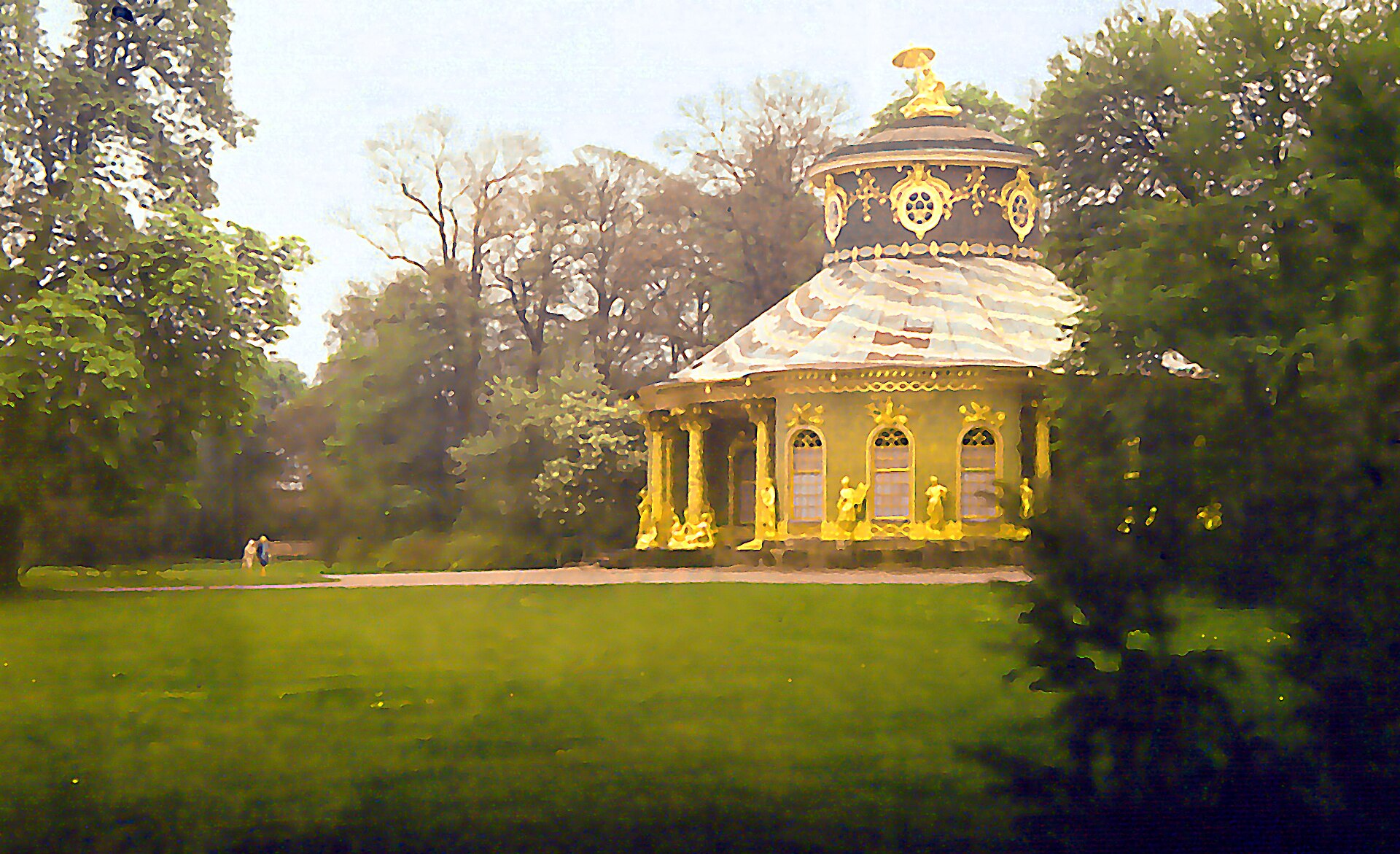
This was Europe’s dream of China rather than the real thing, an ornamental fantasy assembled from imported porcelain, travelers’ tales, and pure imagination. Frederick used the little pavilion for small summer parties and as a place to display his collection of Asian porcelain. Its gleaming gilt figures, forever frozen in their leisurely poses, capture perfectly the playful spirit that ran alongside the palace’s more serious intellectual life. Nobody was meant to take it too seriously, and that was the point.
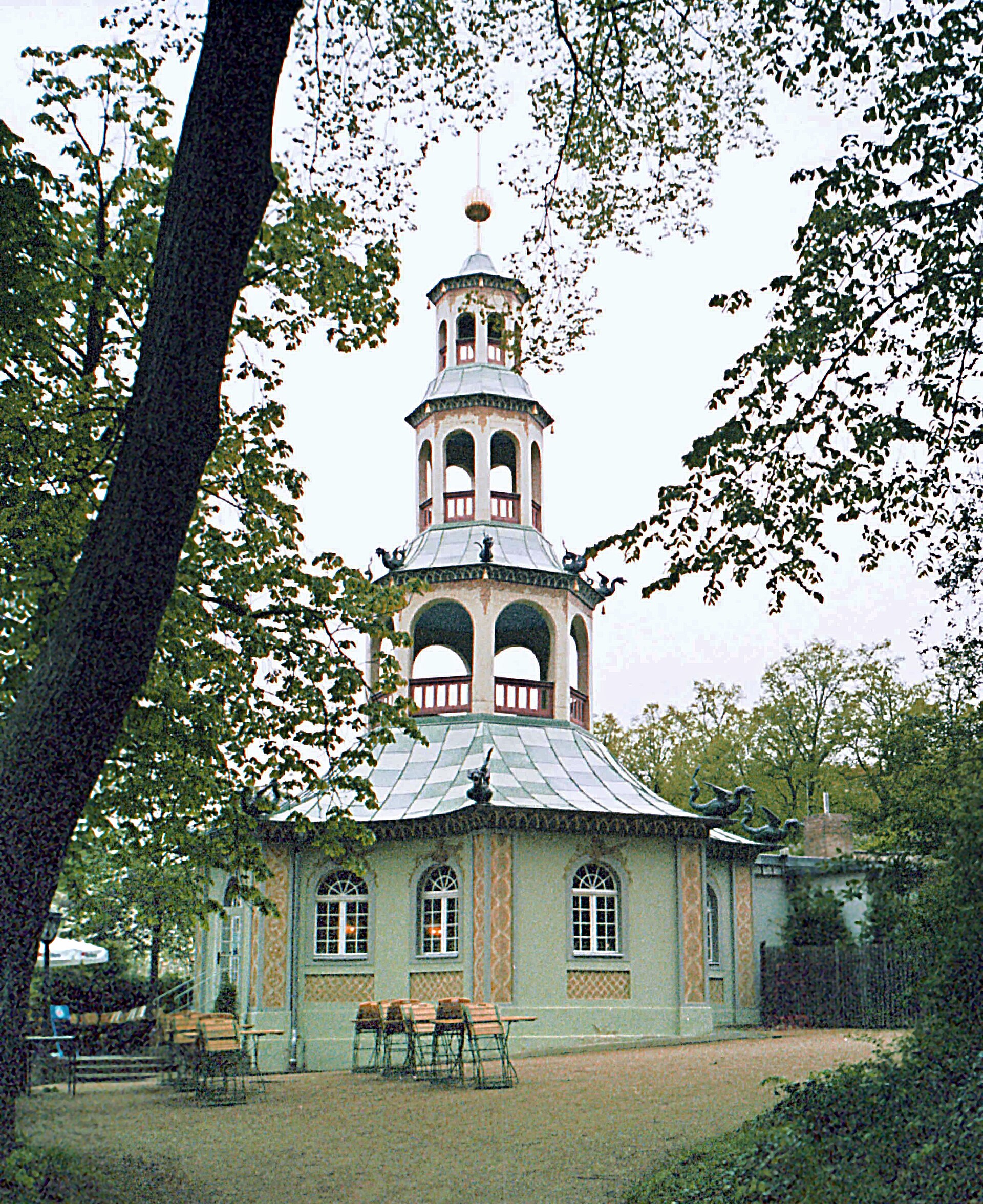
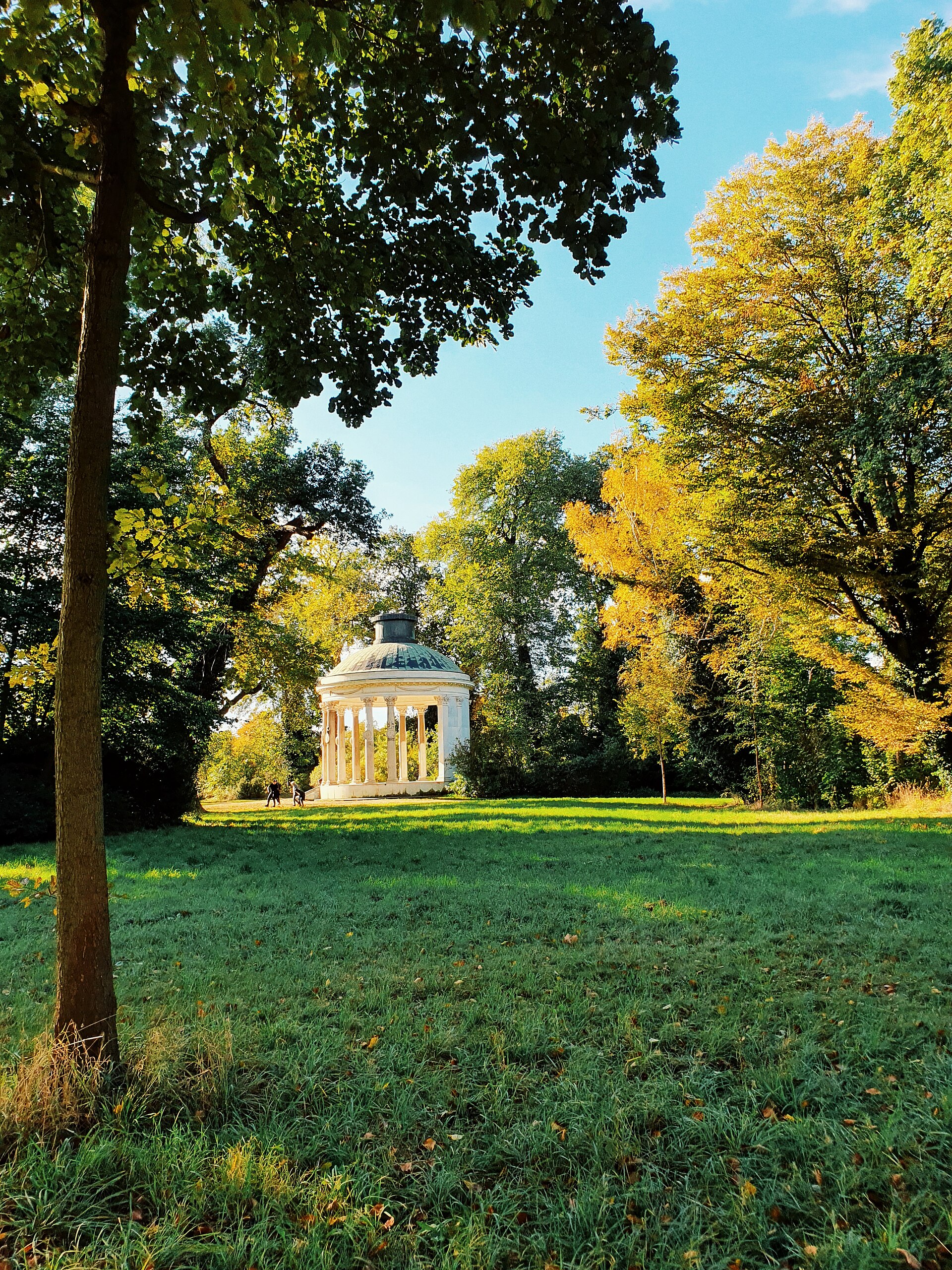
Elsewhere in the park rose other flights of fancy. The Dragon House, built later on a nearby hill, took the shape of a Chinese pagoda with sculpted dragons perched at the corners of its curling roofs, serving as a home for the vineyard keeper. A Temple of Friendship, a circular colonnade, was raised by Frederick in memory of his favorite sister. Roman baths, an orangery, and other structures would follow under later kings, each adding another layer to the park’s happy jumble of styles.
Taken together, these buildings turn the grounds of Sanssouci into a kind of open-air museum of eighteenth-century imagination. You can wander from a Prussian Rococo palace to a gilded Chinese pavilion to a mock-Roman bath in the space of an afternoon, and the mixture never feels incoherent. It reflects a court that treated its gardens as a place to play with ideas and images from across the world, gathering them all into one sunlit Brandenburg park.
The New Palace: Prussia Flexing Its Muscle
At the western end of the park, far from the intimate scale of Sanssouci, stands its enormous counterweight: the New Palace, or Neues Palais. Frederick built it in the 1760s, immediately after the exhausting Seven Years’ War, and its purpose could not have been more different from that of his vineyard retreat. Where Sanssouci whispered, the New Palace was designed to shout, a deliberate and colossal demonstration that Prussia had survived the war and remained a great power to be reckoned with.
Everything about it is large. Its long red-brick facade, crowned with hundreds of sandstone statues and topped by a great dome, houses hundreds of rooms, grand galleries, a theater, and staterooms encrusted with ornament. The famous Grotto Hall is lined with shells, minerals, and semiprecious stones set into the walls in glittering profusion. This was architecture as propaganda, meant to overwhelm visiting dignitaries and dispel any notion that Prussia had been weakened.
Frederick himself was clear-eyed about it. He reportedly referred to the whole grand pile as his “fanfaronade,” his showing-off, and he had little intention of actually living there in any comfortable sense. The New Palace was for guests, for ceremony, for impressing the outside world. His heart remained at the little palace on the vineyard hill, where he could shut the door on exactly the sort of display the Neues Palais existed to provide.
The contrast between the two buildings is the most eloquent thing in the whole park. Standing at opposite ends of a long avenue, Sanssouci and the New Palace embody the two faces of Frederick himself: the private man who wanted nothing more than his books and his flute, and the public king who understood that a state’s survival depends on the appearance of strength. To grasp both buildings is to grasp the paradox at the center of his reign.
A Grave on the Terrace, Beside the Greyhounds
Frederick grew old at Sanssouci, and he grew solitary. In his final years he was a stooped, gout-ridden figure in a shabby coat, his famous wit turned increasingly bitter, his companions mostly his dogs. He died in an armchair in the palace in August 1786, having spent his last summer, as always, at the retreat he loved best. His wishes for his burial were as unconventional as everything else about him, and they were pointedly ignored.
He had left explicit instructions: he wished to be buried quietly on the highest terrace of Sanssouci, in a simple grave he had prepared, alongside his beloved Italian greyhounds. It was a final gesture of the same spirit that built the palace, a preference for the private and the personal over dynastic pomp. His nephew and successor overrode him and had the great king interred instead in the garrison church in Potsdam, among the trappings of state Frederick had tried to escape.
The wish waited two centuries to be honored. Frederick’s coffin was moved several times over the turbulent history that followed, hidden away during the Second World War and kept for decades in western Germany. Only in 1991, after the reunification of Germany, was he finally brought back to Sanssouci and buried, at last, in the plain terrace grave he had designed, beside the resting places of his dogs. Admirers still leave potatoes on the slab, a nod to the crop he championed to feed his people.
There is no more fitting end to the story of Sanssouci than this. The palace was built as an escape from the demands of kingship, and its founder’s most personal wish was to rest there rather than in a royal crypt. That it took two hundred years and the healing of a divided nation to grant that wish only deepens its poignancy. The grave on the terrace, simple and unadorned, is the quietest and most honest monument in the entire glittering park.
The Miller Who Would Not Sell His Windmill
Rising unexpectedly just beside the palace stands a working windmill, and it carries the most beloved legend attached to Sanssouci. According to the famous story, Frederick was irritated by the mill’s clattering sails so close to his refuge and offered to buy it from the miller so it could be torn down. The miller, so the tale goes, flatly refused to sell his family’s livelihood at any price, and stood his ground against a king.
When Frederick threatened to simply seize the mill by royal power, the miller is said to have replied that there were still judges in Berlin who would protect him, a retort that supposedly delighted the king so much that he let the mill stand. Whether or not it happened as told, the anecdote became a cherished parable of the rule of law, a story about a monarch who accepted that even a king must answer to the courts and respect an ordinary man’s rights.
The historical truth is more prosaic. A mill had stood on the spot before the palace was even built, and Frederick actually seems to have valued it as a picturesque ornament to his view rather than resenting it. The dramatic confrontation with the defiant miller appears to be a later invention, embroidered in the decades after his death as Prussia mythologized its great king. But the legend endured precisely because it captured something people wanted to believe about him.
The mill you see today is a reconstruction, the original having burned and been rebuilt more than once, most recently after damage in the Second World War. It still turns its sails beside the palace, a homely counterpoint to all the Rococo splendor around it. Visitors climb it for the view and to hear the old story retold, and it remains one of the small, human touches that keep Sanssouci from ever feeling like a museum of pure grandeur.
Sanssouci Today: A World Heritage Retreat
In 1990 the palaces and parks of Potsdam and Berlin, with Sanssouci at their heart, were inscribed on the UNESCO World Heritage List, recognized as one of the largest and most harmonious cultural landscapes in Europe. The designation gathered Frederick’s vineyard retreat together with the New Palace, the follies, the later additions, and the neighboring royal grounds into a single protected ensemble, and it secured the resources to keep this fragile Rococo world intact.
Managing it is a serious undertaking. The Prussian Palaces and Gardens Foundation cares for the buildings and the vast park, restoring the vineyard terraces, conserving the delicate interiors, and maintaining the fountains and follies against the wear of time and millions of visitors. The gardens are free to wander, laid out much as Frederick knew them, and walking the long avenue between Sanssouci and the New Palace remains one of the great pleasures of a visit.
View the exact location on Google Maps
If you go, climbing the terraces on foot is the way to arrive, just as it was in the eighteenth century, letting the palace reveal itself slowly above the vines. Inside, the compact suite of rooms, the Marble Hall, the Concert Room, the circular library, can be seen in a single unhurried visit, and timed tickets help keep the small spaces from overcrowding. The Chinese House, the Dragon House, and the Orangery reward anyone willing to wander the wider park.
What lingers, in the end, is the intimacy of the place. For all the grandeur that grew up around it, Sanssouci remains the personal creation of one extraordinary and contradictory man, a house built to hold peace of mind. Standing on its terrace, looking out over the fountain and the gardens with the gilt letters of its name above you, it is easy to feel exactly what Frederick sought here, and easy to understand why, after a lifetime of war, he wanted to be laid to rest on this quiet hill and nowhere else.
Palaces Nearby
Another great Prussian palace lies a short journey away in nearby Berlin:
You May Like


2 thoughts on “Sanssouci: The Vineyard Palace Where Frederick the Great Found Peace of Mind”