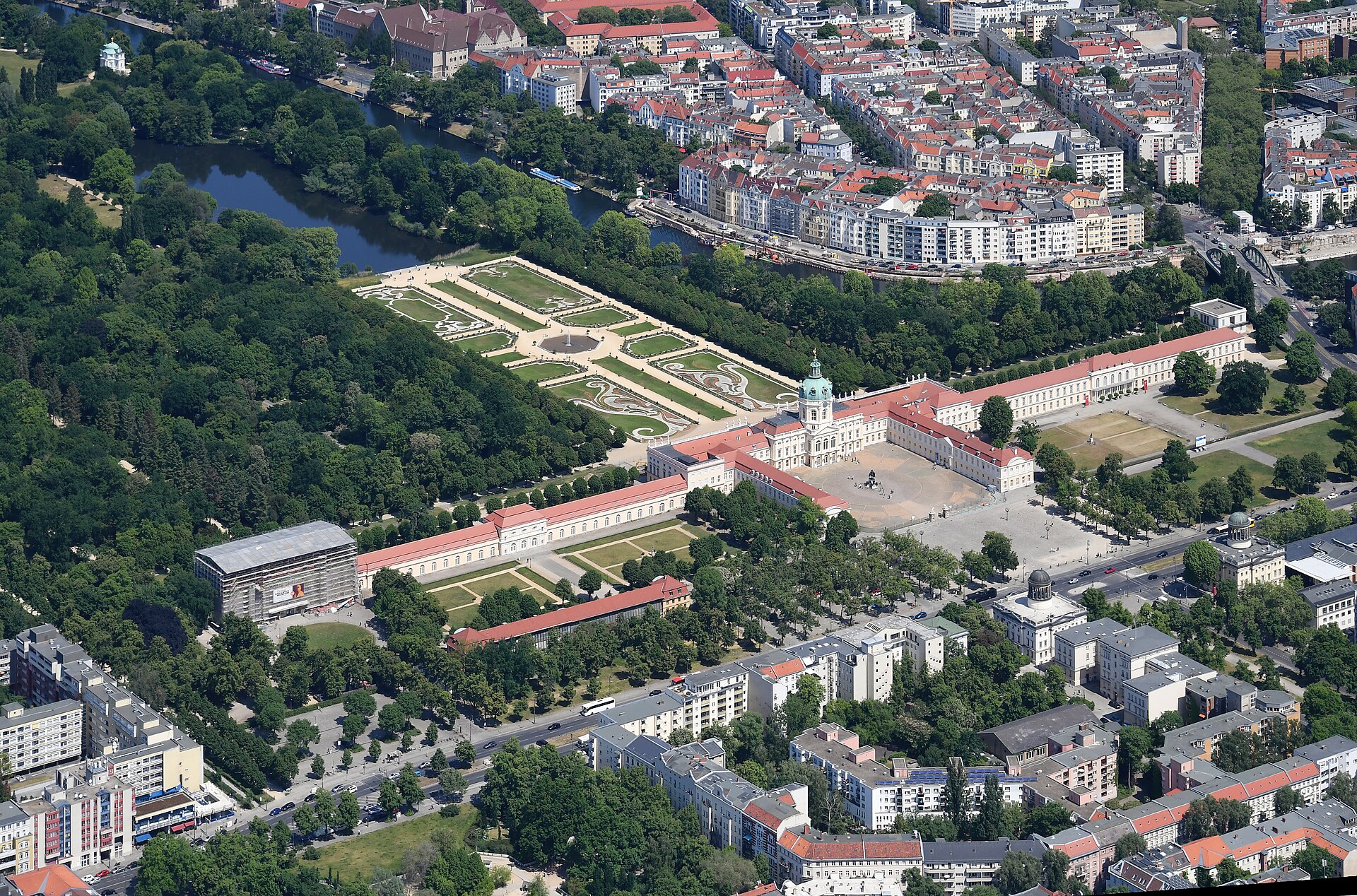
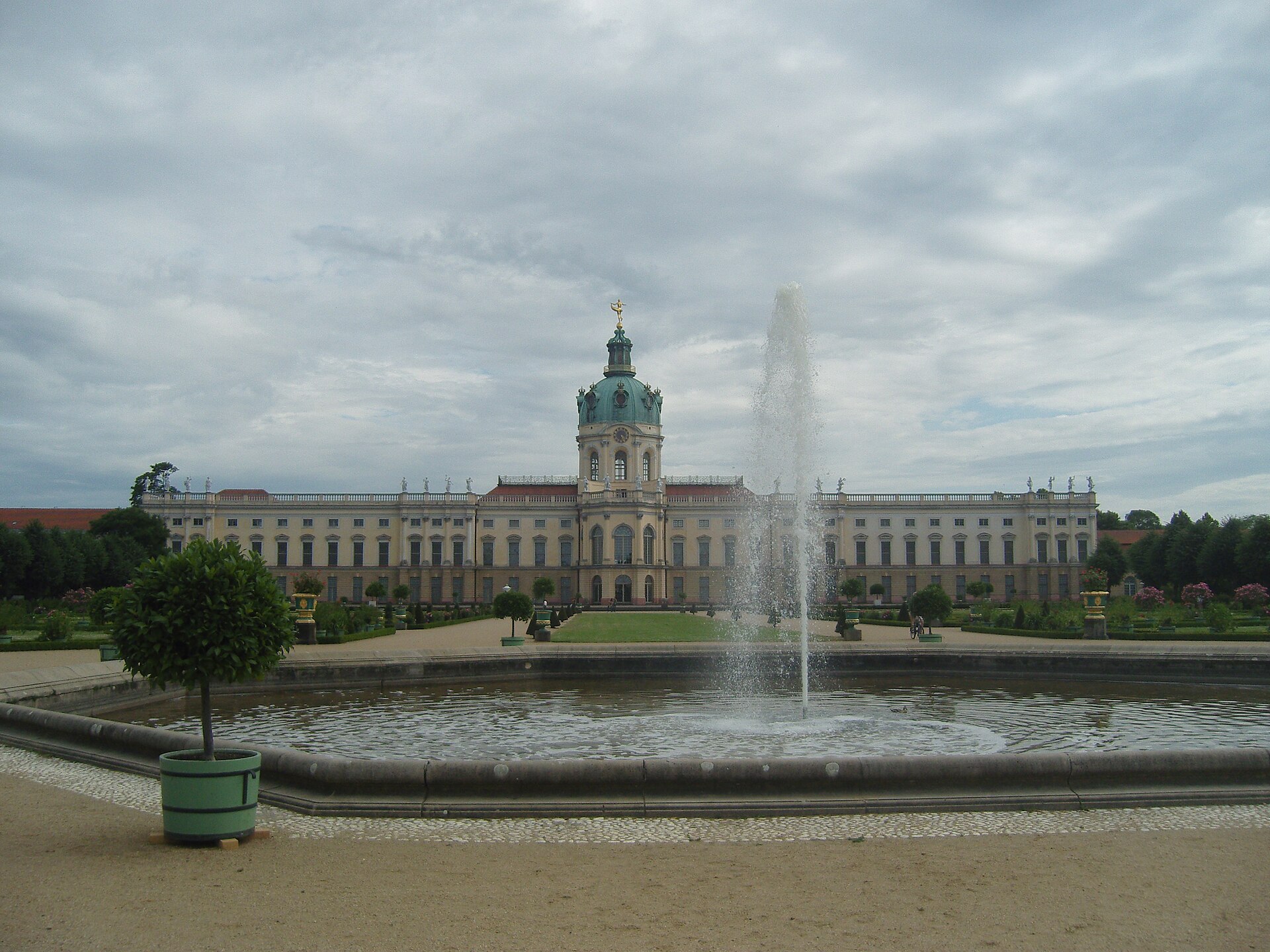
Set a little apart from the noise of central Berlin, at the end of a long forecourt guarded by a green equestrian statue, stands the largest and most magnificent palace the city ever built. Charlottenburg is a sweep of pale Baroque and Rococo architecture crowned by a copper dome, and to walk its length is to move through nearly two and a half centuries of Prussian ambition, from a modest summer villa for a clever queen to a sprawling royal residence that survived even the destruction of the Second World War.
The palace began, as so many great houses do, with a woman who wanted somewhere of her own. Sophie Charlotte, the brilliant and cultivated wife of the Elector who would become the first King in Prussia, was given a plot of land west of Berlin and built herself a summer retreat there in the last years of the seventeenth century. She filled it with music, philosophy, and conversation, and when she died young the grieving king renamed the house and the surrounding town in her honor. Charlottenburg has carried her name ever since.
What makes the palace so rewarding is that no single generation left it alone. Sophie Charlotte’s Baroque villa was enlarged with a grand dome and orangery. Her grandson, Frederick the Great, added a whole new wing of dazzling Rococo state rooms. Later kings laid out romantic gardens, built a mausoleum and garden pavilions, and made Charlottenburg their favored Berlin residence. The result is not one palace but a layered record of Prussian taste, each era adding its own voice to the chorus.
That layering is exactly what you sense as you move from room to room today. The gilded exuberance of the Golden Gallery gives way to the glittering walls of the Porcelain Cabinet; the solemn palace chapel opens onto light-filled staterooms; and beyond the windows the gardens shift from crisp French geometry to the soft curves of an English landscape park. This is the story of how a queen’s private daydream grew, across generations, into the grandest palace in Berlin.
In This Article
- Sophie Charlotte, the Philosopher Queen Who Began It All
- From a Summer Villa to a Royal Baroque Palace
- The Porcelain Cabinet: A Room That Glitters With Thousands of Pieces
- Through the Baroque State Apartments
- Frederick the Great and the New Wing
- The Golden Gallery and the Glitter of the Rococo
- The Palace Chapel and the Court at Prayer
- Gardens Between Two Ideals: French Geometry and English Freedom
- Belvedere, Mausoleum, and the Garden’s Hidden Buildings
- The Great Elector Rides Guard Over the Forecourt
- A Home for Frederick William III and Queen Louise
- Destruction and the Long Work of Restoration
- Charlottenburg Today: Berlin’s Grandest Palace
Sophie Charlotte, the Philosopher Queen Who Began It All
To understand Charlottenburg you have to begin with its founder, one of the most remarkable women in Prussian history. Sophie Charlotte of Hanover married Frederick, the Elector of Brandenburg, in 1684, and she brought to the sober Protestant court of Berlin an intellect and a curiosity that dazzled everyone around her. She was not content to be a decorative consort. She wanted a place where she could gather thinkers, musicians, and philosophers and preside over conversation as their equal.

Her closest intellectual companion was Gottfried Wilhelm Leibniz, the great philosopher and mathematician, who was a frequent guest and correspondent. Under her patronage Berlin took real steps toward becoming a center of learning, and she was instrumental in the founding of the Prussian Academy of Sciences. She questioned everything, reportedly even on her deathbed, and the summer palace she raised was designed from the start to be the setting for this life of the mind rather than a machine for royal ceremony.
Her husband adored her, and in 1701 he elevated the dynasty by crowning himself Frederick I, King in Prussia, making Sophie Charlotte a queen. Yet she remained faithful to her retreat outside Berlin, then called Lietzenburg, where she could escape the stiff protocol of the royal court and live surrounded by ideas and music. The palace was her sanctuary, and its early character was shaped entirely by her tastes.
Sophie Charlotte died suddenly in early 1705, only thirty-six years old, and her loss devastated the king. In his grief he renamed the palace and the growing settlement around it Charlottenburg, “Charlotte’s town,” so that her name would endure in stone and on every map of Brandenburg. Everything the palace later became was built upon the foundation she laid, and her spirit of enlightened curiosity clings to it still.
Contemporaries left vivid accounts of the atmosphere she created, describing evenings of music and debate in which rank mattered less than wit and learning. Sophie Charlotte played the harpsichord, sang, and encouraged composers, and she treated her summer house as a kind of academy in miniature. In an age when few women were permitted such intellectual authority, she carved out a court of her own where ideas circulated freely, and that legacy of open-minded inquiry became part of the palace’s founding character.
From a Summer Villa to a Royal Baroque Palace
The palace that Sophie Charlotte first commissioned was a comparatively modest affair. Begun in 1695 to designs by the court architect Johann Arnold Nering, it was conceived as a summer villa, an elegant Baroque house of restrained scale set in a garden west of Berlin. Nering died soon after work started, and the project passed to other hands, but the core of that first building still sits at the heart of the vast palace you see today.

When Frederick became king in 1701, a summer villa no longer suited the dignity of a royal house, and the building was dramatically enlarged. The architect Johann Friedrich Eosander, sometimes called Eosander von Göthe, took charge of transforming the villa into a proper palace fit for a monarch. He extended the wings, expanded the state apartments, and gave the residence the grander, more ceremonial character that its new royal status demanded.
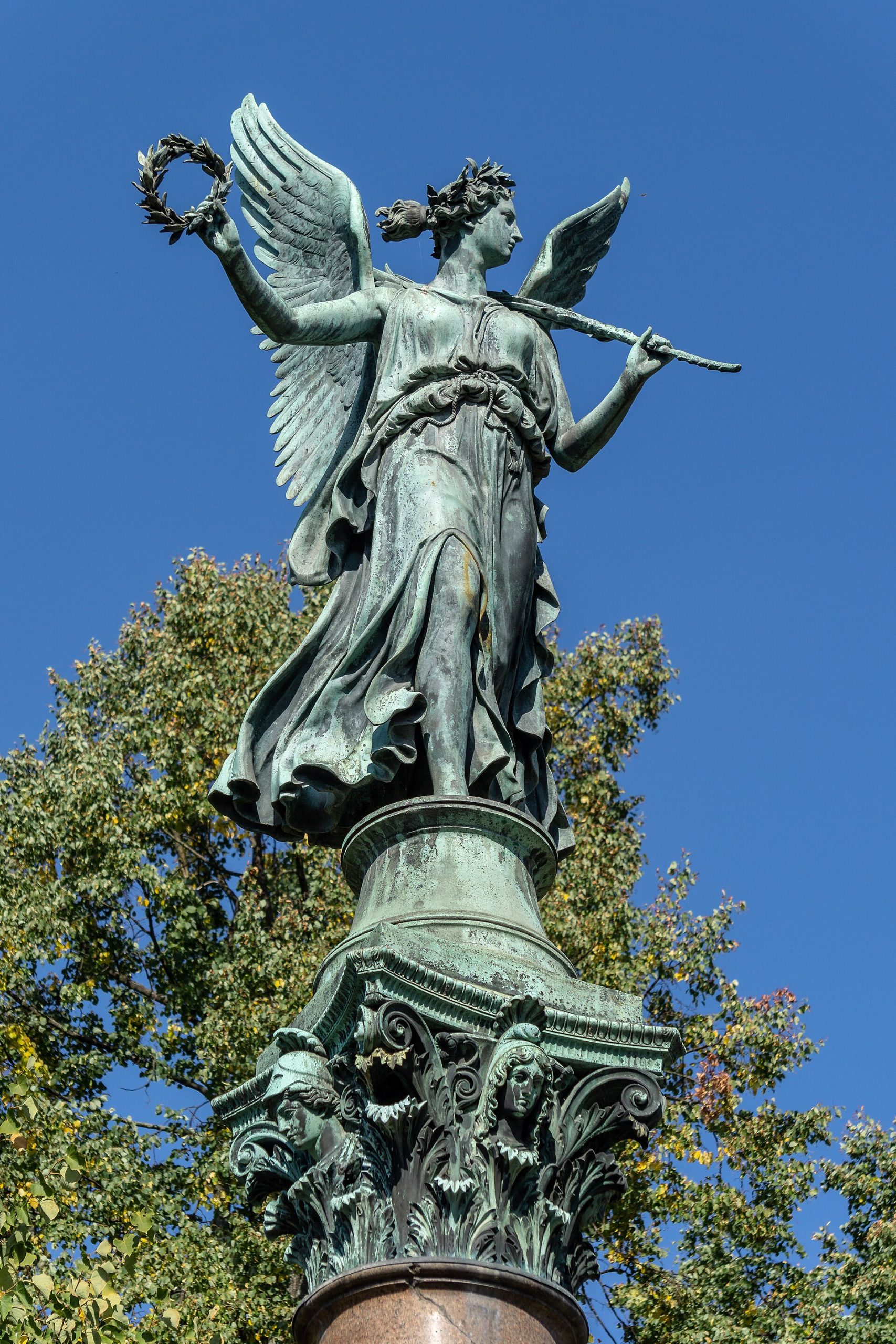
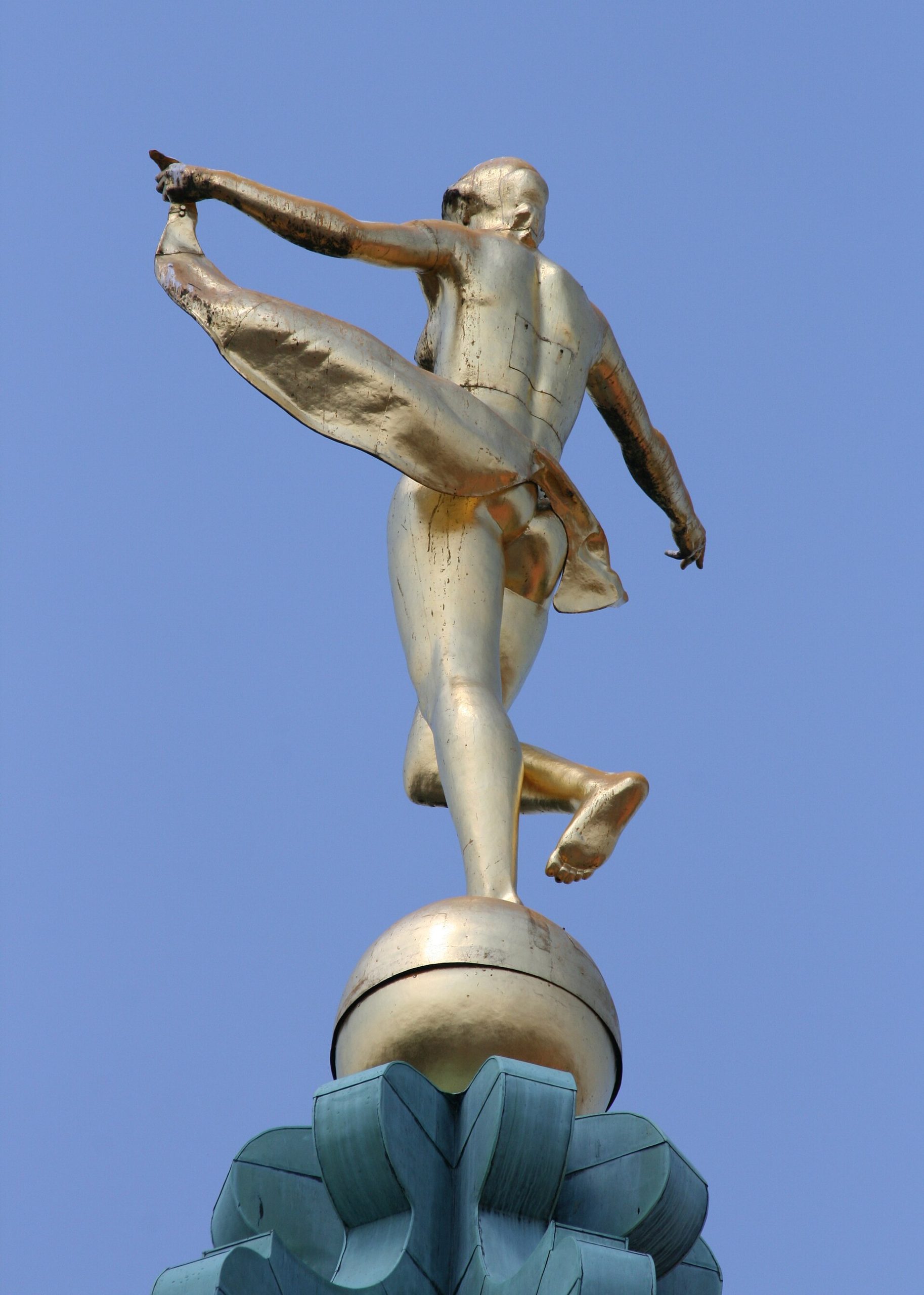
The most visible of Eosander’s additions was the great central dome, a tall copper cupola raised over the entrance that gave the palace its unmistakable silhouette and a sense of vertical drama it had entirely lacked. Atop the dome he placed a gilded weathervane in the form of the goddess Fortuna, spinning with the wind high above the forecourt. That golden figure, catching the light as it turns, remains one of Charlottenburg’s most beloved features.
Eosander also planned the sweeping orangery wing that stretches westward from the palace, a long low range designed to shelter the citrus trees and exotic plants that were the pride of any Baroque court. By the time this phase of work was well advanced, the intimate villa of Sophie Charlotte’s day had become a broad, dome-crowned Baroque palace, the largest royal residence in the Berlin area and a fitting seat for the new kingdom of Prussia.
The Porcelain Cabinet: A Room That Glitters With Thousands of Pieces
Among the many treasures of Charlottenburg, one room stops nearly every visitor in their tracks. The Porcelain Cabinet is a small chamber whose walls are covered, almost to the point of vertigo, with thousands of pieces of Chinese and Japanese porcelain arranged on gilded brackets and consoles from floor to ceiling. Blue-and-white vases, plates, cups, and figures rise in tier upon tier, reflected in mirrors so that the whole room seems to dissolve into a shimmering cascade of ceramics.
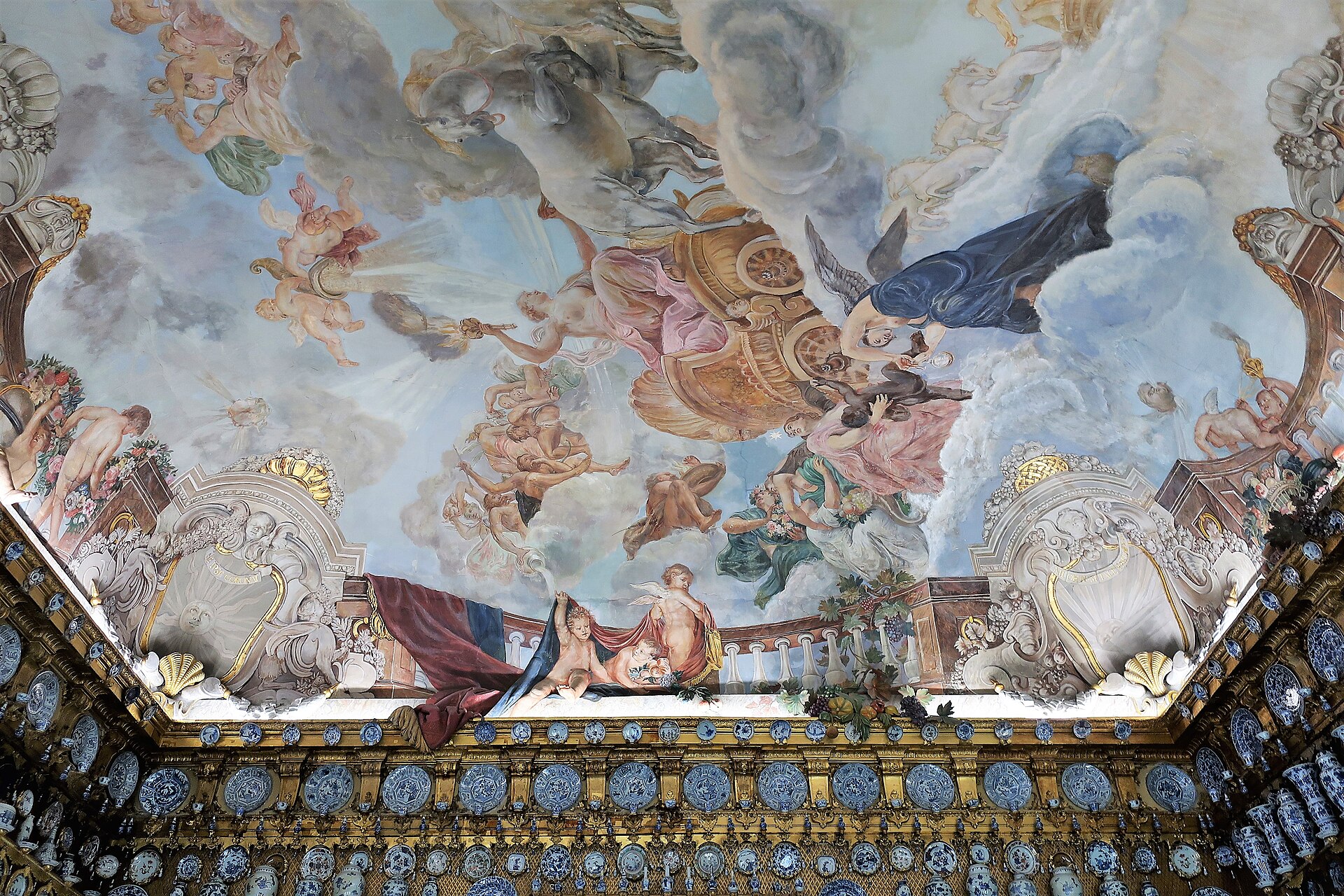
This kind of display was the height of fashion around 1700, when European courts were seized by a craze for East Asian porcelain, then a rare and hugely expensive luxury imported at great cost. To assemble such a collection and mount it in a single dazzling room was a statement of both wealth and taste, a way of showing that the Prussian court could compete with any in Europe. Sophie Charlotte and her successors poured resources into the collection, and the cabinet became one of the most celebrated of its type.
The arrangement is as much architecture as decoration. The porcelain is not merely stored here but choreographed, each piece placed to build patterns of color and shape across the walls, with the mirrors multiplying the effect until the room feels boundless. Gilded carving frames the whole composition, and the ceiling above completes the fantasy. It is excess raised to the level of art, a deliberate assault on the senses that still delights.
Like so much of Charlottenburg, the cabinet you see today is a triumph of restoration. The room and much of its contents were devastated in the Second World War, and painstaking work was needed to bring it back, reassembling surviving pieces and recreating the setting. That it glitters again as it once did is a reminder of how much care has gone into keeping the palace’s most magical spaces alive for new generations.
Rooms like this were sometimes called porcelain chambers, and they carried a meaning beyond mere display. Porcelain from China and Japan was so costly and so difficult to obtain that a wall of it amounted to a fortune made visible, a way of translating trade and wealth into pure spectacle. The obsession would soon drive European makers to discover the secret of hard-paste porcelain themselves, and the great Berlin porcelain manufactory that resulted would later fill palaces like this one with wares of its own.
Through the Baroque State Apartments
Beyond the famous Porcelain Cabinet, the older core of Charlottenburg contains a long sequence of Baroque state apartments that unfold in the classic manner of a royal residence, one room opening into the next along a grand enfilade. These were the ceremonial chambers of Frederick I and his successors, arranged so that a visitor’s importance determined how far along the sequence they were permitted to advance toward the sovereign.

The rooms grow richer as they go. Antechambers give way to audience rooms and bedchambers of state, their walls hung with tapestries, damask, and paintings, their ceilings painted with allegorical scenes glorifying the crown. Fine parquet floors, elaborate chimneypieces, and gilded carving carry the eye from one chamber to the next, and the whole progression was designed as a kind of choreography of power and access.
One of the notable spaces is the Oak Gallery, a long wood-paneled hall whose warm carved oak sets it apart from the brighter, gilded rooms nearby. Elsewhere, the apartments preserve furniture, clocks, mirrors, and objects that give a vivid sense of how the court actually lived, surrounded by luxury goods gathered from across Europe and beyond. Each room was a stage for a particular kind of royal encounter.
Moving through these apartments, you feel the older, weightier grandeur that preceded Frederick the Great’s lighter Rococo additions. This was the Charlottenburg of the first Prussian kings, formal, imposing, and conscious of its new royal dignity. It provides the essential counterpoint to the New Wing, and together the two show how the language of palace interiors shifted across the eighteenth century.
Frederick the Great and the New Wing
When Frederick the Great came to the throne in 1740, he brought to Charlottenburg the same appetite for building that would soon give the world Sanssouci. Although his heart lay in Potsdam, in his early years as king he made Charlottenburg a favored residence, and he commissioned a substantial extension to the eastern end of the palace known simply as the New Wing, or Neuer Flügel. It was designed by Georg Wenzeslaus von Knobelsdorff, the same architect who would shape Sanssouci.

The New Wing gave Charlottenburg a whole suite of magnificent new state rooms in the light, elegant style of the Frederician Rococo. Where the older Baroque apartments were grand and formal, these new spaces were designed for a more refined kind of splendor, full of gilding, mirrors, and delicate ornament. The wing effectively doubled the ceremonial heart of the palace and brought it up to the latest fashion of the mid-eighteenth century.
Frederick used these rooms during his residences in Berlin, and they reflect his personal taste as much as any official program. He was a discerning collector, and the New Wing housed important paintings, including works by French masters he admired. The apartments here were meant to impress visitors with the cultural sophistication of the Prussian crown, not merely its power, and they succeeded handsomely.
In later reigns the New Wing continued to serve as royal living quarters, and successive monarchs adapted its rooms to their own needs. Its two great showpieces, the Golden Gallery and the White Hall, remain among the finest Rococo interiors in Germany. The wing stands as proof that Charlottenburg was never a static monument but a living palace, reshaped by each king who made it his home.
The Golden Gallery and the Glitter of the Rococo
If the Porcelain Cabinet is Charlottenburg’s Baroque marvel, the Golden Gallery is its Rococo one. Running along the garden side of the New Wing, this long festive hall is one of the masterpieces of the Frederician Rococo, its walls a shimmer of green stucco marble overlaid with an extravagant filigree of gilded ornament. Vines, flowers, birds, shells, and figures representing the elements and the seasons spill across the surfaces in gilded profusion, catching the light from the tall garden windows.
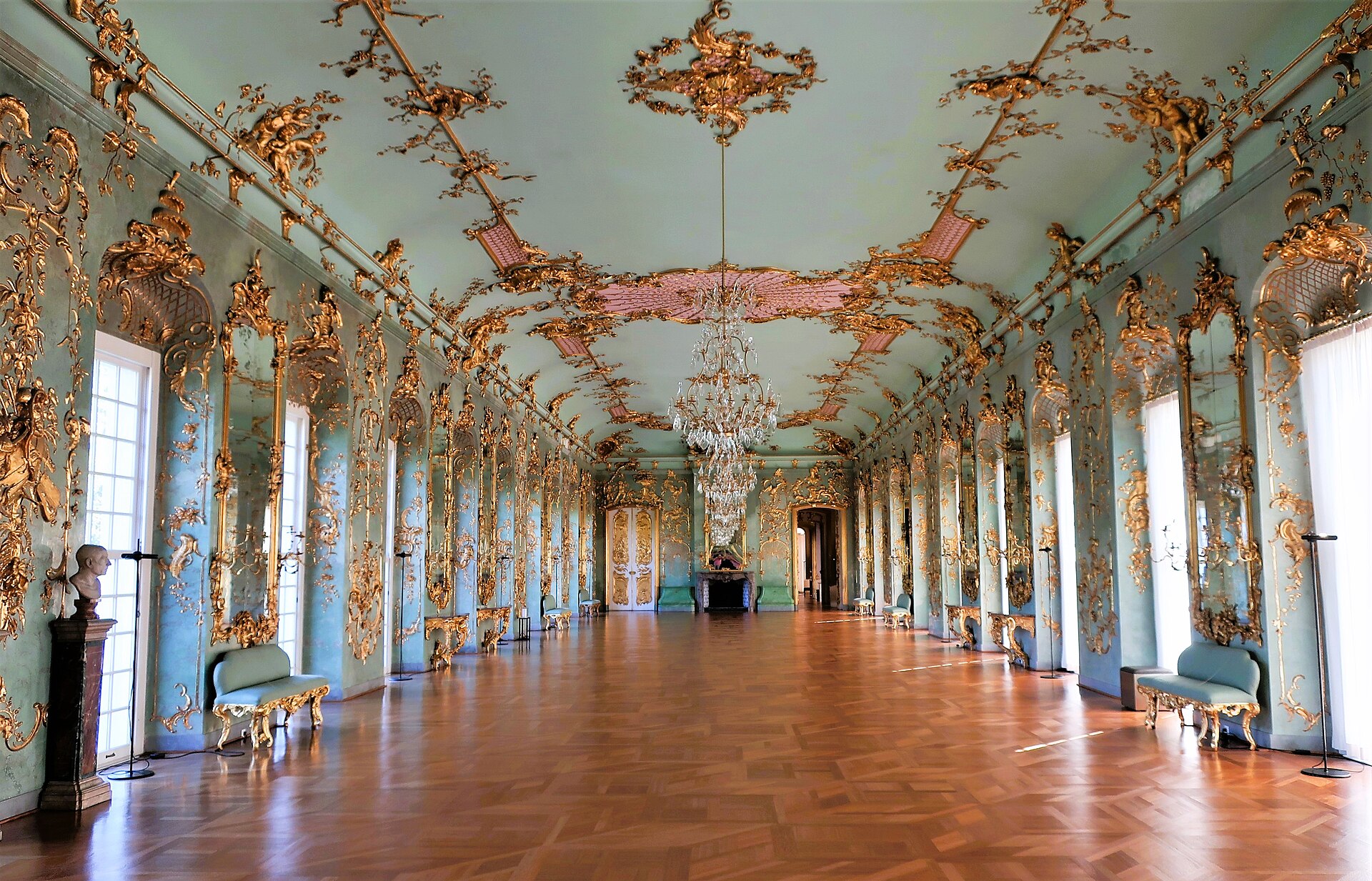
The gallery was conceived as a ballroom and festival hall, a place for the court to gather for dancing and celebration. Its length and the rhythm of its windows and mirrors were designed to make the space feel infinite when filled with candlelight and moving figures. Few rooms convey so vividly the pleasure-loving side of an eighteenth-century court, and it stands in deliberate contrast to the sterner Baroque grandeur of the palace’s older halls.
Nearby, the White Hall served as the principal dining and throne room of the New Wing, a lighter, more classical space that balanced the exuberance of the gallery. Together the two rooms formed the ceremonial climax of Frederick’s addition, a sequence designed to lead guests from formality toward festivity. The craftsmanship throughout is of the highest order, the work of the finest stuccoists and gilders the Prussian court could command.
These rooms suffered terribly in the war, and their recovery was one of the great achievements of postwar restoration in Berlin. Photographs and surviving fragments guided craftsmen who rebuilt the gilded ornament by hand, so that the Golden Gallery once again glows as it did when Frederick’s court danced beneath its ceiling. To stand in it now is to feel the full theatrical ambition of the Rococo at its most confident.
The Palace Chapel and the Court at Prayer
Every royal residence of the period needed a chapel, and Charlottenburg’s is among its most striking interiors. Created as part of Eosander’s expansion in the early eighteenth century, the palace chapel rises through the height of the building in a burst of Baroque splendor, its walls articulated with columns, its surfaces enriched with gilding and painted decoration, and a magnificent organ and pulpit drawing the eye upward toward an ornate canopy.

The chapel reflects the particular character of the Prussian court, which was Calvinist in a largely Lutheran land, and it was designed to serve the devotions of the royal family and their household. Yet for all its religious purpose, the room is unmistakably a court chapel, its decoration proclaiming the glory of the monarchy as much as the glory of God. A crowned canopy and heraldic emblems remind worshippers exactly whose chapel this is.
The centerpiece is the elaborate royal box, or gallery, from which the king and queen could attend services, set high and richly framed so that the sovereign presided over the congregation below. This arrangement, common in Baroque court chapels, expressed the close binding of throne and altar that underpinned the legitimacy of eighteenth-century kingship. The chapel was a place of worship and a theater of royal authority at once.
Damaged like the rest of the palace during the war, the chapel has been carefully restored to its original brilliance. Its soaring space and gleaming ornament make it one of the highlights of any visit, and it offers a moment of vertical drama amid the long horizontal enfilades of the state apartments. It reminds us that the life of the court was measured out not only in banquets and receptions but in the solemn rhythms of prayer.
Gardens Between Two Ideals: French Geometry and English Freedom
The gardens of Charlottenburg are a story in themselves, and like the palace they carry the imprint of changing tastes. When the grounds were first laid out around 1700, they followed the strict French Baroque manner made famous at Versailles. A designer trained in that tradition created a formal parterre directly behind the palace, with clipped hedges, geometric flower beds, straight avenues, and a long central axis leading the eye away toward a carp pond and the woods beyond.
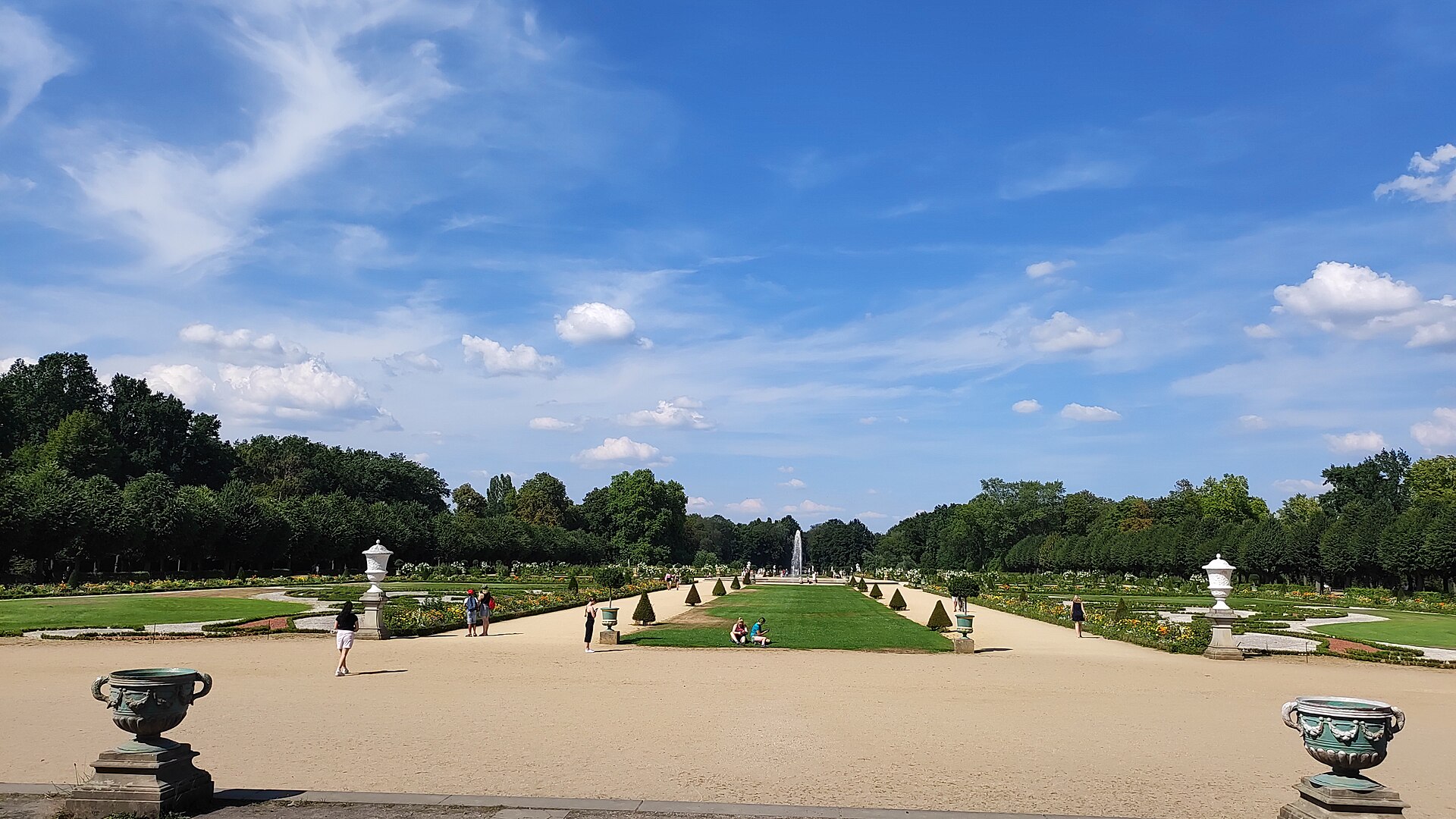
This formal garden was an extension of the palace’s architecture, imposing order on nature in the way the age believed a well-run state imposed order on society. Symmetry ruled everything, and the parterre was meant to be admired from the windows of the state apartments as a living carpet of pattern and color. For much of the eighteenth century this crisp geometry defined the setting of the palace.
View the exact location on Google Maps
Later, taste turned decisively toward the English landscape garden, which prized the appearance of natural, irregular beauty over formal design. From the late eighteenth century onward, large parts of the grounds were transformed into a romantic park of winding paths, gentle lawns, serpentine water, and artfully grouped trees, a softer and more picturesque ideal. The two philosophies now coexist, the formal parterre near the palace giving way to the informal park beyond.
Walking the gardens today, you pass from one world to the other almost without noticing, from the disciplined beds beneath the palace windows to the shady, meandering paths of the landscape park. Restored and maintained with care, the grounds are free to enter and much loved by Berliners, who come to stroll, picnic, and escape the city. They form the perfect complement to the palace, a green stage on which its long architectural drama plays out.
Seasonal change gives the grounds much of their charm. In spring the parterre beds are planted in bright ribbons of color, in summer the lawns fill with visitors, and in autumn the landscape park glows in russet and gold beneath its old trees. The gardeners who tend the grounds work from historical plans where they can, keeping the formal areas true to their Baroque origins while letting the informal park breathe with the looser spirit of its own era.
Belvedere, Mausoleum, and the Garden’s Hidden Buildings
Scattered through the park are several smaller buildings that reward the visitor willing to wander. Near the river stands the Belvedere, a charming three-story teahouse built in the 1780s for King Frederick William II. With its rounded forms and a cupola topped by a group of cherubs, it was designed as a place of retreat and entertainment, and today it houses a fine collection of Berlin porcelain, making it a natural companion to the palace’s famous cabinet.

Elsewhere in the grounds is the New Pavilion, a graceful Italianate villa built in the 1820s for King Frederick William III to designs by the great architect Karl Friedrich Schinkel. Inspired by a villa the king had admired in Naples, it is a jewel of restrained neoclassical elegance, a summer house within the park where the monarch could live simply, away from the formality of the main palace. It now displays art of the Schinkel era.
The most solemn of the garden buildings is the Mausoleum, a small Doric temple set at the end of a shaded avenue. It was built in 1810 to hold the tomb of the beloved Queen Louise, whose early death moved the whole nation, and it later received the remains of her husband Frederick William III and other members of the royal family. The white marble effigies within, carved with tender realism, make it one of the most affecting spaces in all of Charlottenburg.
Together these buildings turn the park into a landscape of memory and retreat as well as pleasure. Each was raised by a different monarch for a different purpose, a teahouse, a summer villa, a tomb, and each adds another layer to the palace’s long history. To explore them is to understand that Charlottenburg was never merely a single grand house but a whole royal world spread across its gardens.
The Great Elector Rides Guard Over the Forecourt
Before you even enter the palace, one work of art commands the forecourt: a magnificent bronze equestrian statue of Frederick William, the Great Elector, mounted on a rearing horse and gazing out over the approach. It is widely regarded as one of the finest Baroque equestrian monuments in Europe, the work of the sculptor Andreas Schlüter, and its presence at Charlottenburg links the palace directly to the founding energies of the Prussian state.
The Great Elector was the ruler who, in the seventeenth century, rebuilt Brandenburg after the devastation of the Thirty Years’ War and laid the foundations of Prussian power. He was the grandfather of Frederick the Great’s father, and the ancestor whose achievements made the later kingdom possible. To place his image at the gates of Charlottenburg was to remind every visitor of the dynasty’s origins and the long climb from electorate to kingdom.
The statue’s own history is a small drama. Cast in the early eighteenth century, it originally stood elsewhere in Berlin, and during the Second World War it was moved for safekeeping. In a famous episode, the barge carrying it sank in a harbor, and the statue lay underwater for years before being recovered and eventually installed in the forecourt of Charlottenburg, where it has stood since the postwar decades.
Now it forms the perfect prelude to the palace behind it. The rearing horse, the commanding figure, and the richly worked base set the tone of dynastic grandeur before you pass through the gates. It ties the whole Hohenzollern story together, from the Great Elector who built Brandenburg’s strength to the queen whose summer villa grew into the palace that carries her name.
A Home for Frederick William III and Queen Louise
In the early nineteenth century, Charlottenburg became especially dear to King Frederick William III and his wife, the greatly loved Queen Louise. The couple preferred a relatively simple and domestic family life, and they made the palace and its park a favored home. The New Pavilion in the garden, in particular, suited their taste for informal living away from the crushing ceremony of the older state rooms.

Those were dark years for Prussia. In 1806 Napoleon crushed the Prussian army and occupied Berlin, and the French emperor himself passed through the conquered capital in triumph. Queen Louise, who had urged resistance, became a symbol of Prussian dignity in defeat and of hope for national revival, and her early death in 1810 turned her almost at once into a beloved national icon mourned across the land.
It was her grieving husband who built the Mausoleum in the Charlottenburg park to receive her body, and the tender marble effigy of the sleeping queen placed there became a place of pilgrimage. The association of the palace with Louise gave Charlottenburg an emotional resonance beyond its architecture, binding it to one of the most poignant stories in Prussian memory.
Under Frederick William III and his successors, Charlottenburg settled into its long role as the principal royal residence in Berlin itself, distinct from the summer world of Potsdam. Generations of the royal family were born, lived, and mourned here, and the palace accumulated the intimate history of a dynasty at home. That domestic dimension, easy to overlook amid the gilding, is part of what makes the place feel human.
Destruction and the Long Work of Restoration
For all its serene appearance today, Charlottenburg came within a hair’s breadth of being lost forever. During the Second World War, Allied bombing raids on Berlin struck the palace repeatedly, and in a devastating raid in 1943 much of it was gutted by fire. The dome collapsed, roofs fell in, and many of the great interiors, the Golden Gallery, the Porcelain Cabinet, the chapel, were reduced to charred and shattered ruins. Photographs from the war’s end show a broken shell.
In the immediate aftermath there was serious debate about whether the ruin should simply be cleared away, as happened to other bombed palaces in the divided city. That Charlottenburg survived owes a great deal to the determination of a handful of conservators, above all the curator who argued passionately for its rescue and oversaw the first stabilization of the wreck. The decision to rebuild rather than demolish set in motion one of the longest restoration campaigns in Germany.
The work stretched across decades. Craftsmen relied on prewar photographs, surviving drawings, and salvaged fragments to recreate the lost interiors, rebuilding gilded ornament, replastering ceilings, and reassembling what could be saved of the collections. The dome was raised again and Fortuna returned to her spinning perch. Room by room, the palace was coaxed back from destruction, a process that continued long after the war and in some ways is never truly finished.
That history of loss and recovery is now part of what Charlottenburg means. The visitor who admires the glittering Rococo halls is also, without always realizing it, admiring an act of collective will, a decision to reconstruct a vanished world rather than let it disappear. The palace stands as a monument not only to the Prussian monarchy but to the postwar resolve to reclaim a heritage that the twentieth century had come so close to erasing.
Standing before a wartime photograph of the gutted palace and then looking up at the restored halls, it is hard not to feel the weight of what was nearly lost and the patience of what was regained. The restorers understood that they were not merely repairing a building but preserving a thread of continuity, a way for a battered city to hold on to its own past. In that sense every gleaming surface at Charlottenburg carries a second, quieter meaning about memory and renewal.
Charlottenburg Today: Berlin’s Grandest Palace
Today Charlottenburg is the largest palace in Berlin and one of the city’s essential sights, cared for by the foundation that manages the former Prussian royal palaces and gardens. The Old Palace with its Baroque apartments and Porcelain Cabinet, the New Wing with its Rococo galleries, the chapel, and the garden pavilions are all open to visitors, and together they offer an unusually complete picture of court life across several reigns.
A visit rewards a little planning. The Old Palace and the New Wing are ticketed separately or together, and each deserves unhurried time; the Porcelain Cabinet and the Golden Gallery are the unmissable highlights, but the smaller rooms and the chapel are quietly rewarding too. The gardens are free to enter, and combining the interiors with a walk out to the Belvedere, the New Pavilion, and the Mausoleum makes for a full and satisfying day.
Getting there is easy, as the palace sits in the Charlottenburg district in the west of the city, well served by public transport and only a short journey from the center. The long forecourt, presided over by the Great Elector on his rearing horse, makes a grand approach, and the copper dome with its golden Fortuna is visible from some distance, drawing you in.
More than three centuries after Sophie Charlotte first built her summer villa here, her palace remains a living link to the world that made Prussia and, in time, Germany. Layered by generations of kings and queens, ravaged by war and lovingly rebuilt, Charlottenburg carries its complicated history with grace. To visit it is to trace the whole arc of a dynasty, from a philosopher queen’s retreat to the grandest palace her city would ever know.
Palaces Nearby
If Charlottenburg has whetted your appetite for Prussian palaces, another masterpiece lies just a short journey away in nearby Potsdam:
You May Like


2 thoughts on “Charlottenburg: Berlin’s Grandest Palace, Born From a Queen’s Summer Villa”